
Water damage is one of the most expensive and preventable problems a homeowner or renter can face. A slow drip under a sink, a sump pump failure, or a leaking water heater can quietly ruin floors, drywall, and personal belongings long before anyone notices. That is why Best Water Leak Detector options have become essential home safety equipment in 2026, especially for basements, laundry rooms, kitchens, and bathrooms.
In this guide, We compared the listed water leak detectors across smart kits, standalone alarms, multi-pack sensors, and moisture-testing tools. Our research focused on sensitivity, alert methods, battery life, waterproof ratings, installation ease, connectivity, and real homeowner use cases. Whether you want a simple battery-powered siren or a long-range smart system with phone alerts, this buying guide is designed to help you choose the right fit without overspending.
Home DVP decision summary
Quick Answer
For Best Water Leak Detector, Home DVP compared 15 products from 9 brands. Place sensors where leaks start and where water can pool. Compare local alarms, app notifications, battery warnings, cable or probe coverage, shutoff integration, and behavior during a Wi-Fi outage.
| Comparison coverage | 15 products from 9 brands, including GoveeLife, YoLink, METAK. |
|---|---|
| Selection priority | Place sensors where leaks start and where water can pool. Compare local alarms, app notifications, battery warnings, cable or probe coverage, shutoff integration, and behavior during a Wi-Fi outage. |
| Evidence basis | Manufacturer specifications, compatibility details, retailer-provided product data, and common homeowner use cases. |
| Reference guidance | EPA WaterSense leak-detection guidance. |
This summary describes the article's comparison set, not every product on the market. Product details should be confirmed before purchase.
If you are already planning bathroom upgrades, pairing leak detection with quality fixtures can further reduce risk. Many readers also review our guides on the best bathroom sink and best toilet while improving wet areas of the home. For a broader look at related products, explore our Plumbing Equipment category as well.
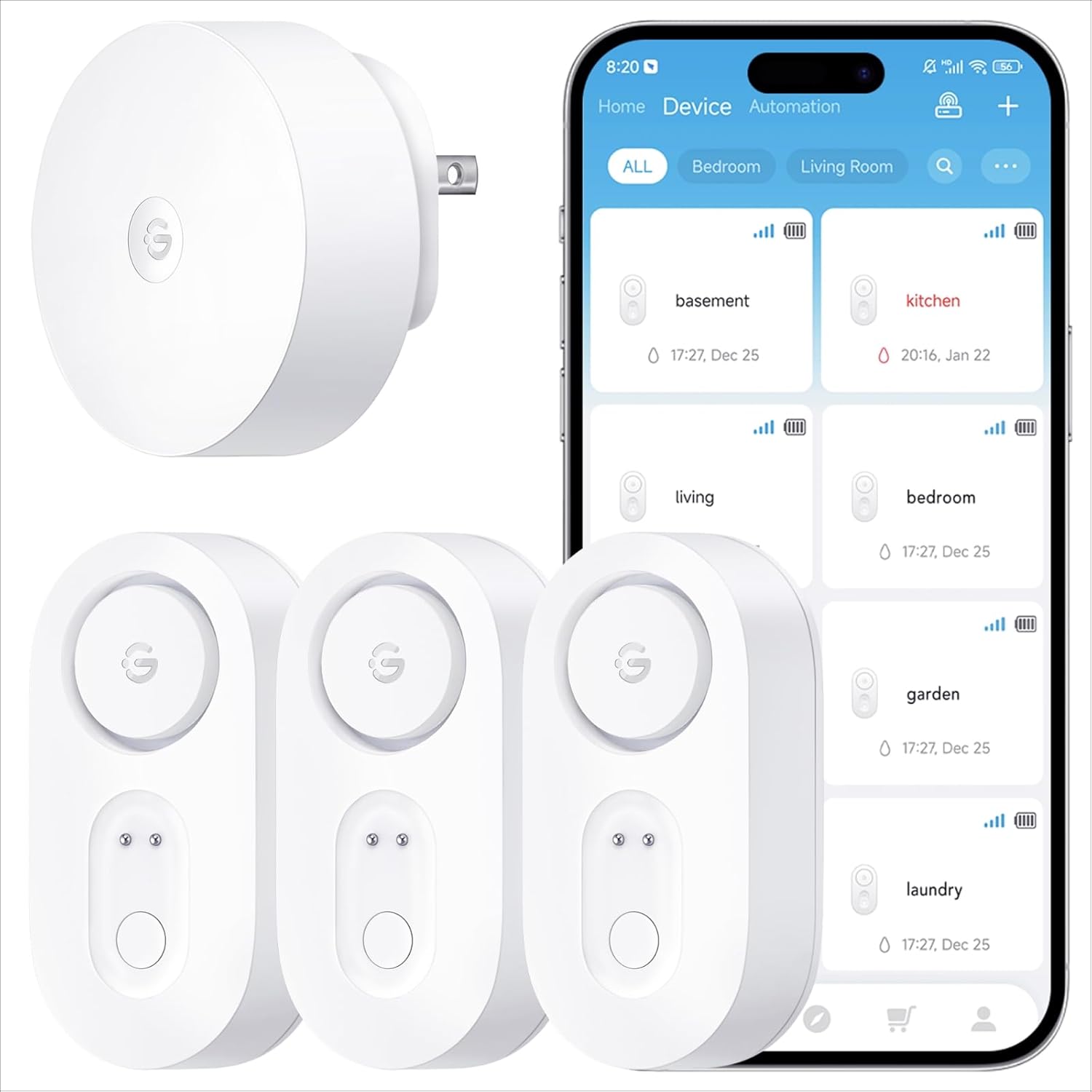
Pros
- Robust listed range through multiple walls for larger properties
- Multi-channel remote alerts including free SMS
Cons
- Gateway supports only 2.4G Wi-Fi and pairs with specified GoveeLife sensors
- First-time smart gateway setup may take extra time for some homeowners
Best For / Avoid If
Best for buyers prioritizing
- Robust listed range through multiple walls for larger properties
- Multi-channel remote alerts including free SMS
- Long listed battery life for low-maintenance monitoring
Consider another option if
- Gateway supports only 2.4G Wi-Fi and pairs with specified GoveeLife sensors
- First-time smart gateway setup may take extra time for some homeowners
- Users needing contractor-scale sensor counts may want higher-capacity systems

Pros
- Starter kit includes the hub and four silent sensors for multi-room coverage right away.
- IP68 sealed sensors and multi-year battery life support damp or hard-to-reach placements.
Cons
- Silent Leak Sensor 1 units need an added SpeakerHub or YoLink siren for loud local alarms.
- Automatic water shutoff depends on pairing with compatible YoLink valves or related devices.
Best For / Avoid If
Best for buyers prioritizing
- Starter kit includes the hub and four silent sensors for multi-room coverage right away.
- IP68 sealed sensors and multi-year battery life support damp or hard-to-reach placements.
- Offline D2D control supports local shutoff responses without cloud or internet dependence.
Consider another option if
- Silent Leak Sensor 1 units need an added SpeakerHub or YoLink siren for loud local alarms.
- Automatic water shutoff depends on pairing with compatible YoLink valves or related devices.
- Buyers seeking only a simple standalone buzzer may find the full smart hub platform more involved than needed.

Pros
- Simultaneous top drip and bottom floor sensing on each unit
- Four volume steps including mute for flexible alert control
Cons
- Local audible alerts only, without listed app or remote notifications
- Batteries still need eventual replacement despite long standby claims
Best For / Avoid If
Best for buyers prioritizing
- Simultaneous top drip and bottom floor sensing on each unit
- Four volume steps including mute for flexible alert control
- Compact, cordless form factor for flexible placement
Consider another option if
- Local audible alerts only, without listed app or remote notifications
- Batteries still need eventual replacement despite long standby claims
- May not suit users seeking fully integrated smart-home water monitoring

Pros
- Two sets of sensor probes on each unit improve early leak detection coverage.
- Volume can be adjusted with button presses or via the app when a compatible gateway is used.
Cons
- Sensors cannot join an app for remote monitoring without a separate GoveeLife H5044 gateway, which is not included.
- Compatible only with the GoveeLife H5044 gateway and not with other brands or certain GoveeLife models such as H5040 and H5043.
Specifications
| Power Source | Battery Powered |
|---|---|
| Compatible Devices | Smartphone |
| Battery Description | Alkaline |
| Number of Batteries | 10 AAA batteries required. (included) |
| Control Method | App |
| Audible Noise | 105 Decibels |
| Mounting Type | Wall Mount |
| Maximum Range | 550 Meters |
| Sensor Technology | 915Mhz |
| Smart Home Compatibility | Smart Home Compatible |
Verify the current product variation before purchase; specifications may change.
Best For / Avoid If
Best for buyers prioritizing
- Two sets of sensor probes on each unit improve early leak detection coverage.
- Volume can be adjusted with button presses or via the app when a compatible gateway is used.
- Ready to use out of the package with a built-in battery and no initial battery install required.
Consider another option if
- Sensors cannot join an app for remote monitoring without a separate GoveeLife H5044 gateway, which is not included.
- Compatible only with the GoveeLife H5044 gateway and not with other brands or certain GoveeLife models such as H5040 and H5043.
- Battery replacement requires removing waterproof pads and screws, which may take extra care for some users.

Pros
- Complete kit pairs a hub with four siren-equipped Leak Sensor 4 units for multi-zone coverage
- LoRa connectivity helps where Wi-Fi struggles across floors and thicker walls
Cons
- Remote notifications and full app features depend on the included hub and network connectivity when online
- Automatic water shutoff requires separate YoLink smart valves that are not part of this starter kit
Best For / Avoid If
Best for buyers prioritizing
- Complete kit pairs a hub with four siren-equipped Leak Sensor 4 units for multi-zone coverage
- LoRa connectivity helps where Wi-Fi struggles across floors and thicker walls
- IP66 waterproof construction supports placement in damp or flood-prone areas
Consider another option if
- Remote notifications and full app features depend on the included hub and network connectivity when online
- Automatic water shutoff requires separate YoLink smart valves that are not part of this starter kit
- Households needing only one basic detector may find a multi-sensor system more extensive than necessary

Pros
- Multi-channel notifications help you respond quickly when away from home
- Long wireless range suits multi-level homes and outbuildings
Cons
- Gateway works only with 2.4 GHz Wi-Fi networks
- Full remote alerts depend on proper gateway setup and stable internet
Specifications
| Power Source | Battery Powered |
|---|---|
| Compatible Devices | Alexa, Google Assistant, IFTTT |
| Battery Description | AAA |
| Number of Batteries | 12 AAA batteries required. (included) |
| Control Method | App |
| Audible Noise | 100 Decibels |
| Mounting Type | Floor Mount |
| Maximum Range | 1968 Feet |
| Sensor Technology | LoRa |
| Smart Home Compatibility | Smart Home Compatible |
Verify the current product variation before purchase; specifications may change.
Best For / Avoid If
Best for buyers prioritizing
- Multi-channel notifications help you respond quickly when away from home
- Long wireless range suits multi-level homes and outbuildings
- Six probes per sensor improve sensitivity to standing water and drips
Consider another option if
- Gateway works only with 2.4 GHz Wi-Fi networks
- Full remote alerts depend on proper gateway setup and stable internet
- First-time users may need extra time to place sensors and complete app pairing

Pros
- Multi-channel notifications combine app push with email and SMS for redundant leak awareness
- Thin 1.8 mm sensor profile can sit in tight or hidden spots near sinks, toilets, and appliances
Cons
- Works with 2.4G WiFi only, so homes limited to 5 GHz networks will need a compatible band available
- Sensors may go offline if placed far from the hub, on metal surfaces, or with low batteries
Best For / Avoid If
Best for buyers prioritizing
- Multi-channel notifications combine app push with email and SMS for redundant leak awareness
- Thin 1.8 mm sensor profile can sit in tight or hidden spots near sinks, toilets, and appliances
- Alarm duration options include short timed rings or continuous sounding for different home preferences
Consider another option if
- Works with 2.4G WiFi only, so homes limited to 5 GHz networks will need a compatible band available
- Sensors may go offline if placed far from the hub, on metal surfaces, or with low batteries
- First-time pairing and alarm-switch checks may take extra attention for users new to hub-based sensors

Pros
- High-sensitivity multi-probe design targets both contact leaks and heavy humid mist
- Adjustable volume including silent mode improves flexibility across rooms
Cons
- Product information notes possible false triggers in highly humid spaces unless probes are wiped dry regularly
- WiFi or gateway features require a separate compatible W13 unit not included in this sensor pack
Best For / Avoid If
Best for buyers prioritizing
- High-sensitivity multi-probe design targets both contact leaks and heavy humid mist
- Adjustable volume including silent mode improves flexibility across rooms
- Five-pack format helps cover multiple common leak points in one purchase
Consider another option if
- Product information notes possible false triggers in highly humid spaces unless probes are wiped dry regularly
- WiFi or gateway features require a separate compatible W13 unit not included in this sensor pack
- Battery-powered design still needs eventual AAA replacements despite long standby claims

Pros
- Dual top and bottom sensing improves detection of both standing water and overhead drips
- Local audible alarm and remote app notifications work together for on-site and away-from-home awareness
Cons
- Full remote alerts depend on Wi-Fi connectivity and a compatible smartphone app
- Real-world wireless range may be shorter than open-area figures once walls and interference are present
Specifications
| Power Source | Battery Powered |
|---|---|
| Compatible Devices | iPad, iPhone |
| Battery Description | AAA |
| Number of Batteries | 8 AAA batteries required. (included) |
| Control Method | App |
| Audible Noise | 100 Decibels |
| Mounting Type | Tabletop Mount |
| Maximum Range | 1700 Feet |
| Sensor Technology | Contact Sensor |
| Smart Home Compatibility | Smart Home Compatible |
Verify the current product variation before purchase; specifications may change.
Best For / Avoid If
Best for buyers prioritizing
- Dual top and bottom sensing improves detection of both standing water and overhead drips
- Local audible alarm and remote app notifications work together for on-site and away-from-home awareness
- Compact sensor size eases placement in tight mechanical and utility spaces
Consider another option if
- Full remote alerts depend on Wi-Fi connectivity and a compatible smartphone app
- Real-world wireless range may be shorter than open-area figures once walls and interference are present
- Sensor batteries require periodic monitoring even with low battery notifications

Pros
- High-sensitivity multi-probe design for drip and overflow detection
- Extremely loud local alarm that continues until the issue is resolved
Cons
- Lacks WiFi, Bluetooth, or app notifications for remote alerts
- Cannot connect to the METAK W13 gateway or other smart systems
Best For / Avoid If
Best for buyers prioritizing
- High-sensitivity multi-probe design for drip and overflow detection
- Extremely loud local alarm that continues until the issue is resolved
- Completely wireless operation with zero setup or app requirements
Consider another option if
- Lacks WiFi, Bluetooth, or app notifications for remote alerts
- Cannot connect to the METAK W13 gateway or other smart systems
- Users must manually check and silence each unit when an alarm sounds

Pros
- Pin-type design targets specific spots in wood, drywall, concrete, and subflooring
- Includes extra 8mm stainless steel pins and a dual-purpose protective cap
Cons
- Pins can leave small marks, so finished surfaces may need careful placement
- Contact-only measurement is less suited to sweeping large flat areas than pinless models
Best For / Avoid If
Best for buyers prioritizing
- Pin-type design targets specific spots in wood, drywall, concrete, and subflooring
- Includes extra 8mm stainless steel pins and a dual-purpose protective cap
- Reading hold function and multi-level visual plus audible alerts simplify field use
Consider another option if
- Pins can leave small marks, so finished surfaces may need careful placement
- Contact-only measurement is less suited to sweeping large flat areas than pinless models
- Users seeking advanced multi-sensor or deep-probe systems may need a higher-spec option

Pros
- Highly sensitive detection of minimal water levels
- Loud whole-house audible alert for quick notice
Cons
- Extra 24-gauge wire is not included when longer runs beyond the 6 ft sensor cable are needed
- Audible-only alert may not suit users who want remote notifications or smart-home integration
Best For / Avoid If
Best for buyers prioritizing
- Highly sensitive detection of minimal water levels
- Loud whole-house audible alert for quick notice
- Flexible sensor placement with included and extendable wiring
Consider another option if
- Extra 24-gauge wire is not included when longer runs beyond the 6 ft sensor cable are needed
- Audible-only alert may not suit users who want remote notifications or smart-home integration
- Placement planning is still required so incidental moisture does not cause unwanted triggers
Pros
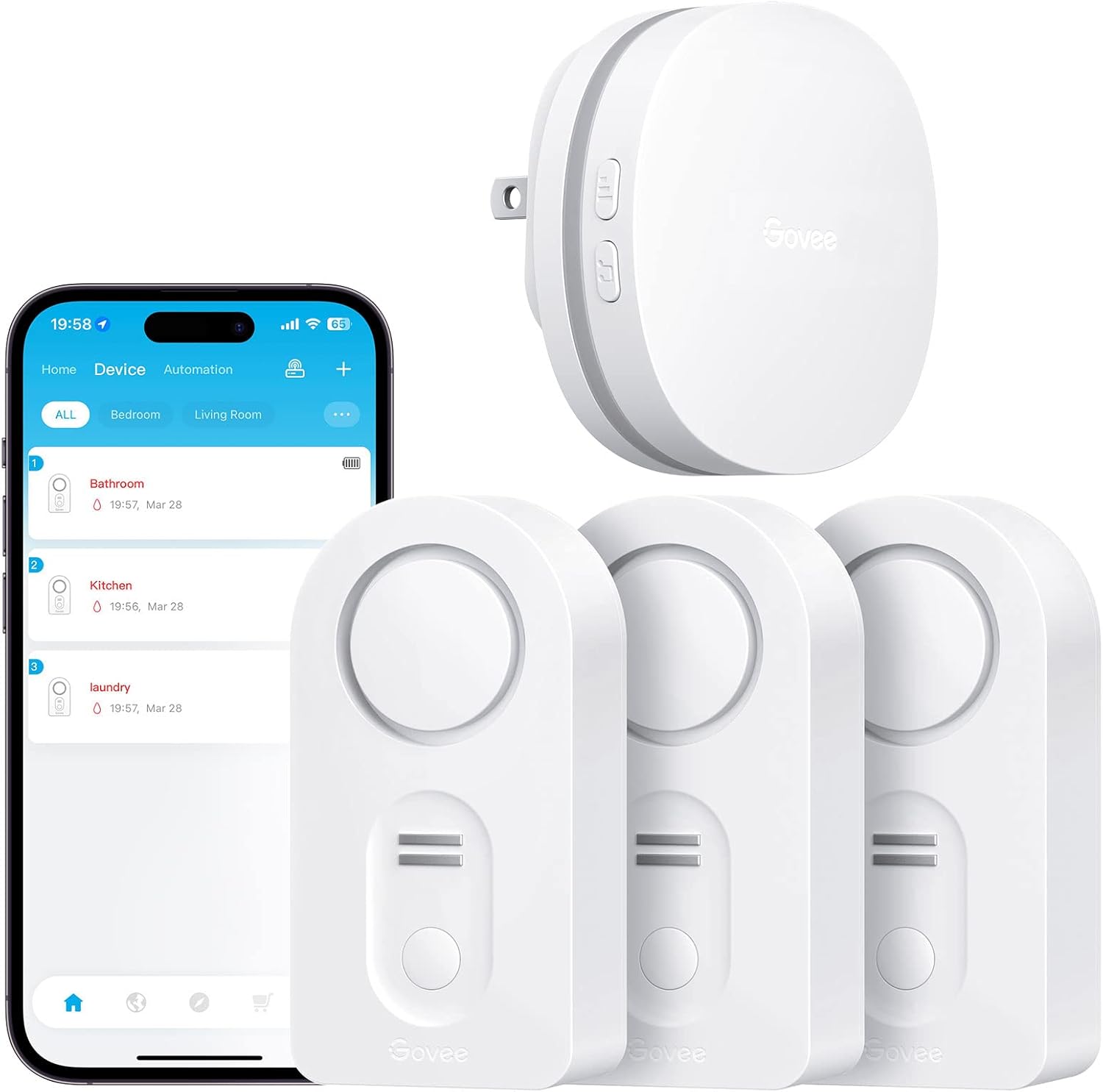
- Remote email and app notifications support monitoring when you are away
- Gateway can connect many sensors for expanded home coverage
Cons
- Gateway connects only to 2.4G Wi-Fi and does not support 5G networks
- Reliable sensor-to-gateway communication is intended within about 196 feet
Best For / Avoid If
Best for buyers prioritizing
- Remote email and app notifications support monitoring when you are away
- Gateway can connect many sensors for expanded home coverage
- Adjustable loud alarm with mute control suits basements and living spaces
Consider another option if
- Gateway connects only to 2.4G Wi-Fi and does not support 5G networks
- Reliable sensor-to-gateway communication is intended within about 196 feet
- Gateway works only with Govee H5054 sensors and is not cross-compatible with other models

Pros
- Three detectors plus base station expand coverage across common leak zones
- High-sensitivity probe layout supports early flood and drip detection
Cons
- Works only with 2.4 GHz Wi-Fi and is incompatible with 5.0 GHz networks
- App control depends on the included base station for connectivity
Best For / Avoid If
Best for buyers prioritizing
- Three detectors plus base station expand coverage across common leak zones
- High-sensitivity probe layout supports early flood and drip detection
- App notifications and family sharing improve remote awareness
Consider another option if
- Works only with 2.4 GHz Wi-Fi and is incompatible with 5.0 GHz networks
- App control depends on the included base station for connectivity
- First-time smart home users may need extra time to complete pairing and placement

Pros
- Ultrasonic sensing supports precise micro leak detection
- Wi-Fi app control and multi-channel alerts improve remote awareness
Cons
- Must stay plugged in to remain networked and fully functional
- Professional installation is recommended, which may add complexity for first-time DIYers
Best For / Avoid If
Best for buyers prioritizing
- Ultrasonic sensing supports precise micro leak detection
- Wi-Fi app control and multi-channel alerts improve remote awareness
- Includes adapters for both 3/4-inch and 1-inch NPT connections
Consider another option if
- Must stay plugged in to remain networked and fully functional
- Professional installation is recommended, which may add complexity for first-time DIYers
- Outdoor placement may need extra cold-weather wrapping in freezing conditions
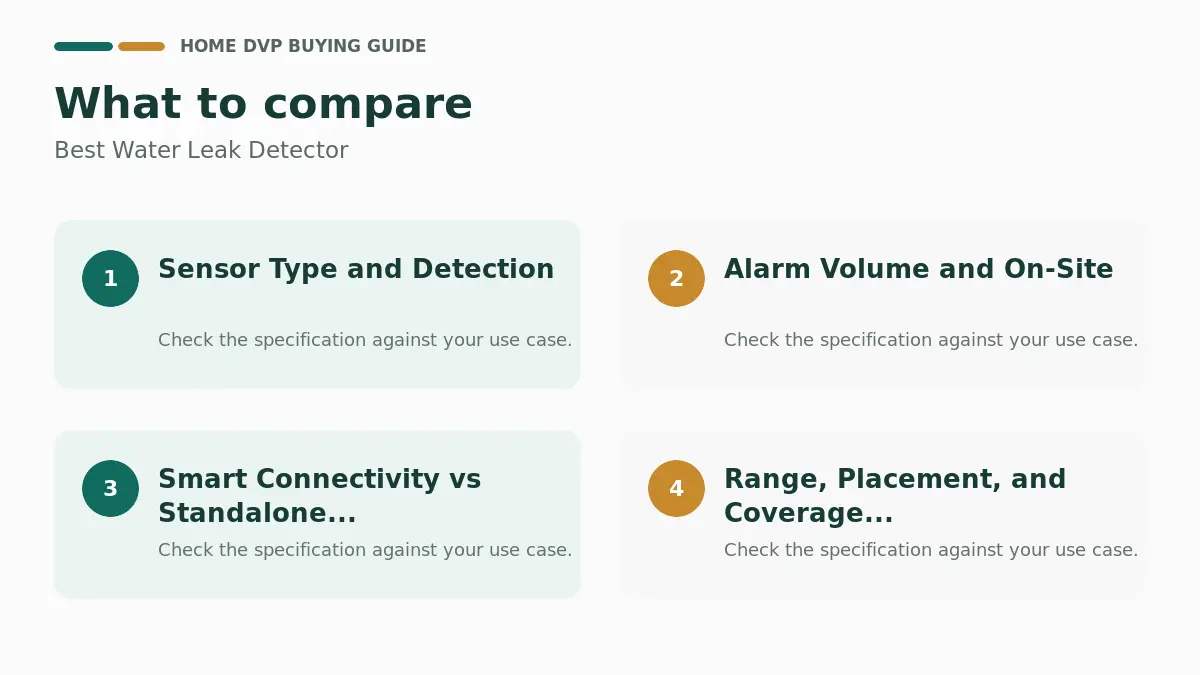
Best Water Leak Detector Buying Guide
Choosing the best water leak detector is less about finding the loudest alarm and more about matching detection style, coverage, and alert method to your home. After carefully analyzing the available specifications, we found that the strongest picks balance sensitivity, reliability, and practical placement.
Sensor Type and Detection Sensitivity
Most modern water leak detectors use metal probes that complete a circuit when they touch moisture. Look for units with both bottom and top probes when possible. Bottom probes catch floor pooling, while top or front probes help detect drips from pipes, valves, or appliance connections. Based on the product data provided, several models claim detection of extremely thin water layers, including as little as 0.015 in or roughly 0.4 mm.
Standalone alarms such as The Basement Watchdog BWD-HWA and METAK detectors are excellent for simple early warning near a water heater, laundry tub, or sink base. Smart kits from YoLink and X-Sense go further by covering multiple rooms with one hub or base station. A common mistake is buying only one sensor for an entire house. If you have multiple risk zones, multi-pack kits usually deliver better protection and value.
Also consider whether you need a passive alarm only or a diagnostic tool. The General Tools MMD4E moisture meter is different from floor sensors. It helps you measure moisture content in wood, drywall, and other building materials after a leak is suspected. That makes it useful for inspection and remediation planning rather than continuous monitoring.
Alarm Volume and On-Site Alerts
A water leak detector is only useful if someone hears it or receives the alert in time. Many homeowner-focused models use 100 dB to 120 dB alarms. That range is usually loud enough to hear across a house, including basements and laundry rooms. The Basement Watchdog model lists a 110 dB alarm, YoLink Sensor 4 and GoveeLife units list 105 dB, and some multi-packs offer adjustable volume up to 120 dB.
Adjustable volume is more important than many buyers expect. A maximum-volume siren is ideal near a sump pump or garage, but it can be disruptive in a quiet apartment or bedroom hallway. Models with mute buttons or silent modes help you silence the alarm after you locate the source. If you travel often or manage rental property, do not rely on sound alone. Remote phone, SMS, or email alerts are much more practical.
Smart Connectivity vs Standalone Simplicity
There are two main paths when shopping for the best water leak detector: simple battery alarms and connected smart systems. Standalone units require almost no setup. Place them where water might collect, replace batteries as needed, and they will sound when moisture is detected. These are ideal for renters, first-time buyers, and anyone who wants protection without apps or hubs.
Smart systems add remote monitoring and automation. YoLink kits use long-range LoRa and can send app, email, and SMS alerts. They also support device-to-device control that can keep working even if internet service drops, which is a major advantage during storms. X-Sense kits use a base station and app notifications, with long wireless range and simultaneous sensor plus base-station alarms. GoveeLife sensors can work as local alarms alone, but app monitoring typically requires a compatible gateway.
Our research indicates that smart connectivity is worth it if you leave home often, own a vacation property, or want whole-home coverage. If you mainly need protection under one sink or beside one appliance, a basic 100 dB unit can still be highly effective. For smart home buyers already investing in related upgrades, pairing leak sensors with stronger bathroom ventilation from a bathroom exhaust fan guide can also help control humidity after minor leaks.
Range, Placement, and Coverage Needs
Placement decides whether a detector actually catches a problem early. Put sensors near water heaters, washing machines, dishwashers, toilets, sinks, refrigerators with ice makers, sump pits, and HVAC condensate lines. Multi-level homes usually need more than one device. Basements and crawlspaces deserve special attention because small leaks can go unnoticed for days.
Range matters most for wireless smart kits. X-Sense lists transmission ranges up to about 1,700 ft in open areas, while YoLink promotes LoRa long-range performance that can reach areas where Wi-Fi is weak. That makes those systems more suitable for larger homes, outbuildings, and thick-walled basements. Detachable or wired sensors, such as the Basement Watchdog design with a 6 ft sensor lead that can be extended, are useful for sump pits and hard-to-reach corners.
A common homeowner mistake is placing a detector too far from the expected water path. If a washing machine hose fails, water may travel under cabinets or along baseboards. Position sensors at the lowest nearby point where water is likely to pool, not just next to the appliance face. Slim designs from brands like X-Sense are especially helpful under appliances and in tight cabinet spaces.
Battery Life, Waterproofing, and Durability
Because leak sensors often sit in dark, humid, and forgotten places, long battery life is a major convenience factor. Several models claim multi-year operation. YoLink sensors and GoveeLife units list up to about 5 years of typical battery life, while some METAK models advertise roughly 2 years of standby time with low-battery alerts. That difference matters if you are placing sensors in crawlspaces or behind appliances.
Waterproof ratings also deserve attention. IP66 and IP67 designs are better suited to damp laundry rooms, basements, and under-sink cabinets. A water sensor itself will be exposed to moisture by design, so rust-resistant probes and sealed housings improve long-term reliability. Still, no sensor replaces good maintenance. Wipe probes occasionally, test alarms, and replace batteries before they fail.
If you are dealing with repeated humidity issues rather than sudden flooding, combine continuous leak detection with better moisture control and cleaning habits. Readers managing damp floors or post-leak cleanup often also review our Cleaning & Floor Care resources and related Air Quality & Climate options for drying and ventilation support.
Ease of Installation and Daily Use
For most households, the best water leak detector is the one that is easy enough to install immediately. Standalone models typically require no tools: insert batteries, place the unit flat on the floor, and you are protected. Multi-packs from METAK, RUIKORING, and GoveeLife make it simple to cover several rooms in one afternoon. Smart kits need a few extra minutes for hub pairing and app setup, but the long-term convenience is often worth that small learning curve.
Look for practical features that reduce frustration: mute buttons, low-battery alerts, named sensor locations in the app, shared family access, and offline backup behavior. YoLink Control-D2D support is especially useful because sensors can still trigger local devices if the internet is down. X-Sense apps that allow temporary mute windows and alarm history also make daily management easier for busy households.
Beginners should avoid overcomplicating the first purchase. Start with one or two high-risk zones, then expand. Experienced DIYers renovating kitchens or baths may prefer a scalable ecosystem that can grow with valves, sirens, and additional sensors. If your project includes fixture upgrades, our Bathroom Fixtures category can help you plan a more complete wet-area refresh.
Value, Kit Size, and Who Each Style Fits
Value is not just the lowest sticker price. A $9.99 single detector can be an excellent buy for one sink cabinet, while a starter kit with four sensors and a hub can be the better investment for a full house. Based on our detailed comparison, multi-packs tend to lower the cost per protected location and reduce the chance that an uncovered room becomes the weak point.
| Home Need | Best Style | Why It Fits |
|---|---|---|
| One appliance or sink | Standalone alarm | Lowest cost and fastest setup |
| Whole-home coverage | Smart starter kit | Multiple sensors plus remote alerts |
| Basement or sump pit | Loud wired or long-range sensor | Better reach into hard-to-access spots |
| Post-leak inspection | Moisture meter | Measures dampness in materials |
| Rental or temporary setup | No-app battery pack | No permanent wiring or hub needed |
Brands represented in this roundup include TheBasementWatchdog, GeneralTools, YoLink, METAK, WINEES, X-Sense. That mix covers trusted basic alarms, expanding smart ecosystems, and practical inspection tools. Choose based on your risk profile rather than brand popularity alone. A home with aging supply lines, frequent freezes, or a finished basement benefits more from multi-sensor smart coverage than from a single bargain unit.
Common Buying Mistakes to Avoid
One frequent mistake is assuming Wi-Fi will always be available when a leak happens. Storms can knock out power and internet at the same time your sump pump is most likely to fail. That is why offline local sirens and device-to-device triggers matter. Another mistake is buying sensors without checking battery access, waterproof rating, or whether a gateway is required for app alerts.
Homeowners also sometimes confuse moisture meters with continuous leak alarms. A pin-type moisture meter is excellent for confirming whether drywall or subflooring is still wet, but it will not sit under a washing machine and warn you at 2 a.m. Use both tools when needed: continuous sensors for prevention and a meter for diagnosis after water has already appeared.
Finally, do not ignore maintenance. Test every sensor periodically, especially before rainy seasons or winter freezes. Keep probes clean, replace aging batteries, and re-check placement after remodeling or appliance moves. A neglected detector gives a false sense of security.
Our Research Methodology & Why You Can Trust Us
At Home DVP, we build product guides for practical homeowners, renters, and DIYers who want clear recommendations based on usable specifications rather than hype. For this Best Water Leak Detector guide, we evaluated each product against category fit for Plumbing Equipment and home water-damage prevention. We compared listed sensitivity, alarm output, connectivity, waterproof rating, battery expectations, kit size, and installation complexity using manufacturer-facing feature data and publicly available product information.
We also weighed user-facing signals such as overall ratings and the types of problems each product is designed to solve. That means a multi-sensor smart kit was judged differently from a single standalone siren or a pin-type moisture meter. Our ranking priorities include performance, features, build quality, ease of use, durability, safety value, reliability, and overall fit for everyday home maintenance. We do not invent hands-on claims. When product data supports a feature, we discuss it. When it does not, we avoid overstatement.
This guide is updated with current market options and refreshed during July as product availability and feature sets change. Our goal is transparent comparison: who each product is best for, where it may fall short, and how it fits real household risk points.
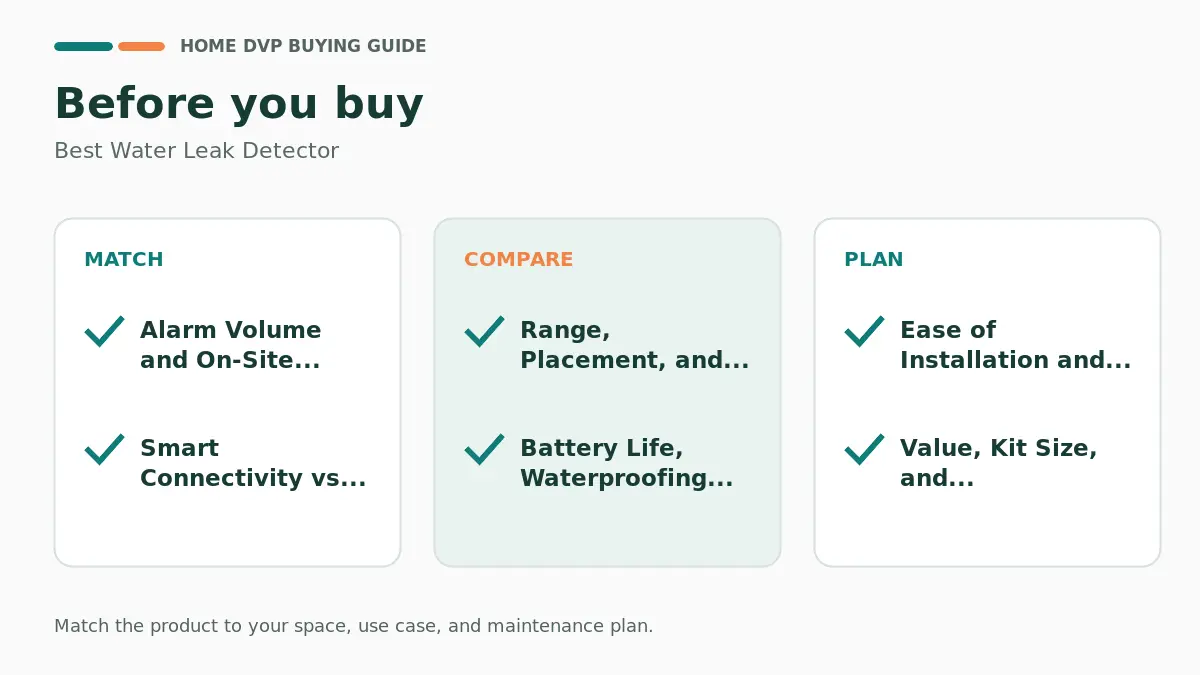
Final Thoughts
If you want one strong overall direction in 2026, start with a scalable smart kit when remote alerts matter and a high-sensitivity standalone alarm when simplicity matters most. Based on available product information, the YoLink Water Leak Starter Kit with Leak Sensor 4 stands out as a premium whole-home pick because it combines hub coverage, 105 dB on-site sirens, long-range LoRa connectivity, multi-year battery life, and offline device-to-device control. The silent YoLink Sensor 1 kit is a smart alternative for discreet monitoring with phone, email, and SMS alerts.
For value and easy setup, The Basement Watchdog 110 dB Water Alarm remains a proven homeowner favorite for single high-risk spots, while METAK and GoveeLife multi-packs make sense when you need several sensors quickly. X-Sense kits are strong midrange smart choices for app alerts, slim placement, and long wireless range. If you already had a leak and need to check whether materials are still damp, the General Tools MMD4E moisture meter is the right diagnostic companion rather than a replacement for continuous floor sensors.
Protect the places most likely to fail first: water heaters, laundry machines, under-sink cabinets, and basements. Then expand coverage as your budget allows. A well-chosen detector can prevent thousands of dollars in repair costs and a great deal of stress. For related planning around wet rooms and fixtures, continue with our bathroom vanity guide or browse more options in Hardware as you complete home maintenance projects.
FAQ
What should I look for when choosing the best water leak detector?
Focus on sensitivity, alarm method, battery life, waterproof rating, and whether you need remote notifications. Multi-probe sensors catch both floor pooling and drips better than single-point designs. Also decide early whether you want a simple standalone siren or a smart kit with app alerts for times when you are away from home.
Are higher-end water leak detector worth it?
Higher-end smart kits are worth it if you manage a larger home, travel frequently, or want whole-home coverage with phone alerts and expandable ecosystems. Budget standalone alarms can still be excellent for one sink, water heater, or laundry area. The better buy is the option that covers your highest-risk locations reliably, not necessarily the most expensive model.
About This Home DVP Research
Home DVP is an independent home-improvement research and product-comparison publisher. Ryan Mitchell prepared this guide by comparing manufacturer specifications, compatibility details, retailer-provided product data, key limitations, and common homeowner use cases. We do not claim hands-on testing unless an article explicitly says so.
Review methodology Affiliate disclosure Last reviewed October 16, 2026