
Running out of hot water mid-shower is one of those home frustrations that never gets old. For many homeowners and renters, traditional tank water heaters take up valuable space, waste energy keeping water hot all day, and still fall short when the whole household needs hot water at once. That is why interest in Tankless Water Heater continues to grow in 2026, especially among people planning bathroom upgrades, kitchen renovations, or whole-home efficiency improvements.
In this guide from Home DVP, we compared 15 tankless water heaters across electric and gas options, flow rates, efficiency features, installation needs, and real-world homeowner use cases. Our goal is simple: help you match capacity, fuel type, and features to your home without getting lost in marketing claims. Whether you want endless hot water for a busy family or a compact point-of-use unit under a sink, the right choice depends on groundwater temperature, electrical service or gas availability, and how many fixtures you run at the same time.
Home DVP decision summary
Quick Answer
For Best Tankless Water Heater, Home DVP compared 15 products from 8 brands. Size a tankless heater from required flow rate and local temperature rise. Fuel supply, venting, electrical service, installation access, and simultaneous fixtures determine whether a model will meet household demand.
| Comparison coverage | 15 products from 8 brands, including EcoSmartWaterHeaters, Titan, CreatingComfortableLiving. |
|---|---|
| Selection priority | Size a tankless heater from required flow rate and local temperature rise. Fuel supply, venting, electrical service, installation access, and simultaneous fixtures determine whether a model will meet household demand. |
| Evidence basis | Manufacturer specifications, compatibility details, retailer-provided product data, and common homeowner use cases. |
| Reference guidance | U.S. Department of Energy tankless water-heater guidance. |
This summary describes the article's comparison set, not every product on the market. Product details should be confirmed before purchase.
We also looked at how these units fit into broader home improvement plans. If you are already updating bathrooms, pairing a new heater with a durable bathroom sink or better ventilation can improve comfort and energy use together. Explore more options in our Plumbing Equipment category as you plan your project.
Top Tankless Water Heater Picks
Paid link disclosure: As an Amazon Associate I earn from qualifying purchases. Learn how we review products.

EcoSmart ECO 11 Electric Tankless Water Heater
Quick take: Homeowners needing a compact point-of-use solution get consistent temperature control from the EcoSmart ECO 11 electric tankless water heater, which uses patented self-modulating technology for bathroom, sink, and low-flow applica...
- Compact 11.5 x 8 x 3.75 inch footprint mounts on a wall and weighs about 6.5 lbs
- Continuous temperature monitoring helps hold selected settings within about 1 degree
- Best matched to point-of-use or low-flow demand rather than whole-home high simultaneous use
Pros
- Compact 11.5 x 8 x 3.75 inch footprint mounts on a wall and weighs about 6.5 lbs
- Continuous temperature monitoring helps hold selected settings within about 1 degree
- Can support one shower in colder climates or two showers in warmer climates when properly sized
- Temperature range of 80°F to 140°F with simple digital adjustment
- Works as a dedicated point-of-use heater for sinks or other low-flow fixtures in colder inlet conditions
Cons
- Best matched to point-of-use or low-flow demand rather than whole-home high simultaneous use
- Requires confirming electrical capacity, including a 60 AMP double-pole breaker and 6 AWG wiring, before installation
- Actual flow rate and multi-fixture support depend heavily on incoming water temperature and climate
The EcoSmart ECO 11 is a 13-kilowatt electric tankless water heater aimed at homeowners, renters, and light commercial users who need reliable hot water at a bathroom, small sink, office breakroom, or similar point-of-use location. Based on the provided product details, it is configured for climates where incoming water is about 67°F and above, while still remaining useful in colder regions as a dedicated low-flow heater when sized correctly.
Based on the listed specifications, the ECO 11 heats water as it passes through the unit instead of storing it in a tank. Patented self-modulating technology adjusts energy use to actual demand, and the product information indicates 99% thermal energy efficiency. Continuously monitored temperature and controlled flow rates help keep output within about 1 degree of the selected setting. Output is listed between 1.3 and 3.1 gallons per minute depending on inlet temperature, which can cover one shower in colder climates or two showers in warmer climates when the unit is properly matched to the application.
Design and usability center on a compact wall-mounted housing measuring 11.5 x 8 x 3.75 inches. Digital temperature control covers 80°F to 140°F in 1-degree steps. Product data lists a 240-volt setup with roughly 54 to 57 amps of draw, a required 60 AMP double-pole breaker, 6 AWG wiring, and 1/2 inch compression fittings. Buyers should verify both hot water demand and electrical service before purchase and installation, since correct sizing is essential for consistent performance.
In practical home use, the ECO 11 can cut waiting for hot water at a point of use, reclaim floor space for storage, and reduce standby energy waste because it only heats when water is called. It is a sensible option for a bathroom fixture pair, a utility sink, a breakroom sink, or other low-flow needs where a full-size tank would be oversized or wasteful. The compact form also helps in tight mechanical closets, RVs, offices, and similar constrained spaces noted in the product information.
Limitations are mainly capacity and installation related. Simultaneous high-flow demand beyond the unit’s intended range may exceed what a 13 kW heater can deliver, especially with very cold inlet water. Electrical upgrades may also be needed if the existing panel or wiring is inadequate. Based on the available product data, the EcoSmart ECO 11 is a practical, space-saving choice for buyers who want efficient electric tankless hot water for bathroom or point-of-use needs and who are prepared to size and wire it correctly.
Homeowners who need broader multi-fixture whole-home performance may want a higher-kilowatt model in the same product family. Those with verified electrical capacity and modest hot water demand will likely find the ECO 11 a useful upgrade for comfort, efficiency, and floor-space savings.
Best For / Avoid If
Best for buyers prioritizing
- Compact 11.5 x 8 x 3.75 inch footprint mounts on a wall and weighs about 6.5 lbs
- Continuous temperature monitoring helps hold selected settings within about 1 degree
- Can support one shower in colder climates or two showers in warmer climates when properly sized
Consider another option if
- Best matched to point-of-use or low-flow demand rather than whole-home high simultaneous use
- Requires confirming electrical capacity, including a 60 AMP double-pole breaker and 6 AWG wiring, before installation
- Actual flow rate and multi-fixture support depend heavily on incoming water temperature and climate

Rinnai RX199iN Condensing Tankless Water Heater
Quick take: Compact yet capable, the Rinnai RX199iN condensing tankless unit brings Smart Sense fuel flexibility for natural gas or propane plus Versa Vent indoor or outdoor placement. Households that need steady hot water for several fixture...
- One model can serve natural gas or propane setups through Smart Sense control
- Indoor and outdoor install options expand placement choices for many homes
- Professional installation is recommended, so DIY-only homeowners may need a qualified technician
Pros
- One model can serve natural gas or propane setups through Smart Sense control
- Indoor and outdoor install options expand placement choices for many homes
- High listed efficiency with a UEF of .98
- Compact design still supports multi-fixture hot water demand up to 11.1 GPM
- User-facing interface and Quick Flush simplify daily operation and upkeep
Cons
- Professional installation is recommended, so DIY-only homeowners may need a qualified technician
- Outdoor installs require the separate RX-OVC vent cap
- WiFi control depends on an optional Controlr module that is not included
Based on the provided product details, the Rinnai RX199iN is a condensing tankless water heater built for homeowners who want continuous hot water without a bulky storage tank. It suits busy households, remodel projects, and property upgrades where space savings and multi-fixture demand both matter. The product information indicates it can serve natural gas or propane applications and can be installed indoors or outdoors when venting requirements are met.
Performance centers on tankless on-demand heating with a listed output up to 11.1 GPM, which the feature set describes as enough for roughly seven fixtures at once. That capacity is useful for simultaneous showers, laundry, and kitchen use. A super-high energy efficiency factor of UEF .98 also stands out in the listed specifications, pointing to strong efficiency for gas-fired residential service when the unit is correctly sized for local groundwater temperatures.
Design and usability focus on a compact body described as suitcase-sized, plus a modern interface and Quick Flush feature for simplified flushing. Installation flexibility comes from Versa Vent for indoor or outdoor mounting and Smart Sense gas control for fuel type. Product guidance strongly recommends professional installation and notes that outdoor installs need the RX-OVC vent cap. An optional Controlr module is referenced for WiFi control but is not included.
In practical home use, the listed strengths favor utility rooms, garages, exterior walls, and renovations where reclaiming space is a priority. Homeowners who want fewer cold-water interruptions during peak morning or evening demand may find the tankless approach especially useful. Support resources such as product guides, size tables, the Rinnai Central App, and regional groundwater temperature mapping can help match the unit to household load and climate conditions.
Potential limitations include the need for professional setup, the extra outdoor vent cap, and optional smart control hardware. Sizing still depends on home demand and regional water temperatures, so this model may not be the best fit for every property. Overall, based on the feature set, the RX199iN is a strong contender for buyers seeking a compact, high-efficiency condensing tankless heater with flexible fuel and placement options, provided installation is handled by a qualified technician and warranty registration is completed within the stated window.
Best For / Avoid If
Best for buyers prioritizing
- One model can serve natural gas or propane setups through Smart Sense control
- Indoor and outdoor install options expand placement choices for many homes
- High listed efficiency with a UEF of .98
Consider another option if
- Professional installation is recommended, so DIY-only homeowners may need a qualified technician
- Outdoor installs require the separate RX-OVC vent cap
- WiFi control depends on an optional Controlr module that is not included

Titan N-120 Electric Tankless Water Heater Review
Quick take: Titan N-120 electric tankless water heater supplies continuous hot water through a 220 V design with 54 max amps. Homeowners replacing bulky storage units with a compact electric option can evaluate this model based on the listed...
- Tankless design provides hot water as needed rather than stored
- Electric 220 V operation matches common residential power setups
- May require 220 V circuit work that some homeowners need a professional to complete
Pros
- Tankless design provides hot water as needed rather than stored
- Electric 220 V operation matches common residential power setups
- 54 max amp rating is clearly stated for planning electrical demand
- Compact style can reduce space taken by a conventional tank heater
Cons
- May require 220 V circuit work that some homeowners need a professional to complete
- Limited published feature details may leave buyers wanting more capacity guidance
- May not suit users who need contractor-grade or multi-unit whole-home systems
The Titan N-120 is an electric tankless water heater aimed at homeowners who want hot water on demand without dedicating floor space to a large storage tank. Based on the provided product details, it is positioned for practical residential use where a compact electric unit can support everyday kitchen and bathroom needs.
Performance centers on tankless electric heating at 220 V with a 54 max amp rating. The product information indicates continuous heating rather than reheating stored water, which can help maintain hot water availability during sequential showers or household tasks when electrical capacity is adequate.
Design and usability revolve around the tankless format itself. Without a storage cylinder, the unit can be easier to place in utility rooms or tight mechanical spaces. Installation still depends on correct 220 V wiring and plumbing connections, so first-time DIYers may want to confirm electrical readiness before purchase.
In real-world home settings, this type of heater is useful for upgrades where space is limited or where owners prefer to avoid standby storage. The listed 220 V and 54 max amp specifications give buyers a clear baseline for matching the unit to existing panels and circuit capacity.
Potential limitations include the need for suitable electrical service and the relatively sparse published feature list beyond voltage and amperage. Buyers seeking extensive controls, multi-zone capacity data, or contractor-level throughput may need to compare additional models. Overall, the Titan N-120 fits homeowners looking for a straightforward electric tankless option based on the available product data.
Those with confirmed 220 V capacity and a desire for compact on-demand heating should consider it. Households needing higher flow for simultaneous multi-bath use or more documented advanced features may prefer a different class of unit.
Best For / Avoid If
Best for buyers prioritizing
- Tankless design provides hot water as needed rather than stored
- Electric 220 V operation matches common residential power setups
- 54 max amp rating is clearly stated for planning electrical demand
Consider another option if
- May require 220 V circuit work that some homeowners need a professional to complete
- Limited published feature details may leave buyers wanting more capacity guidance
- May not suit users who need contractor-grade or multi-unit whole-home systems

Rheem RTEX-24 Electric Tankless Water Heater
Quick take: Homeowners seeking continuous hot water without a bulky tank can look to the Rheem RTEX-24 24kW 240V electric tankless unit, which the product information indicates delivers up to 5.9 GPM for multiple fixtures. Its compact wall-mo...
- Provides whole-home continuous hot water potential when ground water temperature and flow needs align with the performance guide
- Saves space compared with conventional tank-style electric heaters
- Requires three 40 AMP double-pole breakers and is best suited to homes with adequate 200 AMP service and panel space
Pros
- Provides whole-home continuous hot water potential when ground water temperature and flow needs align with the performance guide
- Saves space compared with conventional tank-style electric heaters
- Digital ON/OFF dial control makes temperature adjustments straightforward
- Eliminates venting requirements, expanding indoor installation options
- Energy-focused operation heats water only when needed
Cons
- Requires three 40 AMP double-pole breakers and is best suited to homes with adequate 200 AMP service and panel space
- Output GPM and temperature rise depend on regional ground water temperature, so colder climates may need lower simultaneous fixture use
- Electrical and plumbing setup may take extra planning for first-time DIY installers
The Rheem RTEX-24 is a 24kW 240V electric tankless water heater aimed at homeowners who want continuous hot water without the bulk of a traditional storage tank. Based on the listed specifications, it targets whole-home or multi-fixture use, with the product information noting capacity for applications such as two showers and two sinks in warmer climates. Buyers with sufficient electrical service who are renovating a bathroom, kitchen, or utility space will find the category fit clear: it is a space-saving alternative to tank-type electric heaters.
Performance centers on on-demand heating and a maximum flow rate listed at up to 5.9 GPM. The product details emphasize that ground water temperature affects temperature rise and gallons per minute, so regional conditions matter. Energy modulation on this RTEX model means the unit draws power according to demand rather than keeping a full tank hot. That design supports efficiency claims around reduced standby loss and can help households manage water heating energy when the unit is sized and installed correctly for the climate.
Design and usability features include a compact gray housing listed with dimensions that allow wall mounting, 3/4 inch NPT water connections, and a front digital temperature display with ON/OFF dial control. Set points adjust from 80 to 140 degrees F in one-degree increments. No venting is required, which simplifies placement compared with many gas tankless units. Installation still needs careful electrical planning: three 40 AMP double-pole breakers are required, the model is described as 100A class at 24kW 240V, and 200 AMP household service is recommended with enough panel space available.
In practical home settings, the RTEX-24 can support busy mornings, laundry cycles, and dishwashing without waiting for a tank to reheat. Point-of-use style space savings and whole-home wall mounting both appear in the product information, giving flexibility for closets, utility rooms, or central locations. Continuous hot water for multiple tasks is the core user benefit when flow rates match the home's simultaneous demand.
Limitations are mostly electrical and climate related. Homes without panel capacity or recommended service size will need upgrades before this unit is appropriate. Colder ground water reduces available GPM at a given temperature rise, so buyers should review the performance guide for their region. For households that can meet the power requirements and match expected fixture loads, the Rheem RTEX-24 presents a compact, vent-free electric tankless option focused on continuous hot water and energy-conscious operation.
Those seeking a smaller single-sink point-of-use heater may prefer a lower-kW RTEX model, while buyers with limited electrical infrastructure may need a different water heating approach. Homeowners prepared for the breaker and service needs who want tankless convenience will find the listed feature set aligned with whole-home electric tankless upgrades.
Best For / Avoid If
Best for buyers prioritizing
- Provides whole-home continuous hot water potential when ground water temperature and flow needs align with the performance guide
- Saves space compared with conventional tank-style electric heaters
- Digital ON/OFF dial control makes temperature adjustments straightforward
Consider another option if
- Requires three 40 AMP double-pole breakers and is best suited to homes with adequate 200 AMP service and panel space
- Output GPM and temperature rise depend on regional ground water temperature, so colder climates may need lower simultaneous fixture use
- Electrical and plumbing setup may take extra planning for first-time DIY installers

MIZUDO 199k BTU Natural Gas Tankless Water Heater
Quick take: MIZUDO delivers a 199,000 BTU indoor natural gas tankless unit with up to 10.3 GPM and WiFi app control for continuous hot water across multiple fixtures. Based on the listed specifications, it suits large residential households t...
- High 199,000 BTU output and 10.3 GPM capacity match whole-house demand for larger homes
- App-enabled remote monitoring and scheduling improve everyday convenience
- 3 by 5 inch direct vent kit must be purchased separately, adding an installation step and cost planning item
Pros
- High 199,000 BTU output and 10.3 GPM capacity match whole-house demand for larger homes
- App-enabled remote monitoring and scheduling improve everyday convenience
- Closed combustion design and CSA qualification support safer indoor installation
- Standard 120V power and 3/4-inch NPT connections simplify typical residential plumbing layout
- 2-year unit and 5-year heat exchanger warranty coverage provide longer-term assurance
Cons
- 3 by 5 inch direct vent kit must be purchased separately, adding an installation step and cost planning item
- Non-condensing design may not match the efficiency expectations of buyers specifically seeking condensing models
- Professional gas and venting setup may take extra time for first-time DIY homeowners unfamiliar with tankless systems
Homeowners replacing an aging tank or planning a whole-house upgrade will find the MIZUDO natural gas tankless water heater aimed squarely at large-family residential use. Based on the provided product details, the 199,000 BTU indoor unit is positioned for continuous hot water delivery rather than limited tank recovery cycles, making it relevant for busy households that run multiple bathrooms and kitchen fixtures throughout the day.
Listed capacity reaches a maximum of 10.3 GPM and is described as supporting five to seven fixtures at once. That flow range, paired with six-stage modulation that maintains temperature within roughly one degree Fahrenheit, points to more stable comfort when demand spikes. The product information also highlights on-demand heating, so energy is used only when hot water is needed, which can appeal to buyers focused on practical efficiency for everyday residential loads.
Build details include a phosphorous-deoxidized copper heat exchanger, stainless steel combustion chamber, and a compact 24.8 by 15.9 by 10.4 inch cabinet that mounts on a wall and claims roughly half the space of many tank heaters. Controls extend beyond the unit itself through WiFi and a dedicated app for temperature changes, schedules, usage tracking, and maintenance alerts. Installation notes call for a sealed 3 by 5 inch direct vent system (kit sold separately), 120V power, and 3/4-inch NPT gas and water connections, with a water pressure operating range of 15 to 50 PSI.
In practical home scenarios, the sealed combustion path draws outdoor air only, which helps preserve indoor air quality in basements, utility rooms, or other finished spaces. Freeze protection rated to -13°F, anti-dry-fire protection, flame failure detection, exhaust blockage monitoring, and automatic shutdown form part of more than sixteen listed safety mechanisms. Together these features support year-round reliability for cold climates and multi-bathroom morning routines without relying on a large storage cylinder.
Potential limitations are straightforward. Buyers must budget for the separate direct vent kit, and the unit is non-condensing, so households prioritizing condensing efficiency may prefer another category. Gas line sizing, vent routing, and local code compliance typically require careful planning or a licensed installer. Overall, based on the feature set, this MIZUDO model is a strong match for large-family homes that need high GPM capacity, app-based control, and indoor natural gas operation in a space-saving package.
Choose this option if continuous whole-house hot water, WiFi management, and multi-fixture support are priorities. Consider a smaller BTU or outdoor-rated alternative if your home only needs two to four fixtures or if outdoor installation better fits the property layout.
Best For / Avoid If
Best for buyers prioritizing
- High 199,000 BTU output and 10.3 GPM capacity match whole-house demand for larger homes
- App-enabled remote monitoring and scheduling improve everyday convenience
- Closed combustion design and CSA qualification support safer indoor installation
Consider another option if
- 3 by 5 inch direct vent kit must be purchased separately, adding an installation step and cost planning item
- Non-condensing design may not match the efficiency expectations of buyers specifically seeking condensing models
- Professional gas and venting setup may take extra time for first-time DIY homeowners unfamiliar with tankless systems
Rheem RTEX-13 Tankless Water Heater Review
Quick take: Rheem RTEX-13 residential electric tankless units supply continuous hot water on demand for single point-of-use or multiple applications, backed by self-modulating power control and 99.8% energy efficiency. Homeowners who want pre...
- Precise external LED thermostatic control for fine temperature setting
- Two field-serviceable copper immersion heating elements for serviceability
- 54 A at 240V electrical demand may require dedicated circuit planning or panel capacity upgrades in some homes
Pros
- Precise external LED thermostatic control for fine temperature setting
- Two field-serviceable copper immersion heating elements for serviceability
- High listed energy efficiency of 99.8%
- Adapters and compression connections included to ease plumbing hookup
- Tankless on-demand operation suited to continuous hot water without a storage tank
Cons
- 54 A at 240V electrical demand may require dedicated circuit planning or panel capacity upgrades in some homes
- Flow rate up to 3.17 GPM may feel limiting for larger households running several fixtures at once
- First-time DIY installers may need extra time or professional help for electrical and plumbing connections
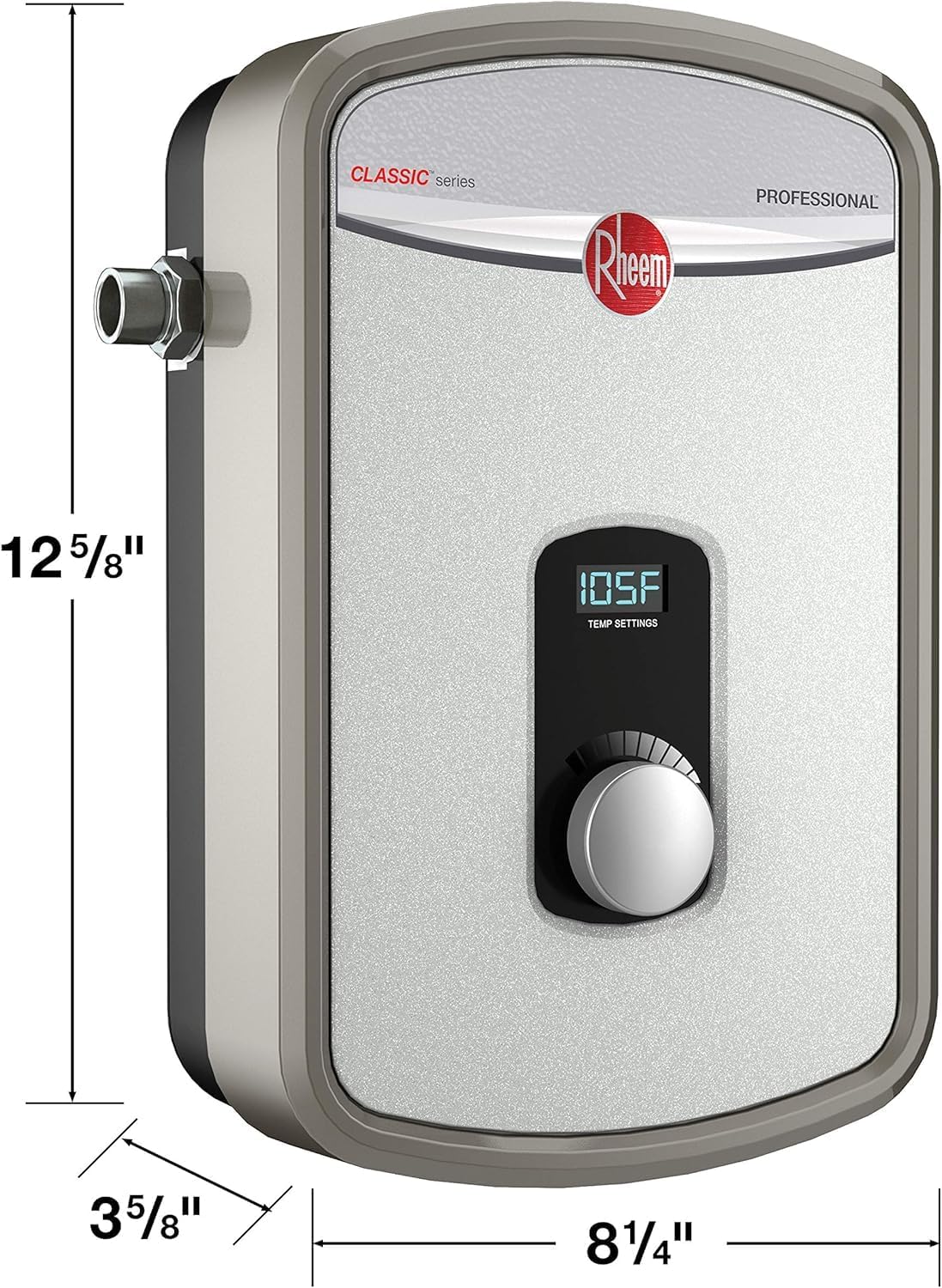
Based on the provided product details, the Rheem RTEX-13 is a residential electric tankless water heater built to deliver continuous hot water on demand for single point-of-use or multiple applications. It is a practical option for homeowners who want compact tankless performance rather than a bulky storage tank, especially when upgrading bathrooms, kitchens, or utility spaces where space and efficiency matter.
The listed specifications indicate a 13kW model with a flow rate up to 3.17 GPM and self-modulating power control that adjusts energy use to demand. At a stated 99.8% energy efficiency, the unit is positioned for reduced standby waste common with traditional tanks. External controls allow temperature changes in 1°F increments, and the digital thermostatic control with LED display is described with plus or minus 1 degree accuracy, which supports more consistent comfort at sinks, showers, and similar fixtures.
Build and usability details center on durable copper immersion heating elements that are field serviceable, plus a digital temperature display and threaded design for easier replacement. Installation is described as simple, with 1/2 NPT adapters included and side 1/2 inch compression water connections. The gray residential unit is framed for straightforward hookup, though the 54 A electrical requirement means proper 240V circuit planning is an important part of setup readiness.
In practical home scenarios, the feature set suits point-of-use upgrades, modest multi-fixture needs, and renovation projects where continuous hot water without a tank is the goal. The water-saver shower head note at 1.5 GPM in the product information further points toward efficiency-minded use cases. Homeowners focused on maintenance convenience can benefit from serviceable heating elements and external controls that keep temperature management accessible.
Potential limitations follow from the product type and listed capacity. High amperage draw may not fit every electrical panel without preparation, and a maximum flow around 3.17 GPM may not fully support simultaneous high-demand use in larger households. Overall, based on the available product data, the Rheem RTEX-13 is a strong fit for buyers seeking an efficient electric tankless solution with digital control and serviceable components.
Buyers who need compact on-demand hot water with precise external controls should consider this model. Those requiring higher simultaneous flow or who lack adequate 240V electrical capacity may want to evaluate larger-capacity or differently configured water heating options instead.
Best For / Avoid If
Best for buyers prioritizing
- Precise external LED thermostatic control for fine temperature setting
- Two field-serviceable copper immersion heating elements for serviceability
- High listed energy efficiency of 99.8%
Consider another option if
- 54 A at 240V electrical demand may require dedicated circuit planning or panel capacity upgrades in some homes
- Flow rate up to 3.17 GPM may feel limiting for larger households running several fixtures at once
- First-time DIY installers may need extra time or professional help for electrical and plumbing connections

WINTEMP WN27 Electric Tankless Water Heater
Quick take: WINTEMP WN27 brings 27kW electric on-demand heating with WiFi temperature control and a slim wall-mounted profile for whole-house use. Homeowners seeking continuous hot water for 2–3 bathroom homes in mild to moderate climates wil...
- On-demand heating removes the wait associated with tank preheating
- LED display and WiFi control simplify temperature management
- High electrical demand requires multiple 40A breakers and substantial household service capacity
Pros
- On-demand heating removes the wait associated with tank preheating
- LED display and WiFi control simplify temperature management
- ETL certification and layered safety protections add homeowner peace of mind
- Slim wall-mounted form factor suits utility rooms and tighter mechanical spaces
- Output range and flow capacity suit multi-fixture use in smaller whole-house setups
Cons
- High electrical demand requires multiple 40A breakers and substantial household service capacity
- Best suited to mild to moderate climates for multi-bathroom simultaneous use
- Professional electrician consultation is strongly recommended before purchase and install
Based on the provided product details, the WINTEMP WN27 is a 27kW, 240V electric tankless water heater aimed at homeowners who want whole-house on-demand hot water without a bulky storage tank. The listed feature set points to strong fit for 2–3 bathroom homes in mild to moderate climate conditions, especially buyers who value endless hot water for showers, baths, kitchens, and laundry.
The product information indicates self-modulating performance that adjusts energy use according to incoming water temperature and flow rate. With a maximum hot water output listed up to 6.5 GPM and activation at a low 0.32 GPM, the unit is positioned to support continuous residential use while reducing wasted standby energy. When water is not flowing, the system is described as consuming no energy, which can improve efficiency versus traditional tank heaters.
Design details emphasize a compact wall-mounted footprint measuring about 19.1" x 11.1" x 4" and weighing 14.3 lbs, helping free floor space in mechanical rooms or utility closets. An LED temperature display and remote WiFi control allow temperature adjustment without standing at the unit. Water connections are 3/4" NPT, and installation guidance calls for 3 x 40 Amp double-pole breakers, 3 x 8 AWG wiring with ground, and robust household service, so electrical readiness is a key planning step.
In practical home use, the listed stable-temperature behavior is useful for everyday showers and simultaneous light household draws, since the heater is designed to maintain set output without tank recovery delays. Safety features including leakage protection, overheat protection, dry-fire protection, and ETL certification further support confident daily operation. A 2-year return and exchange warranty plus long-term technical support is also noted in the product data.
Potential limitations center on infrastructure. The WN27 draws up to 113A and is recommended for substantial household electrical service, so older panels or limited capacity homes may need upgrades. Performance can also vary with incoming water temperature, which matters more in colder regions when multiple fixtures run at once. For homeowners with suitable electrical capacity who want space-saving, on-demand hot water with app-style WiFi control, the WINTEMP WN27 is a practical electric tankless option to consider after consulting a qualified electrician.
Specifications
| Power Source | AC |
|---|---|
| Special Features | LED Display, Overheat Protection, Temperature Lock |
| Wattage | 27000 watts |
| Voltage | 240 Volts |
| Flow Rate | 6.5 Gallons Per Minute |
| Maximum Temperature | 140 Degrees Fahrenheit |
| Heat Output | 27 Kilowatts |
| Efficiency | High Efficiency |
| Maximum Pressure | 150 Pound per Square Inch |
| Mount Type | Wall |
Verify the current product variation before purchase; specifications may change.
Best For / Avoid If
Best for buyers prioritizing
- On-demand heating removes the wait associated with tank preheating
- LED display and WiFi control simplify temperature management
- ETL certification and layered safety protections add homeowner peace of mind
Consider another option if
- High electrical demand requires multiple 40A breakers and substantial household service capacity
- Best suited to mild to moderate climates for multi-bathroom simultaneous use
- Professional electrician consultation is strongly recommended before purchase and install

Westinghouse APOLO-2.0 14kW Electric Tankless
Quick take: Compact 14kW 240V electric tankless heating gives apartments and smaller homes continuous hot water for a shower and faucet at once. Smart WiFi with Alexa and Google Home support makes temperature control convenient for connected...
- Continuous hot water supply without bulky storage tank
- Remote and voice temperature control for smart-home setups
- Maximum 3.38 GPM may not cover heavier multi-fixture demand in larger households
Pros
- Continuous hot water supply without bulky storage tank
- Remote and voice temperature control for smart-home setups
- Slim flush-mount design suits tight utility spaces
- IPX4 rating and multi-layer safety features add peace of mind
- Listed capacity supports one shower plus one faucet at the same time
Cons
- Maximum 3.38 GPM may not cover heavier multi-fixture demand in larger households
- 240V service with a 60-amp breaker may require an electrician if the panel is not already prepared
- Bottom 1/2-inch NPT connections may need adapters depending on existing plumbing
Based on the provided product details, the Westinghouse APOLO-2.0 Upgrade is a 14kW 240V electric tankless water heater aimed at apartments, cabins, and modest homes that need reliable hot water without a bulky tank. It targets practical buyers who want continuous supply for bathroom and kitchen use while reclaiming floor space.
The listed heating system supports up to 3.38 GPM with a 0.5 GPM starting flow, which the product information indicates is enough for one shower and one faucet together. Instant response removes the recovery wait common with tank units, and the 14kW rating at 240V is positioned for residential point-of-use or whole-home light-demand scenarios rather than high-flow commercial loads.
At 14.2 inches high, 9.5 inches wide, and 3.5 inches deep and weighing about 10.4 pounds, the unit mounts flush to the wall. Bottom 1/2-inch NPT water connections and a single 60-amp double-pole breaker with 6 AWG wire keep the installation footprint small. Smart WiFi adds app monitoring plus Alexa and Google Home voice control, while ETL certification, IPX4 water resistance, and four-layer protection (leakage, overheat, dry-fire, high voltage) address safety expectations for damp utility areas.
In everyday home use the design suits bathroom upgrades, kitchen remodels, office restrooms, and compact living where endless hot water and zero floor space matter. The separate water-electricity pathway is described as helping reduce corrosion and scale, which can lower long-term maintenance compared with some traditional designs.
Limitations follow from the specifications: flow tops out at 3.38 GPM, so larger families running multiple showers may need a higher-kW model from the same line. Electrical work should match the 59A current draw and local codes. Overall, the product information points to a strong fit for space-conscious homeowners who value smart controls and continuous hot water for light simultaneous fixture use.
Buyers with adequate 240V capacity and moderate demand should find it a practical upgrade. Those needing multi-shower whole-house capacity or gas fuel sources will want to compare higher-output or alternative fuel options.
Best For / Avoid If
Best for buyers prioritizing
- Continuous hot water supply without bulky storage tank
- Remote and voice temperature control for smart-home setups
- Slim flush-mount design suits tight utility spaces
Consider another option if
- Maximum 3.38 GPM may not cover heavier multi-fixture demand in larger households
- 240V service with a 60-amp breaker may require an electrician if the panel is not already prepared
- Bottom 1/2-inch NPT connections may need adapters depending on existing plumbing

ThermoMate CZ422NG Natural Gas Tankless Water
Quick take: Busy households can rely on the ThermoMate CZ422NG natural gas tankless water heater for continuous hot water at up to 5 GPM with multi-point heating and precise temperature stability. Its compact indoor design and oxygen-free cop...
- Supports multi-point heating for up to four faucets at a maximum 5 GPM flow rate.
- Achieves 98 percent thermal efficiency and a UEF of 0.81 for improved energy performance.
- Requires separate purchase of a 150 psi pressure relief valve and 3-inch metal exhaust pipe for complete installation.
Pros
- Supports multi-point heating for up to four faucets at a maximum 5 GPM flow rate.
- Achieves 98 percent thermal efficiency and a UEF of 0.81 for improved energy performance.
- Activates frost protection at 41 degrees Fahrenheit with ceramic heating cores to help guard against pipe ice.
- Provides ±1 degree Fahrenheit temperature consistency through rapid flow sensor adjustments.
- Includes wind-resistant exhaust performance designed for extreme weather stability.
Cons
- Requires separate purchase of a 150 psi pressure relief valve and 3-inch metal exhaust pipe for complete installation.
- Maximum 5 GPM capacity may be limited for larger homes with more than two simultaneous high-flow showers.
- Indoor natural gas configuration is not suited for outdoor mounting or propane fuel applications.
The ThermoMate CZ422NG is an indoor natural gas tankless water heater built for residential whole-house use, heating water on demand without a storage tank. It suits homeowners who want continuous hot water for everyday fixtures and prefer a compact alternative to traditional tank models.
Based on the listed specifications, the unit delivers up to 5 GPM and 113,000 BTU, enough for two showers at the same time while holding a stable temperature near 105 degrees Fahrenheit with a 65 degree inlet. A smart flow sensor and control chip adjust heating 20,000 times per second for ±1 degree Fahrenheit consistency, and the oxygen-free copper heat exchanger supports 98 percent thermal efficiency with a UEF of 0.81. Product information indicates this design can reduce energy waste by roughly 30 percent compared with conventional systems.
The unit measures 21 inches high by 13 inches wide by 7 inches deep, taking less than one-third the space of many tank heaters. Installation relies on standard 3/4-inch NPT water connections, a 1/2-inch NPT gas inlet, 3-inch OD venting, and a UL-certified 120V plug. A 3.5-inch LED panel displays temperature, flow, fan, and flame status with advanced error codes, while the multi-stage burner and DC high-speed fan promote controlled, low-noise operation.
In practical home use, multi-point heating and eight safety protections (including boil-dry, freeze, overheating, and high-temperature lock) support reliable comfort for busy households. The wind-resistant fan, rated for Category 3 hurricane conditions, helps maintain exhaust integrity and reduce backdraft or flameout risks in exposed locations.
Buyers should plan for additional components such as a 150 psi pressure relief valve and metal exhaust pipe, which are not included. The 5 GPM maximum works well for many families yet may fall short for higher simultaneous demand. Based on the available product details, the ThermoMate CZ422NG is a practical choice for those seeking efficient, space-saving on-demand hot water with strong safety and control features. Households needing greater capacity or outdoor installation may want to consider another model in the lineup.
Best For / Avoid If
Best for buyers prioritizing
- Supports multi-point heating for up to four faucets at a maximum 5 GPM flow rate.
- Achieves 98 percent thermal efficiency and a UEF of 0.81 for improved energy performance.
- Activates frost protection at 41 degrees Fahrenheit with ceramic heating cores to help guard against pipe ice.
Consider another option if
- Requires separate purchase of a 150 psi pressure relief valve and 3-inch metal exhaust pipe for complete installation.
- Maximum 5 GPM capacity may be limited for larger homes with more than two simultaneous high-flow showers.
- Indoor natural gas configuration is not suited for outdoor mounting or propane fuel applications.
Ranein 18kW Electric Tankless Water Heater Review
Quick take: Ranein’s 18kW 240V tankless unit delivers on-demand hot water at up to 4.3 GPM with an LED display and precise control knob, making it a practical choice for households that want continuous supply without a bulky storage tank.
- High thermal efficiency rating suited to continuous on-demand use
- Temperature adjustments in fine 1°F increments for stable output
- Requires two dedicated 240V circuits with 40A breakers and 8 AWG wiring, which may need an electrical upgrade
Pros
- High thermal efficiency rating suited to continuous on-demand use
- Temperature adjustments in fine 1°F increments for stable output
- Space-saving wall-mounted form with 3/4" NPT connections
- Built-in protections including leakage and overheat safeguards
- Capable of serving 2–3 outlets at once based on listed capacity
Cons
- Requires two dedicated 240V circuits with 40A breakers and 8 AWG wiring, which may need an electrical upgrade
- Installation is best handled by a qualified electrician and plumber rather than a first-time DIY homeowner
- Flow performance depends on incoming water temperature and simultaneous fixture demand
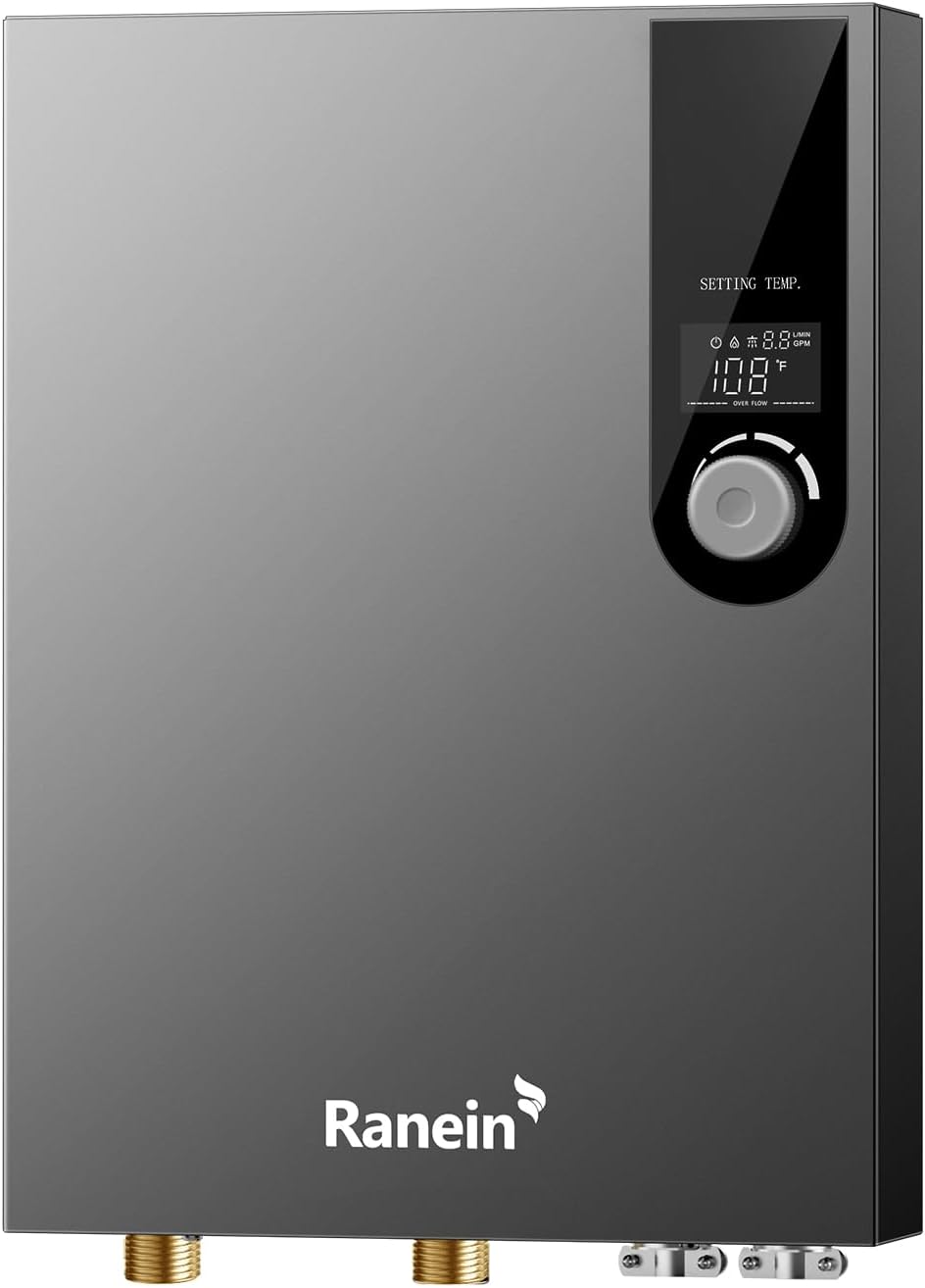
Homeowners looking to replace a bulky storage tank with a compact on-demand system will find the Ranein 18kW electric tankless water heater aimed squarely at whole-house convenience. Based on the listed specifications, this 240V unit is positioned for families that want continuous hot water for everyday bathing, kitchen, and laundry tasks without waiting for a reservoir to reheat.
Product information indicates strong performance for its class, with up to 4.3 GPM flow and roughly 99% thermal efficiency. That combination supports simultaneous use of two to three household outlets, while on-demand heating is said to cut energy waste by eliminating standby losses. Rapid heating technology is promoted for near-instant delivery, which can improve comfort during peak morning or evening demand.
Design and setup details matter for this category. The heater measures 13.8" x 3.1" x 18.7", mounts on the wall, and uses 3/4" NPT water connections. An LED temperature display and control knob make it straightforward to dial in a preferred setting between 86°F and 131°F. Important electrical requirements include two dedicated 240V circuits with 40A double-pole breakers and 8 AWG cables, so planning the panel capacity and wiring path is essential before purchase.
In practical home use, the listed feature set favors busy households that want endless hot water for showers, sinks, and dishwashing while reclaiming floor space. Stainless steel heating elements and moisture-resistant construction are intended to reduce scale issues and support durability. Safety features such as CSA certification, leakage protection, and overheat protection align with typical homeowner expectations for a permanently installed appliance.
Potential limitations center on electrical readiness and real-world flow. Homes without spare double 40A capacity will need professional upgrades, and colder groundwater regions may see lower effective GPM when multiple fixtures run together. Overall, based on the provided product details, the Ranein 18kW model is a solid option for buyers seeking a space-saving, energy-conscious tankless upgrade who can meet its dual-circuit installation needs.
It is best suited to households of roughly four to five people that value continuous hot water and compact installation. Buyers who cannot accommodate two dedicated circuits, or who need substantially higher simultaneous flow for larger homes, may prefer a higher-kilowatt electric model or a different fuel type.
Best For / Avoid If
Best for buyers prioritizing
- High thermal efficiency rating suited to continuous on-demand use
- Temperature adjustments in fine 1°F increments for stable output
- Space-saving wall-mounted form with 3/4" NPT connections
Consider another option if
- Requires two dedicated 240V circuits with 40A breakers and 8 AWG wiring, which may need an electrical upgrade
- Installation is best handled by a qualified electrician and plumber rather than a first-time DIY homeowner
- Flow performance depends on incoming water temperature and simultaneous fixture demand

CAMPLUX TE06 6kW Tankless Electric Water Heater
Quick take: CAMPLUX TE06 delivers point-of-use instant hot water for under-sink setups with self-modulating 6kW performance at 240 volts. Homeowners seeking compact kitchen or bathroom sink upgrades gain quick temperature control and CSA-appr...
- Heats only when water is flowing for more efficient point-of-use operation
- Slim dimensions fit tight under-sink cabinets while still offering a temperature display
- Intended for sink use and is not suitable for showering
Pros
- Heats only when water is flowing for more efficient point-of-use operation
- Slim dimensions fit tight under-sink cabinets while still offering a temperature display
- Listed flow and temperature rise ranges suit sink-side hot water needs
- Mounting hardware is included for wall installation
- Self-modulating power use helps match output to demand rather than running at full load constantly
Cons
- Intended for sink use and is not suitable for showering
- Requires a dedicated 240V circuit, appropriate breaker, and hardwiring that may need an electrician
- Higher simultaneous flow demand can limit temperature rise compared with larger whole-home units
The CAMPLUX TE06 is a 6kW electric tankless water heater built for point-of-use service at a kitchen or bathroom sink. Based on the provided product details, it is aimed at homeowners, renters with proper electrical access, and DIY renovators who want instant hot water close to the fixture without installing a full storage tank.
Listed performance centers on 240V operation, a water flow range of about 0.26 to 1.8 GPM, and a temperature rise range spanning roughly 86°F to 131°F. The product information indicates heat arrives quickly for sink tasks, with self-modulating technology adjusting output to flow so the unit is not forced to run at full capacity every time. That design supports dishwashing, handwashing, vegetable prep, and similar under-sink uses where endless tank reheating is unnecessary.
In design terms, the unit is compact at about 10.95 by 7.4 by 2.52 inches and weighs roughly 4.9 lb, which helps it mount on a wall inside a cabinet. Intelligent touch control with a temperature display simplifies day-to-day adjustments, while 1/2 inch NPT water connections and a hardwired electrical approach keep the install focused. Product details list a 30A breaker requirement with 10AWG wire guidance, and the package includes the heater, manual, mounting bracket, anchors, and screws for a more complete setup.
For practical home use, the TE06 is strongest when placed near the fixture that needs faster hot water. Apartments, tiny homes, offices, and secondary sink locations benefit most because the wall-mounted form factor conserves space and reduces long pipe runs that waste heat. Energy-focused buyers may also appreciate that the heater only warms water on demand and modulates power based on flow, according to the listed features.
Potential limitations are clear from the product data. It is not intended for showering, and electrical readiness matters: users without a suitable 240V circuit should plan for professional wiring. Flow and temperature rise also depend on incoming water conditions, so very high demand at one fixture may reduce how hot the water feels. Overall, based on the listed specifications and features, the CAMPLUX TE06 is a practical under-sink upgrade for buyers who want compact instant hot water at a single point of use rather than a whole-home tankless system.
Choose this model if you need a space-saving sink heater with temperature display and self-modulating control. Look at a larger CAMPLUX capacity if your project requires higher simultaneous flow or broader household coverage.
Best For / Avoid If
Best for buyers prioritizing
- Heats only when water is flowing for more efficient point-of-use operation
- Slim dimensions fit tight under-sink cabinets while still offering a temperature display
- Listed flow and temperature rise ranges suit sink-side hot water needs
Consider another option if
- Intended for sink use and is not suitable for showering
- Requires a dedicated 240V circuit, appropriate breaker, and hardwiring that may need an electrician
- Higher simultaneous flow demand can limit temperature rise compared with larger whole-home units
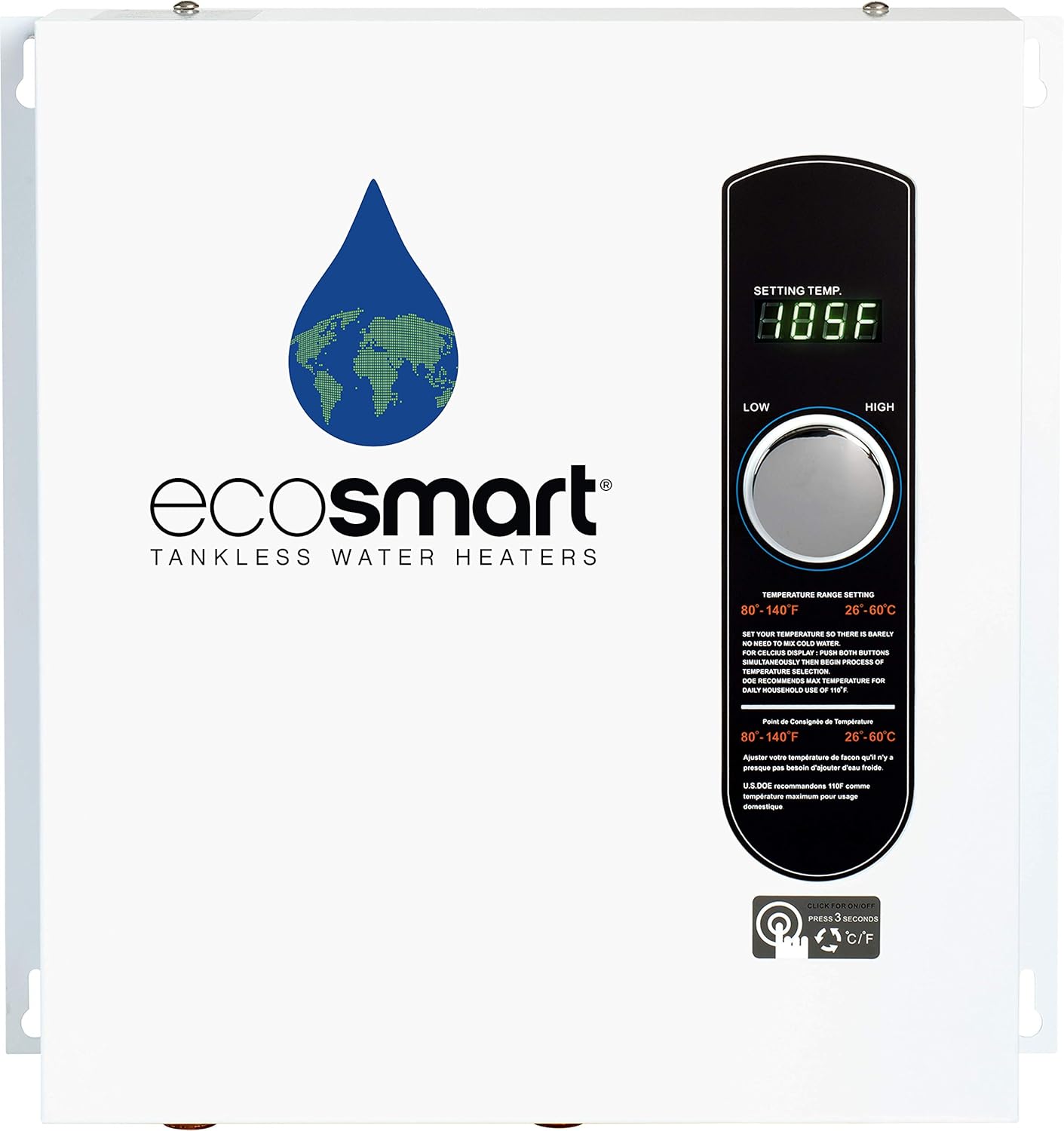
EcoSmart ECO 27 Electric Tankless Water Heater
Quick take: EcoSmart ECO 27 pairs 27 kW tankless heating with patented self-modulating technology for homeowners who need nearly 3 GPM capacity when inlet water runs as cold as 37°F. Digital 1-degree temperature control and a compact wall-mou...
- Patented self-modulating design aims to use only the energy needed for the current flow
- Nearly 3 GPM heating capacity at low inlet temperatures suits colder climate demand
- Requires three 40A double-pole breakers and three 8-gauge wires, so panel upgrades may be needed
Pros
- Patented self-modulating design aims to use only the energy needed for the current flow
- Nearly 3 GPM heating capacity at low inlet temperatures suits colder climate demand
- 1-degree digital temperature adjustments support fine-tuned household comfort
- Wall-mounted slim profile is about 90% smaller than many tank-style heaters
- ETL listing and NSF/ANSI 372 lead-free compliance support safer residential installation
Cons
- Requires three 40A double-pole breakers and three 8-gauge wires, so panel upgrades may be needed
- Flow output varies with inlet temperature, so very cold climates can limit simultaneous fixture use
- Professional electrical and plumbing verification is important before install for first-time DIY buyers
The EcoSmart ECO 27 is a 27 kW electric tankless water heater built for households that want continuous hot water without dedicating floor space to a storage tank. Based on the provided product details, it is configured for climates where incoming water can reach as low as 37°F and is positioned for northern U.S. and Canadian homes as well as southern homes with large Roman-style or Jacuzzi tubs and more demanding usage patterns.
According to the listed specifications, the unit heats water as it flows through the heater rather than storing a limited volume. That design supports endless hot water when the model is sized correctly, with capacity described as nearly 3 gallons per minute at colder inlet temperatures and a broader range of about 2.7 to 6.5 GPM depending on incoming water temperature. Patented self-modulating technology is intended to draw only the energy needed for the current demand, which can help reduce standby losses common with tank heaters.
The ECO 27 measures 17 x 17 x 3.5 inches and mounts on the wall, which the product information indicates is roughly 90% smaller than a traditional tank. Digital temperature control allows settings in 1-degree increments across the stated 80°F to 140°F range. Installation planning is critical: the heater runs on 240V single phase, draws up to 112.5 amps, and requires three 40A double-pole breakers with three 8-gauge wires plus 3/4-inch NPT water connections.
In practical home use, the ECO 27 fits buyers replacing an aging tank unit who need stronger simultaneous hot-water performance for showers, laundry, and large tub fills. Its compact footprint can reclaim utility-room floor space for storage, while point-of-use or whole-home placement can shorten wait times for hot water when the system is correctly matched to household demand.
Potential limitations center on electrical capacity and sizing. Homes without adequate breaker space or wire capacity may need panel work, and colder inlet temperatures reduce available GPM, so multi-fixture use still requires careful load planning. Overall, based on the available product data, the EcoSmart ECO 27 is a strong candidate for homeowners who need higher-capacity electric tankless performance, precise digital control, and a space-saving wall-mounted design, provided they verify electrical service and hot-water demand before purchase.
Buyers with lighter whole-home needs or limited electrical service may prefer a lower-kW EcoSmart model, while those with very high simultaneous demand should confirm the sizing guide against real fixture loads before choosing this 27 kW unit.
Best For / Avoid If
Best for buyers prioritizing
- Patented self-modulating design aims to use only the energy needed for the current flow
- Nearly 3 GPM heating capacity at low inlet temperatures suits colder climate demand
- 1-degree digital temperature adjustments support fine-tuned household comfort
Consider another option if
- Requires three 40A double-pole breakers and three 8-gauge wires, so panel upgrades may be needed
- Flow output varies with inlet temperature, so very cold climates can limit simultaneous fixture use
- Professional electrical and plumbing verification is important before install for first-time DIY buyers

ORBEK 18kW Electric Tankless Water Heater Review
Quick take: ORBEK's 18kW 240V tankless electric water heater supplies up to 4.17 GPM of continuous hot water for 2-3 fixtures at once. Homeowners needing compact, ETL-certified on-demand performance with stable temperature control will find t...
- Supports simultaneous hot water at two to three points of use based on the stated flow capacity
- Space-saving wall-mount footprint compared with conventional tank water heaters
- Needs two 240V/40A two-pole breakers and two sets of 8 AWG wire, so electrical upgrades may be required before install
Pros
- Supports simultaneous hot water at two to three points of use based on the stated flow capacity
- Space-saving wall-mount footprint compared with conventional tank water heaters
- Precise temperature stability for more comfortable showers and sinks
- Multiple safety systems and factory testing claims for safer everyday operation
- Clear digital controls simplify setting and monitoring preferred water temperature
Cons
- Needs two 240V/40A two-pole breakers and two sets of 8 AWG wire, so electrical upgrades may be required before install
- Capacity targets 2-3 fixtures, which may fall short for larger homes with frequent multi-bath simultaneous demand
- 3/4 inch NPT connections and dual-circuit wiring can make first-time DIY installation more involved than plug-and-play options
The ORBEK 18kW electric tankless water heater is positioned as a whole-house style on-demand unit for homes that need hot water at two to three fixtures without storing gallons of heated water. Based on the provided product details, it is aimed at homeowners and renovators who want a compact 240V solution and are prepared to meet the dual-breaker electrical requirements.
Listed performance centers on a maximum of 4.17 GPM, three-second heat-up, and continuous supply rather than limited tank recovery. The product information indicates water-electricity separation to help reduce scale and corrosion, along with potential electricity cost reductions of up to 60 percent compared with traditional tank-style heaters. A control chip that adjusts heating power 20,000 times per second is said to keep temperature stable within 1°F, which matters for comfortable showers when flow varies.
Design-wise, the unit measures about 17 inches high, 13 inches long, and 3.9 inches wide, claiming more than 50 percent space savings versus tank heaters and easier placement in tight corners. Structural improvements are noted to simplify installation, though buyers still need 3/4 inch NPT water connections plus two 240V/40A two-pole breakers and two runs of 8 AWG wire. An LED digital display with soft lighting covers 86°F to 140°F settings and shows real-time temperature changes for straightforward daily use.
In practical home scenarios, the feature set supports kitchens and bathrooms where two or three outlets may run together, such as a shower plus a sink or laundry fill. ETL certification and protections against leakage, over-temperature, dry heating, and lightning resistance address common safety concerns for electric tankless systems. Long-term return and exchange support plus technical consulting further reduce ownership friction for DIY-minded buyers who plan carefully.
Limitations follow from the electrical demand and flow rating. Homes without adequate dual 40A circuits will need panel and wiring work first, and households that regularly run more than a few fixtures at once may need a higher-capacity unit. Based on the listed specifications, this ORBEK model is a sensible choice for mid-size homes seeking compact, efficient on-demand hot water with stable controls, provided the electrical and plumbing prerequisites are confirmed before purchase.
Buyers who already have suitable 240V infrastructure and want space-saving endless hot water for a few simultaneous uses should consider it. Those with larger multi-bath demand or limited electrical capacity may prefer a higher-kW electric model or a different fuel type after reviewing local code and load calculations.
Best For / Avoid If
Best for buyers prioritizing
- Supports simultaneous hot water at two to three points of use based on the stated flow capacity
- Space-saving wall-mount footprint compared with conventional tank water heaters
- Precise temperature stability for more comfortable showers and sinks
Consider another option if
- Needs two 240V/40A two-pole breakers and two sets of 8 AWG wire, so electrical upgrades may be required before install
- Capacity targets 2-3 fixtures, which may fall short for larger homes with frequent multi-bath simultaneous demand
- 3/4 inch NPT connections and dual-circuit wiring can make first-time DIY installation more involved than plug-and-play options

Westinghouse 18kW Electric Tankless Water Heater
Quick take: Copper heating and self-modulating control help this Westinghouse 18kW electric tankless water heater supply up to 4.2 GPM for multiple fixtures without temperature drop. Busy households that want on-demand hot water with WiFi and...
- Endless on-demand hot water without a storage tank
- Smart connectivity for remote and voice temperature control
- Professional installation is recommended because of 240V service and high amperage draw
Pros
- Endless on-demand hot water without a storage tank
- Smart connectivity for remote and voice temperature control
- Precise self-modulating operation for consistent comfort
- Energy use that scales with real water demand
- Space-saving form factor with clear LED status readout
Cons
- Professional installation is recommended because of 240V service and high amperage draw
- Electrical panel capacity may need upgrades to support the required breakers and wiring
- Maximum flow suits moderate multi-fixture use rather than very large simultaneous demand
Homeowners replacing a bulky storage tank or planning a whole-house hot water upgrade will find this Westinghouse 18kW electric tankless water heater aimed at reliable on-demand performance. Based on the provided product details, the unit targets busy households that need hot water for roughly two to three fixtures at once, such as showers and faucets running together.
Performance centers on 18kW output at 240V with a listed flow range up to 4.2 GPM. Copper heating elements are described as delivering stronger thermal conductivity than standard stainless steel coils, which the product information links to faster heat-up and corrosion resistance. Self-modulating technology is said to keep outlet temperature steady within about 1°F while using only the power required, supporting the claim of meaningful energy savings over conventional tank heating.
The unit measures roughly 18.7 by 14.17 by 3.94 inches and weighs about 15.4 pounds, making wall mounting more practical than a traditional tank. A digital LED display shows status at a glance, while WiFi app control and Alexa or Google Assistant voice commands add everyday convenience. Water connections are 3/4 inch NPT. Amperage draw is listed at 75 A, so professional electrical work and correct breaker and wire sizing are important for safe installation.
In practical home settings, the combination of instant delivery, multi-fixture capacity, and smart controls suits morning routines, laundry and shower overlap, or small family schedules that previously ran out of tank capacity. The included scale inhibitor and multiple safety protections against overheating, dry-fire, and leakage further support long-term residential use according to the feature list.
Limitations are mainly electrical and capacity related. Homes without adequate 240V circuits or panel space will need upgrades before install. Very high simultaneous demand beyond the stated two to three fixtures may exceed the 4.2 GPM ceiling. For households that match the listed flow and want compact, efficient, app-connected hot water, the product data indicates a strong whole-house electric tankless option.
Buyers focused on moderate multi-fixture demand, energy efficiency, and smart home convenience should consider this model. Those needing higher continuous flow for larger homes or who prefer gas fuel may want to compare higher-kilowatt or alternative fuel units in the same category.
Specifications
| Power Source | Hard Wiring Required |
|---|---|
| Special Features | 12 Months Warranty, Copper heating elements, ETL Certified, Self-Modulating, Works with Google Assistant, Alexa, and Wi-Fi |
| Wattage | 18 KW |
| Voltage | 240 Volts (AC) |
| Flow Rate | 4.2 Gallons Per Minute |
| Maximum Temperature | 140 Degrees Fahrenheit |
| Heat Output | 18000 Watts |
| Maximum Pressure | 120 Pound per Square Inch |
| Mount Type | Wall |
| Is Electric | Yes |
Verify the current product variation before purchase; specifications may change.
Best For / Avoid If
Best for buyers prioritizing
- Endless on-demand hot water without a storage tank
- Smart connectivity for remote and voice temperature control
- Precise self-modulating operation for consistent comfort
Consider another option if
- Professional installation is recommended because of 240V service and high amperage draw
- Electrical panel capacity may need upgrades to support the required breakers and wiring
- Maximum flow suits moderate multi-fixture use rather than very large simultaneous demand

Rheem RTG-70DVLN-3 Tankless Natural Gas Water
Quick take: The Rheem RTG-70DVLN-3 brings high-efficiency indoor tankless natural gas water heating with up to 7.0 GPM and Hot Start Programming that helps avoid cold bursts during consecutive uses. Homeowners with roughly 2 to 3 bathrooms wh...
- On-demand tankless design supports continuous hot water without tank recovery delays
- Indoor wall-mount form factor helps reclaim storage space in utility areas
- Non-condensing design may deliver less efficiency than condensing tankless models for buyers focused on maximum savings
Pros
- On-demand tankless design supports continuous hot water without tank recovery delays
- Indoor wall-mount form factor helps reclaim storage space in utility areas
- Hot Start feature improves comfort for consecutive showers or appliance cycles
- Built-in leak monitoring and overheat protection support safer long-term operation
- High-efficiency positioning versus standard tank heaters can help lower energy and water waste
Cons
- Non-condensing design may deliver less efficiency than condensing tankless models for buyers focused on maximum savings
- Indoor gas installation typically needs a qualified installer plus proper venting and clearances
- 7.0 GPM capacity and roughly 2.5-bathroom support may fall short for larger homes with heavy simultaneous demand
The Rheem RTG-70DVLN-3 is a high-efficiency non-condensing indoor tankless natural gas water heater aimed at households that want continuous hot water without the bulk of a storage tank. Based on the provided product details, it is positioned for about 2 to 3 bathroom homes where showers, laundry, and dishwashing may overlap. Buyers replacing an aging tank or planning a space-conscious remodel are the clearest fit for this model.
Performance centers on a 7.0 GPM maximum flow rate and 160,000 BTU natural gas input. The product information indicates continuous hot water delivery with minimal wait, which is useful when multiple fixtures call for heat at once. Hot Start Programming keeps the heater ready so back-to-back uses are less likely to produce cold bursts. Efficiency claims include up to 25% less energy use and up to 34% greater efficiency than a 50-gallon tank, plus lower NOx emissions, while the Water Saving Setting can reduce wasted flow until set temperature is reached.
Design-wise, the unit uses a durable compact metal cabinet intended for indoor wall mounting with industry-leading side clearances as small as one-half inch. That combination helps it fit tighter mechanical spaces and free floor area previously occupied by a tank. Protective features listed for the RTG series include Overheat Film Wrap for the heat exchanger and LeakGuard leak detection and prevention, which add practical monitoring for homeowners concerned about maintenance risks.
In everyday home use, the listed strengths map well to busy mornings, laundry days, and shared bathrooms. Continuous output supports dishwashing, clothes washing, and bathing in sequence without waiting for a tank to recover. The space-saving wall bracket approach also benefits laundry closets, utility rooms, and smaller mechanical areas where floor storage is limited.
Potential limitations remain realistic for this category. As a non-condensing indoor gas unit, it may not match the top-tier efficiency of condensing alternatives, and professional installation with correct venting is typically required. Households that routinely run more simultaneous fixtures than a 7.0 GPM, 2.5-bathroom class unit can support may need a higher-capacity model.
Based on the available product data, the RTG-70DVLN-3 is a practical choice for homeowners seeking efficient continuous hot water, water-saving features, and a compact indoor footprint. Larger homes with higher peak demand or buyers prioritizing condensing efficiency may prefer a different RTG or RTGH configuration.
Specifications
| Power Source | Natural Gas |
|---|---|
| Special Features | Integrated Digital Display, Hot-start Programming, High Energy Efficiency, Universal Venting Compatibility, 1/2 Gas Line Compatibility |
| Wattage | 132 watts |
| Voltage | 120 Volts |
| Flow Rate | 7 Gallons Per Minute |
| Maximum Temperature | 140 Degrees Fahrenheit |
| Heat Output | 160000 British Thermal Units |
| Mount Type | Wall |
| Is Electric | No |
| Smart Home Compatibility | Not Smart Home Compatible |
Verify the current product variation before purchase; specifications may change.
Best For / Avoid If
Best for buyers prioritizing
- On-demand tankless design supports continuous hot water without tank recovery delays
- Indoor wall-mount form factor helps reclaim storage space in utility areas
- Hot Start feature improves comfort for consecutive showers or appliance cycles
Consider another option if
- Non-condensing design may deliver less efficiency than condensing tankless models for buyers focused on maximum savings
- Indoor gas installation typically needs a qualified installer plus proper venting and clearances
- 7.0 GPM capacity and roughly 2.5-bathroom support may fall short for larger homes with heavy simultaneous demand
Tankless Water Heater Buying Guide
Choosing tankless water heaters is less about the flashiest display and more about matching output to your home. After carefully analyzing the available specifications, we recommend focusing on fuel type, flow rate, temperature rise, electrical or gas requirements, installation location, and maintenance. The sections below walk through the criteria that matter most for homeowners and DIYers in 2026.
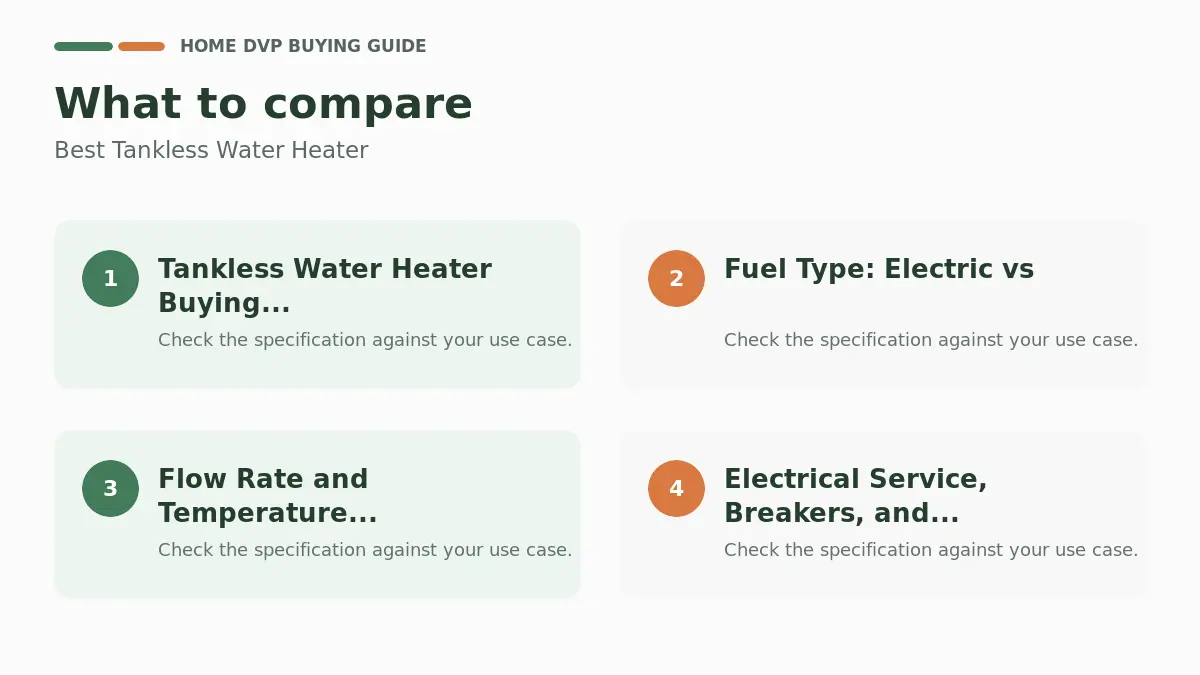
Fuel Type: Electric vs Gas Tankless Water Heaters
Electric tankless water heaters are popular because they do not need venting and can work well for point-of-use or moderate whole-house demand when your electrical panel can support them. Models such as the EcoSmart ECO 11, Rheem RTEX series, CAMPLUX 6kW unit, WINTEMP 27kW, Westinghouse 18kW, and Titan electric heaters heat water only when you open a tap, which can reduce standby energy waste compared with storage tanks.
Gas tankless units, including the Rinnai RX199iN, Rheem RTG-70DVLN-3, and MIZUDO 199,000 BTU models, usually deliver higher flow rates and better performance in colder climates where groundwater is low. They do require proper venting, gas line sizing, and professional installation in most cases. A common mistake is assuming any gas unit will work outdoors or with either fuel; always verify natural gas versus propane compatibility and indoor versus outdoor ratings before you buy.
If your home already has a strong 200-amp electrical service and you want simpler venting, electric may be the cleaner path. If you need high simultaneous fixture use or live in a cold region, gas often provides more practical capacity. For related comfort upgrades that pair well with water heating projects, many homeowners also research heating and cooling solutions at the same time.
Flow Rate and Temperature Rise
Flow rate, measured in gallons per minute (GPM), is the single most important performance number on a tankless water heater. Point-of-use units like the CAMPLUX 6kW are designed for a single sink or small fixture. Mid-size electric models such as EcoSmart ECO 11 and Rheem RTEX-13 often support bathroom or limited multi-fixture use depending on climate. Higher-output electric options like Rheem RTEX-24, Westinghouse 18kW, and WINTEMP 27kW aim at broader household demand, while high-BTU gas models such as Rinnai and MIZUDO can support multiple showers, laundry, and kitchen use at once.
Temperature rise is just as critical. A unit that delivers 5 GPM in a warm climate may only support a fraction of that flow when incoming water is near freezing. Our research indicates homeowners should map expected simultaneous fixtures, then compare GPM charts against local groundwater temperatures. Oversizing wastes money on installation and capacity you never use; undersizing creates lukewarm showers when two people bathe at once.
| Home scenario | Typical simultaneous demand | What to prioritize |
|---|---|---|
| Apartment or powder room | 1 fixture | Point-of-use electric, compact size |
| 1–2 bathroom home | 2–3 fixtures | Mid to high kW electric or moderate gas GPM |
| Large family home | 4–7 fixtures | High GPM gas or high-output electric with strong electrical service |
| Cold climate | Higher temperature rise needed | Higher BTU gas or carefully sized high-kW electric |
Electrical Service, Breakers, and Installation Reality
Electric tankless units can demand significant amperage. Specs for models in this category often call for 25A on small point-of-use heaters, around 54A on 13kW units, 75A on 18kW units, and 100A or more on 24kW and 27kW whole-house models. Several higher-output units recommend 200-amp household service and multiple double-pole breakers. Ignoring this is one of the most expensive mistakes homeowners make.
Before purchasing, have an electrician confirm panel capacity, available breaker spaces, wire gauge, and dedicated circuit requirements. Gas models still need electrical power for controls and fans, plus correctly sized gas supply and venting. Professional installation is commonly recommended for whole-house systems, and it is usually the safer path for warranty compliance and code requirements.
DIY-friendly installs are more realistic for compact under-sink electric heaters when wiring and plumbing access are straightforward. Even then, hardwiring and breaker work should meet local code. If your project also includes fixture replacement, plan sequencing carefully so shutoffs, connections, and finishes align with other bathroom fixture upgrades.
Efficiency, Self-Modulation, and Operating Cost
Tankless heaters score well on efficiency because they heat water on demand instead of storing it. Many electric models in this comparison advertise very high thermal efficiency and self-modulating power control that adjusts output to flow and setpoint. That helps hold temperature closer to your selected degree setting and reduces wasted energy when only one faucet is open.
On the gas side, condensing models such as the Rinnai RX199iN with a high UEF rating extract more heat from combustion gases and can lower fuel use over time. Non-condensing units may cost less up front but often need different venting materials and can be less efficient. Based on the feature set of the products reviewed, look for modulation stages, digital temperature control within about 1 degree, and clear energy factor data rather than vague “energy saving” claims alone.
Remember that real operating cost also depends on water use habits, electricity or gas rates, and scale management. A high-efficiency unit in hard-water areas still needs descaling or a scale inhibitor strategy to stay efficient. Homeowners who already manage indoor air and humidity carefully often appreciate how sealed combustion gas units draw outdoor air instead of depleting indoor air quality.
Smart Controls, Displays, and Daily Usability
Digital LED or touch displays make temperature adjustments easier and help diagnose flow or inlet conditions. Several models now add WiFi or app control so you can change setpoints, monitor status, or receive alerts remotely. Units such as the Westinghouse 18kW, WINTEMP 27kW, and MIZUDO gas heater highlight app or smart-home friendly control, while many Rheem and EcoSmart options emphasize precise digital thermostatic control at the unit.
Smart features are convenient, but they should not outrank capacity and installation fit. Voice control and remote scheduling are nice extras for tech-forward homes, yet a stable temperature and adequate GPM matter more every morning. If you value simple reliability, a clear digital display and durable controls may be enough without depending on an app.
Build Quality, Safety Features, and Maintenance
Materials matter for longevity. Copper heating elements or heat exchangers appear frequently in electric and gas designs because of thermal conductivity and serviceability. Stainless combustion chambers, sealed direct-vent systems, freeze protection, overheat protection, dry-fire protection, and leak safeguards all improve peace of mind. ETL or CSA approvals are useful signals that a unit has been evaluated against safety standards.
Maintenance is often overlooked. Tankless systems still need periodic flushing, especially in hard-water regions. Some gas models advertise quick-flush features, while electric units may include scale inhibitors or serviceable elements. Plan isolation valves and service access during installation so future descaling is not a plumbing nightmare. Warranties also vary widely, from shorter unit coverage on some models to longer heat-exchanger protection on premium gas units when registration requirements are met.
Space Planning and Point-of-Use vs Whole House
One of the biggest advantages of tankless designs is size. Compact wall-mounted electric units free floor space compared with traditional tanks and can sit near the fixture they serve. That is ideal for apartments, ADUs, office break rooms, or remote bathrooms where a long pipe run causes long wait times. Whole-house units still save space but need careful placement for electrical, gas, water, and venting connections.
If hot water delay is your main complaint at one sink, a small under-sink heater may solve the problem more affordably than replacing the entire home system. If laundry, kitchen, and multiple showers compete daily, a whole-house solution is usually better. During renovations, coordinate heater location with cabinetry, access panels, and other plumbing equipment so future service remains easy.
Budget and Total Installed Cost
Current options in this comparison cover several budget levels, from compact electric point-of-use units through premium high-capacity gas systems. Lower-priced models can deliver excellent value for limited demand, while mid-range electric whole-house heaters balance features and capacity. Premium gas units cost more up front but may justify the investment for large households, cold climates, or flexible indoor/outdoor installation needs.
Value is not only the sticker price. Factor in electrical upgrades, venting, permits, professional labor, and expected energy savings. A less expensive heater that requires major panel work can cost more overall than a better-matched unit. Based on our detailed comparison, prioritize correct sizing first, then choose the feature set that fits how your household actually uses hot water.
Choose by Capacity and Installation, Not GPM Alone
A tankless water heater must deliver enough hot water at your home’s actual temperature rise. Subtract the incoming-water temperature from the desired outlet temperature, then compare the manufacturer’s flow chart at that rise. A unit advertised at a high maximum GPM may deliver substantially less in a cold climate.
| Decision | What to verify before buying |
|---|---|
| Electric or gas | Available electrical service and breaker space, or gas-line size, venting, combustion air, and condensate requirements. |
| Required flow | Fixtures that may run together and the unit’s rated GPM at your calculated temperature rise. |
| Installation cost | Permits, panel or gas-line upgrades, venting, isolation valves, drain routing, and professional labor. |
| Long-term upkeep | Scale-control needs, flushing access, warranty conditions, and local service availability. |
Who this guide helps
Tankless systems make the most sense for homes that value continuous hot water, have suitable utilities, and can absorb a higher installation cost. A conventional tank can be the simpler choice when utility upgrades are extensive, peak demand is unusually high, or fast, inexpensive replacement matters most.
Research note and sources
Model specifications and availability can change. Confirm the current installation manual, warranty, flow-rate chart, fuel requirements, and local code requirements before ordering. For background, review the U.S. Department of Energy’s tankless water-heater guidance and verify certified performance in the AHRI Directory when a model is listed.
Tankless Water Heater Sizing Worksheet
Quick answer: add the flow rates of fixtures that may run together, then subtract winter inlet-water temperature from the desired outlet temperature. Select a heater that can supply the combined GPM at that temperature rise on the manufacturer’s performance chart.
- List only the fixtures likely to run at the same time.
- Add their flow rates to find peak simultaneous demand.
- Calculate temperature rise: target outlet temperature minus coldest expected inlet temperature.
- Check the model’s flow chart at that rise, then verify electrical, gas, venting, condensate, and service-access requirements.
Worked example: a 2.0 GPM shower and 1.0 GPM kitchen faucet need about 3.0 GPM together. If inlet water is 50°F and the target is 120°F, the heater must deliver at least 3.0 GPM at a 70°F rise. A headline “maximum GPM” measured at a smaller rise is not enough evidence.
| System type | Best fit | Infrastructure check | Main limitation |
|---|---|---|---|
| Point-of-use electric | One remote sink or light fixture demand | Dedicated circuit, wire size, and mounting clearance | Limited simultaneous flow |
| Whole-home electric | Moderate demand where venting is undesirable | Panel capacity, breaker spaces, amperage, and service size | Output drops as temperature rise increases |
| Gas non-condensing | Higher household flow with lower initial equipment cost | Gas line, combustion air, approved venting, and clearances | Lower efficiency and hotter exhaust than condensing designs |
| Gas condensing | High flow and efficiency for a whole home | Gas line, venting, condensate drain, freeze protection, and service access | Higher installed complexity and upfront cost |
The U.S. Department of Energy also recommends sizing demand-type heaters from required flow and temperature rise. ENERGY STAR certification can help compare qualifying gas models, but certification does not replace a model-specific sizing and installation review.
How We Evaluated Tankless Water Heaters
Home DVP evaluates tankless water heaters using a transparent, specification-first process designed for practical home buyers. We review manufacturer data for capacity, voltage or BTU rating, flow performance, efficiency claims, control features, safety protections, dimensions, and installation requirements. We then compare those specs against common homeowner scenarios such as single-bath rentals, growing families, renovation projects, and cold-climate temperature rise needs.
We also review available user-facing feedback patterns and category research to understand recurring strengths and limitations, including electrical demands, temperature stability, app convenience, and maintenance expectations. We do not invent lab results or claim hands-on installation testing when that is not part of the provided product data. Instead, we focus on what the listed specifications, certifications, and feature sets actually support.
Our ranking priorities include performance fit, features, build and safety indicators, ease of use, durability signals, reliability expectations, value, and suitability for DIY versus professional installation. We refresh category guidance during July 2026 so recommendations stay aligned with current product listings and homeowner needs. Brands represented across this roundup include EcoSmart, Rheem, Rinnai, CAMPLUX, WINTEMP, Westinghouse, MIZUDO, and Titan, along with other recognized names in the plumbing equipment space.
Final Thoughts
If you need a premium whole-home gas solution with high flow and flexible installation options, the NEW Rinnai RX199iN stands out as a strong Premium Pick based on its up to 11.1 GPM capacity, condensing efficiency, dual-fuel Smart Sense design, and indoor or outdoor versatility. For large-family gas demand with app monitoring, the MIZUDO 199,000 BTU indoor unit is a compelling high-capacity alternative with WiFi control and extensive safety protections.
For many electric-focused households, the Westinghouse 18kW whole-house model is a balanced Homeowner Pick thanks to copper heating, self-modulation, WiFi control, and multi-fixture support when electrical service allows. The Rheem RTEX-24 is another capable whole-house electric option for continuous demand, while the EcoSmart ECO 11 and Rheem RTEX-13 remain practical Value and point-of-use oriented choices for bathrooms or lower simultaneous loads. The CAMPLUX 6kW unit is an easy Small Space Pick for under-sink applications, and the Titan electric model remains a straightforward budget-minded option when specs match your circuit capacity.
Match the heater to your fixtures, climate, and utility infrastructure before you fall in love with any single feature. Correct sizing and professional installation planning will do more for comfort than any display screen. As you complete the project, consider complementary upgrades like a refreshed toilet or improved bathroom layout so the entire wet area works better together.
FAQ
What should I look for when choosing tankless water heaters?
Start with fuel type, GPM capacity, temperature rise for your climate, and whether your electrical panel or gas line can support the unit. Then compare efficiency features, safety protections, installation requirements, and warranty terms. Correct sizing for simultaneous fixtures is more important than brand hype alone.
Are higher-end tankless water heaters worth it?
They can be worth it when you need higher flow, condensing efficiency, flexible indoor or outdoor installation, longer warranty coverage, or advanced controls. For a single sink or light-duty bathroom, a compact mid-range electric unit often delivers better value. Pay for capacity and installation fit first, then add premium features if they solve a real need.
About This Home DVP Research
Home DVP is an independent home-improvement research and product-comparison publisher. Ryan Mitchell prepared this guide by comparing manufacturer specifications, compatibility details, retailer-provided product data, key limitations, and common homeowner use cases. We do not claim hands-on testing unless an article explicitly says so.
Review methodology Affiliate disclosure Last reviewed August 26, 2026