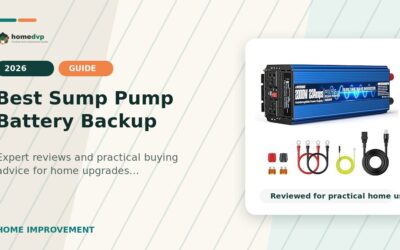

A basement flood alarm is one of those small plumbing safety upgrades that can prevent a much larger repair bill. Whether your basement has a sump pump, water heater, laundry hookups, floor drain, or older foundation walls, early water detection gives homeowners and renters time to respond before moisture turns into damaged flooring, ruined storage, mold concerns, or electrical hazards.
For this Best Basement Flood Alarm guide, we analyzed 15 products using available specifications, feature sets, alert methods, sensor layouts, waterproof ratings, power requirements, setup demands, and practical basement use cases. We also considered how each option fits common home maintenance scenarios, from monitoring a sump pit to placing sensors near a water heater. If you are comparing broader leak detection options, our related guide to water leak detectors for home protection is a helpful next read.
After carefully analyzing the available specifications, the strongest choices were the models that combine reliable moisture sensing with clear alerts, simple placement, and enough durability for damp utility spaces. This guide focuses only on products that clearly match basement flood alarm and plumbing protection needs.

Pros
- Simultaneous top drip and bottom floor sensing on each unit
- Four volume steps including mute for flexible alert control
- Compact, cordless form factor for flexible placement
- Long listed standby life with low-battery light and tone
- Five detectors in one package for multi-room coverage
Cons
- Local audible alerts only, without listed app or remote notifications
- Batteries still need eventual replacement despite long standby claims
- May not suit users seeking fully integrated smart-home water monitoring
Based on the available product data, the METAK 5 pack water leak detectors are compact, battery-powered alarms meant to catch early drips and floor moisture before they become costly water damage. They suit homeowners, renters, and practical DIYers who want simple coverage in basements, kitchens, bathrooms, laundry rooms, and similar high-risk spots without complex wiring.
The listed feature set pairs two front water-sensitive probes for pipe or drain drips with four rear probes for floor flooding or moisture, and both systems work at the same time. When any probe contacts water, a 100 dB alarm can sound, with four volume levels including mute so the alert can be heard across larger areas yet silenced once you arrive to assess the leak.
Each unit measures about 82 mm by 50 mm by 27 mm and runs on two AAA batteries installed from a front compartment designed to keep power components drier. Product details describe an IP66 waterproof build in ABS and stainless steel to help maintain probe sensitivity without rust, while the top Test button covers power on and off, volume changes, testing, and temporary alarm pause for straightforward setup and use.
Real-world placement options include under sinks and faucets, near toilets, beside washing machines, around equipment that might leak, or on floors where roof seepage or burst pipes could start. The five-pack format supports monitoring several zones at once, and the low-battery red flash with tone is intended to reduce the chance of a silent unit after long standby periods described as more than two years.
Limitations follow from the product type: these are local audible detectors, not listed smart hubs with phone alerts, so they work best when someone is home to hear them. Users who need contractor-grade networked monitoring or continuous remote oversight may prefer a connected system. For straightforward multi-room drip and flood awareness based on the provided specifications, this METAK pack remains a practical, easy-to-place option for everyday home protection.
Best For / Avoid If
Best for buyers prioritizing
- Simultaneous top drip and bottom floor sensing on each unit
- Four volume steps including mute for flexible alert control
- Compact, cordless form factor for flexible placement
Consider another option if
- Local audible alerts only, without listed app or remote notifications
- Batteries still need eventual replacement despite long standby claims
- May not suit users seeking fully integrated smart-home water monitoring

Pros
- Multi-channel notifications help you respond quickly when away from home
- Long wireless range suits multi-level homes and outbuildings
- Six probes per sensor improve sensitivity to standing water and drips
- IP66 rating supports placement in wet or humid utility spaces
- Local sound alarm up to 100 dB adds an on-site warning layer
Cons
- Gateway works only with 2.4 GHz Wi-Fi networks
- Full remote alerts depend on proper gateway setup and stable internet
- First-time users may need extra time to place sensors and complete app pairing
GoveeLife’s Premium Smart Water Leak Detector 2 is a gateway-based monitoring kit aimed at homeowners who want early warning against water damage in kitchens, basements, laundry rooms, and utility spaces. Based on the listed product details, the pack includes one LoRa gateway and six sensors, which suits buyers who need multi-room coverage rather than a single point detector.
Performance centers on fast multi-channel alerts and sensitive detection. When the gateway is connected to Wi-Fi, the system can send SMS, app, and email notifications if water is found, helping users act even when they are not home. Each sensor uses two top probes and four bottom probes to pick up leaks and drips, and a local alarm can sound up to 100 dB. LoRa technology is listed with a receiving range of 1968 feet, which the product information indicates can keep distant areas such as basements and sheds in contact with the gateway.
From a design and setup standpoint, the sensors carry an IP66 waterproof rating for long-term use in damp locations, including near toilets, water heaters, dishwashers, sinks, fish tanks, and sump pumps. Battery life is listed at over five years under normal usage, which reduces routine maintenance. Setup relies on connecting the gateway to 2.4 GHz Wi-Fi and managing devices through the GoveeHome app, with Alexa voice assistant support for locating alerts without constantly checking a phone.
In practical home use, the kit is well matched to whole-home leak watch lists: under kitchen sinks, behind laundry machines, around water heaters, and on basement floors. The ability to add sensors to a LoRa gateway, with support noted for a large number of devices, helps households expand coverage over time instead of buying isolated one-off alarms.
Potential limitations include the gateway’s 2.4 GHz Wi-Fi requirement and the need for a stable network if remote SMS, email, and app alerts are essential. Users without compatible Wi-Fi or those who prefer completely offline standalone alarms may want a simpler local-only option. For homeowners seeking connected, long-range, multi-sensor leak protection with durable wet-area placement, the listed feature set makes this GoveeLife kit a strong contender.
Buyers protecting larger homes or multi-level layouts will likely get the most value from the six-sensor pack and long-range gateway. Renters or shoppers who only need one or two spots monitored may prefer a smaller sensor bundle without gateway features.
Specifications
| Power Source | Battery Powered |
|---|---|
| Compatible Devices | Alexa, Google Assistant, IFTTT |
| Battery Description | AAA |
| Number of Batteries | 12 AAA batteries required. (included) |
| Control Method | App |
| Audible Noise | 100 Decibels |
| Mounting Type | Floor Mount |
| Maximum Range | 1968 Feet |
| Sensor Technology | LoRa |
| Smart Home Compatibility | Smart Home Compatible |
Verify the current product variation before purchase; specifications may change.
Best For / Avoid If
Best for buyers prioritizing
- Multi-channel notifications help you respond quickly when away from home
- Long wireless range suits multi-level homes and outbuildings
- Six probes per sensor improve sensitivity to standing water and drips
Consider another option if
- Gateway works only with 2.4 GHz Wi-Fi networks
- Full remote alerts depend on proper gateway setup and stable internet
- First-time users may need extra time to place sensors and complete app pairing
Best Basement Flood Alarm Buying Guide
Choosing the best basement flood alarm is not just about buying the loudest alarm. A good basement flood alarm should match your basement layout, your risk points, your comfort with smart home technology, and your maintenance habits. Below are the most important buying factors to compare before choosing a model.
Sensor Sensitivity and Probe Design
The most important job of any basement flood alarm is detecting water early. Models such as The Basement Watchdog 110 dB Water Alarm w/Detachable Sensor for Hard-to-Reach Areas are designed to detect a very small amount of water, which is useful near a sump pit, water heater pan, or basement floor drain. Other options, including the METAK Water Leak Detector Sensor Alarm and X-Sense Wi-Fi Water Leak Detector, use multiple probes to detect both floor moisture and dripping water.
For basements, bottom-facing probes are useful for water spreading across concrete, tile, or vinyl flooring. Top or front-facing drip probes are better for slow leaks from pipes, valves, washing machine hoses, and sink drains. A common mistake is placing a sensor several feet away from the most likely leak source, which can delay the alert until water has already traveled across the room.
If your basement has multiple risk points, a multi-pack such as the RUIKORING 5 Pack Water Leak Alarm Detector, METAK 5 Pack Water Leak Detectors for Home, GoveeLife Premium Smart Water Leak Detector 2, or Govee WiFi Water Leak Detector 3 Packs may provide more complete coverage than a single alarm. For a single sump pump or water heater, one well-placed sensor may be enough.
| Sensor Feature | Why It Matters in a Basement |
|---|---|
| Bottom probes | Detect water spreading across the floor near a sump pump, drain, or appliance. |
| Top or front drip probes | Help catch slow drips from plumbing connections before pooling occurs. |
| Remote or detachable sensor | Useful for sump pits, tight corners, and hard-to-reach utility areas. |
| Multiple sensors | Better for finished basements, laundry rooms, and mechanical rooms with several leak sources. |
Alarm Volume and Local Alerts
Basement alarms need enough volume to be heard from upstairs or from another room. The Basement Watchdog model is built around a very loud local alarm, while the X-Sense system uses both detector and base station alerts. RUIKORING offers adjustable volume up to a very loud setting, which can be helpful if you want a stronger alert in a larger home or a quieter setting for a small apartment.
Local alarms are especially important if your Wi-Fi goes down or if the sensor is used in an unfinished basement where smart setup is not practical. However, a local-only alarm may not help if you are at work, traveling, or away from a vacation property. In that case, a smart water alarm with app notifications can offer better peace of mind.
Look for mute or silence options, too. METAK, X-Sense, GoveeLife, and Govee models include ways to silence the alarm after you locate the leak. This matters because once you are standing in the basement addressing the issue, you do not want to fight a continuous alarm while shutting off a valve or moving stored items.
Smart Alerts, Wi-Fi, and App Control
Smart basement flood alarms are best for homeowners who want alerts when they are not home. The X-Sense Wi-Fi Water Leak Detector, GoveeLife Premium Smart Water Leak Detector 2, GoveeLife Upgraded Smart Water Leak Detector 1s, Govee WiFi Water Leak Detector 3 Packs, and YoLink Water Leak Detector 4 all focus on remote notifications, though their exact requirements differ. Some require a base station, gateway, or hub, so compatibility should be checked before purchase.
Most smart models in this category rely on compatible home networks, and some specify support for only one Wi-Fi band. That is not unusual for smart home sensors, but it can surprise buyers during setup. Before choosing a smart alarm, confirm that your basement has a strong enough signal or that the included gateway can maintain communication from the main floor.
Smart alerts are most useful for finished basements, second homes, rental properties, and homes with older plumbing. If your basement also has a tank-style or tankless water heater, you may want to review our guide to water heaters or compare tankless water heater options as part of a broader leak-prevention plan.
Wireless Range and Basement Signal Strength
Basements can be challenging for wireless devices because concrete walls, utility equipment, metal ductwork, and distance from the router can reduce signal strength. GoveeLife Premium Smart Water Leak Detector 2, GoveeLife Upgraded Smart Water Leak Detector 1s, X-Sense Wi-Fi Water Leak Detector, and YoLink Water Leak Detector 4 are designed around extended wireless communication, which can help in larger homes or detached spaces.
For a small basement directly below the router, a basic Wi-Fi system may be sufficient. For deep basements, older homes, garages, utility rooms, or outbuildings, long-range communication becomes more important. If your home already has weak Wi-Fi in the basement, a local-only alarm like The Basement Watchdog or METAK standalone models may be more dependable than a smart unit that cannot maintain connection.
One practical approach is to combine both types: use a local alarm near the highest-risk area and smart sensors where remote notification matters most. This layered setup is common in homes with sump pumps, laundry machines, and stored seasonal items in the basement.
Waterproof Rating and Basement Durability
Basements are often damp even when they are not flooding, so durability matters. Several models in this guide, including METAK, X-Sense, RUIKORING, GoveeLife, and Govee options, list waterproof or water-resistant housing ratings intended for humid environments. This helps protect the electronics from splashes, condensation, and periodic moisture exposure.
Waterproof housing is not the same as unlimited submersion protection. A flood alarm should be placed so it can detect water early, not left where it will be buried under standing water for long periods. For sump pits, a detachable or extendable sensor like The Basement Watchdog design can be useful because the sensing element can be positioned where water first appears while the alarm body remains more accessible.
Maintenance is simple but important. Wipe sensor probes periodically, especially in dusty utility rooms or highly humid areas. Mineral deposits, dust, and spiderwebs can interfere with contact points or contribute to false alerts in some environments.
Battery Life, Low-Battery Alerts, and Power Planning
Most basement flood alarms are battery powered so they can keep working even if a storm or electrical issue affects household power. This is especially helpful in basements where power outages and sump pump problems can happen together. Look for low-battery alerts so the alarm does not silently stop protecting your home.
METAK, RUIKORING, X-Sense, GoveeLife, and similar models emphasize long standby operation and low-battery reminders. The exact battery type and replacement process vary by model, so buyers should confirm whether batteries are included and how accessible the compartment is after placement.
A good homeowner habit is to check basement flood alarms during seasonal maintenance. Test them when you inspect sump pumps, change HVAC filters, clean dryer vents, or check plumbing shutoff valves. If you are already building a home maintenance checklist, the Plumbing Equipment category can help you compare related repair and prevention products.
Placement for Sump Pumps, Water Heaters, and Laundry Areas
The right placement depends on where water is most likely to appear first. Near a sump pump, place the sensor where overflow or pump failure would create early pooling. Near a water heater, place the sensor in or beside the drain pan if the design allows safe placement. Near a washing machine, place one sensor near the supply hoses and another near the floor where water would run.
Finished basements need more thoughtful placement than unfinished utility rooms. Water can travel under carpet, behind baseboards, or along low spots in flooring before it is visible. Multi-sensor kits are helpful because one alarm in the wrong corner may not catch a leak quickly enough.
For homes with slow drains or frequent backups, a flood alarm is not a replacement for drain maintenance. If basement floor drains are part of your water-risk profile, our guide to drain snakes for home plumbing may help you plan preventive maintenance alongside leak detection.
Standalone vs Multi-Sensor Systems
Standalone alarms are simple, affordable, and easy to place. The Basement Watchdog 110 dB Water Alarm and METAK Water Leak Detector Sensor Alarm are good examples of straightforward options for homeowners who want immediate local alerts without app setup. They are especially appealing for renters or DIY beginners who do not want to configure a gateway.
Multi-sensor systems are better for whole-basement coverage. X-Sense, GoveeLife, Govee, RUIKORING, and METAK multi-pack options can cover several leak-prone locations at once. Smart systems add remote notifications, while non-smart multi-packs focus on local coverage and simplicity.
The best choice depends on your risk level. A single unfinished utility corner may only need one local alarm. A finished basement with a bathroom, laundry area, sump pump, water heater, and storage room benefits from multiple sensors spread across the space.
| Basement Situation | Best Alarm Style |
|---|---|
| Single sump pump or water heater | Standalone alarm or detachable-sensor alarm |
| Finished basement with several rooms | Multi-sensor kit |
| Vacation home or rental property | Smart alarm with app notifications |
| Weak basement Wi-Fi | Local alarm or long-range hub-based system |
| Budget-focused prevention | Simple battery-powered water alarm |
Our Research Methodology and Why You Can Trust Us
Based on our detailed comparison, we evaluated each basement flood alarm using the product data provided, manufacturer-facing specifications, listed features, compatibility notes, and practical homeowner use cases. We did not claim hands-on testing or installation because the available information does not verify physical testing. Instead, this guide is based on specification analysis and category-fit validation.
Our research focused on performance, alert volume, sensor sensitivity, smart notifications, wireless range, build quality, waterproof ratings, ease of placement, battery planning, and long-term reliability. We also considered whether each model makes sense for common basement plumbing risks, including sump pump failure, water heater leaks, laundry hose problems, drain backups, and minor pipe drips.
Category fit was a key part of the process. Only products that clearly function as water leak detectors, flood alarms, or smart water sensors were considered relevant to Best Basement Flood Alarm and Plumbing Equipment. Products with insufficient relevance would be excluded rather than forced into recommendations.
This guide is structured for practical buyers, not spec-sheet collectors. During July, we review available product information for changes in features, availability, and suitability so homeowners can make a more informed decision in 2026.
Final Thoughts
For a simple, dependable local alarm, The Basement Watchdog 110 dB Water Alarm w/Detachable Sensor for Hard-to-Reach Areas is a strong overall pick because its detachable sensor is useful for sump pits, tight utility corners, and other hard-to-reach basement locations. It is best suited for homeowners who want a loud, straightforward alert without app setup.
For smart monitoring, the X-Sense Wi-Fi Water Leak Detector is a strong homeowner pick because it combines multiple detectors, a base station, app notifications, a loud local alert, and high-sensitivity sensing. GoveeLife Premium Smart Water Leak Detector 2 is a better fit for larger homes or buyers who want expanded sensor coverage and long-range communication, while GoveeLife Upgraded Smart Water Leak Detector 1s is a practical choice for buyers who want smart alerts in a smaller multi-sensor package.
For value-focused coverage, METAK Water Leak Detector Sensor Alarm and METAK 5 Pack Water Leak Detectors for Home are good options for simple placement around basement floors, pipes, sinks, and laundry areas. RUIKORING 5 Pack Water Leak Alarm Detector stands out for adjustable volume and multi-location coverage, while YoLink Water Leak Detector 4 and Zircon Leak Alert Water Leak Detector & Flood Sensor Alarm are also relevant options for buyers comparing smart or battery-powered flood monitoring. For a broader home safety plan, consider pairing alarms with routine plumbing checks and related tools from our Emergency Supplies section.
FAQ
What should I look for when choosing the best basement flood alarm?
Look for reliable water sensing, a loud local alarm, easy placement, battery monitoring, and the right alert style for your home. If you travel often or manage a rental property, smart notifications may be worth prioritizing. If you only need sump pump or water heater monitoring, a simple standalone alarm may be enough.
Are smart basement flood alarms better than basic alarms?
Smart alarms are better when you need remote alerts through an app, email, or compatible system. Basic alarms are often easier to set up and may be more dependable in basements with weak Wi-Fi. Many homeowners use both styles for layered protection.
Where should basement flood alarms be placed?
Place alarms where water is likely to appear first, not where it is easiest to hide the device. Common locations include beside a sump pit, near a water heater pan, under laundry hookups, near basement bathroom plumbing, and close to floor drains. Avoid placing sensors on uneven surfaces where water may not reach the probes quickly.
Are the best basement flood alarm suitable for renters?
Yes, many basement flood alarms are suitable for renters because they can be placed on the floor without permanent installation. Battery-powered standalone models are especially renter-friendly. If you choose a smart model, make sure you can connect it to the available Wi-Fi network and remove it easily when you move.