
Choosing best generator for home backup is less about finding the biggest wattage number and more about matching the power source to your home, fuel access, essential appliances, outage length, and installation plans. A renter who needs to keep a refrigerator, phones, lights, and a modem running has different requirements from a homeowner who wants to support a well pump, sump pump, furnace blower, or selected circuits through a transfer switch.
For this guide, We compared the listed models from DuroMax, Westinghouse, ZeroKor, Oxseryn using their documented output, battery capacity or fuel system, charging options, outlet configuration, portability, safety features, and stated homeowner use cases. The comparison includes gasoline, dual-fuel, tri-fuel, and battery power stations because each approach solves a different backup problem. For related emergency planning, see our guide to plug-in carbon monoxide detectors before operating any fuel-burning generator.
Our opening recommendation is conditional: the Jackery HomePower 3600 Plus Portable Power is the most versatile battery-based option in this group for quiet essential-load backup, while the Westinghouse 12500 Watt Dual Fuel Home Backup and Westinghouse 14500 Peak Watt Tri-Fuel Home Backup are better aligned with high-output, longer-duration household backup. Smaller power stations and mid-size generators may be the more sensible choice when portability, storage, or a limited appliance list matters more than whole-home capacity.

Pros
- High continuous output and dual-voltage parallel capability handle demanding home loads effectively
- Expandable architecture allows capacity growth without replacing the core unit
Cons
- Solar panels remain optional, so full off-grid recharging may require separate accessories
- Larger expanded configurations can occupy more floor space than compact single-unit needs
Best For / Avoid If
Best for buyers prioritizing
- High continuous output and dual-voltage parallel capability handle demanding home loads effectively
- Expandable architecture allows capacity growth without replacing the core unit
- Four distinct charging methods improve recovery speed and energy source flexibility
Consider another option if
- Solar panels remain optional, so full off-grid recharging may require separate accessories
- Larger expanded configurations can occupy more floor space than compact single-unit needs
- Users seeking only low-wattage travel power may find the capacity larger than necessary

Pros
- Useful combination of peak and running wattage for RV camping and emergency home backup.
- Multiple outlet formats improve flexibility for common AC, DC, and RV connections.
Cons
- The 14-hour runtime applies to a 25% load, so heavier power demands will reduce operating time.
- An open-frame gasoline generator may not suit buyers who prioritize the smallest footprint or a fully enclosed design.
Specifications
| Color | Orange |
|---|---|
| Dimensions | 19 x 15.6 x 19.1 inches |
| Weight | 56 pounds |
| Product Group | Lawn & Patio |
| Binding | Tools & Home Improvement |
Verify the current product variation before purchase; specifications may change.
Best For / Avoid If
Best for buyers prioritizing
- Useful combination of peak and running wattage for RV camping and emergency home backup.
- Multiple outlet formats improve flexibility for common AC, DC, and RV connections.
- ECO mode, a fuel gauge, and a claimed runtime of up to 14 hours at 25% load support more efficient light-load operation.
Consider another option if
- The 14-hour runtime applies to a 25% load, so heavier power demands will reduce operating time.
- An open-frame gasoline generator may not suit buyers who prioritize the smallest footprint or a fully enclosed design.
- The listed output is intended for selected backup loads and may not support every appliance or whole-home electrical demand at once.

Pros
- 1070Wh capacity combined with 1500W output handles common household and camping loads effectively
- One-hour emergency charging option shortens downtime between uses
Cons
- Solar panels are not included and only Jackery-compatible models work for solar input
- One-hour super charging must be enabled in the app before each use or it defaults to 1.7 hours
Best For / Avoid If
Best for buyers prioritizing
- 1070Wh capacity combined with 1500W output handles common household and camping loads effectively
- One-hour emergency charging option shortens downtime between uses
- Long-cycle LiFePO4 chemistry supports multi-year reliability
Consider another option if
- Solar panels are not included and only Jackery-compatible models work for solar input
- One-hour super charging must be enabled in the app before each use or it defaults to 1.7 hours
- Capacity may prove limited for users needing whole-home backup coverage

Pros
- Offers 9,500 running watts and 12,500 peak watts on gasoline for substantial household backup capacity.
- Provides useful fuel flexibility with listed propane output of 8,500 running watts and 11,200 peak watts.
Cons
- The nearly 210-pound weight and sizable dimensions may be difficult to move or store in compact spaces.
- Propane operation provides lower listed running and peak wattage than gasoline operation.
Best For / Avoid If
Best for buyers prioritizing
- Offers 9,500 running watts and 12,500 peak watts on gasoline for substantial household backup capacity.
- Provides useful fuel flexibility with listed propane output of 8,500 running watts and 11,200 peak watts.
- Combines automatic low-oil shutdown, a digital hour meter, and a cast iron engine sleeve for maintenance awareness and durability support.
Consider another option if
- The nearly 210-pound weight and sizable dimensions may be difficult to move or store in compact spaces.
- Propane operation provides lower listed running and peak wattage than gasoline operation.
- Users planning a home transfer-switch installation may need additional setup considerations beyond the included accessories.

Pros
- High output provides substantial emergency power capacity for a home, RV, or jobsite.
- Fuel flexibility can be useful when one available fuel source is inconvenient or unavailable.
Cons
- Its 234-pound weight and large footprint may make storage and movement difficult for one person.
- A transfer-switch-ready outlet does not by itself provide a complete transfer-switch installation.
Specifications
| Color | Blue |
|---|---|
| Dimensions | 30 x 29 x 26 inches |
| Weight | 234 pounds |
| Product Group | Lawn & Patio |
| Binding | Tools & Home Improvement |
Verify the current product variation before purchase; specifications may change.
Best For / Avoid If
Best for buyers prioritizing
- High output provides substantial emergency power capacity for a home, RV, or jobsite.
- Fuel flexibility can be useful when one available fuel source is inconvenient or unavailable.
- The metal construction, copper windings, and no-flat tires support durability and mobility.
Consider another option if
- Its 234-pound weight and large footprint may make storage and movement difficult for one person.
- A transfer-switch-ready outlet does not by itself provide a complete transfer-switch installation.
- The high-capacity design may be more generator than needed for users seeking limited backup power.

Pros
- Offers three fuel choices, including natural gas, propane, and gasoline.
- Provides strong running output for larger homes and demanding portable-power needs.
Cons
- At 230 pounds, it may be difficult for one person to move or store in a compact space.
- Its large output and tri-fuel design may require more planning and setup than a smaller single-fuel generator.
Specifications
| Color | Blue |
|---|---|
| Dimensions | 27.2 x 26.1 x 26.5 inches |
| Weight | 230 Pounds |
| Product Group | Lawn & Patio |
| Binding | Tools & Home Improvement |
Verify the current product variation before purchase; specifications may change.
Best For / Avoid If
Best for buyers prioritizing
- Offers three fuel choices, including natural gas, propane, and gasoline.
- Provides strong running output for larger homes and demanding portable-power needs.
- Low THD is suitable for powering many sensitive electronic devices.
Consider another option if
- At 230 pounds, it may be difficult for one person to move or store in a compact space.
- Its large output and tri-fuel design may require more planning and setup than a smaller single-fuel generator.
- The listed runtime on propane is up to 7 hours on a 20-pound tank, which is shorter than the stated gasoline runtime.
Pros
- Long-cycle LFP battery chemistry supporting extensive charge life for repeated emergency use
- Quiet operation potential down to 30 dB when silent mode is enabled via the app
Cons
- Lacks a 12V DC port that some users may need for certain vehicle or accessory devices
- Solar panel remains optional and requires separate purchase for full solar generator capability
Best For / Avoid If
Best for buyers prioritizing
- Long-cycle LFP battery chemistry supporting extensive charge life for repeated emergency use
- Quiet operation potential down to 30 dB when silent mode is enabled via the app
- Portable dimensions and 35.7 lb weight for easier movement between home and outdoor settings
Consider another option if
- Lacks a 12V DC port that some users may need for certain vehicle or accessory devices
- Solar panel remains optional and requires separate purchase for full solar generator capability
- 1500W continuous limit may need careful management when powering higher-draw appliances to avoid overload

Pros
- Includes complete 60W solar panel kit for true off-grid recharging
- Versatile mix of AC, USB, and DC ports handles common smart devices and camping gear
Cons
- 300W limit means high-draw appliances such as hair dryers or pumps can overload the unit
- Solar panel junction box is not waterproof and requires dry conditions
Specifications
| Wattage | 300 watts |
|---|---|
| Fuel Type | Electric |
| Power Source | Battery-Powered, Solar Powered(Portable Power Station with 60W Solar Panel), AC/DC(9V-12.6V max) |
| Voltage | 110 Volts (AC) |
| Output Wattage | 300 |
| Additional Features | 300W Max Portable Solar Generator(Solar panels included), Overload Protection, Portable Power/Portable Solar Generator/Home Solar Generator with Panels included, Portable Solar Power Station/Solar Powered Generator, Short Circuit Protection |
| Engine Type | 4 Stroke |
| Ignition System Type | Compression |
| Total Power Outlets | 2 |
| Current Rating | 2.4 Amps |
Verify the current product variation before purchase; specifications may change.
Best For / Avoid If
Best for buyers prioritizing
- Includes complete 60W solar panel kit for true off-grid recharging
- Versatile mix of AC, USB, and DC ports handles common smart devices and camping gear
- Lightweight lithium-ion design with compact dimensions aids portability
Consider another option if
- 300W limit means high-draw appliances such as hair dryers or pumps can overload the unit
- Solar panel junction box is not waterproof and requires dry conditions
- Users should avoid full discharge and long storage without recharging to prevent protection mode

Pros
- Gasoline and propane fuel options provide practical backup flexibility.
- Multiple receptacle types cover household, RV, and transfer-switch-ready connections.
Cons
- At 135.6 pounds, the generator may be cumbersome to move or store despite the included wheel kit.
- The product information does not specify transfer-switch installation requirements or compatible systems.
Specifications
| Color | Blue |
|---|---|
| Dimensions | 21 x 18 x 19.09 inches |
| Weight | 135.6 pounds |
| Product Group | Lawn & Patio |
| Binding | Unknown Binding |
Verify the current product variation before purchase; specifications may change.
Best For / Avoid If
Best for buyers prioritizing
- Gasoline and propane fuel options provide practical backup flexibility.
- Multiple receptacle types cover household, RV, and transfer-switch-ready connections.
- Factory functional testing, EPA compliance, and listed three-year service, labor, and parts coverage add purchase support.
Consider another option if
- At 135.6 pounds, the generator may be cumbersome to move or store despite the included wheel kit.
- The product information does not specify transfer-switch installation requirements or compatible systems.
- The listed output may not meet the needs of buyers seeking higher-capacity power for many large loads at once.
How to choose best generator for home backup
The first decision is whether you need an engine-driven generator or a battery power station. Fuel generators can continue producing electricity as long as you have suitable fuel and perform required maintenance. Battery stations operate quietly and produce no exhaust at the point of use, but their runtime is limited by stored watt-hours and the ability to recharge during the outage.
Start with essential loads, not the whole house
Make a written list of the equipment you actually need during an outage. Common priorities include a refrigerator, freezer, internet equipment, phones, lighting, medical equipment where appropriate, a sump pump, a gas furnace blower, and a garage door opener. Heating elements, central air-conditioning compressors, electric water heaters, well pumps, and clothes dryers can require substantially more power than small electronics.
Add the running wattage of the loads that may operate simultaneously, then account for startup demand from motors and compressors. A generator’s running or rated watts are more useful for planning than its peak figure. If a refrigerator and sump pump start together, the brief surge may exceed the continuous output even when the average load appears acceptable.
- For phones, lights, networking equipment, and small electronics, a compact power station may be sufficient.
- For a refrigerator, freezer, and several household essentials, look for more battery capacity or a mid-size fuel generator.
- For pumps, larger heating equipment, or selected 240-volt circuits, verify both running watts and voltage compatibility.
Understand watts, watt-hours, and surge demand
Watts describe the rate of electrical power available at a moment in time. Watt-hours describe stored energy. A power station with a larger watt-hour figure may run a refrigerator or router longer, but it may still be unable to start a high-demand motor if its AC output is too low.
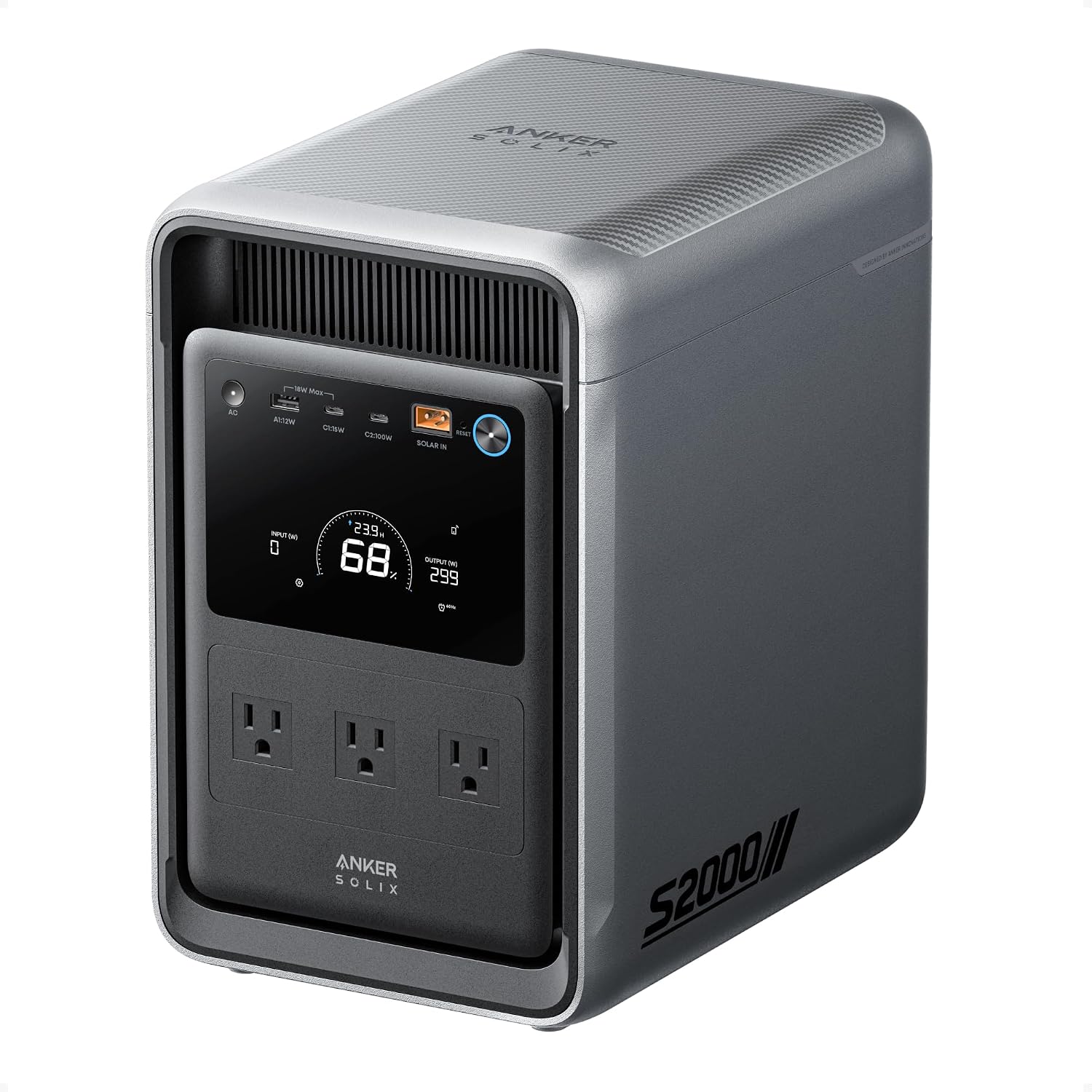
Battery runtime is also affected by inverter losses, appliance cycling, standby consumption, temperature, and the power station’s operating mode. Manufacturer runtime statements are useful planning references, not guarantees for every home. The Anker SOLIX S2000 Portable Power Station, for example, lists a 2,010Wh LFP battery and a 1,500W continuous output, making it more suitable for essential loads than high-wattage heating appliances.
Choose fuel flexibility based on local access
Dual-fuel generators can run on gasoline or propane, while a tri-fuel model adds natural gas. This flexibility can reduce dependence on one fuel source, but each fuel normally has different output and runtime characteristics. Propane storage also requires appropriate containers and safe handling, while natural gas requires a suitable connection and professional installation considerations.
The Westinghouse 12500 Watt Dual Fuel Home Backup lists higher gasoline output than propane output, while the Westinghouse 14500 Peak Watt Tri-Fuel Home Backup lists separate ratings for gasoline, propane, and natural gas. Compare the rating for the fuel you are most likely to use rather than choosing solely from the largest advertised peak number.
Check transfer-switch and outlet compatibility
A transfer-switch-ready outlet does not mean a generator is automatically connected to your home’s electrical system. A properly sized transfer switch or approved interlock, suitable wiring, grounding, and compliance with local requirements may be necessary. Electrical work should be evaluated by a qualified professional, especially when connecting a portable generator to a service panel.
Never backfeed a home through a wall outlet. That practice can energize utility lines and create a serious hazard. Renters and homeowners who do not want permanent wiring can use approved extension cords for individual appliances, provided the cords are rated for the load and kept dry, protected, and appropriately sized.
Compare portability with practical placement
Portability is valuable only if the unit can be moved safely to an appropriate operating location. Large open-frame generators may have wheels and handles, but their size and weight can make positioning difficult. Smaller inverter generators and battery stations are easier to store and move, although their lower output may limit which appliances they can support.
Fuel generators must be operated outdoors, away from doors, windows, vents, and other openings. They should never be used in a garage, basement, shed, or enclosed porch, even when a door is open. Carbon monoxide is odorless, and a built-in CO sensor is a useful feature but not a substitute for correct placement and working alarms. Our related guide to portable carbon monoxide detectors can help with broader emergency planning.
Evaluate noise, power quality, and overnight use
Noise matters when a generator will run near bedrooms, neighbors, or an outdoor living area. The Oxseryn Power Equipment 4400 Watts Inverter lists a noise claim measured from a stated distance, but that figure should not be treated as a universal noise level under every load. Engine speed, enclosure design, surface reflection, and operating distance all affect perceived sound.
For electronics, look for a documented pure sine wave inverter or a low-total-harmonic-distortion claim when provided. The Westinghouse 14500 Peak Watt Tri-Fuel Home Backup specifically lists low THD for sensitive electronics. Even then, use surge protection and follow the requirements of valuable equipment such as computers, networking hardware, and medical devices.
Plan charging, fuel storage, and maintenance
Battery stations should be stored and charged according to the manufacturer’s instructions. A model that supports AC, solar, car, or generator charging gives you more recovery options, but solar charging depends on panel compatibility, weather, placement, and available sunlight. The Jackery Explorer 1000 v2 Portable Power lists app-controlled charging modes and compatibility with Jackery solar panels, with the panel sold separately according to the published product information.
Fuel generators need more active ownership. Plan for oil checks, battery maintenance on electric-start models, fuel quality, periodic exercise, safe fuel storage, and replacement items such as filters or spark plugs as specified by the manual. A generator that remains unused in a shed for years may not start when needed unless it has been maintained and periodically inspected.
Match the system to your outage scenario
| Backup scenario | What matters most | Models to consider from this comparison |
|---|---|---|
| Phones, lights, internet, and small electronics | Low weight, quiet operation, USB outputs, and simple storage | Portable Solar Generator or Jackery Explorer 1000 v2 Portable Power |
| Refrigerator and selected essentials | Battery capacity, inverter output, recharge options, and surge capability | Anker SOLIX S2000 Portable Power Station or Westinghouse 6500 Watt Dual Fuel Home Backup |
| Several 120-volt household loads | Higher continuous wattage, fuel flexibility, and outlet selection | Westinghouse 12500 Watt Dual Fuel Home Backup |
| Large home or selected high-demand circuits | High running watts, 120/240-volt support, and transfer-switch planning | DuroMax XP13000EH 13,000-Watt Dual Fuel or Westinghouse 14500 Peak Watt Tri-Fuel Home Backup |
| Quiet, exhaust-free indoor-area operation | Battery storage, adequate watt-hours, and safe charging | Jackery HomePower 3600 Plus Portable Power or Anker SOLIX S2000 Portable Power Station |
Product-by-product analysis
Jackery HomePower 3600 Plus Portable Power: premium battery backup
The Jackery HomePower 3600 Plus Portable Power Station is the strongest fit for homeowners who want a high-capacity battery platform without engine noise or exhaust during use. Its documented specifications include 3,600W output, 3,584Wh capacity, LFP battery chemistry, dual-voltage capability when configured in parallel, and expansion options stated by the manufacturer.
Its advantages are quiet operation, multiple charging paths, wheels and a telescoping handle, and the ability to expand storage. The tradeoff is that expansion, solar panels, and any transfer-system equipment can affect the total ownership cost and setup complexity. The product data also describes pairing with an MTS, so buyers should confirm the exact integration requirements before assuming it can power a panel automatically.
Jackery Explorer 1000 v2 Portable Power: compact homeowner option
The Jackery Explorer 1000 v2 Portable Power is a practical match for renters, apartment dwellers, and homeowners who need backup for electronics, lighting, communications equipment, and selected smaller appliances. It lists a 1,070Wh LFP battery, 1,500W AC output, 3,000W surge capability, two USB-C ports, a 100W USB-C output, and a weight of 23.8 pounds.
The app provides charging modes, including an emergency charging setting and a quieter overnight mode. That flexibility is useful, but the fastest charging mode must be enabled through the app, and the published information says the unit is compatible only with Jackery solar panels for solar charging. Buyers should skip it if they expect to run high-draw heating, cooking, or pump equipment for extended periods.
Westinghouse 12500 Watt Dual Fuel Home Backup: high-output value
The Westinghouse 12500 Watt Dual Fuel Home Backup is aimed at homeowners who need substantially more output than a compact inverter generator or battery station can provide. Its listed ratings are 9,500 running watts and 12,500 peak watts on gasoline, with lower stated ratings on propane. It includes remote, electric, and recoil starting, a 120/240V receptacle, a transfer-switch-ready outlet, an hour meter, and low-oil shutdown.
This model makes sense when a home has several essential circuits and fuel storage is manageable. It is not a quiet, maintenance-free appliance, and the product data does not establish that it can run every appliance in every home simultaneously. Have an electrician verify circuit loads and transfer equipment rather than relying on the phrase home backup alone.
Oxseryn Power Equipment 4400 Watts Inverter: portable mid-size generator
The Oxseryn Power Equipment 4400 Watts Inverter lists 3,400 running watts and 4,400 peak watts, along with an ECO mode, a two-gallon fuel tank, a 12V DC port, and an RV outlet. Its listed weight of 56 pounds makes it more movable than the high-output open-frame models in this comparison.
It may fit a homeowner who wants to operate a refrigerator, lights, chargers, and modest tools without buying a large whole-home generator. The limitation is capacity: 3,400 running watts is not a substitute for the output needed by multiple large motors or electric heating appliances. The open-frame design and stated noise rating also mean buyers should plan placement carefully.
DuroMax XP13000EH 13,000-Watt Dual Fuel: heavy-duty household backup
The DuroMax XP13000EH 13,000-Watt Dual Fuel is designed for buyers prioritizing high output, dual-fuel operation, and a transfer-switch-ready 50A outlet. The published information describes push-button starting, a metal frame and power panel, no-flat tires, and copper windings. These features point toward a substantial outdoor unit intended for demanding emergency use rather than casual portability.
Its main advantage is reserve capacity for larger homes and selected high-demand circuits. Its disadvantages are the physical footprint, fuel consumption, engine maintenance, and the need for proper electrical integration. Choose it only after confirming that the home’s service equipment, transfer method, fuel plan, and storage location are appropriate.
Westinghouse 14500 Peak Watt Tri-Fuel Home Backup: maximum fuel flexibility
The Westinghouse 14500 Peak Watt Tri-Fuel Home Backup is the most flexible engine generator in this group for homes with access to gasoline, propane, and natural gas. It lists 11,500 running watts on gasoline, 10,500 on propane, and 9,500 on natural gas, plus a 19-hour gasoline runtime claim under the manufacturer’s stated conditions.
Tri-fuel capability can be valuable during extended outages because it gives the owner more than one fuel strategy. However, the natural gas option depends on an appropriate household connection and installation. This is a heavy-duty solution for a prepared homeowner, not an automatic justification for running every appliance. Load management and professional electrical planning remain essential.
Anker SOLIX S2000 Portable Power Station: quiet refrigerator backup
The Anker SOLIX S2000 Portable Power Station combines a 2,010Wh LFP battery with a 1,500W continuous output and 3,000W peak output. The manufacturer lists a refrigerator backup claim of up to 35 hours, a 400W solar input, app control, a UPS switchover claim of less than 10 milliseconds, and multiple outlet locations.
This is a compelling format for keeping a refrigerator and communications equipment operating without fuel fumes or engine noise. It does not include a 12V DC port, which matters to buyers with DC-specific equipment. It also cannot match the sustained output of the larger fuel generators, so it is best for essential-load prioritization rather than whole-home operation.
Portable Solar Generator: entry-level small-device backup
The Portable Solar Generator is a compact ZeroKor power station with a listed 280Wh battery, 300W maximum AC output, and an included 60W folding solar panel. It also includes USB, DC, and AC outputs, along with a flashlight and SOS modes. The product information specifically warns against using appliances above 300W and identifies coffee makers, hair dryers, and pumps as unsuitable examples.
Its best use is keeping phones, tablets, laptops, lights, and other low-demand devices available during a short outage or while traveling. It should not be treated as a refrigerator, pump, or whole-home backup system. The published information also advises regular charging and discharging and keeping the battery within a partial-charge range during storage, so ownership includes basic battery care.
Westinghouse 6500 Watt Dual Fuel Home Backup: balanced generator capacity
The Westinghouse 6500 Watt Dual Fuel Home Backup occupies the middle ground between compact inverter units and high-output household generators. It lists 5,300 running watts on gasoline and 4,800 on propane, a 120/240V selector, an L14-30R transfer-switch-ready outlet, an RV outlet, and automatic low-oil and CO shutdown.
This model is worth considering when you need enough capacity for a refrigerator, freezer, communications equipment, lights, and selected tools or pumps, but do not need the output of a large 13,000-watt class generator. It still requires outdoor operation, fuel management, and a realistic load plan. The CO shutdown feature adds a layer of protection, but it does not make indoor use acceptable.
Our research methodology and why you can trust us
We evaluated the listed products by first validating category fit. Every model included here is marketed or specified for emergency, home, portable, RV, or outage-related power use, so the comparison focuses on generator and power-station behavior rather than unrelated emergency equipment. We then compared continuous output, peak output, battery capacity where listed, fuel choices, charging paths, outlet types, voltage options, portability, noise claims, safety features, and stated maintenance considerations.
Our analysis is based on the product information available for this article, including manufacturer-facing specifications and the user-feedback signals provided in the source data. Because review coverage is not consistent across the listed models, we do not treat the displayed ratings as equivalent evidence of long-term reliability. We also do not claim hands-on testing, installation, measured runtime, or independent noise verification.
Ranking emphasis was placed on performance, features, build information, ease of use, durability indicators, safety-related functions, value, fuel or charging flexibility, and fit for realistic homeowner scenarios. The guide should be reviewed and updated as specifications, compatibility, accessories, and retailer information can change. Before purchase, confirm the current manual, local electrical requirements, fuel restrictions, warranty terms, and included accessories.
Final thoughts
The right choice depends on the failure you are preparing for. For quiet, exhaust-free essential-load backup with substantial battery capacity, the Jackery HomePower 3600 Plus Portable Power is the most capable battery option listed here. For a smaller apartment or a limited device list, the Jackery Explorer 1000 v2 Portable Power or Anker SOLIX S2000 Portable Power Station may be easier to store and simpler to use.
Choose the Westinghouse 6500 Watt Dual Fuel Home Backup when balanced generator capacity and dual-fuel flexibility are more important than silent operation. Move up to the Westinghouse 12500 Watt Dual Fuel Home Backup, DuroMax XP13000EH 13,000-Watt Dual Fuel, or Westinghouse 14500 Peak Watt Tri-Fuel Home Backup only when your load calculation, fuel plan, outdoor placement, and transfer-switch strategy support a larger machine. A generator is an emergency system, not just an appliance, so safe installation, carbon monoxide protection, maintenance, and realistic load management should guide the final decision.
What should I look for when choosing best generator for home backup?
Begin with the appliances you need during an outage and separate continuous wattage from startup demand. Then compare fuel type, battery capacity, running watts, peak watts, outlet configuration, transfer-switch compatibility, recharge options, noise, portability, and maintenance requirements. A larger advertised peak number is not enough if the continuous output or voltage does not match your equipment.
Are higher-end best generator for home backup worth it?
Higher-end models can be worthwhile when they provide enough capacity for critical motors, longer runtime, multiple fuel choices, expansion, or cleaner integration with selected home circuits. They are not automatically better for every buyer because larger systems also bring greater storage, maintenance, installation, and fuel-planning demands. Renters and buyers with modest essential loads may get better practical value from a smaller power station.
How should beginners choose best generator for home backup?
Beginners should list the refrigerator, lights, internet equipment, chargers, and other priority loads before shopping. A battery station is often easier to operate, while a fuel generator may support more power but requires outdoor placement, fuel handling, maintenance, and stricter safety planning. If you want panel integration, consult a qualified electrician before buying a transfer-switch-ready model.
Can a portable generator power a whole house?
Some high-output generators may support many household circuits, but whole-home capability depends on the home’s electrical service, appliance load, generator output, voltage, and transfer equipment. A transfer-switch-ready outlet alone does not create a complete installation. Never connect a generator by backfeeding a wall outlet, and have a qualified professional evaluate any panel connection.
Are battery power stations safer than fuel generators?
Battery power stations do not produce exhaust at the point of use, which avoids the carbon monoxide hazard associated with operating combustion engines. They still require proper charging, ventilation according to the manual, electrical load management, and protection from unsuitable conditions. Fuel generators can be effective for extended outages, but they must remain outdoors and away from openings.
How long should quality best generator for home backup last?
Service life varies by battery chemistry, charge cycles, engine maintenance, fuel quality, storage conditions, duty cycle, and manufacturer support. Several battery products in this comparison publish cycle or lifespan claims, but those claims should be interpreted as manufacturer specifications rather than a guarantee of identical performance in every home. Engine generators also need periodic maintenance even when they are rarely used.
What other emergency supplies should homeowners plan for?
Power backup works best as part of a broader emergency plan that includes carbon monoxide detection, smoke detection, lighting, communication, food, water, and safe fuel storage. You can also review our guides to battery-operated smoke detectors and USB-C rechargeable flashlights to cover risks and needs that a generator cannot address.