
Choosing best whole house generator is less about chasing the biggest wattage number and more about matching a generator to your home’s electrical loads, fuel access, installation plan, and outage routine. A portable dual-fuel unit can be the practical choice for a DIY-minded homeowner who only needs essential circuits, while a permanently installed standby generator better suits a household that wants automatic backup with minimal manual involvement when severe weather hits.
For this guide, we analyzed 9 listed models from DuroMax, Westinghouse, Honeywell and more using the available specifications: rated and peak output, fuel types, starting controls, transfer-switch compatibility, monitoring features, construction claims, and warranty terms. The options span a broad $999.00 – $7,229.00, but the equipment price is only one part of ownership. Installation, fuel storage, permits, electrical work, and safe placement can materially change the total cost and convenience of any model you choose.
If you are building a broader outage plan, generator research works best alongside basic preparedness. Our guide to a hand crank emergency radio covers communications gear that works when batteries and cell networks fail, and it pairs naturally with the backup power options discussed below.

Pros
- Delivers clean, low-distortion electricity that protects sensitive electronics and modern appliances during outages.
- The purpose-built, pressure-lubricated G-Force engine is designed for dependable generator use with less routine maintenance than competing engines.
Cons
- As a permanently installed standby unit, setup typically involves site preparation, electrical work, and a licensed installer, which adds time and cost beyond the unit itself.
- The 48 x 25 x 29 inch footprint needs a dedicated outdoor location with proper clearances, which may be a challenge for smaller lots or tight side yards.
Specifications
| Dimensions | 48 x 25 x 29 inches |
|---|---|
| Product Group | Lawn & Patio |
| Binding | Automotive |
Verify the current product variation before purchase; specifications may change.
Best For / Avoid If
Best for buyers prioritizing
- Delivers clean, low-distortion electricity that protects sensitive electronics and modern appliances during outages.
- The purpose-built, pressure-lubricated G-Force engine is designed for dependable generator use with less routine maintenance than competing engines.
- Quiet-Test mode keeps scheduled self-tests noticeably quieter and more fuel-efficient than standard exercise cycles.
Consider another option if
- As a permanently installed standby unit, setup typically involves site preparation, electrical work, and a licensed installer, which adds time and cost beyond the unit itself.
- The 48 x 25 x 29 inch footprint needs a dedicated outdoor location with proper clearances, which may be a challenge for smaller lots or tight side yards.
- Remote smartphone monitoring is not listed among the provided features, so oversight relies on the onboard Sync Controller display.

Pros
- Offers 9,500 running watts and 12,500 peak watts on gasoline for substantial household backup capacity.
- Provides useful fuel flexibility with listed propane output of 8,500 running watts and 11,200 peak watts.
Cons
- The nearly 210-pound weight and sizable dimensions may be difficult to move or store in compact spaces.
- Propane operation provides lower listed running and peak wattage than gasoline operation.
Best For / Avoid If
Best for buyers prioritizing
- Offers 9,500 running watts and 12,500 peak watts on gasoline for substantial household backup capacity.
- Provides useful fuel flexibility with listed propane output of 8,500 running watts and 11,200 peak watts.
- Combines automatic low-oil shutdown, a digital hour meter, and a cast iron engine sleeve for maintenance awareness and durability support.
Consider another option if
- The nearly 210-pound weight and sizable dimensions may be difficult to move or store in compact spaces.
- Propane operation provides lower listed running and peak wattage than gasoline operation.
- Users planning a home transfer-switch installation may need additional setup considerations beyond the included accessories.

Pros
- Provides automatic whole-home backup coverage during power interruptions
- Cellular capability enables convenient monitoring and control while home or away
Cons
- The 524-pound weight and substantial dimensions may complicate handling and site planning
- Real-time Mobile Link premium functions require an ongoing subscription
Specifications
| Color | Metro Gray |
|---|---|
| Dimensions | 46.4 x 26.3 x 30.7 inches |
| Weight | 524 Pounds |
| Product Group | Lawn & Patio |
| Binding | Tools & Home Improvement |
Verify the current product variation before purchase; specifications may change.
Best For / Avoid If
Best for buyers prioritizing
- Provides automatic whole-home backup coverage during power interruptions
- Cellular capability enables convenient monitoring and control while home or away
- Fuel and ignition management is intended to improve operating efficiency
Consider another option if
- The 524-pound weight and substantial dimensions may complicate handling and site planning
- Real-time Mobile Link premium functions require an ongoing subscription
- Its whole-home capacity may be more than households seeking backup for only a few essential circuits need

Pros
- Provides automatic whole-house backup protection for key household comfort and connectivity needs.
- Offers remote monitoring and control from the Mobile Link app, along with performance and maintenance notifications.
Cons
- At 451 pounds and approximately 46.4 by 26.3 by 30.7 inches, the generator may be difficult to place in compact areas.
- Mobile Link remote monitoring and control requires a premium subscription.
Best For / Avoid If
Best for buyers prioritizing
- Provides automatic whole-house backup protection for key household comfort and connectivity needs.
- Offers remote monitoring and control from the Mobile Link app, along with performance and maintenance notifications.
- Combines oil-level monitoring, cold-start support, and weather-conscious housing details with a 5-year limited warranty.
Consider another option if
- At 451 pounds and approximately 46.4 by 26.3 by 30.7 inches, the generator may be difficult to place in compact areas.
- Mobile Link remote monitoring and control requires a premium subscription.
- The provided product information does not detail installation requirements, transfer-switch specifications, or fuel capacity.
Pros
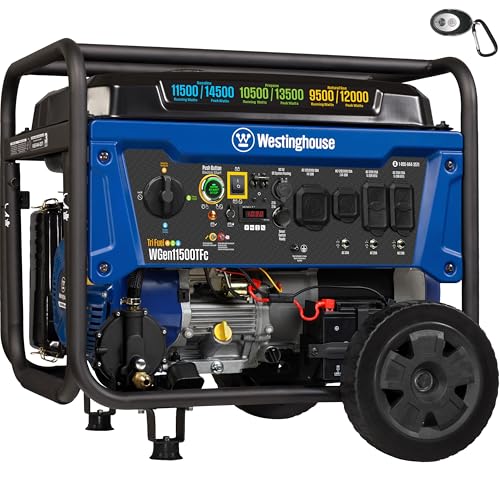
- Offers three fuel choices, including natural gas, propane, and gasoline.
- Provides strong running output for larger homes and demanding portable-power needs.
Cons
- At 230 pounds, it may be difficult for one person to move or store in a compact space.
- Its large output and tri-fuel design may require more planning and setup than a smaller single-fuel generator.
Specifications
| Color | Blue |
|---|---|
| Dimensions | 27.2 x 26.1 x 26.5 inches |
| Weight | 230 Pounds |
| Product Group | Lawn & Patio |
| Binding | Tools & Home Improvement |
Verify the current product variation before purchase; specifications may change.
Best For / Avoid If
Best for buyers prioritizing
- Offers three fuel choices, including natural gas, propane, and gasoline.
- Provides strong running output for larger homes and demanding portable-power needs.
- Low THD is suitable for powering many sensitive electronic devices.
Consider another option if
- At 230 pounds, it may be difficult for one person to move or store in a compact space.
- Its large output and tri-fuel design may require more planning and setup than a smaller single-fuel generator.
- The listed runtime on propane is up to 7 hours on a 20-pound tank, which is shorter than the stated gasoline runtime.

Pros
- High output provides substantial emergency power capacity for a home, RV, or jobsite.
- Fuel flexibility can be useful when one available fuel source is inconvenient or unavailable.
Cons
- Its 234-pound weight and large footprint may make storage and movement difficult for one person.
- A transfer-switch-ready outlet does not by itself provide a complete transfer-switch installation.
Specifications
| Color | Blue |
|---|---|
| Dimensions | 30 x 29 x 26 inches |
| Weight | 234 pounds |
| Product Group | Lawn & Patio |
| Binding | Tools & Home Improvement |
Verify the current product variation before purchase; specifications may change.
Best For / Avoid If
Best for buyers prioritizing
- High output provides substantial emergency power capacity for a home, RV, or jobsite.
- Fuel flexibility can be useful when one available fuel source is inconvenient or unavailable.
- The metal construction, copper windings, and no-flat tires support durability and mobility.
Consider another option if
- Its 234-pound weight and large footprint may make storage and movement difficult for one person.
- A transfer-switch-ready outlet does not by itself provide a complete transfer-switch installation.
- The high-capacity design may be more generator than needed for users seeking limited backup power.

Pros
- Offers broad whole-house outage protection for key household systems and connected devices.
- Provides useful remote visibility and control when the homeowner is away, subject to the required subscription.
Cons
- The 384-pound weight and 47.3 x 25.6 x 30.7-inch dimensions require careful planning for placement and setup.
- Mobile Link remote monitoring and control requires a premium subscription.
Specifications
| Color | Gray |
|---|---|
| Dimensions | 47.3 x 25.6 x 30.7 inches |
| Weight | 384 Pounds |
| Product Group | Lawn & Patio |
| Binding | Lawn & Patio |
Verify the current product variation before purchase; specifications may change.
Best For / Avoid If
Best for buyers prioritizing
- Offers broad whole-house outage protection for key household systems and connected devices.
- Provides useful remote visibility and control when the homeowner is away, subject to the required subscription.
- Includes design features intended to support readiness in cold climates and reduce snow or ice intrusion.
Consider another option if
- The 384-pound weight and 47.3 x 25.6 x 30.7-inch dimensions require careful planning for placement and setup.
- Mobile Link remote monitoring and control requires a premium subscription.
- The available product information does not specify detailed output limitations or installation requirements.

Pros
- Flexible fuel choice across gasoline, propane, and natural gas
- High output that can support larger-home backup applications
Cons
- At 557 pounds and measuring 38 x 35 x 40.4 inches, it may require substantial storage space and careful movement.
- Using the 125A terminal block for whole-home hardwiring requires work by a licensed electrician.
Specifications
| Color | Black |
|---|---|
| Dimensions | 38 x 35 x 40.4 inches |
| Weight | 557 Pounds |
| Product Group | Lawn & Patio |
| Binding | Tools & Home Improvement |
Verify the current product variation before purchase; specifications may change.
Best For / Avoid If
Best for buyers prioritizing
- Flexible fuel choice across gasoline, propane, and natural gas
- High output that can support larger-home backup applications
- Broad outlet selection with transfer-switch and interlock-kit readiness
Consider another option if
- At 557 pounds and measuring 38 x 35 x 40.4 inches, it may require substantial storage space and careful movement.
- Using the 125A terminal block for whole-home hardwiring requires work by a licensed electrician.
- The highest output figures depend on gasoline use, while propane and natural gas produce lower peak and running wattage.

Pros
- Provides automatic whole-house backup functionality for essential comfort, refrigeration, lighting, and connectivity.
- Remote status checks and maintenance notifications can make ongoing generator oversight more convenient.
Cons
- The 426-pound cabinet and approximately 46.4 by 26.3 by 30.7-inch dimensions may be difficult to accommodate in tighter spaces.
- Mobile Link premium subscription is required for the listed remote monitoring and control features.
Specifications
| Color | Gray |
|---|---|
| Dimensions | 46.4 x 26.3 x 30.7 inches |
| Weight | 426 Pounds |
| Product Group | Lawn & Patio |
| Binding | Automotive |
Verify the current product variation before purchase; specifications may change.
Best For / Avoid If
Best for buyers prioritizing
- Provides automatic whole-house backup functionality for essential comfort, refrigeration, lighting, and connectivity.
- Remote status checks and maintenance notifications can make ongoing generator oversight more convenient.
- The listed weather-conscious design and oil-level monitoring support readiness in demanding conditions.
Consider another option if
- The 426-pound cabinet and approximately 46.4 by 26.3 by 30.7-inch dimensions may be difficult to accommodate in tighter spaces.
- Mobile Link premium subscription is required for the listed remote monitoring and control features.
- Buyers seeking only limited backup coverage may find whole-home capability more than they need.
Best Whole House Generator Buying Guide
After comparing the listed specifications, the most important decision is whether you need a portable generator connected through properly installed transfer equipment or a home standby generator designed for permanent installation. These products are not interchangeable simply because their names include phrases such as home backup or whole home power, and the differences show up in cost, installation effort, and what you must do when the lights go out.
Portable or standby: choose the ownership model first
Portable generators trade automation for flexibility. The Westinghouse 12500 Watt Dual Fuel Home Backup, the Westinghouse 14500 Peak Watt Tri-Fuel Home Backup, and the DuroMax XP13000EH 13,000-Watt Dual Fuel can be moved between jobs, stored when not needed, and used for recreation or work away from the house. The tradeoff is responsibility: you decide where the unit operates, how it connects to the house, how fuel is stored and supplied, and who starts and monitors it during an outage.
Standby models are a different commitment. The Generac 10kW, 18kW, 22kW, and 26kW Whole Home Generators and the Honeywell 14kW Home Standby Generator are permanently installed units described as automatically detecting outages and delivering backup power. Generac’s standby listings state that built-in cellular connectivity supports monitoring through the Mobile Link app, although the manufacturer notes this requires a premium subscription. The listings do not specify which transfer switch, fuel connection, or installation package applies to each model, so those details need confirmation with a licensed installer before you commit.
- Choose portable backup when mobility, dual-fuel flexibility, or a lower equipment commitment matters most.
- Choose standby backup when permanent placement, automatic operation, and professionally planned installation are higher priorities.
- Never connect a portable generator to household wiring through a wall outlet or improvised cord; a qualified electrician should determine the correct transfer equipment.
Capacity in this comparison gives you a rough map of the field. The Generac 10kW sits at the smaller end of the standby group and the Generac 26kW at the top, while the portable group runs from the DuroMax XP13000EH up to the Westinghouse 28000 Peak Watt Tri-Fuel Home Backup, whose 20,000 running watts on gasoline approach the sustained output of a mid-size standby unit. Where you land should depend on the circuits you must keep alive, not on the biggest number available.
Running watts matter more than peak watts
Running watts describe the output a generator can sustain, while peak or starting watts provide temporary headroom for motor-driven equipment. Refrigerators, sump pumps, well pumps, furnace blowers, and air-conditioning equipment all draw extra power for a moment when their motors start. A model with an impressive peak rating can still be a poor fit if its continuous running output cannot support the loads you need at the same time.
Make a written load list before shopping. Record the running and starting requirements for each essential appliance, then decide which items must run simultaneously. A smaller household may only need refrigeration, lighting, internet equipment, and a furnace blower. A larger home with a well pump, electric water heating, or central air conditioning may need load management or a substantially larger generator. If cooling is part of your plan, our apartment air conditioner BTU guide explains how cooling capacity and electrical demand relate, which is useful context when estimating what an AC unit will pull from backup power.
| Specification | Why it matters | Common mistake |
|---|---|---|
| Running watts | Indicates sustained electrical capacity | Using peak watts as everyday capacity |
| Peak watts | Covers short motor-start surges | Assuming every appliance can start at once |
| Fuel-specific output | Shows how output changes between gasoline, propane, and natural gas | Planning around the highest rating while running another fuel |
| Transfer-switch readiness | May support a planned connection to household circuits | Assuming the switch, wiring, and installation are included |
The documented numbers show why fuel matters. The Westinghouse 12500 Watt Dual Fuel Home Backup delivers 9,500 running watts on gasoline and 8,500 on propane. The Westinghouse 14500 Peak Watt Tri-Fuel Home Backup ranges from 11,500 running watts on gasoline down to 9,500 on natural gas, and the Westinghouse 28000 spans from 20,000 running watts on gasoline to 16,000 on natural gas. Planning around the fuel you will actually use prevents an unwelcome surprise in the middle of an outage.
Fuel choice affects resilience and maintenance
Dual-fuel generators run on gasoline or propane, while tri-fuel models add natural gas. The Westinghouse 14500 and 28000 Peak Watt Tri-Fuel units are specified for all three fuels, and the Honeywell 14kW and Generac standby models connect to a home fuel supply as installed equipment. Multiple fuel options are valuable when one fuel becomes hard to find during a prolonged regional outage, and they let you choose between stored liquid fuel and a continuous supply line, subject to the product’s installation requirements and local rules.
Runtime figures in the listings are manufacturer estimates, not guarantees. The Westinghouse 12500 lists up to 12 hours on its 6.6-gallon gasoline tank. The Westinghouse 14500 lists up to 19 hours on a 9.5-gallon gasoline tank and up to 7 hours on a 20-pound propane tank. The Westinghouse 28000 lists up to 15 hours at 25 percent load on its 17.2-gallon tank. Actual runtime changes with electrical demand, fuel quality, temperature, and engine condition, so treat these numbers as planning reference points rather than promises.
Each fuel carries different logistics. Gasoline requires approved containers, rotation, and stabilizer for storage. Propane stores well in tanks but typically delivers lower output, and runtime depends on tank size and demand. Natural gas removes refueling trips for tri-fuel and standby units but requires a professional connection and verification that your gas meter and line can support the added load. Always follow the manufacturer’s fuel, ventilation, shutdown, and storage instructions for the specific model.
Check electrical compatibility before buying
Outlet configuration determines how a portable generator connects to your home. The Westinghouse 12500 lists two GFCI household receptacles, a transfer-switch-ready L14-30R 30-amp outlet, and an RV-ready 14-50R 50-amp outlet. The DuroMax XP13000EH includes a transfer-switch-ready 50-amp outlet, and the Westinghouse 28000 adds two 14-50R outlets, two L14-30R outlets, an L5-30R outlet, and four GFCI duplex receptacles, all described as transfer switch and interlock kit ready. These features are useful only if they match the inlet box, transfer switch, or interlock your electrician plans to install.
The Westinghouse 28000 goes further with a 125-amp 240-volt AC terminal block that the manufacturer says allows a licensed electrician to hardwire the generator directly to the home for full power delivery. That kind of connection is genuinely different from cord-and-outlet setups, and it is exactly the type of detail to review with your electrician before purchase rather than after delivery.
Power quality matters for electronics. The Westinghouse 14500 and 28000 are described as engineered with low total harmonic distortion for phones, computers, and televisions, and the Honeywell 14kW specifies less than 5 percent THD through its PrecisionPower technology. The Westinghouse listings do not state an exact THD percentage, so if sensitive electronics are central to your plan, confirm the figure in current documentation and still use appropriate surge protection.
- Confirm whether your essential circuits are 120-volt, 240-volt, or a combination.
- Ask an electrician to verify the inlet, breaker, transfer switch, wiring, and grounding arrangements.
- Confirm whether the transfer switch is included with the generator or purchased separately.
- For air conditioners, pumps, and other motors, verify starting requirements rather than relying on nameplate wattage alone.
Starting controls and monitoring influence everyday usability
Starting features matter most when an outage begins at night or in severe weather. The Westinghouse 12500 offers remote start with an included key fob plus electric and recoil backup, and the Westinghouse 14500 and 28000 list remote electric start. The DuroMax XP13000EH uses push-button start with a front-facing interface for switching fuel types. On the standby side, automation is the point: the Generac models detect outages and start on their own, and the Honeywell 14kW adds a Sync Controller with a multilingual LCD that tracks battery status and maintenance intervals.
Monitoring changes how you supervise the system. Generac’s standby listings describe built-in cellular connectivity with real-time updates and maintenance alerts through the Mobile Link app, with the manufacturer noting that a premium subscription is required. The 18kW model is also described as compatible with the Generac Home Energy Ecosystem, including ecobee thermostats and PWRcell battery systems. The portable Westinghouse models take a simpler approach with digital readouts showing voltage, frequency, and lifetime hours, and the 12500 adds a fuel gauge and hour meter for quick operating checks.
For occasional use, remote start may matter less than portability and simple controls. For a household that expects frequent storms or is often away during outage season, cellular monitoring and automatic transfer carry real value, provided you confirm the subscription terms and service coverage in your area. Treat convenience features as part of the ownership system, never as substitutes for correct sizing and maintenance.
Build quality, placement, and noise deserve attention
Fuel-burning generators need a safe outdoor operating location with generous clearance from doors, windows, and ventilation openings. Never run a generator inside a home, garage, basement, crawl space, or shed. Carbon monoxide can accumulate without obvious warning, so placement and ventilation instructions must be followed exactly. A carbon monoxide alarm inside the home is an essential second layer, but it never makes indoor operation acceptable.
Documented construction details favor durability. The DuroMax XP13000EH is described with a heavy-duty all-metal frame and power panel, no-flat tires, and 100 percent copper windings. The Westinghouse portables list cast iron engine sleeves and copper windings, and the 28000 adds a 999cc V-twin OHV engine with automatic low-oil shutdown and low idle mode. The Honeywell 14kW stands out among standby units with a corrosion-resistant all-aluminum enclosure finished with RhinoCoat powder coating, while the Generac standby listings mention oil level sensors and cold-climate start support. These are meaningful design claims, but not proof of service life; longevity still depends on maintenance, weather protection, and parts availability.
Noise information is largely missing from the published data, which matters for close neighbors, nighttime use, and properties with strict rules. The one documented exception is the Honeywell 14kW Quiet-Test mode, which runs a self-test at lower RPM for five or twelve minutes to reduce sound and fuel consumption. For the portable units, check current technical documentation for operating sound levels before choosing a placement, especially if the generator will sit near a bedroom window or a property line.
Maintenance and total ownership cost
A generator is emergency equipment that needs preparation before the emergency. Portable ownership typically means oil changes, air filter service, spark plug checks, battery care on electric-start models, and fuel system management. Standby ownership adds professional service visits and, on the Generac models, a possible monitoring subscription. None of the listings provides a complete maintenance schedule, so consult the manual for each model before setting intervals.
When comparing value, calculate past the equipment price. Include the transfer switch or interlock kit, inlet box, wiring, permits, electrician labor, fuel containers or tanks, weather protection, and replacement batteries. The lowest-priced portable model in this comparison sits at the bottom of the $999.00 – $7,229.00 range, while the top standby units sit near the top, and installed costs can add substantially to the standby side. A less expensive portable can be economical for short outages if you are comfortable with manual setup, while a standby model earns its price only for households that depend on automatic operation.
Preparedness extends beyond the generator itself. Keep food, water, communications, and medical supplies ready, because a generator that fails or runs dry should never leave your household stranded. Our first aid kit refill guide is a practical companion resource, and outdoor solar lights for fences can provide perimeter lighting that does not depend on your generator’s fuel supply.
How the listed models fit different homes
The table below summarizes where each listed model fits based on the published data, along with the main limitation to verify before you buy.
| Model | Best fit based on published data | Important limitation |
|---|---|---|
| Westinghouse 12500 Watt Dual Fuel Home Backup | Portable buyers wanting dual fuel, remote start, a fuel gauge, and multiple connection options | Requires safe placement, manual oversight, and a planned transfer connection |
| Westinghouse 14500 Peak Watt Tri-Fuel Home Backup | Larger portable power needs with gasoline, propane, and natural gas flexibility | Natural gas connection details and fuel-specific output need installer verification |
| Westinghouse 28000 Peak Watt Tri-Fuel Home Backup | Homes needing near-standby output from a portable unit, with a hardwire terminal block option | Large and heavy; requires substantial fuel storage and firm placement planning |
| DuroMax XP13000EH 13,000-Watt Dual Fuel | Buyers prioritizing an all-metal frame, push-button start, and a 50-amp outlet | Runtime and noise figures are not documented in the published data |
| Generac 10kW Whole Home Generator | Smaller homes or essential-circuit standby plans with automatic operation | Capacity limits whole-home coverage; installation details need confirmation |
| Generac 18kW Whole Home Generator | Mid-capacity standby with cellular monitoring and smart-home ecosystem compatibility | Mobile Link premium subscription is required for connected features |
| Generac 22kW Whole Home Generator | Higher-capacity standby with stated transfer-switch and cellular capability | Verify included equipment, installation scope, and monitoring terms |
| Generac 26kW Whole Home Generator | Larger homes with heavier standby electrical demands | Higher capacity does not remove the need for a professional load calculation |
| Honeywell 14kW Home Standby Generator | Standby buyers focused on power quality below 5 percent THD and quieter self-testing | Service network and installation specifics should be confirmed locally |
Our Research Methodology & Why You Can Trust Us
We evaluated the listed products for category fit first, keeping only generators marketed for home backup, whole-home backup, or home standby use. We then compared the available information across sustained and peak output, fuel types and fuel-specific ratings, starting controls, transfer-switch readiness, outlet configuration, monitoring features, construction claims, runtime statements, safety-related features, and warranty terms where listed.
Our analysis is specification-based; we did not operate these units ourselves. The published record includes product descriptions and manufacturer feature statements, but it does not include independent laboratory measurements, installation records, noise measurements, or long-term service histories. Customer ratings were limited, review text was not available for weighting, and several models had sparse feature lists. Where information was missing, we stated the limitation rather than treating the absence of data as a feature.
We also framed the comparison around real homeowner situations: short outages, multi-day storm events, renters who need mobility, DIY users comfortable with a portable setup, and homeowners who prefer permanent standby equipment. This guide was reviewed and updated in November using the published product data and available category information. Because electrical codes, fuel rules, product revisions, and monitoring terms change, confirm current documentation and consult qualified electrical and fuel professionals before installation.
Ranking emphasis fell on performance, documented features, build quality, ease of use, durability indicators, safety considerations, value, and fit for homeowner or DIY use. No model was treated as superior simply because it carried a larger peak rating or a higher price. The right choice depends on your load plan, fuel strategy, installation budget, and how much manual involvement you can realistically provide during an outage.
Safety and installation checklist
Fuel-burning generators produce exhaust and must operate outdoors in a location that follows the manufacturer’s clearance instructions. Keep units away from doors, windows, vents, and anywhere exhaust could enter living space. Never backfeed household wiring, and never assume a transfer-switch-ready outlet means the generator connects without additional equipment and professional work.
- Read the current manual before adding fuel, starting the engine, or connecting a load.
- Use only the fuel types and tank arrangements approved for your specific model.
- Let the engine and exhaust components cool before refueling or storing the unit.
- Install carbon monoxide detection inside the home and follow local fire and electrical codes.
- Store fuel away from ignition sources and follow applicable storage rules.
- Have a qualified professional size the system and install transfer equipment, gas connections, or standby components.
Final Thoughts
For a portable backup setup, the Westinghouse 14500 Peak Watt Tri-Fuel Home Backup offers the strongest documented combination of output, three-fuel flexibility, runtime claims, remote starting, and transfer-switch readiness in this comparison. The Westinghouse 12500 Watt Dual Fuel Home Backup is a focused value option for buyers who want dual-fuel operation, remote start, and useful onboard controls at the lowest equipment price in the group, while the DuroMax XP13000EH 13,000-Watt Dual Fuel appeals when a rugged all-metal frame, push-button start, and a 50-amp outlet are priorities. Shoppers with larger demands should compare the Westinghouse 28000 Peak Watt Tri-Fuel Home Backup, whose 20,000 running watts on gasoline and hardwire terminal block blur the line between portable and standby.
For a permanent solution, work through a professional load calculation and installation quote rather than choosing by capacity alone. The Generac 10kW Whole Home Generator suits essential-circuit plans, the Generac 18kW Whole Home Generator and Generac 22kW Whole Home Generator cover mid-size and larger homes with cellular monitoring, the Generac 26kW Whole Home Generator addresses heavier demands, and the Honeywell 14kW Home Standby Generator differentiates on sub-5-percent THD power quality and quieter self-testing.
Ultimately, best whole house generator should be selected around the circuits you truly need, the fuel you can reliably access, and the maintenance and safety responsibilities you are prepared to manage. Confirm installation requirements with a licensed electrician, verify current specifications before purchase, and build your wider outage plan, including lighting and communications, alongside the purchase.
Frequently Asked Questions
What should I look for when choosing best whole house generator?
Start with a load calculation that identifies your essential running watts and motor-starting demands. Then compare fuel options and fuel-specific output, transfer-switch compatibility, starting controls, installation requirements, maintenance support, and safe operating clearances. A larger advertised peak number is not automatically the right choice for your home.
Are higher-end best whole house generator worth it?
They can be worthwhile when you need higher sustained capacity, automatic operation, cellular monitoring, or greater fuel flexibility. They may not make sense for a household that only needs a few essential circuits during occasional short outages. Compare the complete ownership cost, including electrical work, fuel equipment, service, and any monitoring subscription.
How should beginners choose best whole house generator?
Beginners should first decide whether portable or standby ownership fits their property and comfort level. A portable generator still requires safe outdoor placement, fuel handling, manual oversight, and an approved connection method. If you are unsure about electrical loads, transfer equipment, natural gas connections, or placement, consult qualified professionals before buying.
Can a portable generator power an entire house?
Some portable generators are marketed for whole-home backup, but actual coverage depends on running watts, your home’s electrical service, appliance starting demands, and the transfer equipment installed. You may need to prioritize circuits or use load management. Never connect a portable generator to household wiring through an improvised cord or wall outlet.
Is dual-fuel or tri-fuel operation better?
Neither is universally better. Dual fuel provides useful flexibility between gasoline and propane, while tri-fuel adds natural gas when a suitable connection is available. Compare the output and runtime ratings for the fuel you will actually use, because both figures usually drop when you switch away from gasoline.
How long should quality best whole house generator last?
The published data does not establish a guaranteed service life for any listed model. Longevity depends on load, operating hours, oil and filter maintenance, fuel storage, weather exposure, battery care, and access to parts and service. Treat design claims such as cast iron sleeves, metal frames, or copper windings as construction information rather than a lifespan promise.
What other emergency supplies should I plan alongside a generator?
Plan for lighting, food, water, communications, medication storage, carbon monoxide detection, and first aid supplies, because any backup power source can fail or run out of fuel. Battery and solar-powered options help here; our guide to the best motion sensor lights covers safety lighting that does not depend on your generator.