
Power outages, severe weather, and unexpected emergencies can leave households without reliable communication or lighting. That is why many homeowners, renters, and outdoor enthusiasts keep a dependable hand crank emergency radio ready in their emergency kits. These compact devices combine hand-crank power, solar charging, NOAA weather alerts, and phone charging so you stay informed and powered when the grid fails.
In this updated 2026 guide, we carefully compared 13 models ranging across a wide price range from trusted names including MidlandRadio, RunningSnail, FosPower, Raynic, Leaton, yesiwtc. Our analysis focused on real homeowner needs such as multi-source charging reliability, clear NOAA reception, useful lighting, SOS signaling, and overall durability for both home storage and outdoor use. Whether you are preparing a family emergency kit or adding gear for camping, this guide helps you choose wisely. For broader preparedness options, explore our full collection of emergency supplies.
We evaluated each option based on specifications, feature sets, battery capacity claims, charging methods, and practical suitability for everyday households. The result is clear, data-driven advice so you can select the right hand crank emergency radio without guesswork.

Pros
- Multiple power input methods including hand crank, USB, and Type-C support continuous off-grid readiness
- Integrated flashlight, reading lamp, and SOS features expand usefulness beyond radio reception alone
Cons
- Initial battery activation requires 3-5 minutes of cranking before first use
- Battery lifespan may decrease if the unit is allowed to fully deplete regularly
Best For / Avoid If
Best for buyers prioritizing
- Multiple power input methods including hand crank, USB, and Type-C support continuous off-grid readiness
- Integrated flashlight, reading lamp, and SOS features expand usefulness beyond radio reception alone
- Compact lightweight form with lanyard enables convenient outdoor or emergency kit portability
Consider another option if
- Initial battery activation requires 3-5 minutes of cranking before first use
- Battery lifespan may decrease if the unit is allowed to fully deplete regularly
- Optimal signal may need antenna repositioning or tuning adjustments based on location

Pros
- Triple charging methods support resilience when conventional power is unavailable
- Automatic NOAA weather scanning covers critical alert channels for timely information
Cons
- Sustained operation may depend on regular hand cranking or solar exposure during extended outages
- Accessories serve as compact supplements and may not replace full specialized survival gear for advanced users
Best For / Avoid If
Best for buyers prioritizing
- Triple charging methods support resilience when conventional power is unavailable
- Automatic NOAA weather scanning covers critical alert channels for timely information
- Built-in flashlight, SOS alarm, headphone jack, and USB port expand everyday emergency utility
Consider another option if
- Sustained operation may depend on regular hand cranking or solar exposure during extended outages
- Accessories serve as compact supplements and may not replace full specialized survival gear for advanced users
- First-time users organizing a complete kit may need extra time to familiarize with all components
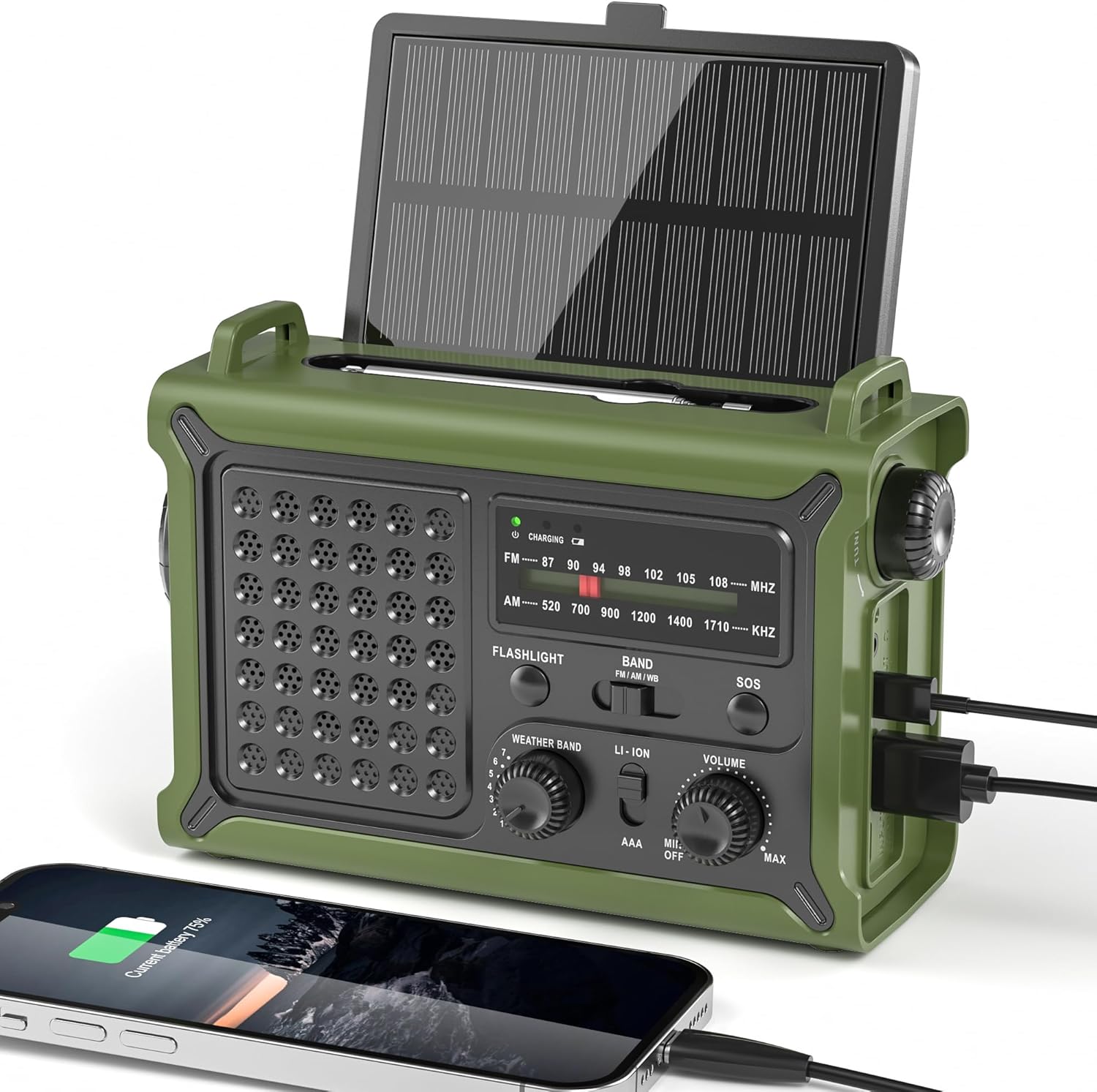
Pros
- True 12000mAh capacity supports extended radio use and device charging during blackouts
- Multiple recharging methods including large solar panel and efficient hand crank for off-grid reliability
Cons
- Does not include alerts in power-off mode unlike some other models in the series
- Dial tuning may feel less precise than digital display alternatives for quick station changes
Specifications
| Additional Features | 5-Way Powered, Emergency Cellphone Charger, LED Flashlight & Reading Lamp, Portable, SOS Alarm |
|---|---|
| Connectivity Technology | USB |
| Tuner Type | Stronger, Faster, Clearer |
| Power Source | Solar Panel | Hand Crank | 12000mAh Lithium Battery | Type-C Input 5V/2A | 3 AAA Batteries |
| Radio Bands Supported | NOAA | FM | AM |
| Frequency | 162 MHz |
| Compatible Devices | Smartphone |
| Voltage | 5 Volts |
| Speaker Maximum Output Power | 5 Watts |
| Number of Batteries | 1 Nonstandard Battery batteries required. (included) |
Verify the current product variation before purchase; specifications may change.
Best For / Avoid If
Best for buyers prioritizing
- True 12000mAh capacity supports extended radio use and device charging during blackouts
- Multiple recharging methods including large solar panel and efficient hand crank for off-grid reliability
- Clear stable signal reception across NOAA AM and FM bands with noise reduction
Consider another option if
- Does not include alerts in power-off mode unlike some other models in the series
- Dial tuning may feel less precise than digital display alternatives for quick station changes
- Larger dimensions and 1.6 lb weight reduce pocket portability compared with more compact options

Pros
- Multiple recharge methods including crank, solar, and batteries ensure power availability in varied conditions
- Built-in power bank supports charging most small mobile devices during emergencies
Cons
- Power bank capacity suits phones and small tablets but may require recharging for prolonged multi-device use
- Hand crank and solar regeneration can take sustained effort depending on conditions
Specifications
| Additional Features | Portable |
|---|---|
| Connectivity Technology | USB C |
| Tuner Type | AM/FM/WB |
| Power Source | Solar, Battery, Handcrank |
| Radio Bands Supported | AM, FM, WB |
| Frequency | 108 MHz |
| Compatible Devices | Smartphone, Tablet |
| Voltage | 3.7 Volts |
| Speaker Maximum Output Power | 2 Watts |
| Number of Batteries | 4 AAA batteries required. |
Verify the current product variation before purchase; specifications may change.
Best For / Avoid If
Best for buyers prioritizing
- Multiple recharge methods including crank, solar, and batteries ensure power availability in varied conditions
- Built-in power bank supports charging most small mobile devices during emergencies
- Dependable NOAA and AM/FM reception for continuous access to weather and news broadcasts
Consider another option if
- Power bank capacity suits phones and small tablets but may require recharging for prolonged multi-device use
- Hand crank and solar regeneration can take sustained effort depending on conditions
- Basic feature set may leave advanced users wanting extra digital interfaces or specialized alert options

Pros
- Upgraded three-LED design offers brighter directional beam than typical single-LED emergency radios
- Three charging methods extend runtime during prolonged blackouts or outdoor use
Cons
- 2000mAh capacity supports only limited phone top-ups rather than full daily recharges
- Manual dial tuning lacks digital presets found on some higher-end weather radios
Best For / Avoid If
Best for buyers prioritizing
- Upgraded three-LED design offers brighter directional beam than typical single-LED emergency radios
- Three charging methods extend runtime during prolonged blackouts or outdoor use
- Lightweight pocket form factor suits grab-and-go preparedness without bulk
Consider another option if
- 2000mAh capacity supports only limited phone top-ups rather than full daily recharges
- Manual dial tuning lacks digital presets found on some higher-end weather radios
- Hand-crank and solar modes work best as backups since Type-C is preferred for complete charging

Pros
- Built-in cables for common device connectors simplify emergency power sharing
- Four recharging methods maintain functionality when grid power is unavailable
Cons
- Hand cranking may require sustained effort to restore substantial battery charge after heavy use
- Solar panel output can vary with limited sunlight, making alternative sources necessary at times
Best For / Avoid If
Best for buyers prioritizing
- Built-in cables for common device connectors simplify emergency power sharing
- Four recharging methods maintain functionality when grid power is unavailable
- NOAA and AM/FM reception supports timely storm and hazard information
Consider another option if
- Hand cranking may require sustained effort to restore substantial battery charge after heavy use
- Solar panel output can vary with limited sunlight, making alternative sources necessary at times
- AAA battery backup involves keeping spare cells on hand for extended outages

Pros
- Supports solar, hand crank, rechargeable battery, and AA power for versatile emergency use
- Provides automatic weather band scanning plus AM/FM reception
Cons
- AA batteries for backup power are not included with the unit
- Hand crank recharging demands ongoing physical effort during long outages
Specifications
| Additional Features | Built-In Flashlight |
|---|---|
| Connectivity Technology | USB |
| Tuner Type | AM/FM |
| Power Source | Solar Powered |
| Radio Bands Supported | 2-Band |
| Frequency | 108 MHz |
| Compatible Devices | Smartphone, Tablet |
| Number of Batteries | 6 AA batteries required. (included) |
| Smart Home Compatibility | Not Smart Home Compatible |
| Display Type | LED |
Verify the current product variation before purchase; specifications may change.
Best For / Avoid If
Best for buyers prioritizing
- Supports solar, hand crank, rechargeable battery, and AA power for versatile emergency use
- Provides automatic weather band scanning plus AM/FM reception
- Includes bright dual-setting LED flashlight with SOS mode
Consider another option if
- AA batteries for backup power are not included with the unit
- Hand crank recharging demands ongoing physical effort during long outages
- Added features may exceed needs for users wanting a basic weather radio only

Pros
- Triple power sources provide flexible charging without dependence on grid electricity.
- All-in-one design combines radio functions with flashlight, SOS, and compass for space-saving preparedness.
Cons
- The IPX3 rating offers splash resistance but may not handle prolonged immersion in water.
- Hand cranking for power can demand physical effort during extended emergencies.
Specifications
| Additional Features | Built-In Flashlight |
|---|---|
| Connectivity Technology | USB |
| Tuner Type | AM/FM/SW/NOAA |
| Power Source | Battery Powered |
| Radio Bands Supported | 3-Band |
| Compatible Devices | Smartphone |
| Number of Batteries | 2 Nonstandard Battery batteries required. (included) |
| Smart Home Compatibility | Not Smart Home Compatible |
| Hardware Interface | USB |
| Color | Grey |
Verify the current product variation before purchase; specifications may change.
Best For / Avoid If
Best for buyers prioritizing
- Triple power sources provide flexible charging without dependence on grid electricity.
- All-in-one design combines radio functions with flashlight, SOS, and compass for space-saving preparedness.
- Extended antenna supports stable reception of AM, FM, SW, and NOAA bands.
Consider another option if
- The IPX3 rating offers splash resistance but may not handle prolonged immersion in water.
- Hand cranking for power can demand physical effort during extended emergencies.
- Users seeking high-capacity dedicated chargers or pro audio may find the multi-function design less specialized.

Pros
- High-capacity rechargeable battery enables phone charging and longer runtime
- Four charging methods provide flexible ways to restore power without grid electricity
Cons
- Hand cranking requires ongoing physical effort to generate meaningful power
- Solar recharging performance depends on available sunlight and outdoor placement
Specifications
| Additional Features | Built-In AM Antenna, Built-In Flashlight, Portable, Rechargeable, SOS Alarm |
|---|---|
| Connectivity Technology | USB |
| Tuner Type | AM/FM/WB |
| Power Source | Corded-Electric, Rechargeable Battery,Solar Panel, Hand Crank |
| Radio Bands Supported | AM/FM/ Weather Band |
| Frequency | 108 MHz |
| Compatible Devices | Smartphone |
| Speaker Maximum Output Power | 1 Watts |
| Number of Batteries | 2 Lithium Polymer batteries required. (included) |
| Smart Home Compatibility | Not Smart Home Compatible |
Verify the current product variation before purchase; specifications may change.
Best For / Avoid If
Best for buyers prioritizing
- High-capacity rechargeable battery enables phone charging and longer runtime
- Four charging methods provide flexible ways to restore power without grid electricity
- Dual lighting system covers both long-range flashlight and gentle nighttime reading needs
Consider another option if
- Hand cranking requires ongoing physical effort to generate meaningful power
- Solar recharging performance depends on available sunlight and outdoor placement
- Feature set may feel basic for users seeking more advanced digital or connectivity options

Pros
- Supports automatic weather alerts across seven NOAA bands for continuous monitoring.
- Offers multiple recharging methods for dependable performance in emergencies.
Cons
- Built-in battery is listed as irreplaceable, which could limit long-term serviceability if it degrades.
- AAA batteries for the alternate power option are not included in the package.
Best For / Avoid If
Best for buyers prioritizing
- Supports automatic weather alerts across seven NOAA bands for continuous monitoring.
- Offers multiple recharging methods for dependable performance in emergencies.
- Combines radio functions with flashlight, reading lamp, and device charging capabilities.
Consider another option if
- Built-in battery is listed as irreplaceable, which could limit long-term serviceability if it degrades.
- AAA batteries for the alternate power option are not included in the package.
- Users seeking larger capacity power banks may find the 5000mAh rating better suited for short-term emergency use.

Pros
- True 10000mAh capacity delivers extended radio playtime and emergency device charging
- Multiple independent light sources cover room lighting, focused beams, and distress signaling
Cons
- Manual tuning without S.A.M.E. technology requires users to locate the local weather station themselves
- USB output limited to 5V/1A provides only slow emergency phone charging rather than fast rates
Best For / Avoid If
Best for buyers prioritizing
- True 10000mAh capacity delivers extended radio playtime and emergency device charging
- Multiple independent light sources cover room lighting, focused beams, and distress signaling
- Efficient crank and solar options keep the unit powered without grid access
Consider another option if
- Manual tuning without S.A.M.E. technology requires users to locate the local weather station themselves
- USB output limited to 5V/1A provides only slow emergency phone charging rather than fast rates
- Lacks AAA battery backup and headphone jack compared to some alternative emergency radios

Pros
- Three charging methods keep the radio functional without external batteries or wall power
- 2000mAh capacity supplies emergency phone power for important communications
Cons
- Solar panel mainly preserves battery charge rather than fully powering the unit in normal conditions
- Single-mode flashlight may feel limited for users wanting adjustable brightness levels
Best For / Avoid If
Best for buyers prioritizing
- Three charging methods keep the radio functional without external batteries or wall power
- 2000mAh capacity supplies emergency phone power for important communications
- Compact lightweight body fits easily in emergency kits, vehicles, or backpacks
Consider another option if
- Solar panel mainly preserves battery charge rather than fully powering the unit in normal conditions
- Single-mode flashlight may feel limited for users wanting adjustable brightness levels
- Analog tuning requires manual dialing that can feel less precise than digital alternatives
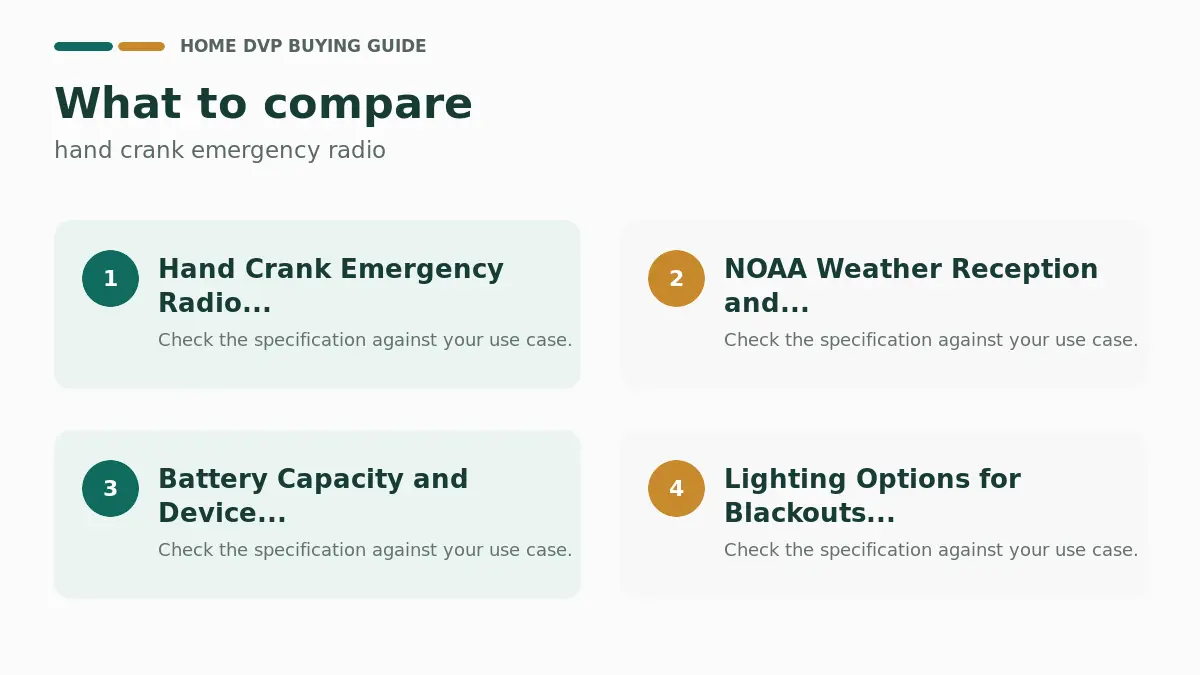
Hand Crank Emergency Radio Buying Guide
Choosing the right hand crank emergency radio requires looking beyond basic claims. Homeowners need devices that work when power is completely unavailable, deliver accurate weather information, and serve multiple roles such as lighting and device charging. The following sections break down the most important buying factors based on product specifications and real-world homeowner needs.
Power Sources and Charging Reliability
The core advantage of any hand crank emergency radio is independence from wall outlets. Look for models that combine at least three power options: hand crank, solar panel, and internal rechargeable battery. Many also accept USB input or AAA battery backup for maximum flexibility. A high-torque hand crank with an extended arm reduces effort and charges faster during prolonged outages.
Solar panels vary widely. Larger monocrystalline panels capture more light even on cloudy days, while smaller decorative panels charge very slowly. Always charge the unit fully before storing it and test the crank regularly. A common mistake is relying solely on solar without practicing hand-crank use. In a real blackout you may need quick power when sunlight is limited.
For households that experience multi-day storms, prioritize units with higher battery capacity expressed in mAh or mWh. This ensures the radio, lights, and phone charging remain available longer. Models with USB-C input offer faster and more modern recharging when electricity returns.
NOAA Weather Reception and Alert Features
Accurate weather information is one of the most valuable functions of a hand crank emergency radio. Choose models with dedicated NOAA weather band reception that can access the seven standard U.S. weather channels. Automatic weather scan and alert features lock onto the strongest signal and sound an alarm when severe weather warnings are issued.
Clear reception depends on a sensitive chip, noise-reduction circuitry, and a telescoping or external antenna. Analog tuning knobs remain popular because they work with gloved hands or in the dark. Digital displays help some users, but simple large knobs and labeled buttons often prove more reliable for older adults or stressed situations.
Homeowners in hurricane or tornado-prone regions should confirm the unit can receive local NOAA stations clearly. Test reception at home before an emergency. Pairing your radio with other preparedness steps found in our emergency supplies section creates a more complete plan.
Battery Capacity and Device Charging Ability
Battery capacity directly affects how long the radio, flashlight, and phone charging functions last. Capacities commonly range from roughly 2000mAh up to larger 10000mAh or 12000mAh true lithium packs. Higher capacity units can power a smartphone for multiple partial charges during multi-day outages.
Check whether the radio includes built-in cables (Lightning, USB-C, Micro-USB) or requires you to carry separate cables. Dual USB outputs allow charging two devices at once. Note that emergency charging is typically slower than wall chargers; it is designed to restore basic communication, not full speed charging.
A frequent homeowner error is purchasing a unit with inflated capacity claims. Look for transparent mAh or mWh ratings and read the fine print. Fully charge the battery upon arrival and top it up every few months while stored. This practice keeps the hand crank emergency radio ready for immediate use.
Lighting Options for Blackouts and Outdoor Use
Most quality models include both a focused flashlight and a softer reading or area light. Multi-mode flashlights with high, low, and SOS settings provide flexibility. Reading lamps with motion sensors or flip-up panels help at night without waking the entire household.
Brightness measured in lumens or described by beam distance (for example, several hundred feet) helps compare options. Waterproof or water-resistant ratings such as IPX6 increase reliability during storms. Compact size and non-slip grips make handheld use easier when you are moving through a dark house or campsite.
Consider how you plan to use the light. A strong beam is useful for outdoor signaling or checking exterior damage, while a warm reading light is better for indoor sheltering. Units that combine both give the most versatility for typical homeowner emergency kits.
SOS Alarms, Signaling, and Extra Safety Features
An audible SOS siren louder than 80 dB can attract attention when you need help. Some models add flashing red lights or Morse code beacon modes. Ultrasonic dog whistles and compasses appear on higher-end units and can assist search-and-rescue efforts or navigation when cell service is down.
Additional survival items such as thermal blankets or paracord bracelets bundled with certain radios increase value for outdoor-focused buyers. These extras are secondary to core radio performance but useful for comprehensive kits. Evaluate whether the extras feel like genuine additions or simply marketing filler.
Always test the SOS button once after purchase so everyone in the household knows how to activate it. Store the radio in an easily accessible location rather than buried in a closet. Pairing it with basic first-aid and lighting items creates a more complete household response plan.
Portability, Build Quality, and Everyday Practicality
Size and weight matter if you plan to keep the radio in a bug-out bag, car glove box, or travel kit. Pocket-sized models under one pound are easy to carry, while larger units with bigger batteries and solar panels offer longer runtime. Non-slip textured grips and rugged housings improve handling in wet or stressful conditions.
Look for clear labeling, large knobs, and intuitive buttons that work in low light. Waterproof ratings and shock-resistant construction increase longevity. For households with children or elderly members, simpler controls reduce confusion during an actual emergency.
Store the unit where temperature extremes are avoided and check it seasonally. A well-built hand crank emergency radio should last for years of standby use if the battery is maintained. Consider how the design fits your specific home layout and mobility needs.
Value, Brand Support, and Long-Term Ownership
Prices for reliable hand crank emergency radio typically fall within the typical price range. Lower-cost models cover essential needs for many households, while premium options add larger batteries, automatic weather alerts, stronger lights, and extra survival accessories. Focus on feature balance rather than the absolute lowest price.
Brands such as those in MidlandRadio, RunningSnail, FosPower, Raynic, Leaton, yesiwtc offer different strengths. Longer warranties and responsive customer support provide peace of mind. Lifetime technical support claims can be helpful if you encounter setup questions years later. Read the included warranty terms carefully.
Avoid models that lack clear capacity ratings or feel flimsy. Investing a bit more for proven multi-source charging and solid NOAA performance usually pays off during real emergencies. Homeowners preparing for hurricane season or frequent storms often prefer mid-to-upper range options with replaceable batteries or AA backup.
Who Should Choose Which Type of Model
Beginners and apartment renters usually do well with compact, easy-to-use units that include basic hand crank, solar, and phone charging. Families in storm-prone areas benefit from larger battery capacity and automatic NOAA alerts. Outdoor enthusiasts may prefer models bundled with thermal blankets or multi-tool bracelets.
If storage space is limited, prioritize slim pocket designs. For whole-house preparedness, consider a higher-capacity model that can charge multiple phones. Always match the radio to your most likely emergency scenarios rather than buying the most feature-packed unit available.
Reviewing these criteria against the product shortcode list above will help you narrow choices quickly. Cross-check battery size, power sources, and lighting features against your household size and risk level.
Our Research Methodology & Why You Can Trust Us
At Home DVP we approach every product category with transparent, specification-driven analysis. For this hand crank emergency radio guide we examined the listed features, battery capacities, power source combinations, NOAA capabilities, lighting specifications, and included accessories of 13 models. We compared build claims, charging methods, and practical homeowner suitability without relying on unverified marketing language.
Our ranking considerations include performance of multi-source charging, clarity and reliability of weather reception, usable battery capacity for phone charging, effectiveness of flashlights and SOS features, overall durability indicators, ease of operation for non-experts, value within the typical price range, and fit for typical home emergency kits. We also reviewed available user feedback patterns and brand support information to identify consistent strengths and potential limitations.
We do not claim hands-on laboratory testing unless product data explicitly supports it. Instead we focus on objective feature comparison and real-world homeowner use cases. Content is reviewed and refreshed to reflect current market options and specification updates. This process helps readers make informed decisions based on clear evidence rather than hype.
Readers can trust that every recommendation stays within the emergency supplies category and matches the hand crank emergency radio intent. We exclude unrelated products and only discuss models that provide genuine hand-crank and weather radio functionality.
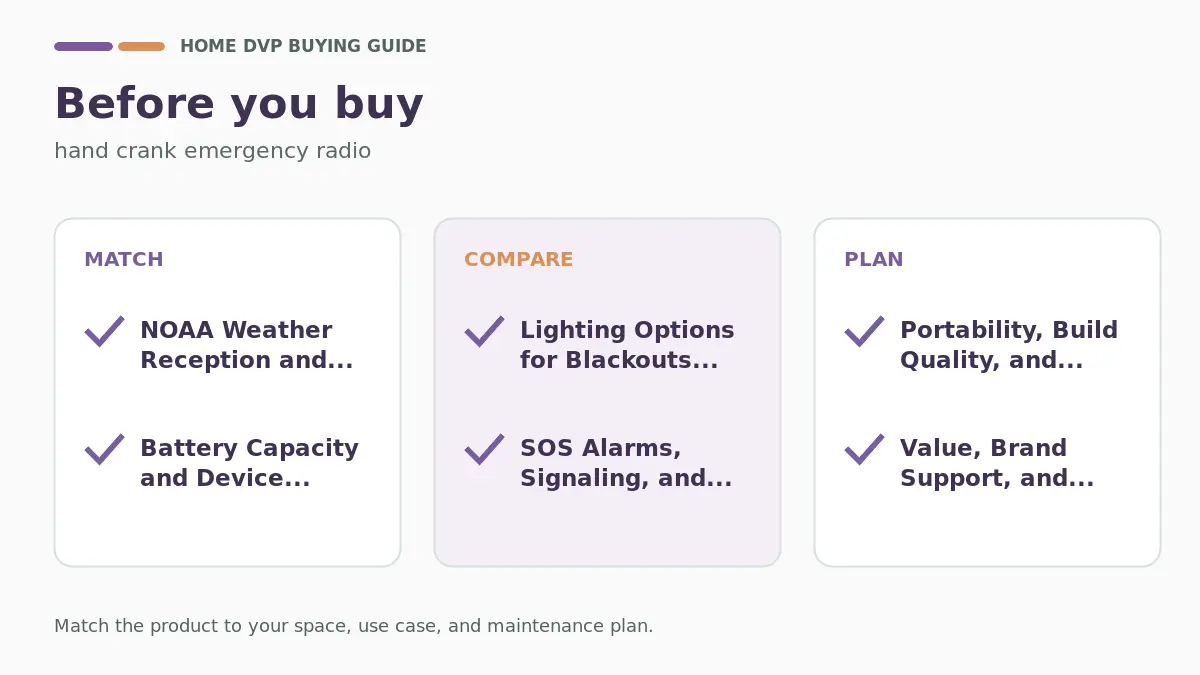
Final Thoughts
After comparing specifications across the available models, several clear standouts emerge for different homeowner needs. For an overall balanced choice that combines solid battery capacity, multiple power sources, NOAA weather scan and alert, SOS flashlight, and phone charging, the Midland ER310 stands out as a reliable premium option suited for serious household preparedness.
Budget-conscious buyers seeking essential hand crank, solar, and NOAA functions will find strong value in the RunningSnail MD-090P and the more compact RunningSnail pocket model, both of which deliver proven multi-source charging and lighting at accessible price points. The Mesqool unit with its larger true 12000mAh capacity and efficient solar panel appeals to those wanting extended runtime and dual lighting modes. Compact everyday options such as the EMGYKIT and FosPower models work well for small spaces or secondary kits, while the Leaton and vokida radios add waterproofing or bundled survival accessories for outdoor-focused users.
Select based on your primary scenario: home blackout readiness, storm season, or portable camping use. Fully charge any new radio, test the crank and NOAA reception, and store it in an accessible location. Pairing a quality hand crank emergency radio with other items from our emergency supplies category and related home preparedness resources creates a more complete safety plan. Check back for updates as new models appear.
Frequently Asked Questions
What should I look for when choosing hand crank emergency radio?
Prioritize multiple power sources including hand crank, solar, and rechargeable battery, clear NOAA weather band reception, adequate battery capacity for phone charging, useful flashlight modes, and an SOS alarm. Also consider size, ease of controls, and build quality for your specific home or outdoor needs. Matching these features to your most likely emergency scenarios leads to better long-term satisfaction.
Are higher-end hand crank emergency radio worth it?
Higher-end models often provide larger true battery capacity, automatic weather scan and alert, stronger lighting, better waterproofing, and extra survival tools. For households in high-risk weather areas or those wanting multi-day runtime, the added features and durability usually justify the cost. Basic models remain perfectly adequate for lighter preparedness needs within the typical price range.
How should beginners choose hand crank emergency radio?
Beginners should start with a compact model that has simple large knobs, clear labels, three power sources, and a basic flashlight plus SOS function. Avoid overly complex units with many extra modes until you understand your real usage. Fully charge the device on arrival, practice the hand crank, and store it with your other emergency items for easy access.
How long should quality hand crank emergency radio last?
With proper battery maintenance and occasional testing, a well-built unit can remain ready for many years of standby service. Rechargeable lithium batteries gradually lose capacity over time, so periodic top-up charging every few months helps. Hand crank and solar components typically outlast the battery itself when the housing stays intact.
What brands make reliable hand crank emergency radio?
Established options from MidlandRadio, RunningSnail, FosPower, Raynic, Leaton, yesiwtc consistently appear with solid feature sets and positive specification transparency. Look for clear capacity ratings, multi-source charging, and warranty support rather than brand name alone. Comparing the actual power sources and NOAA capabilities across models is more important than any single logo.
How much should homeowners expect from hand crank emergency radio in 2026?
Most capable models fall within the typical price range and deliver hand crank, solar, NOAA reception, flashlight, and emergency phone charging. Spending toward the middle or upper end of that range usually secures higher battery capacity and automatic alerts. Extremely low-priced units may compromise on real capacity or build quality, so balance cost against the features you will actually use.
Are hand crank emergency radio suitable for DIY projects, home repairs, or regular maintenance?
While primarily designed for emergencies, many homeowners keep a hand crank emergency radio in the garage or workshop for power outages during repairs or storms. The flashlight and phone charging functions prove useful during home maintenance when electricity is temporarily unavailable. They also complement other tools and preparedness items found across our hardware and emergency categories for complete household readiness.