
For location-based weather alerts under $50, the Midland WR120B stands out because it supports S.A.M.E. programming for up to 25 counties and alerts for more than 60 hazard types. If you also need a flashlight, reading lamp, hand crank, solar charging, or phone charging, compare the portable radios below—but their supplied descriptions do not establish S.A.M.E. alert support.
The portable models list NOAA weather-band reception and several backup-power features. Product ratings are shown as supplied; each listing reports zero reviews, so ratings offer little basis for comparing buyer experience.
Compare emergency radios under $50
| Model | Supported features | Best fit |
|---|---|---|
| Midland – WR120B – NOAA Emergency Weather Alert | S.A.M.E. localized programming; alerts for over 60 hazards; up to 25 counties; alert indicators | Home users who want county-specific alerts |
| Emergency Weather Radio with Large Solar Panel (Roxicosly, B0F4XKLQDK) | AM/FM/NOAA bands; 12,000mAh battery; solar panel; hand crank; flashlight; reading lamp; SOS alarm | People prioritizing lighting and backup charging |
| Emergency Radio with Hand Crank & Solar (OnLyee) | AM/FM/WB; 12,000mAh battery; solar panel; hand crank; Type-C input; flashlight; reading lamp; SOS alarm; IPX6 rating claimed by seller | People seeking multiple power options and rain resistance |
| Emergency Weather Radio with Large Solar Panel (Roxicosly, B0F4XHC2YL) | Same listed feature set as Roxicosly B0F4XKLQDK | Compare exact listing details before choosing; supplied descriptions are duplicates |
| NOAA Weather Radio-12000mAh/44400mWh AM/FM (PPLEE) | AM/FM/NOAA; 12,000mAh battery; solar panel; hand crank; AAA battery option; flashlight; lamp; SOS siren | People who want listed AAA backup batteries alongside rechargeable power |
What matters most in this comparison
Choose alert behavior before extra features
The Midland WR120B is the only listed model whose supplied details specify S.A.M.E. localized programming. You can program up to 25 counties, and the radio lists alerts for more than 60 kinds of weather hazards and emergencies. That makes it the clearest fit here if you want alerts limited to selected areas.
The other four descriptions list NOAA weather-band reception or broadcasts, but do not document S.A.M.E. programming or automatic alert behavior. OnLyee says its radio must be powered on and tuned to a NOAA station to receive broadcasts. Do not assume that NOAA-band reception alone means the radio will wake up and warn you while tuned elsewhere. Confirm alert mode, power state, and setup requirements in the exact model’s manual before relying on it.
Decide whether backup power and lights justify tradeoffs
The portable models add features useful during outages: rechargeable batteries, hand cranks, solar panels, lights, and phone charging. PPLEE also lists three AAA batteries as an alternate power source. These features do not replace a dedicated alert function, and the supplied descriptions do not provide comparable recharge times or tested phone-charge results.
OnLyee lists an IPX6 water-resistance rating, while Roxicosly also claims IPX6 protection. Treat those as seller-stated specifications, not independent test results. Check the product documentation for limits on exposure and charging before using any radio in wet conditions.
Product details
Midland: localized alert focus
Midland – WR120B – NOAA Emergency Weather Alert costs $47.00 in the supplied data. Its S.A.M.E. feature lets users program specific counties, with support for up to 25 counties and color-coded alert indicators. The description also lists continuous backlighting and an alert override. Choose it when alert targeting matters more than a crank, solar panel, or phone-charging features; those features are not listed for this model.
OnLyee: multiple charging options
Emergency Radio with Hand Crank & Solar costs $49.99. Its listing specifies a 12,000mAh battery, solar panel, hand crank, and Type-C charging input, plus a flashlight, reading lamp, and SOS alarm. It lists AM/FM/WB reception and IPX6 water resistance. The supplied description does not establish S.A.M.E. alerts, so verify alert behavior if that is a requirement.
Roxicosly: two listings with matching supplied details
Emergency Weather Radio with Large Solar Panel and the second Emergency Weather Radio with Large Solar Panel both cost $49.99 and have matching supplied feature descriptions. Those descriptions list AM/FM/NOAA bands, a 12,000mAh battery, solar charging, a hand crank, dual lights, an SOS alarm, and an IPX6 claim. The data provided does not show a meaningful feature difference; compare the exact listings and manuals rather than treating them as distinct choices.
PPLEE: AAA battery option
NOAA Weather Radio-12000mAh/44400mWh AM/FM costs $49.99. The listing describes a 12,000mAh rechargeable battery, solar panel, hand crank, and support for three AAA batteries. It also lists AM/FM/NOAA reception, a flashlight, a lamp, an SOS siren, and a headphone jack. The description does not specify S.A.M.E. alert programming. Its runtime figures and charging claims are manufacturer statements, not independently verified results.
How to choose
- Choose Midland if county-specific alert programming is your main requirement.
- Choose a portable crank-and-solar model if lighting and backup charging matter, and verify whether it provides automatic alerts.
- Choose PPLEE if the listed AAA battery option matters; confirm battery requirements in the manual.
- Before an emergency, check local reception, set up alert preferences, and learn how the radio must be powered and tuned to receive warnings.
For more backup-power options, see our solar emergency radio overview and portable power station guide. A radio’s phone-charging feature is a backup, not a substitute for planning how to keep essential devices powered.

Pros
- S.A.M.E. localized programming delivers precise area-specific emergency notifications
- NOAA Weather Scan covers over 60 kinds of weather hazards and emergencies automatically
Cons
- Initial entry of S.A.M.E. codes and county selections may require research and extra setup time for first-time users
- Primarily focused on weather and emergency alerts rather than general listening or entertainment features
Specifications
| Additional Features | SOS Alarm |
|---|---|
| Connectivity Technology | AC Power Adapter |
| Tuner Type | FM |
| Power Source | Corded Electric, Battery |
| Radio Bands Supported | 1-Band |
| Frequency | 108 MHz |
| Compatible Devices | Devices capable of receiving NOAA weather alerts |
| Number of Batteries | 6 AAA batteries required. |
| Smart Home Compatibility | Not Smart Home Compatible |
| Display Type | LCD |
Verify the current product variation before purchase; specifications may change.
Best For / Avoid If
Best for buyers prioritizing
- S.A.M.E. localized programming delivers precise area-specific emergency notifications
- NOAA Weather Scan covers over 60 kinds of weather hazards and emergencies automatically
- Supports programming of up to 25 counties for broader yet targeted monitoring
Consider another option if
- Initial entry of S.A.M.E. codes and county selections may require research and extra setup time for first-time users
- Primarily focused on weather and emergency alerts rather than general listening or entertainment features
- Users wanting expanded two-way communication may need to explore other models in the Midland range

Pros
- Combines radio alerts, lighting, SOS signaling and phone charging in one emergency device.
- Multiple charging methods improve usefulness when power access is limited.
Cons
- A full charge with a 5V/1A charger is listed at 18 to 20 hours, so advance charging is important.
- Solar and crank charging are best viewed as backup options rather than the fastest way to fully recharge the battery.
Best For / Avoid If
Best for buyers prioritizing
- Combines radio alerts, lighting, SOS signaling and phone charging in one emergency device.
- Multiple charging methods improve usefulness when power access is limited.
- Large listed battery capacity is well suited for emergency preparedness kits.
Consider another option if
- A full charge with a 5V/1A charger is listed at 18 to 20 hours, so advance charging is important.
- Solar and crank charging are best viewed as backup options rather than the fastest way to fully recharge the battery.
- Users who only need a basic weather radio may find the added power bank and lighting features more than necessary.

Pros
- Multiple charging methods keep the radio and devices powered when outlets are unavailable
- Combined flashlight, reading light, and SOS functions expand usefulness beyond basic weather listening
Cons
- NOAA reception requires the unit to stay powered on and manually tuned to the station
- Solar recharging depends on available sunlight and may take longer under cloudy conditions
Specifications
| Additional Features | 120dB SOS Alarm & Flashing Beacon, Massive 12,000mAh Rechargeable Battery, Military-Grade Hand Crank Generator, Oversized 8500mm² Monocrystalline Solar Panel, Water-Resistant (IPX6), Dustproof & Shockproof |
|---|---|
| Connectivity Technology | USB |
| Tuner Type | AM/FM/NOAA WEATHER RADIO |
| Power Source | Solar Panel | Hand Crank | 12000mAh Lithium Battery | USB-C Input 5V/2A | 3 AAA Batteries |
| Radio Bands Supported | 7-Band NOAA WEATHER RADIO, AM/FM |
| Frequency | 108 MHz |
| Compatible Devices | Headphone, Receiver, Smartphone, Speaker |
| Voltage | 5 Volts |
| Speaker Maximum Output Power | 5 Watts |
| Number of Batteries | 1 C batteries required. (included) |
Verify the current product variation before purchase; specifications may change.
Best For / Avoid If
Best for buyers prioritizing
- Multiple charging methods keep the radio and devices powered when outlets are unavailable
- Combined flashlight, reading light, and SOS functions expand usefulness beyond basic weather listening
- Multi-band reception including NOAA supports storm tracking for home, RV, and camping preparedness
Consider another option if
- NOAA reception requires the unit to stay powered on and manually tuned to the station
- Solar recharging depends on available sunlight and may take longer under cloudy conditions
- Hand crank recharging involves manual effort that some users may find tiring for extended sessions

Pros
- Real 12000mAh capacity supports extended lighting and device charging without exaggerated claims
- Reinforced crank arm with high-efficiency dynamo enables quick manual power generation in emergencies
Cons
- Full battery recharge through a 5V/1A adapter requires 18 to 20 hours based on listed details
- Larger solar panel surface may feel bulkier for users seeking the most compact emergency radios
Specifications
| Additional Features | Portable, Rechargeable |
|---|---|
| Connectivity Technology | USB |
| Tuner Type | AM/FM/WB |
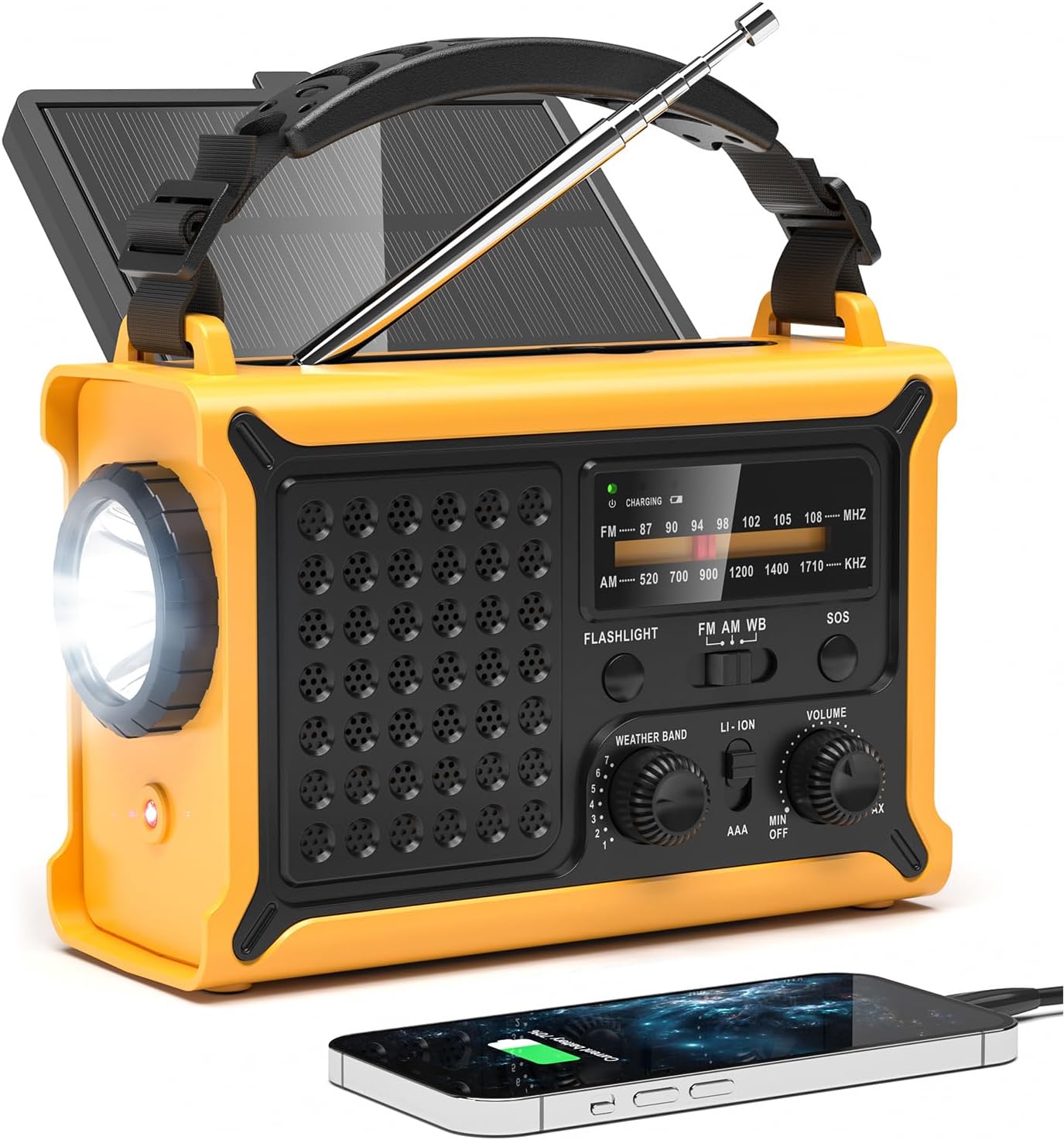
| Power Source | Built-in Battery/Type-C Corded/Solar Panel/Hand Crank/AAA Batteries |
| Radio Bands Supported | AM/FM/7 NOAA Bands |
| Compatible Devices | MP3 Player, Flash Drive |
| Smart Home Compatibility | Not Smart Home Compatible |
| Display Type | Tuner |
| Water Resistance Level | Waterproof |
| Color | Yellow |
Verify the current product variation before purchase; specifications may change.
Best For / Avoid If
Best for buyers prioritizing
- Real 12000mAh capacity supports extended lighting and device charging without exaggerated claims
- Reinforced crank arm with high-efficiency dynamo enables quick manual power generation in emergencies
- Adjustable dual lights and SOS alarm enhance visibility and signaling during blackouts or outdoor use
Consider another option if
- Full battery recharge through a 5V/1A adapter requires 18 to 20 hours based on listed details
- Larger solar panel surface may feel bulkier for users seeking the most compact emergency radios
- Manual cranking still demands physical effort for prolonged power needs beyond short bursts
Pros
- Multiple independent charging methods reduce the risk of complete power loss in emergencies
- Listed battery capacity supports long runtimes for radio, lighting, and phone charging
Cons
- Solar charging performance depends on available sunlight and may slow under cloudy conditions
- Hand crank operation requires physical effort to generate meaningful charge during outages
Best For / Avoid If
Best for buyers prioritizing
- Multiple independent charging methods reduce the risk of complete power loss in emergencies
- Listed battery capacity supports long runtimes for radio, lighting, and phone charging
- Dedicated NOAA weather bands lock quickly for timely severe weather information
Consider another option if
- Solar charging performance depends on available sunlight and may slow under cloudy conditions
- Hand crank operation requires physical effort to generate meaningful charge during outages
- Added features such as the solar panel and large battery can make the unit less compact for minimalist packing
Have questions about our emergency radio recommendations? Check out our How We Rank page for details on our review process or our Copyright Policy for information on content usage.