
Choosing Portable AC for Apartment is not as simple as picking the highest BTU rating or the lowest sticker price. Apartment cooling comes with practical constraints: limited floor space, window compatibility, lease restrictions, noise concerns, drainage needs, and electrical load. Renters and homeowners also need to think about whether a unit can cool a bedroom, studio, living room, or home office without permanent installation.
After carefully analyzing the available specifications, we compared 15 products across cooling capacity, room coverage, controls, installation requirements, mobility, humidity management, noise ratings, energy features, and apartment-friendly usability. This guide focuses on options that clearly fit the Heating, Cooling & Air category and are relevant to renters, condo owners, and homeowners who want flexible cooling without central air upgrades. For broader climate-control planning, see our Heating, Cooling & Air category.
Based on the product data provided, most relevant models fall into three practical groups: compact portable AC units for bedrooms and small apartments, midrange models for everyday living spaces, and higher-output or smart units for larger rooms. We also included guidance on evaporative air coolers, which can be useful in dry environments but should not be confused with compressor-based portable air conditioners.
For an independent technical reference, the U.S. Department of Energy portable air conditioner guidance defines portable air conditioners as refrigeration-based equipment that delivers cooled air to an enclosed space, which is different from a simple fan or evaporative cooler.
Portable AC for Apartment Buying Guide
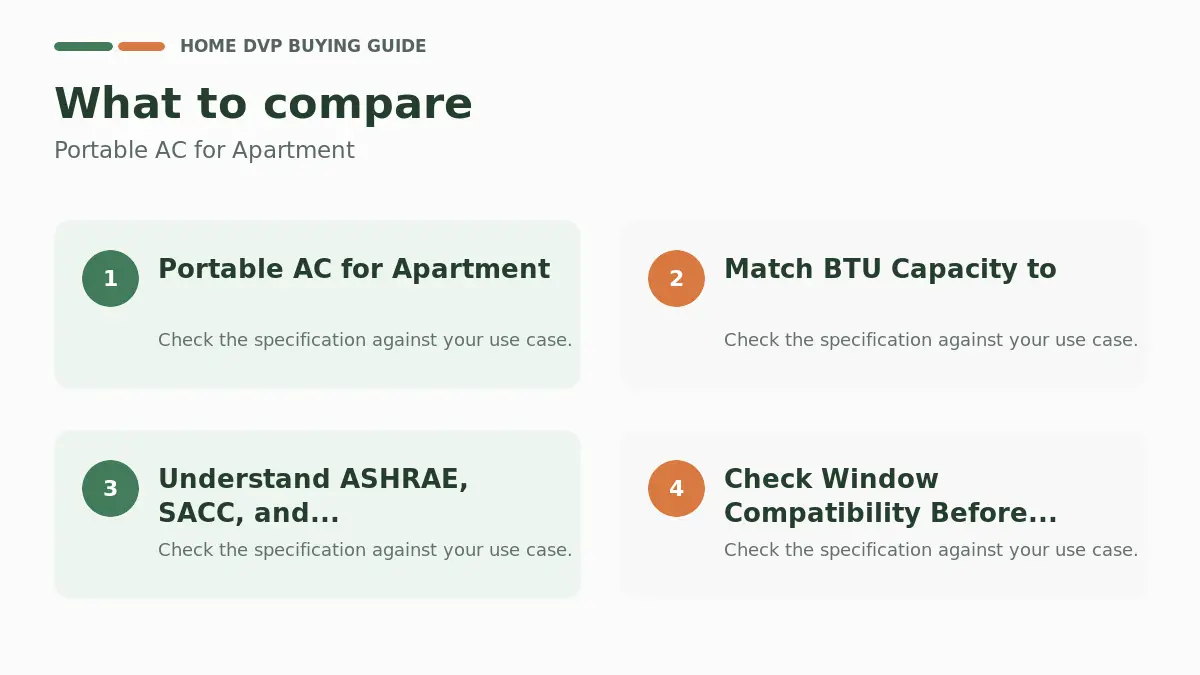
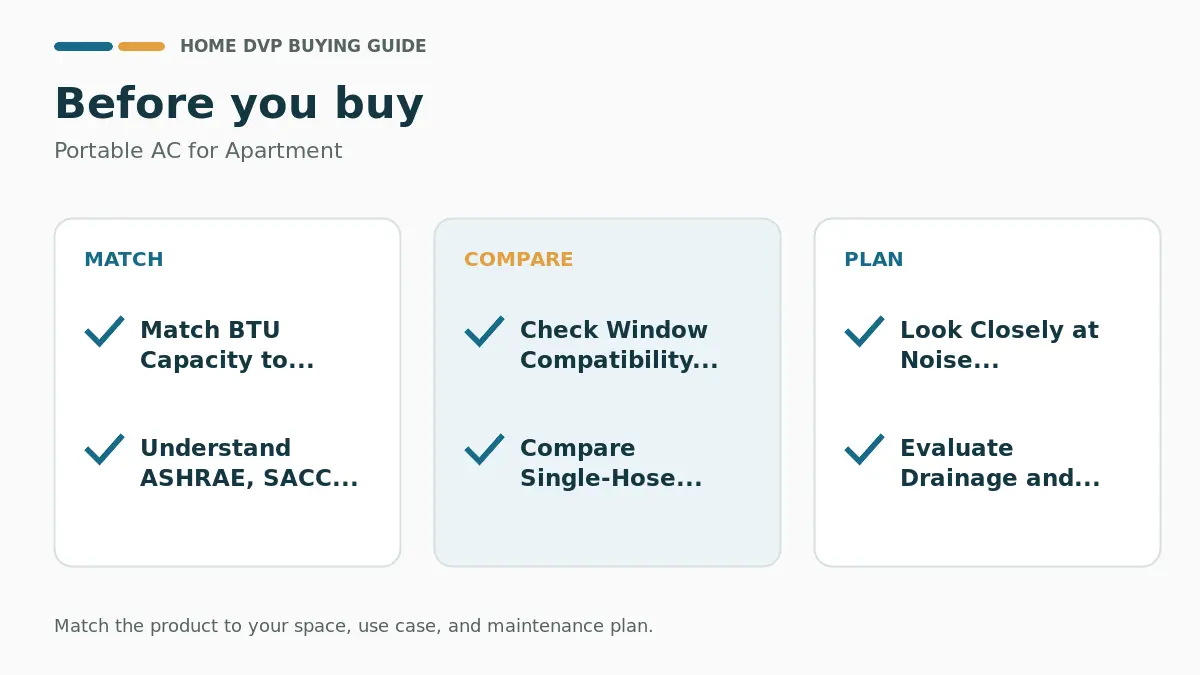
Match BTU Capacity to Apartment Size
Cooling capacity is one of the most important specifications when choosing portable ac for apartment. Smaller units such as the Garvee 8000 BTU Portable Air Conditioner and DREO Portable Air Conditioner 318S are better suited to bedrooms, dorm-style spaces, home offices, and compact apartments. Larger models such as the VACOOR 14000 BTU Portable Air Conditioner, HUMHOLD 14000 BTU Portable Air Conditioners, and ZAFRO Smart Inverter Portable Air Conditioners are designed for bigger rooms or open living areas.
A common mistake is buying more cooling power than the room can realistically use. Oversized units may cycle more often, take up extra floor space, and cost more to run. Undersized units can run continuously and still leave the room uncomfortable during heat waves. For apartments, measure the room, consider ceiling height, sun exposure, and whether the room connects to a hallway or kitchen.
| Apartment Situation | What to Prioritize |
|---|---|
| Small bedroom or home office | Compact footprint, lower noise, simple window kit |
| Studio apartment | Balanced BTU rating, strong airflow, timer control |
| Open living room | Higher BTU rating, better air circulation, dehumidifier mode |
| Hot upper-floor apartment | Fast cooling, sleep mode, efficient operation |
Understand ASHRAE, SACC, and Real Cooling Expectations
Portable air conditioners may list more than one cooling rating. ASHRAE ratings often appear higher, while SACC or DOE ratings can better reflect real-world portable AC performance after accounting for heat from the exhaust system. For example, some DREO and ZAFRO models provide both ASHRAE and SACC-style figures, which helps shoppers compare performance more realistically.
For apartment use, do not rely on the biggest number alone. Look at the full feature set: airflow direction, exhaust setup, room coverage claim, compressor efficiency, and whether the unit includes a proper window kit. The KoolSiln 12,000 BTU Portable Air Conditioner, for instance, emphasizes auto-evaporation and quiet operation in addition to cooling capacity, which may matter more than raw output in a bedroom or office.
If you are trying to reduce humidity as well as temperature, compare dehumidifier capacity and drainage options. In humid apartments, a portable AC with a dry mode may make the room feel more comfortable even when the thermostat setting is not extremely low. For more information on moisture management, see our guide to dehumidifier drain hose setup.
Check Window Compatibility Before You Buy
Most compressor-based portable AC units require an exhaust hose and window venting kit. That matters in apartments because not every window style works easily with standard panels. Sliding windows, double-hung windows, and some horizontal windows are commonly supported, while casement windows, crank-out windows, and balcony doors may need extra sealing accessories.
Several relevant models include window kits in the product data, including the Garvee 8000 BTU Portable Air Conditioner, Feelfunn 10,000 BTU Portable Air Conditioner, HUMHOLD 14000 BTU Portable Air Conditioners, VACOOR 14000 BTU Portable Air Conditioner, and KoolSiln 12,000 BTU Portable Air Conditioner. Before ordering, measure the window opening and compare it with the listed panel range. Renters should also confirm that the installation does not require drilling or permanent modification.
A poor window seal reduces cooling performance and can let warm outdoor air leak back inside. If your apartment has high humidity, gaps around the exhaust panel can also make the AC work harder. Good sealing is one of the easiest ways to improve portable AC comfort without changing the unit itself.
Compare Single-Hose, Dual-Hose, and Evaporative Designs
Most apartment portable AC units use a hose to vent hot air outdoors. Single-hose models are common and easier to install, while dual-hose models can improve efficiency by separating intake and exhaust airflow. The ZAFRO Smart Inverter Portable Air Conditioners stands out in the provided data because it uses a dual hose system and inverter technology, making it a premium-style choice for shoppers prioritizing efficiency and stronger cooling control.
Evaporative air coolers are different. The CoamoTrail 4 in 1 Evaporative Air Cooler uses water, mist, and airflow rather than compressor-based refrigeration. It may help in dry climates or for personal cooling, but it is not the same as a true portable AC for a humid apartment. In humid regions, evaporative cooling can add moisture to the room, which may not be desirable.
For renters who cannot vent through a window, an evaporative cooler may be tempting because it requires no exhaust hose. However, buyers should set realistic expectations. If your primary goal is to lower room temperature significantly during a hot, humid summer, a vented compressor-based portable AC is usually the more appropriate category.
Look Closely at Noise Ratings for Bedrooms and Shared Walls
Apartment cooling is not just about temperature. Noise can affect sleep, work-from-home calls, and neighbors in buildings with thin walls. Several models in the provided data list low operating noise claims, including DREO Portable Air Conditioner 515S, DREO Portable Air Conditioner 318S, KoolSiln 12,000 BTU Portable Air Conditioner, HUMHOLD 14000 BTU Portable Air Conditioners, Feelfunn 10,000 BTU Portable Air Conditioner, and ZAFRO Smart Inverter Portable Air Conditioners.
When comparing noise ratings, remember that compressor cycling, fan speed, floor vibration, and installation quality all influence perceived sound. A unit on hard flooring may sound louder if it rattles against trim, furniture, or an uneven surface. In bedrooms, sleep mode, display dimming, timer settings, and lower fan speeds are especially helpful.
If you are sensitive to noise, prioritize models with sleep mode and lower listed sound levels rather than only looking at cooling output. Smart controls can also help because you can pre-cool the room before bedtime and reduce fan speed overnight.
Evaluate Drainage and Humidity Control
Portable AC units remove moisture from indoor air as they cool. Some models evaporate much of that condensate through the exhaust hose, while others may need occasional draining, especially in humid climates or dry mode. Apartment shoppers should check whether the unit has a self-evaporating system, a drain hose option, a full-water alert, or continuous drainage capability.
The DREO Portable Air Conditioner 515S, DREO Portable Air Conditioner 318S, ZAFRO Smart Inverter Portable Air Conditioners, KoolSiln 12,000 BTU Portable Air Conditioner, VACOOR 14000 BTU Portable Air Conditioner, and HUMHOLD 14000 BTU Portable Air Conditioners all include drainage-related features in the available product information. These details matter if the unit will run for long hours in a bedroom, basement apartment, or humid living room.
Do not ignore maintenance access. A removable washable filter, clear drain location, and easy-to-reach rear panel can make regular care simpler. For related humidity and indoor comfort topics, our Air Quality & Climate section offers more climate-control resources.
Consider Smart Controls, Timers, and Daily Convenience
Remote controls, LED panels, timers, app control, and voice assistant compatibility can make portable ac for apartment more practical in everyday apartment life. If the unit sits across the room or near a window, being able to change settings from bed or a sofa is more than a luxury. It can also help reduce energy use by running the unit only when needed.
The DREO Portable Air Conditioner 515S and DREO Portable Air Conditioner 318S include app, voice, and remote-control functionality according to the provided specifications. The ZAFRO Smart Inverter Portable Air Conditioners also emphasizes app control, scheduling, and smart modes. Simpler models such as Garvee, Feelfunn, CARLOX, KoolSiln, VACOOR, and HUMHOLD still offer practical controls such as remotes, timers, sleep modes, and display panels.
Smart features should support comfort, not complicate it. Beginners may prefer a straightforward remote and clear display. Tech-focused homeowners may appreciate app scheduling, smart-home integration, and energy-saving modes. If you also use connected climate controls, our comparison of smart thermostat vs programmable thermostat options may help you think through broader home cooling strategy.
Balance Price, Features, and Long-Term Value
The listed options span several price tiers, so value depends on what your apartment actually needs. A compact unit can be a smart buy for a single bedroom, while a higher-capacity smart or inverter model may be worth considering for an open apartment, top-floor room, or space that gets strong afternoon sun.
Do not pay extra for capacity or smart features you will not use. At the same time, avoid choosing only by the lowest price if the unit lacks adequate room coverage, window compatibility, or drainage convenience. Based on our detailed comparison, the strongest value usually comes from matching the AC to the room and choosing features that reduce daily friction, such as a washable filter, remote control, sleep mode, and reliable venting kit.
| Feature | Why It Matters in Apartments |
|---|---|
| Window kit | Allows temporary installation without permanent building changes |
| Sleep mode | Improves overnight comfort and reduces disruption |
| Dehumidifier mode | Helps with sticky indoor air and humid rooms |
| Casters and handles | Makes it easier to move between rooms |
| App or remote control | Improves convenience in bedrooms and living rooms |
Our Research Methodology & Why You Can Trust Us
We evaluated the products based on available product information, user-facing specifications, stated cooling capacity, room-size claims, operating modes, installation requirements, drainage features, noise-related details, energy-related features, and apartment suitability. We did not claim hands-on testing because the provided data does not confirm physical testing by our team.
Our research indicates that category fit is especially important for portable ac for apartment. We separated compressor-based portable air conditioners from evaporative air coolers and considered how each type fits real apartment use. Products that clearly matched Heating, Cooling & Air needs were considered for discussion, while unrelated categories were excluded from recommendations.
Ranking criteria included performance potential, features, build-quality indicators, ease of use, durability signals, safety-related convenience, value, reliability, and homeowner or renter use-case fit. We also looked at practical ownership details such as washable filters, window installation, caster mobility, remote operation, timer settings, and moisture handling.
This guide is updated during July 2026 to keep recommendations aligned with current product information. Because prices, availability, and product listings can change, readers should verify current details before buying and prioritize the model that best matches their room size, window type, and comfort needs.
Final Thoughts
For an overall apartment-friendly pick, the VACOOR 14000 BTU Portable Air Conditioner is a strong fit for larger rooms because it combines high cooling capacity, a 3-in-1 design, upward airflow, sleep mode, wheels, handles, and a renter-friendly window kit. It is best suited to apartments, living rooms, and bedrooms where stronger airflow and broader coverage are priorities.
For smaller apartments or bedrooms, the Garvee 8000 BTU Portable Air Conditioner stands out as a value-oriented option with cooling, dehumidifying, fan mode, remote control, timer, compact mobility, and an included window kit. For shoppers who want smart controls and quiet operation, the DREO Portable Air Conditioner 515S and DREO Portable Air Conditioner 318S are worth considering based on their app, voice, remote, drainage-free, and low-noise feature sets.
For premium performance, the ZAFRO Smart Inverter Portable Air Conditioners offers dual-hose cooling, inverter technology, smart controls, and efficiency-focused operation. If your apartment is humid, compare drainage features carefully and consider related indoor comfort planning through our cool mist vs warm mist humidifier guide, especially if you are balancing cooling with overall air comfort.
FAQ
What should I look for when choosing portable ac for apartment?
Start with room size, window compatibility, and cooling capacity. Then compare noise level, sleep mode, timer controls, drainage options, and whether the unit includes a window venting kit. Apartment shoppers should also confirm that installation does not require permanent changes.
Are higher-end portable ac for apartment worth it?
Higher-end models can be worth it if you need stronger cooling, quieter operation, smart controls, inverter efficiency, or a dual-hose design. They may not be necessary for a small bedroom or occasional use. The best value comes from matching the unit to your actual room and comfort needs.
Do portable AC units need to be vented through a window?
Compressor-based portable AC units typically need an exhaust hose vented outdoors. Without venting, hot air stays in the room and cooling performance drops. Evaporative coolers do not need exhaust venting, but they are a different product type and work best in dry conditions.
How important is dehumidifier mode in an apartment?
Dehumidifier mode can be very useful in humid apartments because removing moisture helps the room feel cooler and less sticky. It is especially helpful in bedrooms, basement apartments, and poorly ventilated spaces. For drainage planning, our dehumidifier drain hose guide explains related moisture-control considerations.
Can portable ac for apartment cool an entire apartment?
Most portable AC units are designed to cool one room or a defined open area, not an entire multi-room apartment. A larger unit may help in a studio or open living space, but closed doors, hallways, kitchens, and sun exposure affect performance. For whole-apartment comfort, you may need strategic placement or more than one cooling solution.
Related Apartment Cooling Guides
- apartment air conditioner installation steps
- apartment air conditioner guide
- best portable air conditioner roundup
Portable AC for Apartment Checklist
A portable AC for apartment use should fit the room’s actual cooling load, the available outlet, and the permitted exhaust route. For bedrooms, a portable AC for apartment living also needs quiet low-speed operation and a display that can be dimmed at night. Before buying a portable AC for apartment layouts, measure the window or sliding-door opening and confirm where condensate will drain.