
Choosing Apartment Air Conditioner is not as simple as picking the highest BTU rating or the lowest shelf price. Apartment dwellers often have lease rules, limited window types, shared walls, small bedrooms, open-plan living areas, and electrical limits to consider. An updated guide matters because today’s models range from compact window units to smart inverter designs and portable systems with dehumidifier modes, sleep settings, remote controls, and no-drill window kits.
After carefully analyzing the available specifications, we compared 15 products across cooling capacity, room-size suitability, installation requirements, noise ratings, energy features, drainage needs, controls, filter maintenance, and renter-friendly setup. We focused on models that clearly fit the Heating, Cooling & Air category and make practical sense for apartments, bedrooms, home offices, dorm rooms, and small living spaces. For broader climate-control planning, you can also explore our Heating, Cooling & Air category.
Based on our detailed comparison, the strongest choice depends on your space. A small bedroom may only need a compact window unit, while a larger living room may call for a portable unit with higher capacity and a window exhaust kit. This guide explains how to compare apartment air conditioner without overbuying, undercooling, or choosing a model that creates installation problems with your lease or window style.
For an independent technical reference, the U.S. Department of Energy home-cooling overview explains the main home cooling approaches and reinforces the importance of proper sizing, efficiency, and safe installation.
Apartment Air Conditioner Buying Guide
Apartment cooling has a different set of priorities than whole-house HVAC. You may need a unit that installs without permanent changes, runs quietly enough for a bedroom, fits a narrow window, or moves between rooms on casters. The right apartment air conditioner should match the room, the window, the noise tolerance of nearby neighbors or roommates, and the amount of maintenance you are willing to handle during hot weather.
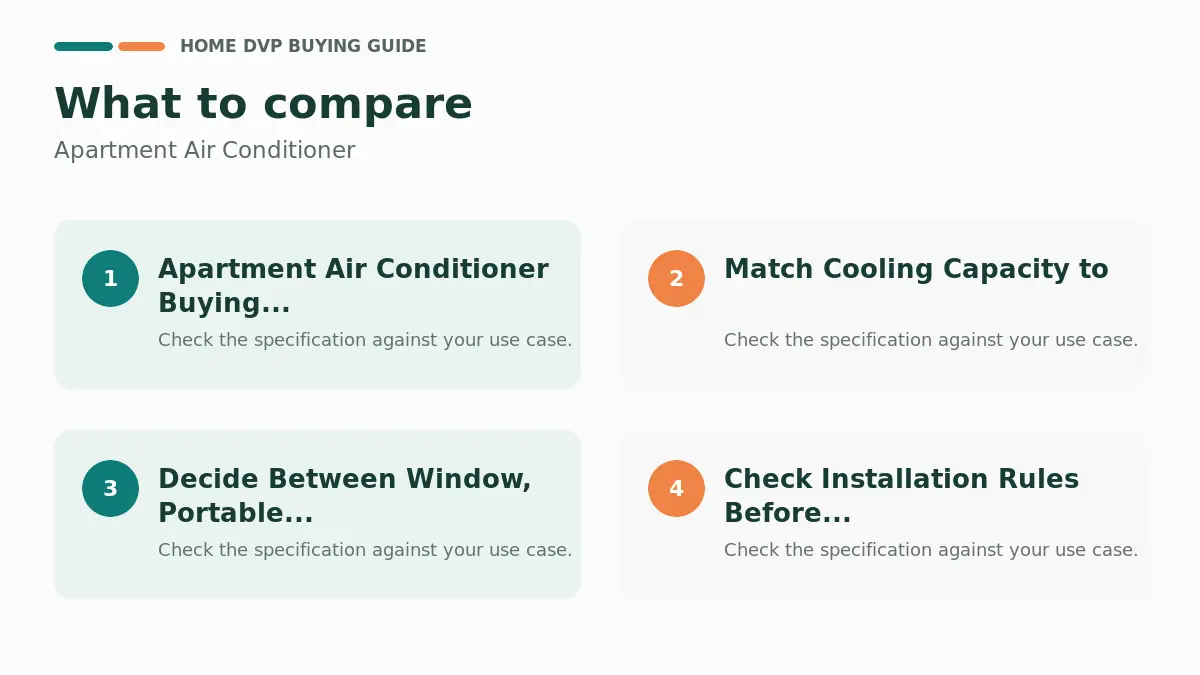
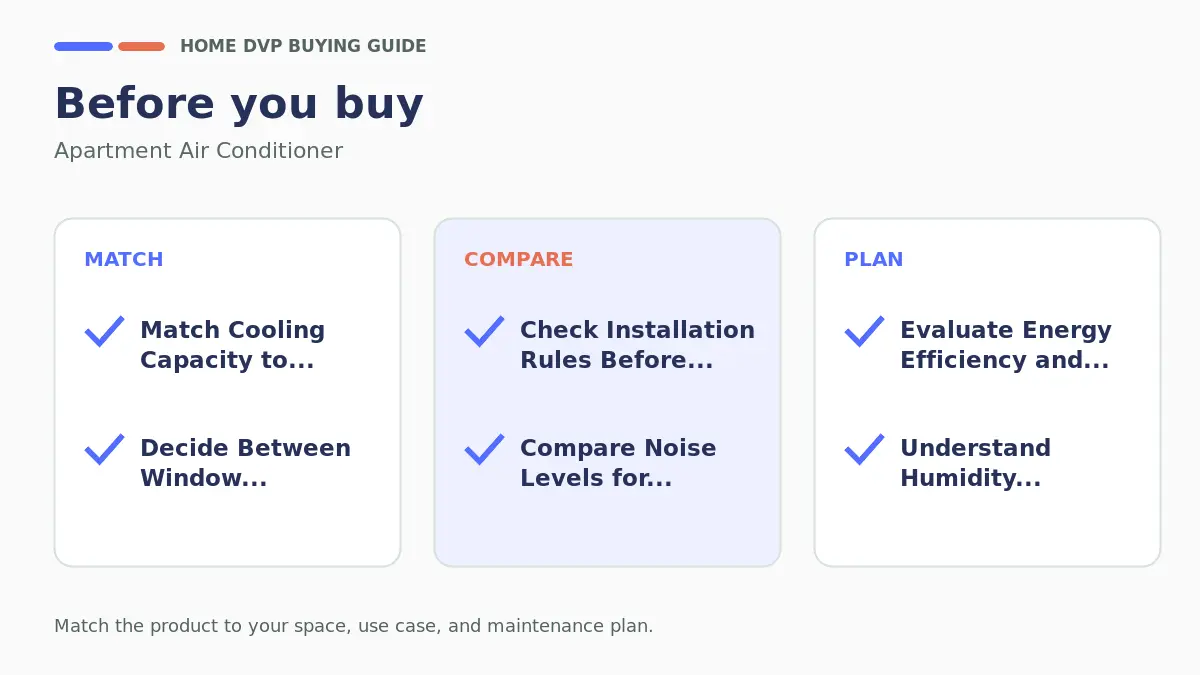
Match Cooling Capacity to Your Actual Room Size
Cooling capacity is one of the most important specifications, but it is also one of the most misunderstood. Compact window units such as the Frigidaire window-mounted air conditioner, Amazon Basics window air conditioner, and Midea EasyCool window air conditioner are designed for smaller rooms. These are often better fits for bedrooms, studio sleeping areas, or home offices where a larger unit could cycle too quickly and leave the room feeling humid.
For larger apartment living rooms or open layouts, portable units such as the VACOOR portable air conditioner, Feelfunn portable air conditioner, Air Future portable air conditioner, and DREO portable air conditioner offer stronger room coverage. These models are useful when a window unit is not allowed, when you need to move cooling between rooms, or when you want combined cooling, fan, and dehumidifier functions. The tradeoff is that portable AC units require floor space and an exhaust hose connection.
A common mistake is buying the largest unit available for a small bedroom. Oversizing can increase noise, waste energy, and reduce humidity removal because the compressor may not run long enough. Undersizing is just as frustrating because the unit runs constantly without reaching a comfortable temperature. Measure the room, account for sun exposure, ceiling height, and kitchen heat, then choose capacity accordingly.
| Apartment Situation | Practical Cooling Direction |
|---|---|
| Small bedroom or home office | Consider compact window units with quiet operation and washable filters. |
| Medium bedroom or studio area | Look at smart window units or portable AC units with sleep mode and remote control. |
| Larger living room or open space | Compare higher-capacity portable units with stronger airflow and dehumidifier mode. |
| Desk, dorm, or personal spot cooling | Personal evaporative units can help nearby comfort but should not replace true room air conditioning. |
Decide Between Window, Portable, and Personal Cooling Designs
Window air conditioners are usually efficient for small rooms because the hot side of the system sits outside the window opening. The Frigidaire window-mounted air conditioner and Amazon Basics window air conditioner are straightforward mechanical-control options for small spaces, while the Midea U-shaped smart inverter models add quieter operation, smart controls, and the ability to open the window with the unit installed. If your lease allows window units and your window dimensions match the product requirements, this format is often space-saving.
Portable air conditioners are often more renter-friendly because they usually rely on a window exhaust kit rather than a heavy unit sitting in the window frame. The VACOOR portable air conditioner is suited for larger apartment spaces based on its listed capacity and airflow, while the DREO portable air conditioner emphasizes quiet operation, app or voice control, and drainage-free operation under specified humidity conditions. The Feelfunn and Air Future portable units also combine cooling, fan, dehumidifier, timer, and sleep features for flexible apartment use.
Personal evaporative coolers, such as the YAFVPIZUT dual-nozzle unit, are different. They use water and airflow for close-range cooling and are not a direct substitute for compressor-based air conditioning. They can be useful at a desk, bedside table, or camping-style setup, but apartment shoppers should understand that evaporative cooling works best in drier environments and will not cool an entire room like a window or portable AC.
Check Installation Rules Before You Buy
Apartment installation is where many buyers run into problems. Before choosing apartment air conditioner, review your lease, building rules, window style, and whether outside brackets or visible exterior units are allowed. Some buildings prohibit standard window AC units for safety or appearance reasons, while others allow them only with approved supports. If the building does not allow window-mounted systems, a portable model with an included window kit may be the safer choice.
Window size matters. The Midea U-shaped smart inverter units list compatibility with single-hung or double-hung windows within a specified width and minimum height, while compact window units use adjustable side panels and mounting kits. Portable models such as the Feelfunn and Air Future units include window kits for sliding-style setup, but you still need to verify the panel range against your window opening.
Renters should avoid drilling unless the lease clearly permits it. Look for included brackets, expandable panels, and no-drill or low-impact installation details. Also check whether the power cord can reach a grounded outlet without an extension cord. For related moisture-control setup considerations, our dehumidifier drain hose guide can help explain why drainage planning matters in humid rooms.
Compare Noise Levels for Bedrooms and Shared Walls
Noise is especially important in apartments because the unit may sit near a bed, desk, nursery, or shared wall. The Midea U-shaped inverter designs stand out on paper for very low listed operating noise because the window helps block compressor sound. DREO’s portable unit also emphasizes reduced compressor and turbulence noise, making it a practical option for bedrooms or work-from-home setups where constant background noise can be distracting.
Traditional compact window units such as the Frigidaire and Amazon Basics models may be simple and cost-conscious, but they can sound more noticeable because the compressor and fan are closer to the room. That does not make them a poor choice. It simply means they are better for buyers who value straightforward cooling and can tolerate moderate fan noise, especially in small bedrooms where the unit does not need to run at maximum output all night.
If you are a light sleeper, prioritize sleep mode, lower decibel ratings, inverter operation, and remote control. A timer can also help by reducing runtime after the room cools down. Avoid placing portable units directly beside the bed if you have room to position them farther away, and keep filters clean so airflow restrictions do not make the fan work harder.
Evaluate Energy Efficiency and Smart Controls
Energy efficiency matters in apartments because many renters pay their own electric bills and run cooling for long hours during heat waves. Inverter window models, including the Midea U-shaped smart inverter units, are designed to reduce energy use by adjusting compressor output rather than cycling on and off as aggressively. The VACOOR portable air conditioner also lists a CEER efficiency figure, which helps shoppers compare energy performance among portable systems.
Smart controls can improve daily convenience. Midea’s U-shaped models support app and voice control, while the DREO portable air conditioner includes app, voice, and remote control options. These features are useful if you want to cool the apartment before you arrive home, adjust settings from bed, or create a more predictable sleep schedule. If you are already building a climate-control setup, our guide to smart thermostat vs programmable thermostat decisions may help you think through scheduling and energy habits.
Mechanical controls still have a place. The Amazon Basics window air conditioner and similar simple models may appeal to shoppers who want fewer electronics, easy operation, and no app dependency. The best choice is not always the most connected one. It is the model that matches your room, your energy goals, and how you actually adjust cooling day to day.
Understand Humidity Control and Drainage
Cooling and dehumidification are connected, but not identical. Many apartments feel uncomfortable because of humidity as much as temperature. Portable models such as the VACOOR, Feelfunn, DREO, and Air Future units include dehumidifier or dry modes that can help reduce sticky indoor air. This is especially useful for garden-level apartments, older buildings, kitchens, and rooms with limited ventilation.
Drainage requirements vary by model and humidity level. Some portable units use self-evaporating systems that reduce how often you need to empty water, while others include drain hoses or full-water alerts. DREO’s listed drainage-free system is designed for certain humidity conditions, while the VACOOR unit includes drainage features and a water-full alert. Air Future’s product information also notes self-evaporation during normal operation, with draining needed in very humid conditions.
Do not ignore drainage instructions. A portable AC that is not drained properly may shut off, leak, or perform poorly. If you live in a humid region, compare dehumidifier capacity, drain hose support, water tank alerts, and access to a nearby drain or safe collection container before buying.
Look at Maintenance, Filters, and Long-Term Reliability
Maintenance is simple, but it is easy to neglect. Most apartment AC units rely on washable or reusable filters that should be cleaned regularly during heavy use. The Frigidaire, Amazon Basics, Midea EasyCool, and Air Future models all emphasize removable or washable filter access, which is important for airflow, cooling performance, and dust control.
Build quality is difficult to judge from a listing alone, so we look at user-facing details such as filter access, caster wheels, side handles, mounting hardware, control layout, drainage alerts, and auto-restart features. Auto restart is useful in apartments where summer power interruptions can happen. It allows the unit to resume prior settings after power returns, reducing the risk of coming home to a hot room.
Plan for seasonal storage as well. Portable units take more closet space but are easier to remove at the end of the cooling season. Window units save floor space during use but require safe lifting, removal, and storage if your building does not allow year-round installation. If indoor air comfort is a broader concern, the Air Quality & Climate category is a useful place to compare related home comfort products.
Choose Features Based on How You Use the Apartment
The right feature set depends on your lifestyle. If you work from home, quiet operation, remote control, app control, and stable temperature settings matter more than maximum output. If you are cooling a bedroom, sleep mode and low-noise performance should move to the top of the list. If you are cooling a living room, airflow direction, room coverage, and dehumidifier mode may matter more.
For larger apartment spaces, the VACOOR portable air conditioner provides a strong listed capacity, upward airflow, dehumidifier function, and a renter-friendly window kit. For quieter smart window cooling, the Midea U-shaped smart inverter units are compelling because of their inverter design, app support, and window-opening flexibility. For small rooms and straightforward use, the Frigidaire and Amazon Basics models keep things simple with washable filters and basic controls.
Avoid paying for features you will not use. Voice control is convenient, but it is not essential for every renter. Likewise, a high-output portable unit may be unnecessary for a small bedroom. Start with the room and installation constraints, then compare convenience features after the fundamentals are covered.
Our Research Methodology & Why You Can Trust Us
We evaluated the products based on available product information, listed specifications, category fit, room-size claims, installation requirements, controls, maintenance features, and apartment suitability. We did not claim hands-on testing. Instead, our analysis is based on specification-level comparison and practical homeowner considerations that affect real-world buying decisions.
Our research indicates that the most important ranking criteria for apartment air conditioner are performance, feature set, build quality, ease of use, durability, safety, value, reliability, and fit for renter or homeowner use cases. We also considered whether each model made sense for apartments specifically, including window compatibility, portability, noise control, drainage, filter access, and whether setup appears renter-friendly.
We validated products against the Heating, Cooling & Air category and only discussed items that clearly relate to apartment cooling. Compressor-based window and portable AC units were treated differently from personal evaporative coolers because they solve different cooling problems. This distinction matters because a desk cooler can improve personal comfort, but it should not be presented as equal to a true room air conditioner.
This guide is designed for practical shoppers and is updated during July 2026 to keep the advice aligned with current product data. Because prices and availability can change, we use the dynamic several price tiers placeholder rather than hardcoding cost claims. For safe year-round climate planning, our space heater safety guide is also helpful when comparing cooling and heating choices for small homes.
Final Thoughts
Based on the available specifications, the VACOOR portable air conditioner is a strong heavy-duty pick for larger apartment rooms because it combines high listed cooling capacity, upward airflow, dehumidifier mode, sleep mode, caster wheels, handles, and a window kit designed for rental spaces. It is best suited for renters who need flexible placement and room-wide cooling, but buyers should confirm they have floor space and a compatible window for venting.
For quiet smart window cooling, the Midea U-shaped smart inverter window air conditioners are excellent options to compare. The smaller version is better suited to more compact rooms, while the larger version fits shoppers who need more coverage and still want low-noise operation, app control, voice compatibility, and window-opening flexibility. For a simple small-space value approach, the Amazon Basics window air conditioner and Frigidaire window-mounted air conditioner are practical choices for bedrooms or offices where basic, reliable cooling is the priority.
If you need portable flexibility with modern controls, the DREO portable air conditioner stands out for quiet operation, smart climate control, and drainage management, while the Feelfunn and Air Future portable units are useful for renters who want cooling, fan, dehumidifier, timer, and sleep functions in one movable appliance. The YAFVPIZUT personal evaporative unit is best viewed as close-range personal cooling, not a full-room replacement. For more comparisons across home comfort products, visit our cool mist vs warm mist humidifier guide.
FAQ
What should I look for when choosing apartment air conditioner?
Start with room size, window compatibility, noise level, and whether your lease allows window-mounted units. Then compare cooling capacity, energy features, drainage needs, filter access, and controls. The right apartment air conditioner should fit your apartment physically and match how you cool the room day to day.
Are higher-end apartment air conditioner worth it?
Higher-end models can be worth it when they add meaningful benefits such as inverter operation, quieter performance, smart controls, stronger airflow, or better humidity management. They are less necessary for a small room where a simple compact window unit can do the job. Compare the features against your actual room and usage pattern before paying more.
Are apartment air conditioner suitable for apartments with humidity problems?
Many portable and window AC units can help reduce humidity while cooling, and some models include dedicated dry or dehumidifier modes. If humidity is a major issue, pay special attention to drainage requirements, dehumidifier capacity, and water-full alerts. You can also compare related moisture-control advice in our dehumidifier drain hose guide.