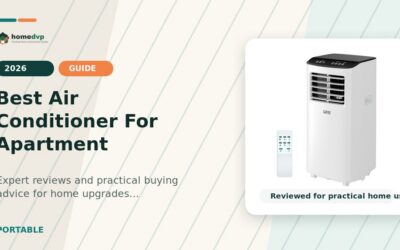

Choosing best budget window air conditioner for bedrooms is not simply a matter of buying the least expensive unit. A bedroom air conditioner must have enough capacity for the space, operate at a tolerable sound level, fit the available window, and provide controls that are convenient at night. An undersized unit may struggle continuously, while an oversized model can cool too quickly without managing humidity comfortably.
After carefully analyzing the available specifications for 10 window air conditioners, we compared cooling capacity, stated room coverage, low-mode noise, controls, energy-saving functions, installation requirements, filter maintenance, and overall value. Our findings include compact conventional units, digital models, and quieter inverter options. Renters who are still deciding between window and portable designs may also want to read our guide to apartment air conditioners for renters and small rooms.
The clearest value choice for a typical small bedroom is the Midea 5,000 BTU Window Air Conditioner, based on its combination of coverage up to 150 square feet, remote control, Eco mode, timer, dehumidification, and a manufacturer-stated low setting of 52 dB. The right answer changes for a larger bedroom, a noise-sensitive sleeper, or anyone who needs simple mechanical controls, so use the decision framework below rather than relying on one universal recommendation.

Pros
- Three comfort modes for cooling, circulating air, and reducing humidity
- Quiet low-mode operation paired with remote control including batteries
Cons
- Screwdriver is required for installation but not included
- Pilot holes may be needed for certain window frames
Best For / Avoid If
Best for buyers prioritizing
- Three comfort modes for cooling, circulating air, and reducing humidity
- Quiet low-mode operation paired with remote control including batteries
- Auto restart restores previous settings after power loss
Consider another option if
- Screwdriver is required for installation but not included
- Pilot holes may be needed for certain window frames
- Capacity suits spaces up to 150 square feet so larger rooms may need higher BTU units

Pros
- Quiet performance at 52 dBA reduces noise in sleeping areas.
- Washable filter allows simple cleaning to maintain airflow.
Cons
- Cooling capacity suits rooms no larger than 150 square feet.
- Requires permanent window installation which may limit placement options.
Specifications
| Cooling Power | 5000 British Thermal Units |
|---|---|
| Additional Features | Adjustable Side Panels, Dust Filter |
| Color | White |
| Noise | 52 Decibels |
| Refrigerant | R-32 |
| Filter Type | Washable |
| Inverter Type | No Inverter |
| Installation Type | Window |
| Compressor Type | rotary_scroll |
| Is Outdoor Unit Required | No |
Verify the current product variation before purchase; specifications may change.
Best For / Avoid If
Best for buyers prioritizing
- Quiet performance at 52 dBA reduces noise in sleeping areas.
- Washable filter allows simple cleaning to maintain airflow.
- Auto restart restores settings after outages without manual intervention.
Consider another option if
- Cooling capacity suits rooms no larger than 150 square feet.
- Requires permanent window installation which may limit placement options.
- Lacks remote control or additional modes beyond basic fan speeds.

Pros
- Mechanical controls remove any need for internet connectivity or smartphone pairing.
- Washable reusable filter and lack of required draining reduce ongoing maintenance tasks.
Cons
- Mechanical design omits remote control and timer functions present on electronic GE models.
- Cooling capacity targets only rooms up to 150 square feet so larger spaces need a higher BTU unit.
Specifications
| Cooling Power | 5000 British Thermal Units |
|---|---|
| Additional Features | Washable Filter |
| Color | White |
| Noise | 56 Decibels |
| Refrigerant | R-32 |
| Filter Type | Washable Filter |
| Inverter Type | No Inverter |
| Installation Type | Window |
| Compressor Type | rotary_scroll |
| Is Outdoor Unit Required | No |
Verify the current product variation before purchase; specifications may change.
Best For / Avoid If
Best for buyers prioritizing
- Mechanical controls remove any need for internet connectivity or smartphone pairing.
- Washable reusable filter and lack of required draining reduce ongoing maintenance tasks.
- Auto-restart function preserves user settings during outages for reliable daily operation.
Consider another option if
- Mechanical design omits remote control and timer functions present on electronic GE models.
- Cooling capacity targets only rooms up to 150 square feet so larger spaces need a higher BTU unit.
- Fits only double-hung windows within the listed width and height range.

Pros
- Combines cooling, dry mode, and heat functions in one window unit for greater versatility
- Maintains low operating noise suitable for bedrooms and living areas
Cons
- Heat pump function will not operate when outside temperatures drop to 41°F or below
- Requires double-hung windows within a specific width and height range for proper fit
Best For / Avoid If
Best for buyers prioritizing
- Combines cooling, dry mode, and heat functions in one window unit for greater versatility
- Maintains low operating noise suitable for bedrooms and living areas
- Supports wireless app and voice control for convenient adjustments from anywhere
Consider another option if
- Heat pump function will not operate when outside temperatures drop to 41°F or below
- Requires double-hung windows within a specific width and height range for proper fit
- First-time installers may need extra care aligning the unit and sealing the opening

Specifications
| Color | White |
|---|---|
| Size | New 5,000 BTU Electronic Controls |
| Dimensions | 13.38 x 16.36 x 12.59 inches |
| Weight | 36.5 Pounds |
| Product Group | Home |
| Binding | Misc. |
Verify the current product variation before purchase; specifications may change.
Pros
- Appropriate cooling capacity for spaces up to 250 square feet
- Convenient electronic controls, remote operation, timer, and auto-restart
Cons
- Requires a compatible double-hung window measuring 27.125 to 36 inches wide with at least 13.375 inches of height
- Not suitable for buyers seeking WiFi or smart home control
Specifications
| Color | White |
|---|---|
| Size | New 6,000 BTU Electronic Controls |
| Dimensions | 13.38 x 16.36 x 12.59 Inches |
| Weight | 38 pounds |
| Product Group | Home |
| Binding | Misc. |
Verify the current product variation before purchase; specifications may change.

Pros
- Ultra-quiet inverter operation minimizes noise and vibration disruption
- Strong energy efficiency from DC technology and ENERGY STAR status
Cons
- Fits only single-hung or double-hung windows 22 to 36 inches wide with at least 13.75 inches height
- Cooling capacity is oriented toward rooms of 250 square feet or less
Best For / Avoid If
Best for buyers prioritizing
- Ultra-quiet inverter operation minimizes noise and vibration disruption
- Strong energy efficiency from DC technology and ENERGY STAR status
- Convenient smart connectivity for app and voice-based control from anywhere
Consider another option if
- Fits only single-hung or double-hung windows 22 to 36 inches wide with at least 13.75 inches height
- Cooling capacity is oriented toward rooms of 250 square feet or less
- Full smart features depend on available Wi-Fi and compatible assistant devices
best budget window air conditioner for bedrooms Buying Guide
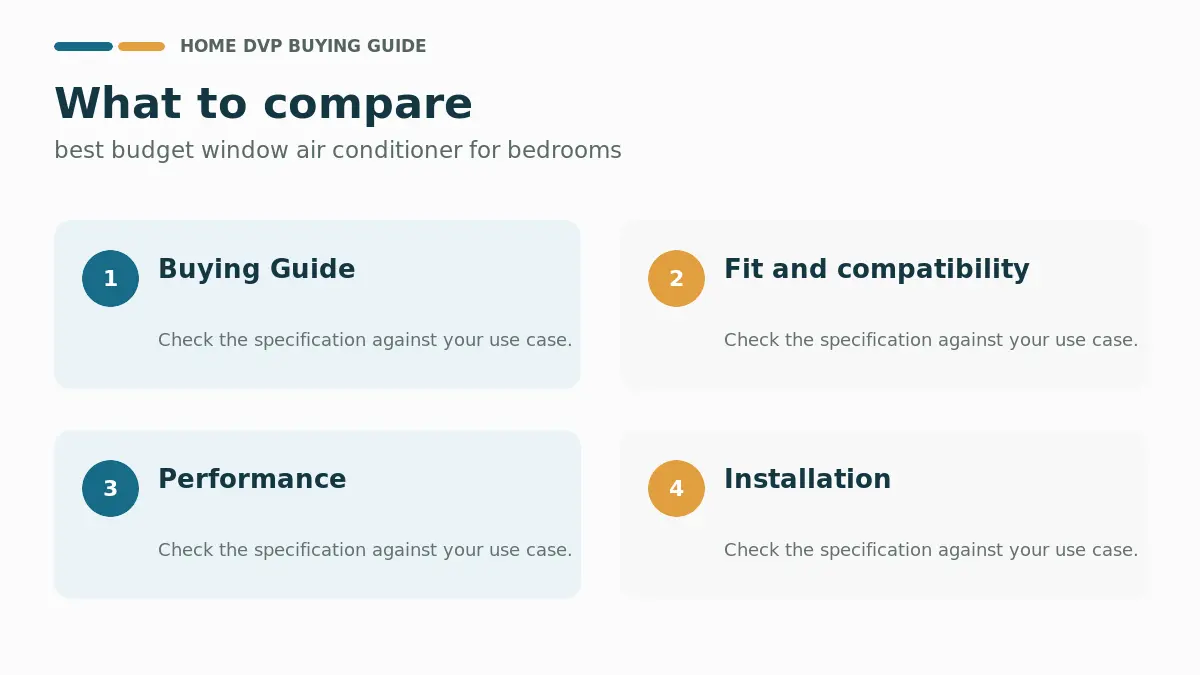
The available models span a wide price range but upfront cost alone does not identify the strongest value. Bedroom size, nighttime noise, window compatibility, installation support, and expected operating hours can make a moderately more capable unit the less frustrating purchase. The following criteria explain how to narrow the list without paying for capacity or connected features that will not improve your room.
Match BTU Capacity to the Bedroom
Start by measuring the conditioned area, not the entire home. Multiply the bedroom’s length by its width to estimate square footage, then compare that result with the manufacturer’s stated coverage. The listed 5,000 BTU models are intended for rooms up to 150 square feet, while the 6,000 BTU options claim coverage up to 250 square feet. These ratings are useful comparison points, but actual results depend on insulation, ceiling height, sunlight, outdoor temperature, air leakage, and heat-producing electronics.
For a compact bedroom, the Midea 5,000 BTU Window Air Conditioner, Frigidaire 5,000 BTU Window-Mounted Air, GE Window Air Conditioner 5,000 BTU AC Unit, GE 5,000 BTU Digital Window Air Conditioner, and LG 5000 BTU Window Air Conditioner with Remote are appropriately targeted by their listed coverage. A bedroom approaching 250 square feet is a better match for the LG 6,000 BTU Window Air Conditioner, 115V, GE 6,000 BTU Electronic Window Air Conditioner, or Midea 6,000 BTU U Shaped Smart Inverter Window Air.
A common mistake is buying the highest-capacity model within the budget as insurance. The 12,000 BTU models list coverage up to 550 square feet and are generally excessive for a closed, ordinary-size bedroom. They make more sense for a large primary suite, an open bedroom-and-sitting-area layout, or another unusually demanding space. Oversizing also adds weight, installation complexity, and purchase cost without automatically producing better sleep comfort.
| Bedroom scenario | Capacity tier in this comparison | Models to consider |
|---|---|---|
| Small room up to the listed 150-square-foot limit | 5,000 BTU | Midea EasyCool, Frigidaire, GE manual or digital, and LG compact models |
| Room approaching the listed 250-square-foot limit | 6,000 BTU | LG conventional, GE electronic, or Midea U-shaped inverter model |
| Very large suite or open connected space | 12,000 BTU | Midea inverter models, subject to window and electrical compatibility |
Prioritize Low and Predictable Nighttime Noise
Compressor cycling, fan noise, vibration, and air movement all affect bedroom comfort. Several conventional units in the comparison list a low operating level of 52 dB or 52 dBA. That figure provides a useful baseline, but published sound ratings may be measured under different conditions and do not describe every tone, rattle, or change when the compressor starts. Installation quality also matters because loose side panels and gaps can amplify vibration.
The Midea 6,000 BTU U Shaped Smart Inverter Window Air has the strongest documented noise specification in the bedroom-size group, with operation claimed as low as 32 dBA. Its U-shaped design places the closed window between the compressor and the room, while inverter operation can vary output instead of relying only on abrupt full-power cycling. That makes it a compelling premium choice for light sleepers, although it costs more and requires a compatible single- or double-hung window.
If sound sensitivity is moderate, a conventional 52 dB-class model may offer better value. The manual GE model can also appeal to sleepers who dislike electronic beeps because it uses mechanical dials. Regardless of model, seal the accordion panels, level and secure the chassis according to the instructions, and keep curtains from touching the cabinet. Never improvise installation angles or supports that conflict with the manual.
Choose Mechanical, Digital, or Smart Controls
Controls affect daily convenience more than cooling capacity. Mechanical dials are straightforward, do not require an app, and may avoid bright displays or button sounds. The GE Window Air Conditioner 5,000 BTU AC Unit provides two cooling modes, two fan speeds, and multiple temperature settings through mechanical controls. Its tradeoff is that a numbered dial is less precise than selecting a specific temperature on a digital thermostat.
Digital controls are more convenient when the unit is across the bedroom. The Midea 5,000 BTU model, GE digital units, and LG remote-control models let users make adjustments without getting out of bed. Timers and Eco modes can reduce unnecessary runtime, but cycling behavior may be noticeable to sensitive sleepers. The two GE electronic models specify a programmable timer, remote, digital thermostat, and automatic restart, but they are not Wi-Fi compatible.
Smart control is worth paying for when scheduling, remote monitoring, or voice control will be used regularly. The U-shaped Midea units support app and voice control, according to the published specifications. Smart features do not compensate for incorrect capacity or poor window sealing, however. If connected climate control is a priority throughout the home, compare these functions with the automation and compatibility considerations in our smart thermostat price comparison.
Measure the Window Before Ordering
Window compatibility can eliminate a model before performance enters the discussion. Measure the clear opening width and vertical height with the sash raised. Confirm the window type, sill condition, exterior clearance, screen or storm-window interference, and whether the lease or homeowners association restricts window units. Product dimensions alone are not enough because mounting kits have their own opening ranges.
The GE 5,000 and 6,000 BTU models specify double-hung openings from 27.125 to 36 inches wide with at least 13.375 inches of clear height. The compact LG 5,000 BTU model lists a 21- to 35-inch width and a 12-inch minimum height. The 6,000 BTU Midea U-shaped model lists single- or double-hung windows from 22 to 36 inches wide and at least 13.75 inches high. These are manufacturer-provided fit ranges and should be verified against the current manual before purchase.
Installation kits reduce the number of parts a DIYer must source, but they do not guarantee that every sill or storm window will work. A window air conditioner is heavy and projects outdoors, so use two people when appropriate, follow the supplied bracket and fastener instructions, and never trust the sash alone unless the manufacturer explicitly permits it. Renters should obtain permission before drilling pilot holes or fastening hardware to the frame.
Compare Energy Features and Ownership Cost
Purchase price is only one part of value. Operating cost depends on power draw, local electricity rates, runtime, thermostat setting, room heat gain, maintenance, and whether the unit cycles efficiently. A programmable timer can prevent the air conditioner from running all day, while Eco mode generally cycles the compressor and fan in response to room temperature. Actual savings will vary, so manufacturer percentage claims should not be treated as a guaranteed utility-bill reduction.
The manual GE 5,000 BTU unit lists a 440-watt draw, while the Frigidaire description lists 450 watts. The Midea U-shaped models use variable-speed inverter technology and carry manufacturer claims of more than 37 percent energy savings compared with traditional units. The larger Midea model with heat lists a CEER of 13.3 and Energy Star certification in the published information, but its capacity and higher initial cost only make sense for a genuinely large space or multi-season need.
Think in terms of cost per useful night rather than the lowest shelf price. A light sleeper using an air conditioner every night may receive meaningful value from a quieter inverter model. Someone cooling a guest room occasionally may be better served by a basic 5,000 BTU unit. Homes with persistent summer moisture should also distinguish air conditioning from dedicated humidity control; our dehumidifier price comparison explains where a separate appliance may be more appropriate.
Look at Airflow, Humidity Control, and Comfort
Cooling capacity does not fully describe comfort. Fan speeds and adjustable louvers help distribute conditioned air without blowing directly across the bed. The LG 6,000 BTU and GE electronic models list two-way air direction, while several models offer multiple fan speeds. Before installation, consider where the bed sits in relation to the window and whether the louvers can direct air toward the center of the room.
The Midea 5,000 BTU model includes separate cooling, fan, and dehumidifier modes. That added function can be helpful during muggy weather, but no moisture-removal rate was listed, so it should not be assumed to replace a whole-room dehumidifier in a damp building. An oversized air conditioner can also reach the temperature setting before completing longer moisture-removal cycles, which is another reason to avoid buying excessive BTU capacity.
Keep bedroom doors and windows closed during normal cooling, reduce direct sunlight with appropriate shades, and seal gaps around the chassis. These low-cost steps reduce heat gain and can improve comfort without selecting a larger unit. Airflow should remain unobstructed on both the indoor intake and outdoor discharge sides.
Plan for Filter Cleaning and Seasonal Care
Every model in this comparison with documented maintenance information uses a washable or reusable filter. A dirty filter restricts airflow and can reduce cooling effectiveness, so inspect it regularly and follow the manual’s cleaning interval. The compact LG model specifically recommends cleaning its slide-out filter every 30 days, while the GE digital units provide a filter reminder indicator.
Washable filters primarily capture larger airborne dust and debris; they should not be treated as substitutes for dedicated high-efficiency air purification. Let a washed filter dry completely before reinstalling it. Also inspect exterior drainage paths and keep leaves or lint away from the outdoor coil, but do not open the sealed refrigerant system or bend coil fins.
For seasonal storage, follow the manufacturer’s removal, draining, cleaning, and orientation instructions. Store the unit where it will remain dry and protected from impacts. Long-term value depends partly on whether the owner is willing to clean the filter, maintain the window seals, and safely remove or weatherize the unit when cooling season ends.
Check Electrical and Safety Requirements
The published specifications identify several models as 115-volt appliances, but buyers should verify the label, plug configuration, current requirements, and manual for the exact model. Use a properly grounded receptacle and do not rely on an extension cord or adapter. The Frigidaire includes an extra-long three-prong cord intended to eliminate the need for an extension cord, but outlet location still needs to be confirmed before installation.
A dedicated circuit may be required depending on the unit, existing circuit load, and local electrical rules. If the receptacle is loose, ungrounded, frequently trips a breaker, or cannot support the listed load, consult a qualified electrician. Keep the cord away from pinch points and water, and do not defeat leakage-current protection or other plug-mounted safety devices.
Window security matters as well. Conventional units may prevent the sash from locking normally, so install any manufacturer-specified sash lock or security hardware. The Midea U-shaped design includes a stated anti-theft mechanism when the window is closed, but users must still follow installation directions. Never place a unit where an unstable frame, damaged sill, blocked fire escape, or falling-object risk makes installation unsafe.
Which Models Fit Different Bedroom Scenarios?
| Recommendation | Product | Why it fits | Main limitation |
|---|---|---|---|
| Overall value for a small bedroom | Midea 5,000 BTU Window Air Conditioner | Remote, timer, Eco mode, dehumidifier mode, and stated 52 dB low operation | Coverage is limited to the listed 150 square feet |
| Simple mechanical choice | GE Window Air Conditioner 5,000 BTU AC Unit | Dial controls, no app, no digital beeps, and listed 440-watt draw | No remote or exact digital temperature selection |
| Established basic design | Frigidaire 5,000 BTU Window-Mounted Air | Two fan speeds, auto restart, washable filter, and stated 52 dBA operation | Feature set is less extensive than digital alternatives |
| Medium bedroom value | GE 6,000 BTU Electronic Window Air Conditioner | Listed 250-square-foot coverage, remote, timer, and Eco mode | No Wi-Fi; published information includes no user-review history |
| Quiet premium option | Midea 6,000 BTU U Shaped Smart Inverter Window Air | Claimed 32 dBA minimum, inverter operation, app control, and opening-window design | Higher purchase cost and more involved bracket installation |
| Large multi-season suite | Midea Inverter Window Air Conditioner with Heat | 12,000 BTU, smart control, dehumidification, and supplemental heat | Usually oversized for a normal bedroom; heat does not operate below 41°F outdoors |
The 12,000 BTU U-shaped Midea is also a valid window air conditioner, but its listed 550-square-foot coverage and premium positioning make it difficult to classify as a budget bedroom choice. Consider it only when measurements confirm a very large suite or connected space and the quieter architecture is worth the added expense. For ordinary bedrooms, the 5,000 or 6,000 BTU groups provide a more defensible capacity match.
Our Research Methodology and Why You Can Trust Us
We evaluated the products based on the listed user-facing specifications rather than claiming hands-on testing. Our process first validated that each item was a window-mounted air conditioner suitable for at least one plausible bedroom scenario. We then compared stated BTU capacity, room coverage, sound level, control type, fan and cooling modes, timer and energy functions, installation ranges, voltage information, filter access, warranty details where listed, and special capabilities such as inverter operation or supplemental heat.
Ranking weight favored appropriate bedroom capacity, nighttime usability, installation compatibility, maintenance, safety, and value. We also considered available user-feedback signals, but we did not reproduce review counts because those figures change and some listed products had no recorded feedback. Manufacturer claims about sound, coverage, and energy savings were treated as claims, not guaranteed outcomes. Build quality, long-term durability, and reliability could not be independently verified from the provided information, so we avoided assigning unsupported service-life promises.
This guide is reviewed to keep model fit and decision criteria current. Prices, listings, certifications, warranty terms, and availability can change, so readers should verify the current product page and manual before ordering. Our recommendation framework emphasizes the right size and safe fit over feature count because those factors have the greatest practical effect on bedroom cooling.
Final Thoughts
Based on our detailed comparison, the Midea 5,000 BTU Window Air Conditioner is the most balanced budget-oriented choice for a bedroom within its listed 150-square-foot coverage. Its remote, Eco mode, timer, reusable filter, and dehumidifier setting provide more flexibility than a bare mechanical model. Buyers who prefer fewer electronics should instead consider the GE Window Air Conditioner 5,000 BTU AC Unit, while the Frigidaire is a straightforward alternative with auto restart and washable filtration.
For a bedroom approaching 250 square feet, the GE 6,000 BTU Electronic Window Air Conditioner offers a practical combination of listed capacity, digital control, remote operation, and scheduling. Noise-sensitive sleepers with more room in the budget should evaluate the Midea 6,000 BTU U Shaped Smart Inverter Window Air, provided its bracket and window requirements are compatible. If you are also planning cold-weather comfort, use our space heater price comparison before paying for a large air-conditioner-and-heat combination that may be oversized for the room.
Before buying, measure the room and window, confirm electrical compatibility, and decide whether remote, timer, and smart functions will actually be used. Those checks are more important than choosing the model with the longest feature list. A correctly sized, securely installed basic unit can be a better bedroom purchase than a more powerful model that is noisy, cumbersome, or poorly matched to the space.
Frequently Asked Questions
What should I look for when choosing best budget window air conditioner for bedrooms?
Match the stated BTU capacity to the measured bedroom area, then verify window opening dimensions, electrical requirements, and low-mode noise. After those essentials, compare remote controls, timers, Eco modes, airflow direction, filter access, and installation hardware.
Is a 5,000 BTU window air conditioner enough for a bedroom?
The 5,000 BTU products in this comparison claim coverage up to 150 square feet, making them plausible choices for compact bedrooms. Rooms with strong afternoon sun, poor insulation, high ceilings, open doorways, or substantial heat gain may need a different capacity assessment.
Are higher-end best budget window air conditioner for bedrooms worth it?
A higher-end inverter model can be worthwhile for a light sleeper or someone who runs the unit for long periods because it may provide quieter, steadier operation and advanced scheduling. Occasional users in small guest rooms may receive better value from a conventional model with correct capacity and a washable filter.
How quiet should a bedroom window air conditioner be?
Several conventional models here state low-mode levels around 52 dB or dBA, while the U-shaped inverter model claims operation as low as 32 dBA. Published ratings are not always measured identically, and vibration from an imperfect installation can make any unit more noticeable.
Can renters install a window air conditioner?
Many renters can use window units, but lease terms, building rules, window condition, and exterior safety requirements vary. Obtain permission before drilling or modifying the frame, and review our guide to air conditioners for renters and small rooms for additional selection considerations.
How often should the filter be cleaned?
Follow the current manual because dust levels and manufacturer schedules differ. One listed LG model calls for cleaning every 30 days, but homes with pets, smoke, renovation dust, or frequent operation may require more frequent inspection.
Should I buy a 12,000 BTU model for faster bedroom cooling?
Not unless the bedroom or connected suite matches the model’s capacity requirements. A 12,000 BTU unit is generally intended for a much larger area than a typical closed bedroom, and oversizing can increase cost, weight, and cycling without guaranteeing better humidity control.