
Crawl spaces are easy to ignore until musty odors, wood moisture, insulation problems, pests, or condensation start showing up inside the home. A properly sized Best Crawl Space Dehumidifier can help control humidity below the floor system, protect framing, support better indoor air quality, and reduce the conditions that encourage mold growth. This updated guide is built for homeowners, renters with accessible crawl spaces, DIY maintenance shoppers, and renovation planners who want practical guidance before buying.
After carefully analyzing the available specifications, we reviewed 15 crawl-space-focused dehumidifiers and compared capacity, drainage options, airflow, coverage area, controls, safety features, build quality, warranty coverage, and homeowner usability. Because crawl spaces are part of the broader moisture-control system in a home, you may also want to explore our Air Quality & Climate resources when planning ventilation, filtration, and humidity improvements.
Home DVP decision summary
Quick Answer
For Best Crawl Space Dehumidifier, Home DVP compared 15 products from 11 brands. Choose capacity for the crawl-space area, moisture load, temperature range, and drainage route. Low-temperature operation, a humidistat, continuous drainage, filter access, and ducting options are more useful than an oversized water-removal claim.
| Comparison coverage | 15 products from 11 brands, including ALORAIR, Argendon, Airzentti. |
|---|---|
| Selection priority | Choose capacity for the crawl-space area, moisture load, temperature range, and drainage route. Low-temperature operation, a humidistat, continuous drainage, filter access, and ducting options are more useful than an oversized water-removal claim. |
| Evidence basis | Manufacturer specifications, compatibility details, retailer-provided product data, and common homeowner use cases. |
| Reference guidance | EPA moisture and mold-control guidance. |
This summary describes the article's comparison set, not every product on the market. Product details should be confirmed before purchase.
Based on the product data provided, the valid models in this guide all clearly match the Heating, Cooling & Air category and are designed for crawl spaces, basements, commercial drying, or similar high-moisture areas. We avoided unrelated product types and focused only on models that fit the intended use case.
Best Crawl Space Dehumidifier Buying Guide
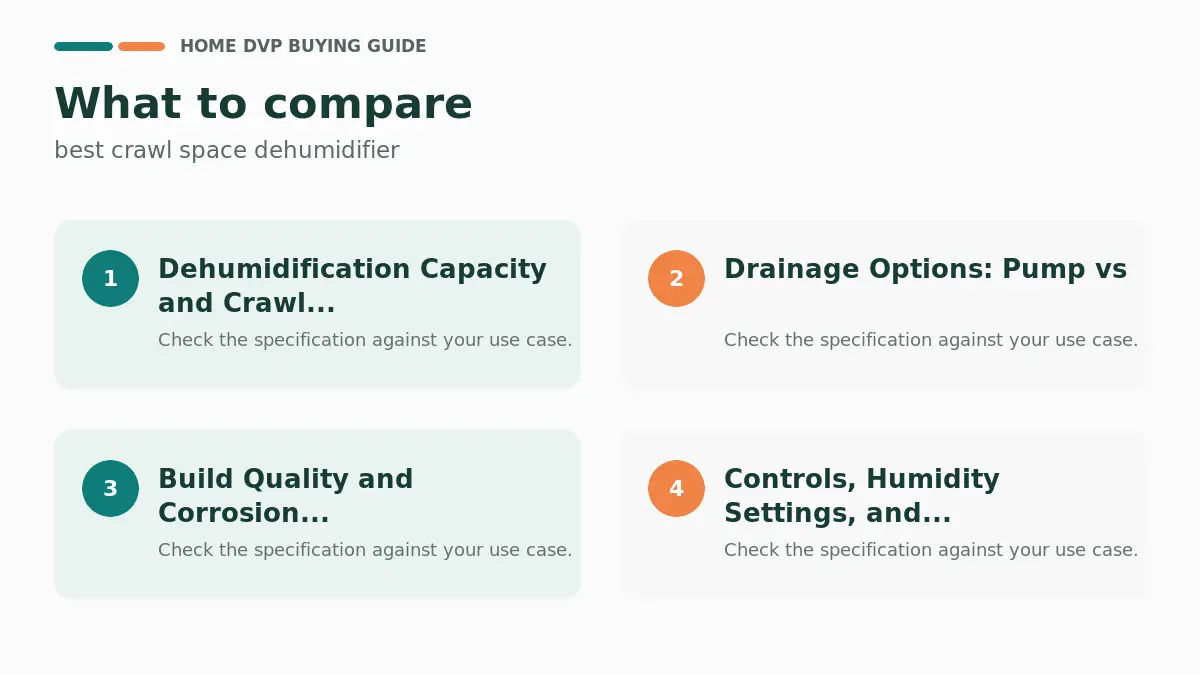
Dehumidification Capacity and Crawl Space Size
Capacity is the first specification to check when comparing best crawl space dehumidifier. Crawl space units are often rated in pints per day, but the rating may be listed under different test conditions. Saturation ratings look impressive because they reflect very humid conditions, while AHAM ratings are generally more useful for comparing normal indoor-style performance.
For example, the 155 Pints Commercial Dehumidifier for Basement with Pump and Drain Hose from Airzentti lists a high saturation removal rate and a separate AHAM figure, which makes it easier to judge real-world performance. The Waykar 125 Pint Crawl Space Dehumidifier with Pump & Drain Hose is also designed for large areas and lists both capacity and airflow details. Smaller crawl spaces may not need the highest-capacity unit, but undersizing can cause the machine to run constantly without reaching the target humidity.
| Specification | Why It Matters | Homeowner Tip |
|---|---|---|
| Daily pint removal | Shows how much moisture the unit can remove under stated conditions. | Compare ratings carefully and note whether the number is AHAM or saturation-based. |
| Coverage area | Helps match the unit to the crawl space, basement, or storage area. | Allow extra capacity for damp soil, poor vapor barriers, or seasonal humidity swings. |
| Airflow | Moves damp air across the coil and helps dry larger spaces more evenly. | Higher airflow can be useful in open crawl spaces but may require thoughtful placement. |
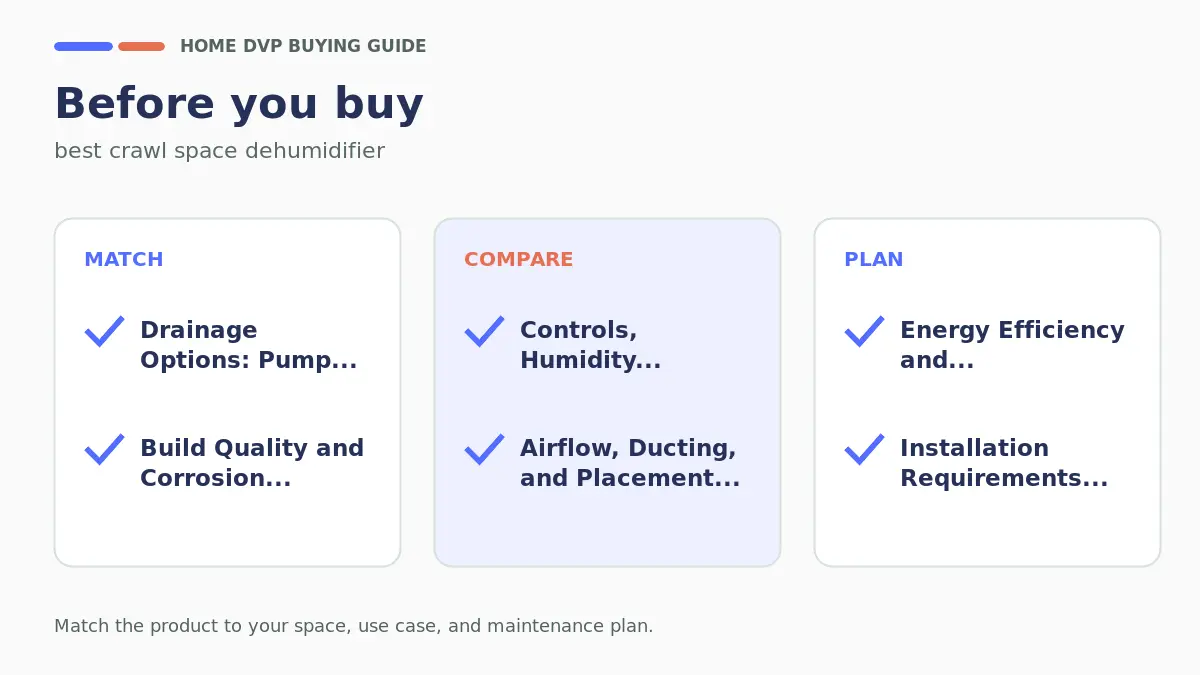
Drainage Options: Pump vs Gravity Drain
Drainage is one of the most important buying decisions for crawl space installation. A tank-style dehumidifier is inconvenient below the house because emptying it requires regular access. Most crawl-space-ready models use continuous drainage, either through gravity drainage or a built-in pump.
A gravity drain works well when the hose can slope downward to a floor drain, sump basin, or safe discharge point. A built-in pump is better when water must move upward or across a longer distance. The ARGENDON Commercial Dehumidifiers with Pump and Drain Hose for Crawlspace, Basement, the Airzentti 155-pint model, and the Waykar 125-pint model all provide pump-based drainage support, which can simplify installation in tight or low-clearance spaces.
A common mistake is buying a strong dehumidifier without planning where the water will go. Before choosing the best crawl space dehumidifier, check the crawl space access point, available outlet, hose route, drain height, and whether local conditions require discharge away from the foundation.
Build Quality and Corrosion Resistance
Crawl spaces are harder on appliances than finished rooms. Dust, moisture, temperature swings, and limited airflow can shorten the life of a lightweight unit. For this category, metal housings, protected coils, durable compressors, quality filters, and automatic defrost functions are more than convenience features. They help the unit survive in a damp mechanical environment.
Based on the available specifications, the Waykar 125 Pint Crawl Space Dehumidifier highlights a heavy-duty metal casing, rotary compressor, and condenser design intended for demanding spaces. The ARGENDON Commercial Dehumidifiers with Pump and Drain Hose for Crawlspace, Basement lists internal corrosion protection and evaporator materials designed to reduce coil deterioration. These details matter for homeowners who want a unit to run seasonally without constant attention.
If your crawl space has standing water, exposed soil, or a missing vapor barrier, fix those issues first or at least address them alongside the dehumidifier. A machine can manage airborne humidity, but it should not be expected to compensate for active water intrusion indefinitely.
Controls, Humidity Settings, and Set-and-Forget Operation
Because crawl spaces are inconvenient to access, controls should be simple and reliable. Look for adjustable humidity settings, memory restart, auto-restart after power loss, timer functions, continuous mode, and clear error indicators. Remote control support can also be useful, especially when the unit is mounted or placed far from the entry point.
The Airzentti 155 Pints Commercial Dehumidifier includes humidity level settings, a timer, gravity drain support, auto drain, auto defrost, and a screen lock. The Waykar 125 Pint Crawl Space Dehumidifier lists touchscreen controls and optional remote control capability. The ARGENDON model includes humidity setting, continuous mode, GPP mode, auto turn on and off, troubleshooting display, and drainage mode switching.
For homeowners already upgrading heating and cooling controls, humidity management often pairs well with broader climate planning. Our guide to smart thermostat vs programmable thermostat features can help you think through whole-home comfort and efficiency from another angle.
Airflow, Ducting, and Placement
Airflow determines how quickly damp air reaches the dehumidifier. In a small sealed crawl space, placement near the center may be enough. In a larger or divided crawl space, airflow restrictions from foundation piers, ductwork, stored materials, or insulation can leave damp pockets behind.
Some models support duct collars or pipe-mounted exhaust layouts, which can help distribute dry air or pull humid air from a problem area. The Airzentti unit lists a duct collar diameter, while the Waykar model supports pipe-mounted exhaust vents. These features are especially useful for encapsulated crawl spaces or larger basements where airflow needs to be directed intentionally.
Do not place the unit where intake or exhaust air is blocked. Leave service space for filter cleaning, hose inspection, and control access. If your crawl space also has HVAC equipment, avoid directing discharge air in a way that interferes with furnace, air handler, or duct service clearances.
Energy Efficiency and Certifications
A crawl space dehumidifier may run for long periods during humid weather, so efficiency should be part of the value calculation. Energy-efficient models can cost more upfront but may be more practical for seasonal use. Look for Energy Star information, TUV compliance, ETL certification, or other safety and performance references when available in the product data.
The Airzentti 155 Pints Commercial Dehumidifier lists Energy Star certification and TUV compliance. The Waykar model lists TUV standards, and the ARGENDON model lists ETL safety certification. These certifications do not guarantee a perfect fit for every home, but they do provide useful signals when comparing safety, energy use, and manufacturing standards.
If you are also evaluating filtration or indoor air quality upgrades, our comparison of HEPA filter vs carbon filter options explains how different air-quality tools solve different problems. Dehumidifiers manage moisture, while filters target particles, odors, or gases depending on the media.
Installation Requirements and Maintenance Access
Before buying best crawl space dehumidifier, measure the crawl space opening and the path to the intended installation location. Commercial-style units can be compact for their capacity, but they may still be heavy. Check dimensions, weight, power cord length, hose routing, and whether the unit can sit level on the crawl space floor or needs mounting hardware.
Maintenance is usually simple but should not be ignored. Filters need periodic cleaning or replacement, drain hoses should be checked for clogs, and coils should be protected from heavy dust buildup. Models with service reminders, removable filters, and accessible panels are easier for homeowners to live with over time.
For a broader look at climate-related upkeep around the home, the Heating, Cooling & Air category includes related guidance on comfort systems, cooling equipment, air treatment, and maintenance planning.
Value, Warranty, and Long-Term Reliability
The $332–$530 range in this product set shows that crawl space dehumidifiers are a serious home-maintenance purchase. Instead of choosing only by upfront cost, compare capacity, pump inclusion, warranty terms, certifications, casing material, controls, and drainage flexibility. A lower-cost unit can be a good value if it fits the space, but a larger or better-protected model may be worth it for very damp homes.
Warranty coverage is especially important in crawl space applications because the unit may run in tougher conditions than a living-room appliance. The Waykar model lists multi-year quality coverage, and the ARGENDON model lists a limited warranty. Read the current warranty terms before purchase because coverage can depend on registration, installation, maintenance, and use conditions.
Our Research Methodology & Why You Can Trust Us
We evaluated the products based on available product information, user-facing specifications, category fit, and practical homeowner use cases. Our research focused on crawl space and basement suitability, moisture-removal capacity, drainage design, airflow, installation flexibility, safety features, efficiency references, build quality, and long-term maintenance needs.
We did not claim hands-on testing or installation because the provided product data does not document physical testing by our team. Instead, this guide uses specification-based analysis and transparent comparison language. Products that clearly matched best crawl space dehumidifier and the Heating, Cooling & Air category were considered valid, while unrelated products would be excluded from recommendations.
During July, we prioritize updates that reflect capacity claims, warranty language, drainage options, certification details, and value within $332–$530. Our ranking criteria include performance, features, build quality, ease of use, durability, safety, value, reliability, and fit for homeowner or DIY maintenance needs.
Final Thoughts
For a heavy-duty pick, the 155 Pints Commercial Dehumidifier for Basement with Pump and Drain Hose from Airzentti stands out based on its large stated capacity, airflow rating, built-in pump, gravity drain option, auto defrost, screen lock, Energy Star certification, and TUV compliance. It is best suited for homeowners managing larger crawl spaces, basements, garages, or mixed-use areas where stronger moisture removal and set-and-forget drainage matter.
For a strong balance of capacity and installation flexibility, the Waykar 125 Pint Crawl Space Dehumidifier with Pump & Drain Hose is a compelling homeowner pick. Based on the listed specifications, it offers a broad humidity adjustment range, pump and gravity drainage, pipe-mounted exhaust support, a metal casing, rotary compressor design, and long support coverage. It may be especially appealing if you want flexible drainage and a rugged housing without jumping straight to the largest unit in the group.
For smaller or more controlled spaces, the ARGENDON Commercial Dehumidifiers with Pump and Drain Hose for Crawlspace, Basement and ARGENDON Crawl Space Dehumidifier with Pump, 70 Pint Compact Commercial Dehumidifier for Basement are worth considering based on their crawl-space focus, pump drainage, auto defrost, safety certification, and warranty language. If you are also working on broader cooling or moisture-control projects, our mini split AC cleaning guide can help with related home comfort maintenance.
FAQ
What should I look for when choosing the best crawl space dehumidifier?
Start with capacity, coverage area, drainage design, and whether the unit has a built-in pump. Then compare airflow, auto defrost, certifications, controls, filter access, and warranty terms. The right choice depends on crawl space size, moisture severity, drain location, and how easy the area is to access.
Are higher-end crawl space dehumidifier worth it?
Higher-end models can be worth it when you need stronger moisture removal, pump drainage, more durable construction, or better controls. They may also make sense for encapsulated crawl spaces, damp basements, or homes in humid climates. For a small, dry, well-sealed crawl space, a lower-capacity model may be enough.
Are the best crawl space dehumidifier suitable for regular home maintenance?
Yes, crawl space dehumidifiers can be a practical part of regular home maintenance when moisture is a recurring issue. They work best alongside proper drainage, vapor barriers, sealed vents where appropriate, and routine inspections. For more climate and air-quality planning, visit our Heating, Cooling & Air section.
About This Home DVP Research
Home DVP is an independent home-improvement research and product-comparison publisher. Ryan Mitchell prepared this guide by comparing manufacturer specifications, compatibility details, retailer-provided product data, key limitations, and common homeowner use cases. We do not claim hands-on testing unless an article explicitly says so.
Review methodology Affiliate disclosure Last reviewed September 10, 2026