
Basements are one of the most moisture-prone areas in a home, especially when humid outdoor air, foundation seepage, laundry areas, or poor airflow combine in the same space. Choosing the best Basement Dehumidifier With Pump can help homeowners, renters, and DIYers control musty odors, reduce condensation, and protect stored tools, flooring, drywall, furniture, and seasonal gear from excess humidity.
After carefully analyzing the available specifications for 15 products, we focused on units that clearly match the Heating, Cooling & Air category and are relevant for basement moisture control with pump-assisted drainage. We compared capacity, pump functionality, drainage flexibility, energy efficiency, noise level, tank design, safety features, user-facing controls, and overall suitability for real household use. For more climate-control context, you can also browse our Heating, Cooling & Air guides.
Home DVP decision summary
Quick Answer
For Best Basement Dehumidifier With Pump, Home DVP compared 15 products from 8 brands. Match capacity to basement area and moisture load, then plan a reliable drain route for the pump. Compare low-temperature performance, humidistat accuracy, hose lift, noise, filter access, and restart behavior after an outage.
| Comparison coverage | 15 products from 8 brands, including Midea, Waykar, AeockyDirect. |
|---|---|
| Selection priority | Match capacity to basement area and moisture load, then plan a reliable drain route for the pump. Compare low-temperature performance, humidistat accuracy, hose lift, noise, filter access, and restart behavior after an outage. |
| Evidence basis | Manufacturer specifications, compatibility details, retailer-provided product data, and common homeowner use cases. |
| Reference guidance | EPA moisture and mold-control guidance. |
This summary describes the article's comparison set, not every product on the market. Product details should be confirmed before purchase.
This guide is updated for 2026 and is designed to help you avoid common buying mistakes, such as choosing a gravity-drain model when your drain is above the unit, undersizing a dehumidifier for a wet basement, or overlooking auto-defrost performance in cooler spaces. Because prices and availability change, we reference $170–$450 only as a dynamic range and focus primarily on long-term fit, features, and practical homeowner value.

Pros
- Energy-efficient design supports extended runtime with minimal impact on utility costs.
- Built-in pump and large tank enable reliable performance in areas without convenient drains.
- Child lock and auto shut-off enhance safety during household use.
- Auto defrost function helps sustain operation in varying temperature conditions.
Cons
- Initial drainage setup requires careful tank emptying to avoid leaks as noted in product details.
- Continuous drain hose use depends on proximity to suitable outlets since no floor drain pipe is included.
- Large capacity design may limit portability for frequent room-to-room moves.
The avylo dehumidifier provides substantial moisture removal capacity suited to homeowners dealing with persistent dampness in basements or expansive living areas.
Its certified efficiency rating and high-capacity compressor allow effective performance across seasons while supporting target humidity levels through sensor-based controls.
Design elements include a top-mounted tank for easy access, integrated pump for extended drainage reach, and an LED interface displaying current conditions for straightforward monitoring.
Practical applications extend to garages and bedrooms where quiet fan operation and timer functions add convenience without disruption.
Users should note setup tips such as emptying the tank before configuring drains and recognize that some accessories like floor pipes are not supplied with the unit.
This option fits well for those prioritizing energy compliance and multiple drainage methods, though individuals with very specific space constraints might evaluate dimensions against their needs.
Specifications
| Floor Area | 4500 Square Feet |
|---|---|
| Other Special Features of the Product | Automatic Shutoff |
| Capacity | 2.11 gallons |
| Tank Volume | 2.11 Gallons |
| Number of Speeds | 3 |
| Wattage | 235 watts |
| Operation Mode | Automatic |
| Upper Temperature Rating | 120 Degrees Fahrenheit |
| Dehumidification Capacity | 90 Pints per Day |
| Voltage | 115 Volts |
Verify the current product variation before purchase; specifications may change.
Best For / Avoid If
Best for buyers prioritizing
- Energy-efficient design supports extended runtime with minimal impact on utility costs.
- Built-in pump and large tank enable reliable performance in areas without convenient drains.
- Child lock and auto shut-off enhance safety during household use.
Consider another option if
- Initial drainage setup requires careful tank emptying to avoid leaks as noted in product details.
- Continuous drain hose use depends on proximity to suitable outlets since no floor drain pipe is included.
- Large capacity design may limit portability for frequent room-to-room moves.

Pros
- Effective moisture removal for demanding residential spaces up to 3500 square feet
- Low operating noise suitable for bedrooms and offices
- Copper coil construction supports longer lifespan in humid conditions
- Flexible drainage options reduce daily maintenance
- Auto-defrost and smart controls maintain consistent performance
Cons
- Water tank must remain installed even when using continuous drain
- Gravity drain setup works best when a suitable outlet is nearby
- Size and capacity may exceed requirements for very small rooms
The AeockyDirect BOREAS-001 compressor dehumidifier targets homeowners who need reliable moisture removal in basements, garages, and living spaces reaching 3500 square feet.
It extracts up to 50 pints per day under tested conditions and incorporates higher energy efficiency than many comparable units, allowing longer run times while helping control electricity use.
Construction features pure copper tubing with hydrophilic fins, a reinforced handle, and smooth casters, while the dual-chamber acoustic design and BLDC motor keep sound levels near 40 decibels during operation.
Practical benefits include the 2-meter drain hose for continuous gravity drainage, a 24-hour timer, and a multicolor ambient light that shows current humidity at a glance without needing to read small displays.
Users should note that the tank stays in place during hose drainage and that a nearby floor drain works best for uninterrupted use; the unit lacks a built-in pump for upward discharge.
This model fits homeowners seeking steady whole-home humidity control in medium to large spaces who value quiet operation and durable components over smaller units meant for single rooms.
Specifications
| Floor Area | 3500 Square Feet |
|---|---|
| Other Special Features of the Product | Adjustable Humidity Control(40%-80%), Child Lock, Fan Speed Control, Timer |
| Capacity | 0.8 gallons |
| Tank Volume | 0.8 Gallons |
| Wattage | 380 watts |
| Operation Mode | Continuous |
| Dehumidification Capacity | 50 Pints per Day |
| Item Dimensions D x W x H | 13.19"D x 17.99"W x 8.66"H |
| Recommended Uses For Product | Residential |
| Color | Ivory |
Verify the current product variation before purchase; specifications may change.
Best Basement Dehumidifier With Pump Buying Guide
Based on our detailed comparison, the most relevant options are models that combine basement-grade moisture removal with a built-in pump or clearly stated pump-included drainage. In the available product data, the valid pump-focused picks include the avylo 5000 Sq.Ft Energy Star Most Efficient Dehumidifier with Pump, Waykar 150 Pints Energy Star Dehumidifier with Pump, AEOCKY 5500 Sq.Ft Energy Star Most Efficient Dehumidifier with Pump, 5000 Sq.Ft Dehumidifier with Pump, Midea 4,500 Sq. Ft. Dehumidifier with Pump Included Renewed, and Midea 4,500 Sq. Ft. Dehumidifier With Pump Included.
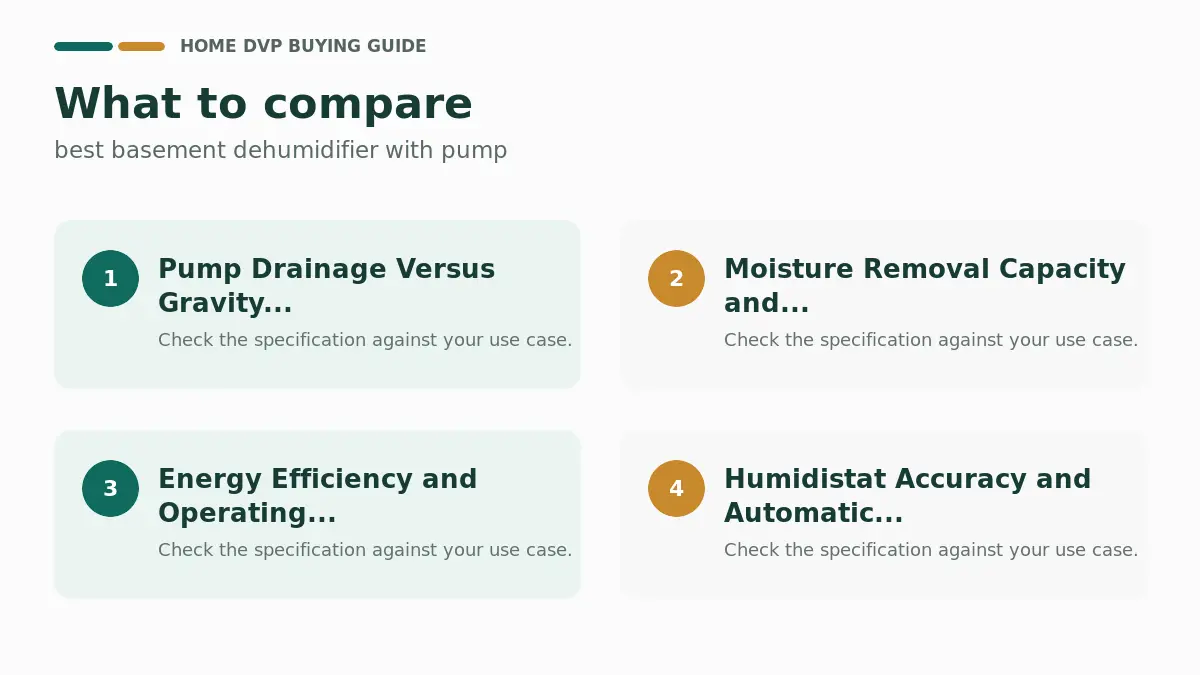
Pump Drainage Versus Gravity Drainage
The main reason to buy the best basement dehumidifier with pump instead of a standard basement dehumidifier is drainage flexibility. A gravity-drain unit needs the hose to slope downward into a floor drain, utility sink, sump basin, or condensate drain. A pump-equipped model can move collected water upward or across a longer path, which is useful when the only drain is above the floor or across the basement.
For example, the avylo 5000 Sq.Ft Energy Star Most Efficient Dehumidifier with Pump lists a built-in pump, included drain hose, and vertical lift capability. The 5000 Sq.Ft Dehumidifier with Pump also emphasizes vertical drainage, which can be helpful in finished basements, workshops, and laundry spaces where placing the unit directly beside a floor drain is not practical.
A common mistake is assuming every dehumidifier with a drain hose has a pump. A hose alone may only support gravity drainage. If your drain outlet is higher than the dehumidifier or the hose cannot maintain a steady downward slope, prioritize a built-in pump or pump-included model rather than a standard continuous-drain design.
| Drainage Setup | Best Use Case | Buying Advice |
|---|---|---|
| Built-in pump | Draining up to a sink, window well route, or elevated drain | Best match for the best basement dehumidifier with pump when basement layout is awkward |
| Gravity drain | Nearby floor drain or sump basin below the unit | Works well only when the hose slopes downward |
| Manual tank emptying | Occasional use or smaller humidity problems | Less convenient for damp basements or unattended operation |
Moisture Removal Capacity and Basement Size
Capacity matters because basements often have more persistent moisture than bedrooms or upstairs living areas. Product listings may reference maximum pint-per-day performance under warm and humid conditions, while real basement output can be lower in cooler spaces. That is why the best fit is not always the smallest unit that technically covers your square footage.
The Waykar 150 Pints Energy Star Dehumidifier with Pump is the heavy-duty option in this group based on its stated high-capacity design and commercial or industrial positioning. It is better suited for large basements, workshops, storage rooms, or homes with frequent dampness. By comparison, the Midea 4,500 Sq. Ft. Dehumidifier with Pump Included models are more moderate-capacity choices for homeowners who want pump drainage without moving into a larger commercial-style unit.
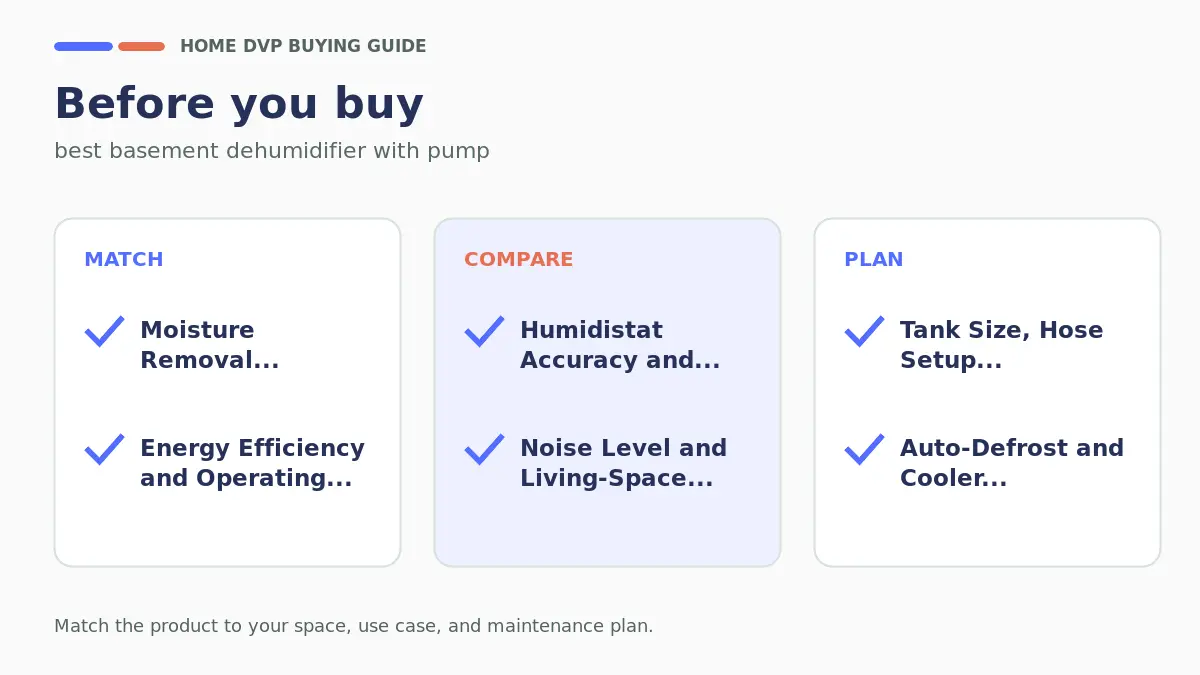
When comparing best basement dehumidifier with pump, think about both room size and moisture load. A lightly damp finished basement may need less capacity than an unfinished basement with seepage after storms. If you are also managing cooling comfort in apartments or above-grade rooms, our apartment air conditioner guide can help you think through whole-home comfort alongside humidity control.
Energy Efficiency and Operating Cost
Basement dehumidifiers may run for long stretches during humid seasons, so energy efficiency is more than a nice extra. ENERGY STAR and Most Efficient claims in the product data are worth considering because a more efficient compressor and airflow design can help reduce long-term operating costs while maintaining moisture control.
The avylo 5000 Sq.Ft Energy Star Most Efficient Dehumidifier with Pump highlights efficient operation, smart humidity sensing, and safety certifications. The AEOCKY 5500 Sq.Ft Energy Star Most Efficient Dehumidifier with Pump also emphasizes high-efficiency compressor design and smart humidity control. These features are especially important if the unit will run daily in a basement, laundry area, or workshop.
Do not shop only by the lowest initial cost. A less efficient unit may be cheaper at checkout but more expensive over time if it runs constantly. Homeowners who are already comparing HVAC efficiency may also find our smart thermostat versus programmable thermostat guide useful for broader energy-management decisions.
Humidistat Accuracy and Automatic Controls
A good humidistat helps the dehumidifier cycle on and off based on the target humidity level. This matters because running a unit continuously can waste energy, while letting humidity climb too high can contribute to musty smells, condensation, and potential damage to stored belongings.
Look for clear digital controls, target humidity adjustment, auto restart, timer functions, and power-off memory when available. The AEOCKY 5500 Sq.Ft Energy Star Most Efficient Dehumidifier with Pump lists intelligent humidistat features, while the avylo unit includes humidity and temperature display support. These features make daily operation easier for homeowners who do not want to constantly check the basement.
For most basements, the practical goal is stable moisture control rather than the lowest possible humidity. Over-drying can make a space uncomfortable and may not be necessary. A smart control system helps balance comfort, appliance life, and energy use.
Noise Level and Living-Space Comfort
Noise matters more if the dehumidifier sits near a home office, finished basement family room, bedroom, or rental unit. Compressor dehumidifiers naturally produce sound, but quieter fan design and vibration control can make a noticeable difference in everyday use.
The avylo 5000 Sq.Ft Energy Star Most Efficient Dehumidifier with Pump is positioned as a quieter option based on its listed low-noise operation. The AEOCKY 5500 Sq.Ft Energy Star Most Efficient Dehumidifier with Pump also emphasizes quiet performance for its size. If the unit will run near a media room or sleeping area, quieter operation should be weighted nearly as heavily as capacity.
For unfinished basements, garages, and storage areas, noise may be less important than durability, pump performance, and large-space capacity. Still, a lower-noise unit is often easier to live with, especially when the basement is part of your daily routine.
Tank Size, Hose Setup, and Maintenance
Even with a pump, tank design still matters. A larger tank can reduce emptying frequency if you use manual mode, while a full-tank shutoff helps prevent overflow. For pump or hose drainage, check whether the hose is included, whether the tank must remain seated during drainage, and whether the instructions specify priming or emptying the tank before setup.
The avylo unit lists a top-mounted tank, multiple drainage options, auto shutoff, and an included drain hose. That combination is useful for homeowners who may switch between manual, gravity, and pump drainage depending on the season. The Midea pump-included models are also appealing for buyers who want a familiar basement-ready format, though renewed options should be evaluated carefully for warranty and condition details.
Maintenance is straightforward but important. Clean or replace filters as recommended, keep the intake and exhaust clear, inspect hoses for kinks, and periodically confirm that pumped water is reaching the drain. If your basement also deals with dust, pet hair, or stored renovation materials, our HEPA filter versus carbon filter guide can help you understand complementary air-quality solutions.
Auto-Defrost and Cooler Basement Performance
Basements can be cooler than the rest of the home, especially in shoulder seasons or partially conditioned spaces. Compressor dehumidifiers may frost when the coil temperature drops, which can reduce performance or cause the unit to pause. Auto-defrost helps the appliance manage frost buildup and resume moisture removal more reliably.
The avylo, AEOCKY pump model, 5000 Sq.Ft Dehumidifier with Pump, and Waykar heavy-duty pump model all reference auto-defrost or basement-suitable operation in the available data. This is a valuable feature for unfinished basements, utility rooms, and below-grade spaces that do not stay consistently warm.
If your basement regularly gets cold, do not rely only on maximum pint ratings. Look for defrost capability, stable compressor protection, and safety shutoffs. In very cold spaces, also address insulation, air sealing, and water intrusion rather than expecting the dehumidifier to solve every moisture problem by itself.
Safety Certifications and Long-Term Reliability
A basement dehumidifier often runs unattended, so safety features deserve close attention. Look for full-tank shutoff, overload protection, leakage protection, child lock, compressor protection, and relevant electrical or efficiency certifications when available. These features are especially important in homes with children, pets, finished flooring, or stored valuables.
The avylo model lists multiple U.S. compliance and safety standards along with child lock and compressor protections. The AEOCKY pump model emphasizes compressor construction, heat-exchange components, and smart control features, while the Waykar heavy-duty pump model is positioned for large spaces and extended operation. Based on the feature set, these units are better aligned with ongoing basement maintenance than occasional spot drying.
Reliability also depends on setup. Keep the unit level, avoid extension cords unless the manufacturer allows them, clean filters, route the pump hose securely, and verify that the drain endpoint will not back up. For homeowners planning larger climate upgrades, our mini split AC cleaning guide offers additional maintenance-focused advice.
Our Research Methodology & Why You Can Trust Us
We evaluated the products based on available product information, listed specifications, category fit, and homeowner use cases. Because the target is best basement dehumidifier with pump, we gave priority to models that clearly include a pump or pump-included drainage. Products that only listed a drain hose without pump functionality were not treated as primary recommendations, even if they were otherwise relevant dehumidifiers.
Our research indicates that the most important ranking factors for this category are moisture-removal capacity, pump drainage capability, drainage hose design, energy efficiency, humidistat controls, auto-defrost, noise level, tank convenience, safety protections, and value within $170–$450. We also considered how each model would fit practical household situations, including unfinished basements, finished family rooms, laundry areas, workshops, storage spaces, and rental properties.
We do not claim hands-on testing where the product data does not support it. Instead, this guide uses a transparent specification-based comparison, user-facing product details, and category-fit validation. During July, we also review the guide for relevance, availability signals, and whether listed models still match the needs of homeowners shopping in 2026.
Trustworthy buying advice means acknowledging tradeoffs. A heavy-duty pump dehumidifier may be better for a large wet basement but may take up more room. A renewed pump-included model may offer value but requires more careful review of condition and warranty details. A quieter, efficient model may be ideal for finished spaces but should still be matched to the actual moisture load in the home.
Final Thoughts
For an overall homeowner pick, the avylo 5000 Sq.Ft Energy Star Most Efficient Dehumidifier with Pump stands out because it combines pump drainage, efficient operation, smart humidity monitoring, multiple drainage options, quiet operation, and safety-focused features. It is a strong fit for homeowners who want a basement-ready unit that can run with less daily attention.
For larger or more demanding spaces, the Waykar 150 Pints Energy Star Dehumidifier with Pump is the heavy-duty pick based on its stated high-capacity design and commercial-style positioning. For buyers who want a feature-rich efficient option, the AEOCKY 5500 Sq.Ft Energy Star Most Efficient Dehumidifier with Pump is a compelling choice because it emphasizes smart humidity control, efficient compressor design, and pump functionality.
If value is your priority, the Midea 4,500 Sq. Ft. Dehumidifier with Pump Included Renewed may be worth considering, provided you carefully review condition, seller terms, and warranty coverage. For additional climate and air-quality planning, visit our Air Quality & Climate resources.
FAQ
What should I look for when choosing the best basement dehumidifier with pump?
Focus first on whether the unit truly has a built-in pump or pump-included drainage, not just a drain hose. Then compare capacity, basement coverage, auto-defrost, tank design, noise level, energy efficiency, and safety protections.
Are higher-end basement dehumidifier with pump worth it?
Higher-end models can be worth it if you need strong moisture removal, pump-assisted drainage, quieter operation, or more efficient long-term performance. For a lightly damp space with a nearby floor drain, a simpler unit may be enough, but wet basements usually benefit from stronger features.
Are the best basement dehumidifier with pump suitable for regular home maintenance?
Yes, they can be a practical part of basement maintenance, especially in humid climates or homes with storage, laundry, or workshop areas below grade. They work best when paired with basic moisture prevention, such as clearing gutters, sealing obvious leaks, improving airflow, and maintaining HVAC equipment. For more seasonal comfort planning, see our window AC for apartment guide.
About This Home DVP Research
Home DVP is an independent home-improvement research and product-comparison publisher. Ryan Mitchell prepared this guide by comparing manufacturer specifications, compatibility details, retailer-provided product data, key limitations, and common homeowner use cases. We do not claim hands-on testing unless an article explicitly says so.
Review methodology Affiliate disclosure Last reviewed September 10, 2026