Choosing Apartment Air Conditioner is not as simple as picking the highest BTU rating or the lowest shelf price. Apartment dwellers often have lease rules, limited window types, shared walls, small bedrooms, open-plan living areas, and electrical limits to consider. An updated guide matters because today’s models range from compact window units to smart inverter designs and portable systems with dehumidifier modes, sleep settings, remote controls, and no-drill window kits.
After carefully analyzing the available specifications, we compared 15 products across cooling capacity, room-size suitability, installation requirements, noise ratings, energy features, drainage needs, controls, filter maintenance, and renter-friendly setup. We focused on models that clearly fit the Heating, Cooling & Air category and make practical sense for apartments, bedrooms, home offices, dorm rooms, and small living spaces. For broader climate-control planning, you can also explore our Heating, Cooling & Air category.
Based on our detailed comparison, the strongest choice depends on your space. A small bedroom may only need a compact window unit, while a larger living room may call for a portable unit with higher capacity and a window exhaust kit. This guide explains how to compare Apartment Air Conditioner without overbuying, undercooling, or choosing a model that creates installation problems with your lease or window style.
Pros
- Multiple functions allow adaptation to changing seasonal needs without additional equipment.
- Remote access makes temperature changes simple from across the room.
- Timer and sleep features help maintain comfort during overnight hours.
- Rolling design and included venting components support flexible placement in different rooms.
Cons
- Does not include WiFi or smart home integration options available on other units.
- Initial window kit assembly may require some time for users new to portable air conditioners.
The Coolblus portable air conditioner serves homeowners seeking a movable cooling solution for medium-sized living areas or bedrooms without permanent installation.
Its 12000 BTU capacity supports effective temperature reduction in spaces up to 550 square feet while the dehumidification function removes excess moisture at a rate of 45 pints per day to improve overall indoor air quality.
Setup involves the provided exhaust hose and window slider kit after which the unit can be controlled through the onboard LED panel or the included remote from up to 25 feet away and the mesh filter is designed for quick removal during cleaning routines.
Practical applications include maintaining comfortable conditions in home offices during work hours or using the timer to pre-cool a space before bedtime with the automatic evaporation system minimizing the need for frequent manual drainage.
One consideration is the absence of heating or wireless connectivity features making it best suited for cooling-focused use rather than all-season climate management yet the combination of mobility features and operational modes delivers solid value for seasonal relief in appropriately sized rooms.
Pros
- Upward airflow design promotes better air distribution than traditional models
- Multiple modes allow adaptation to different humidity and temperature needs
- Portable features like wheels and handles support easy movement between rooms
- Remote and sleep functions improve usability for bedroom settings
Cons
- Installation depends on access to a suitable sliding window for the exhaust hose
- May occupy noticeable floor space in smaller rooms
- Dehumidification capacity listed at 50L per day but real-world results vary with conditions
The VACOOR portable air conditioner provides 14000 BTU cooling capacity for rooms reaching 700 square feet, making it appropriate for apartment residents and homeowners facing seasonal heat in bedrooms or living areas.
Based on the listed specifications its performance centers on 235 CFM airflow delivered via an upward vent that the product details suggest achieves quicker whole-room cooling compared with standard front-vent units along with a CEER 7.8 efficiency rating for managing electricity costs over long periods.
Setup relies on the supplied window kit that accommodates most horizontal and vertical sliding windows without drilling while built-in wheels side handles and a drain hose simplify positioning and moisture management across different spaces.
In everyday residential scenarios the three operating modes combined with sleep function at 50dB noise levels and remote control reaching 20 to 26 feet support comfortable adjustments in bedrooms or home offices during humid or warm conditions.
Limitations include dependence on window access for proper venting which can restrict placement choices and coverage remains defined by the stated maximum room size so larger or open-plan areas may need additional units.
This option suits renters and homeowners wanting a movable seasonal cooling solution while individuals preferring fixed installations might explore alternative HVAC systems instead.
Pros
- Versatile modes allow use throughout the year without additional devices
- Portable design with wheels enables simple relocation as needed
- Quiet operation and sleep mode promote undisturbed rest
- Tool-free setup makes it practical for temporary or rental housing
Cons
- Cooling capacity is best suited for areas no larger than 450 square feet
- Installation depends on having a compatible window for the exhaust hose
- Lacks advanced connectivity options such as Wi-Fi control found in other models
Based on the listed specifications the Line Blaster portable air conditioner offers a flexible cooling solution for people living in apartments or smaller homes who prefer not to install fixed systems.
The 8500 BTU output combined with dual turbo airflow allows it to reach temperatures as low as 61 degrees Fahrenheit in rooms measuring up to 450 square feet while the three operating modes handle excess moisture and basic circulation as well.
Built with 360 degree swivel wheels and side handles the unit moves easily between rooms and the supplied window sealing kit attaches without tools or permanent changes to the property.
Daily use benefits from noise levels kept below 52 decibels along with a sleep mode that gradually adjusts fan speed and temperature making it appropriate for bedrooms or home offices where quiet conditions matter.
Users should consider that the listed cooling area restricts effectiveness in larger open spaces and that proper venting always requires access to a window.
This model works well for renters or seasonal users who value portability and multiple functions though buyers needing greater capacity or remote smart controls may prefer higher output versions from the same brand.
Pros
- Versatile 3-in-1 functionality handles cooling, air circulation, and moisture removal in one compact unit
- Quiet performance under 50 dB makes it suitable for bedrooms and home offices
- Straightforward mobility and window kit installation allow flexible placement without permanent changes
- Helpful controls including remote, LED display, timer, and water alert improve everyday convenience
- Energy-focused design with sleep mode and solid CEER rating supports efficient long-term use
Cons
- Water tank may need more frequent attention in high-humidity environments
- Floor-standing footprint and weight could feel bulky in very tight spaces
- Only high and low fan speeds may limit fine-tuned airflow preferences for some users
Based on the listed specifications, the Feelfunn 10000 BTU portable air conditioner targets homeowners, renters, and dorm residents who need effective cooling for medium rooms without complex permanent installation. Its 10000 BTU ASHRAE rating (6000 BTU SACC) covers areas up to 450 square feet, making it a practical option for bedrooms, living areas, and apartments seeking adaptable climate control.
Performance centers on rapid temperature adjustment from 60 to 86 degrees F via an advanced compressor, while the 3-in-1 design adds fan-only circulation and dehumidification that extracts up to 52 pints of moisture each day. The CEER rating of 6.6 and sleep mode that automatically fine-tunes settings promote energy-conscious use, helping maintain comfort without excessive power draw during extended operation.
Design emphasizes usability with dimensions of 11.4 inches deep by 12 inches wide by 26.7 inches high and a weight of 43.65 pounds. 360 degree casters plus hidden handles allow easy repositioning, and the included window kit fits openings from 20 to 49 inches for straightforward setup that preserves outdoor views. An LED display, remote control, 24 hour timer, and full-water alert simplify operation and maintenance.
In everyday home scenarios, the unit supports quiet performance below 50 dB that suits sleep and work environments, while multi-mode flexibility helps manage both heat and humidity across seasonal changes. Renters appreciate the portable nature that requires no wall modifications, and the overall feature set delivers reliable comfort for standard living spaces.
Limitations remain modest and typical of this category: the water collection system requires monitoring in very humid conditions, and the unit occupies floor space that some compact rooms may find noticeable. Based on the provided product details, this model remains a capable choice for medium-area cooling with strong multi-function value and convenient mobility.
Buyers needing coverage beyond 450 square feet or extra fan speed options may prefer larger-capacity alternatives, yet those seeking quiet, efficient, and easy-to-install portable cooling for bedrooms or apartments will find the Feelfunn 10000 BTU unit well matched to their needs.
Pros
- Quiet performance at 52 dBA reduces noise in sleeping areas.
- Washable filter allows simple cleaning to maintain airflow.
- Auto restart restores settings after outages without manual intervention.
- Adjustable panels accommodate various window sizes for secure fit.
Cons
- Cooling capacity suits rooms no larger than 150 square feet.
- Requires permanent window installation which may limit placement options.
- Lacks remote control or additional modes beyond basic fan speeds.
The Frigidaire FFRA051WAE serves as a window-mounted air conditioner intended for small-room cooling based on the provided product details.
Effortless temperature control works with two fan speeds to keep conditions steady in spaces reaching 150 square feet while the unit runs quietly.
Design elements include a washable filter for dust capture during upkeep plus adjustable side panels and a long power cord that aid window placement.
Practical benefits appear in bedrooms where auto restart handles power fluctuations and low noise supports rest without added disturbance.
Users should consider that the unit targets compact areas and depends on proper window access for installation.
Pros
- Effective cooling reach with fan assistance for larger room coverage
- Quiet performance suitable for bedrooms and workspaces
- Flexible smart controls through multiple interfaces
- Reduced maintenance from automatic water evaporation in most conditions
Cons
- Drain hose required when humidity exceeds 90 percent
- Standing design occupies floor space in compact rooms
- Temperature range limited to 61 through 86 degrees
The DREO 318S portable air conditioner provides a practical cooling solution for homeowners and renters who need flexible climate control in bedrooms and indoor living areas without permanent installation.
Its IceCool system combined with fan assistance extends cooling reach up to 14 feet while allowing users to set temperatures between 61 and 86 degrees across Cool, Fan, and Dry modes for year-round versatility.
The design incorporates a patented noise isolation system that maintains operation at 45 dB along with touchpad, remote, app, and voice controls that integrate with popular smart home platforms for daily convenience.
Real-world applications include maintaining comfortable conditions during hot weather, reducing excess moisture through dehumidification, and supporting quiet environments for rest or focused tasks.
Potential limitations include the requirement for a drain hose in very high humidity above 90 percent and the need for adequate floor space due to the standing unit size.
This model fits users seeking smart features and low-noise performance in moderate climates while those requiring higher capacity or specialized settings may consider other options in the DREO portable series.
Pros
- Portable and lightweight for easy movement between rooms or travel
- Simple top-fill water tank and plug-in readiness for quick setup
- Four speed settings with multi-directional vents for customizable airflow
- Energy-conscious 8-10 watt draw supports longer daily operation
- Integrated seven-color LED nightlight adds nighttime convenience
Cons
- Primarily intended for personal or small-space cooling rather than large open areas
- Water runtime depends on speed setting, room temperature, and humidity, so occasional refills may be needed
- Basic feature set may leave advanced users wanting more specialized whole-room capabilities
The ArcticAir Pure Chill 2.0 evaporative air cooler is a personal space cooler featuring Hydro-Chill Technology and dual cooling jets that help cool and humidify the air nearby. Based on the provided product details, it is well matched to homeowners, renters, and office users who want a portable option for bedrooms, desks, living rooms, or similar personal areas rather than full-home systems.
Based on the listed specifications, the cooler runs on 8-10 watts for energy-efficient performance while the multi-directional air vents and four speed settings let users aim and adjust airflow intensity. It helps create cooler, more humidified personal zones and operates at 120 volts for standard household use in indoor or outdoor personal spaces.
The compact sleek design fits easily on an office desk, nightstand, coffee table, or kitchen counter. Lightweight construction supports simple carrying around the house or while travelling, and the top-fill tank combines with touch controls for straightforward water addition and speed selection. A built-in LED nightlight with seven color options further improves usability.
In practical home scenarios the unit can sit beside a workspace for daytime refreshment or on a nightstand for overnight comfort, with listed runtime up to 10 hours depending on speed setting, room temperature, and humidity levels. The quiet portable nature and adjustable vents make it useful for focused cooling without rearranging larger appliances.
Potential limitations include best results in personal rather than expansive rooms and the need to monitor water based on conditions. Based on the feature set, the ArcticAir Pure Chill 2.0 stands as a convenient eco-friendly choice for users prioritizing lightweight, low-power personal cooling with simple controls and a nightlight.
Those wanting an easy desk or bedside cooler for targeted comfort will find the listed capabilities practical, while buyers needing high-capacity whole-room air conditioning may prefer larger dedicated systems.
Pros
- Mechanical controls remove any need for internet connectivity or smartphone pairing.
- Washable reusable filter and lack of required draining reduce ongoing maintenance tasks.
- Auto-restart function preserves user settings during outages for reliable daily operation.
Cons
- Mechanical design omits remote control and timer functions present on electronic GE models.
- Cooling capacity targets only rooms up to 150 square feet so larger spaces need a higher BTU unit.
- Fits only double-hung windows within the listed width and height range.
This GE window air conditioner addresses cooling needs in compact spaces such as bedrooms, home offices, and dorm rooms where square footage stays at or below 150.
Two cooling modes paired with two fan speeds allow users to select lower output for quiet nighttime conditions or higher output for faster temperature reduction during warmer periods.
The fixed chassis and mechanical dials support direct installation in double-hung windows measuring 27.125 to 36 inches wide, with the EZ Mount kit supplying side panels and foam insulation for a complete seal.
Practical benefits include automatic resumption of prior settings after power loss and a washable filter that maintains airflow without replacement purchases.
Owners seeking basic reliable performance may appreciate the straightforward controls, while those needing remote access or scheduling functions could explore electronic alternatives within the GE window unit range.
Pros
- Three comfort modes for cooling, circulating air, and reducing humidity
- Quiet low-mode operation paired with remote control including batteries
- Auto restart restores previous settings after power loss
- Removable washable filter helps capture dust and pet hair
- Backed by 1 year parts and labor warranty
Cons
- Screwdriver is required for installation but not included
- Pilot holes may be needed for certain window frames
- Capacity suits spaces up to 150 square feet so larger rooms may need higher BTU units
Based on the available product data, the Midea 5,000 BTU EasyCool Window Air Conditioner offers homeowners and renters a focused option for cooling modest interiors such as bedrooms, living rooms, or home offices. Ideal users include those seeking straightforward electronic control and multi-mode comfort without advanced smart-home complexity.
Performance centers on its ability to cool spaces up to 150 square feet while also circulating air with a 3-speed fan or reducing humidity in dehumidifier mode. Flexible settings like EcoSave and SleepWell plus automatic temperature control via remote help maintain comfort efficiently, and auto restart resumes the last settings after any power interruption.
Usability stands out through the intuitive LED display and remote control that includes batteries for adjusting time, temperature, and modes from across the room. Installation fits existing window frames with expandable panels and all mounting accessories provided, though a screwdriver is needed and pilot holes may assist some frames. The washable reusable filter with clean filter warning supports easy upkeep and helps limit dust and pet hair.
Practical strengths appear in everyday scenarios where quiet operation as low as 52dB benefits sleep or focused work, while the EasyTimer enables up to 24-hour scheduling that matches daily routines. Apartment residents or owners updating smaller rooms can leverage the energy-efficient modes for ongoing comfort and simpler maintenance.
Limitations arise mainly from the room-size focus, which may leave larger areas insufficiently cooled, and from basic tool requirements during setup that first-time installers should anticipate. Based on the listed features and specifications, the unit delivers solid value for quiet multi-mode cooling and convenient controls in compact living spaces.
Those with rooms under 150 square feet who want remote convenience, reusable filtration, and reliable auto restart will find it a practical match, while buyers needing higher capacity or expanded connectivity options may consider other window units.
Pros
- Strong listed cooling capacity paired with adjustable 61 to 90 degree Fahrenheit range for flexible comfort
- Multi-mode versatility that handles cooling, moisture removal, and air circulation in one compact body
- Straightforward digital panel and remote controls that simplify daily operation
- Portable caster design that keeps the unit easy to relocate between rooms
Cons
- Internal tank may still fill and require manual draining under extremely humid conditions
- Window kit works only with sliding windows in the stated 25.6 to 50 inch range
- Best suited to rooms within the 450 square foot recommendation rather than larger open areas
Based on the provided product details the Air Future 10,000 BTU portable air conditioner targets homeowners, renters, and DIY users who need temporary or supplemental cooling without permanent installation. It is positioned for bedrooms, living rooms, offices, and kitchens up to 450 square feet where a movable, multi-purpose climate unit proves useful.
Performance centers on 240 CFM airflow that the listed specifications indicate can bring a 200 square foot room to comfortable temperatures in roughly 15 minutes. Temperature adjusts between 61 and 90 degrees Fahrenheit. Dehumidifier mode extracts as much as 50 pints of moisture per day while fan mode offers two speeds reaching 27 feet per second. Sleep mode keeps operation at 45 decibels so overnight use remains relatively quiet.
Design choices emphasize reduced size and simple handling. The 2025-upgraded chassis measures 11.3 by 11.8 by 26.6 inches and rolls on four casters. The included window kit requires no tools or drilling, fits left-right or top-bottom sliding windows, and adjusts from 25.6 to 50 inches. An easy-to-read digital display pairs with a remote that works up to 12 feet away. Long-pressing the lock button for three seconds activates child lock, a rinseable filter eases maintenance, and the built-in evaporation system manages 90 percent of condensate. A 24-hour timer supports energy-conscious scheduling.
In everyday home settings the unit can cool personal spaces during hot spells, lower humidity in damp rooms, or provide circulating air when full cooling is unnecessary. The self-evaporating design means most condensation stays inside the unit under normal conditions, though the product notes require both rubber plugs to remain inserted and advise against adding a drain hose.
Potential limitations include the need for occasional manual draining when humidity is extreme enough to fill the internal tank, which then stops the unit and signals the user. The window kit also suits only sliding windows within its size range. Overall the feature set indicates a practical, low-fuss option for medium rooms that prioritizes portability, quiet sleep use, and multi-mode convenience.
Buyers who want flexible cooling for bedrooms or living areas and value quick tool-free setup will find this unit well matched to their needs. Those requiring coverage beyond 450 square feet or venting for non-sliding windows may prefer a different style of portable or window air conditioner.
Pros
- Full-featured remote allows operation from across the room
- Low-noise performance suits bedrooms and workspaces
- Washable filter reduces replacement needs over time
- Installation kit matches common double-hung window sizes
Cons
- Cooling capacity targets areas no larger than 150 square feet
- Filter requires cleaning on a monthly schedule for best results
- Fixed chassis limits use to specific window dimensions
The LG LW5025R window air conditioner delivers targeted cooling for compact spaces and fits the needs of users who manage temperature in bedrooms or home offices.
With 5000 BTU output the unit addresses rooms reaching 150 square feet while the energy save function supports efficient runtime throughout warmer months.
Fixed chassis design works with the included EZ Mount kit for installation in double-hung windows sized 21 to 35 inches wide and 12 inches high while the LCD panel and remote provide straightforward access to temperature and fan controls.
Two cooling modes and fan speeds let users adjust airflow to match daily routines and the reusable filter helps capture dust during regular operation.
Limitations include its focus on smaller rooms which may leave larger spaces under-served and the requirement for monthly filter maintenance to sustain performance.
Owners of standard double-hung windows who need modest cooling capacity may consider this model while those requiring coverage beyond 150 square feet might evaluate higher-output alternatives.
Pros
- Installation-free portable design suited to bedrooms, desks, offices, and camping
- Large water tank with a visible window and leak-proof construction for easier monitoring
- Remote control for speed, timer, and light adjustments from a distance
- Flexible USB power options for indoor and outdoor personal cooling
- Adjustable outlet and multiple speeds for customized airflow direction
Cons
- Best suited to personal or small-area cooling rather than whole-room air conditioning
- Evaporative cooling still requires periodic water refills for continuous chilled airflow
- Users seeking contractor-grade HVAC capacity may prefer a larger traditional unit
Homeowners, renters, and travelers looking for portable personal cooling without window installation may find the YAFVPIZUT dual-nozzle evaporative mini air conditioner a practical option. Based on the provided product details, it is positioned for bedroom, desk, office, dorm, and camping use, with a compact form that prioritizes plug-and-play convenience over permanent HVAC upgrades.
Performance centers on dual nozzles intended to increase personal cooling coverage, three selectable speeds, and a 70-degree adjustable air outlet for directing airflow. The listed 1600ml tank supports extended sessions and automatically switches to fan mode when water is low, which helps protect the unit while a visible water window simplifies level checks. Timer settings of 1H, 3H, and 6H further support overnight or desk-side use with less manual attention.
Design and usability features emphasize quiet operation at about 55 dB, remote control from up to 33 ft for speed, timer, and LED light changes, and USB power compatibility with power banks, laptops, car chargers, and wall adapters. Ten color night light options add soft ambiance for evening settings. The leak-proof tank design and lack of window installation requirements keep setup straightforward for temporary or shared living spaces.
In practical home and travel scenarios, the unit can serve as a personal cooler beside a bed, on a work desk, or in a camping setup where traditional air conditioners are unavailable. The combination of adjustable airflow, remote convenience, and flexible power sources supports users who move between rooms or need cooling away from fixed outlets. Soft night lighting also makes it more useful in bedrooms where harsh lamps are undesirable.
Potential limitations follow from the product type itself. As an evaporative mini cooler, it is better for personal comfort than for cooling an entire large room, and continuous chilled airflow depends on keeping the tank filled. Buyers who need whole-home capacity or permanent installation should look elsewhere. For those seeking portable, USB-powered personal relief with dual nozzles, remote control, and simple timer options, the listed feature set presents a convenient and flexible choice.
Pros
- Suitable capacity for compact bedrooms, offices, or small living spaces
- Quiet performance supports restful sleeping and productive working environments
- Washable filter simplifies maintenance while helping manage dust and allergens
- Quick-install kit with expandable panels suits common window sizes
- Intuitive mechanical controls and multiple settings allow easy customization
Cons
- Capacity is limited to rooms up to 150 square feet so larger areas may need a higher BTU model
- Installation requires basic tools such as a screwdriver that is not included in the kit
- Mechanical controls may feel less advanced for users seeking digital or smart options
The Amazon Basics 5000-BTU Window Air Conditioner is a compact cooling appliance aimed at small rooms. Based on the provided product details, it suits homeowners and renters who need reliable temperature relief in bedrooms, home offices, or similar spaces up to 150 square feet without large or complex equipment.
Performance centers on efficient cooling with a two-in-one cool and fan-only design. The listed features indicate seven precise temperature settings, two-speed cooling and fan modes, and two-way air direction control, giving users flexible ways to manage comfort and airflow in everyday home conditions.
Design emphasizes practical usability and straightforward setup. Intuitive mechanical controls keep operation simple, while the easy-access washable filter captures dust and allergens for routine care. The unit ships with an adjustable window kit, expandable side panels, and complete mounting hardware that fits standard windows 23 to 36 inches wide and a minimum of 13 inches high, though basic tools are needed for installation.
In real-world home scenarios the quiet operation rated up to 56 dB supports peaceful sleeping and focused work. Combined with the dual modes and directional airflow, the unit becomes a useful option for targeted cooling in compact living areas during warmer seasons or for light air circulation year round.
Limitations include its size-specific capacity, so households with bigger rooms may require a more powerful model, and first-time installers may need extra time gathering tools. Based on the available product information, this window air conditioner remains a practical choice for simple, quiet cooling needs in small spaces.
Buyers seeking an uncomplicated solution for bedrooms or offices will find the feature set well matched, while those wanting larger coverage or advanced digital interfaces may prefer alternative units with expanded capabilities.
Pros
- Ultra-quiet inverter operation minimizes noise and vibration disruption
- Strong energy efficiency from DC technology and ENERGY STAR status
- Convenient smart connectivity for app and voice-based control from anywhere
- U-shaped form factor preserves window opening and natural light access
- Straightforward bracket-based installation for compatible window sizes
Cons
- Fits only single-hung or double-hung windows 22 to 36 inches wide with at least 13.75 inches height
- Cooling capacity is oriented toward rooms of 250 square feet or less
- Full smart features depend on available Wi-Fi and compatible assistant devices
The Midea 6,000 BTU U-shaped smart inverter window air conditioner targets homeowners, renters, and apartment residents who want efficient room cooling without constant noise or high energy draw. Based on the provided product details, it covers spaces up to 250 square feet and suits practical buyers seeking quiet comfort plus modern connectivity for bedrooms, home offices, or living areas.
Performance centers on the advanced DC inverter system that the product information indicates delivers more than 37 percent energy savings versus traditional units. It is noted as the first window air conditioner to earn ENERGY STAR certification, while the highly efficient design supports ultra-low noise and vibration levels for steady cooling without the typical roar of standard window units.
Design and setup emphasize the U-shaped form that uses the window itself to help block exterior sound, achieving operation as low as 32 dBA and described as nine times quieter than conventional models. Installation relies on the included quick-snap bracket: place the unit on the bracket, secure the sidearms, and finish for single-hung or double-hung windows measuring 22 to 36 inches wide with a minimum height of 13.75 inches. When closed, the anti-theft mechanism adds a layer of security.
In everyday home settings the flexible window-opening feature lets users bring in fresh air and maintain more of the outdoor view even with the air conditioner in place. Smart controls expand usefulness through Wi-Fi connectivity that works with the SmartHome app on iOS or Android, plus voice commands via Alexa or Google Assistant devices for convenient adjustment from anywhere in the house or while away.
Potential limitations involve the specific window size requirements and the 250 square foot cooling range, so larger rooms or non-standard openings may need a different capacity or style. Based on the listed features and specifications, this unit offers a balanced combination of quiet operation, energy efficiency, smart accessibility, and installation simplicity that makes it a practical choice for many modern households seeking reliable window air conditioning.
Pros
- Very quiet listed operation at as low as 32 dBA
- Smart app, remote, Alexa, and Google Assistant control options
- Allows the window to open while installed
- Energy-saving inverter system with ENERGY STAR certification noted in the product data
- Designed for common single-hung and double-hung window sizes
Cons
- Only listed for rooms up to 350 square feet, so larger spaces may need a higher-capacity unit
- Installation requires compatible single-hung or double-hung windows within the stated size range
- Smart features depend on Wi-Fi and app setup, which may take extra time for some users
Based on the available product data, the Midea U 8,000 BTU Smart Inverter Window Air Conditioner is a window-mounted cooling unit aimed at homeowners, renters, and apartment users who want quieter room cooling with modern controls. Its listed coverage of up to 350 square feet makes it best suited for spaces such as bedrooms, home offices, small living rooms, and similar areas where a central HVAC upgrade may not be practical.
The standout feature is the U-shaped design, which uses the window as a sound barrier to help reduce noise from the outdoor side of the unit. The product information lists operation as low as 32 dBA, along with a high-efficiency inverter system intended to reduce vibration and noise compared with traditional window air conditioners. The unit is also listed with 710 cooling watts, rated cooling amps of 8.78, roomside airflow of 215 CFM on high and 150 CFM on low, and R32 refrigerant.
Energy efficiency is another important part of the feature set. The product data states that its DC inverter technology delivers more than 35 percent energy savings compared with traditional units, and the listing notes ENERGY STAR certification. For daily comfort, the Wi-Fi capability allows control through the SmartHome app on iOS or Android, while Alexa and Google Assistant compatibility provide voice-control options for users who already have a smart home setup.
The design also addresses one of the common drawbacks of window air conditioners, loss of window access. Because of the U-shaped layout, the window can still open, allowing fresh air into the room and helping maintain more of the view. When the window is closed, the listed anti-theft mechanism locks the window for added security. This combination of cooling, visibility, and fresh-air flexibility gives it practical appeal for rooms that are used throughout the day.
Installation is described around an included quick-snap bracket, with the air conditioner placed on the bracket and secured using sidearms. The listed compatibility is for single-hung or double-hung windows with widths from 22 inches to 36 inches and a minimum height of 13.75 inches, so buyers should measure carefully before ordering. Overall, based on the provided product details, this Midea U model is a compelling option for users who prioritize quiet operation, smart controls, energy-conscious cooling, and a less obstructive window setup.
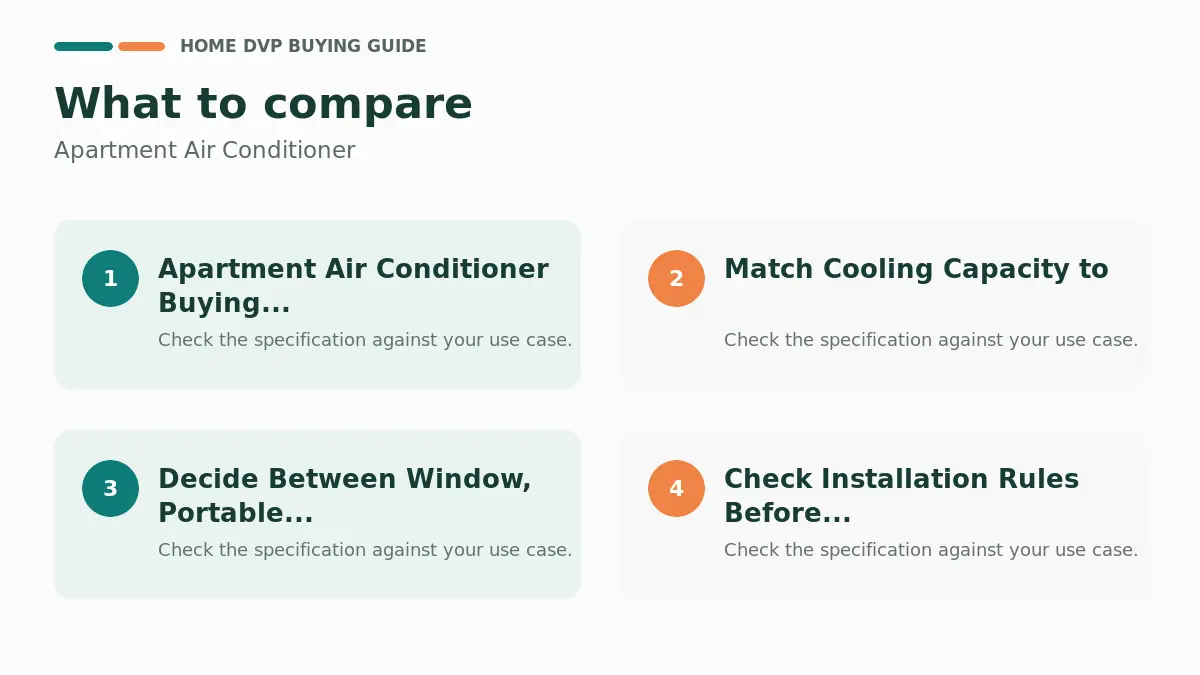
Apartment Air Conditioner Buying Guide
Apartment cooling has a different set of priorities than whole-house HVAC. You may need a unit that installs without permanent changes, runs quietly enough for a bedroom, fits a narrow window, or moves between rooms on casters. The right Apartment Air Conditioner should match the room, the window, the noise tolerance of nearby neighbors or roommates, and the amount of maintenance you are willing to handle during hot weather.
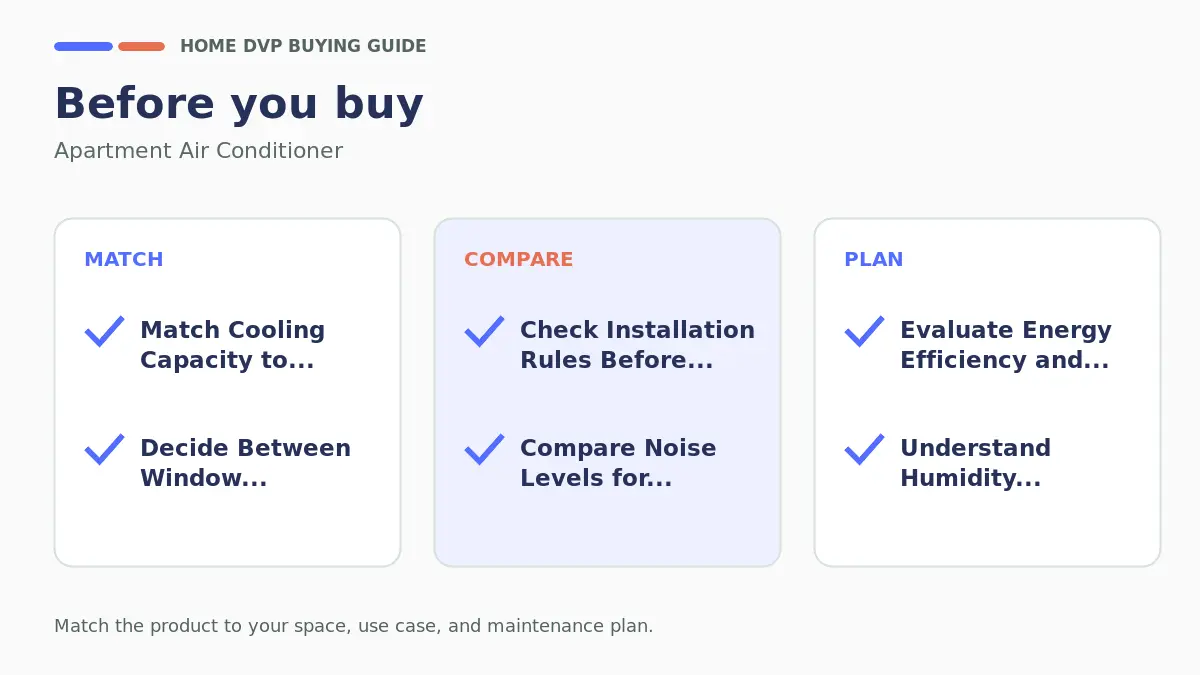
Match Cooling Capacity to Your Actual Room Size
Cooling capacity is one of the most important specifications, but it is also one of the most misunderstood. Compact window units such as the Frigidaire window-mounted air conditioner, Amazon Basics window air conditioner, and Midea EasyCool window air conditioner are designed for smaller rooms. These are often better fits for bedrooms, studio sleeping areas, or home offices where a larger unit could cycle too quickly and leave the room feeling humid.
For larger apartment living rooms or open layouts, portable units such as the VACOOR portable air conditioner, Feelfunn portable air conditioner, Air Future portable air conditioner, and DREO portable air conditioner offer stronger room coverage. These models are useful when a window unit is not allowed, when you need to move cooling between rooms, or when you want combined cooling, fan, and dehumidifier functions. The tradeoff is that portable AC units require floor space and an exhaust hose connection.
A common mistake is buying the largest unit available for a small bedroom. Oversizing can increase noise, waste energy, and reduce humidity removal because the compressor may not run long enough. Undersizing is just as frustrating because the unit runs constantly without reaching a comfortable temperature. Measure the room, account for sun exposure, ceiling height, and kitchen heat, then choose capacity accordingly.
| Apartment Situation | Practical Cooling Direction |
|---|---|
| Small bedroom or home office | Consider compact window units with quiet operation and washable filters. |
| Medium bedroom or studio area | Look at smart window units or portable AC units with sleep mode and remote control. |
| Larger living room or open space | Compare higher-capacity portable units with stronger airflow and dehumidifier mode. |
| Desk, dorm, or personal spot cooling | Personal evaporative units can help nearby comfort but should not replace true room air conditioning. |
Decide Between Window, Portable, and Personal Cooling Designs
Window air conditioners are usually efficient for small rooms because the hot side of the system sits outside the window opening. The Frigidaire window-mounted air conditioner and Amazon Basics window air conditioner are straightforward mechanical-control options for small spaces, while the Midea U-shaped smart inverter models add quieter operation, smart controls, and the ability to open the window with the unit installed. If your lease allows window units and your window dimensions match the product requirements, this format is often space-saving.
Portable air conditioners are often more renter-friendly because they usually rely on a window exhaust kit rather than a heavy unit sitting in the window frame. The VACOOR portable air conditioner is suited for larger apartment spaces based on its listed capacity and airflow, while the DREO portable air conditioner emphasizes quiet operation, app or voice control, and drainage-free operation under specified humidity conditions. The Feelfunn and Air Future portable units also combine cooling, fan, dehumidifier, timer, and sleep features for flexible apartment use.
Personal evaporative coolers, such as the YAFVPIZUT dual-nozzle unit, are different. They use water and airflow for close-range cooling and are not a direct substitute for compressor-based air conditioning. They can be useful at a desk, bedside table, or camping-style setup, but apartment shoppers should understand that evaporative cooling works best in drier environments and will not cool an entire room like a window or portable AC.
Check Installation Rules Before You Buy
Apartment installation is where many buyers run into problems. Before choosing Apartment Air Conditioner, review your lease, building rules, window style, and whether outside brackets or visible exterior units are allowed. Some buildings prohibit standard window AC units for safety or appearance reasons, while others allow them only with approved supports. If the building does not allow window-mounted systems, a portable model with an included window kit may be the safer choice.
Window size matters. The Midea U-shaped smart inverter units list compatibility with single-hung or double-hung windows within a specified width and minimum height, while compact window units use adjustable side panels and mounting kits. Portable models such as the Feelfunn and Air Future units include window kits for sliding-style setup, but you still need to verify the panel range against your window opening.
Renters should avoid drilling unless the lease clearly permits it. Look for included brackets, expandable panels, and no-drill or low-impact installation details. Also check whether the power cord can reach a grounded outlet without an extension cord. For related moisture-control setup considerations, our dehumidifier drain hose guide can help explain why drainage planning matters in humid rooms.
Compare Noise Levels for Bedrooms and Shared Walls
Noise is especially important in apartments because the unit may sit near a bed, desk, nursery, or shared wall. The Midea U-shaped inverter designs stand out on paper for very low listed operating noise because the window helps block compressor sound. DREO’s portable unit also emphasizes reduced compressor and turbulence noise, making it a practical option for bedrooms or work-from-home setups where constant background noise can be distracting.
Traditional compact window units such as the Frigidaire and Amazon Basics models may be simple and cost-conscious, but they can sound more noticeable because the compressor and fan are closer to the room. That does not make them a poor choice. It simply means they are better for buyers who value straightforward cooling and can tolerate moderate fan noise, especially in small bedrooms where the unit does not need to run at maximum output all night.
If you are a light sleeper, prioritize sleep mode, lower decibel ratings, inverter operation, and remote control. A timer can also help by reducing runtime after the room cools down. Avoid placing portable units directly beside the bed if you have room to position them farther away, and keep filters clean so airflow restrictions do not make the fan work harder.
Evaluate Energy Efficiency and Smart Controls
Energy efficiency matters in apartments because many renters pay their own electric bills and run cooling for long hours during heat waves. Inverter window models, including the Midea U-shaped smart inverter units, are designed to reduce energy use by adjusting compressor output rather than cycling on and off as aggressively. The VACOOR portable air conditioner also lists a CEER efficiency figure, which helps shoppers compare energy performance among portable systems.
Smart controls can improve daily convenience. Midea’s U-shaped models support app and voice control, while the DREO portable air conditioner includes app, voice, and remote control options. These features are useful if you want to cool the apartment before you arrive home, adjust settings from bed, or create a more predictable sleep schedule. If you are already building a climate-control setup, our guide to smart thermostat vs programmable thermostat decisions may help you think through scheduling and energy habits.
Mechanical controls still have a place. The Amazon Basics window air conditioner and similar simple models may appeal to shoppers who want fewer electronics, easy operation, and no app dependency. The best choice is not always the most connected one. It is the model that matches your room, your energy goals, and how you actually adjust cooling day to day.
Understand Humidity Control and Drainage
Cooling and dehumidification are connected, but not identical. Many apartments feel uncomfortable because of humidity as much as temperature. Portable models such as the VACOOR, Feelfunn, DREO, and Air Future units include dehumidifier or dry modes that can help reduce sticky indoor air. This is especially useful for garden-level apartments, older buildings, kitchens, and rooms with limited ventilation.
Drainage requirements vary by model and humidity level. Some portable units use self-evaporating systems that reduce how often you need to empty water, while others include drain hoses or full-water alerts. DREO’s listed drainage-free system is designed for certain humidity conditions, while the VACOOR unit includes drainage features and a water-full alert. Air Future’s product information also notes self-evaporation during normal operation, with draining needed in very humid conditions.
Do not ignore drainage instructions. A portable AC that is not drained properly may shut off, leak, or perform poorly. If you live in a humid region, compare dehumidifier capacity, drain hose support, water tank alerts, and access to a nearby drain or safe collection container before buying.
Look at Maintenance, Filters, and Long-Term Reliability
Maintenance is simple, but it is easy to neglect. Most apartment AC units rely on washable or reusable filters that should be cleaned regularly during heavy use. The Frigidaire, Amazon Basics, Midea EasyCool, and Air Future models all emphasize removable or washable filter access, which is important for airflow, cooling performance, and dust control.
Build quality is difficult to judge from a listing alone, so we look at user-facing details such as filter access, caster wheels, side handles, mounting hardware, control layout, drainage alerts, and auto-restart features. Auto restart is useful in apartments where summer power interruptions can happen. It allows the unit to resume prior settings after power returns, reducing the risk of coming home to a hot room.
Plan for seasonal storage as well. Portable units take more closet space but are easier to remove at the end of the cooling season. Window units save floor space during use but require safe lifting, removal, and storage if your building does not allow year-round installation. If indoor air comfort is a broader concern, the Air Quality & Climate category is a useful place to compare related home comfort products.
Choose Features Based on How You Use the Apartment
The right feature set depends on your lifestyle. If you work from home, quiet operation, remote control, app control, and stable temperature settings matter more than maximum output. If you are cooling a bedroom, sleep mode and low-noise performance should move to the top of the list. If you are cooling a living room, airflow direction, room coverage, and dehumidifier mode may matter more.
For larger apartment spaces, the VACOOR portable air conditioner provides a strong listed capacity, upward airflow, dehumidifier function, and a renter-friendly window kit. For quieter smart window cooling, the Midea U-shaped smart inverter units are compelling because of their inverter design, app support, and window-opening flexibility. For small rooms and straightforward use, the Frigidaire and Amazon Basics models keep things simple with washable filters and basic controls.
Avoid paying for features you will not use. Voice control is convenient, but it is not essential for every renter. Likewise, a high-output portable unit may be unnecessary for a small bedroom. Start with the room and installation constraints, then compare convenience features after the fundamentals are covered.
Our Research Methodology & Why You Can Trust Us
We evaluated the products based on available product information, listed specifications, category fit, room-size claims, installation requirements, controls, maintenance features, and apartment suitability. We did not claim hands-on testing. Instead, our analysis is based on specification-level comparison and practical homeowner considerations that affect real-world buying decisions.
Our research indicates that the most important ranking criteria for Apartment Air Conditioner are performance, feature set, build quality, ease of use, durability, safety, value, reliability, and fit for renter or homeowner use cases. We also considered whether each model made sense for apartments specifically, including window compatibility, portability, noise control, drainage, filter access, and whether setup appears renter-friendly.
We validated products against the Heating, Cooling & Air category and only discussed items that clearly relate to apartment cooling. Compressor-based window and portable AC units were treated differently from personal evaporative coolers because they solve different cooling problems. This distinction matters because a desk cooler can improve personal comfort, but it should not be presented as equal to a true room air conditioner.
This guide is designed for practical shoppers and is updated during July to keep the advice aligned with current product data. Because prices and availability can change, we use the dynamic $33.99 – $399.99 placeholder rather than hardcoding cost claims. For safe year-round climate planning, our space heater safety guide is also helpful when comparing cooling and heating choices for small homes.
Final Thoughts
Based on the available specifications, the VACOOR portable air conditioner is a strong heavy-duty pick for larger apartment rooms because it combines high listed cooling capacity, upward airflow, dehumidifier mode, sleep mode, caster wheels, handles, and a window kit designed for rental spaces. It is best suited for renters who need flexible placement and room-wide cooling, but buyers should confirm they have floor space and a compatible window for venting.
For quiet smart window cooling, the Midea U-shaped smart inverter window air conditioners are excellent options to compare. The smaller version is better suited to more compact rooms, while the larger version fits shoppers who need more coverage and still want low-noise operation, app control, voice compatibility, and window-opening flexibility. For a simple small-space value approach, the Amazon Basics window air conditioner and Frigidaire window-mounted air conditioner are practical choices for bedrooms or offices where basic, reliable cooling is the priority.
If you need portable flexibility with modern controls, the DREO portable air conditioner stands out for quiet operation, smart climate control, and drainage management, while the Feelfunn and Air Future portable units are useful for renters who want cooling, fan, dehumidifier, timer, and sleep functions in one movable appliance. The YAFVPIZUT personal evaporative unit is best viewed as close-range personal cooling, not a full-room replacement. For more comparisons across home comfort products, visit our cool mist vs warm mist humidifier guide.
FAQ
What should I look for when choosing Apartment Air Conditioner?
Start with room size, window compatibility, noise level, and whether your lease allows window-mounted units. Then compare cooling capacity, energy features, drainage needs, filter access, and controls. The right Apartment Air Conditioner should fit your apartment physically and match how you cool the room day to day.
Are higher-end Apartment Air Conditioner worth it?
Higher-end models can be worth it when they add meaningful benefits such as inverter operation, quieter performance, smart controls, stronger airflow, or better humidity management. They are less necessary for a small room where a simple compact window unit can do the job. Compare the features against your actual room and usage pattern before paying more.
How should beginners choose Apartment Air Conditioner?
Beginners should avoid overcomplicating the decision. Measure the room and window, check lease rules, choose a capacity suited to the space, and prioritize easy installation with clear filter maintenance. If drilling or lifting a window unit is a concern, a portable model with a window kit may be easier to manage.
How long should quality Apartment Air Conditioner last?
Longevity depends on build quality, runtime, cleaning habits, humidity exposure, and storage. Keeping filters clean, following drainage instructions, and storing removable units properly at the end of the season can help protect performance. Models with washable filters, auto restart, and accessible maintenance points are generally easier to care for over time.
What brands make reliable Apartment Air Conditioner?
The product data includes options from AmazonBasics, ArcticAir, Coolblus and more, with different strengths across compact window units, smart inverter models, portable AC units, and personal cooling designs. Reliability should be judged by more than brand name alone. Look closely at specifications, room coverage, warranty language when provided, user-facing maintenance features, and whether the design fits your apartment.
How much should homeowners expect from Apartment Air Conditioner in 2026?
Shoppers should expect options across $33.99 – $399.99, depending on size, cooling format, smart features, and capacity. Compact mechanical window units usually focus on basic cooling, while smart inverter and larger portable units tend to add convenience, quiet operation, and broader room coverage. Always check current pricing and availability before making a final decision.
Are Apartment Air Conditioner suitable for apartments with humidity problems?
Many portable and window AC units can help reduce humidity while cooling, and some models include dedicated dry or dehumidifier modes. If humidity is a major issue, pay special attention to drainage requirements, dehumidifier capacity, and water-full alerts. You can also compare related moisture-control advice in our dehumidifier drain hose guide.

Write Your Review
No reviews yet. Be the first to share your experience!