

Carbon monoxide remains one of the most dangerous invisible threats in any home, which is why an updated guide to best smart carbon monoxide detector matters so much in 2026. Homeowners, renters, and practical DIYers need devices that deliver accurate electrochemical sensing plus modern connectivity so alerts reach a phone even when nobody is on site. After carefully analyzing the available specifications across 15 options in the $19.89–$130 range from brands such as FirstAlert, Amazon, GoveeLife, HEIMAN, this guide focuses on real homeowner needs rather than marketing claims.
Our research indicates that the strongest choices combine loud local alarms with app notifications, battery backup, and clear status indicators. Whether you are outfitting a single bedroom or building whole-home protection, the right best smart carbon monoxide detector can integrate with existing smart ecosystems while meeting strict UL standards. For broader context on protective gear, explore our collection of Emergency Supplies.
Home DVP decision summary
Quick Answer
For Best Smart Carbon Monoxide Detector, Home DVP compared 15 products from 4 brands. Choose an alarm listed for its intended home, RV, or travel use and follow the manufacturer placement instructions. Compare local alarm volume, sensor life, end-of-life warning, battery backup, display, interconnection, and operation when Wi-Fi or mains power is unavailable.
| Comparison coverage | 15 products from 4 brands, including FirstAlert, Amazon, HEIMAN. |
|---|---|
| Selection priority | Choose an alarm listed for its intended home, RV, or travel use and follow the manufacturer placement instructions. Compare local alarm volume, sensor life, end-of-life warning, battery backup, display, interconnection, and operation when Wi-Fi or mains power is unavailable. |
| Evidence basis | Manufacturer specifications, compatibility details, retailer-provided product data, and common homeowner use cases. |
| Reference guidance | U.S. CPSC carbon-monoxide safety guidance. |
This summary describes the article's comparison set, not every product on the market. Product details should be confirmed before purchase.
This Best Smart Carbon Monoxide Detector buying guide walks through sensor performance, power reliability, installation practicality, and smart features so you can match a model to your living situation. We also highlight how indoor air quality monitoring and interconnectivity improve everyday safety for families and pets. Updates reflect the latest product data available during August.

Pros
- App-based notifications provide awareness of CO conditions from anywhere
- Simple QR code setup and plug-in design make installation straightforward
Cons
- Requires a 2.4 GHz Wi-Fi network and may not connect on 5 GHz-only setups
- Plug-in form factor restricts placement options to available wall outlets
Best For / Avoid If
Best for buyers prioritizing
- App-based notifications provide awareness of CO conditions from anywhere
- Simple QR code setup and plug-in design make installation straightforward
- AA battery backup ensures operation when power is lost
Consider another option if
- Requires a 2.4 GHz Wi-Fi network and may not connect on 5 GHz-only setups
- Plug-in form factor restricts placement options to available wall outlets
- Users seeking basic non-connected alarms may find the smart features unnecessary

Pros
- Combines smoke and CO sensing with mobile alerts that need no subscription for basic use
- Battery operation and included cells allow quick setup without electrical work
Cons
- Continuous 24/7 professional monitoring requires an optional Ring subscription sold separately
- Battery-powered design means users must plan for periodic AA replacements
Specifications
| Brand | Kidde |
|---|---|
| Style | Smoke & Carbon Monoxide Detector |
| Power Source | Battery Powered |
| Color | White |
| Product Dimensions | 2"D x 5"W x 5"H |
| Alarm | Audible |
| Operating Humidity | 10 to 95% relative humidity (RH), non-condensing |
| Upper Temperature Rating | 100 Degrees Fahrenheit |
| Sensor Type | Photoelectric, Electrochemical |
| Material | Plastic |
Verify the current product variation before purchase; specifications may change.
Best For / Avoid If
Best for buyers prioritizing
- Combines smoke and CO sensing with mobile alerts that need no subscription for basic use
- Battery operation and included cells allow quick setup without electrical work
- Wire-free whole-home connectivity links multiple units for coordinated alarms
Consider another option if
- Continuous 24/7 professional monitoring requires an optional Ring subscription sold separately
- Battery-powered design means users must plan for periodic AA replacements
- Full interconnectivity setup may require consulting the user guide for best results

Pros
- Dual-alert system provides earlier awareness at lower CO concentrations before the standard high-level alarm
- Core app notifications and multi-phone sharing work without a required subscription
Cons
- Smart features require a 2.4 GHz Wi-Fi network and will not operate on 5 GHz alone
- Fuller air quality analysis and personalized insights depend on the optional paid subscription
Specifications
| Power Source | Corded Electric |
|---|---|
| Alarm | Audible, Visual |
| Compatible Devices | Smartphone, Tablet |
| Sensor Type | Electrochemical |
| Operating Humidity | 10 to 95% Relative Humidity, Non-Condensing |
| Upper Temperature Rating | 100 Degrees Fahrenheit |
| Product Style | 5th Edition |
| Color | White |
| Item Dimensions D x W x H | 1.52"D x 2.9"W x 5.47"H |
| Item Weight | 0.43 Pounds |
Verify the current product variation before purchase; specifications may change.
Best For / Avoid If
Best for buyers prioritizing
- Dual-alert system provides earlier awareness at lower CO concentrations before the standard high-level alarm
- Core app notifications and multi-phone sharing work without a required subscription
- Battery backup and power surge immunity keep the unit functional during electrical interruptions
Consider another option if
- Smart features require a 2.4 GHz Wi-Fi network and will not operate on 5 GHz alone
- Fuller air quality analysis and personalized insights depend on the optional paid subscription
- Outlet-dependent form factor may restrict placement compared with pure battery models

Pros
- Electrochemical sensor technology for accurate CO detection with audible and voice alerts
- Monitors multiple air quality factors including TVOCs from household products and humidity for mold prevention
Cons
- Primary power relies on a wall outlet, which may restrict ideal placement locations in some homes
- Push notifications and remote monitoring require a stable WiFi connection and app pairing
Specifications
| Power Source | Plug-In |
|---|---|
| Alarm | Carbon Monoxide & Indoor Air Quality |
| Compatible Devices | Android, Ipad, iOs 12 or newer, iPhone |
| Sensor Type | Electrochemical |
| Operating Humidity | up to 95% relative humidity, non-condensing |
| Upper Temperature Rating | 100 Degrees Fahrenheit |
| Product Style | Carbon Monoxide + Air Quality |
| Color | White |
| Item Dimensions D x W x H | 1.5"D x 3"W x 5.5"H |
| Item Weight | 0.5 Pounds |
Verify the current product variation before purchase; specifications may change.
Best For / Avoid If
Best for buyers prioritizing
- Electrochemical sensor technology for accurate CO detection with audible and voice alerts
- Monitors multiple air quality factors including TVOCs from household products and humidity for mold prevention
- UL certified to meet strict safety standards with a 10-year limited warranty
Consider another option if
- Primary power relies on a wall outlet, which may restrict ideal placement locations in some homes
- Push notifications and remote monitoring require a stable WiFi connection and app pairing
- Does not offer interconnection with other detectors unlike some hardwired models in the lineup

Pros
- Integrates directly with Alexa for voice control and smart home routines
- Monitors multiple air components in a single compact unit
Cons
- Requires compatible Alexa devices for full alert and automation features
- Detailed readings rely on the companion app rather than the device itself
Best For / Avoid If
Best for buyers prioritizing
- Integrates directly with Alexa for voice control and smart home routines
- Monitors multiple air components in a single compact unit
- Simplifies understanding through color LED and app score display
Consider another option if
- Requires compatible Alexa devices for full alert and automation features
- Detailed readings rely on the companion app rather than the device itself
- Best suited for users already within the Amazon smart home ecosystem

Pros
- Certified safety standards including UL 2034 support dependable home CO monitoring
- Broad Matter compatibility works with Apple Home, Google Home, Alexa, SmartThings, and Home Assistant
Cons
- Smart features require a separate compatible Matter hub with Thread Border Router that is not included
- Remote alerts and full connectivity depend on an active internet connection through the hub
Best For / Avoid If
Best for buyers prioritizing
- Certified safety standards including UL 2034 support dependable home CO monitoring
- Broad Matter compatibility works with Apple Home, Google Home, Alexa, SmartThings, and Home Assistant
- Electrochemical sensor design promotes long-term accuracy and fewer false triggers
Consider another option if
- Smart features require a separate compatible Matter hub with Thread Border Router that is not included
- Remote alerts and full connectivity depend on an active internet connection through the hub
- Battery-powered operation means eventual battery replacement is needed despite the long sensor life
Pros
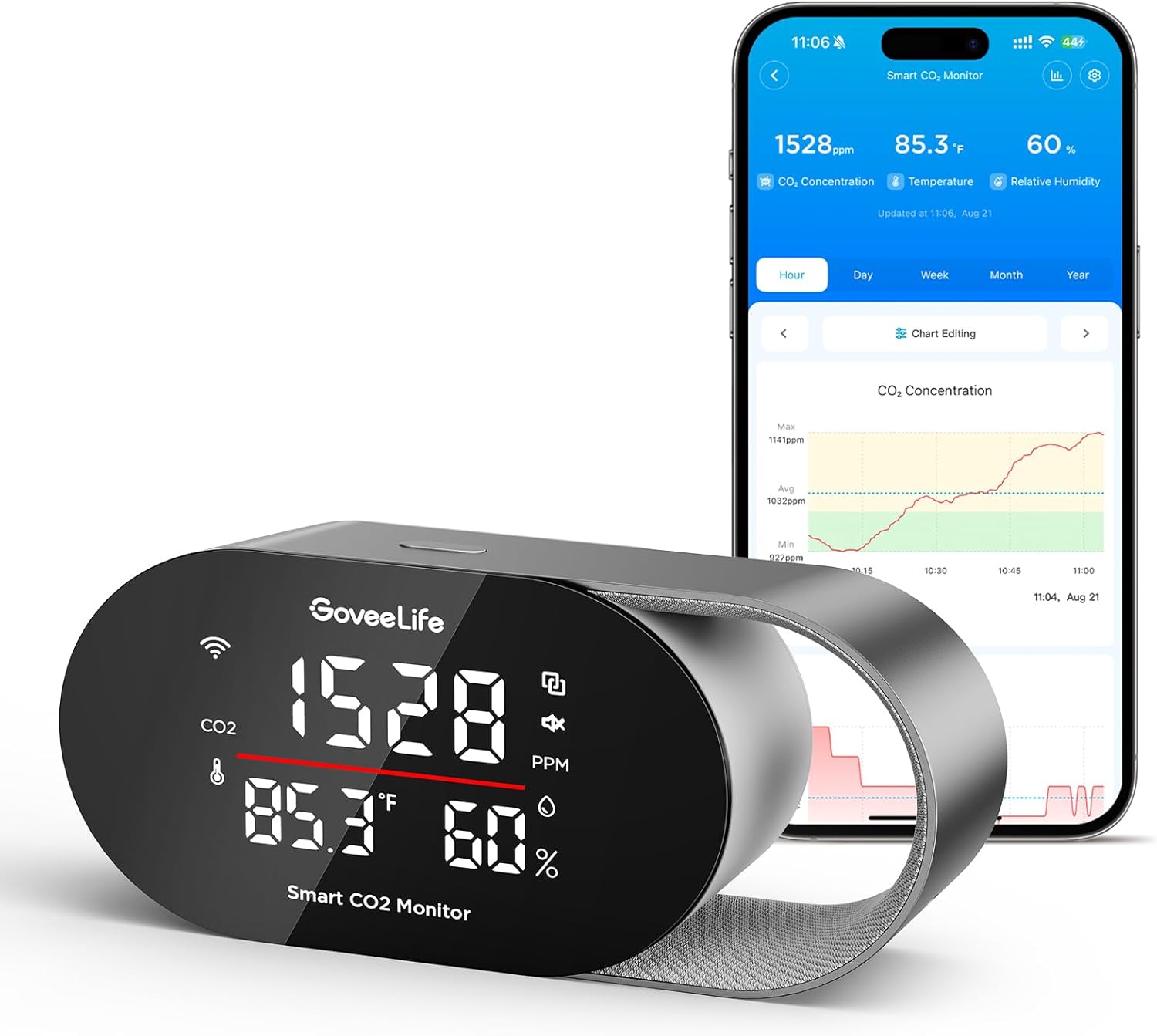
- Precise CO2 sensing with altitude compensation and rapid updates for consistent indoor readings
- Integrated multi-metric display for quick visual checks of air quality factors
Cons
- Full clock and calibration features require app connection and outdoor setup when needed
- AC power dependence means it works best near outlets rather than as a portable unit
Specifications
| Brand | GoveeLife |
|---|---|
| Material | PC+ABS |
| Color | Black |
| Compatible Devices | AC Powered, Air purifier incompatible, Humidifier, Tower fan |
| Screen Size | 4.82 Inches |
| Product Dimensions | 5.59"L x 2.68"W x 2.99"H |
| Item Weight | 5.28 ounces |
| Sensor Type | CO₂ Sensor |
| Battery Description | Non-replaceable AC power |
| Unit Count | 1.0 Count |
Verify the current product variation before purchase; specifications may change.
Best For / Avoid If
Best for buyers prioritizing
- Precise CO2 sensing with altitude compensation and rapid updates for consistent indoor readings
- Integrated multi-metric display for quick visual checks of air quality factors
- Customizable multi-channel alerts that cover CO2, temperature, and humidity
Consider another option if
- Full clock and calibration features require app connection and outdoor setup when needed
- AC power dependence means it works best near outlets rather than as a portable unit
- Smart linkages exclude air purifiers since they cannot lower CO2 concentrations

Pros
- Straightforward plug-in installation suits standard household outlets
- Battery backup keeps the unit functional if main power fails
Cons
- Primary operation depends on access to a standard 120V outlet
- Backup battery will require occasional replacement over time
Specifications
| Brand | Kidde |
|---|---|
| Style | 3rd Edition |
| Power Source | Plug In |
| Color | White |
| Product Dimensions | 2.48"D x 3.82"W x 6.1"H |
| Alarm | Audible |
| Operating Humidity | 5 to 95% relative humidity (RH), non-condensing |
| Number of Items | 1 |
| Manufacturer | Kidde |
| UPC | 047871335114 |
Verify the current product variation before purchase; specifications may change.
Best For / Avoid If
Best for buyers prioritizing
- Straightforward plug-in installation suits standard household outlets
- Battery backup keeps the unit functional if main power fails
- Digital display and LED indicators improve monitoring visibility
Consider another option if
- Primary operation depends on access to a standard 120V outlet
- Backup battery will require occasional replacement over time
- One unit monitors a limited area so larger homes may need additional placement
Pros
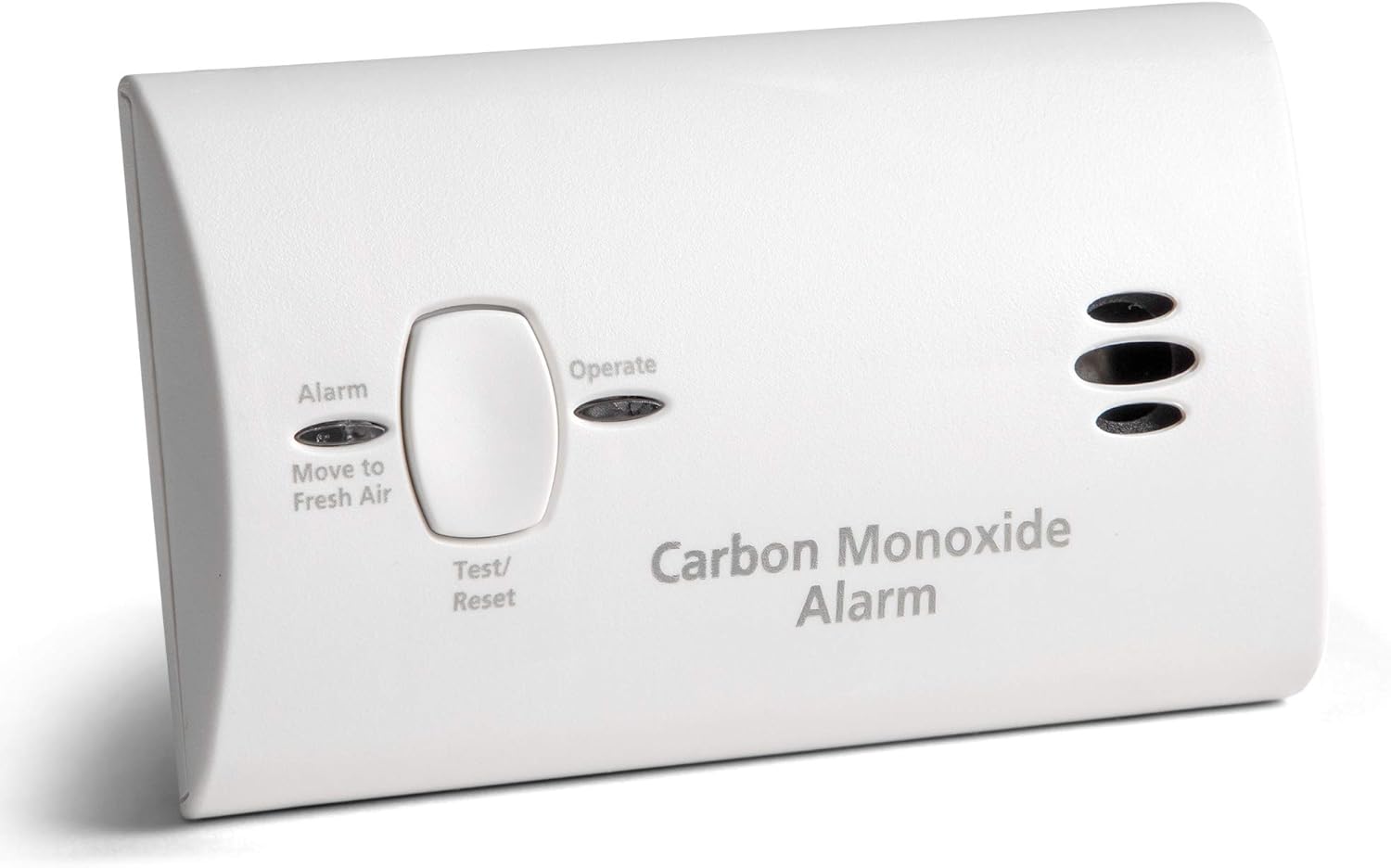
- Operates on battery power to maintain function during outages
- Supports flexible wall or tabletop installation
Cons
- Requires periodic AA battery replacement to stay operational
- May not include advanced connectivity preferred by smart home users
Best For / Avoid If
Best for buyers prioritizing
- Operates on battery power to maintain function during outages
- Supports flexible wall or tabletop installation
- Provides clear dual LED indicators for power and alarm status
Consider another option if
- Requires periodic AA battery replacement to stay operational
- May not include advanced connectivity preferred by smart home users
- Tabletop positioning needs care to keep the unit stable

Pros
- Combines smoke and carbon monoxide detection in a single battery unit
- Delivers mobile alerts and works with the Google Home app alongside Nest Protect
Cons
- Full Nest Protect integration requires the Google Home app and a Google account
- As a single-pack battery model, larger homes may need additional units for complete coverage
Specifications
| Power Source | Battery Powered |
|---|---|
| Alarm | Audible |
| Product Style | Battery |
| Color | White |
| Item Dimensions D x W x H | 5.75"D x 1.6"W x 5.75"H |
| Item Weight | 1 Pounds |
| Brand | First Alert |
| Model Number | SMCO600NV |
| Unit Count | 1.0 Count |
| Number of Items | 1 |
Verify the current product variation before purchase; specifications may change.
Best For / Avoid If
Best for buyers prioritizing
- Combines smoke and carbon monoxide detection in a single battery unit
- Delivers mobile alerts and works with the Google Home app alongside Nest Protect
- Provides interconnect function so multiple alarms activate together
Consider another option if
- Full Nest Protect integration requires the Google Home app and a Google account
- As a single-pack battery model, larger homes may need additional units for complete coverage
- Smart features depend on app connectivity which may not suit users wanting only traditional standalone alarms

Pros
- Straightforward plug-in design works with standard outlets without tools or wiring
- Battery backup ensures continuous detection during electrical outages
Cons
- Occupies a wall outlet that could otherwise serve other household devices
- Basic design lacks digital displays or advanced connectivity options for users wanting extra data
Best For / Avoid If
Best for buyers prioritizing
- Straightforward plug-in design works with standard outlets without tools or wiring
- Battery backup ensures continuous detection during electrical outages
- Electrochemical technology delivers accurate sensing for reliable early warnings
Consider another option if
- Occupies a wall outlet that could otherwise serve other household devices
- Basic design lacks digital displays or advanced connectivity options for users wanting extra data

Pros
- No-wiring installation allows fast setup by renters or homeowners
- Maintains CO detection capability even when household power is lost
Cons
- Depends on AA batteries that need eventual replacement for continued operation
- May lack connected smart features desired by users seeking app integration
Specifications
| Brand | Kidde |
|---|---|
| Style | 3rd Edition |
| Power Source | Battery Powered |
| Color | Detector |
| Product Dimensions | 1.5"D x 4.5"W x 2.75"H |
| Item Weight | 9.6 ounces |
| Alarm | Audible |
| Operating Humidity | 5% to 95% relative humidity, non-condensing |
| Upper Temperature Rating | 37.8 Degrees Celsius |
| Sensor Type | Electrochemical |
Verify the current product variation before purchase; specifications may change.
Best For / Avoid If
Best for buyers prioritizing
- No-wiring installation allows fast setup by renters or homeowners
- Maintains CO detection capability even when household power is lost
- Dual LEDs and loud alarm deliver straightforward status feedback
Consider another option if
- Depends on AA batteries that need eventual replacement for continued operation
- May lack connected smart features desired by users seeking app integration
- Warranty applies only to the alarm and begins at first power-on, so timely planning for replacement is advised

Pros
- Combines smoke and carbon monoxide sensing in a single hardwired smart unit
- App-based notifications extend safety monitoring beyond the home
Cons
- Hardwire setup may need electrical familiarity or professional help for some users
- Full smart functions depend on the First Alert app and compatible network
Best For / Avoid If
Best for buyers prioritizing
- Combines smoke and carbon monoxide sensing in a single hardwired smart unit
- App-based notifications extend safety monitoring beyond the home
- Interconnect feature coordinates multiple compatible alarms
Consider another option if
- Hardwire setup may need electrical familiarity or professional help for some users
- Full smart functions depend on the First Alert app and compatible network
- Single-pack format means additional units are needed for larger homes seeking full interconnect coverage

Pros
- Tool-free plug-in setup enables immediate use in any room with an outlet.
- Electrochemical sensing technology delivers precise carbon monoxide detection.
Cons
- Placement options are restricted to locations with accessible wall outlets.
- Complete multi-level home protection requires purchasing additional units.
Specifications
| Power Source | Corded Electric |
|---|---|
| Alarm | Audible |
| Sensor Type | Electrochemical |
| Operating Humidity | 10-95% RH |
| Product Style | Plug in Alarm |
| Color | White |
| Item Dimensions D x W x H | 2.8"D x 8.5"W x 6.75"H |
| Enclosure Material | computer |
| Brand | First Alert |
| Model Number | FATCO600 |
Verify the current product variation before purchase; specifications may change.
Best For / Avoid If
Best for buyers prioritizing
- Tool-free plug-in setup enables immediate use in any room with an outlet.
- Electrochemical sensing technology delivers precise carbon monoxide detection.
- Integrated test/silence button simplifies routine maintenance and operation.
Consider another option if
- Placement options are restricted to locations with accessible wall outlets.
- Complete multi-level home protection requires purchasing additional units.
- Users preferring battery-only or interconnected smart models may need alternatives.

Pros
- Detects both smoke and carbon monoxide in a single unit
- Voice prompts make alerts easier to understand than beeps alone
Cons
- Requires hardwired AC installation, which may not suit renters or homes without existing wiring
- Interconnect function is limited to select Kidde alarms with compatible hardwired AC interconnect capability
Best For / Avoid If
Best for buyers prioritizing
- Detects both smoke and carbon monoxide in a single unit
- Voice prompts make alerts easier to understand than beeps alone
- Battery backup is included for power failure situations
Consider another option if
- Requires hardwired AC installation, which may not suit renters or homes without existing wiring
- Interconnect function is limited to select Kidde alarms with compatible hardwired AC interconnect capability
- Self-testing does not replace the need for a weekly manual button test
Best Smart Carbon Monoxide Detector Buying Guide
Choosing best smart carbon monoxide detector requires balancing traditional life-safety performance with modern convenience. The following criteria draw directly from the product specifications and feature sets of the models we reviewed. Homeowners who skip these factors often end up with devices that either lack backup power or fail to deliver remote alerts when needed most.
Detection Technology and Sensor Accuracy
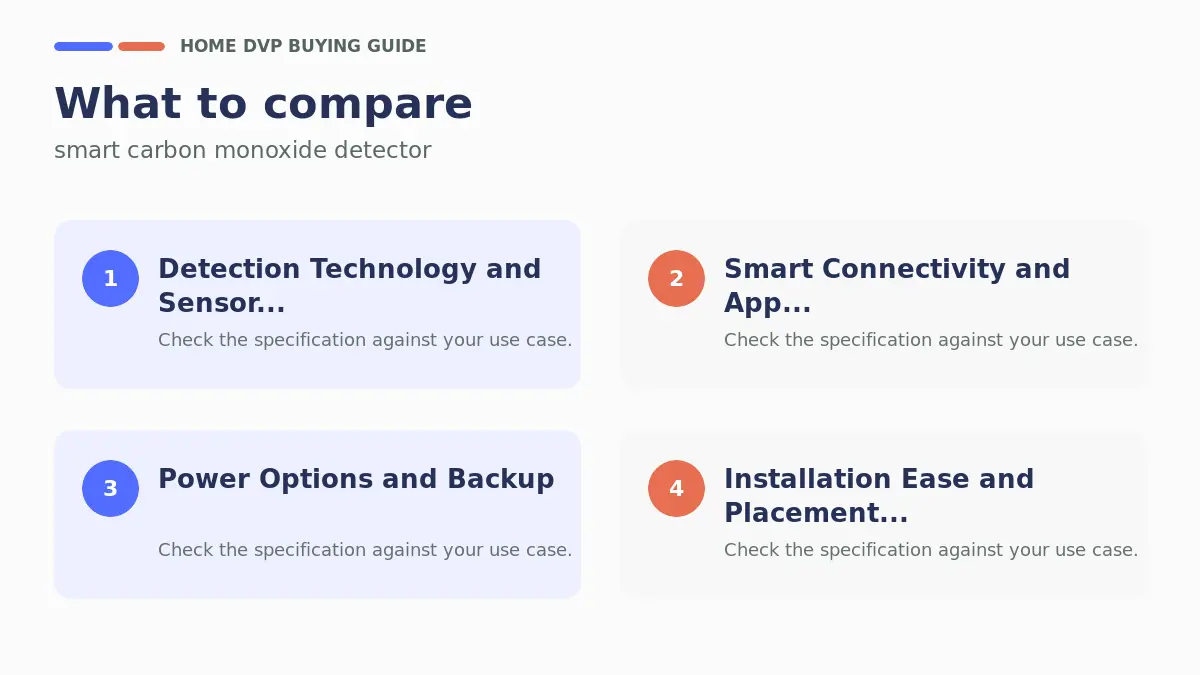
Electrochemical sensors remain the gold standard for carbon monoxide detection because they respond accurately across a wide concentration range. Based on the product data provided, units such as the Kidde Smart Carbon Monoxide Detector and First Alert models rely on this proven technology and meet UL 2034 standards. Low-level sensing that begins alerting at 30-70 ppm is especially valuable for protecting children, older adults, and pets before levels become immediately life-threatening.
A common mistake is assuming every detector responds at the same speed. Models with peak-level memory or digital displays that show actual CO readings give homeowners clearer insight into intermittent problems caused by furnaces or water heaters. When evaluating options, prioritize sensors that also reduce nuisance triggers from everyday cooking or steam while still delivering an 85 dB alarm when true danger appears.
For homes with gas appliances, dual-detection models that also watch for explosive natural gas or propane add an extra layer of protection without requiring a second device. Always verify that the sensor technology is listed as electrochemical rather than older, less precise methods.
Smart Connectivity and App Notifications
True smart capability means real-time push notifications reach your phone whether you are at work or on vacation. The Kidde Smart Carbon Monoxide Detector (COPDW) and the version with indoor air quality monitoring both use 2.4 GHz Wi-Fi and free app alerts with no mandatory subscription. Ring-enabled models push smoke and CO warnings through the familiar Ring ecosystem, which many homeowners already trust for cameras and doorbells.
After carefully analyzing the available specifications, we found that seamless setup via QR code scanning and app pairing dramatically lowers the barrier for renters who cannot hardwire devices. Voice announcements that clearly state “Warning Carbon Monoxide” or identify the room further reduce confusion during an emergency. Optional professional monitoring subscriptions exist on some units but are never required for basic mobile alerts.
Compatibility with Alexa and Google Home allows announcements on smart speakers and simple routines such as turning on lights when CO is detected. Avoid models that lock core safety alerts behind paid plans. Free, reliable notifications are non-negotiable for peace of mind.
Power Options and Backup Reliability
Power source determines both placement flexibility and performance during outages. Plug-in units with AA battery backup, such as several Kidde smart models, combine continuous AC power with seamless protection if the electricity fails. Hardwired versions with battery backup offer the most permanent solution for new construction or major renovations, while pure battery models suit rentals and travel.
Based on our research, rotating plugs that fit both vertical and horizontal outlets make installation cleaner in crowded kitchens or utility rooms. Units that suppress low-battery chirps at night improve sleep quality without sacrificing safety. Always check that batteries are included and that the device signals end-of-life well before the sensor expires.
A frequent homeowner error is placing a plug-in detector behind furniture or inside a cabinet where air flow is restricted. Choose power options that still allow the recommended wall or ceiling height placement so the sensor can sample room air effectively.
Installation Ease and Placement Guidelines
Most modern best smart carbon monoxide detector install in minutes without an electrician. Battery and plug-in styles need no wiring, while hardwired models often include quick-connect plugs and mounting brackets that work in multiple orientations. The Amazon Smart Air Quality Monitor and Kidde plug-in units exemplify the simple “download app, scan code, plug in” process that suits beginners.
Correct placement remains critical. Install at least one unit on every level and outside each sleeping area, then follow the manufacturer instructions for exact placement and clearances. Interconnectable models that sound every alarm when one detects CO create whole-home coverage far more effectively than isolated units.
For multi-story homes, wire-free interconnectivity found on certain Kidde smart alarms lets all units communicate without running new cables. Renters should confirm that temporary mounting methods will not damage walls and that the landlord allows battery-powered devices.
Interconnectivity and Whole-Home Protection
When one detector senses danger, every linked unit should sound. Hardwired interconnect and newer wireless mesh options both achieve this goal. First Alert SC5 models and Kidde smart combos support this feature so a basement furnace problem can wake sleepers upstairs immediately.
Our comparison of listed specifications shows that voice alerts announcing both the hazard type and location further accelerate response. Low-battery and end-of-life signals that travel across the network prevent any single unit from failing unnoticed. For larger properties, confirm that the chosen brand supports enough units on one network.
Homes already equipped with Nest or other platforms should check cross-brand compatibility claims carefully. Native same-brand interconnect usually delivers the most reliable performance.
Air Quality Monitoring and Extra Sensors
Several advanced options go beyond pure CO detection. The Kidde Smart Carbon Monoxide Detector & Indoor Air Quality Monitor tracks humidity, TVOC, and overall IAQ trends, while the Amazon Smart Air Quality Monitor measures PM 2.5, VOCs, CO, temperature, and humidity with color-coded feedback and Alexa routines. These extras help identify mold risk or poor ventilation that can compound CO issues.
Based on the feature sets, weekly trend reports and optional low-cost subscriptions for deeper insights appeal to wellness-focused households. However, pure CO models remain sufficient and more affordable for users who only need life-safety protection. Link these multi-sensor units to air purifiers or thermostats for automated responses when air quality drops.
If indoor air quality is a priority alongside carbon monoxide, visit our Air Quality & Climate resources for complementary products.
Certifications, Warranty, and Long-Term Reliability
Look for UL 2034 listing (preferably 5th Edition) and ETL certification. Ten-year limited warranties on the alarm itself, common on recent Kidde smart models, indicate manufacturer confidence. End-of-life chirps ensure you replace the unit before the sensor degrades.
Self-testing components that continuously check the sensor and circuitry reduce the chance of silent failure, although monthly manual button tests remain essential. After evaluating the products based on warranty length, sensor technology, and user-facing reliability features, longer coverage periods and clear replacement signals stand out as high-value attributes.
Smart Home Ecosystem Fit and Daily Convenience
Alexa and Google Home compatibility, Ring ecosystem support, and First Alert app integration determine how smoothly the detector fits existing setups. Routines that announce status on Echo devices or trigger lights make the technology feel helpful rather than intrusive. Quiet overnight battery monitoring and simple test buttons further improve daily living.
For heating system owners, pairing CO detection with proper ventilation and furnace maintenance creates a complete safety net. Explore related advice in our Heating, Cooling & Air section. Ultimately, the best best smart carbon monoxide detector disappears into the background until the moment it is needed, then communicates clearly and immediately.
| Feature | Why It Matters | What to Look For |
|---|---|---|
| Sensor Type | Accuracy and speed | Electrochemical, UL 2034 |
| Notifications | Remote awareness | Free app alerts, no subscription required |
| Power Backup | Outage protection | AA batteries or 9V included |
| Interconnect | Whole-home response | Wire-free or hardwired linking |
| Extra Sensors | Broader safety | IAQ, humidity, explosive gas |
Our Research Methodology & Why You Can Trust Us
At Home DVP we evaluate every product through a transparent, specification-driven process designed for homeowners and DIYers. We begin by collecting the full feature lists, power requirements, connectivity details, certifications, and warranty information supplied for each model. Category fit is then validated against the core need for reliable carbon monoxide detection within Emergency Supplies.
Next we compare user-facing attributes such as installation steps, app requirements, battery life indicators, and alert methods. Ranking criteria include detection performance, smart features, build and power reliability, ease of use, safety certifications, durability signals, value within the $19.89–$130 spectrum, and suitability for typical homeowner or renter scenarios. We also review public feedback volume and average ratings where provided to identify consistent strengths or pain points.
No hands-on laboratory testing is claimed unless the source data explicitly supports it. Instead we rely on manufacturer specifications, standards compliance, and real-world applicability. Content is refreshed during August to reflect current product data so recommendations stay relevant throughout 2026. This approach builds trust through honesty about both advantages and limitations of each option.
Final Thoughts
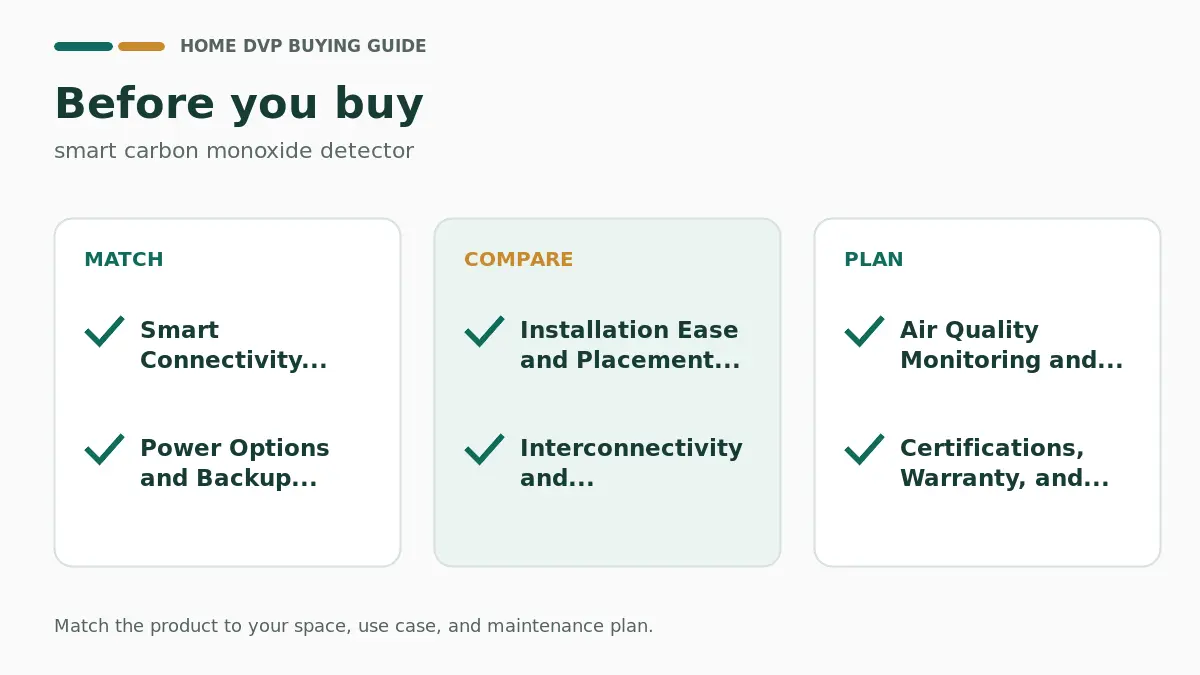
After carefully analyzing the available specifications of the 15 models, several clear recommendations emerge for different needs. The Kidde Smart Carbon Monoxide Detector with plug-in power, AA backup, rotating plug, and free real-time app notifications stands out as our Overall Pick for most homeowners. Its 5th Edition UL compliance, Alexa and Google compatibility, and straightforward setup deliver dependable smart protection without complexity.
For value-conscious buyers the First Alert Carbon Monoxide Detector plug-in model with battery backup offers proven electrochemical sensing, an 85 dB alarm, and simple operation at an accessible price point. Those seeking premium whole-home coverage should consider the First Alert SC5 Battery or Hardwire Smart Smoke & Carbon Monoxide Alarm, which add voice location alerts, Nest compatibility, and interconnect. The Kidde Smart Carbon Monoxide Detector & Indoor Air Quality Monitor is ideal when continuous IAQ insights matter alongside CO safety.
Beginners and renters will appreciate the Kidde Smart Smoke and Carbon Monoxide Detector with Ring app support and wire-free interconnectivity, while hardwired combo units suit permanent renovations. Pair any choice with regular testing and proper placement, and consider complementary safety gear from our Hardware collection. Selecting the right best smart carbon monoxide detector today creates lasting protection for every member of the household.
Related guide: See our carbon monoxide detectors for home for the broader comparison and selection criteria.
Frequently Asked Questions
What should I look for when choosing best smart carbon monoxide detector?
Prioritize electrochemical sensors meeting current UL standards, free real-time app notifications, reliable battery backup, and clear voice or digital alerts. Interconnectivity and smart-home compatibility further improve whole-home safety. Always confirm placement flexibility for your specific rooms and power situation.
Are higher-end best smart carbon monoxide detector worth it?
Models with indoor air quality monitoring, low-level early alerts, and multi-device interconnect deliver meaningful extra protection for households with children, pets, or gas appliances. The added cost is justified when remote monitoring and reduced nuisance alarms improve daily confidence. Basic plug-in units remain excellent for simpler needs.
How should beginners choose best smart carbon monoxide detector?
Start with plug-in or battery-powered smart models that pair via QR code and require no wiring. Look for free app alerts and an included battery so protection begins immediately. Follow manufacturer placement guides and test the unit monthly after installation.
How long should quality best smart carbon monoxide detector last?
Most quality units are designed for seven to ten years of service before the sensor reaches end of life. Built-in chirps or app notifications signal when replacement is due. Regular testing and keeping the unit free of dust help maintain accuracy throughout its lifespan.
What brands make reliable best smart carbon monoxide detector?
Trusted names include those represented in our comparison such as FirstAlert and Amazon, along with established safety specialists offering Kidde smart options. Focus on UL listing, warranty length, and consistent feature delivery rather than brand alone. Cross-check current specifications before purchasing.
How much should homeowners expect from best smart carbon monoxide detector in 2026?
Expect solid coverage within the $19.89–$130 spectrum. Entry-level smart models provide essential remote alerts, while mid-to-premium units add air quality data, voice location announcements, and robust interconnect. Value is highest when features match your home size and smart ecosystem.
Are best smart carbon monoxide detector suitable for DIY projects, home repairs, or regular maintenance?
Yes. Most modern options install in minutes with basic tools or no tools at all, making them perfect for DIY upgrades and rental properties. They also support routine home maintenance by monitoring combustion appliances and alerting to ventilation issues. Combine them with other practical safety items found in Emergency Supplies for complete readiness.
About This Home DVP Research
Home DVP is an independent home-improvement research and product-comparison publisher. Ryan Mitchell prepared this guide by comparing manufacturer specifications, compatibility details, retailer-provided product data, key limitations, and common homeowner use cases. We do not claim hands-on testing unless an article explicitly says so.
Review methodology Affiliate disclosure Last reviewed October 10, 2026