Table of Contents

4 sections 12 min read

RV owners, full-time travelers, and homeowners preparing for outages know that reliable off-grid power is no longer optional. Whether you need to run a refrigerator, charge devices, power a CPAP machine, or keep lights and fans going during dry camping, a quality portable power station delivers quiet, fume-free energy that traditional gas generators cannot match. In 2026, battery chemistry, RV-specific ports, and solar input have advanced enough that the right unit can handle multi-day trips while remaining compact enough to store easily.

After carefully analyzing the available specifications of 15 models ranging from $459.00 – $1,619.00, our team at Home DVP compared capacity, continuous and surge output, LiFePO4 cycle life, charging speeds, dedicated RV outlets such as TT-30 and 30A ports, expandability, weight, and UPS response times. We focused strictly on units that clearly support RV and emergency use so you can choose with confidence. For more emergency preparedness ideas, visit our Emergency Supplies category.

This guide walks you through the most important buying factors, highlights who each style of station suits best, and ends with clear recommendations based solely on published product data. Whether you are a weekend camper or planning extended off-grid stays, the right portable power station for RV can transform how you travel and prepare for power interruptions.

1
Best Seller

Jackery Explorer 1000 v2 Portable Power Station Review: Compact Fast-Charge Solar Generator

9.8 /10
AI Score
AI score rating is a scoring system developed by our experts. The score is from 0 to 10 based on the data collected by the AI tool. This score doesn't impact from any manufacturer or sales agent websites. Learn more ›
Pros & Cons

Pros

  • 1070Wh capacity combined with 1500W output handles common household and camping loads effectively
  • One-hour emergency charging option shortens downtime between uses
  • Long-cycle LiFePO4 chemistry supports multi-year reliability
  • Diverse ports allow simultaneous charging of phones, laptops, and larger appliances
  • Lightweight build with foldable handle simplifies carrying and storage

Cons

  • Solar panels are not included and only Jackery-compatible models work for solar input
  • One-hour super charging must be enabled in the app before each use or it defaults to 1.7 hours
  • Capacity may prove limited for users needing whole-home backup coverage
Detailed Review

The Jackery Explorer 1000 v2 portable power station provides a compact energy solution for homeowners, RV travelers, and outdoor enthusiasts who require dependable off-grid or backup power. Based on the listed specifications, its 1070Wh LiFePO4 battery and 1500W AC output position it well for running everyday appliances during camping trips, road excursions, or household emergencies without the noise and bulk of traditional generators.

Performance focuses on versatility and efficiency. The 3000W surge capacity supports startup of higher-draw items such as refrigerators, electric pots, or small air conditioners, while pure sine wave AC outlets help protect sensitive electronics. Product information indicates the dual USB-C ports with 100W PD delivery enable rapid laptop and device charging, and the overall design allows multiple appliances to draw power simultaneously across the available outlets.

Design and usability emphasize portability and control. At 23.8 lbs with a foldable handle, the unit remains manageable for carrying into campsites or storing in an RV. The Jackery app lets users switch between emergency one-hour charging, quiet 30 dB overnight mode, and energy-efficiency settings. ChargeShield 2.0 technology underpins safer and smarter recharging, and built-in LED lights supply basic illumination when needed.

In everyday scenarios the power station proves useful for keeping essential devices running during storms, supporting remote work tools, or powering camp kitchens and lights. Homeowners can rely on it for limited backup needs, while off-grid users benefit from the long cycle life that maintains over 70 percent capacity after 4000 charges. The combination of capacity, output variety, and app-based flexibility addresses a wide range of practical power gaps.

Limitations remain modest and clear from the product details. Solar charging requires separate Jackery panels, and the fastest recharge option needs manual app activation each session. Based on the feature set, the Explorer 1000 v2 delivers strong portable performance for camping, emergency readiness, and RV living, making it a practical choice for buyers who prioritize lightweight design, multi-device support, and multi-year battery longevity over larger whole-home systems.

Anyone seeking ready-to-go solar capability or substantially higher watt-hour capacity may prefer a different configuration, yet most users focused on portable, app-controlled power will find the listed capabilities well matched to their needs.

2
Editor's Pick

Jackery HomePower 3600 Plus Portable Power Station Review: Expandable Quiet Backup for Homes

9.8 /10
AI Score
AI score rating is a scoring system developed by our experts. The score is from 0 to 10 based on the data collected by the AI tool. This score doesn't impact from any manufacturer or sales agent websites. Learn more ›
Pros & Cons

Pros

  • High continuous output and dual-voltage parallel capability handle demanding home loads effectively
  • Expandable architecture allows capacity growth without replacing the core unit
  • Four distinct charging methods improve recovery speed and energy source flexibility
  • Wheeled compact design improves transport between rooms, garage, or RV compared with bulkier stations
  • Thermal-resistant cells and extended cycle life promote safer multi-year service

Cons

  • Solar panels remain optional, so full off-grid recharging may require separate accessories
  • Larger expanded configurations can occupy more floor space than compact single-unit needs
  • Users seeking only low-wattage travel power may find the capacity larger than necessary
Detailed Review

The Jackery HomePower 3600 Plus serves as a portable LFP solar generator aimed at homeowners, renters, and RV users who require dependable backup when the grid fails or when traveling off-site. Based on the provided product details, its 3584Wh base capacity, 3600W AC output, and expandability up to 21kWh position it for multi-day essential power rather than light device charging alone.

Performance centers on running common household loads. The listed 3600W continuous output (7200W parallel) supports pumps, heaters, dryers, refrigerators for approximately 6 hours, and microwaves for about 2.6 hours, while dual 120V and 240V capability in parallel broadens appliance compatibility. Hybrid AC plus DC recharging reaches full in 2 hours, and solar or gas generator options extend usability in prolonged events, delivering quiet operation without fuel noise or fumes for indoor or campsite settings.

Design emphasizes practicality and reduced bulk. Automotive-grade CTB construction makes this the lightest 3.6kWh-class unit according to the specifications, measuring 34 percent smaller and 29.3 percent lighter than similar models. The luggage-style chassis with wheels and telescopic handle allows rolling from kitchen to living areas, yard, or RV storage. Plug-and-play pairing with transfer solutions eliminates complex installation, and high-temperature ceramic membrane cells tested to 302 °F help prevent thermal issues while maintaining function down to -4 °F.

In real-world home and outdoor contexts the unit addresses kitchen refrigeration, living-room lighting and electronics, home-office equipment, yard tools, and RV power needs. Expandable modules and multi-unit scaling to 43kWh support longer outages for a three-person household spanning more than two weeks. Four charging routes and ZeroDrain features further reduce downtime and standby losses, translating listed capacity into usable daily energy savings and convenience.

Potential limitations include the need for optional solar panels to maximize renewable charging and the physical footprint that grows with expansion packs. Advanced users wanting permanent whole-home hardwiring may prefer fixed systems, yet for portable emergency readiness the feature set remains strong. Overall the Jackery HomePower 3600 Plus stands as a versatile generator choice for practical homeowners seeking scalable, safe, and mobile backup power based on the available specifications.

Those who prioritize multi-week household coverage, quiet indoor-safe operation, and easy relocation will find it well matched. Buyers focused solely on ultralight camping or minimal device charging may prefer smaller capacity models from the same lineup.

3
Limited Time

BLUETTI Elite 300 Portable Power Station Review: Compact 3kWh Backup for Homes and RVs

9.8 /10
AI Score
AI score rating is a scoring system developed by our experts. The score is from 0 to 10 based on the data collected by the AI tool. This score doesn't impact from any manufacturer or sales agent websites. Learn more ›
Pros & Cons

Pros

  • Recognized compact form factor that packs 3014Wh into a space-saving footprint
  • Built-in RV ports enable seamless adapter-free appliance connections on the road
  • 10ms UPS response protects sensitive electronics without interruption
  • App connectivity provides remote control and custom charge or discharge settings
  • Multiple input options including solar support reliable recharging anywhere

Cons

  • 58 lb weight can make solo carrying over longer distances less convenient
  • Solar recharging requires panels meeting 12-60V Voc and up to 1200W limits for best results
  • Capacity focuses on essentials and mid-range loads rather than extended whole-home high-draw demands
Detailed Review

The BLUETTI Elite 300 is a portable power station aimed at homeowners who want quiet backup during outages and RV owners or campers who need ready onboard energy. Based on the listed specifications, its 3014Wh LiFePO4 battery and 2400W AC output (with 4800W surge) suit keeping core household and travel appliances running without traditional generators.

Power delivery supports refrigerators, lights, routers, TVs, and CPAP machines while the surge capacity starts resistive loads such as kettles. The 10ms UPS switch maintains computers, routers, and office equipment without disruption, and full pass-through charging lets the unit power devices while it recharges for uninterrupted service. Solar input reaches 1200W max when panels meet the 12-60V Voc and 22A limits, and AC input tops out at 1800W.

Build details center on a compact 14.4 by 12 by 11.7 inch chassis weighing 58 lbs, noted as nearly 59 percent smaller than typical large stations and recognized as the world's smallest 3kWh portable unit. The design includes four 120V AC outlets, the TT-30 RV port, a high-current 12V/30A DC output, and app control via Bluetooth or Wi-Fi for remote on/off, custom settings, and scheduling. Setup uses the included AC cable, grounding screw, and optional solar or car inputs.

Practical strengths appear in home outage readiness for comfort and safety as well as camping or road trips where the RV ports run 12V fridges, water pumps, diesel heaters, portable coolers, and coffee makers without extra adapters. The LiFePO4 chemistry rated for 6000-plus cycles supports frequent use, and the overall form factor aids storage and transport for both garage backup and vehicle travel.

Limitations include the need for compatible solar panels to hit full recharge speed and the unit weight for single-person long carries. Based on the product details, the Elite 300 remains a balanced choice for targeted essential-power needs rather than unlimited whole-home demand.

Homeowners focused on quiet essential-circuit backup and RV travelers wanting direct appliance integration will find it well matched, while users seeking multi-day whole-house coverage or markedly lighter weight may prefer expandable higher-capacity systems or smaller stations.

4
Top Rated

BLUETTI AC200L Portable Power Station Review: Expandable Solar Generator for Home Backup

9.9 /10
AI Score
AI score rating is a scoring system developed by our experts. The score is from 0 to 10 based on the data collected by the AI tool. This score doesn't impact from any manufacturer or sales agent websites. Learn more ›
Pros & Cons

Pros

  • Supports multiple expansion battery configurations for scalable energy storage tailored to different power requirements.
  • Offers rapid AC recharging and strong solar input for minimized wait times between uses.
  • Includes specialized RV and DC ports alongside standard outlets for flexible connection options.
  • Handles substantial continuous loads while remaining suitable for quiet indoor emergency operation based on product details.
  • Provides estimated runtime guidance using the 2048Wh capacity and conversion factor for practical appliance planning.

Cons

  • The 61.6-pound weight and 16.5 by 11.0 by 14.4-inch dimensions may reduce convenience for solo carrying or compact storage spaces.
  • Full capacity expansion requires separate purchase of battery packs, and certain models need additional cables.
  • Users seeking lighter portable options or built-in higher base capacity without add-ons may prefer alternative models.
Detailed Review

The BLUETTI AC200L serves as a portable power station and solar generator aimed at homeowners needing backup power, RV travelers, and campers preparing for off-grid use. Based on the provided product details, its core 2048Wh LiFePO4 battery forms a solid foundation that expands through various packs to reach as much as 8192Wh, making it adaptable for everyday emergencies or extended outdoor stays.

Performance relies on 2400W continuous AC output with power lifting to 3600W, enabling it to run most appliances under that limit including refrigerators, microwaves, and similar loads. The listed specifications show max 2400W AC charging that reaches 0-80 percent in 45 minutes plus 1200W solar input for full recharges in 1.7 to 2.2 hours. Runtime estimates follow 2048Wh multiplied by 0.85 divided by the device operating power, offering a clear way to plan usage while actual times can vary by conditions.

Design and usability features center on the compact yet substantial form measuring 16.5 by 11.0 by 14.4 inches at 61.6 pounds, paired with 11 ports that cover AC outlets, USB, car, 100W PD, a dedicated 30A RV output, and 48V/8A DC. Included accessories such as the AC charging cable, solar and car charging cable, and XT90-aviation cable support straightforward setup for home, vehicle, or solar panel connections without complex installation steps.

Real-world strengths appear in home blackout scenarios where product information indicates the unit can sustain a standard kitchen refrigerator for roughly a day and a half, or handle simultaneous loads like those mentioned for RV batteries and high-draw tools. Quiet performance under loads approaching 2100W further suits indoor emergency placement, while expansion options with packs such as two B300K units or two B210 units allow customization for longer camping trips or multi-day home resilience.

Potential limitations involve the overall weight that could require two people for frequent moves and the separate cost of expansion batteries for maximum capacity. Based on the feature set, the AC200L delivers strong practical value as an upgraded option over prior models with higher output and broader expandability for users prioritizing versatile ports and fast recovery.

Buyers focused on camping, RV integration, and home emergency preparedness who value LiFePO4 longevity and multi-source recharging will find this power station aligns closely with the available details. Those needing lighter weight for frequent hiking or higher built-in capacity without add-ons may explore other configurations within the same product family.

5

ABOK Ark3600 Portable Power Station Review: Expandable LiFePO4 Power for Home Backup and Camping

ABOK
9.8 /10
AI Score
AI score rating is a scoring system developed by our experts. The score is from 0 to 10 based on the data collected by the AI tool. This score doesn't impact from any manufacturer or sales agent websites. Learn more ›
Pros & Cons

Pros

  • High base capacity with clear expansion path for longer runtimes
  • Broad mix of input methods including solar for flexible recharging
  • Ample multi-port selection that handles varied devices simultaneously
  • Mobility aids like wheels and handle simplify relocation for outdoor use
  • App-based monitoring supports convenient oversight without constant manual checks

Cons

  • Charging requires ambient temperatures above 32°F and may delay in colder conditions
  • Solar panel and inverter compatibility must be confirmed beforehand to prevent connection issues
  • Expanded battery configurations can increase overall footprint and storage demands
Detailed Review

Based on the available product data the ABOK Ark3600 functions as a portable power station built around a 3840Wh LiFePO4 battery pack that expands to 11520Wh. This configuration targets homeowners preparing for outages along with campers, RV owners, and anyone needing substantial off-grid energy for DIY work or outdoor activities.

The listed specifications indicate 3600W continuous output with 4500W peak power that supports 99 percent of household appliances. Flexible charging arrives through 1500W AC, 2000W solar PV, and car inputs, allowing a full charge in roughly 3 hours on AC alone or as little as 1.29 hours when AC and solar combine. UPS response timed at 10ms helps protect sensitive electronics during sudden grid loss.

Design elements emphasize convenience through an extendable telescoping handle and durable wheels for transport. Fifteen output ports include one 30A AC, four 20A AC, multiple USB-A and USB-C options up to 100W PD, DC ports, XT60, and a cigarette lighter socket. Bluetooth app connectivity lets users monitor status and make remote adjustments for better control.

Practical applications drawn from the feature set cover home backup of lights and small appliances, powering tools during DIY projects, sustaining camping setups, supporting RV living, and even food truck operations. The long cycle life of over 4000 cycles and projected 10-year span from the EV-grade LiFePO4 chemistry add durability for repeated seasonal or emergency use.

Limitations noted in the product information include the requirement to charge only above 32°F, possible wait times in cold weather before charging begins, and the need to verify solar panel plus inverter compatibility. Overall the listed details present a capable expandable solar generator for those who value capacity, portability, and multi-device support in one package.

Buyers focused on serious home preparedness or frequent mobile power needs will find the strongest match, whereas users with light intermittent demands may prefer a smaller non-expandable station.

6

Jackery Explorer 2000 v2 Portable Power Station Review: Compact Backup for Outages and Camping

9.8 /10
AI Score
AI score rating is a scoring system developed by our experts. The score is from 0 to 10 based on the data collected by the AI tool. This score doesn't impact from any manufacturer or sales agent websites. Learn more ›
Pros & Cons

Pros

  • Smaller and lighter profile than typical 2 kWh stations improves portability for camping or yard use
  • Supports AC, solar, and app-controlled emergency charging modes for flexible recharging
  • Near-silent operation and lack of exhaust make indoor placement practical and safe
  • Long-cycle LiFePO4 chemistry supports multi-year reliability for emergency preparedness

Cons

  • Solar panels must be purchased separately for solar recharging capability
  • Battery capacity cannot be expanded for users needing multi-day whole-home coverage
  • Not designed to charge electric vehicles
Detailed Review

The Jackery Explorer 2000 v2 functions as a portable solar generator and home backup battery for homeowners, renters, and outdoor users who want clean power without permanent installation. Based on the provided product details, its 2042Wh LiFePO4 capacity and 2200W continuous output suit keeping refrigerators, electronics, and small appliances running during outages, camping trips, or temporary DIY power needs.

Performance relies on versatile output options that include three AC ports plus a USB-C PD 100W port for rapid device charging. The listed specifications show AC fast charging to 80 percent in 66 minutes and full recharges around 1.7 hours, while 400W solar input can restore energy in as few as six hours. Silent charging mode stays under 30 dB, and the 20 ms UPS switchover maintains continuous power when the grid fails, supporting reliable emergency use.

Design prioritizes portability through CTB cell-to-body construction that reduces weight to 39.5 lbs and overall bulk compared with typical 2 kWh units. Setup requires no hardwiring; simply plug in wall power or connect compatible solar panels with the DC8020 cable. The compact form factor aids storage in a closet, garage, or vehicle, while smart temperature control manages fan noise for quieter everyday operation.

In practical scenarios the station powers a 520W refrigerator for roughly 3.2 hours or recharges laptops multiple times, making it useful for storm readiness, remote work, road trips, or backyard projects. Its fume-free and quiet nature allows safe indoor placement near living spaces, offering a convenient substitute for traditional fuel generators during short-term disruptions.

Limitations include the lack of battery expandability for users seeking longer runtime and the optional nature of solar panels. Overall, based on the feature set the Jackery Explorer 2000 v2 provides a balanced, long-lasting portable power solution for homeowners who value mobility, quiet performance, and straightforward backup readiness. Those needing whole-home multi-day capacity may prefer larger expandable systems.

7

Dabbsson 2000L Portable Power Station Review: Reliable High-Capacity Power for Backup and Travel

Dabbsson
9.6 /10
AI Score
AI score rating is a scoring system developed by our experts. The score is from 0 to 10 based on the data collected by the AI tool. This score doesn't impact from any manufacturer or sales agent websites. Learn more ›
Pros & Cons

Pros

  • 1.3 times longer runtime than comparable stations of similar capacity
  • Supports hybrid dual-input charging for flexible recharging
  • Flame-retardant housing and comprehensive BMS safeguards
  • Includes AC and car charging cables with multi-year warranty support
  • LED light and full port array for versatile device connections

Cons

  • Solar panel remains optional and must be acquired separately for solar operation
  • At 41 pounds the unit may feel substantial for users who relocate it often alone
  • App features require initial setup that could take extra time for some first-time users
Detailed Review

The Dabbsson 2000L portable power station targets practical homeowners and outdoor users who require dependable electricity for backup scenarios, camping, or RV trips. Product details indicate its 2048Wh semi-solid LiFePO4 battery and robust output capabilities position it well for keeping essentials running when grid power fails or remote locations lack outlets.

Based on the listed specifications, the station provides 2200W continuous AC power with a 3300W boost to manage multiple heavy devices simultaneously, such as refrigerators, heaters, and tools. Flexible recharging reaches full capacity in one hour via AC, with additional solar input up to 800W MPPT and 12V car options for off-grid adaptability and hybrid use.

Design focuses on a slim rectangular profile measuring 18.3 by 8.9 by 11.2 inches at 41 pounds, facilitating placement beside gear or in limited spaces. Build incorporates UL94-V0 flame-retardant materials and extensive safeguards, while included cables support quick setup. The companion app allows remote adjustments to charging and monitoring through Wi-Fi or Bluetooth connectivity.

Practical strengths emerge in home emergency situations where it can sustain a 100W refrigerator for around 20 hours, alongside kitchen, office, DIY, and camping applications. The EPS function switches in under 10ms to avoid interruptions for computers or other critical loads, enhancing reliability across varied settings.

Limitations include the absence of a solar panel in the standard package, requiring separate purchase for solar generation, and the weight that remains notable despite the compact form. Overall the product information suggests the Dabbsson 2000L delivers a balanced solution for energy needs in both residential and recreational contexts.

Buyers prioritizing portable high-capacity power with smart features and safety should consider it, whereas those seeking integrated solar or greater output may look at other configurations.

8

EF ECOFLOW DELTA 3 Classic Portable Power Station Review: Backup Power for Home, Camping and RV Use

9.8 /10
AI Score
AI score rating is a scoring system developed by our experts. The score is from 0 to 10 based on the data collected by the AI tool. This score doesn't impact from any manufacturer or sales agent websites. Learn more ›
Pros & Cons

Pros

  • Strong output capacity for a portable power station in household and outdoor scenarios
  • Fast AC recharge time helps keep the unit ready between uses
  • LiFePO4 chemistry is listed for 10+ years of daily use
  • UPS functionality adds value for computers, servers, and listed medical devices
  • Multiple charging methods include AC, solar, generator, and car charging

Cons

  • Solar panel is optional, so solar recharging capability depends on an additional purchase
  • Not compatible with DELTA 2 Smart Extra Battery or DELTA 3 Series Smart Extra Battery
  • May not be the right fit for users who need whole-home generator capacity beyond the listed output
Detailed Review

Based on the available product data, the EF ECOFLOW DELTA 3 Classic is a portable power station aimed at homeowners, renters, campers, and RV users who need dependable backup power without relying on a traditional fuel generator. With a 1024Wh LiFePO4 battery, 1800W AC output, 3600W surge rating, and 100W USB-C output listed in the product title, it is positioned for running everyday electronics and select household appliances during outages, travel, or off-grid use.

The feature set centers on practical power delivery. EcoFlow lists the DELTA 3 Classic as capable of powering items such as refrigerators, microwaves, laptops, and more, with X-Boost technology expanding supported loads up to 2600W. The product information also highlights X-Stream AC charging, which can take the unit from 0 to 80% in 45 minutes, plus solar recharging in about 2.5 hours when paired with an optional 500W solar panel. That combination makes it useful for storm preparation, weekend camping, RV travel, and short-term backup around the home.

Usability is another strong part of the listed design. The DELTA 3 Classic supports AC charging, solar charging, generator charging, and car charging, giving users several ways to top it off depending on the situation. The product data notes six ports, smart app control, and quiet 30 dB operation, which should make it easier to manage in living rooms, offices, kitchens, and outdoor settings. App functions include monitoring usage, setting charging schedules, and activating backup modes such as Storm Alert or Self-Powered Mode.

For home backup, the under 10ms UPS switching is one of the most homeowner-relevant features. Based on the provided details, the power station can automatically switch to battery power quickly enough to help prevent downtime for sensitive electronics such as PCs, servers, and medical devices. That does not make it a substitute for a dedicated whole-home standby generator, but it does make it a flexible option for keeping selected devices running when utility power is unstable.

Durability is supported by the listed LiFePO4 battery cells, which are rated for 10+ years of daily use, along with an EV-grade CTC design and smart Battery Management System. These details suggest a focus on long service life and safer power management, especially for users who expect to recharge and discharge the unit regularly. The main limitations are compatibility and expansion. The DELTA 3 Classic is specifically not compatible with the DELTA 2 Smart Extra Battery or Delta 3 Series Smart Extra Battery, and solar charging requires an optional panel.

Overall, the EF ECOFLOW DELTA 3 Classic makes the most sense for buyers who want a portable solar-generator-style power station for essential home backup, RV use, camping, office electronics, and emergency preparedness. Users needing to power an entire home or integrate with unavailable battery accessories may want a different setup, but for focused backup power with fast charging and app control, the listed specifications are well matched to practical homeowner needs.

9

AFERIY AF-P210 Portable Power Station Review: Long-Lasting LiFePO4 Backup Power

AFERIY
9.6 /10
AI Score
AI score rating is a scoring system developed by our experts. The score is from 0 to 10 based on the data collected by the AI tool. This score doesn't impact from any manufacturer or sales agent websites. Learn more ›
Pros & Cons

Pros

  • Extended 3500-plus cycle life from LiFePO4 chemistry for long-term reliability
  • Versatile recharging options via AC, solar, and dual methods for flexible replenishment
  • Comprehensive 16-port array covering AC, USB, Type-C, DC, car, and XT60 needs
  • Near-silent performance suitable for residential environments
  • Fast UPS switching under 10ms for seamless backup transitions

Cons

  • 48.5-pound weight may prove less convenient for users requiring frequent solo carrying over distance
  • Solar panels are optional accessories needed for complete renewable off-grid charging
  • UPS activation requires app adjustment of AC standby time that first-time users may need to configure carefully
Detailed Review

The AFERIY AF-P210 serves as a practical portable power station for homeowners, DIYers, and outdoor users who need dependable energy storage. Based on the listed specifications, its 2048Wh LiFePO4 capacity paired with 2400W continuous output addresses home backup, camping, and light off-grid demands while remaining compatible with third-party solar panels.

Performance relies on pure sine wave AC input and output that matches standard wall power quality, protecting sensitive electronics from damage. The product information indicates a conversion-rate-based runtime estimate of capacity times 0.85 divided by device wattage, along with AC-plus-solar charging in about 1.5 hours and support for up to 500W solar DC input. Silent levels of 16 dB under normal load and under 30 dB at full load further enhance indoor comfort.

Design emphasizes portability at 48.5 pounds with a compact high-density battery form. Setup includes the power station, AC charger, MC4-XT90 cable, dust cover, wire pouch, and manual. The AFERIY app provides intelligent management of energy consumption and automation, while the XT60 DC output at 300W and other ports expand connectivity without complex installation.

Practical strengths appear in home emergency scenarios where the server-level UPS activates in under 10ms to maintain continuous power, camping setups that charge multiple devices at once, and support for DIY garden tools or temporary off-grid living. The 7-year extended warranty and 24/7 support add further homeowner confidence based on the feature set.

Limitations include the optional nature of solar panels for full renewable capability and the need to set AC standby time to never shut off via the app for UPS function. Overall, based on the available product data, the AFERIY AF-P210 offers a balanced solution for buyers seeking multi-port, long-cycle power storage that covers both residential outages and recreational needs without excessive noise or complexity.

10

EcoFlow DELTA Pro Portable Power Station Review: Dependable Backup Power for Home and Travel

9.8 /10
AI Score
AI score rating is a scoring system developed by our experts. The score is from 0 to 10 based on the data collected by the AI tool. This score doesn't impact from any manufacturer or sales agent websites. Learn more ›
Pros & Cons

Pros

  • High 3600Wh capacity with LFP chemistry supports reliable long-duration power storage
  • Multiple fast-charge options restore energy quickly from wall or solar sources
  • Expandable design with extra batteries reaches higher total storage when needed
  • Fifteen total output ports enable versatile multi-device operation without adapters
  • App control simplifies real-time status checks and personalized power management

Cons

  • Unit weight near 84 lbs can make frequent moving less convenient for some users
  • Maximum solar input benefits most from multiple higher-watt panels for fastest recharges
  • Reaching peak 7200W output requires pairing two units rather than a single station
Detailed Review

The EcoFlow DELTA Pro is a 3600Wh portable power station designed as a solar generator for home backup, outages, camping, RV use, and emergency preparedness. Based on the listed specifications, it targets practical homeowners and outdoor enthusiasts who need substantial, quiet power without traditional fuel generators. The LiFePO4 battery chemistry and expandable capacity make it a solid match for users prioritizing long-term reliability over lightweight portability alone.

Performance centers on a 3600W AC output that surges higher and reaches up to 4500W through X-Boost technology, allowing the unit to run most household appliances and many heavy-duty devices. Five ways to recharge, including wall outlets, solar up to 1600W, car, EV stations, and smart generators, provide flexibility. X-Stream charging restores the battery in as little as 1.8 hours from 240V or about 2.7 hours from a standard 1800W outlet, while solar options leverage efficient conversion for off-grid scenarios. The product information indicates strong multi-device support through its full suite of ports.

Design includes five 120V AC outlets, dual USB-C 100W ports, USB-A fast-charge options, car power, DC outlets, and an Anderson port for a total of 15 connection methods. App control via Wi-Fi or Bluetooth lets users monitor charge status, temperature, and remaining runtimes while adjusting settings for battery life and power flow. The included package covers the core station, AC and car cables, and basic accessories, supporting straightforward setup for first-time portable power users without specialized tools.

In real-world home scenarios the DELTA Pro can keep refrigerators, lights, medical devices, and communication gear running during outages. For camping or RV trips it powers tools, coolers, and electronics while recharging from solar or vehicle sources. Expandable capacity up to 25kWh with extra batteries or pairing two units for 7200W output further extends its usefulness for professional work sites or larger household loads. Potential eligibility for a Residential Clean Energy Credit when used with qualified solar equipment adds practical appeal for energy-conscious buyers.

Potential limitations include the unit size and weight that may require wheeled transport or fixed placement rather than frequent carrying, and optimal solar recharging benefits from multiple panels. Advanced dual-unit configurations for maximum wattage add cost and complexity. Overall, based on the available product data, the EcoFlow DELTA Pro stands out as a capable, feature-rich choice for homeowners and travelers seeking versatile high-capacity backup power that balances speed, expandability, and multi-output convenience.

Buyers who need robust outage protection, RV support, or flexible outdoor power will find this model well aligned with their needs. Those seeking only ultra-compact weekend camping power or ultra-light travel units may prefer smaller alternatives within the same brand lineup.

11

Jackery HomePower 3000 Portable Power Station Review: Reliable Backup for Outages and RV

9.7 /10
AI Score
AI score rating is a scoring system developed by our experts. The score is from 0 to 10 based on the data collected by the AI tool. This score doesn't impact from any manufacturer or sales agent websites. Learn more ›
Pros & Cons

Pros

  • High 3072Wh capacity powers essential home loads for extended periods including up to 15 hours of household use
  • Multiple versatile ports and RV-ready TT-30 connection support both indoor backup and outdoor scenarios
  • Fast AC and hybrid recharge options minimize downtime between uses
  • Long cycle life from durable LFP chemistry and protective ChargeShield technology
  • Space-efficient honeycomb design improves stability and portability for a unit of this capacity

Cons

  • Solar panels remain optional so full solar generator capability requires additional purchase
  • Capacity and size may exceed needs of users who only charge small electronics occasionally
  • First-time setup of app control and multi-source charging can take extra familiarization time
Detailed Review

The Jackery HomePower 3000 portable power station combines a 3072Wh LFP battery with 3600W continuous output to serve as essential home backup for outages, RV trips, and emergencies. Homeowners, renters, and practical outdoor users who want clean, quiet power for refrigerators, lights, routers, and small appliances will find it well matched to those needs based on the listed specifications.

Performance centers on the robust output that can handle a 520W refrigerator for about 5 hours and supports microwave loads for roughly 2 hours according to product data. The 20ms or faster UPS transfer keeps sensitive devices running smoothly, while dual 100W PD ports and the full range of AC, USB, and DC outlets let several essentials charge at once. Hybrid AC plus DC charging finishes in 1.7 hours and solar input with compatible panels reaches 80 percent in about 9 hours, giving flexible ways to restore energy.

Design emphasizes portability through CTB technology that increases space efficiency by 14 percent and makes the station noticeably smaller and lighter than many same-capacity competitors. The honeycomb bottom shell adds structural strength, the integrated PV and inverter layout improves safety, and the overall form remains compact enough for garage storage or vehicle transport. Controls and the optional app provide monitoring convenience without complicated installation steps.

In practical home use the unit shines for keeping core systems alive during storms or grid failures and for powering an RV via the built-in TT-30 port. ChargeShield 2.0 algorithms help maintain charging speed and battery health across thousands of cycles, so the station remains a long-term resource for seasonal camping, workshop backup, or everyday preparedness. Clean power output further suits electronics that dislike dirty generator waveforms.

Potential limitations include the need to buy solar panels separately for full off-grid solar operation and the possibility that the capacity feels oversized for users focused only on phones and laptops. Those seeking contractor-level continuous output or 240V capability may prefer larger models. Overall the Jackery HomePower 3000 stands as a solid choice for homeowners wanting dependable, portable backup that balances capacity, speed, and reduced bulk based on the provided feature set.

Buyers preparing for power outages, RV travel, or multi-device charging will appreciate the combination of UPS reliability and recharge flexibility. Users needing only minimal capacity or who already own a full solar array may look at smaller or differently configured options instead.

12

EF ECOFLOW DELTA 2 Portable Power Station Review: Fast Backup Power for Home, Camping and RVs

9.8 /10
AI Score
AI score rating is a scoring system developed by our experts. The score is from 0 to 10 based on the data collected by the AI tool. This score doesn't impact from any manufacturer or sales agent websites. Learn more ›
Pros & Cons

Pros

  • Very quick wall-outlet recharge compared with many portable power stations
  • Strong 1800W AC output for a 1kWh class unit
  • Expandable capacity is useful for RV trips, camping and longer outage planning
  • Solar input capability adds flexibility for off-grid use
  • Includes AC charging cable and user manual in the listed package

Cons

  • Solar panels are optional, so solar charging may require an additional purchase
  • Users with very high whole-home backup demands may need more capacity than the base 1024Wh unit provides
  • Extra batteries are needed to reach the listed 3kWh expanded capacity
Detailed Review

Based on the available product data, the EF ECOFLOW DELTA 2 is a portable power station designed for home backup, camping, RV travel and off-grid use. It offers a 1024Wh capacity, LiFePO4 battery chemistry, 1800W AC output and 100W USB-C output, placing it in the practical middle ground for homeowners who want backup power without relying on a traditional fuel generator.

The standout feature is charging speed. The listed specifications state that the DELTA 2 can charge from 0 to 80 percent in 50 minutes and from 0 to 100 percent in 80 minutes using AC input. For outage preparation or last-minute packing before a camping trip, that quick wall charging can make the unit easier to keep ready. The product information also lists up to 500W of solar input, so users can recharge from optional solar panels during RV trips, camping stays or off-grid projects.

Functionally, the DELTA 2 is built around flexibility. Its 1800W AC output, 2200W X-Boost AC output listing and 15 outlets suggest it is intended to handle multiple devices from one compact power source. The 1024Wh base capacity can also be expanded from 1 to 3kWh with extra batteries, which is helpful for users who may start with a single station but later need longer backup time.

Durability is another major part of the listed feature set. The LiFePO4 battery chemistry is rated for 3000 plus cycles, and the product information notes a sophisticated battery management system that auto-regulates operation for safety and reliability. For homeowners who plan to use a power station regularly rather than only during rare outages, that longer cycle life is a meaningful advantage.

For practical home use, the DELTA 2 makes sense for keeping essential electronics, small appliances, work devices or camping gear powered where an outlet is unavailable. It is also better suited to quiet indoor-adjacent backup needs than a gas generator, since the product data highlights power without fumes or noise. The included AC charging cable and user manual cover the basic package, while optional solar panels and extra batteries can expand its role for longer trips or more demanding backup plans.

The main limitation is that the base 1024Wh capacity may not satisfy users looking for extended whole-home backup, and solar charging requires optional solar panels. Still, based on the listed specifications, the EF ECOFLOW DELTA 2 is a strong option for homeowners, RV owners and campers who want fast recharge capability, expandable capacity and a long-life LiFePO4 portable power station.

13

ComJoy 3000W Portable Power Station Review: LiFePO4 UPS Backup for RV and Home

ComJoy
9.9 /10
AI Score
AI score rating is a scoring system developed by our experts. The score is from 0 to 10 based on the data collected by the AI tool. This score doesn't impact from any manufacturer or sales agent websites. Learn more ›
Pros & Cons

Pros

  • High 2560Wh LiFePO4 capacity and 3000W output handle most home and recreational appliances according to listed specs.
  • Ultra-fast 1.6-hour recharge plus multi-port design covering AC, USB-C PD, and DC simplifies simultaneous device support.
  • Quiet operation under 51dB at full load combined with app monitoring improves comfort and control in various settings.
  • Wheels, telescopic handle, built-in LED with SOS mode, and UPS functionality add practical convenience for mobility and emergencies.
  • Industrial-grade LFP cells rated for over 4000 cycles and intelligent protection promote extended reliable use.

Cons

  • Solar panels are sold separately, so pure solar charging requires an additional purchase.
  • Overall size may prove less convenient for users with very limited storage or transport space despite the wheels and handle.
  • Buyers seeking highly specialized professional features beyond the listed ports and app may prefer other configurations.
Detailed Review

ComJoy presents a 3000W portable power station with 2560Wh LiFePO4 capacity and wheels, positioned for RV travel, camping, van life, and home emergency backup based on the provided product details. The unit targets practical users who want multi-device support and quiet operation without relying on traditional fuel generators. Its combination of ports, capacity, and UPS function makes it relevant for homeowners and outdoor enthusiasts preparing for outages or off-grid time.

Performance centers on 3000W continuous output with 5000W surge that the specifications indicate can power 99 percent of household appliances. Fourteen ports deliver AC (including 2/3-prong), dual USB-C PD 100W, USB-A, DC5521, Anderson 378W, and car charger options to meet most daily charging needs. The 1.6-hour wall recharge, car charging support, and solar compatibility (panels not included) promote efficient turnaround, while sub-51dB operation at full load maintains a peaceful environment even when running heavier loads.

Design emphasizes usability with a luggage-style telescopic handle and all-terrain wheels for easier movement across different surfaces. An integrated intelligent BMS and cooling system help manage heat and safety under load, supporting the claimed longevity of more than 4000 cycles. Users can monitor the station through the ComJoy app via Wi-Fi or Bluetooth, and the built-in LED offers three brightness levels plus SOS mode for dark conditions during blackouts, camping, or roadside needs.

In everyday home scenarios the 14ms UPS switchover keeps full-size refrigerators, CPAP machines, and security systems running without flicker according to the product information. For outdoor living the same capacity and ports support tools, lights, and electronics during camping or van life, while the quiet profile avoids the disruption of engine-driven generators. Included AC and car cables plus anti-slip gloves add immediate readiness after unpacking.

Limitations include the separate purchase needed for solar panels and the potential bulk for those with tight storage areas, even with mobility aids. Based on the listed features and specifications, the ComJoy station offers a balanced choice for buyers prioritizing high capacity, fast recharge, multi-port versatility, and seamless home backup. Compact-only users or those needing only minimal wattage may find smaller units more suitable, while this model fits well for mixed RV, camping, and household preparedness roles.

14

Jackery Explorer 2000 Plus Power Station Review: Expandable Backup for Home and Off-Grid Use

9.8 /10
AI Score
AI score rating is a scoring system developed by our experts. The score is from 0 to 10 based on the data collected by the AI tool. This score doesn't impact from any manufacturer or sales agent websites. Learn more ›
Pros & Cons

Pros

  • Strong base capacity and high wattage handle demanding home and recreational loads
  • Flexible expansion options adapt the system as energy needs increase
  • Fast dual solar and AC recharging minimizes downtime between uses
  • Quiet performance and smart app monitoring improve everyday convenience
  • Long-life LiFePO4 cells and five-year warranty support extended reliability

Cons

  • Solar panels are sold separately, so full solar charging requires extra purchases
  • Reaching maximum capacity needs additional battery packs or a second station, expanding the overall footprint
  • Higher-capacity configurations may demand more storage space than compact portable units
Detailed Review

Homeowners and outdoor enthusiasts looking for dependable portable electricity will find the Jackery Explorer 2000 Plus a capable solar generator option. Based on the listed specifications, this 2042Wh LiFePO4 unit targets emergency home backup, RV travel, camping, and light off-grid living where reliable AC power is essential.

Performance centers on 3000W continuous output that can run air conditioners, power tools, and other heavy loads. The product information indicates the system can expand with up to five battery packs to roughly 12kWh or pair two stations for 24kWh and 6000W output. Ultra-fast charging reaches full capacity in about two hours from a wall outlet or six SolarSaga 200W panels, while the 30 dB operating level keeps noise low enough for indoor or overnight use.

Build quality emphasizes safety through advanced lithium technology, improved heat dissipation, shock resistance, and fire-resistant features. ChargeShield technology and Smart Shallow Charging Mode aim to extend battery life toward a decade of use. The included AC and car charging cables plus Wi-Fi or Bluetooth app control simplify setup and daily monitoring of remaining capacity and custom settings.

In practical scenarios the unit supports whole-house essentials during blackouts, keeps an RV powered on the road, or runs workshop equipment when grid power is unavailable. Multiple output ports and quiet operation make it suitable for both stationary backup and mobile adventures without constant generator noise.

Limitations include the need to buy solar panels separately and the added cost and space of expansion packs for maximum capacity. Users seeking only occasional light charging may find a smaller station simpler. Overall, based on the feature set, the Explorer 2000 Plus offers strong value for anyone prioritizing expandable, quiet, and long-lasting portable power for home emergencies or outdoor living.

Buyers who need scalable backup for larger appliances or frequent off-grid trips should consider this model. Those with minimal power demands or tight storage may prefer a more compact alternative.

15

Anker SOLIX C1000 Gen 2 Portable Power Station Review: Rapid Recharge for Home Backup

9.8 /10
AI Score
AI score rating is a scoring system developed by our experts. The score is from 0 to 10 based on the data collected by the AI tool. This score doesn't impact from any manufacturer or sales agent websites. Learn more ›
Pros & Cons

Pros

  • Supports multiple recharging methods including AC and solar for flexible power restoration
  • Delivers enough capacity and ports for simultaneous home office and kitchen device use
  • Offers quieter operation suitable for indoor backup and overnight camping
  • Includes app management for monitoring and mode selection without constant manual checks
  • Provides long-term battery durability suited to frequent outage prep and van life

Cons

  • Expansion of capacity is not available in order to keep the unit smaller and lighter, so higher storage needs point to other models
  • Inductive loads and compressor devices such as pumps or electric saws may not be suitable due to high startup power demands
  • UltraFast recharging speed depends on battery temperature and slows noticeably below 20 °C
Detailed Review

The Anker SOLIX C1000 Gen 2 serves as a portable power station and solar generator aimed at homeowners, renters, and outdoor enthusiasts who want dependable electricity during outages, camping, tailgating, or remote work. With 1,024Wh of LiFePO4 capacity and strong continuous output, it fits practical backup and off-grid needs without requiring permanent installation.

Based on the provided product details, the unit delivers 2,000W of continuous power with a 3,000W peak and recharges fully in 49 minutes under UltraFast conditions at 1,600W AC input. Solar input up to 600W restores the battery in about 1.8 hours, while the 10 ports allow simultaneous connection of multiple household and electronics devices. The under 10 ms UPS function keeps critical items like CPAP machines and laptops running during brief grid failures, and TOU mode via the Anker app helps optimize charging against electricity rates.

The compact dimensions of 15.12 x 8.19 x 9.61 inches and 24.9 lb weight make the station easier to carry and store than bulkier alternatives, with the listed 14% size and 11% weight reductions improving room-to-room or vehicle transport. Quiet operation supports indoor placement, and app control simplifies mode selection between Standard for everyday use and TOU for cost-aware scheduling. Setup involves the included AC cable and optional solar panels, keeping initial handling straightforward for most users.

In everyday home scenarios the station covers kitchen appliances, office gear, and essential lighting during storms, while outdoor applications include overlanding, beach outings, and RV power. The long cycle life that retains at least 80% capacity after 4,000 cycles supports repeated daily or seasonal use. These attributes create reliable value for practical owners seeking both portability and multi-device capability.

Limitations include the lack of battery expansion to preserve the lighter form factor, temperature sensitivity that can reduce UltraFast speeds in cooler conditions, and unsuitability for high-surge inductive loads such as certain pumps or saws. Overall, the Anker SOLIX C1000 Gen 2 stands as a balanced choice for users prioritizing fast recharging, solid output, and manageable size for home backup and portable power needs. Those requiring expandable capacity or higher continuous wattage for heavy tools may prefer larger models in the lineup.

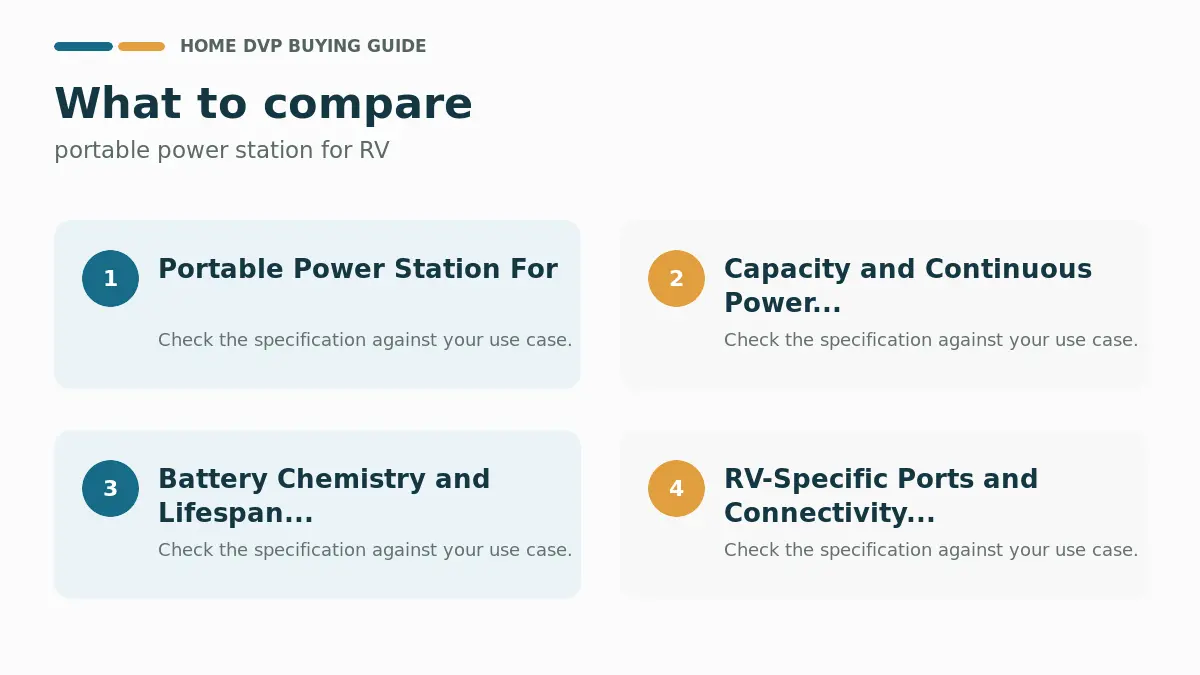
Portable Power Station For RV Buying Guide

Choosing the right portable power station for RV use requires matching battery capacity and output to your actual loads while confirming the presence of RV-friendly ports and practical charging methods. Below we break down the key criteria homeowners and RV owners should evaluate before buying.

Capacity and Continuous Power Output

Battery capacity measured in watt-hours (Wh) determines how long you can run devices, while continuous wattage and surge rating determine what you can start. For RV use a common starting point is 1,000–2,000 Wh for weekend trips and 3,000 Wh or more for longer stays or larger appliances. Many units now offer 1,500–3,600 W continuous output with higher surge capability to handle refrigerator compressors or air conditioners.

A frequent mistake is focusing only on Wh without checking if the inverter can handle simultaneous loads such as a microwave plus lights and a water pump. Based on available product information, look for pure sine wave inverters and clear surge ratings. Calculate your daily Wh needs by listing every device, its wattage, and hours of use, then add a 20–30% buffer. Units that expand via extra batteries give you room to grow without replacing the whole station.

Battery Chemistry and Lifespan

LiFePO4 (lithium iron phosphate) has become the standard for quality portable power station for RV because it delivers 3,000–6,000 cycles while retaining high capacity and remaining thermally stable. This chemistry is far safer and longer lasting than older NMC packs. After thousands of cycles many of these batteries still hold 70–80% of original capacity, translating to a practical 10-year lifespan under normal RV use.

Homeowners should avoid units that do not clearly state cycle life or BMS (battery management system) protections. A strong BMS monitors temperature, voltage, and current to prevent overcharge or over-discharge. In real-world RV scenarios this reliability means you can leave the station partially charged for storage without rapid degradation. When comparing models, prioritize those advertising 3,000+ cycles and EV-grade cell construction.

RV-Specific Ports and Connectivity

Not every power station is equally convenient for RV life. Dedicated 30A TT-30 RV outlets, high-current 12V/30A DC ports, and cigarette lighter sockets make it simple to connect to your RV shore power inlet or charge the house battery bank. Some models include XT60 or Anderson-style connectors for solar and accessories.

A common error is buying a high-capacity station that forces you to use multiple adapters or extension cords inside a limited RV space. Look for units that list a 30A RV output or TT-30 port explicitly. USB-C PD 100W ports are also valuable for modern laptops and phones. Based on our research, stations designed with RV travel in mind reduce setup time and cable clutter on every trip.

Charging Speed and Solar Compatibility

Fast AC recharging (0–80% in under an hour on many current models) lets you top up at campgrounds or home before departure. Solar input of 500–2,000 W allows true off-grid recharging while parked. Hybrid AC + solar charging can restore a full pack even faster. Confirm maximum solar voltage and open-circuit voltage limits so your panels match the station.

Many owners underestimate daily solar production on cloudy days or when parking under trees. Choose a station that accepts high solar wattage and supports car charging as a backup. App control for charging modes (quiet overnight, emergency fast charge) adds convenience. For related outdoor power strategies, see our resources on Heating, Cooling & Air.

Portability, Weight, and Design

Even a powerful station must be practical to move in and out of an RV or store under a dinette. Weights range from roughly 24 lb for compact 1 kWh units to 50+ lb for 3–4 kWh models. Look for foldable handles, wheels on larger units, and compact footprints. Some designs use cell-to-body technology borrowed from EVs to reduce size and weight while improving structural integrity.

Homeowners with smaller trailers or van conversions should prioritize lighter units that one person can lift. Larger fifth-wheels or motorhomes can accept wheeled stations that roll easily. Measure storage space before buying. A station that is too heavy or bulky often ends up unused. Quiet operation (under 30–45 dB in silent modes) is another design factor that matters when the unit sits near sleeping areas.

Safety Features and UPS Response

Quality stations include multiple protections: over-voltage, under-voltage, over-current, short-circuit, and temperature control. Many now offer UPS-style switchover in under 10–20 ms, keeping computers, CPAP machines, and routers running without interruption during an outage or transfer from shore power.

For RV and emergency use this seamless transition is critical. Pure sine wave output protects sensitive electronics. Built-in LED lights, app monitoring, and clear displays of remaining runtime further improve safety and usability. Always verify certifications such as UL or similar listings when available in the product data.

Expandability and Long-Term Value

Many modern units accept extra battery packs that can triple or more the base capacity. This modular approach lets you start with a mid-size station and add storage later as needs grow. Expandable models are especially useful for full-time RVers or homeowners who also want whole-house backup capability.

Value is not just the lowest purchase price. Factor in cycle life, warranty length (often 5–7 years on better brands), included cables, and app features. Units from established makers tend to have better long-term support and accessory availability. For additional home organization and storage ideas that pair well with emergency gear, check Hardware resources.

Who Should Buy Which Type

Weekend campers and van-lifers often do best with 1,000–2,000 Wh compact stations that weigh under 40 lb and offer solid solar input. Full-time RVers and those powering larger appliances benefit from 3,000+ Wh expandable units with dedicated RV ports. Homeowners seeking dual-use emergency backup should prioritize UPS function and high continuous wattage. Beginners should start with well-reviewed mid-range models that include clear manuals and app control rather than the absolute largest station.

Common pitfalls include underestimating air-conditioner or microwave draw, ignoring solar voltage limits, and choosing a unit without any high-current DC output for RV house batteries. Matching the station to your actual appliance list and travel style prevents buyer’s remorse.

Buying FactorWhat to Look ForWhy It Matters for RV Use
Capacity1,000–4,000+ Wh (expandable preferred)Determines multi-day runtime for fridge, lights, devices
Output1,500–3,600 W continuous + surgeStarts compressors and runs multiple appliances
RV PortsTT-30 / 30A + high-current 12V DCDirect connection to RV systems without adapters
BatteryLiFePO4, 3,000+ cyclesLong lifespan and safer thermal behavior
Solar Input500–2,000 W+True off-grid recharging while boondocking
WeightUnder 50 lb for easy handlingPractical storage and movement inside limited RV space

Our Research Methodology & Why You Can Trust Us

At Home DVP we evaluate products strictly through specification analysis, feature comparison, user-feedback patterns, and category-fit validation. For this portable power station for RV guide we examined continuous and peak wattage, Wh capacity, expandability options, listed charging times, solar input limits, presence of RV-specific ports, battery chemistry and cycle ratings, UPS transfer times, weight, port selection, and warranty statements. We cross-checked these details against typical RV power loads such as refrigerators, lights, CPAP machines, water pumps, and small air conditioners.

Our ranking criteria emphasize real-world homeowner and RV usefulness: performance under expected loads, build quality indicators, ease of charging and monitoring, durability via cycle life, safety features, value across the $459.00 – $1,619.00 spectrum, and reliability for emergency or travel use. We deliberately avoid claiming hands-on testing when the data does not support it. Instead we rely on transparent, data-driven comparisons so readers can verify every claim against the published specifications.

We update our guides during July and throughout the year as new models and firmware improvements appear. Brands represented among the reviewed units include those in AFERIY, Dabbsson, ABOK and more along with other well-known makers that publish clear RV-compatible features. This process ensures the recommendations remain practical for DIYers, renters preparing for outages, and full-time travelers alike. For more climate-related preparedness topics, explore our Air Quality & Climate section.
Final Thoughts

After comparing the listed specifications of the available models, several clear standouts emerge for different needs. The BLUETTI AC200L Portable Power Station stands out as our Overall Pick thanks to its 2,048 Wh base capacity expandable to over 8,000 Wh, 2,400 W output with power lifting, dedicated 30A RV port, and fast 45-minute AC recharge to 80%. It balances power, expandability, and RV-specific connectivity for most travelers and homeowners.

For a Value Pick, the Jackery Explorer 1000 v2 offers 1,070 Wh, 1,500 W output, one-hour fast charging capability, a lightweight 23.8 lb design, and strong 4,000-cycle LiFePO4 longevity at an accessible entry point. The Jackery HomePower 3600 Plus serves as a Premium Pick with 3,584 Wh expandable far higher, 3,600 W output, wheels for mobility, and multi-day household backup potential ideal for larger RVs or dual home-and-travel use. The BLUETTI Elite 300 earns Heavy-Duty / RV-Ready recognition for its compact 3,014 Wh package, TT-30 RV port, 12V/30A DC output, and 2,400 W continuous power. The AFERIY 2048Wh unit and ABOK Ark3600 provide additional solid options for users prioritizing ports, expandability, or warranty length.

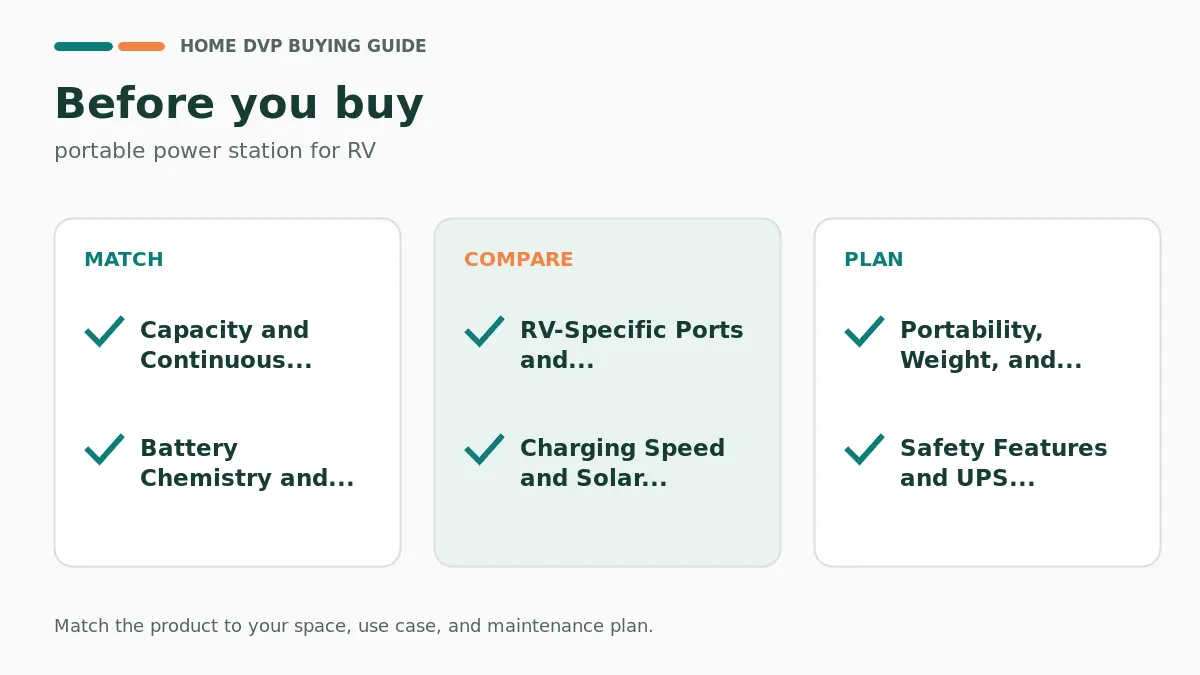
Match the station to your daily Wh consumption, confirm the presence of the ports you actually need, and prefer LiFePO4 chemistry with clear cycle ratings. With the right choice you gain quiet, clean power that supports both adventure and emergency preparedness. Review the full shortcode list above and compare the exact features that matter most to your RV or home setup.

Frequently Asked Questions

What should I look for when choosing portable power station for RV?

Focus on watt-hour capacity that matches your daily loads, continuous and surge wattage high enough for your largest appliances, LiFePO4 chemistry with at least 3,000 cycles, and RV-friendly ports such as TT-30 or 30A outlets. Also verify solar input limits, weight for your storage space, and UPS transfer speed if you need seamless backup. Calculating your actual appliance list first prevents overspending or under-buying.

Are higher-end portable power station for RV worth it?

Higher-end models often justify the cost through greater expandability, faster recharging, dedicated high-current RV ports, longer cycle life, quieter operation, and stronger warranties. For occasional weekend use a mid-range unit may suffice, but full-time RVers or those powering air conditioners and multiple appliances usually benefit from the extra capacity and durability. Compare the features against your real needs rather than price alone.

How should beginners choose portable power station for RV?

Start by listing every device you want to run and estimating daily watt-hours. Then select a station with a pure sine wave inverter, clear LiFePO4 cycle rating, app monitoring, and at least one high-current DC or RV port. Compact models around 1,000–2,000 Wh with good solar input are usually the easiest entry point. Avoid the largest expandable systems until you understand your actual consumption.

How long should quality portable power station for RV last?

LiFePO4 models that advertise 3,000–6,000 cycles commonly deliver a practical 8–10 years of regular use while retaining most of their capacity. Lifespan depends on depth of discharge, temperature extremes, and storage habits. Units with robust BMS protection and good thermal design tend to age more gracefully. Follow manufacturer storage guidelines when the station sits unused for long periods.

What brands make reliable portable power station for RV?

Among the models we reviewed, brands such as those in AFERIY, Dabbsson, ABOK and more along with Jackery, BLUETTI, EcoFlow, and Anker consistently publish detailed specifications for capacity, cycle life, RV ports, and safety features. Reliability comes from transparent data, strong warranties, and proven LiFePO4 chemistry rather than brand name alone. Always verify the specific model’s ports and expandability against your RV setup.

How much should homeowners expect from portable power station for RV in 2026?

Current pricing for capable units suitable for RV and emergency use typically falls in the $459.00 – $1,619.00 range depending on capacity and features. Expect 1,000–4,000 Wh base packs, fast AC and solar charging, LiFePO4 batteries rated for thousands of cycles, and increasing availability of dedicated RV outlets. Expanding capacity with extra batteries is now common, improving long-term value.

Are portable power station for RV suitable for DIY projects, home repairs, or regular maintenance?

Yes. Beyond RV travel, these stations power tools, lights, and chargers during home repairs, garage projects, or outages. Pure sine wave output and multiple AC/USB ports make them practical for cordless tool battery charging, work lights, and temporary workshop power. Their quiet operation and lack of fumes also suit indoor emergency use better than gas generators. Pairing one with basic solar panels further increases versatility for both travel and home preparedness. For broader emergency planning visit our Emergency Supplies page.