
When severe weather strikes or the power goes out, staying informed can make all the difference for homeowners, renters, and DIYers. A reliable noaa weather radio delivers official NOAA weather alerts, AM/FM broadcasts, and often emergency power options that keep you connected when cell service and electricity fail. In 2026, models have advanced with larger solar panels, higher-capacity batteries, and multi-function designs that double as flashlights, phone chargers, and SOS tools.
Our team carefully compared 15 options across the $11.99–$135 range from brands including MidlandRadio, FosPower, Raynic, Nitigo, PRUNUS, Mesqool. We focused on specification-based analysis of reception quality, power sources, alert features, build durability, and real-world homeowner suitability for emergency kits, camping, or home backup. This guide helps you choose the right unit without guesswork. For more preparedness essentials, explore our full Emergency Supplies collection.
Whether you live in a hurricane-prone area, face frequent winter storms, or simply want peace of mind for power outages, understanding the key differences in noaa weather radio will lead to a smarter purchase. Below we break down the top contenders and the factors that matter most.

Pros
- S.A.M.E. localized programming delivers precise area-specific emergency notifications
- NOAA Weather Scan covers over 60 kinds of weather hazards and emergencies automatically
- Supports programming of up to 25 counties for broader yet targeted monitoring
- Color-coded alert indicators provide clear visual cues on type and severity
- Continuous backlighting option keeps the LCD readable when needed
Cons
- Initial entry of S.A.M.E. codes and county selections may require research and extra setup time for first-time users
- Primarily focused on weather and emergency alerts rather than general listening or entertainment features
- Users wanting expanded two-way communication may need to explore other models in the Midland range
The Midland WR120B NOAA Emergency Weather Alert Radio provides dedicated reception of critical weather and emergency information through localized programming options. Homeowners, renters, and families living in areas subject to severe weather find this type of device useful for maintaining situational awareness without depending solely on television or mobile apps.
Based on the listed features, NOAA Weather Scan automatically alerts users to over 60 kinds of weather hazards and emergencies. S.A.M.E. localized programming lets the owner enter codes for country, state, county, and in some cases partial county coverage so that only pertinent events trigger a response. Notification settings further allow programming of up to 25 different counties, while color-coded indicators display both the alert type and its severity for rapid understanding.
Setup centers on entering the desired S.A.M.E. codes and choosing selectable alert tones. The continuous backlighting option keeps the LCD illuminated for convenient viewing, and the alert override function switches the unit automatically when danger approaches. The trilingual display and straightforward controls support everyday usability once the initial programming is complete, making the radio approachable for typical home environments.
In real-world home use the radio helps residents prepare for storms, flooding, or other hazards by delivering targeted warnings that can prompt timely protective actions. It remains valuable during power disruptions or when other media channels are unavailable, focusing attention on monitored counties. Alarm functions and the ability to limit alerts to relevant areas add practical safety value for households seeking reliable information.
Potential limitations include the time required for first-time S.A.M.E. and multi-county programming, which can feel involved without prior experience. The unit concentrates on weather and emergency functions rather than multi-purpose entertainment. Based on the product information, the Midland WR120B offers a practical, focused solution for homeowners who prioritize localized emergency weather alerts and clear visual indicators for household safety planning.
Specifications
| Additional Features | SOS Alarm |
|---|---|
| Connectivity Technology | AC Power Adapter |
| Tuner Type | FM |
| Power Source | Corded Electric, Battery |
| Radio Bands Supported | 1-Band |
| Frequency | 108 MHz |
| Compatible Devices | Devices capable of receiving NOAA weather alerts |
| Number of Batteries | 6 AAA batteries required. |
| Smart Home Compatibility | Not Smart Home Compatible |
| Display Type | LCD |
Verify the current product variation before purchase; specifications may change.
Best For / Avoid If
Best for buyers prioritizing
- S.A.M.E. localized programming delivers precise area-specific emergency notifications
- NOAA Weather Scan covers over 60 kinds of weather hazards and emergencies automatically
- Supports programming of up to 25 counties for broader yet targeted monitoring
Consider another option if
- Initial entry of S.A.M.E. codes and county selections may require research and extra setup time for first-time users
- Primarily focused on weather and emergency alerts rather than general listening or entertainment features
- Users wanting expanded two-way communication may need to explore other models in the Midland range

Pros
- Multiple recharge methods including crank, solar, and batteries ensure power availability in varied conditions
- Built-in power bank supports charging most small mobile devices during emergencies
- Dependable NOAA and AM/FM reception for continuous access to weather and news broadcasts
- Dual light sources and SOS function enhance safety and visibility in outages
Cons
- Power bank capacity suits phones and small tablets but may require recharging for prolonged multi-device use
- Hand crank and solar regeneration can take sustained effort depending on conditions
- Basic feature set may leave advanced users wanting extra digital interfaces or specialized alert options
The FosPower A1 NOAA emergency weather radio serves as a compact all-in-one tool for homeowners and outdoor enthusiasts building practical emergency preparedness. Based on the provided product details, it combines weather radio functions with a portable power bank and lighting, making it suitable for power outage kits, storm readiness, or camping setups where reliable information and backup energy matter most.
Functionality centers on dependable access to NOAA emergency weather broadcasts alongside full AM/FM radio reception for ongoing news and alerts. The 7400mWh power bank charges phones or small USB devices in critical moments, while the three primary power sources of hand crank, solar panel, and AAA batteries keep the unit running when conventional electricity is lost. Dual lights further support usefulness, with a zoom-capable 1W LED flashlight and a 4 LED reading light offering illumination for safe movement or basic tasks.
Design emphasizes portability and straightforward usability for indoor or outdoor environments. Controls provide access to radio bands, the SOS alarm with siren and flashing light, and the lighting modes without complex setup. The crank lever and solar panel integrate for on-demand regeneration, and battery operation adds a straightforward backup layer. Overall construction focuses on durability for emergency storage and grab-and-go scenarios rather than heavy daily handling.
In real-world home use cases, this radio proves valuable for storm seasons, blackout preparation, or as part of a vehicle emergency bag. Families can monitor weather updates, charge a phone to call for assistance, and use the lights and SOS feature to improve safety and visibility. Outdoor users benefit from the multi-source charging that reduces reliance on fixed power, supporting extended trips or remote locations with basic communication and lighting needs.
Potential limitations include the power bank size, which suits short-term device boosts better than extended multi-device charging, and the physical effort sometimes needed for full solar or crank recharging. Advanced buyers seeking digital displays or automatic alert systems may prefer higher-end alternatives. Based on the listed features, the FosPower A1 remains a solid choice for practical homeowners prioritizing multi-function emergency tools over specialized gear, offering clear value for everyday readiness without unnecessary complexity.
Specifications
| Additional Features | Portable |
|---|---|
| Connectivity Technology | USB C |
| Tuner Type | AM/FM/WB |
| Power Source | Solar, Battery, Handcrank |
| Radio Bands Supported | AM, FM, WB |
| Frequency | 108 MHz |
| Compatible Devices | Smartphone, Tablet |
| Voltage | 3.7 Volts |
| Speaker Maximum Output Power | 2 Watts |
| Number of Batteries | 4 AAA batteries required. |
Verify the current product variation before purchase; specifications may change.
Best For / Avoid If
Best for buyers prioritizing
- Multiple recharge methods including crank, solar, and batteries ensure power availability in varied conditions
- Built-in power bank supports charging most small mobile devices during emergencies
- Dependable NOAA and AM/FM reception for continuous access to weather and news broadcasts
Consider another option if
- Power bank capacity suits phones and small tablets but may require recharging for prolonged multi-device use
- Hand crank and solar regeneration can take sustained effort depending on conditions
- Basic feature set may leave advanced users wanting extra digital interfaces or specialized alert options

Pros
- Supports solar, hand crank, rechargeable battery, and AA power for versatile emergency use
- Provides automatic weather band scanning plus AM/FM reception
- Includes bright dual-setting LED flashlight with SOS mode
- Enables charging of external portable devices
Cons
- AA batteries for backup power are not included with the unit
- Hand crank recharging demands ongoing physical effort during long outages
- Added features may exceed needs for users wanting a basic weather radio only
The Midland ER310 emergency crank weather AM/FM radio serves homeowners focused on disaster readiness by combining multi-source power with weather monitoring tools. Based on the provided product details, it suits those building emergency kits or living in storm-prone regions who need dependable alerts and backup functions without relying solely on household electricity.
Functionality draws from the NOAA weather scan that searches seven weather band channels and locks onto the strongest signal, paired with an alert that sounds for severe weather risks. AM and FM reception add everyday listening options. The rechargeable 2600 mAh battery supports up to 32 hours of radio use, while the solar panel and hand crank enable recharging in sunlight or during outages. The unit can also accept six AA batteries as further backup.
Build includes a red and black housing with straightforward controls for power modes, tuning, and light settings. The solar panel allows passive recharging in direct light, and the hand crank offers mechanical input when other options are unavailable. Setup centers on initial battery charging or inserting optional AA cells, after which the included USB cable supports external device charging. Its compact form aids storage in go-bags or home emergency containers.
Practical home applications cover continuous weather monitoring during storms, signaling with the SOS Morse code flashlight beacon or the 130 lumen CREE LED on high or low brightness, and using the ultrasonic dog whistle to aid location by rescuers. Charging phones or tablets keeps communication available when grid power is out, supporting family safety plans and outdoor readiness.
Limitations based on the listed features include the separate purchase needed for AA batteries and the physical effort required for hand crank recharging over time. The Midland ER310 delivers practical multi-power weather radio performance for emergency preparedness, though those seeking only simple listening may prefer less equipped models. Homeowners valuing alerts, signaling, and device charging will find the strongest match for their kits.
Specifications
| Additional Features | Built-In Flashlight |
|---|---|
| Connectivity Technology | USB |
| Tuner Type | AM/FM |
| Power Source | Solar Powered |
| Radio Bands Supported | 2-Band |
| Frequency | 108 MHz |
| Compatible Devices | Smartphone, Tablet |
| Number of Batteries | 6 AA batteries required. (included) |
| Smart Home Compatibility | Not Smart Home Compatible |
| Display Type | LED |
Verify the current product variation before purchase; specifications may change.
Best For / Avoid If
Best for buyers prioritizing
- Supports solar, hand crank, rechargeable battery, and AA power for versatile emergency use
- Provides automatic weather band scanning plus AM/FM reception
- Includes bright dual-setting LED flashlight with SOS mode
Consider another option if
- AA batteries for backup power are not included with the unit
- Hand crank recharging demands ongoing physical effort during long outages
- Added features may exceed needs for users wanting a basic weather radio only

Pros
- Supports automatic weather alerts across seven NOAA bands for continuous monitoring.
- Offers multiple recharging methods for dependable performance in emergencies.
- Combines radio functions with flashlight, reading lamp, and device charging capabilities.
- Includes headphone jack for private listening without disturbing others.
- Portable size with carrying strap and carabiner for easy transport.
Cons
- Built-in battery is listed as irreplaceable, which could limit long-term serviceability if it degrades.
- AAA batteries for the alternate power option are not included in the package.
- Users seeking larger capacity power banks may find the 5000mAh rating better suited for short-term emergency use.
The Raynic emergency radio stands out as a multi-function NOAA weather alert device designed for homeowners in storm-prone regions and those who enjoy outdoor activities. Based on the product details, it combines AM/FM/SW/WB reception with automatic alert scanning to keep users informed of severe weather threats at any time.
According to the listed specifications, the radio auto-scans seven NOAA bands even in standby mode, sounding alerts for incoming hazards so preparations can begin promptly. Its high-capacity rechargeable battery supports up to 12 hours of radio use or 18 hours of light, while the USB port allows charging of cell phones during outages for essential connectivity.
Design elements include a large backlit LCD screen that displays battery level and frequency for easy digital tuning, simple band switching, and a lock function. The unit measures compactly at 6.8 by 3.7 by 2.9 inches and weighs 1.2 lb, with IPX3 water resistance, a carrying strap, and carabiner for portability. Controls are straightforward, and a dimmer helps conserve power.
In practical home scenarios, this radio proves useful during power outages from hurricanes, tornadoes, or storms by providing alerts, lighting via the 3W flashlight and 2.5W reading lamp, and SOS signaling. It also suits camping or hiking trips where weather awareness and backup power matter, with the headphone jack enabling quiet listening.
Potential limitations include the irreplaceable nature of the built-in battery and the need to supply AAA batteries separately if that option is used. Overall, based on the feature set, the Raynic radio offers solid value for practical buyers seeking an all-in-one emergency preparedness tool rather than specialized high-end gear.
Homeowners building emergency kits or frequent outdoor enthusiasts should consider this option, while those needing extended multi-day power capacity might explore alternatives with larger batteries.
Best For / Avoid If
Best for buyers prioritizing
- Supports automatic weather alerts across seven NOAA bands for continuous monitoring.
- Offers multiple recharging methods for dependable performance in emergencies.
- Combines radio functions with flashlight, reading lamp, and device charging capabilities.
Consider another option if
- Built-in battery is listed as irreplaceable, which could limit long-term serviceability if it degrades.
- AAA batteries for the alternate power option are not included in the package.
- Users seeking larger capacity power banks may find the 5000mAh rating better suited for short-term emergency use.

Pros
- Highly portable dimensions and low weight simplify storage in kits and one-handed carrying
- Reliable AA battery power supports continuous use during extended power failures
- Analog-style three-control design removes confusion for quick emergency tuning
- Versatile speaker and stereo earphone options suit both group and personal listening
- Complete NOAA band range provides essential severe weather information
Cons
- Does not support automatic notification for NOAA alerts so manual tuning is required
- Depends solely on AA batteries with no hand crank or solar options listed for multi-source power
- Basic feature set may feel limited for users seeking advanced digital displays or multi-power charging
Based on the listed specifications, the PRUNUS J161 is a compact NOAA weather radio with AM and FM bands intended for emergency preparedness and everyday portable listening. It serves homeowners, renters, and outdoor enthusiasts who need a simple battery-powered device to stay informed during power outages, storms, or remote activities without relying on internet or complex electronics.
The product information indicates strong reception performance through a 13-inch retractable antenna that adjusts 360 degrees and an advanced DSP chip covering weather bands from 162.40-162.55 kHz including all seven NOAA channels, FM 87-108 MHz, and AM 520-1710 kHz. Running on two AA batteries, it maintains operation off the grid, making it useful for hikes, camping, or home power failures while the internal magnetic speaker with two sound holes aims to deliver crisp balanced audio, and the 3.5 mm jack allows private headphone listening.
Design details show a portable form measuring 4.7 x 2.8 x 1.2 inches and weighing 0.24 lb excluding batteries, easy to hold in one hand or store in an emergency kit. Three basic controls handle power and volume, tuning, and band selection for straightforward operation, while a power indicator shows status and a lanyard is included for convenient carrying. Package contents are limited to the radio, lanyard, and user manual for quick setup.
In practical home use, the radio supports building storm preparedness kits for hurricanes or tornadoes, providing valuable time to react even without electricity. Its lightweight build suits walking or running with news and music, and the simple interface appeals to elderly or middle-aged users seeking reliable weather updates without digital menus, positioning it as a thoughtful gift that adds safety awareness.
Potential limitations include the lack of automatic NOAA alert notifications, requiring users to tune manually, and exclusive dependence on AA batteries rather than multi-power sources. Overall, based on the feature set, the PRUNUS J161 offers a practical no-frills solution for those prioritizing portability, clear reception, and ease of use in emergency or outdoor settings, while buyers needing solar charging or auto alerts may prefer more advanced models.
Best For / Avoid If
Best for buyers prioritizing
- Highly portable dimensions and low weight simplify storage in kits and one-handed carrying
- Reliable AA battery power supports continuous use during extended power failures
- Analog-style three-control design removes confusion for quick emergency tuning
Consider another option if
- Does not support automatic notification for NOAA alerts so manual tuning is required
- Depends solely on AA batteries with no hand crank or solar options listed for multi-source power
- Basic feature set may feel limited for users seeking advanced digital displays or multi-power charging
Pros
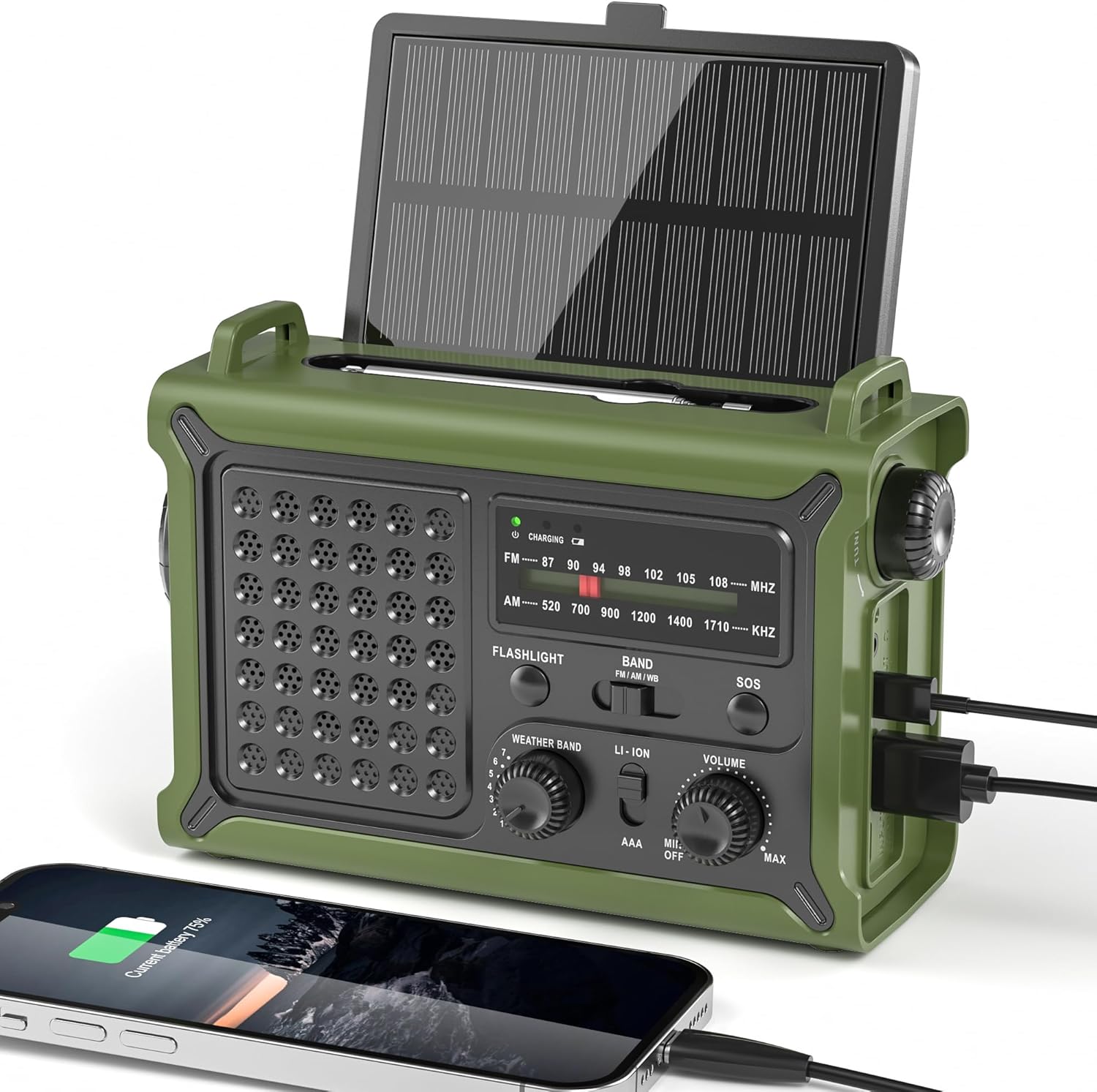
- True 12000mAh capacity supports extended radio use and device charging during blackouts
- Multiple recharging methods including large solar panel and efficient hand crank for off-grid reliability
- Clear stable signal reception across NOAA AM and FM bands with noise reduction
- Versatile dual-mode LED lighting combines long-range flashlight and soft reading lamp
- Dual USB outputs expand charging convenience beyond single-port models
Cons
- Does not include alerts in power-off mode unlike some other models in the series
- Dial tuning may feel less precise than digital display alternatives for quick station changes
- Larger dimensions and 1.6 lb weight reduce pocket portability compared with more compact options
The Mesqool solar emergency hand crank radio functions as a core weather radio for homeowners building storm kits campers heading off grid and practical buyers wanting multi-source power backup. Based on the provided product details it pairs AM FM NOAA reception with a substantial battery and versatile charging to keep essential communications and lighting available when outlets fail.
Reception performance relies on a high-sensitivity signal chip noise-reduction circuitry and extended antenna for fast stable updates across NOAA AM and FM bands. The listed 12000mAh capacity powers the radio flashlight and phone charging for extended periods while the oversized monocrystalline solar panel and high-torque crank with reinforced generator deliver efficient recharging that the feature set indicates outperforms typical smaller panels or standard cranks.
Build and usability center on an ergonomic form measuring 6.8 x 4.8 x 2.9 inches and weighing 1.6 pounds with a firm non-slip grip large tuning knob responsive buttons and clear labels that simplify operation in the dark. Dual USB A and Type C outputs plus the 3.5mm headphone jack enhance everyday practicality while the flip-up frosted reading lamp and focused flashlight with two brightness levels add flexible illumination without extra tools.
Practical home and outdoor scenarios include sheltering through storms where clear weather alerts and device charging prove critical camping trips relying on solar or crank power and household blackouts needing both light and information. The combination of dual outputs long beam reach and soft lamp supports navigation tent use or calm reading once power is restored or while waiting for crews.
Limitations include the lack of power-off mode alerts and dial rather than digital display which may slow fine tuning for some users along with bulkier size that suits fixed kits better than ultra-minimal packs. Based on the available product data the Mesqool radio remains a straightforward reliable option for families and DIYers prioritizing clear signals multi-day power and simple multi-source recharging over specialized extras.
Specifications
| Additional Features | 5-Way Powered, Emergency Cellphone Charger, LED Flashlight & Reading Lamp, Portable, SOS Alarm |
|---|---|
| Connectivity Technology | USB |
| Tuner Type | Stronger, Faster, Clearer |
| Power Source | Solar Panel | Hand Crank | 12000mAh Lithium Battery | Type-C Input 5V/2A | 3 AAA Batteries |
| Radio Bands Supported | NOAA | FM | AM |
| Frequency | 162 MHz |
| Compatible Devices | Smartphone |
| Voltage | 5 Volts |
| Speaker Maximum Output Power | 5 Watts |
| Number of Batteries | 1 Nonstandard Battery batteries required. (included) |
Verify the current product variation before purchase; specifications may change.
Best For / Avoid If
Best for buyers prioritizing
- True 12000mAh capacity supports extended radio use and device charging during blackouts
- Multiple recharging methods including large solar panel and efficient hand crank for off-grid reliability
- Clear stable signal reception across NOAA AM and FM bands with noise reduction
Consider another option if
- Does not include alerts in power-off mode unlike some other models in the series
- Dial tuning may feel less precise than digital display alternatives for quick station changes
- Larger dimensions and 1.6 lb weight reduce pocket portability compared with more compact options

Pros
- S.A.M.E. county code programming delivers only relevant local warnings
- Three alert modes plus color indicators provide flexible notification options
- Dual plug-in and battery power supports both daily and emergency use
- FM radio and alarm clock add everyday convenience beyond weather alerts
- Always-on critical hazards ensure life-saving messages remain available
Cons
- Alert volume cannot be adjusted independently from the FM radio and weather broadcast volume
- Three AA alkaline batteries required for backup are not included
- Initial county programming and optional event settings may need extra time for first-time setup
The DreamSky NOAA weather radio provides homeowners and families with a compact multi-function device that combines emergency alerts, FM listening, and an alarm clock. It is well suited to households in weather-prone regions that want hyper-local notifications without the need for constant monitoring of broader broadcasts.
Based on the listed specifications, S.A.M.E. technology locks the unit onto a programmed county code so users receive only real-time, neighborhood-specific warnings drawn from more than 80 NOAA hazards. Three alert modes (voice, tone, and display) along with color-coded indicators help ensure timely awareness of approaching danger, while critical alerts such as tornado warnings remain permanently enabled.
The unit operates on plug-in power for everyday countertop or bedside placement and switches to three AA batteries (not included) when electricity fails. An LCD time display offers three backlight choices for night visibility, and simple controls handle alarm, snooze, FM tuning, and event selection. County code entry and optional alert muting form the main setup steps.
In practical home use the radio doubles as a daily companion for morning news or kitchen music while standing ready for storm nights. Dual power keeps it functional during outages or camping, and the compact size allows easy storage in an emergency kit or permanent placement on a nightstand or desk.
Users should note that alert volume cannot be adjusted separately and batteries must be supplied separately. Based on the provided product details, the DreamSky model offers solid value for standard homeowner and family preparedness needs. Those seeking advanced professional features may prefer a more specialized unit, but this radio covers core emergency and daily radio requirements effectively.
Best For / Avoid If
Best for buyers prioritizing
- S.A.M.E. county code programming delivers only relevant local warnings
- Three alert modes plus color indicators provide flexible notification options
- Dual plug-in and battery power supports both daily and emergency use
Consider another option if
- Alert volume cannot be adjusted independently from the FM radio and weather broadcast volume
- Three AA alkaline batteries required for backup are not included
- Initial county programming and optional event settings may need extra time for first-time setup

Pros
- Multiple power options, including solar, crank, AAA backup, and internal battery support.
- Large listed battery capacity for a portable emergency radio.
- Includes both a long-range flashlight and a warm reading lamp with two brightness levels.
- Designed with easy-grip handling, large tuning control, and responsive buttons.
- Supports NOAA, AM, and FM bands for weather alerts and general radio listening.
Cons
- At 1.6 lb, it may feel bulkier than smaller emergency radios for ultralight packing.
- The listed product comparison indicates this version does not support alerts while powered off.
- A Type-C adapter is not listed as included for this version.
Based on the provided product details, the Mesqool 4th Gen Weather Radio is a portable emergency radio aimed at homeowners, campers, and preparedness-minded buyers who want more than a basic battery-operated receiver. It combines NOAA, AM, and FM reception with backup power options, built-in lights, and device charging support, making it useful for storm kits, blackout supplies, camping gear, and family emergency storage.
The standout feature set centers on power redundancy. The radio lists a 12000mAh lithium battery, an 8500mm² monocrystalline solar panel, hand-crank charging, and AAA power backup. That combination gives users several ways to keep the radio available when standard power is limited. The product information also notes USB-A and Type-C outputs, so it can serve as a backup charging source for small devices when needed.
For weather and emergency awareness, the radio supports NOAA, AM, and FM bands with a high-sensitivity signal chip, noise-reduction circuitry, and an extended antenna. The listed design uses a dial display, large tuning knob, responsive buttons, clear labels, and a non-slip grip. Its dimensions are listed as 6.8 x 4.8 x 2.9 inches, with a weight of 1.6 lb, which makes it substantial enough for tabletop emergency use while still portable for travel kits.
Lighting is another practical strength. The product data lists a flashlight with a focused beam reaching up to 260 feet, plus a frosted reading lamp intended to provide a softer glow. Both lights include two brightness levels, which can help conserve power or improve comfort depending on whether you are navigating a dark hallway, setting up a tent, checking a breaker area, or reading during an outage.
There are a few limitations to keep in mind. Based on the comparison information provided, this 4th Gen version does not list alerts in power-off mode, so users may need to keep that in mind when relying on it for active weather monitoring. It is also heavier than some smaller emergency radios, and the listed details do not indicate that a Type-C adapter is included. Even so, the combination of radio reception, charging flexibility, emergency lighting, and ergonomic controls makes it a strong option for household preparedness and outdoor backup use.
Specifications
| Additional Features | 5-Way Powered, Built-In Flashlight, LED Flashlight & Reading Lamp, Portable, SOS Alarm |
|---|---|
| Connectivity Technology | USB |
| Tuner Type | Stronger, Faster, Clearer |
| Power Source | Solar Panel | Hand Crank | 12000mAh Lithium Battery | Type-C Input 5V/2A | 3 AAA Batteries |
| Radio Bands Supported | NOAA | FM | AM |
| Frequency | 162 MHz |
| Compatible Devices | MP3 Player, Digital Audio Player |
| Voltage | 5 Volts |
| Speaker Maximum Output Power | 5 Watts |
| Number of Batteries | 1 Nonstandard Battery batteries required. (included) |
Verify the current product variation before purchase; specifications may change.
Best For / Avoid If
Best for buyers prioritizing
- Multiple power options, including solar, crank, AAA backup, and internal battery support.
- Large listed battery capacity for a portable emergency radio.
- Includes both a long-range flashlight and a warm reading lamp with two brightness levels.
Consider another option if
- At 1.6 lb, it may feel bulkier than smaller emergency radios for ultralight packing.
- The listed product comparison indicates this version does not support alerts while powered off.
- A Type-C adapter is not listed as included for this version.

Pros
- Supports precise geographic filtering with up to 23 S.A.M.E. county codes
- Delivers continuous NOAA reception and dual-power backup for outage resilience
- Offers granular on/off control across more than 80 alert types including weather and system events
- Includes intuitive knobs, backlit display, and smart alarm with snooze for easy daily operation
- Comes with external antenna and warning light to support better reception and visibility
Cons
- Three AA batteries for backup power are not included and must be obtained separately
- Initial programming of multiple county codes can require extra setup time for new users
- Certain system-required alert functions cannot be turned off or customized
The RunningSnail NOAA weather radio functions as a focused emergency preparedness device for homeowners and renters who want reliable, localized weather and hazard alerts. Based on the listed product details, its S.A.M.E. technology and dual-power design make it a practical option for households in areas that experience frequent storms or other natural threats and that value continuous monitoring without constant false alarms.
Performance centers on 24/7 NOAA all-hazards reception across seven selectable channels that cover storms, wildfires, and other multi-hazard events. Users can configure hyper-local filtering for all, multiple, or single counties and manage more than 80 alert types with voice, siren, or visual options. Individual on/off toggles allow quiet nighttime operation while still delivering critical real-time warnings from NOAA’s system, supporting proactive readiness in the home.
Design and usability features include simple knob controls for volume, alarms, and siren tests, plus a backlit digital display that shows time in 12- or 24-hour format along with the date. The smart alarm offers one-touch snooze with 9-minute repeats. Dual power from 110V AC mains and three AA batteries (not included) keeps the unit running for over 54 hours during outages. The package supplies an external antenna and external warning light to aid reception and visibility.
In everyday home settings the radio helps families stay aware of tornadoes, floods, and similar risks by delivering targeted alerts that reach only the programmed area. The 110 dB siren provides strong auditory penetration, while the clock and alarm add routine value beyond emergencies. These elements combine to create a useful tool for storm-prone regions that need always-available power and clear notifications.
Potential drawbacks include the separate purchase of batteries and the time needed to program up to 23 county codes on first use. Based on the available feature set, the unit emphasizes core NOAA reception and customization rather than additional connectivity. Overall it offers solid practical value for buyers seeking dependable localized emergency radio performance.
Homeowners prioritizing hyper-local alerts and battery-backed reliability will find it well matched to their needs. Those seeking extensive smart-home integration or highly specialized professional equipment may prefer different solutions.
Specifications
| Additional Features | Built-In Clock |
|---|---|
| Connectivity Technology | Auxiliary |
| Tuner Type | NOAA |
| Power Source | Corded Electric |
| Radio Bands Supported | NOAA |
| Frequency | 162.4 MHz |
| Compatible Devices | Speaker, Headphone |
| Number of Batteries | 3 AA batteries required. |
| Display Type | LCD or LED |
| Hardware Interface | Radio Frequency |
Verify the current product variation before purchase; specifications may change.
Best For / Avoid If
Best for buyers prioritizing
- Supports precise geographic filtering with up to 23 S.A.M.E. county codes
- Delivers continuous NOAA reception and dual-power backup for outage resilience
- Offers granular on/off control across more than 80 alert types including weather and system events
Consider another option if
- Three AA batteries for backup power are not included and must be obtained separately
- Initial programming of multiple county codes can require extra setup time for new users
- Certain system-required alert functions cannot be turned off or customized

Pros
- Five distinct power sources support extended radio and light operation without grid access
- Dual USB outputs enable emergency recharging of cell phones for help calls
- Four flashlight modes including warning strobe cover varied lighting and signaling needs
- 3.5mm headphone jack allows private listening during quiet hours or shared spaces
- Lightweight portable build with strap stores conveniently in go-bags or home kits
Cons
- AA batteries required for one backup power method are not included and must be obtained separately
- Generating power via hand crank demands consistent physical effort at recommended speeds
- Users needing highly specialized professional radio capabilities may prefer models with expanded features
Based on the available product data, the Rckskaya emergency NOAA weather radio functions as a compact all-in-one preparedness device aimed at homeowners facing storm risks and outdoor users on camping or hiking trips. It integrates weather band reception, multi-source power, device charging, and lighting into a single portable package for those assembling emergency kits against hurricanes, tornadoes, or power failures.
The listed specifications indicate solid performance for staying informed and powered. Coverage spans AM 520-1710 KHz, FM 87-108 MHz, and full NOAA frequencies with a telescopic antenna for reliable signal lock and reduced static. Five power pathways (solar panel, hand crank generator, USB-C input, 10000mAh lithium battery rated 37000mWh, and AA backup) maintain operation, while dual USB ports support phone charging for urgent messages. The 3W flashlight delivers four beam modes including far, dipped, mixed, and red/blue warning strobe, paired with a 115dB SOS alarm for visibility and signaling when conditions turn critical.
Design and usability draw from practical details such as the digital LCD screen that shows battery level and frequency, battery indicator lights, and clearly labeled responsive buttons that remain simple even for seniors. Measuring 7.48 inches long by 3.74 inches wide by 2.36 inches high and weighing 1.27 pounds, the unit includes a hand strap for carry. An IPX6 waterproof rating helps it endure rain, dust, or drops, and the 3.5mm headphone jack enables private listening without disturbing others during blackouts or late-night camp use.
In everyday home and outdoor contexts the radio proves useful for sheltering during outages by providing real-time weather instructions independent of cell networks or electricity. Campers and hikers can rely on solar or crank power for continuous alerts and light far from outlets, while the compact form slides readily into go-bags for quick deployment. Families in hurricane-prone regions gain an essential tool that combines information, illumination, and backup energy in one place.
Potential limitations arise mainly from the AA batteries not being supplied and the physical effort needed for hand-crank recharging. Based on the feature set, this Rckskaya radio delivers practical value as a versatile emergency companion for most homeowners and recreational users seeking multi-power reliability and clear reception. Those requiring contractor-level specialized communications gear may look elsewhere, yet for standard storm readiness and outdoor safety it stands as a well-rounded choice.
Best For / Avoid If
Best for buyers prioritizing
- Five distinct power sources support extended radio and light operation without grid access
- Dual USB outputs enable emergency recharging of cell phones for help calls
- Four flashlight modes including warning strobe cover varied lighting and signaling needs
Consider another option if
- AA batteries required for one backup power method are not included and must be obtained separately
- Generating power via hand crank demands consistent physical effort at recommended speeds
- Users needing highly specialized professional radio capabilities may prefer models with expanded features
Pros
- Multiple independent charging methods reduce the risk of complete power loss in emergencies
- Listed battery capacity supports long runtimes for radio, lighting, and phone charging
- Dedicated NOAA weather bands lock quickly for timely severe weather information
- Large analog dial and clear speaker make operation straightforward for all household members
Cons
- Solar charging performance depends on available sunlight and may slow under cloudy conditions
- Hand crank operation requires physical effort to generate meaningful charge during outages
- Added features such as the solar panel and large battery can make the unit less compact for minimalist packing
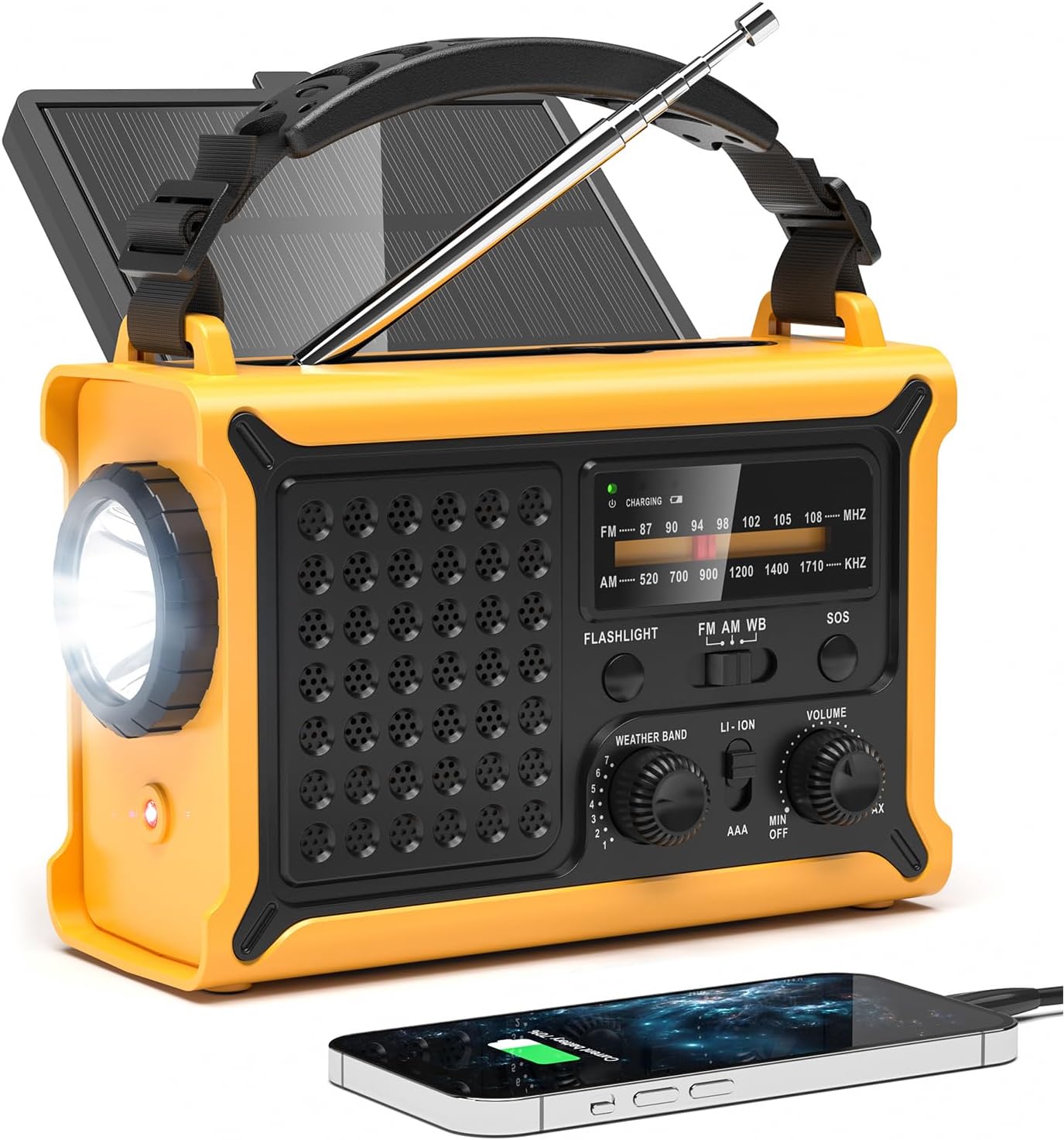
The PPLEE NOAA weather radio functions as a portable emergency device combining AM/FM reception, dedicated weather bands, multi-source charging, and lighting for homeowners, renters, and outdoor users who need reliable information and power during outages or severe conditions. Based on the provided product details, it targets practical preparedness rather than everyday entertainment alone.
Functionality draws from a listed 12000mAh battery that supports roughly 60 hours of radio broadcast, 30 hours of SOS siren, and 60 hours of separate flashlight or lamp use, while also serving as a power bank for phones and tablets. The 8500mm² monocrystalline solar panel, hand crank, and AC input create three primary charging paths, with 3xAAA batteries as an additional backup source. Premium high-sensitivity IC chip and precision-tuned antenna aim to deliver steady reception even in remote cabins, beaches, road trips, or basements so NOAA weather and AM/FM stations remain usable when static would otherwise interfere.
Design elements include a pull-up solar panel for faster outdoor charging, a longer hand crank for use when sunlight is unavailable, a large analog dial for quick station changes even by seniors, and a 57mm 5W stereo speaker driven by a neodymium magnet for crisp audio. Dual-brightness 12 LED lighting covers flashlight and lamp needs, an SOS siren adds signaling capability, and a 3.5mm headphone jack enables private listening. The overall layout keeps controls accessible without complex setup steps.
In real-world home scenarios the seven preset NOAA channels (162.400 through 162.550) help users track hurricanes, tornadoes, floods, and local emergency news. During power failures the unit can illuminate rooms, charge devices, and keep music or talk radio available. Camping, hiking, or beach outings benefit from the solar panel and portable form that converts sunlight more efficiently than smaller panels on comparable radios.
Potential limitations include variable solar performance under low light and the physical effort required for hand-crank charging to restore significant capacity. Advanced users seeking ultra-compact size or professional-grade broadcast features may prefer specialized alternatives. Based on the feature set and listed specifications, the PPLEE radio still provides solid practical value for everyday emergency kits.
Families or individuals building storm readiness and multi-function preparedness gear will find the combination of weather alerts, lighting, and redundant power most useful, while those needing only a basic pocket radio without solar or SOS options may want a simpler model.
Best For / Avoid If
Best for buyers prioritizing
- Multiple independent charging methods reduce the risk of complete power loss in emergencies
- Listed battery capacity supports long runtimes for radio, lighting, and phone charging
- Dedicated NOAA weather bands lock quickly for timely severe weather information
Consider another option if
- Solar charging performance depends on available sunlight and may slow under cloudy conditions
- Hand crank operation requires physical effort to generate meaningful charge during outages
- Added features such as the solar panel and large battery can make the unit less compact for minimalist packing

Pros
- Three power options support continuous weather updates without relying on household electricity
- Combined lighting and alert functions expand usefulness beyond basic radio reception
- High-gain antenna promotes reliable sound quality across different locations
- Device charging capability adds practical value for survival kits and outdoor activities
Cons
- Hand crank operation may demand ongoing physical effort to restore full battery levels
- Solar panel charging efficiency can decrease under limited sunlight or cloudy conditions
- Basic interface may leave users wanting more advanced digital controls for specialized needs
The Nitigo emergency weather radio serves as a compact preparedness tool for homeowners, renters, and outdoor users who need dependable information when severe weather approaches. Based on the provided product details, it offers NOAA band alerts alongside switchable AM/FM reception, making it useful both for daily listening and crisis situations. Ideal buyers include those stocking emergency kits for power outages, camping excursions, or remote travel where grid access may be limited.
Functionality focuses on delivering real-time updates about tornadoes, hurricanes, floods, thunderstorms, and blizzards so users gain time to shelter or evacuate safely. The adjustable high-gain antenna supports crisp, loud audio even indoors or in more remote spots, while the 4000mAh battery keeps messaging available through USB, solar, or hand crank methods. This multi-source power approach helps the unit remain ready for automatic weather alerts during extended blackouts.
Build and usability emphasize practical multifunction design with an ultra-bright LED flashlight and a retractable reading lamp that rotates 180 degrees for directed light at night or during outages. Easy band switching pairs with a loud SOS alarm and eye-catching flashing light for signaling help, and the 3.5mm headphone jack allows private enjoyment of radio content. The portable form factor fits easily into luggage, suitcases, or home emergency supplies for convenient storage and transport.
Real-world home applications include monitoring local news and weather during storms while providing supplemental lighting and the ability to charge phones or tablets from the radio itself. Outdoor scenarios such as fishing, hiking, cycling, driving, or camping benefit from the solar and crank options that reduce dependence on fixed outlets. Placement in a household kit ensures the radio can support family safety across a range of weather events and power disruptions.
Potential limitations involve the physical effort required for hand cranking when other charging sources are unavailable and reduced solar performance in low-light conditions. Based on the listed specifications and features, the Nitigo radio offers solid value for practical buyers seeking multi-powered NOAA reception, lighting, and SOS tools rather than high-end digital interfaces. Homeowners prioritizing straightforward emergency readiness will find the overall design aligns well with everyday preparedness and outdoor needs.
Those requiring larger battery capacities or extensive app connectivity may explore other options, yet users focused on reliable weather radio performance with backup power and multifunction extras can rely on the product information for informed selection.
Best For / Avoid If
Best for buyers prioritizing
- Three power options support continuous weather updates without relying on household electricity
- Combined lighting and alert functions expand usefulness beyond basic radio reception
- High-gain antenna promotes reliable sound quality across different locations
Consider another option if
- Hand crank operation may demand ongoing physical effort to restore full battery levels
- Solar panel charging efficiency can decrease under limited sunlight or cloudy conditions
- Basic interface may leave users wanting more advanced digital controls for specialized needs

Pros
- Supports NOAA alerts with both sound and visual notification
- Programmable for up to 25 counties and 80 emergency alerts
- Includes solar, hand-crank, and rechargeable battery power options
- Can automatically switch from AM/FM mode to relevant all-hazard alerts
- Adds everyday convenience with AM/FM radio and alarm clock features
Cons
- First-time users may need extra time to set up S.A.M.E. county programming correctly
- Hand-crank and solar charging are best viewed as backup power methods rather than primary everyday charging
- Product information references both WR400 and ER40 naming, which may be confusing when comparing models
Based on the provided product details, the MidlandRadio deluxe home and travel emergency radio is a weather alert radio aimed at homeowners, renters, small businesses, and outdoor users who want direct National Weather Service information in an emergency-ready format. It combines NOAA weather scanning, S.A.M.E. digital programming, AM/FM radio, alarm clock functions, and backup charging options, making it more versatile than a basic weather receiver.
The strongest part of the feature set is its NOAA Weather Scan and Alert capability. The radio is listed as scanning through 10 available weather band channels and locking onto the strongest weather channel, then sounding an alarm when severe weather risk is reported for the area. S.A.M.E. programming adds another useful layer by allowing the radio to connect with county-level warning systems, with support for up to 25 counties and 80 different emergency alerts.
For usability, the product information points to a compact, travel-friendly design that can fit into a pocket or gear bag, which is helpful for camping, fishing, hunting, hiking, overlanding, or general home preparedness. The built-in clock, alarm, snooze button, and AM/FM radio give it everyday value, especially on a nightstand, in a kitchen, or in a home office where weather and local radio updates may be useful even outside emergency situations.
Power flexibility is another practical advantage. The listed solar panel, hand crank, rechargeable 2600mAh battery, and USB output make the radio suitable for outage planning and off-grid use. While solar and crank charging should be treated as backup methods, they add reassurance when standard charging is not available and can help keep the radio operating during storms or travel.
There are a few considerations before buying. S.A.M.E. programming is a valuable feature, but users who have never set up a county-coded weather radio may need to spend a little time configuring it properly. The product data also references both WR400 and ER40 naming, so buyers comparing models should read the listing carefully. Overall, the feature set makes this MidlandRadio weather radio a strong fit for practical emergency preparedness, especially for users who want NOAA alerts plus everyday AM/FM and alarm clock functions in one device.
Specifications
| Additional Features | Built-In Flashlight, Rechargeable |
|---|---|
| Connectivity Technology | USB |
| Tuner Type | NOAA |
| Power Source | Battery Powered, Solar Powered |
| Radio Bands Supported | AM/FM/Weather |
| Voltage | 3.7 Volts |
| Hardware Interface | USB |
| Display Technology | LCD" or "LED |
| Style Name | Midland Deluxe Home and Travel Emergency Radios |
| Brand | Midland |
Verify the current product variation before purchase; specifications may change.
Best For / Avoid If
Best for buyers prioritizing
- Supports NOAA alerts with both sound and visual notification
- Programmable for up to 25 counties and 80 emergency alerts
- Includes solar, hand-crank, and rechargeable battery power options
Consider another option if
- First-time users may need extra time to set up S.A.M.E. county programming correctly
- Hand-crank and solar charging are best viewed as backup power methods rather than primary everyday charging
- Product information references both WR400 and ER40 naming, which may be confusing when comparing models

Pros
- Flexible power choices with included AC adapter and battery support
- Visible fluorescent dial improves usability in dark conditions
- AFC-assisted tuning promotes stable station reception
- Clear audio output from the built-in speaker
- Headphone compatibility for personal listening privacy
Cons
- Analog-focused design may lack presets preferred by users seeking more modern digital options
- Portable battery use requires four AA cells that need periodic replacement
- Basic feature set may feel limited for those wanting advanced connectivity or multiple bands
The Panasonic RF-2400D is a simple portable AM/FM radio built for reliable everyday and emergency use. It serves homeowners needing a backup during power outages as well as campers and outdoor users seeking portable entertainment and information.
Based on the listed features, the radio provides clear crisp sound through its 10-centimeter speaker and ferrite antenna across AM and FM bands. The digital tuner with Auto Frequency Control supports stable and easy station locking for consistent listening to music, news, or weather updates.
Design emphasizes practicality with a large dial featuring a fluorescent pointer that stays visible in the dark for straightforward tuning. Dual power via the included AC adapter or four AA batteries, combined with a compact silver body and 3.5 millimeter headphone jack, keeps controls simple and the unit easy to place or carry.
Real-world strengths appear in emergency preparedness kits, severe weather situations, camping outings, and general home listening. The antennas and dual power sources allow flexible indoor outdoor performance while the headphone option enables private use without disturbing others.
Potential limitations include the analog style approach that may not include digital presets or extra bands some users desire, along with the need for batteries in fully portable mode. Overall the product data indicates a practical choice for those valuing ease of use and dual power reliability, while buyers seeking advanced digital radios may prefer other options.
Specifications
| Additional Features | Lightweight |
|---|---|
| Connectivity Technology | Auxiliary |
| Tuner Type | AM |
| Power Source | Battery Powered |
| Radio Bands Supported | AM/FM |
| Frequency | 108 MHz |
| Compatible Devices | Headphone, Speaker |
| Voltage | 110 Volts |
| Number of Batteries | 4 AA batteries required. |
| Audio Output Mode | Stereo |
Verify the current product variation before purchase; specifications may change.
Best For / Avoid If
Best for buyers prioritizing
- Flexible power choices with included AC adapter and battery support
- Visible fluorescent dial improves usability in dark conditions
- AFC-assisted tuning promotes stable station reception
Consider another option if
- Analog-focused design may lack presets preferred by users seeking more modern digital options
- Portable battery use requires four AA cells that need periodic replacement
- Basic feature set may feel limited for those wanting advanced connectivity or multiple bands
Pros
- Provides up to 30-mile reach potential in unobstructed environments with minimal obstacles
- Delivers NOAA weather scan plus alert for automatic severe weather updates
- Creates extensive channel combinations through 121 CTCSS privacy codes for reduced interference
- Allows alkaline battery use for reliable operation away from chargers
- Features convenient channel scan to monitor activity across FRS bands
Cons
- Maximum range applies mainly in open settings and can drop with obstacles or terrain
- Depends on standard alkaline batteries which require replacement rather than simple recharging
- Privacy code setup may take extra familiarization time for first-time two-way radio users
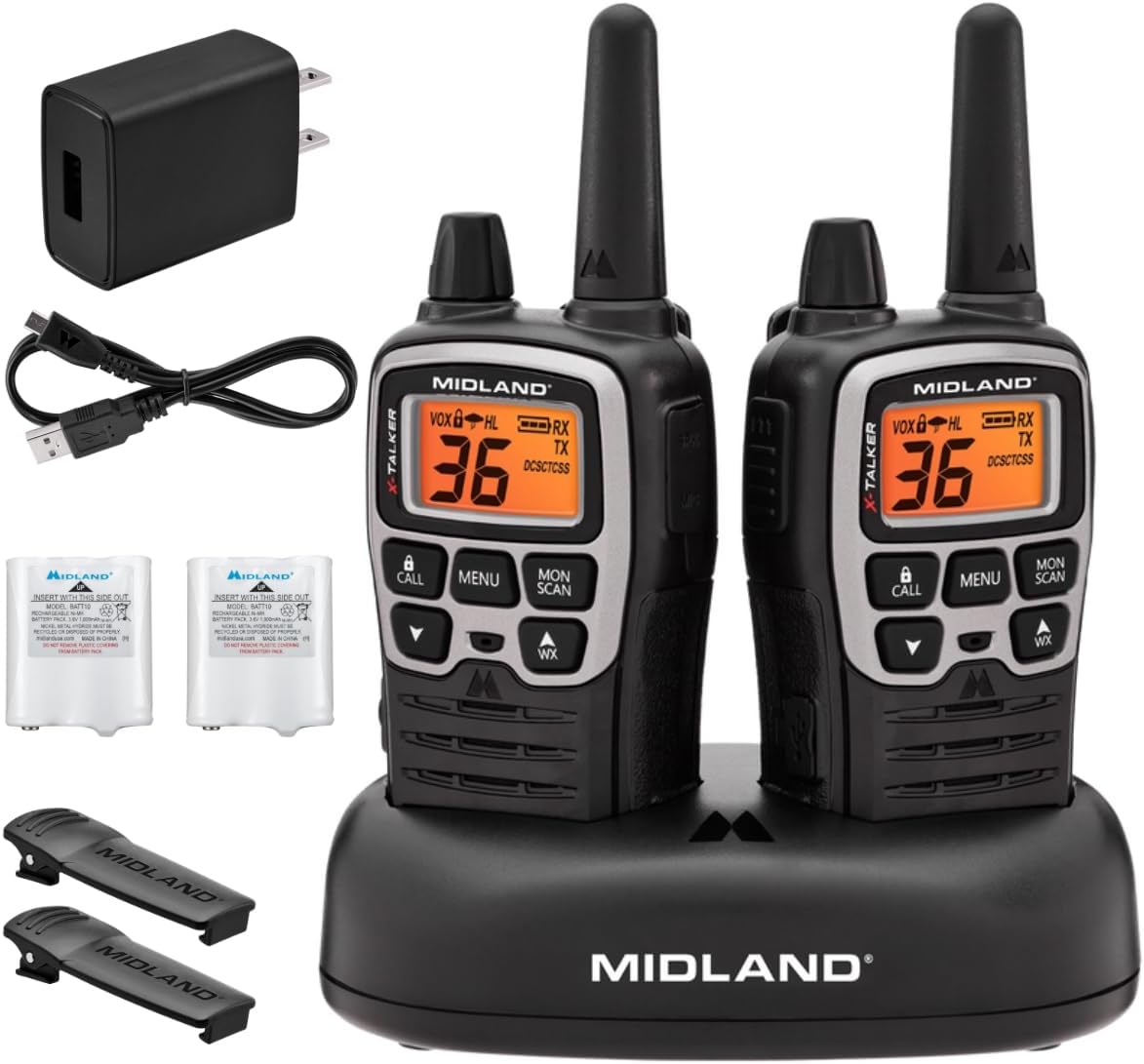
Based on the provided product details, the Midland T71VP3 X-TALKER is a two-pack of FRS two-way radios designed for reliable communication during outdoor pursuits. Ideal users include campers, overlanders, and rock crawlers who need portable group contact without cellular coverage. The listed features position these radios as practical tools for homeowners and DIYers handling remote property work or family outdoor trips.
Performance centers on 36 FRS channels with a channel scan function that lets users check for activity easily. The product information indicates up to 30-mile range capability in unobstructed environments with minimal obstacles, supporting seamless connections over greater distances. Combined with 121 CTCSS privacy codes that expand options up to 2,662 combinations, the radios help block other conversations for clearer exchanges. NOAA Weather Scan automatically checks 10 weather band channels and locks onto the strongest signal to alert users of severe weather updates, adding a safety layer for outdoor activities.
Design emphasizes portability and power flexibility in a black and silver two-pack format. Controls support straightforward channel selection and scanning, while the ability to use standard alkaline batteries ensures the units stay powered even when recharging is not an option. Based on the feature set, setup appears accessible for typical homeowner use, with no complex installation required beyond inserting batteries and choosing channels. Storage is simple for vehicle glove boxes or packs during overlanding or camping trips.
In real-world home and outdoor scenarios, these radios shine for coordinating family members across large properties, managing group hikes, or maintaining contact during rock crawling sessions. The privacy codes and weather alerts provide practical value for safety-conscious users in variable conditions. Power flexibility supports extended time off the grid or during outages, making the pair useful for emergency kits or remote DIY projects where reliable voice links improve workflow and awareness.
Potential limitations include range performance that depends heavily on open terrain, so denser environments may reduce effective distance. First-time users might need time to configure privacy codes fully. Overall, based on the available product data, the Midland T71VP3 X-TALKER offers solid FRS functionality for outdoor and homeowner communication needs, delivering dependable features without unnecessary complexity.
Those seeking straightforward long-range walkie talkies for camping, overlanding, or property coordination should find this 2-pack a strong match. Users wanting exclusively rechargeable systems or higher-power radio services may prefer alternative models.
Specifications
| Number of Channels | 36 |
|---|---|
| Additional Features | Long Range |
| Frequency Range | UHF 462 MHz (FRS) and VHF 162 MHz (NOAA Weather) |
| Talking Range Maximum | 38 Mile |
| Voltage | 1.5 Volts |
| Water Resistance Level | Not Water Resistant |
| Number of Batteries | 2 Product Specific batteries required. (included) |
| Audible Noise | 30 Decibels |
| Compatible Devices | Two-Way Radio Devices |
| Battery Average Life | 10 Hours |
Verify the current product variation before purchase; specifications may change.
Best For / Avoid If
Best for buyers prioritizing
- Provides up to 30-mile reach potential in unobstructed environments with minimal obstacles
- Delivers NOAA weather scan plus alert for automatic severe weather updates
- Creates extensive channel combinations through 121 CTCSS privacy codes for reduced interference
Consider another option if
- Maximum range applies mainly in open settings and can drop with obstacles or terrain
- Depends on standard alkaline batteries which require replacement rather than simple recharging
- Privacy code setup may take extra familiarization time for first-time two-way radio users
Noaa Weather Radio Buying Guide
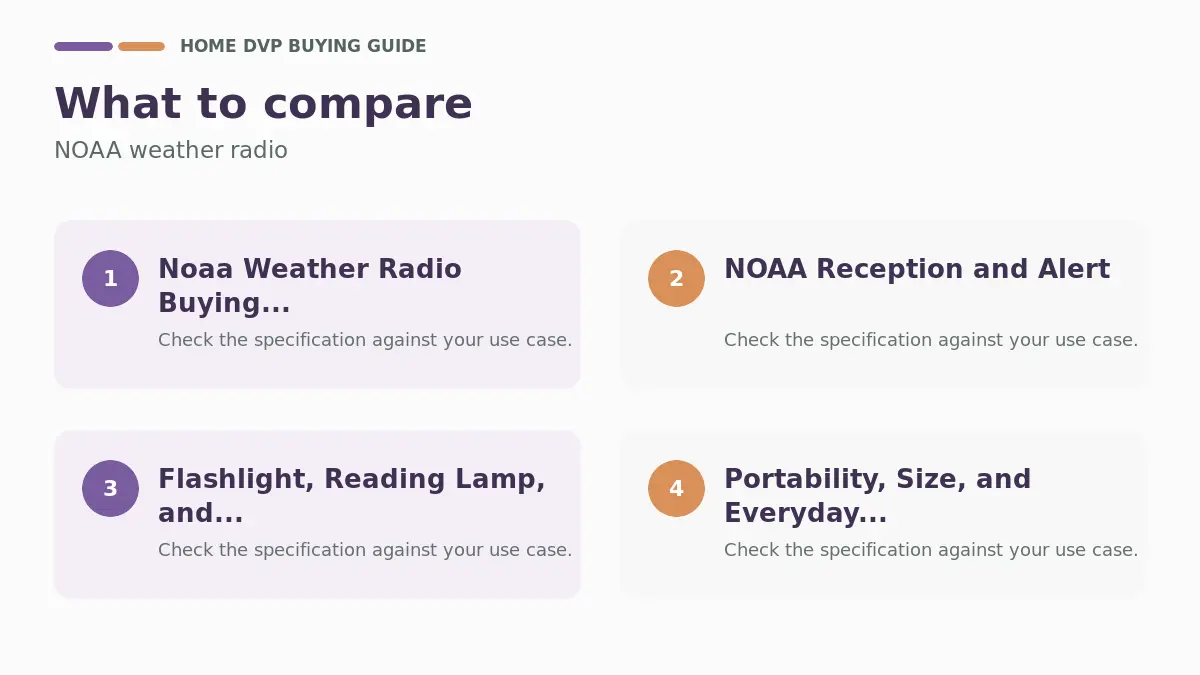
Selecting the right noaa weather radio requires looking beyond basic radio reception. Modern emergency models combine weather alerts with multi-source power, lighting, and device charging. After carefully analyzing the available specifications, we identified the most important criteria for homeowners and practical users. Use the sections below to match features to your needs, whether you want a compact bedside unit or a rugged go-bag essential.
NOAA Reception and Alert Features
The core purpose of any noaa weather radio is clear, reliable reception of the seven NOAA weather band frequencies (162.400–162.550 MHz). Look for models with high-sensitivity chips, extended telescopic antennas, and automatic NOAA Weather Scan that locks onto the strongest local channel. Units with NOAA Weather Alert sound an alarm for severe weather warnings, giving you time to take action.
Advanced options such as the Midland WR120B include S.A.M.E. (Specific Area Message Encoding) localized programming. This lets you enter county codes so you only receive alerts relevant to your area, reducing false alarms. Midland ER310 models add automatic scan and alert with Morse-code SOS flashlight support. A common mistake is buying a basic AM/FM radio that lacks dedicated NOAA bands or alert tones. For households in tornado or hurricane zones, prioritize SAME-capable or automatic-alert designs.
Digital LCD displays showing frequency and battery level make tuning easier, especially for seniors or nighttime use. Headphone jacks allow private listening without disturbing others during overnight watches. Based on our detailed comparison, models with precision-tuned antennas perform better in basements or remote areas where signal can be weak.
Power Sources and Battery Capacity
Power independence is critical during outages. The best noaa weather radio options offer multiple charging methods: hand crank, solar panel, USB-C or AC input, and often AA/AAA battery backup. Battery capacities range from around 2000–12000mAh. Higher capacity (10000mAh+) units can run the radio for days and still charge a phone once or twice.
Large monocrystalline solar panels (for example 8500mm² on Mesqool and PPLEE models) charge faster even in low light compared with small decorative panels. Hand cranks with high-torque generators provide usable power after just a few minutes of turning. Some designs, such as the Rckskaya unit, support five ways to charge including USB-C and AA cells. Always fully charge the internal battery upon arrival and test the crank or solar function before an emergency.
A frequent homeowner error is underestimating runtime needs. If you plan to charge phones or run lights for extended periods, choose models advertising real (not inflated) 10000–12000mAh capacity. Units that also function as power banks add practical value for modern households. Keep spare alkaline batteries on hand as a final backup.
Flashlight, Reading Lamp, and SOS Functions
Lighting turns a weather radio into a complete emergency tool. Look for multi-mode LED flashlights with high, medium, and strobe settings, plus separate reading lamps for low-light tasks. Brightness levels around 200–650 lux or 130+ lumens (as on the Midland ER310 CREE LED) provide useful illumination without draining the battery too quickly.
SOS features are equally important. Many units include a loud 115dB alarm paired with red/blue or flashing lights that can signal rescuers. The Midland ER310 adds an ultrasonic dog whistle for search-and-rescue scenarios. Red/blue warning strobes help during roadside emergencies. Retractable or flip-up reading lamps on Mesqool and Nitigo models are ideal for reading maps or charging cables at night without blinding others.
IPX-rated water resistance (IPX3 or IPX6 on several models) protects against rain and splashes. When packing a go-bag or home kit, choose a radio whose lights can operate independently of the radio function so you can conserve power. Test all light modes periodically to ensure readiness.
Portability, Size, and Everyday Usability
Most modern noaa weather radio units are compact enough for emergency kits, glove boxes, or nightstands. Typical dimensions fall around 6–8 inches long and under 1.5 lb. Hand straps or non-slip grips improve carrying comfort during camping or evacuation. Larger LCD screens and clearly labeled buttons help users of all ages, including seniors, operate the radio in low light or under stress.
Ergonomic designs with large tuning knobs (common on Mesqool models) reduce fumbling. Headphone jacks support quiet listening. For home use, a unit that sits stably on a counter or shelf is preferable; for outdoor or bug-out use, prioritize lightweight models with carry straps. Avoid overly bulky designs if storage space is limited.
Our research indicates that the most practical units balance portability with feature set. A radio that is too small may sacrifice battery size or solar panel area. Measure your intended storage location and consider how the radio will be used day-to-day versus only during storms.
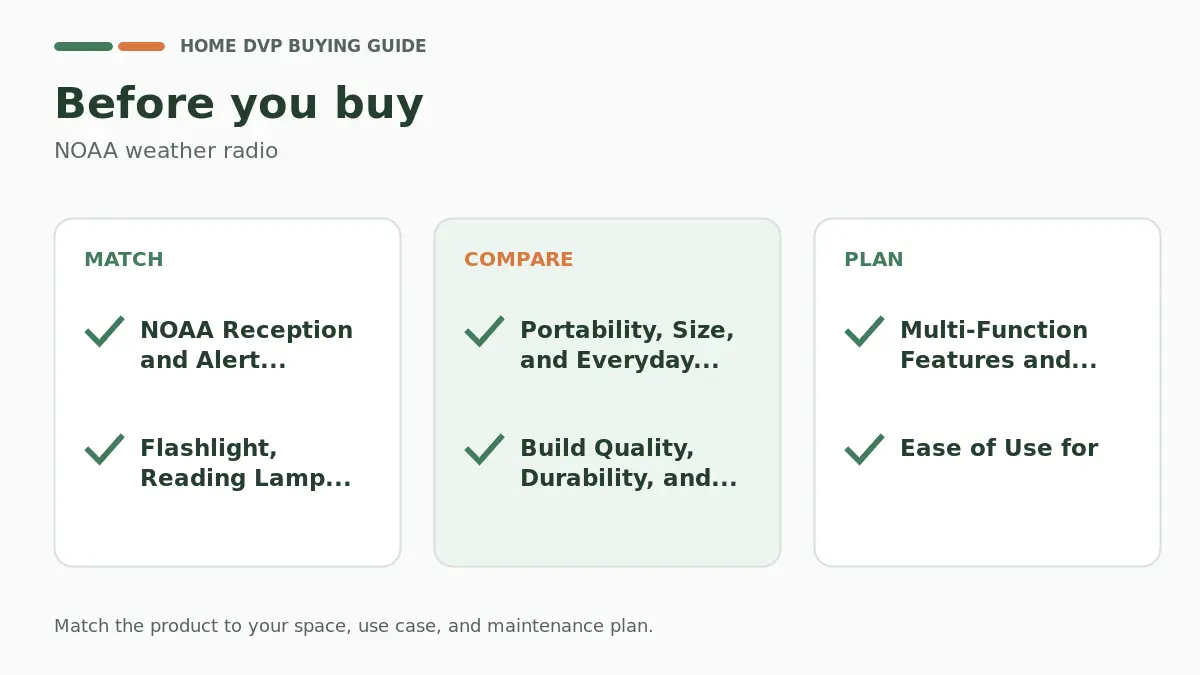
Build Quality, Durability, and Weather Resistance
Emergency gear must survive drops, dust, and moisture. Look for robust plastic housings, reinforced crank arms, and claimed IPX water resistance. Telescopic antennas should lock securely and resist bending. Brands such as MidlandRadio have long track records in weather radios, while newer options from Raynic, FosPower, and Mesqool emphasize upgraded generators and solar panels.
Replaceable rechargeable batteries (found on some Midland units) extend product life. Avoid models with flimsy cranks or tiny solar panels that claim high performance. Check for clear labeling of battery capacity and charging methods so you can verify claims against real use. Dust and drop resistance matter for camping or vehicle storage.
Homeowners should also consider warranty coverage. Some FosPower units include limited lifetime warranties, adding long-term trust. Store the radio in a cool, dry place and cycle the battery every few months to maintain capacity.
Multi-Function Features and Phone Charging
Beyond weather alerts, many noaa weather radio models charge phones, tablets, or other USB devices. Dual USB outputs or USB-C ports speed emergency charging. Combined with solar and crank power, these units become portable power stations during blackouts. Reading lamps, SOS alarms, and even ultrasonic dog whistles expand usefulness.
AM/FM (and sometimes shortwave) bands provide news and entertainment when weather channels are quiet. Digital tuning or large analog dials make station changes simple. Units with 3.5 mm headphone jacks support private listening. These extras make the radio valuable year-round rather than only during storms.
A practical tip: keep a short USB cable with the radio so you can charge a phone immediately. Test charging speed with your own devices. Models advertising “real” high mAh capacity tend to deliver more consistent phone top-ups than those with inflated claims.
Ease of Use for Beginners and Seniors
Complicated menus reduce reliability in an emergency. Prefer radios with physical buttons, large knobs, and straightforward band selection. Digital LCDs that show battery percentage and frequency reduce guesswork. Trilingual displays on some Midland models help diverse households.
Automatic NOAA scan and alert features minimize the need to manually search channels. Color-coded alert lights indicate severity at a glance. For elderly users or beginners, avoid units that require apps or complex programming. The simpler the controls, the more likely the radio will be used correctly under pressure.
Practice operating the radio during calm weather so everyone in the household knows how to switch bands, activate the flashlight, and start the SOS alarm. Keep the manual in a waterproof bag with the radio.
Value, Price Range, and Who Each Style Suits
Prices for quality noaa weather radio typically fall within $11.99–$135. Budget-friendly models around the lower end deliver solid NOAA reception, basic crank/solar power, and a flashlight. Mid-range units add larger batteries, better solar panels, and phone charging. Premium options from established brands emphasize SAME alerts, longer runtimes, and refined ergonomics.
Homeowners preparing a basic emergency kit can start with a multi-power radio that includes SOS and lighting. Campers and outdoor users benefit from high-capacity solar and rugged builds. Apartment renters or those needing localized alerts may prefer compact SAME-capable models. Compare features against your most likely scenarios rather than buying the most expensive unit by default.
For complementary home preparedness ideas, visit our Air Quality & Climate resources and Heating, Cooling & Air guides. A well-chosen weather radio pairs naturally with other safety and climate tools.
Our Research Methodology & Why You Can Trust Us
At Home DVP we approach every product guide with transparent, specification-driven research. We do not claim hands-on laboratory testing of every unit. Instead, we evaluate available manufacturer specifications, feature sets, build details, power capacities, user-facing ratings, and category fit for emergency use. Our process begins with validating that each product genuinely belongs in the Emergency Supplies category and supports NOAA weather reception.
We compare reception claims, battery and solar performance data, multi-power options, lighting outputs, alert technologies (including SAME where listed), size, weight, and extra functions such as phone charging or SOS. User feedback patterns help surface common strengths and potential drawbacks. Industry standards for NOAA radios and practical homeowner scenarios (power outages, severe weather, camping) guide our ranking criteria: performance, features, build quality, ease of use, durability, safety, value, reliability, and DIY/home fit.
Content is reviewed and updated during September to reflect current model availability and feature trends. We prioritize honest strengths and limitations so readers can match products to their specific needs. This approach builds trust through clear methodology rather than exaggerated claims.
Final Thoughts
After comparing the listed specifications across 15 models, several stand out for different needs. For an overall balanced pick, the Midland ER310 offers proven NOAA Weather Scan + Alert, multiple power sources including solar and crank, a bright SOS flashlight, phone charging, and the added ultrasonic dog whistle—making it a strong homeowner and emergency-kit choice. Its established brand reputation and solid feature set suit most households preparing for storms or outages.
As a value-oriented option, the NITIGO 4000mAh model or FosPower A1 deliver reliable NOAA/AM/FM reception, solar/hand-crank/USB charging, flashlight, reading lamp, and SOS functions at accessible price points. They work well for beginners, secondary kits, or budget-conscious shoppers who still want multi-source power. For higher capacity and strong solar performance, Mesqool 12000mAh units or the Rckskaya 10000mAh radio provide extended runtime, large solar panels, and versatile lighting—ideal for longer outages or outdoor use. The Midland WR120B remains excellent when localized SAME alerts are the top priority for a primary home unit.
Choose based on your most likely use case: compact bedside alerts, go-bag portability, or maximum multi-day power. Pair your noaa weather radio with other essentials from our Emergency Supplies category and keep it charged and ready. With the right model, you gain reliable information and practical tools exactly when you need them most.
Frequently Asked Questions
What should I look for when choosing noaa weather radio?
Prioritize clear NOAA band reception with automatic scan and alert features, multiple power sources (crank, solar, USB, battery backup), usable flashlight and SOS functions, and a battery capacity that matches your expected runtime. Also consider ease of controls, size for your storage space, and whether SAME localized programming is important for your area. Matching these factors to power-outage or storm scenarios ensures practical performance.
Are higher-end noaa weather radio worth it?
Higher-end models often justify the cost through larger real battery capacity, more efficient solar panels, SAME alerts that reduce false alarms, better build quality, and extra features such as dual USB charging or stronger flashlights. For primary home units in severe-weather regions they can provide meaningful peace of mind. Budget models still work well for basic kits or secondary locations when core NOAA and multi-power functions are present.
How should beginners choose noaa weather radio?
Beginners should start with straightforward controls, automatic NOAA Weather Scan and Alert, at least three power options, and a built-in flashlight plus SOS. Look for clear labeling, a readable display, and a reputation for reliable reception. Avoid overly complex programming if possible. Practice using the radio once it arrives so everyone in the home knows the basics before an emergency.
How long should quality noaa weather radio last?
With proper care—regular battery cycling, dry storage, and occasional testing—most quality units last several years. Replaceable batteries on some models extend lifespan further. Solar panels and cranks can continue providing power long after the original charge cycles diminish. Treat the radio as critical emergency gear and store it ready for use.
What brands make reliable noaa weather radio?
Established names such as MidlandRadio are frequently associated with dependable NOAA radios and localized alerts. Other options including FosPower, Raynic, Mesqool, and similar makers offer strong multi-power and multi-function designs at various price points. Compare specific features and user feedback patterns rather than relying solely on brand name.
How much should homeowners expect from noaa weather radio in 2026?
Expect solid NOAA reception, multi-source charging that includes solar and crank, phone-charging capability, flashlight and SOS functions, and runtimes measured in hours to days depending on battery size. Prices commonly fall within $11.99–$135. Features such as large solar panels, high true mAh ratings, and SAME programming have become more accessible. Pair your radio with broader preparedness items found in our Emergency Supplies section.
Are noaa weather radio suitable for DIY projects, home repairs, or regular maintenance?
Yes. Beyond weather emergencies, these radios serve well during power outages caused by electrical work, for outdoor DIY or camping trips, and as reliable information sources while performing home maintenance in remote or basement areas. Many homeowners keep one in the garage or workshop for both safety alerts and practical lighting/charging needs.