
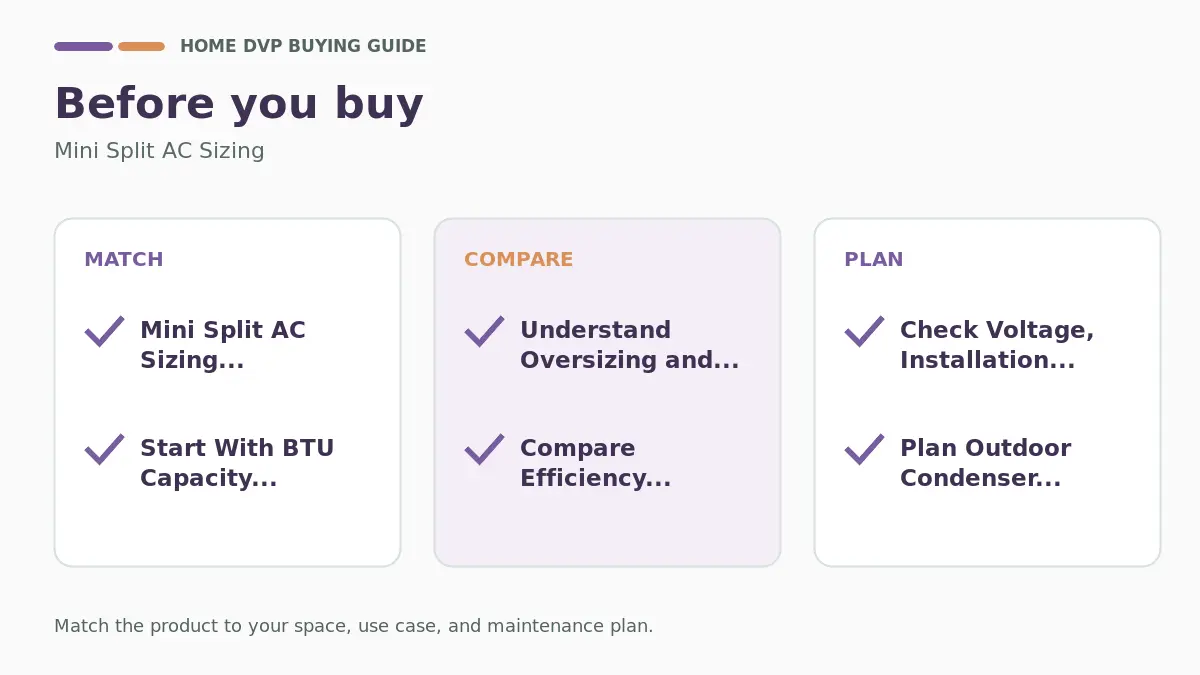
Mini Split AC Sizing: Mini Split AC Sizing starts with the room or zone load, not a product label. Square footage is only a first-pass estimate; climate, insulation, windows, air leakage, ceiling height, occupancy, appliances, and heating demand can materially change the required capacity.
Choosing the right mini split system is not just about picking a popular air conditioner. Proper Mini Split AC Sizing affects comfort, humidity control, energy use, noise, installation cost, and long-term equipment life. A unit that is too small may run constantly without keeping up, while an oversized unit may short cycle, leave rooms clammy, and waste energy.
After carefully analyzing the available specifications, we reviewed 15 products in the Heating, Cooling & Air category, then focused our recommendations on the items that clearly support mini split selection, sizing, installation planning, or compatible system setup. Our comparison considered BTU capacity, room coverage, voltage, SEER2 or efficiency ratings, installation requirements, smart controls, outdoor unit support, airflow planning, warranty coverage, and practical homeowner use cases.
If you are comparing a mini split with other climate-control upgrades, our Heating, Cooling & Air section is a helpful place to continue researching whole-home comfort, room-by-room cooling, supplemental heat, and indoor air management.
Mini Split AC Sizing: Start With a Load Calculation
Use a square-footage estimate only to create a shortlist. Before buying, ask a qualified HVAC professional to verify the load for each zone and evaluate equipment turndown, design temperatures, line-set limits, condensate routing, and electrical service. Correct sizing improves comfort and humidity control while reducing short cycling.
For an independent technical reference, the ENERGY STAR ductless heating and cooling guidance recommends proper sizing and professional load calculations, such as ACCA Manual J, because square footage alone does not capture the building load.
Mini Split AC Sizing Buying Guide
Based on our detailed comparison, the strongest choices for mini split ac sizing are not always the most powerful systems. The better match is the product that fits the room load, installation conditions, electrical setup, and long-term maintenance needs of the home. The products that most directly fit this guide include mini split heat pump systems, a duct and airflow sizing calculator, and an outdoor condenser pad that supports installation planning.
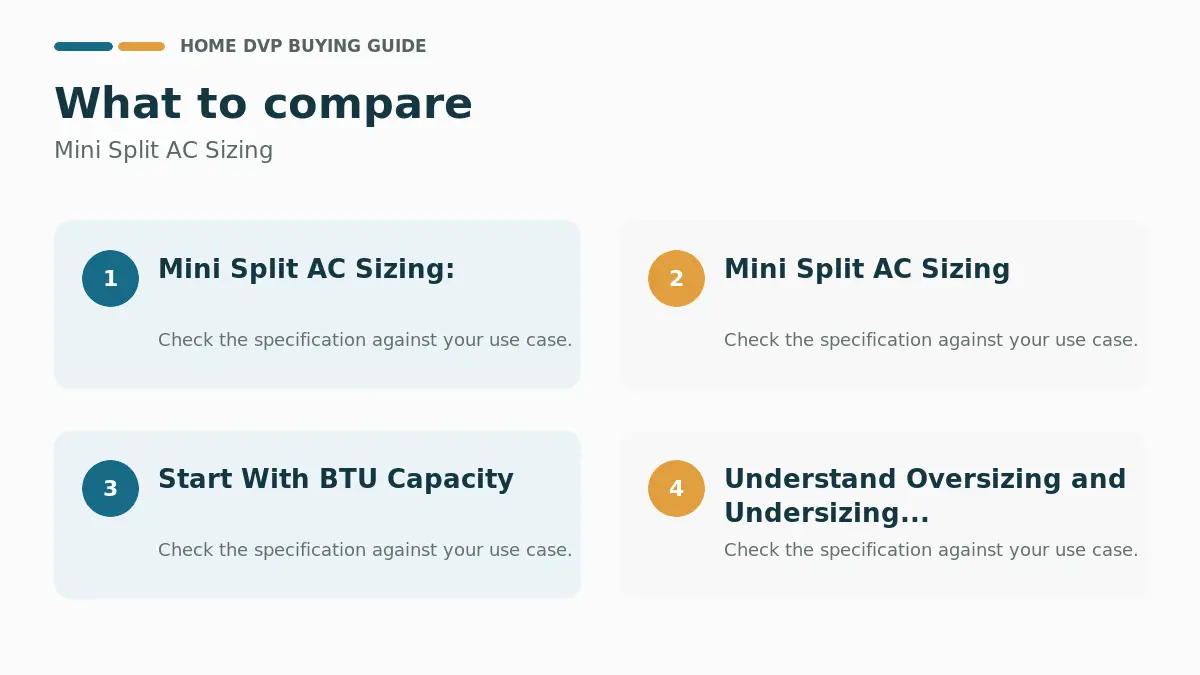
Start With BTU Capacity and Room Coverage
BTU capacity is the foundation of mini split ac sizing. A smaller room, enclosed office, garage workspace, or addition may need less capacity than an open living area with high ceilings, west-facing windows, or poor insulation. Product listings such as the ROVSUN Wifi Enabled Mini Split Air Conditioner & Heater identify a lower-capacity system for smaller spaces, while several listed ductless systems provide higher-capacity room coverage for larger single-zone applications.
A common homeowner mistake is sizing only by square footage. Square footage matters, but so do ceiling height, sun exposure, insulation, air leakage, window area, local climate, and whether the space includes heat-generating appliances. A sunroom, attic office, bonus room over a garage, or converted workshop may need more careful load planning than a well-insulated bedroom of similar size.
For homeowners comparing listed systems, the Senville LETO Series Mini Split Air Conditioner Heat Pump, COSTWAY Mini Split Air Conditioner & Heater, GarveeHome Mini Split Air Conditioner, and Nexaro Mini Split Air Conditioner Heat Pump all provide useful sizing clues through their BTU ratings and stated room coverage. Those specifications are a starting point, not a substitute for a professional load calculation when the space is unusual or the installation is permanent.
| Sizing Factor | Why It Matters | Homeowner Tip |
|---|---|---|
| BTU rating | Shows cooling and heating capacity | Match capacity to the real load, not just room size |
| Room coverage | Helps estimate practical application | Use stated coverage as a guideline, then adjust for heat gain |
| Insulation | Affects how quickly heat enters or leaves | Older rooms may need added air sealing before upsizing equipment |
| Sun exposure | Raises cooling demand | South and west-facing rooms often require closer evaluation |
Understand Oversizing and Undersizing Risks
Undersizing is easy to notice because the room never feels comfortable during peak heat or cold. The system may run for long periods, struggle to reach the thermostat setpoint, and leave homeowners assuming the equipment is poor quality when the issue may be capacity. This is especially common in converted garages, poorly insulated additions, and rooms with large glass doors.
Oversizing can be more subtle. A large mini split may cool the air quickly but shut off before removing enough moisture, which can make the room feel damp. In heating mode, oversizing can also create uneven comfort because the unit cycles instead of modulating steadily. Inverter-driven systems help reduce this issue, but correct sizing still matters.
When comparing options such as the Senville LETO Series Mini Split Air Conditioner Heat Pump and COSTWAY Mini Split Air Conditioner & Heater, pay attention to both capacity and efficiency. A higher-capacity model may look appealing, but the best fit is the one that can maintain comfort without constant cycling or continuous full-output operation.
Compare Efficiency Ratings and Inverter Performance
Efficiency ratings such as SEER2 and SEER help homeowners understand how effectively a mini split converts electricity into cooling performance. Several products in the available data use inverter technology, which allows the compressor to adjust output instead of simply turning fully on and off. That can improve comfort, reduce noise, and help control operating costs when the unit is sized correctly.
The Senville LETO Series lists a strong SEER2 rating and smart control compatibility, while the COSTWAY Mini Split Air Conditioner & Heater emphasizes inverter operation and all-season heating and cooling. The GarveeHome Mini Split Air Conditioner and ROVSUN Wifi Enabled Mini Split Air Conditioner & Heater also highlight inverter technology, quiet operation, and energy-saving features.
Our research indicates that efficiency should be evaluated alongside installation quality. A high-efficiency mini split can underperform if the line set is poorly installed, the refrigerant charge is incorrect, the outdoor unit lacks stable support, or the indoor head is mounted where air cannot circulate well. If energy management is a priority, you may also want to compare controls with our guide to smart thermostat and programmable thermostat differences.
Check Voltage, Installation Requirements, and Professional Support
Voltage is one of the most important practical details in mini split ac sizing. Some ductless systems are designed for standard residential circuits, while others require a different electrical setup. Before buying, homeowners should confirm the unit voltage, breaker requirements, disconnect placement, line-set route, wall penetration location, and whether the installation must be completed by a licensed HVAC professional.
The Senville LETO Series Mini Split Air Conditioner Heat Pump specifies professional installation, and the COSTWAY Mini Split Air Conditioner & Heater also notes licensed HVAC installation. GarveeHome provides an installation kit and guidance, but still indicates that professional installation is recommended for optimal performance. These details matter because warranty support, refrigerant handling, and electrical safety can depend on proper installation.
DIY beginners should be especially cautious. Mounting an indoor head and placing an outdoor condenser may look straightforward, but vacuuming lines, checking for leaks, handling refrigerant-related fittings, and wiring the system are not the same as installing a window air conditioner. If you are not comfortable with HVAC service procedures, plan for professional help before purchasing.
Plan Outdoor Condenser Placement and Support
The outdoor unit affects both performance and durability. A condenser should sit level, drain properly, maintain clear airflow, and stay protected from excessive vibration or standing water. Poor placement can reduce efficiency, increase noise, and shorten equipment life.
The Cestluck Mini Split Pad for AC Condenser is relevant because it supports outdoor equipment placement for mini split heat pump systems. Its raised profile, reinforced base, weather-resistant polypropylene construction, vibration-reducing surface, and broad equipment compatibility make it a practical consideration for homeowners setting a condenser on soil, gravel, grass, or other outdoor surfaces.
When planning placement, avoid tight corners, clogged vegetation, snow-drift areas, and spots where roof runoff falls directly onto the unit. In climates with heavy moisture or humidity concerns, pairing good outdoor drainage with indoor condensate planning is important. Our guide to dehumidifier drain hose setup can also help homeowners think through moisture removal and drainage basics in utility spaces.
Use Airflow and Duct Planning Tools When Needed
Most mini splits are ductless, but airflow planning still matters. Air should be able to circulate across the room without being blocked by tall furniture, room dividers, shelving, or awkward ceiling shapes. If a home project involves ducts, flexible duct runs, or a hybrid HVAC layout, airflow sizing tools become more relevant.
The ADI Ductulator by the Air Distribution Institute is a practical tool for airflow and duct size planning. Its data accounts for flexible duct compression and the pressure loss that occurs when duct is not fully stretched. That makes it useful for HVAC planning scenarios where duct sizing, CFM, FPM, fittings, bends, or flex duct installation quality may affect performance.
For homeowners, the key takeaway is simple: equipment sizing and air distribution must work together. Even the right mini split capacity can feel disappointing if air does not reach the seating area, bed area, home office desk, or workshop zone where comfort is needed most.
Evaluate Heating Performance, Dehumidification, and All-Season Use
Many shoppers focus on cooling, but mini split heat pumps are often purchased for year-round comfort. Heating performance matters for bedrooms, finished basements, garage offices, workshops, and additions that are not well served by the main HVAC system. Look for product data that confirms heat pump capability, operating temperature limits, defrost features, and whether the system includes dry or dehumidification modes.
The Senville LETO Series includes cooling, heating, dehumidifying, fan, and turbo functions. The COSTWAY Mini Split Air Conditioner & Heater includes multiple operating modes, self-cleaning, and auto defrost. Nexaro highlights heating, cooling, dry, fan, auto modes, mildew protection, and self-defrosting. These features can make a mini split more versatile than a cooling-only room air conditioner.
If indoor humidity is a major comfort issue, sizing becomes even more important. An oversized unit may lower temperature without running long enough to remove moisture effectively. For broader indoor comfort planning, our Air Quality & Climate category can help you compare products that support healthier, more comfortable indoor air.
Look at Controls, Noise, Maintenance, and Warranty
Daily usability is easy to overlook during mini split ac sizing. Remote controls, app control, voice assistant compatibility, sleep modes, timers, filter access, and self-cleaning functions can affect how satisfied homeowners are after installation. A properly sized unit that is difficult to control or loud in a bedroom may still be the wrong choice.
The Senville LETO Series offers Alexa-enabled control and app-related features. ROVSUN highlights app and voice control compatibility along with quiet operation. GarveeHome emphasizes sleep mode, a programmable timer, self-diagnosis, and low-noise operation. COSTWAY includes remote operation, quiet function details, self-cleaning, and warranty coverage for key components.
Maintenance should also influence your buying decision. Washable filters, accessible indoor heads, outdoor coil clearance, and seasonal inspections help preserve efficiency. If a unit is installed in a dusty workshop, pet area, or kitchen-adjacent space, expect to clean filters more often than the minimum schedule suggests.
Our Research Methodology & Why You Can Trust Us
We evaluated the products based on available product information, listed specifications, homeowner-facing features, category fit, and practical installation considerations. Because Mini Split AC Sizing depends heavily on matching equipment to the room, we prioritized BTU capacity, stated coverage, inverter operation, voltage, heat pump capability, installation requirements, airflow planning, condenser support, durability indicators, and warranty information.
We also validated product relevance before making recommendations. Mini split systems, outdoor condenser support, and duct or airflow sizing tools were considered relevant to this guide. Products that did not clearly support mini split ac sizing, mini split installation planning, or Heating, Cooling & Air decision-making were not used for recommendation summaries, FAQ examples, or final picks.
Our ranking criteria included performance potential, features, build quality, ease of use, durability, safety, value, reliability, and fit for homeowner or DIY planning. We did not claim hands-on testing. Instead, our conclusions are based on detailed specification analysis, product data, user-facing feature claims, industry research, and the practical needs of homeowners comparing systems during July 2026.
We also considered where each product makes sense. A full mini split system is appropriate when replacing or supplementing room comfort equipment. A condenser pad is useful when outdoor placement, vibration, drainage, and leveling are priorities. A duct sizing calculator is best for homeowners, DIY planners, or HVAC-related projects where airflow and flexible duct performance must be estimated carefully.
Final Thoughts
For an overall homeowner pick, the Senville LETO Series Mini Split Air Conditioner Heat Pump stands out because it combines inverter operation, strong efficiency specifications, smart control compatibility, heating and cooling functions, and a clear installation package. It is best suited for homeowners who want a polished single-zone mini split and are prepared for professional installation.
For value-focused shoppers, the COSTWAY Mini Split Air Conditioner & Heater offers a strong mix of cooling, heating, inverter technology, multiple comfort modes, self-cleaning, auto defrost, and warranty coverage. For smaller spaces, the ROVSUN Wifi Enabled Mini Split Air Conditioner & Heater is worth considering because its capacity and stated coverage are better aligned with compact rooms, offices, and similar residential applications.
For project planning, the ADI Ductulator is the most relevant tool for airflow and duct sizing work, while the Cestluck Mini Split Pad for AC Condenser is a practical installation accessory for supporting outdoor equipment. If you are still comparing comfort products beyond mini splits, our guides to oil-filled radiator heaters and space heater safety can help you evaluate supplemental heating options.
FAQ
What should I look for when choosing mini split ac sizing?
Start with BTU capacity, room coverage, insulation quality, sun exposure, ceiling height, and whether the space needs cooling, heating, or both. Then compare voltage, installation requirements, efficiency ratings, control options, and warranty coverage before choosing a system.
Are higher-end mini split ac sizing worth it?
Higher-end options can be worth it when they provide better inverter performance, stronger efficiency ratings, quieter operation, smart controls, and better warranty support. However, paying more does not fix poor sizing, weak insulation, or improper installation.
Can a mini split be too large for a room?
Yes. An oversized mini split may cool quickly but cycle off before removing enough humidity, which can leave the room uncomfortable. Correct mini split ac sizing helps the system run steadily, maintain even temperatures, and manage moisture better.