A reliable home battery backup without solar can keep essential devices running when storms, rolling outages, grid failures, or unexpected electrical work interrupt power. For homeowners and renters, the right system can protect refrigerated food, keep internet service active, support medical devices such as CPAP machines, and provide safer indoor backup power without relying on fuel storage or exhaust-producing generators.
After carefully analyzing the available specifications, we compared 15 products across capacity, AC output, battery chemistry, UPS capability, recharge speed, outlet selection, portability, indoor safety features, and practical home use. We also considered how these units fit into broader emergency planning, including when a portable battery makes more sense than a fuel-powered option. For more context on that decision, see our guide to portable power stations versus generators.
This guide focuses on battery backup systems that can be used without solar panels. Some models support optional solar charging, but the key question here is how well they work from wall charging, generator charging, or standard household preparedness routines when solar is not part of your setup.

Pros
- Centralizes compatible whole-home backup components in one system hub.
- Offers flexible energy-source management across solar and supported gas generators.
Cons
- Its benefits depend on compatible DELTA Pro Ultra, DELTA Pro 3, solar, or generator equipment.
- The listed 50 x 33 x 12-inch dimensions and 40-pound weight may make placement and handling difficult in smaller spaces.
Specifications
| Color | Black |
|---|---|
| Dimensions | 50 x 33 x 12 inches |
| Weight | 40 pounds |
| Product Group | Lawn & Patio |
| Binding | Tools & Home Improvement |
Verify the current product variation before purchase; specifications may change.
Best For / Avoid If
Best for buyers prioritizing
- Centralizes compatible whole-home backup components in one system hub.
- Offers flexible energy-source management across solar and supported gas generators.
- Fast automatic transfer can reduce the disruption caused by power outages.
Consider another option if
- Its benefits depend on compatible DELTA Pro Ultra, DELTA Pro 3, solar, or generator equipment.
- The listed 50 x 33 x 12-inch dimensions and 40-pound weight may make placement and handling difficult in smaller spaces.
- It is a system hub, so it does not provide backup power by itself without connected equipment.

Pros
- Very quick wall-outlet recharge compared with many portable power stations
- Strong 1800W AC output for a 1kWh class unit
Cons
- Solar panels are optional, so solar charging may require an additional purchase
- Users with very high whole-home backup demands may need more capacity than the base 1024Wh unit provides
Best For / Avoid If
Best for buyers prioritizing
- Very quick wall-outlet recharge compared with many portable power stations
- Strong 1800W AC output for a 1kWh class unit
- Expandable capacity is useful for RV trips, camping and longer outage planning
Consider another option if
- Solar panels are optional, so solar charging may require an additional purchase
- Users with very high whole-home backup demands may need more capacity than the base 1024Wh unit provides
- Extra batteries are needed to reach the listed 3kWh expanded capacity

Pros
- High energy capacity in a single 48V battery cabinet.
- Updated active balancing and aerosol fire-suppression features add practical safety and maintenance value.
Cons
- The 293.2-pound weight and tall 19.69 by 10.24 by 33.13-inch enclosure require careful placement planning.
- Pallet delivery by truck may be inconvenient for addresses that cannot accommodate large freight shipments.
Specifications
| Size | 48V 314Ah |
|---|---|
| Dimensions | 19.69 x 10.24 x 33.13 inches |
| Weight | 293.2 pounds |
| Product Group | Lawn & Patio |
| Binding | Electronics |
Verify the current product variation before purchase; specifications may change.
Best For / Avoid If
Best for buyers prioritizing
- High energy capacity in a single 48V battery cabinet.
- Updated active balancing and aerosol fire-suppression features add practical safety and maintenance value.
- Extended 10-year warranty and compatibility with V1 units support future expansion planning.
Consider another option if
- The 293.2-pound weight and tall 19.69 by 10.24 by 33.13-inch enclosure require careful placement planning.
- Pallet delivery by truck may be inconvenient for addresses that cannot accommodate large freight shipments.
- First-time DIY users may need extra setup time to coordinate the battery with compatible inverter and communication connections.

Pros
- 1070Wh capacity combined with 1500W output handles common household and camping loads effectively
- One-hour emergency charging option shortens downtime between uses
Cons
- Solar panels are not included and only Jackery-compatible models work for solar input
- One-hour super charging must be enabled in the app before each use or it defaults to 1.7 hours
Best For / Avoid If
Best for buyers prioritizing
- 1070Wh capacity combined with 1500W output handles common household and camping loads effectively
- One-hour emergency charging option shortens downtime between uses
- Long-cycle LiFePO4 chemistry supports multi-year reliability
Consider another option if
- Solar panels are not included and only Jackery-compatible models work for solar input
- One-hour super charging must be enabled in the app before each use or it defaults to 1.7 hours
- Capacity may prove limited for users needing whole-home backup coverage

Pros
- Ultra-fast 1.5-hour AC recharge minimizes downtime between uses
- Pass-through charging lets the unit accept power while supplying connected devices
Cons
- Solar panels are sold separately and must be added for renewable recharging
- Safety labeling restricts use in wet, rainy, or humid outdoor conditions
Best For / Avoid If
Best for buyers prioritizing
- Ultra-fast 1.5-hour AC recharge minimizes downtime between uses
- Pass-through charging lets the unit accept power while supplying connected devices
- Pure sine wave inverter protects delicate electronics and medical equipment
Consider another option if
- Solar panels are sold separately and must be added for renewable recharging
- Safety labeling restricts use in wet, rainy, or humid outdoor conditions
- 600W continuous rating suits essentials better than high-draw appliances over long periods

Pros
- High 10,240Wh capacity is useful for longer-duration emergency power needs.
- The 3-in-1 inverter design consolidates power conversion, solar charging, and battery charging functions.
Cons
- At 223.8 pounds, the complete package is not well suited to frequent moving or casual portable use.
- The system may require more planning and technical setup than a conventional plug-in power station.
Specifications
| Size | 10240Wh+5KwOutput |
|---|---|
| Dimensions | 20.55 x 17.13 x 5.63 inches |
| Weight | 223.8 pounds |
| Product Group | Electronics |
Verify the current product variation before purchase; specifications may change.
Best For / Avoid If
Best for buyers prioritizing
- High 10,240Wh capacity is useful for longer-duration emergency power needs.
- The 3-in-1 inverter design consolidates power conversion, solar charging, and battery charging functions.
- Bluetooth and WiFi monitoring can make battery status easier to check through the ECO-WORTHY app.
Consider another option if
- At 223.8 pounds, the complete package is not well suited to frequent moving or casual portable use.
- The system may require more planning and technical setup than a conventional plug-in power station.
- Compatibility with other solar equipment should be confirmed because communication depends on supported protocols and system integration.

Pros
- Single-unit 240V capability simplifies access to higher-voltage backup power.
- Fast UPS switching is well suited to computers and appliances that should remain powered during an outage.
Cons
- A manual transfer switch is needed for the listed home energy hub and auto-backup setup, so installation planning is required.
- At 74 pounds, the unit may be difficult to move frequently or store in a compact location.
Specifications
| Dimensions | 14.76 x 10.83 x 17.72 inches |
|---|---|
| Weight | 74 Pounds |
| Product Group | Lawn & Patio |
Verify the current product variation before purchase; specifications may change.
Best For / Avoid If
Best for buyers prioritizing
- Single-unit 240V capability simplifies access to higher-voltage backup power.
- Fast UPS switching is well suited to computers and appliances that should remain powered during an outage.
- Expandable capacity and multiple recharge options support different backup planning needs.
Consider another option if
- A manual transfer switch is needed for the listed home energy hub and auto-backup setup, so installation planning is required.
- At 74 pounds, the unit may be difficult to move frequently or store in a compact location.
- The 3.6kWh starting capacity may require expansion for extended outages or multiple high-demand appliances.

Pros
- Low 4W self-consumption improves efficiency and supports longer continuous fridge operation
- True UPS with four modes (Standard, PV Priority, Time of Use, Customized) adapts to household power needs
Cons
- Only two AC outlets may limit simultaneous powering of multiple high-draw appliances
- Full expansion to 8064Wh requires separate BlueCell 200 batteries not included in the base package
Specifications
| Additional Features | Quiet |
|---|---|
| Voltage | 120 Volts |
| Form Factor | Portable |
| Adjustable Temperature Control | No |
| Is Electric | Yes |
| Smart Home Compatibility | Not Smart Home Compatible |
| Power Source | Solar Powered |
| Item Dimensions D x W x H | 2.95"D x 2.95"W x 2.95"H |
| Item Weight | 41.9 Pounds |
| Size | 75mm |
Verify the current product variation before purchase; specifications may change.

Pros
- High 3072Wh capacity powers essential home loads for extended periods including up to 15 hours of household use
- Multiple versatile ports and RV-ready TT-30 connection support both indoor backup and outdoor scenarios
Cons
- Solar panels remain optional so full solar generator capability requires additional purchase
- Capacity and size may exceed needs of users who only charge small electronics occasionally
Best For / Avoid If
Best for buyers prioritizing
- High 3072Wh capacity powers essential home loads for extended periods including up to 15 hours of household use
- Multiple versatile ports and RV-ready TT-30 connection support both indoor backup and outdoor scenarios
- Fast AC and hybrid recharge options minimize downtime between uses
Consider another option if
- Solar panels remain optional so full solar generator capability requires additional purchase
- Capacity and size may exceed needs of users who only charge small electronics occasionally
- First-time setup of app control and multi-source charging can take extra familiarization time

Pros
- Lightweight build simplifies transport for outdoor and emergency scenarios
- Versatile port selection handles laptops, cameras, drones, and CPAP needs within rated limits
Cons
- Solar panels are not included and must be purchased separately
- 300W continuous limit excludes high-draw appliances such as toasters or larger kitchen devices
Best For / Avoid If
Best for buyers prioritizing
- Lightweight build simplifies transport for outdoor and emergency scenarios
- Versatile port selection handles laptops, cameras, drones, and CPAP needs within rated limits
- Long-lasting battery chemistry supports decade-scale reliability
Consider another option if
- Solar panels are not included and must be purchased separately
- 300W continuous limit excludes high-draw appliances such as toasters or larger kitchen devices
- Lacks smart app control found on higher-capacity models in the lineup

Pros
- Offers a useful mix of AC, DC, standard USB, and QC USB connections for common personal electronics.
- Portable form factor makes it easier to move between a vehicle, campsite, RV, and indoor storage area.
Cons
- The 300W maximum output limits compatibility with high-draw appliances such as hair dryers, toasters, coffee makers, pumps, and ice makers.
- A compatible solar panel must be purchased separately for solar recharging.
Specifications
| Color | Orange |
|---|---|
| Dimensions | 8.5 x 6.7 x 4.1 inches |
| Weight | 5.08 pounds |
| Product Group | Lawn & Patio |
| Binding | Tools & Home Improvement |
Verify the current product variation before purchase; specifications may change.
Best For / Avoid If
Best for buyers prioritizing
- Offers a useful mix of AC, DC, standard USB, and QC USB connections for common personal electronics.
- Portable form factor makes it easier to move between a vehicle, campsite, RV, and indoor storage area.
- Supports three recharge methods, including an optional solar panel with a built-in MPPT controller.
Consider another option if
- The 300W maximum output limits compatibility with high-draw appliances such as hair dryers, toasters, coffee makers, pumps, and ice makers.
- A compatible solar panel must be purchased separately for solar recharging.
- The unit should be recharged at least every half month when unused, so it requires ongoing battery-maintenance attention.
Pros
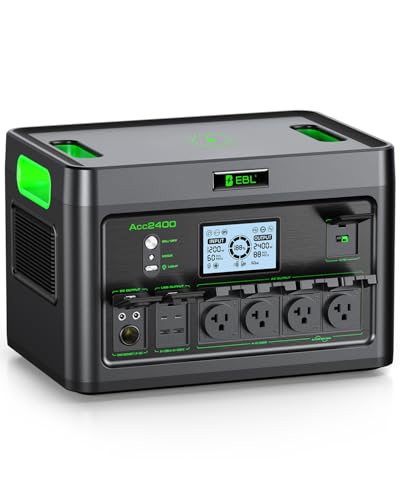
- Strong combination of high output and large battery capacity for a portable power station.
- Broad connection options make it practical for family camping, jobsite tasks, and household electronics.
Cons
- At approximately 54 pounds, it may be cumbersome for users who frequently carry equipment over long distances.
- The provided product details do not specify recharge time, charging inputs, or included accessories.
Best For / Avoid If
Best for buyers prioritizing
- Strong combination of high output and large battery capacity for a portable power station.
- Broad connection options make it practical for family camping, jobsite tasks, and household electronics.
- Built-in protection against overcharging, over-discharging, short circuits, and high temperatures supports safer operation.
Consider another option if
- At approximately 54 pounds, it may be cumbersome for users who frequently carry equipment over long distances.
- The provided product details do not specify recharge time, charging inputs, or included accessories.
- Its portable capacity may not meet the needs of buyers seeking power for an entire home or multiple high-demand appliances for extended periods.

Pros
- High 3600W output is suited to several power-hungry household appliances.
- Multiple charging methods provide useful flexibility for outage preparation and recovery.
Cons
- At 77.16 pounds, it is portable with wheels but still heavy to lift and carry.
- The home power setup is described as working with an MTS, so buyers should confirm the required arrangement before planning whole-home use.
Best For / Avoid If
Best for buyers prioritizing
- High 3600W output is suited to several power-hungry household appliances.
- Multiple charging methods provide useful flexibility for outage preparation and recovery.
- Ceramic membrane battery cells, a listed 6,000-cycle rating, and a stated 10-year lifespan support long-term backup planning.
Consider another option if
- At 77.16 pounds, it is portable with wheels but still heavy to lift and carry.
- The home power setup is described as working with an MTS, so buyers should confirm the required arrangement before planning whole-home use.
- Its 15.2 by 12.2 by 19.3-inch footprint may require dedicated storage space in smaller homes or apartments.

Pros
- Pure sinewave output is listed for use with active PFC and conventional power supplies.
- AVR, line-interactive topology, and GreenPower features support practical power management.
Cons
- The 24.9-pound, 14-inch-long tower may be cumbersome for compact desks, shelves, or storage areas.
- Only six of the twelve outlets provide battery backup, so connected equipment must be assigned carefully.
Best For / Avoid If
Best for buyers prioritizing
- Pure sinewave output is listed for use with active PFC and conventional power supplies.
- AVR, line-interactive topology, and GreenPower features support practical power management.
- Includes a three-year warranty covering the battery, a connected equipment guarantee, and PowerPanel management software.
Consider another option if
- The 24.9-pound, 14-inch-long tower may be cumbersome for compact desks, shelves, or storage areas.
- Only six of the twelve outlets provide battery backup, so connected equipment must be assigned carefully.
- The listed power specifications include both 1000W and 900W references, so buyers should confirm the applicable output rating for their equipment.
Home Battery Backup Without Solar Buying Guide
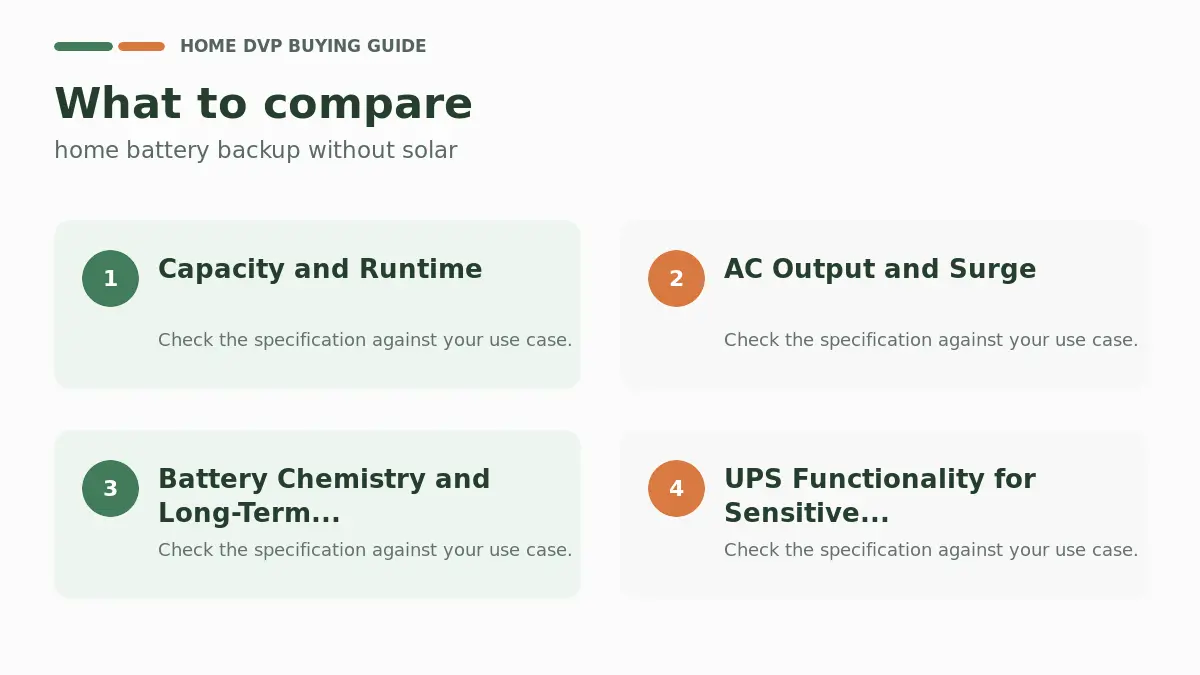
Based on our detailed comparison, the best choice depends less on brand name alone and more on the loads you need to support. A compact power station may be enough for phones, lights, and a router, while a larger LiFePO4 system is better suited for refrigerators, sump pumps, medical equipment, and multi-device outage planning.
Capacity and Runtime
Capacity is the first specification to check when choosing a home battery backup without solar. It is usually listed in watt-hours, and it tells you how much stored energy the battery can provide before it needs to be recharged. A smaller unit such as the MARBERO Portable Power Station is useful for phones, lights, and small electronics, while larger systems such as the Jackery HomePower 3000 Portable Power Station or BLUETTI FridgePower Portable Power Station are better suited for extended outages and higher-demand appliances.
A common mistake is assuming that a battery with an AC outlet can run any household appliance for a long time. Runtime depends on both battery capacity and the wattage of the device plugged into it. A refrigerator, sump pump, or microwave-style load draws far more power than a WiFi router or LED lamp, so homeowners should estimate their essential loads before buying.
| Household Need | Capacity Guidance |
|---|---|
| Phones, tablets, LED lights, small fans | Compact portable station may be enough |
| Router, laptop, CPAP, small electronics | Mid-capacity LiFePO4 station is a safer target |
| Refrigerator, freezer, sump pump, multiple essentials | High-capacity battery backup with strong AC output is preferred |
| Longer multi-day preparedness | Expandable or high-capacity systems should be considered |
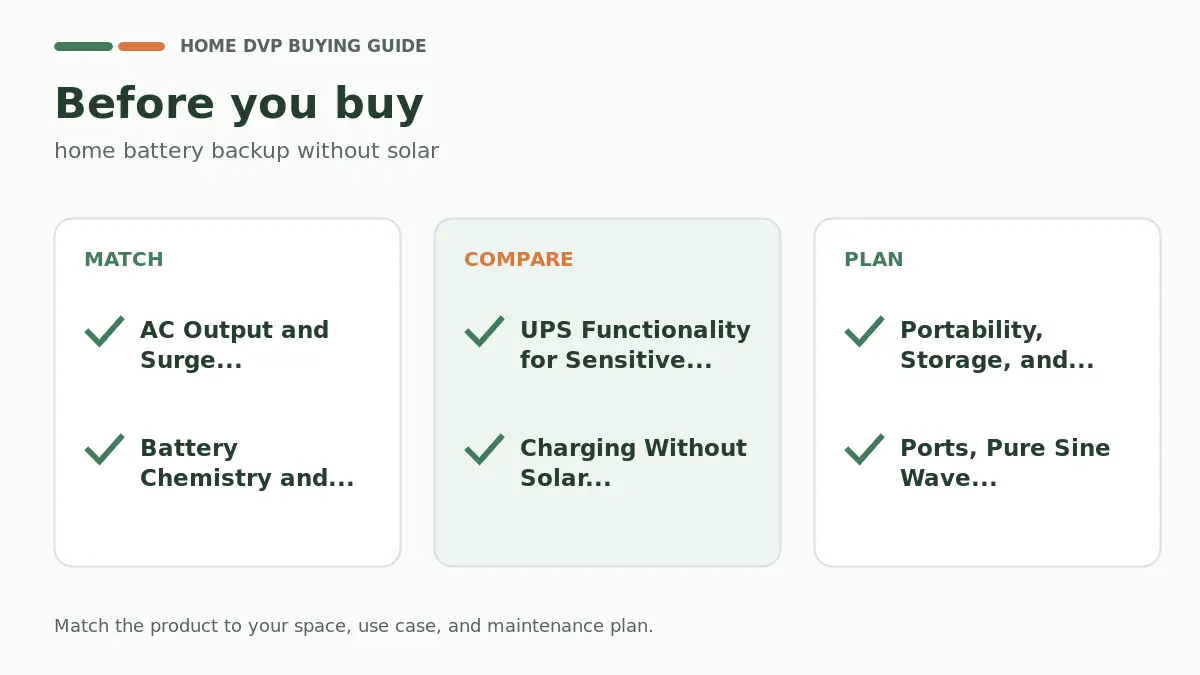
AC Output and Surge Power
AC output determines what a battery backup can actually run. The EF ECOFLOW Portable Power Station DELTA 2 provides a strong AC output for common appliances, while the Jackery Explorer 1000 v2 Portable Power Station balances portable size with enough inverter capacity for many emergency loads. The Jackery HomePower 3000 Portable Power Station is better suited for heavier home backup needs because it offers substantially higher running and surge output.
Surge rating matters because many appliances need extra power for a few seconds at startup. Refrigerators, pumps, and motor-driven tools can briefly pull more than their running wattage. If the surge rating is too low, the battery may shut down even if the appliance appears to be within the normal wattage range.
For homeowners planning around refrigerators specifically, a dedicated guide can be helpful because fridge compressors behave differently from simple electronics. See our related resource on choosing a portable power station for a refrigerator if cold food storage is your main concern.
Battery Chemistry and Long-Term Durability
LiFePO4 battery chemistry is a major advantage in many current home backup systems. Models such as the EF ECOFLOW Portable Power Station DELTA 2, Jackery Explorer 1000 v2 Portable Power Station, LIBRIDS Portable Power Station C600, Jackery HomePower 3000 Portable Power Station, and EBL 2400W Portable Power Station use lithium iron phosphate chemistry according to the available product information. This chemistry is valued for long cycle life, stability, and suitability for repeated charging.
Durability also depends on thermal management, enclosure design, battery management systems, and how the owner stores the unit. A power station left fully discharged for long periods may lose performance faster than one kept within the manufacturer’s recommended storage range. For emergency supplies, schedule a recurring calendar reminder to inspect charge level and cables.
Build quality becomes especially important if the unit will be moved between the house, garage, RV, and outdoor shelter areas. The LIBRIDS Portable Power Station C600 emphasizes a metal enclosure, while the MARBERO Portable Power Station focuses on compact portability. Neither design is automatically better for every buyer, but each points to a different use case.
UPS Functionality for Sensitive Devices
UPS functionality is important if you want a battery to automatically take over when grid power drops. The LIBRIDS Portable Power Station C600 lists a fast UPS transfer time for devices such as routers, CPAP machines, and essential electronics. The BLUETTI FridgePower Portable Power Station is designed around refrigerator backup with automatic transfer capability, while the Jackery HomePower 3000 Portable Power Station includes UPS support for essential appliances and connected devices.
Not every battery backup is a true computer-grade UPS, and not every appliance requires instant transfer. A desktop computer, modem, medical refrigerator, or home security system benefits from quick switching. A phone charger or lamp usually does not. Before relying on a unit for medical or critical safety equipment, verify device compatibility and follow the manufacturer’s guidance.
The CyberPower CP1500PFCLCD PFC Sinewave UPS Battery Backup and Surge Protector is a more traditional UPS-style option for electronics rather than a portable power station for long appliance runtime. It can be a good fit for computer desks, networking equipment, and electronics that need surge protection and short-term backup, but it is not the same type of extended household energy storage as larger portable power stations.
Charging Without Solar
The phrase home battery backup without solar does not mean solar-compatible products should be ignored. It means the product should work well without requiring solar panels. Many of the listed models are marketed as solar generators, but the available specifications show that they can also charge from AC wall power. That makes them practical for apartments, shaded properties, storm seasons, and households that are not ready to install panels.
Fast AC charging is especially useful when storms are forecast or rolling outages are expected. The EF ECOFLOW Portable Power Station DELTA 2, Jackery Explorer 1000 v2 Portable Power Station, LIBRIDS Portable Power Station C600, and Jackery HomePower 3000 Portable Power Station all emphasize fast charging in their listed feature sets. If you have limited warning before an outage, recharge speed may matter almost as much as total capacity.
Optional solar can still be valuable later, especially for camping, RV use, or longer off-grid recovery. If you want to compare battery-first systems with panel-based options, our guide to a solar generator for home backup explains when solar charging becomes more useful.
Portability, Storage, and Indoor Placement
Portability affects how often you will actually use the backup system. A compact unit such as the Jackery Portable Power Station Explorer 300 or MARBERO Portable Power Station can be stored in a closet, carried to a bedroom, or packed for travel. Larger models provide more capability but require more planning for storage space and lifting.
Renters should pay close attention to footprint, noise level, cable routing, and whether the unit can be used without permanent installation. Homeowners may be able to dedicate a utility room, garage shelf, pantry space, or kitchen gap to a larger unit. The BLUETTI FridgePower Portable Power Station is notable because its slim design is aimed at refrigerator-adjacent placement, which can save floor space.
Indoor safety also matters. Battery stations should be used in dry, ventilated areas and kept away from moisture, heat sources, and blocked vents. Even when a unit can power outdoor activities, follow the product’s indoor and weather exposure warnings carefully.
Ports, Pure Sine Wave Output, and Device Compatibility
Outlet selection determines how flexible a backup battery will be during an outage. AC outlets are needed for household plugs, USB-C ports are useful for laptops and phones, DC car ports can support travel accessories, and dedicated RV outlets can help in mobile setups. The EF ECOFLOW Portable Power Station DELTA 2 stands out for broad port selection, while the Jackery Explorer 1000 v2 Portable Power Station offers a practical mix for emergency and travel use.
Pure sine wave output is worth prioritizing for sensitive electronics, CPAP machines, laptops, and some appliance controls. The LIBRIDS Portable Power Station C600 specifically highlights pure sine wave protection, and the CyberPower CP1500PFCLCD PFC Sinewave UPS Battery Backup and Surge Protector is designed for electronics that benefit from cleaner output and automatic voltage regulation.
Avoid plugging in high-draw heaters, large air conditioners, or major appliances unless the product specifications clearly support them. Battery backups are quiet and convenient, but they still have defined inverter limits. Overloading a unit can trigger shutdowns and may shorten long-term reliability.
Value, Price Range, and Use Case Fit
The available products span a wide price range so value depends on your outage priorities. The lowest-cost option is usually not the best for refrigerators or pumps, and the highest-capacity option may be unnecessary if your only goal is to charge phones and keep a router running. Match the battery to your essential load list before comparing features.
For a small apartment emergency kit, compact models are easier to store and carry. For a family home with a refrigerator, freezer, medical devices, and home office needs, a larger LiFePO4 power station is usually the better long-term choice. For whole-home energy storage or off-grid electrical systems, a battery such as the ECO-WORTHY Powermega 48V 314Ah LiFePO4 Battery may be relevant, but it is a more involved system component and should be evaluated for installation requirements, inverter compatibility, and electrical safety.
If you are building a complete preparedness plan, battery backup should be paired with lighting, water, food, and communication supplies. Our Emergency Supplies category can help you compare additional items beyond power storage.
Our Research Methodology & Why You Can Trust Us
We evaluated the products based on available product information, user-facing specifications, category fit, and practical homeowner needs. Our review process prioritized performance, features, build quality, ease of use, durability, safety, value, reliability, and fit for home outage scenarios.
After comparing the listed specifications, we validated each product against the purpose of home battery backup without solar in the Emergency Supplies category. Products were considered relevant when they provided battery-based backup power, UPS-style support, portable power station functionality, or home energy storage capability without requiring solar panels as the only charging method.
Our research indicates that the most important differences are capacity, inverter output, battery chemistry, recharge speed, UPS behavior, outlet layout, and whether the product is practical for the intended room or appliance. We also considered common homeowner mistakes, such as undersizing a unit for refrigerators, ignoring surge wattage, or buying a system that is too large to store conveniently.
This guide is structured for regular updates so recommendations can stay aligned with available product data, emergency preparedness needs, and changing home power expectations. The goal is to help readers make a confident, specification-based decision rather than choosing based on marketing language alone.
Final Thoughts
For an overall homeowner pick, the EF ECOFLOW Portable Power Station DELTA 2 is a strong option because it combines LiFePO4 chemistry, expandable capacity, fast AC charging, and enough output for many household essentials. It is best suited for homeowners who want a flexible backup battery that can serve the house, RV, or camping setup without requiring solar panels.
For value-focused buyers, the Jackery Explorer 1000 v2 Portable Power Station offers a compelling balance of capacity, portability, fast charging, and LiFePO4 durability. For heavier home backup needs, the Jackery HomePower 3000 Portable Power Station is better suited to larger essential-load plans. For refrigerator-specific placement, the BLUETTI FridgePower Portable Power Station deserves consideration because its design is tailored around fridge backup and space efficiency.
Small-space shoppers may prefer the Jackery Portable Power Station Explorer 300 or MARBERO Portable Power Station for lights, phones, laptops, and basic emergency comfort. Buyers who need router, CPAP, or sensitive electronics support should look closely at UPS behavior and pure sine wave output, including options such as the LIBRIDS Portable Power Station C600 and CyberPower CP1500PFCLCD PFC Sinewave UPS Battery Backup and Surge Protector. If your emergency plan also includes outdoor or travel use, our guide to a portable power station for camping can help compare portable use cases.
FAQ
What should I look for when choosing a home battery backup without solar?
Start with the devices you need to run, then compare capacity, AC output, surge rating, battery chemistry, and recharge options. For home use, LiFePO4 batteries, pure sine wave output, and clear safety features are especially valuable. If you need automatic backup for a router, CPAP machine, or refrigerator, check UPS transfer specifications carefully.
Are higher-end home battery backup systems worth it?
Higher-end models can be worth it when you need to power refrigerators, sump pumps, multiple electronics, or essential home office equipment during longer outages. They often provide larger capacity, stronger AC output, faster charging, and better battery longevity. For occasional phone charging or short outages, a compact lower-capacity option may be more practical.
How should beginners choose a home battery backup without solar?
Beginners should make a simple outage list that includes lights, phones, router, medical devices, refrigerator, and any must-have appliances. Then choose a battery that can handle both running wattage and startup surge for those devices. Avoid buying solely by size or brand without checking compatibility.
Can a home battery backup without solar run a refrigerator?
Some models can run a refrigerator, but the battery must have enough capacity and inverter output to handle compressor startup. Larger options such as refrigerator-focused or high-capacity power stations are better suited for that role than compact power banks. For more appliance-specific guidance, see our article on battery backup for refrigerator use.
How long should a quality home battery backup last?
Longevity depends on battery chemistry, cycle rating, storage conditions, and charging habits. LiFePO4 models generally offer strong long-term durability compared with older lithium battery designs. Keep the unit dry, ventilated, periodically charged, and stored according to the manufacturer’s recommendations.
Do I need solar panels for a home battery backup?
No, many battery backup systems can recharge from a standard wall outlet and work without solar panels. Solar compatibility can be useful for extended outages or outdoor use, but it is not required for every household. If your home has shade, limited outdoor space, or apartment restrictions, AC charging may be the simpler option.
What brands make reliable home battery backup systems?
The products analyzed include models from CyberPower, MARBERO, ZeroKor, EF ECOFLOW, EBL, ECO-WORTHY and other recognized power station and UPS manufacturers represented in the product data. Reliability should be judged by specifications such as battery chemistry, safety systems, warranty support, output capability, and fit for your home use case. A well-matched midrange unit is often more reliable in practice than an oversized model used incorrectly.