
Choosing an air conditioner without window access can be surprisingly tricky for renters, condo owners, dorm residents, and homeowners with rooms that do not have standard windows. Many portable AC units still need an exhaust hose and window panel, while true windowless options are usually evaporative coolers that rely on water, ice packs, airflow, and room ventilation rather than compressor-based cooling.
After carefully analyzing the available specifications for 15 products, we focused our editorial recommendations on models that clearly fit the Heating, Cooling & Air category and are designed for windowless or no-hose operation. We compared cooling method, airflow, tank capacity, room coverage claims, timer functions, noise ratings, controls, portability, maintenance needs, and renter-friendly setup. For more climate-control resources, visit our Heating, Cooling & Air category.
Home DVP decision summary
Quick Answer
For Air Conditioner Without Window, Home DVP compared 15 products from 9 brands. Start with the room size, heat gain, exhaust route, and electrical circuit. A portable or through-wall unit that is oversized can cycle poorly, while an undersized unit may run continuously without controlling heat and humidity.
| Comparison coverage | 15 products from 9 brands, including CENSTECH, Feelfunn, Coolblus. |
|---|---|
| Selection priority | Start with the room size, heat gain, exhaust route, and electrical circuit. A portable or through-wall unit that is oversized can cycle poorly, while an undersized unit may run continuously without controlling heat and humidity. |
| Evidence basis | Manufacturer specifications, compatibility details, retailer-provided product data, and common homeowner use cases. |
| Reference guidance | U.S. Department of Energy room air-conditioner guidance. |
This summary describes the article's comparison set, not every product on the market. Product details should be confirmed before purchase.
One important note before you buy: a no-window evaporative cooler is not the same as a traditional compressor air conditioner. It can be a practical solution for dry climates, bedrooms, home offices, and small apartments where window access is limited, but it may not be the right choice for very humid rooms or sealed spaces that need true refrigerant-based cooling.
Before comparing any air conditioner without window setup, separate compressor cooling from evaporative comfort. The U.S. Department of Energy’s portable air conditioner guidance describes portable AC equipment as refrigeration-based cooling for an enclosed space. Those compressor units still need a safe way to release heat, while a no-hose evaporative cooler works differently.
Air Conditioner Without Window Buying Guide
Based on our detailed comparison, the strongest air conditioner without window options are models that clearly state no window, no exhaust hose, or no duct installation. The most relevant products in the provided data are windowless evaporative air coolers from CENSTECH, FLOWBREEZE, and SUNGDOGIN. Compressor-style portable AC units with window kits can be useful in apartments, but they do not fully match the no-window requirement and are not the focus of our recommendations.
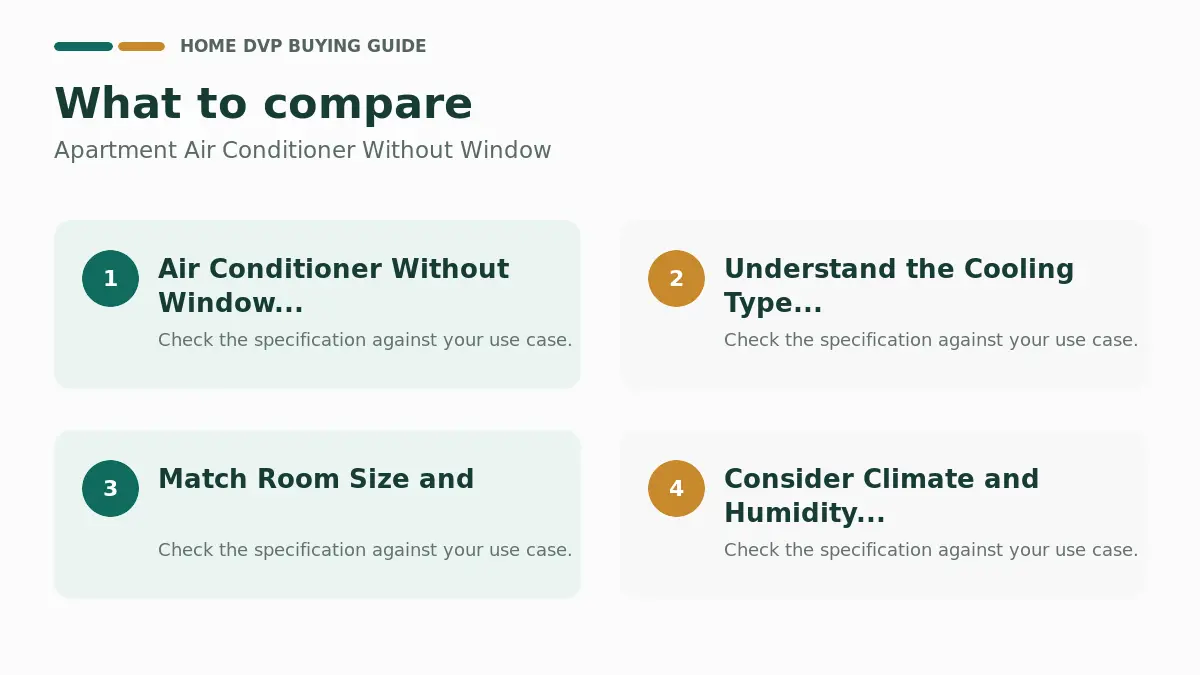
Understand the Cooling Type Before Buying
The biggest buying decision is whether you need true air conditioning or a windowless evaporative cooling system. A traditional portable AC uses a compressor and must exhaust hot air outdoors, usually through a window kit. A windowless evaporative cooler uses water and ice packs to cool moving air, so it does not need a window, hose, or permanent installation.
For renters, dorm rooms, and bedrooms without usable windows, evaporative designs such as the CENSTECH Windowless Portable Air Conditioner w/Dual Tanks for 24H Cooling and the SUNGDOGIN 1800CFM Windowless Air Conditioner Portable are more aligned with the keyword intent. These models emphasize plug-and-play use, water tanks, ice packs, oscillation, and mobility rather than window sealing.
The common mistake is expecting a ventless evaporative cooler to perform exactly like a high-BTU compressor AC. It may provide better comfort than a fan in dry air, especially when loaded with cold water or ice packs, but it does not remove heat from the room the same way a vented AC does.
| Cooling Type | Best Use | Window Needed? |
|---|---|---|
| Windowless evaporative cooler | Dry climates, bedrooms, offices, rentals, dorms | No |
| Vented portable compressor AC | Humid rooms, strong temperature reduction, larger spaces | Usually yes |
| Fan-only cooling | Air circulation and personal comfort | No |
Match Room Size and Airflow to Your Apartment Layout
Room coverage claims are useful, but they should be treated as estimates rather than guarantees. Open floor plans, high ceilings, direct sunlight, poor insulation, and electronics that give off heat can all reduce perceived cooling performance. For a studio apartment or bedroom, prioritize airflow, oscillation range, and whether the unit can be positioned near where people actually sit or sleep.
Several valid models list strong airflow and wide oscillation. The CENSTECH Windowless Portable Air Conditioners w/Dual Tank for 24H Cooling 600Sq.ft and the CENSTECH Windowless Air Conditioner Portable 1800CFM w/4 Modes&3 Speeds both emphasize broad coverage and 120° swing, making them better suited for living areas or larger bedrooms than compact personal coolers.
If you are cooling a small bedroom, a compact model like the FLOWBREEZE Windowless Portable Air Conditioner may be easier to place beside a bed or desk. If you are trying to move air through a larger living room, look for higher airflow claims, larger water capacity, wheels, and oscillation.
Consider Climate and Humidity
Evaporative cooling works best when the air is dry enough to absorb moisture. That is why many no-window models are especially practical in dry-summer regions and apartments where adding a little humidity can make the room feel more comfortable. If your apartment already feels damp or sticky, a windowless swamp cooler may add moisture you do not want.
For humid homes, consider whether a dehumidifier would solve part of the comfort problem. Moisture control often makes a room feel cooler even without dropping the thermostat dramatically. Our guide to a dehumidifier drain hose may help if your cooling issue is connected to high indoor humidity or basement moisture.
A practical homeowner tip is to use a windowless evaporative cooler with some air exchange when possible. Even a cracked door, hallway airflow, or bathroom exhaust fan can help prevent the room from feeling overly humid during longer run times.
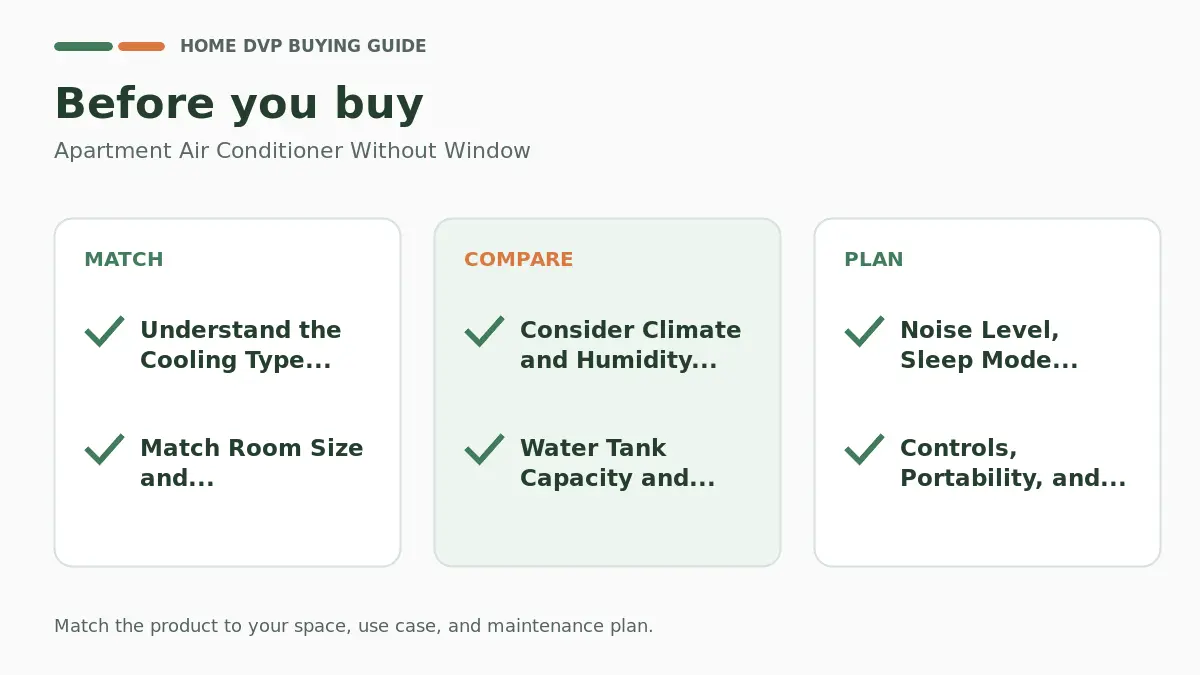
Water Tank Capacity and Refill Convenience
Tank design has a major impact on everyday convenience. Smaller tanks are easier to refill and move, but they may need more frequent attention. Larger tanks can support longer operation, but they add weight and require more careful cleaning to prevent mineral buildup or stale water odors.
Based on available product information, the SUNGDOGIN 1800CFM Windowless Air Conditioner Portable stands out for its large detachable tank design, while the CENSTECH dual-tank models focus on no-bend refilling and longer cooling sessions. These features matter for seniors, pregnant users, renters, or anyone who does not want to move a heavy appliance to the sink every night.
Look for visible water-level indicators, removable tanks, and accessible grilles or cooling pads. The easier a unit is to clean, the more likely it is to perform well over time. If your tap water is hard, periodic cleaning is especially important.
Noise Level, Sleep Mode, and Bedroom Comfort
For bedrooms and small apartments, noise can matter as much as airflow. Product specifications for several valid CENSTECH models highlight low-noise operation and sleep-focused settings, while FLOWBREEZE also emphasizes quiet use for work, sleep, or meditation. These features are especially important if the cooler will sit close to your bed.
Timers are also valuable for apartment use. A smart timer lets you cool the room while falling asleep without running the unit all night. This can reduce energy use, limit humidity buildup, and make the cooler more practical for renters who pay their own utilities.
When comparing an air conditioner without window access, avoid choosing only by maximum airflow. A model with a sleep mode, lower fan setting, remote control, and dim display may be better for bedrooms than a louder high-output unit that is better suited to daytime living areas.
Controls, Portability, and Apartment-Friendly Setup
One reason homeowners and renters search for an air conditioner without window access is to avoid drilling, mounting brackets, window panels, and lease concerns. For this use case, prioritize plug-and-play setup, a compact footprint, built-in handles, casters, and remote control. These features make it easier to move cooling from a bedroom to a home office or living room.
The CENSTECH Windowless Portable Air Conditioner w/Dual Tanks for 24H Cooling is notable for its lightweight design and remote operation, while the CENSTECH Windowless Air Conditioner Portable 1800CFM w/4 Modes&3 Speeds includes rolling wheels for easier movement. SUNGDOGIN also lists rolling wheels and a carry handle, which can help in apartments with multiple small rooms.
If you are building a more complete comfort setup, a thermostat can still help manage other heating and cooling equipment in your home. See our comparison of smart thermostat vs programmable thermostat options for broader climate-control planning.
Safety, Cleaning, and Maintenance
Because windowless evaporative coolers use water near electrical components, safety details matter. Look for fused plugs, circuit protection, stable bases, anti-pinch grilles, bladeless designs, removable filters, and clear maintenance access. Product data for some CENSTECH models specifically mentions family safety features and removable covers for cleaning.
Maintenance is straightforward but important. Empty standing water when the unit will not be used, rinse or wipe the tank, clean the rear grille or filter as directed, and allow parts to dry before storage. This helps reduce odors, mineral deposits, and airflow restriction.
Apartment renters should also place the unit on a level surface and avoid overfilling the tank. If the cooler is used near wood floors, rugs, or electronics, check for condensation, spills, or leaks during the first few uses.
Value, Features, and Who Should Avoid Windowless Coolers
Prices and availability change frequently, so value depends less on the lowest upfront cost and more on whether the feature set matches your room. A lower-cost unit may be the better buy for personal cooling, while a larger tank, wider oscillation, and more modes may be worth it for a living room or shared apartment.
Windowless coolers are a good fit for renters, dorm residents, small-space homeowners, and dry-climate users who cannot vent a traditional portable AC. They are less ideal for very humid apartments, sealed rooms with no air exchange, or buyers who expect the same performance as a vented compressor air conditioner.
If your goal is whole-home comfort, you may need more than a room cooler. You can browse related indoor comfort topics in our Air Quality & Climate section.
Our Research Methodology & Why You Can Trust Us
We evaluated the products based on available product information, user-facing specifications, category fit, and practical homeowner use cases. Our first step was relevance validation: only products that clearly match air conditioner without window intent and the Heating, Cooling & Air category were considered for editorial recommendations. Models that rely on a window kit or exhaust hose were not treated as top fits for a no-window search intent.
After comparing the listed specifications, we looked at cooling approach, water-tank design, airflow claims, oscillation, modes, timer settings, remote control range, portability, maintenance access, safety features, and stated room suitability. We also considered whether the design is practical for renters and small apartments where permanent installation is not realistic.
Our research indicates that the best choice depends heavily on climate and expectations. Evaporative models can provide useful comfort in dry conditions, but they should not be oversold as direct replacements for compressor AC systems. We update product roundups during July 2026 to keep recommendations aligned with current specifications and availability.
Ranking criteria included performance potential, features, build quality indicators, ease of use, durability considerations, safety, value, reliability, and fit for real apartment life. We do not claim hands-on testing unless product data clearly supports it, and this guide is based on specification-based analysis rather than physical installation or in-home testing.
Final Thoughts
For an overall apartment-friendly pick, the CENSTECH Windowless Portable Air Conditioners w/Dual Tank for 24H Cooling 600Sq.ft stands out because it combines dual tanks, multiple modes, quiet operation, ice packs, and broad oscillation. It is a strong fit for renters who want a no-hose setup with enough airflow for a bedroom, office, or modest living area.
For larger tank convenience, the SUNGDOGIN 1800CFM Windowless Air Conditioner Portable is appealing because of its detachable tank, wide oscillation, remote control, and portable design. For compact spaces, the FLOWBREEZE Windowless Portable Air Conditioner is a practical small-space pick thanks to its no-window design, sleep-friendly features, remote control, and included ice packs.
If you want a more feature-rich CENSTECH option, the CENSTECH Windowless Air Conditioner Portable 1800CFM w/4 Modes&3 Speeds is worth considering for its larger tank, multiple modes, long timer, and wheeled design. For seasonal safety planning around other climate devices, our space heater safety guide is also useful when preparing your apartment for year-round comfort.
FAQ
What Should I Look for in an Air Conditioner Without Window Access?
Look for true no-window operation, not just portable design. Prioritize water-tank capacity, airflow, oscillation, quiet settings, timer controls, easy cleaning, and portability. Also confirm whether the product is an evaporative cooler or a compressor AC with a window kit.
Are windowless evaporative coolers the same as portable air conditioners?
No. A compressor portable air conditioner removes heat and usually vents it through a window hose, while an evaporative cooler uses water and airflow to make the air feel cooler. Windowless evaporative models are easier for apartments without windows, but they perform best in dry air.
Are Higher-End Air Conditioner Without Window Options Worth It?
Higher-end models can be worth it if they add meaningful features such as a larger tank, better oscillation, quieter sleep mode, safer grilles, reusable ice packs, and easier cleaning. If you only need personal cooling at a desk or bedside, a simpler model may be enough.
Do Air Conditioner Without Window Options Work Well in Humid Apartments?
They may be less effective in humid apartments because evaporative cooling adds moisture to the air. If your room already feels damp, a dehumidifier or vented compressor AC may be more appropriate. You can also review our cool mist vs warm mist humidifier guide to better understand indoor moisture comfort.
What Should Buyers Expect From an Air Conditioner Without Window Setup in 2026?
Homeowners and renters should expect convenient spot cooling, improved airflow, and better comfort in dry rooms. They should not expect the same whole-room temperature reduction as a properly vented compressor air conditioner. The most realistic expectations come from matching the unit to room size, climate, and ventilation.
Which Brands Make Reliable Air Conditioner Without Window Products?
Based on the provided product data, CENSTECH, FLOWBREEZE, SUNGDOGIN, and other brands appear in this category. Reliability should be judged by specification clarity, safety features, tank design, maintenance access, controls, and whether the model honestly fits windowless use.
If you are still deciding which cooling approach is realistic for your building, start with our broader guide on how to cool an apartment without windows. It compares true air-conditioning options with humidity control, airflow, and personal cooling.
About This Home DVP Research
Home DVP is an independent home-improvement research and product-comparison publisher. Ryan Mitchell prepared this guide by comparing manufacturer specifications, compatibility details, retailer-provided product data, key limitations, and common homeowner use cases. We do not claim hands-on testing unless an article explicitly says so.
Review methodology Affiliate disclosure Last reviewed August 26, 2026