

Choosing the best Whole House Fan in 2026 is about more than moving air. A whole house fan needs to match your home size, attic ventilation, climate, installation plan, noise expectations, and energy goals. For homeowners who want to reduce air-conditioning runtime during cool mornings and evenings, the right model can make the house feel fresher without relying only on refrigerated cooling.
After carefully analyzing the available specifications, We compared the listed products and focused our recommendations on models that clearly fit the whole-house cooling category. Products that function primarily as attic ventilation fans were not treated as whole house fan recommendations. If you are comparing other cooling upgrades, our Heating, Cooling & Air category is a useful place to continue researching practical home comfort options.
Home DVP decision summary
Quick Answer
For Best Whole House Fan, Home DVP compared 11 products from 1 brands. Size a whole-house fan for the home and verify that the attic has enough exhaust vent area. Climate, outdoor humidity, window-opening strategy, noise, insulated shutters, and professional installation matter more than peak airflow alone.
| Comparison coverage | 11 products from 1 brands, including Quietcool. |
|---|---|
| Selection priority | Size a whole-house fan for the home and verify that the attic has enough exhaust vent area. Climate, outdoor humidity, window-opening strategy, noise, insulated shutters, and professional installation matter more than peak airflow alone. |
| Evidence basis | Manufacturer specifications, compatibility details, retailer-provided product data, and common homeowner use cases. |
| Reference guidance | U.S. Department of Energy home-cooling guidance. |
This summary describes the article's comparison set, not every product on the market. Product details should be confirmed before purchase.
Our comparison considered airflow capacity, stated home coverage, control type, energy use where listed, warranty language, grille access, and suitability for common homeowner installations. Based on the product data provided, the strongest options are the dedicated whole house fan models with wireless control, two-speed operation, and coverage ratings that align with real household square footage needs.

Pros
- Moves substantial air quickly for whole-house cooling and ventilation.
- Wireless control includes two speeds and a long countdown timer for flexible daily use.
Cons
- Requires 5.89 square feet of net free attic venting, so attic compatibility should be confirmed before purchase.
- The ceiling opening and attic-mounted installation may be more involved for first-time DIY users than a portable fan.
Specifications
| Color | Blue |
|---|---|
| Size | 4,415 CFM |
| Dimensions | 38 x 20 x 38 inches |
| Product Group | Home |
| Binding | Unknown Binding |
Verify the current product variation before purchase; specifications may change.
Best For / Avoid If
Best for buyers prioritizing
- Moves substantial air quickly for whole-house cooling and ventilation.
- Wireless control includes two speeds and a long countdown timer for flexible daily use.
- Listed installation design fits 16- or 24-inch on-center framing without joist cutting or additional framing.
Consider another option if
- Requires 5.89 square feet of net free attic venting, so attic compatibility should be confirmed before purchase.
- The ceiling opening and attic-mounted installation may be more involved for first-time DIY users than a portable fan.
- Its 38-by-20-by-38-inch dimensions may require careful planning around attic access and available installation space.

Pros
- Moves substantial air at 5,665 CFM on high and 4,289 CFM on low for large-home ventilation.
- Wireless timer control makes scheduled operation more convenient than manual switching.
Cons
- The required 7.56 square feet of net free attic venting may limit compatibility in homes with insufficient attic ventilation.
- The 14-by-36-inch ceiling opening and attic installation require careful planning, even though the listed setup does not require joist cutting.
Specifications
| Color | Blue |
|---|---|
| Size | 14 in. x 36 in. |
| Dimensions | 38 x 20 x 38 inches |
| Product Group | Home |
| Binding | Kitchen |
Verify the current product variation before purchase; specifications may change.
Best For / Avoid If
Best for buyers prioritizing
- Moves substantial air at 5,665 CFM on high and 4,289 CFM on low for large-home ventilation.
- Wireless timer control makes scheduled operation more convenient than manual switching.
- Attic-mounted design and included damper box support a cleaner ceiling installation with seasonal insulation benefits.
Consider another option if
- The required 7.56 square feet of net free attic venting may limit compatibility in homes with insufficient attic ventilation.
- The 14-by-36-inch ceiling opening and attic installation require careful planning, even though the listed setup does not require joist cutting.
- Its large-home airflow capacity may be more than needed for smaller spaces.

Pros
- Strong airflow range makes it suitable for larger average homes.
- Low-speed operation uses as little as 75 watts, supporting energy-conscious ventilation.
Cons
- The installation requires 5.6 square feet of net free attic venting, which may limit suitability for some homes.
- The required ceiling opening and attic mounting still call for careful planning, even though joist cutting is not required.
Specifications
| Color | Green |
|---|---|
| Size | 4,195 CFM |
| Dimensions | 36 x 22 x 40 inches |
| Product Group | Home Improvement |
| Binding | Kitchen |
Verify the current product variation before purchase; specifications may change.
Best For / Avoid If
Best for buyers prioritizing
- Strong airflow range makes it suitable for larger average homes.
- Low-speed operation uses as little as 75 watts, supporting energy-conscious ventilation.
- Wireless control, timer functionality, and included window locks improve everyday convenience.
Consider another option if
- The installation requires 5.6 square feet of net free attic venting, which may limit suitability for some homes.
- The required ceiling opening and attic mounting still call for careful planning, even though joist cutting is not required.
- The listed dimensions may be challenging to accommodate in smaller attic spaces.

Pros
- Strong airflow capacity for large homes, with separate high and low speed outputs.
- Low-wattage operation on the lower setting can support energy-conscious ventilation.
Cons
- Installation requires a 14 x 36 inch ceiling cutout plus 7.44 square feet of net free attic venting.
- The attic-mounted design may not suit spaces without appropriate access or compatible framing.
Specifications
| Color | green |
|---|---|
| Size | 5,576 CFM |
| Dimensions | 40 x 26 x 40 inches |
| Product Group | Home Improvement |
| Binding | Tools & Home Improvement |
Verify the current product variation before purchase; specifications may change.
Best For / Avoid If
Best for buyers prioritizing
- Strong airflow capacity for large homes, with separate high and low speed outputs.
- Low-wattage operation on the lower setting can support energy-conscious ventilation.
- Wireless control, a 12-hour timer, and included window locks add practical convenience.
Consider another option if
- Installation requires a 14 x 36 inch ceiling cutout plus 7.44 square feet of net free attic venting.
- The attic-mounted design may not suit spaces without appropriate access or compatible framing.
- Its stated coverage is limited to homes up to approximately 2,790 square feet.
Pros
- High airflow capacity is suitable for ventilating homes up to about 2,510 square feet.
- Wireless control and a 12-hour timer simplify everyday operation.
Cons
- Installation depends on having 6.68 square feet of net free attic venting and space for the specified ceiling opening.
- The 69-pound assembly and large overall dimensions may require careful handling during installation.
Specifications
| Color | blue |
|---|---|
| Size | 5,024 CFM |
| Dimensions | 38 x 20 x 38 inches |
| Weight | 69.00027876076 pounds |
| Product Group | Home |
| Binding | Unknown Binding |
Verify the current product variation before purchase; specifications may change.
Best For / Avoid If
Best for buyers prioritizing
- High airflow capacity is suitable for ventilating homes up to about 2,510 square feet.
- Wireless control and a 12-hour timer simplify everyday operation.
- The attic-mounted motor head and included window locks support a practical whole-house setup.
Consider another option if
- Installation depends on having 6.68 square feet of net free attic venting and space for the specified ceiling opening.
- The 69-pound assembly and large overall dimensions may require careful handling during installation.
- Its 634-watt high setting and 525-watt low setting may be more capacity than smaller homes require.
Pros
- High airflow capacity is suitable for homes up to 3,440 square feet.
- ECM motor offers two operating speeds with substantially lower wattage on low.
Cons
- The installation requires 9.18 square feet of net free attic venting, which may limit compatibility with some homes.
- Attic access and a 14 by 36 inch ceiling cutout are required for installation.
Specifications
| Color | Green |
|---|---|
| Size | 6,878 CFM |
| Dimensions | 41 x 28 x 40 inches |
| Product Group | Home Improvement |
| Binding | Tools & Home Improvement |
Verify the current product variation before purchase; specifications may change.
Best For / Avoid If
Best for buyers prioritizing
- High airflow capacity is suitable for homes up to 3,440 square feet.
- ECM motor offers two operating speeds with substantially lower wattage on low.
- Typical installation is listed at one to two hours without framing or joist cutting.
Consider another option if
- The installation requires 9.18 square feet of net free attic venting, which may limit compatibility with some homes.
- Attic access and a 14 by 36 inch ceiling cutout are required for installation.
- The listed 41 by 28 by 40 inch dimensions may be substantial for spaces with limited attic room.

Pros
- Combines app control with thermostat and humidistat automation for convenient operation.
- Offers high airflow with three selectable speeds and low power use on the lowest setting.
Cons
- Interchangeable roof flashings are sold separately, so the necessary flashing may require an additional purchase.
- The 31-pound, 28-by-28-inch housing may require careful planning before roof installation.
Specifications
| Color | Black |
|---|---|
| Size | 28 inches (W) x 28 inches (D) x 10.25 inches (H) |
| Dimensions | 28 x 28 x 10.25 inches |
| Weight | 31 Pounds |
| Product Group | Home |
| Binding | Misc. |
Verify the current product variation before purchase; specifications may change.
Best For / Avoid If
Best for buyers prioritizing
- Combines app control with thermostat and humidistat automation for convenient operation.
- Offers high airflow with three selectable speeds and low power use on the lowest setting.
- Includes a long 20-foot cord and fire safety shutoff for added installation convenience and protection.
Consider another option if
- Interchangeable roof flashings are sold separately, so the necessary flashing may require an additional purchase.
- The 31-pound, 28-by-28-inch housing may require careful planning before roof installation.
- The available product details do not specify the included flashing for a particular roof type.

Pros
- Combines app access with thermostat and humidistat automation for convenient operation.
- High-speed airflow reaches up to 2,801 CFM, according to the listed specifications.
Cons
- The 20 x 12 x 20-inch size may not suit every gable-vent opening or tight installation area.
- Its 14-pound weight may require careful positioning during mounting.
Best For / Avoid If
Best for buyers prioritizing
- Combines app access with thermostat and humidistat automation for convenient operation.
- High-speed airflow reaches up to 2,801 CFM, according to the listed specifications.
- Plug-and-play design and included 20-foot power cord can reduce setup complexity.
Consider another option if
- The 20 x 12 x 20-inch size may not suit every gable-vent opening or tight installation area.
- Its 14-pound weight may require careful positioning during mounting.
- The product information does not list compatibility details for specific attic structures or vent dimensions.

Pros
- Offers two airflow and power settings for more flexible attic ventilation.
- Includes helpful installation features such as mounting tabs, anti-vibration pads, and a long power cord.
Cons
- The supplied information does not specify compatibility with particular gable-vent opening sizes.
- The unit measures 16.5 by 16.5 by 10 inches, which may require adequate space around the installation area.
Specifications
| Color | Blue |
|---|---|
| Size | 16.5 x 16.5 x 10 inches |
| Dimensions | 16.5 x 16.5 x 10 inches |
| Product Group | Home |
| Binding | Misc. |
Verify the current product variation before purchase; specifications may change.
Best For / Avoid If
Best for buyers prioritizing
- Offers two airflow and power settings for more flexible attic ventilation.
- Includes helpful installation features such as mounting tabs, anti-vibration pads, and a long power cord.
- Combines thermostat control, vent covers, and a fire safety shutoff in one attic fan.
Consider another option if
- The supplied information does not specify compatibility with particular gable-vent opening sizes.
- The unit measures 16.5 by 16.5 by 10 inches, which may require adequate space around the installation area.
- The listed design is focused on gable-vent ventilation, so buyers seeking a different attic ventilation format may need another option.
Pros
- Strong airflow capacity for homes up to approximately 1,610 square feet
- Wireless operation includes a useful 12-hour countdown timer
Cons
- Proper operation requires 4.17 square feet of net free attic venting, which may require checking existing attic ventilation first
- The listed 38-by-20-by-38-inch dimensions may require careful attic layout planning despite the smaller ceiling cut-out
Best For / Avoid If
Best for buyers prioritizing
- Strong airflow capacity for homes up to approximately 1,610 square feet
- Wireless operation includes a useful 12-hour countdown timer
- Attic installation does not require framing or joist cutting according to the provided product information
Consider another option if
- Proper operation requires 4.17 square feet of net free attic venting, which may require checking existing attic ventilation first
- The listed 38-by-20-by-38-inch dimensions may require careful attic layout planning despite the smaller ceiling cut-out
- The system is intended for small homes, so it may not provide the same fit for larger floor plans
Pros
- Strong ventilation capacity for large residential spaces
- Wireless control includes a useful countdown timer of up to 12 hours
Cons
- Requires 9.24 square feet of net free attic venting, which may limit suitability for some homes
- The large fan assembly and ceiling opening require careful attic planning before installation
Specifications
| Color | Blue |
|---|---|
| Size | 6,924 CFM |
| Dimensions | 38 x 20 x 38 inches |
| Product Group | Home |
| Binding | Kitchen |
Verify the current product variation before purchase; specifications may change.
Best For / Avoid If
Best for buyers prioritizing
- Strong ventilation capacity for large residential spaces
- Wireless control includes a useful countdown timer of up to 12 hours
- Attic damper doors and a 10-year warranty support seasonal use and long-term ownership
Consider another option if
- Requires 9.24 square feet of net free attic venting, which may limit suitability for some homes
- The large fan assembly and ceiling opening require careful attic planning before installation
- Its whole-house design may provide more capacity than needed for smaller homes or limited ventilation zones
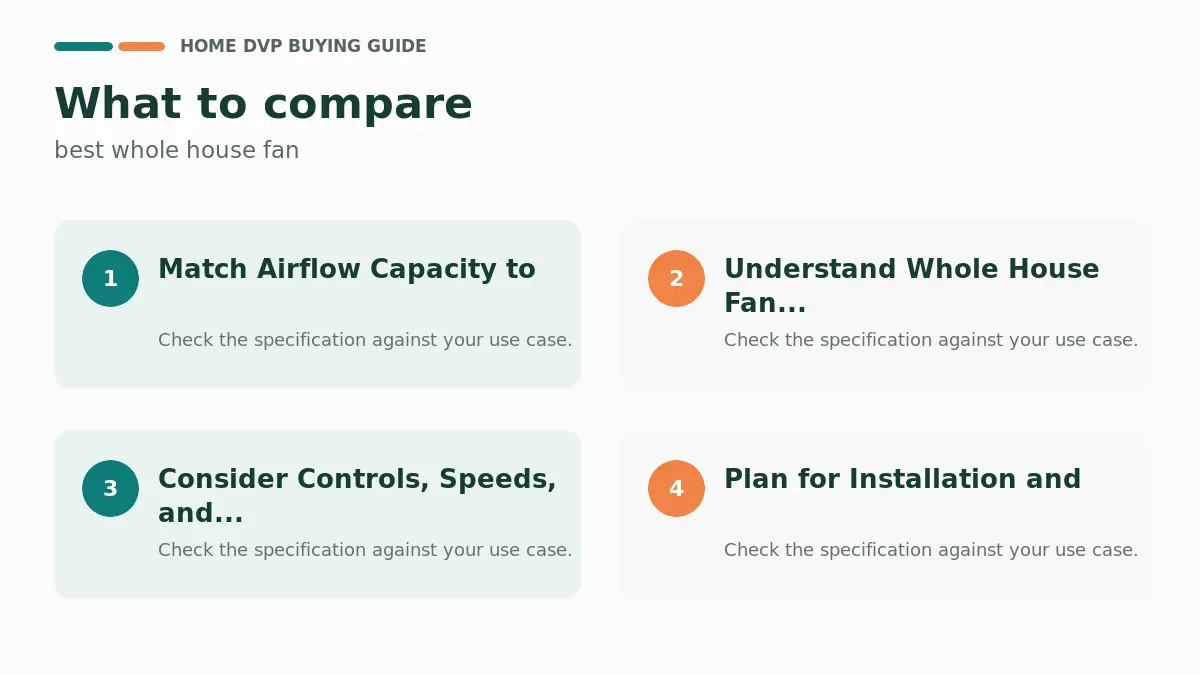
Best Whole House Fan Buying Guide
Match Airflow Capacity to Your Home
Airflow is one of the most important specifications when comparing whole house fans. Models in this guide range from compact whole-house options such as the Quietcool QC CL-3100 RF Classic Advanced Whole House Fan to larger-capacity choices such as the Quietcool QC CL-7000 RF Classic Advanced Whole House Fan and Quietcool QC ES-7000 RF Energy Saver Advanced Whole House Fan. A smaller fan can be easier to live with in a modest home, while an oversized unit may pull air aggressively and create unnecessary noise or pressure if the attic ventilation is not adequate.
As a practical rule, look at the manufacturer-stated coverage rating and compare it with the part of the home you actually intend to cool. Many homeowners assume they need the largest model available, but a properly matched mid-size whole house fan can be more comfortable for nightly ventilation. If your home has a divided floor plan, closed-off rooms, or limited attic exhaust area, installation planning matters as much as the fan rating.
| Home Situation | What to Prioritize |
|---|---|
| Smaller single-story home | Moderate CFM, simple controls, manageable sound level |
| Medium family home | Balanced airflow, two-speed control, strong stated coverage |
| Larger open-plan home | Higher CFM, efficient motor design, careful attic ventilation planning |
| Energy-focused household | Lower wattage specifications, controlled runtime, good sealing when off |
Understand Whole House Fan vs Attic Ventilation Fan
A whole house fan is designed to pull outdoor air through open windows and exhaust warm indoor air into the attic, where it then exits through attic vents. An attic ventilation fan is different: it is primarily intended to ventilate the attic space itself. Both products can support home comfort, but they are not interchangeable when your goal is whole-home air exchange.
For this guide, we only discuss dedicated whole house fan models as recommendations. That includes products such as the QuietCool QC CL-6000 RF Classic Advanced Whole House Fan, Quietcool QC CL-4700 RF Classic Advanced Whole House Fan, Quietcool QC CL-5400 RF Classic Advanced Whole House Fan, Quietcool QC ES-4700 RF Energy Saver Advanced Whole House Fan, and related whole-house models from the same product data. This distinction matters because buying an attic-only fan when you expect whole-house cooling is one of the most common shopper mistakes.
If indoor air quality and filtration are also part of your decision, it may help to compare ventilation with filtration-focused upgrades. Our guide to HEPA filter vs carbon filter choices explains how different air-quality tools solve different household problems.
Consider Controls, Speeds, and Daily Convenience
Most of the strongest whole house fan options in the provided data include wireless control and two-speed operation. Wireless control is useful because homeowners often run these fans at transitional times of day, such as early morning or evening, when the outdoor temperature is cooler than the indoor temperature. Two-speed control gives you a quieter, lower-airflow setting for gentle ventilation and a stronger setting when you want to flush warm air quickly.
The QuietCool QC CL-6000 RF Classic Advanced Whole House Fan and Quietcool QC CL-4700 RF Classic Advanced Whole House Fan both stand out as practical homeowner options because their feature sets combine stated whole-home coverage, removable grilles, two-speed operation, and wireless control. The larger Quietcool QC CL-7000 RF Classic Advanced Whole House Fan is better suited to homes that can benefit from higher airflow, but it should be paired with proper attic venting and thoughtful window-opening habits.
Convenience also affects whether you will use the system consistently. A fan that is easy to turn on, adjust, and maintain is more likely to become part of your cooling routine. If you are comparing comfort controls in general, our article on smart thermostat vs programmable thermostat options can help you think through automation and daily use patterns.
Plan for Installation and Attic Venting
Whole house fans are usually installed in a ceiling opening that connects the living space to the attic. That means installation is more involved than placing a portable fan in a window. DIYers should evaluate joist spacing, ceiling access, electrical requirements, duct or fan housing placement, attic clearance, and exhaust vent area before choosing a model.
One overlooked issue is attic exhaust capacity. A powerful fan needs a path for air to leave the attic safely and efficiently. If the attic cannot exhaust the incoming air, the system may become noisy, less effective, or more likely to push air where it should not go. Homeowners planning a remodel, insulation upgrade, or roofing project should coordinate these details before installation.
Because installation affects performance, renters should be cautious unless they have written permission and a suitable property layout. Homeowners with limited attic access may want a professional assessment. If your cooling needs are focused on a small rental or single room rather than full-home ventilation, you may also want to compare alternatives such as window AC options for apartments.
Compare Energy Use and Operating Costs
Whole house fans can be an energy-conscious cooling tool when used at the right time. They are most effective when outdoor air is cooler than indoor air, such as evenings after a hot day. Instead of cooling air mechanically, they exchange stale warm air for cooler outside air, which can reduce reliance on central air conditioning in suitable climates.
The Energy Saver models in the provided data are especially relevant for homeowners who prioritize efficiency. The Quietcool QC ES-4700 RF Energy Saver Advanced Whole House Fan lists low-watt operation and whole-home coverage for medium-size homes, while the Quietcool QC ES-7000 RF Energy Saver Advanced Whole House Fan offers a larger-capacity approach with energy-focused specifications. These models make the most sense for households that plan to run a fan regularly during cooling season.
A common mistake is running a whole house fan when outdoor conditions are not favorable. If the outside air is hot, smoky, humid, or full of pollen, ventilation may not improve comfort. In those situations, a sealed cooling system, filtration, or dehumidification strategy may be more appropriate.
Evaluate Noise, Comfort, and Air Movement
Any fan capable of moving whole-home volumes of air will create some sound. The key is choosing a model and speed setting that match your comfort expectations. Two-speed models help because you can use a lower setting for routine airflow and reserve the higher setting for short, fast ventilation sessions.
Noise perception also depends on installation quality. A fan that is poorly mounted, installed too close to bedrooms, or placed in a home with limited attic venting may seem louder than expected. Removable grille designs, such as those listed on several QuietCool Classic Advanced models, can also simplify access for cleaning and maintenance, which helps preserve airflow over time.
For bedrooms, nurseries, home offices, or open living areas, balance airflow with daily comfort. A smaller model like the Quietcool QC CL-3100 RF Classic Advanced Whole House Fan may be more appropriate for compact homes, while larger models are better reserved for bigger floor plans where high airflow can be distributed more comfortably.
Look at Warranty, Build Quality, and Maintenance
Warranty coverage is an important trust signal for installed home equipment. Several whole house fan models in the provided data list long warranty coverage, which is meaningful because these units are installed in a ceiling or attic environment and are expected to operate season after season. While warranty terms should always be verified at purchase, listed coverage can help separate casual ventilation products from more serious whole-house systems.
Maintenance is usually straightforward but should not be ignored. Homeowners should keep grilles clean, check for dust buildup, confirm louvers or dampers operate properly if applicable, and make sure attic pathways remain clear. If your home also uses ductless cooling, our guide to mini split AC cleaning provides additional context on maintaining cooling equipment for better performance.
Build quality matters most in the motor, housing, grille assembly, and control components. Based on the listed specifications, the dedicated whole house models are better aligned with long-term home comfort than products designed only for attic ventilation. Choose the model that fits your space rather than simply choosing the highest airflow number.
Choose by Home Size and Use Case
Different homeowners need different solutions. The Quietcool QC CL-3100 RF Classic Advanced Whole House Fan is a logical fit for smaller homes or homeowners who want a less aggressive whole-house system. The Quietcool QC CL-4700 RF Classic Advanced Whole House Fan and Quietcool QC CL-5400 RF Classic Advanced Whole House Fan sit in a practical middle ground for many standard homes.
For larger homes, the QuietCool QC CL-6000 RF Classic Advanced Whole House Fan, Quietcool QC CL-7000 RF Classic Advanced Whole House Fan, and Quietcool QC ES-7000 RF Energy Saver Advanced Whole House Fan offer higher airflow capacity. The Energy Saver line is especially worth considering when efficiency is a priority. The Quietcool QC ES-4700 RF Energy Saver Advanced Whole House Fan is a strong option for homeowners who want a balance of controlled airflow and energy-conscious operation.
| Recommendation Need | Valid Product Example | Why It Fits |
|---|---|---|
| Smaller home | Quietcool QC CL-3100 RF Classic Advanced Whole House Fan | Lower stated coverage makes it more suitable for compact spaces. |
| Balanced everyday use | Quietcool QC CL-4700 RF Classic Advanced Whole House Fan | Good middle-ground specifications with wireless control. |
| Larger home | QuietCool QC CL-6000 RF Classic Advanced Whole House Fan | Higher airflow and broad stated coverage for bigger layouts. |
| Energy-focused buyer | Quietcool QC ES-4700 RF Energy Saver Advanced Whole House Fan | Energy Saver design with whole-house coverage. |
| Maximum capacity preference | Quietcool QC ES-7000 RF Energy Saver Advanced Whole House Fan | Large-capacity whole-house model with efficiency-focused specs. |
Our Research Methodology & Why You Can Trust Us
We evaluated the products based on category fit, listed airflow capacity, stated home coverage, energy-use information where available, control features, warranty language, ease-of-use indicators, and suitability for homeowner installation planning. Because the product data includes both whole-house models and attic ventilation products, we first validated which items actually match best whole house fan before making recommendations.
Based on our detailed comparison, dedicated whole house fans with wireless control, two-speed operation, removable grille access, and clear coverage ratings were given stronger consideration. We did not claim hands-on testing, physical installation, or in-home performance results. Instead, our recommendations are based on the available product information, user-facing specifications, and practical home improvement criteria.
Our ranking criteria included performance, features, build quality signals, ease of use, durability, safety considerations, value, reliability, and fit for homeowner or DIY use cases. We also considered how each product would likely fit into common scenarios, including smaller homes, larger open layouts, energy-conscious households, and renovation planning.
This guide is reviewed with regular updates during July so that product positioning, availability, and category relevance can be reassessed. For broader home comfort research, you can also visit our Air Quality & Climate section.
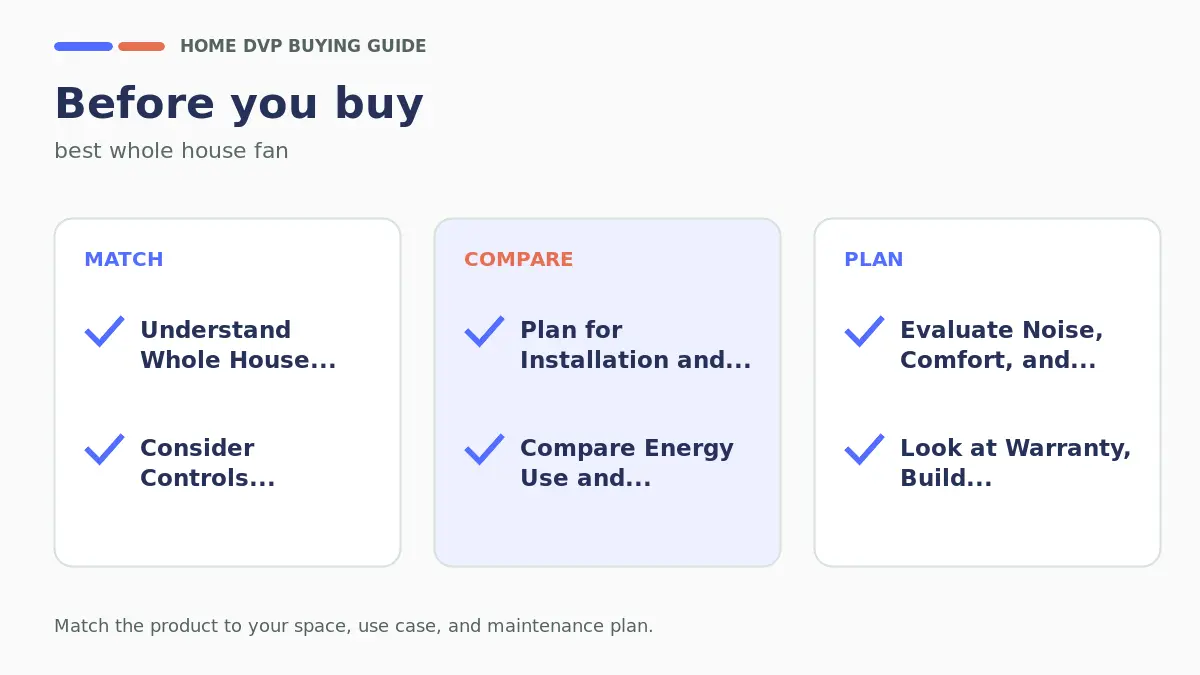
Final Thoughts
For most homeowners comparing best whole house fan, the QuietCool QC CL-6000 RF Classic Advanced Whole House Fan is a strong overall pick because it combines high airflow, broad stated coverage, wireless control, two-speed operation, removable grille access, and long warranty language. It is best suited for larger homes where the attic ventilation and installation plan can support that level of air movement.
For a balanced homeowner pick, the Quietcool QC CL-4700 RF Classic Advanced Whole House Fan offers a practical middle ground, while the Quietcool QC CL-3100 RF Classic Advanced Whole House Fan is better for smaller spaces. If energy efficiency is a top priority, the Quietcool QC ES-4700 RF Energy Saver Advanced Whole House Fan and Quietcool QC ES-7000 RF Energy Saver Advanced Whole House Fan are the most compelling choices from the valid product data.
The right choice depends on home size, climate, attic venting, and how often you plan to use the fan. If your cooling needs are more room-specific, review our apartment air conditioner guide before committing to a permanent whole-house installation.
FAQ
What should I look for when choosing the best whole house fan?
Start with home coverage, airflow capacity, attic ventilation, control options, and installation requirements. A good whole house fan should match the size of your living space and the amount of attic exhaust your home can support. Wireless control and multiple speeds can make daily use much easier.
Are higher-end whole house fan worth it?
Higher-end models can be worth it when they provide stronger airflow, better efficiency, easier controls, longer warranty coverage, or a better fit for a larger home. However, the most expensive option is not always the right choice. A properly sized model usually delivers better real-world comfort than an oversized fan in a poorly vented attic.
Can best whole house fan replace air conditioning?
Whole house fans work best as a complement to air conditioning, not a complete replacement in every climate. They are most effective when outdoor air is cooler and cleaner than indoor air. In hot, humid, smoky, or high-pollen conditions, mechanical cooling or filtration may be more appropriate.
About This Home DVP Research
Home DVP is an independent home-improvement research and product-comparison publisher. Ryan Mitchell prepared this guide by comparing manufacturer specifications, compatibility details, retailer-provided product data, key limitations, and common homeowner use cases. We do not claim hands-on testing unless an article explicitly says so.
Review methodology Affiliate disclosure Last reviewed October 16, 2026