
Choosing the best Whole House Water Filter For Pfas is more important than comparing ordinary taste-and-odor filters. PFAS concerns require homeowners to look closely at reduction claims, filter media, capacity, system size, and whether the filtration setup is designed for point-of-entry use across the home. An updated guide matters because product listings change, certification language varies, and not every whole-house filter that improves water taste is designed for PFAS reduction.
After carefully analyzing the available specifications, we reviewed 15 listed products and focused our recommendations on models that clearly match whole-house filtration, PFAS reduction, and Kitchen & Bathroom water-quality needs. If you are also comparing hardness control alongside filtration, our water softener buying guide can help you understand when softening and contaminant filtration should be treated as separate upgrades.
Home DVP decision summary
Quick Answer
For Best Whole House Water Filter For PFAS, Home DVP compared 15 products from 8 brands. Use a water report or qualified test to identify the PFAS concern, then verify a third-party certification for the exact reduction claim. Whole-house flow, media capacity, replacement cost, bypass plumbing, and post-installation testing are essential checks.
| Comparison coverage | 15 products from 8 brands, including iSpring, Purcooflow, EXPRESS WATER. |
|---|---|
| Selection priority | Use a water report or qualified test to identify the PFAS concern, then verify a third-party certification for the exact reduction claim. Whole-house flow, media capacity, replacement cost, bypass plumbing, and post-installation testing are essential checks. |
| Evidence basis | Manufacturer specifications, compatibility details, retailer-provided product data, and common homeowner use cases. |
| Reference guidance | EPA guidance for filters certified to reduce PFAS. |
This summary describes the article's comparison set, not every product on the market. Product details should be confirmed before purchase.
Based on the product data provided, the strongest category matches are whole-house systems that specifically reference PFAS, PFOA, PFOS, heavy metals, sediment, chlorine, carbon filtration, or large-format housings. We did not treat general anti-scale systems, small replacement filters, or broad contaminant filters as primary PFAS recommendations unless the listing clearly supported the keyword intent.
Best Whole House Water Filter For Pfas Buying Guide
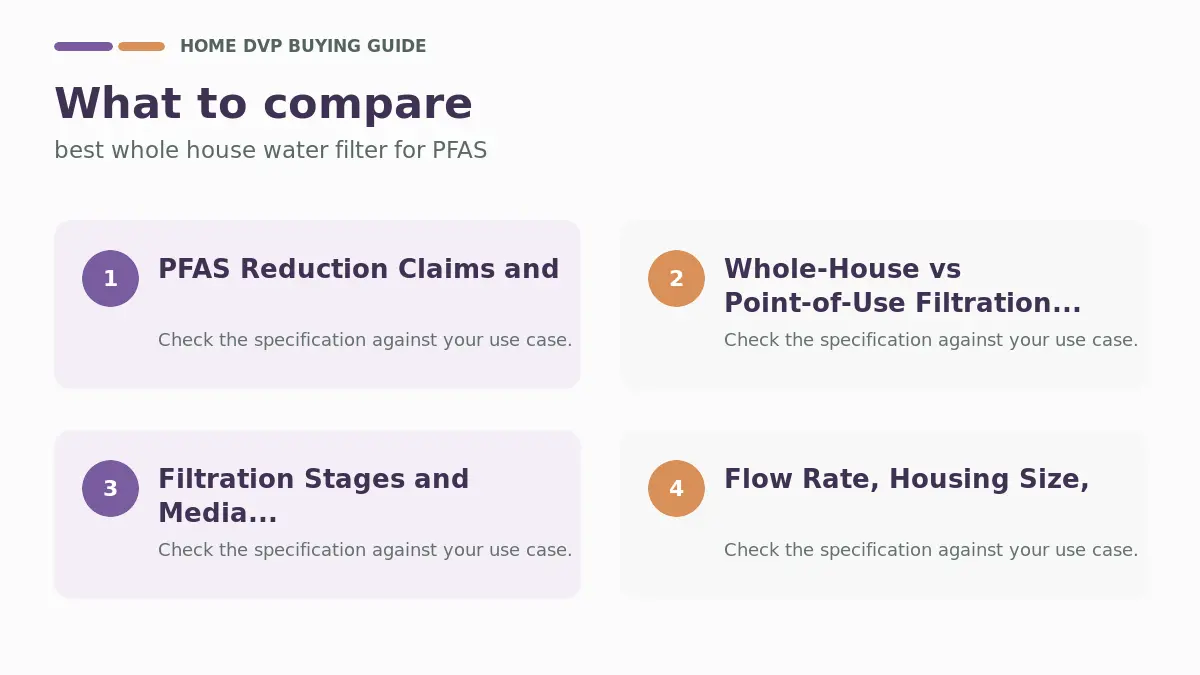
PFAS Reduction Claims and Testing Language
The first thing to check is whether the system directly references PFAS, PFOA, PFOS, or tested reduction of those compounds. Some whole-house filters improve taste, reduce chlorine, or manage sediment, but that does not automatically mean they are designed for PFAS. For this guide, products such as the iSpring PFAS & Heavy Metals Whole House Water Filter System Model: WGB32B-PFKS, iSpring PFAS Whole House Water Filter System Model: WGB32B-PF, and iSpring Whole House Water Filter System Ultimate PFAS Scale and Heavy Metals Protection Model: WGB32B-PFKDS+WSP50J stood out because their names and listed specifications directly address PFAS-related reduction.
Homeowners should be cautious with broad phrases such as “reduces contaminants” when PFAS is the priority. That language may be useful for general water improvement, but it is not as specific as a product listing that names PFAS, PFOA, or PFOS. A common mistake is assuming any carbon block filter is equivalent for PFAS. Carbon media can be part of a PFAS reduction strategy, but the actual cartridge design, contact time, flow rate, and tested claims matter.
When comparing listings, look for third-party testing references, certification language, or manufacturer-stated performance claims. Based on available product information, several iSpring systems reference SGS-tested media and reduction of PFOA and PFOS. That kind of wording gives buyers more useful information than a generic statement about cleaner water.
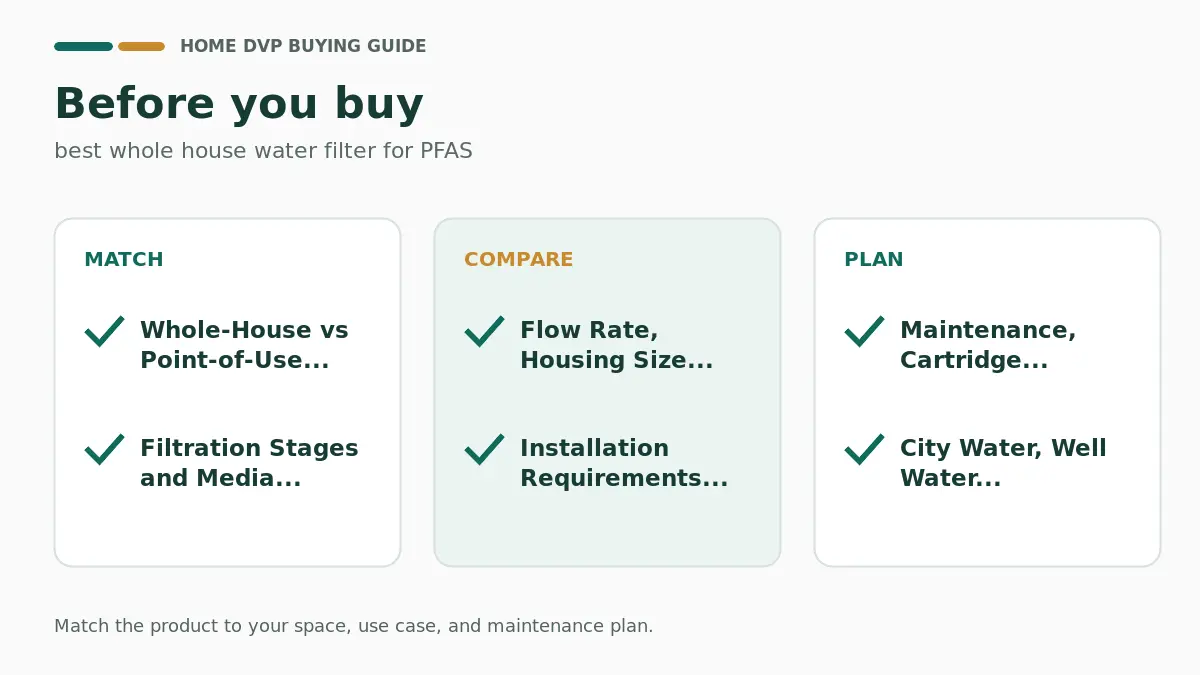
Whole-House vs Point-of-Use Filtration
A whole-house water filter is installed near the main water line so it can treat water before it reaches showers, bathroom sinks, laundry equipment, kitchen faucets, and appliances. That makes it different from a countertop filter, refrigerator filter, under-sink system, or pitcher. If your goal is broad home coverage, the system should clearly be described as whole-house or point-of-entry filtration.
For PFAS concerns, some homeowners choose both approaches: a whole-house system for broad exposure reduction and a dedicated drinking-water system at the kitchen sink for an added layer of treatment. If you are planning a broader Kitchen & Bathroom upgrade, browse the Kitchen & Bathroom category for related fixtures and water-focused home improvement guides.
Renters and condo owners should be especially careful. A large whole-house system may require access to the main service line, enough wall space, shutoff valves, and permission for plumbing changes. Homeowners with basements, utility rooms, garages, or mechanical closets usually have more installation flexibility.
Filtration Stages and Media Design
Most strong whole-house PFAS systems use multiple stages. A sediment filter often comes first to catch dirt, rust, sand, and larger particles. Carbon filtration usually follows to help reduce chlorine, chemical taste, odor, and certain organic contaminants. PFAS-focused carbon blocks or specialized media may be included as a dedicated stage.
The 3-Stage Whole House Water Filter System, PFAS Reduction, 20×4.5 Inch, Includes PP, CTO & PFAS Carbon Block is a good example of a listing that clearly identifies the treatment sequence. The iSpring PFAS & Heavy Metals Removal 3-Stage Whole House Water Filter System Model: WGB31B-PFKS is another option that combines PFAS-related claims with heavy-metal reduction language and whole-house sizing.
Do not choose stages by count alone. A two-stage system with the right PFAS-focused media may be more relevant than a three-stage system that only targets sediment and chlorine. For homes with high sediment, well water, or older plumbing, a pre-filter or spin-down sediment stage can help protect more expensive cartridges from clogging too quickly.
| Filtration Feature | Why It Matters for Homeowners |
|---|---|
| Sediment pre-filter | Helps protect downstream cartridges from sand, rust, and visible particles. |
| Carbon block or carbon media | Often used for chlorine, taste, odor, and chemical reduction, depending on design. |
| PFAS-specific cartridge or media | Provides more targeted relevance when PFAS, PFOA, or PFOS reduction is the main goal. |
| Large-format housings | Can support stronger flow and longer service intervals in busy households. |
| Pressure gauges or drain valves | Make maintenance easier by helping owners monitor restriction and service needs. |
Flow Rate, Housing Size, and Household Demand
Whole-house systems must support daily water demand without creating frustrating pressure drops. A household running a shower, dishwasher, washing machine, and kitchen faucet at the same time needs more flow capacity than a small home with lower peak demand. Large-format filters, such as 20-inch by 4.5-inch systems, generally provide more cartridge surface area than smaller housings, which can help with flow and service life.
The iSpring PFAS Whole House Water Filter System Model: WGB32B-PF uses 20-inch filters and a 1-inch inlet/outlet, which makes it more appropriate for homeowners who want larger cartridges and main-line compatibility. The iSpring PFAS Whole House Water Filter System Model: WGB21B-PF uses 10-inch filters, which may appeal to smaller homes, tighter installation spaces, or buyers who want a simpler two-stage configuration.
A common DIY mistake is focusing only on contaminant claims and ignoring plumbing size. If your home uses a larger main line, a restricted system can affect showers and fixtures. When in doubt, match the system port size to your plumbing plan and consider professional installation if you are modifying copper, PEX, CPVC, or threaded fittings near the main shutoff.
Installation Requirements and DIY Practicality
Installing a whole-house water filter is more involved than replacing a faucet aerator or adding a pitcher filter. The system usually mounts on a wall or freestanding bracket near the water entry point. You may need pipe cutting, bypass valves, shutoff valves, pressure relief, unions, threaded adapters, drain access, and enough clearance below the housings for cartridge changes.
Products that include installation kits, brass ports, drain valves, or wrenches can reduce extra shopping and make maintenance easier. The 3-Stage Whole House Water Filter System, PFAS Reduction, 20×4.5 Inch, Includes PP, CTO & PFAS Carbon Block lists 1-inch NPT brass ports, drain valves, a wrench, and an install kit, which are practical details for buyers planning a DIY-friendly setup.
Even confident DIYers should plan carefully. Shut off the main water supply, depressurize the line, confirm flow direction, support heavy housings securely, and check local plumbing code requirements. If you are updating several water-related fixtures at once, our touchless faucet guide may also be useful for kitchen upgrades that improve convenience at the sink.
Maintenance, Cartridge Changes, and Long-Term Cost
Maintenance is where many whole-house filters succeed or fail in real homes. A system may look affordable at purchase, but replacement cartridges, service intervals, and filter availability determine long-term value. PFAS-focused cartridges may cost more than standard sediment filters, so buyers should confirm replacement part numbers before committing.
Look for systems with clear filter schedules, accessible housings, and enough clearance for cartridge removal. Pressure gauges can help identify clogging, while drain valves can make housing service cleaner. Households with heavy sediment or well water may need more frequent pre-filter changes than homes on cleaner municipal water.
Do not wait until water pressure drops dramatically before checking the system. Reduced pressure can be a sign of clogged sediment media or overworked cartridges. A simple maintenance calendar, especially during July updates or seasonal home checks, helps keep the system working as intended.
City Water, Well Water, and Pre-Treatment Needs
Municipal water and well water create different filtration challenges. City water commonly involves chlorine taste, disinfectant byproducts, and distribution-system concerns. Well water may involve sediment, iron, manganese, sulfur odor, hardness, and microbial concerns depending on the source. A PFAS filter should be selected as part of the whole water profile, not in isolation.
The WF3-03 3-Stage Free-Standing Whole House Water Filtration System lists a UV filter and reduction claims for heavy metals, PFAS, chlorine, sediment, odor, and VOCs. That feature mix may appeal to homeowners who want a freestanding system with broader contaminant coverage. However, any well-water household should start with a current water test so the filtration plan matches actual conditions.
If hard water is also a problem, do not assume a PFAS filter will solve scale. A dedicated softener may still be needed for hardness minerals, appliance protection, and soap performance. Compare options in our guide to water softeners if scale buildup is part of the project.
Value, Reliability, and Who Should Spend More
The right budget depends on water concerns, household size, and installation complexity. Higher-end whole-house PFAS systems may include larger housings, more stages, specialized media, spin-down sediment protection, or additional contaminant reduction claims. Lower-cost systems may still be appropriate for smaller homes or lighter-duty setups if they clearly match the PFAS use case.
The iSpring Whole House Water Filter System Ultimate PFAS Scale and Heavy Metals Protection Model: WGB32B-PFKDS+WSP50J is the most feature-rich listing in the provided data because it combines PFAS, scale, heavy metals, and a jumbo spin-down sediment filter. The iSpring PFAS Whole House Water Filter System Model: WGB21B-PF is a more streamlined option for buyers who want PFAS-focused filtration without moving to a larger multi-stage package.
Spend more when you need higher flow capacity, more complete pre-filtration, heavy-metal claims, or better protection against sediment. Spend less only if the product still clearly addresses PFAS and fits your plumbing. Value is not the lowest upfront cost; it is the system that solves the right water problem with manageable maintenance.
Our Research Methodology & Why You Can Trust Us
We evaluated the products based on category fit, available product information, filtration claims, system format, stated compatibility, cartridge size, installation features, maintenance considerations, and overall homeowner usefulness. We specifically looked for products that matched the intent of the best Whole House Water Filter For Pfas, meaning whole-house water treatment with explicit PFAS, PFOA, or PFOS relevance.
Based on our detailed comparison, we gave more weight to systems that clearly list PFAS reduction, whole-house installation, large-format filtration, 1-inch ports, multi-stage design, heavy-metal reduction, sediment management, or third-party testing language. We did not claim hands-on testing, and we did not treat every listed product as equally relevant just because it appeared near the same category.
Our research indicates that ranking criteria for this category should include performance claims, filtration features, build quality, ease of installation, maintenance practicality, durability, safety, value, and fit for real homeowner or DIY use cases. We also considered whether the product would make sense in a kitchen and bathroom water-quality plan, especially for households comparing filtration with other plumbing upgrades such as garbage disposals or water-saving fixtures.
This guide is structured for regular updates during July so product data, availability, and category relevance can be reviewed as listings change. Because PFAS filtration is a health-related water-quality topic, homeowners should verify current manufacturer documentation, local water reports, and independent water testing before final installation decisions.
Final Thoughts
For an Overall Pick, the iSpring PFAS & Heavy Metals Whole House Water Filter System Model: WGB32B-PFKS is one of the strongest matches because it combines whole-house design, PFAS and heavy-metal language, 3-stage filtration, large-format filters, and 1-inch inlet/outlet sizing. It is best suited for homeowners who want a more comprehensive system and have enough room for a larger installation.
For a Value Pick, the iSpring PFAS Whole House Water Filter System Model: WGB21B-PF is a practical option because it focuses on PFAS reduction in a simpler two-stage format with 10-inch filters. For a Premium Pick, the iSpring Whole House Water Filter System Ultimate PFAS Scale and Heavy Metals Protection Model: WGB32B-PFKDS+WSP50J is the most complete listing among the valid matches because it adds scale and sediment protection features to the PFAS and heavy-metal focus.
For homeowners who want a non-iSpring valid category match, the 3-Stage Whole House Water Filter System, PFAS Reduction, 20×4.5 Inch, Includes PP, CTO & PFAS Carbon Block deserves attention because it clearly names PFAS reduction and includes practical installation components. If your project includes a wider bathroom refresh, our bidet toilet seat guide may help you plan another comfort-focused upgrade while keeping water access and plumbing layout in mind.
FAQ
What should I look for when choosing the best whole house water filter for pfas?
Look for explicit PFAS, PFOA, or PFOS reduction language, whole-house installation compatibility, suitable flow capacity, and cartridge sizes that match your household demand. Also consider whether the system includes sediment pre-filtration, carbon media, pressure monitoring, and easy cartridge access.
Are higher-end whole house water filter for pfas worth it?
Higher-end systems can be worth it when they offer larger housings, more stages, specialized PFAS media, heavy-metal reduction, or added sediment protection. They make the most sense for larger homes, well-water applications, or households that want broader contaminant coverage beyond taste and odor.
Do whole-house PFAS filters replace water softeners?
Usually, no. PFAS filtration targets chemical contaminants, while a water softener addresses hardness minerals that cause scale, spotting, and soap performance issues. If you have both concerns, compare a PFAS filter with a separate softening solution, and review the water softener guide for hardness-specific advice.
How often do the best whole house water filter for pfas need maintenance?
Maintenance depends on water quality, household size, cartridge type, and total water use. Sediment-heavy water can clog pre-filters faster, while PFAS-focused cartridges should be replaced according to the manufacturer schedule and any performance guidance provided with the system.
Are the best whole house water filter for pfas suitable for DIY installation?
Some systems are suitable for experienced DIYers who are comfortable shutting off the main water line, cutting pipe, mounting heavy housings, and checking for leaks. Beginners may prefer professional installation because a whole-house filter becomes part of the home’s main plumbing system.
Should renters buy the best whole house water filter for pfas?
Renters should be cautious because whole-house systems usually require plumbing modifications and landlord approval. A renter may be better served by a point-of-use drinking-water solution unless they have permission and access to the main water line.
About This Home DVP Research
Home DVP is an independent home-improvement research and product-comparison publisher. Ryan Mitchell prepared this guide by comparing manufacturer specifications, compatibility details, retailer-provided product data, key limitations, and common homeowner use cases. We do not claim hands-on testing unless an article explicitly says so.
Review methodology Affiliate disclosure Last reviewed August 26, 2026