
Choosing the best Countertop Reverse Osmosis System can make a noticeable difference in everyday kitchen convenience, especially for homeowners and renters who want cleaner-tasting drinking water without cutting into cabinets or modifying plumbing. Countertop reverse osmosis systems are popular because they usually plug in, sit on the counter, and avoid the permanent installation required by many under-sink systems.
For this 2026 guide, we analyzed 15 products using available product specifications, filtration stages, certification claims, water efficiency, pitcher or tank design, maintenance needs, and homeowner-friendly usability. If you are comparing broader kitchen upgrades, our Kitchen & Bathroom category includes related guides for practical home improvement decisions.
Home DVP decision summary
Quick Answer
For Best Countertop Reverse Osmosis System, Home DVP compared 15 products from 8 brands. Verify the exact contaminant-reduction certification, membrane and filter replacement schedule, wastewater ratio, tank capacity, dispensing speed, and required water pressure. Countertop convenience should not replace matching treatment to a water test.
| Comparison coverage | 15 products from 8 brands, including Bluevua, PHILIPS, DREO. |
|---|---|
| Selection priority | Verify the exact contaminant-reduction certification, membrane and filter replacement schedule, wastewater ratio, tank capacity, dispensing speed, and required water pressure. Countertop convenience should not replace matching treatment to a water test. |
| Evidence basis | Manufacturer specifications, compatibility details, retailer-provided product data, and common homeowner use cases. |
| Reference guidance | EPA home drinking-water filtration guidance. |
This summary describes the article's comparison set, not every product on the market. Product details should be confirmed before purchase.
After carefully analyzing the available specifications, we focused our recommendations on countertop reverse osmosis systems that clearly match the category and ignored products that did not fit the countertop use case. The goal is to help you understand which features matter before you buy, not to overwhelm you with marketing claims.

Pros
- No installation needed, just plug in and use
- Offers both cold and hot water dispensing on demand
- Certified to safety standards with transparent TDS readings
Cons
- Limited to room temperature dispensing in standard mode per specifications
- Needs consistent daily water replacement in the tank for optimal results
- Filter replacement falls outside the standard machine warranty coverage
The PHILIPS countertop reverse osmosis system serves households looking for an accessible way to obtain purified water with added convenience features.
Its six-stage filtration incorporates Aquaporin technology to handle impurities effectively down to very small sizes and includes a remineralization step for improved water taste.
Users interact via a touch panel that selects from multiple temperature settings and volume options while showing live TDS values for both input and output.
This setup works well for preparing beverages or providing drinking water throughout the day in homes with moderate usage needs.
Regular upkeep like refilling the source tank and running self-clean cycles helps maintain function, though the unit may not fit every space due to its overall dimensions.
Best For / Avoid If
Best for buyers prioritizing
- No installation needed, just plug in and use
- Offers both cold and hot water dispensing on demand
- Certified to safety standards with transparent TDS readings
Consider another option if
- Limited to room temperature dispensing in standard mode per specifications
- Needs consistent daily water replacement in the tank for optimal results
- Filter replacement falls outside the standard machine warranty coverage
Best Countertop Reverse Osmosis System Buying Guide
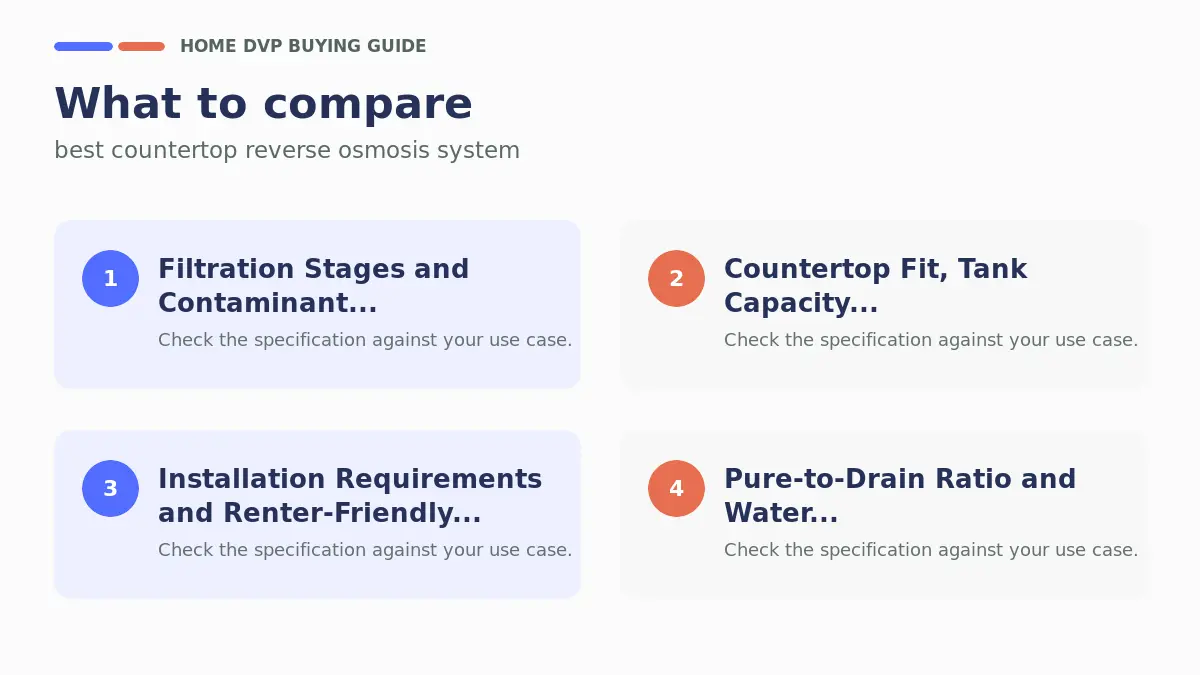
Filtration Stages and Contaminant Reduction
The most important feature in countertop reverse osmosis systems is the filtration path. Many valid models in this category use multi-stage filtration that may include sediment filtration, carbon filtration, reverse osmosis membrane filtration, remineralization, and sometimes UV treatment. Based on the product data provided, examples such as the Bluevua RO100ROPOT Countertop Reverse Osmosis Water Filter System, the PHILIPS Reverse Osmosis Water Filter Countertop ADD6928DG/37, the Waterdrop M6SL Mineral Reverse Osmosis Water Filter Countertop, and the Bluevua RO100ROPOT-Lite Countertop Reverse Osmosis Water Filter System all emphasize multi-stage filtration.
Reverse osmosis is especially useful when you want to reduce dissolved solids, improve taste, and address common tap water concerns. However, shoppers should avoid assuming every RO system removes every contaminant equally. Look for specific certification language, membrane ratings, and filter replacement guidance rather than relying only on broad claims like purified water or clean water.
A common mistake is choosing the system with the highest number of stages without checking what those stages actually do. A well-designed five-stage system with a quality RO membrane and clear filter monitoring may be more practical than a system with more stages but vague maintenance requirements.
| Feature | Why It Matters | What to Check |
|---|---|---|
| RO membrane | Core filtration stage for dissolved solids and many impurities | Micron rating, TDS reduction claims, certification details |
| Carbon filtration | Helps with chlorine taste and odor | Pre-filter and post-filter design |
| Remineralization | Can improve taste after RO filtration | Whether minerals are added back after filtration |
| UV stage | Adds another treatment layer on select models | Whether UV is included and how maintenance is handled |
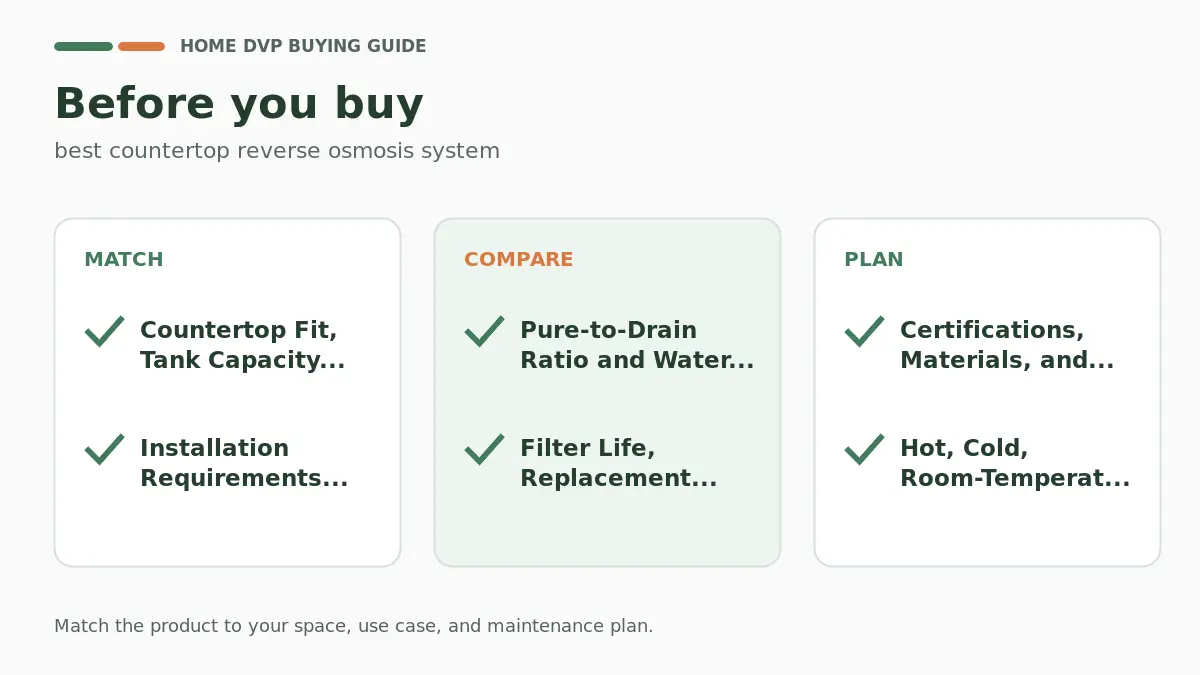
Countertop Fit, Tank Capacity, and Daily Convenience
Countertop RO systems are convenient only if they fit your kitchen routine. Before buying, measure your counter depth, cabinet clearance, and the space near an electrical outlet. A system that looks compact online can feel bulky beside a coffee maker, dish rack, or small appliance cluster.
Capacity matters for families, home offices, and anyone who fills bottles throughout the day. The PHILIPS Reverse Osmosis Water Filter Countertop ADD6928DG/37 is positioned for family use with a larger source tank and portable jug design, while systems like the Bluevua RO100ROPOT Countertop Reverse Osmosis Water Filter System emphasize a glass carafe and no-install setup. DREO Reverse Osmosis Water Filter Countertop models may appeal to shoppers who want install-free operation and pitcher-style convenience.
If you drink mostly water at meals, a smaller carafe may be fine. If you use filtered water for coffee, tea, cooking, pets, and water bottles, prioritize a larger tank or faster dispensing design. For other kitchen performance upgrades, see our guide to the Best Touchless Faucet.
Installation Requirements and Renter-Friendly Design
One of the main reasons shoppers look for the best countertop reverse osmosis system is installation simplicity. Many countertop RO systems require no plumbing changes, which makes them attractive for renters, condos, temporary housing, and homeowners who do not want to drill into cabinets or modify sink plumbing.
Based on available product information, the Bluevua RO100ROPOT Countertop Reverse Osmosis Water Filter System, PHILIPS Reverse Osmosis Water Filter Countertop ADD6928DG/37, Aigerri UV Countertop Reverse Osmosis Water Filter, Waterdrop M6SL Mineral Reverse Osmosis Water Filter Countertop, Bluevua RO100ROPOT-Lite Countertop Reverse Osmosis Water Filter System, and DREO Reverse Osmosis Water Filter Countertop models all align with the countertop, no-install or install-free use case.
Before purchasing, check whether the unit needs only a power outlet or if it also requires any faucet adapter, drain setup, or special water source. The simpler the setup, the easier it is to move the system for cleaning, seasonal use, or relocation.
Pure-to-Drain Ratio and Water Efficiency
Reverse osmosis filtration separates purified water from concentrated reject water. That makes the pure-to-drain ratio an important specification for homeowners who care about efficiency, especially in areas where water costs are high or conservation matters.
Several countertop models highlight water-saving ratios. The Bluevua RO100ROPOT Countertop Reverse Osmosis Water Filter System lists a water-saving design, while the Aigerri UV Countertop Reverse Osmosis Water Filter, Waterdrop M6SL Mineral Reverse Osmosis Water Filter Countertop, Bluevua RO100ROPOT-Lite Countertop Reverse Osmosis Water Filter System, and DREO Reverse Osmosis Water Filter Countertop products emphasize efficient pure-to-drain ratios in their product positioning.
Do not compare RO systems only by purchase cost within $200–$640. A less efficient unit may use more water over time, while a more efficient system can be more appealing for daily household use. Also check whether leftover water can be repurposed for plants, cleaning, or non-drinking tasks, if the manufacturer supports that use.
Filter Life, Replacement Cost, and Maintenance
Maintenance is where many buyers underestimate the long-term ownership experience. A countertop RO system can be easy to set up but still frustrating if filters are expensive, hard to find, or difficult to replace. Look for clear filter life indicators, simple cartridge access, and replacement availability before you commit.
The Bluevua RO100ROPOT Countertop Reverse Osmosis Water Filter System includes a filter life monitor and water quality display, which can help homeowners avoid guessing when replacement is due. The PHILIPS Reverse Osmosis Water Filter Countertop ADD6928DG/37 also highlights real-time TDS display and maintenance guidance, including routine water replacement and self-cleaning steps.
A practical mistake is placing the unit in direct sunlight or leaving source water sitting too long. Treat a countertop RO system like a small kitchen appliance: keep it clean, refresh the tank regularly, and follow the manufacturer’s storage directions if you leave for an extended trip.
Certifications, Materials, and Safety Details
Certification language can help separate stronger product claims from vague marketing. For drinking water products, shoppers should look for references to NSF, ANSI, WQA, SGS, or related material safety and performance standards when available. Certification details do not replace reading the manual, but they do provide a more objective basis for comparison.
The Bluevua RO100ROPOT Countertop Reverse Osmosis Water Filter System lists WQA certification, while the PHILIPS Reverse Osmosis Water Filter Countertop ADD6928DG/37 references NSF/ANSI/CAN material safety certification and SGS certification for the filter core. The Aigerri UV Countertop Reverse Osmosis Water Filter and Waterdrop M6SL Mineral Reverse Osmosis Water Filter Countertop also reference NSF/ANSI-related certification language in the available data.
Material choice matters too. A glass carafe, BPA-free pitcher, and clear water-contact material claims can be meaningful for families who want to reduce plastic exposure. If hard water is part of your broader home concern, our Best Water Softener guide explains a different type of water treatment that may complement drinking water filtration.
Hot, Cold, Room-Temperature, and Pitcher Features
Not every countertop RO system dispenses water the same way. Some focus on purified room-temperature water, while others add chilled or hot water functions. Extra temperature features can be convenient, but they may also increase size, complexity, power use, and maintenance needs.
The PHILIPS Reverse Osmosis Water Filter Countertop ADD6928DG/37 is notable because its feature set includes cold and hot water options along with a touch panel and volume presets. That can make sense for tea drinkers, coffee prep, cold drinks, and families that want a more appliance-like dispenser rather than a basic filtration carafe.
For smaller kitchens, a simpler pitcher or carafe-style design may be easier to live with. The right choice depends on how often you need filtered water, whether you want temperature control, and how much counter space you are willing to dedicate.
Matching the System to Your Household
The right best countertop reverse osmosis system for a single renter may not be the right system for a busy family. Apartment dwellers may value portability and no-install setup above all else, while homeowners may prioritize capacity, water efficiency, display features, and lower maintenance frequency.
For a compact kitchen, prioritize footprint, carafe storage, and whether the unit can sit under upper cabinets. For family use, look at source tank capacity, filtered water availability, and how quickly the system produces water. For tech-focused buyers, TDS display, filter alerts, self-cleaning, and app or smart features may be worth considering when supported by the product data.
If your kitchen upgrades also include food waste management, our Best Garbage Disposal guide may help you compare another high-use fixture for daily kitchen cleanup.
Our Research Methodology and Why You Can Trust Us
We evaluated the products based on category fit, available specifications, filtration design, installation requirements, water efficiency, certifications, maintenance needs, ease of use, and practical homeowner value. Products that did not clearly match countertop reverse osmosis use were not included in our recommendation discussion, even if they appeared in the broader product data.
Based on our detailed comparison, we gave extra weight to systems with no-install countertop operation, clear filtration-stage descriptions, TDS or filter life monitoring, safety certification language, efficient pure-to-drain ratios, and designs that make sense for real kitchens. We also considered whether each product appears better suited to renters, families, small spaces, or buyers who want extra convenience features.
Our research indicates that the strongest buying decisions come from comparing performance, features, build quality, ease of use, durability, safety, value, reliability, and home use case fit together. We do not claim hands-on testing; this guide is based on available product information, user-facing specifications, and category-specific product analysis.
This guide is designed to be updated during July as product information, availability, and category trends change. That update process helps keep recommendations aligned with current homeowner expectations and practical kitchen use.
Final Thoughts
For an overall countertop RO choice, the Bluevua RO100ROPOT Countertop Reverse Osmosis Water Filter System stands out because it combines no-install operation, a glass carafe, multi-stage filtration, remineralization, water-saving design, and filter life monitoring. It is a strong fit for homeowners or renters who want a balanced countertop system without plumbing changes.
For buyers who want premium convenience, the PHILIPS Reverse Osmosis Water Filter Countertop ADD6928DG/37 is the more feature-rich option thanks to its larger family-oriented design, real-time TDS display, mineralization stage, and hot or cold dispensing features. For value-focused shoppers, the DREO Reverse Osmosis Water Filter Countertop models are worth considering because they focus on install-free RO filtration, pitcher convenience, and practical daily use.
If safety certification language and efficient water use are priorities, compare the Aigerri UV Countertop Reverse Osmosis Water Filter, Waterdrop M6SL Mineral Reverse Osmosis Water Filter Countertop, and Bluevua RO100ROPOT-Lite Countertop Reverse Osmosis Water Filter System closely. For other bathroom-focused upgrades after your kitchen water project, see our guide to the Best Bidet Toilet Seat.
FAQ
What should I look for when choosing the best countertop reverse osmosis system?
Focus on filtration stages, certification language, tank or carafe capacity, pure-to-drain ratio, filter replacement needs, and counter space requirements. A good countertop RO system should fit your kitchen routine as well as your water quality goals.
Are higher-end countertop reverse osmosis system worth it?
Higher-end models can be worth it if they add useful features such as real-time TDS display, larger capacity, hot or cold dispensing, self-cleaning, better materials, or clearer certification support. If you only need basic room-temperature filtered water, a simpler system may be the better value.
Are the best countertop reverse osmosis system useful for renters and small kitchens?
Yes, many countertop RO systems are especially appealing for renters because they avoid permanent plumbing changes. If you have a compact kitchen, measure carefully and review more space-conscious kitchen upgrades in our Best Bidet guide for another example of fixture-focused buying criteria.
About This Home DVP Research
Home DVP is an independent home-improvement research and product-comparison publisher. Ryan Mitchell prepared this guide by comparing manufacturer specifications, compatibility details, retailer-provided product data, key limitations, and common homeowner use cases. We do not claim hands-on testing unless an article explicitly says so.
Review methodology Affiliate disclosure Last reviewed September 10, 2026