Power outages from storms, grid strain, and extreme weather continue to disrupt homes across the country. For homeowners, renters, and DIYers who want clean, quiet backup without gas fumes or noisy engines, investing in reliable solar generator for home backup has become essential emergency preparedness. A well-chosen solar generator keeps refrigerators running, medical devices powered, lights on, and communication tools charged during blackouts while offering solar recharging for multi-day resilience.
In this updated 2026 guide for July, our team at Home DVP carefully analyzed 15 models suited to home backup scenarios. We focused on capacity, continuous and surge output, battery chemistry, solar input, UPS switchover times, expandability, portability, safety systems, and overall value within the typical $469.00 – $2,149.00. Our comparison draws from detailed product specifications, user-facing features, and category fit for Emergency Supplies rather than marketing claims.
Whether you need compact emergency coverage for essential devices or larger expandable systems for multi-appliance households, understanding the right specifications prevents overspending or under-powering. Explore more options in our emergency supplies category to round out your preparedness kit. Below you will find our structured product overview, practical buying criteria, transparent methodology, and clear recommendations based on available data.
Pros
- High output and dual voltage options handle major appliances effectively for home and emergency use
- Flexible charging via AC, solar, hybrid, or gas generator keeps the unit prepared quickly
- Portable wheeled construction improves mobility for a high-capacity LFP station
- Long cycle life and heat-resistant cells promote durable safe performance over many years
- Included dual solar panels enable sustainable recharging for extended off-grid or outage scenarios
Cons
- Power station and solar panels ship separately and may arrive in different packages
- Base capacity could require expansion modules for very large homes needing more than two weeks of runtime
- Users new to multi-mode systems may need extra time to learn all charging and parallel configurations
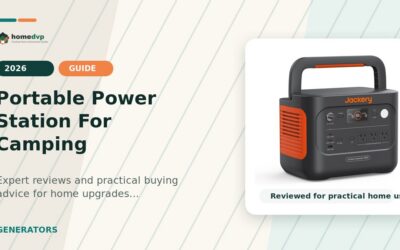
The Jackery HomePower 3600 Plus portable power station functions as a capable solar generator for homeowners, renters, and RV owners who require dependable backup during outages or remote use. Based on the listed specifications, it combines 3584Wh LFP storage with two 200W solar panels, 3600W AC output, and expandability to create a practical essential home energy solution focused on simplicity and longevity.
Based on the provided product details, the 3600W continuous rating that reaches 7200W in parallel configuration supports demanding loads such as pumps, heaters, and dryers with dual 120V and 240V voltage options. Capacity starts at 3584Wh and expands to 21kWh per unit or 43kWh across multiple units, enough to cover a three-person household for over two weeks. Recharging flexibility includes hybrid AC plus solar in two hours, AC alone in 2.5 hours, solar in four hours, or gas generator input, delivering quiet clean energy for daily or emergency needs.
The product information indicates an ultra-portable build that uses automotive-grade CTB technology to achieve 34 percent smaller size and 29.3 percent lighter weight than other models in its class, remaining the lightest 3.6kWh LFP station. Luggage-style wheels and a telescopic handle allow easy rolling from kitchen to living room, home office, yard, or RV. Safety comes from high-temperature resistant ceramic membrane battery cells tested at 302 F that resist thermal runaway, supporting reliable operation down to -4 F across 6000 cycles and a projected ten-year lifespan.
In practical home scenarios the plug-and-play approach paired with MTS lets users simply connect appliances and press Power-On without wiring or professional installation, keeping kitchen, living areas, or workspaces running smoothly. Strengths include support for UPS functions, zero drain storage, and solar charging that promotes energy savings while powering essentials quietly indoors or outdoors. The design also suits RV travel where clean portable power maintains comfort without noise or fumes.
Potential limitations involve separate shipment of the station and solar panels, which may lead to staggered delivery times. Larger properties seeking maximum runtime will likely add expansion batteries. Overall, based on the available product data the Jackery HomePower 3600 Plus offers a balanced expandable solution for reliable home backup and mobile energy that prioritizes safety, portability, and multi-source charging.
Households preparing for emergencies, families wanting quiet alternative power, and RV users will find the strongest value, while those needing only compact personal chargers may prefer smaller models from the same lineup.
Pros
- High continuous output and dual-voltage parallel capability handle demanding home loads effectively
- Expandable architecture allows capacity growth without replacing the core unit
- Four distinct charging methods improve recovery speed and energy source flexibility
- Wheeled compact design improves transport between rooms, garage, or RV compared with bulkier stations
- Thermal-resistant cells and extended cycle life promote safer multi-year service
Cons
- Solar panels remain optional, so full off-grid recharging may require separate accessories
- Larger expanded configurations can occupy more floor space than compact single-unit needs
- Users seeking only low-wattage travel power may find the capacity larger than necessary
The Jackery HomePower 3600 Plus serves as a portable LFP solar generator aimed at homeowners, renters, and RV users who require dependable backup when the grid fails or when traveling off-site. Based on the provided product details, its 3584Wh base capacity, 3600W AC output, and expandability up to 21kWh position it for multi-day essential power rather than light device charging alone.
Performance centers on running common household loads. The listed 3600W continuous output (7200W parallel) supports pumps, heaters, dryers, refrigerators for approximately 6 hours, and microwaves for about 2.6 hours, while dual 120V and 240V capability in parallel broadens appliance compatibility. Hybrid AC plus DC recharging reaches full in 2 hours, and solar or gas generator options extend usability in prolonged events, delivering quiet operation without fuel noise or fumes for indoor or campsite settings.
Design emphasizes practicality and reduced bulk. Automotive-grade CTB construction makes this the lightest 3.6kWh-class unit according to the specifications, measuring 34 percent smaller and 29.3 percent lighter than similar models. The luggage-style chassis with wheels and telescopic handle allows rolling from kitchen to living areas, yard, or RV storage. Plug-and-play pairing with transfer solutions eliminates complex installation, and high-temperature ceramic membrane cells tested to 302 °F help prevent thermal issues while maintaining function down to -4 °F.
In real-world home and outdoor contexts the unit addresses kitchen refrigeration, living-room lighting and electronics, home-office equipment, yard tools, and RV power needs. Expandable modules and multi-unit scaling to 43kWh support longer outages for a three-person household spanning more than two weeks. Four charging routes and ZeroDrain features further reduce downtime and standby losses, translating listed capacity into usable daily energy savings and convenience.
Potential limitations include the need for optional solar panels to maximize renewable charging and the physical footprint that grows with expansion packs. Advanced users wanting permanent whole-home hardwiring may prefer fixed systems, yet for portable emergency readiness the feature set remains strong. Overall the Jackery HomePower 3600 Plus stands as a versatile generator choice for practical homeowners seeking scalable, safe, and mobile backup power based on the available specifications.
Those who prioritize multi-week household coverage, quiet indoor-safe operation, and easy relocation will find it well matched. Buyers focused solely on ultralight camping or minimal device charging may prefer smaller capacity models from the same lineup.
Pros
- Lightweight compact build eases transport without a wheel kit
- PowerRush technology increases starting capacity for motor-driven appliances
- Up to 7 hours runtime at 25 percent load covers overnight camping or multi-hour outages
- USDA-qualified spark arrestor permits use in national forests and dry outdoor zones
- Versatile outlets accommodate household devices, USB charging, and RV twist-lock connections
Cons
- Uses recoil pull-start only without electric or remote options
- Runs solely on unleaded gasoline and needs a separate adapter for standard RV TT-30R inlets
- No wheel kit included which may reduce mobility convenience for some users
Based on the available product data, the Generac GP3300i model 7153 is a portable inverter generator that produces 2,500 running watts and 3,300 starting watts in a 59.5-pound package. Homeowners preparing for power outages, along with campers and RV travelers who need reliable portable electricity, form the core audience for this unit.
The listed specifications indicate effective performance through TruePower Technology that holds total harmonic distortion under 3 percent, allowing safe connection of laptops, tablets, and CPAP machines. PowerRush Advanced Technology supplies extra starting capacity to manage refrigerator or RV air conditioner surges, while Economy Mode matches engine speed to load for better fuel use and quieter operation. The 1.06-gallon tank yields up to 7 hours at 25 percent load or 4.5 hours at 50 percent load, covering multi-hour home outages or overnight camping without frequent refueling.
Design emphasizes field readiness with a molded carry handle and compact form that one person can transport. The PowerDial combines choke, run, and off positions for the recoil start system. Outlets consist of two 120V 20A household receptacles, one 120V 30A L5-30R twist-lock, and two USB-A ports. A USDA-qualified spark arrestor supports use in national parks and dry outdoor conditions, and engine oil plus an oil funnel ship in the box for initial setup.
In practical home applications the generator can keep a refrigerator operating with lights and entertainment running during outages. Outdoor living benefits include tailgating, family camping, or RV power via the twist-lock outlet, though an L5-30P-to-TT-30R adapter is required for standard RV inlets. Parallel readiness enables pairing a second unit with the sold-separately kit for up to 5,000 running watts when higher demand arises.
Potential limitations include the lack of electric start, dual-fuel capability, and an included wheel kit, plus the need for periodic oil changes using 0.6 qt of 10W-30 or SAE 30 oil. Overall the product information indicates a practical option for users who value clean portable power, safety monitoring via COsense, and compact transport. Buyers needing continuous high output or remote starting may prefer larger models in the Generac range.
Pros
- Charges from 0 to 80% in 45 minutes with X-Stream AC charging.
- Supports AC, solar, generator, and car charging methods based on the listed product details.
- LFP battery is rated for 10 plus years of daily use according to the product information.
- Solar panel is listed with a 23% conversion rate and IP68 protection.
- UPS function can switch to battery power in under 10ms.
Cons
- The solar generator and 110W solar panel may arrive separately, which could require extra planning before first use.
- Solar recharge with the included 110W panel is listed at 11.6 hours, so users needing faster off-grid recharging may want more solar capacity if compatible.
- May not suit users who need whole-home generator capacity or sustained power for multiple high-draw appliances at once.
Based on the available product data, the EF ECOFLOW DELTA 3 Classic Solar Generator is a portable power station package aimed at homeowners, campers, RV users, and anyone who wants backup power without relying only on fuel-based generators. It combines a 1024Wh power station with a 110W solar panel, giving buyers both stored battery power and a renewable charging option for outdoor or emergency use.
The listed performance is the main reason this unit stands out in the generator category. It provides 1800W AC output with a 3600W surge rating, and the product information says it can support common appliances and electronics such as refrigerators, microwaves, and laptops. X-Boost technology is also listed, with expandable support up to 2600W for heavier loads, making it a more flexible option than small power banks for practical home backup needs.
Charging flexibility is another strong part of the feature set. The DELTA 3 Classic supports AC charging, solar charging, generator charging, and car charging, which is useful when power sources change between home, campsite, vehicle, and emergency situations. With X-Stream AC charging, it is listed to charge from 0 to 80% in 45 minutes, while the included 110W solar panel is listed to recharge the unit in 11.6 hours under suitable conditions.
For everyday usability, the product details point to a compact and portable design, six ports, a 100W USB-C output, smart app control, and quiet 30 dB operation. The under 10ms UPS feature is especially useful for sensitive electronics, since the product information says it can automatically switch to battery power quickly enough to help prevent interruptions for devices such as PCs, servers, and medical devices.
Durability is supported by the listed LiFePO4 battery cells, which are rated for 10 plus years of daily use, along with an EV-grade CTC design and smart Battery Management System. The solar panel also adds outdoor practicality with a stated 23% conversion rate, IP68 protection, and an adjustable kickstand for positioning in the sun.
The main limitations are typical for this type of portable solar generator. The included 110W panel is useful for renewable charging, but the listed 11.6-hour recharge time means solar-only users should plan ahead. The product information also notes that the DELTA 3 Classic Solar Generator and 110W Solar Panel arrive separately. Overall, based on the provided details, this is a strong fit for buyers who want a portable backup power source for home essentials, electronics, camping, RV travel, and short-term outage preparedness rather than a full whole-home generator replacement.
Pros
- 2200W continuous and 2600W peak AC output handles most household appliances and camping equipment
- Ultra-quiet 23 dB recharging with five SGS noise-level tests supports use in calm environments
- Fast 70-minute grid recharge and 140W USB-C ports expand daily charging flexibility
- LiFePO4 battery with 4000-cycle life and comprehensive BMS safety features for lasting reliability
Cons
- MPPT and car charging modules are not built-in so solar panels or car batteries need separate compatible adapters
- 28.6-pound weight may feel less portable for users seeking ultra-lightweight backpacking options
- Solar panel is optional and not included in the base package
The DJI Power 1000 stands out as a 1024Wh LiFePO4 portable power station aimed at homeowners, campers, and DIYers who need dependable backup electricity. Based on the listed specifications, its 2200W continuous output with 2600W peak makes it suitable for powering the majority of household appliances along with outdoor camping gear and power tools during projects or outages.
Performance centers on versatile energy delivery and rapid recovery. The unit fully recharges from grid power in 70 minutes and supports up to 800W solar input for a 1.35-hour recharge at maximum speed. Multiple output options including AC and 140W USB-C ports allow simultaneous use of several devices, while the LiFePO4 chemistry delivers up to 4000 cycles for extended service life around 10 years.
Design emphasizes quiet and secure operation. The station measures noise as low as 23 dB during recharging, lower than most household refrigerators and verified through five SGS noise-level tests. Multi-safeguard BMS technology protects against over-current, over-voltage, and over-discharge, and the product has passed 26 SGS certifications. It ships with an AC power cable and carries a five-year warranty, though MPPT and car charging modules require separate adapters.
In practical home and outdoor scenarios the Power 1000 serves as a household standby battery for refrigerators, lights, or medical devices during blackouts, while also supporting camping setups and content-creation gear that demand clean portable power. The combination of high continuous wattage and solar readiness keeps adventures or emergency readiness extended without constant grid access.
Potential limitations include the need for optional solar panels and external adapters for certain charging methods, plus the 28.6-pound weight that may challenge ultra-portable packing. Overall, based on the provided product details the DJI Power 1000 offers a balanced mix of capacity, speed, silence, and safety for practical homeowners and outdoor users seeking a capable solar generator option.
Those prioritizing quiet high-output backup for home emergencies or multi-day camping will find the feature set well matched, while buyers needing built-in solar controllers or lighter packs may prefer alternate configurations within the same series.
Pros
- Double-sided solar design improves energy capture and charging speed
- Fast dual input charging reduces wait times significantly
- LFP battery chemistry supports thousands of cycles for longevity
- High output and multiple outlets handle diverse home and outdoor devices
- Lightweight waterproof panels enhance portability and weather resistance
Cons
- Full kit with dual panels may require more storage space than compact units
- Solar performance relies on available sunlight for optimal results
- First-time users may need extra time to master dual charging and X-Boost modes
The EF ECOFLOW DELTA 2 Max solar generator pairs a 2048Wh portable power station with two 220W solar panels for campers, RV owners, and homeowners seeking versatile backup energy. Based on the provided product details, it emphasizes fast dual charging and broad device compatibility without fuel dependence.
Performance highlights include combining up to 1000W solar with AC for an 80 percent charge in 43 minutes or 80 percent via AC alone in 1.1 hours. Output reaches 2400W continuous and up to 3400W in X-Boost mode across 15 outlets, supporting nearly any household appliance according to the listed features.
Design centers on durable LFP battery chemistry rated for 3000 full cycles to 80 percent capacity, equating to more than 10 years of use. The double-sided panels offer a 220W primary side plus 175W ambient capture for up to 28 percent more energy, 25 percent conversion efficiency, foldable 15.4 lb construction, thin tempered glass durability five times stronger than similar options, and IP68 water and dust resistance for practical outdoor handling.
Real-world strengths appear in camping, RV, and home backup scenarios where the capacity and outlets keep refrigerators, lights, tools, and electronics running. Dual charging and solar input options allow flexible recharging, while the compact panels simplify setup and storage for outdoor living or emergency readiness.
Potential limitations involve the larger overall package size for storage and the need for suitable sunlight to maximize solar speeds. Based on the feature set, the EF ECOFLOW DELTA 2 Max suits users wanting long-lasting high-output portable power with solar support. Those with basic needs may prefer simpler units, yet it provides strong practical value for comprehensive homeowner and adventure applications.
Pros
- Lightning-fast recharging to full capacity in 58 minutes
- Expandable battery system reaching up to 4kWh for greater energy reserves
- Lightweight and compact relative to similar power stations for easier handling
- High peak power supports simultaneous use of power-hungry appliances
- Efficient design extends runtime for essential home devices
Cons
- Solar panels are optional and not included in the base package
- Base capacity of 2048Wh may require expansion for very large households or extended off-grid use
- At 41.7 lb the unit remains substantial for users seeking ultra-light portability
Based on the available product data the Anker SOLIX C2000 Gen 2 portable power station serves as a versatile solar generator suited for homeowners preparing for power outages as well as those who enjoy camping or RV travel. Its 2048Wh LiFePO4 battery and 2400W output position it as a practical choice for reliable energy needs in residential and outdoor settings.
Performance highlights include a low 9W standby draw that enables a dual-door fridge to run for up to 32 hours and the ability to expand capacity to 4kWh for double that runtime. The unit recharges fully in 58 minutes via AC or solar and supports 800W alternator charging for on-the-go replenishment in about 3 hours. With 4000W peak power it can handle most window and RV air conditioners along with multiple appliances simultaneously.
The design emphasizes portability measuring 18.1 by 9.8 by 10.1 inches and weighing 41.7 lb which the product information indicates is 25 percent lighter and 29 percent smaller than similar products. Setup involves the included AC charging cable with straightforward ports featuring five AC outlets and two high-output USB-C connections. Its compact size aids storage in basements garages or vehicle compartments.
In practical home scenarios the station can power a basement during blackouts support RV living or energize outdoor adventures and passion projects. Features like OptiSave technology and quiet reliable operation enhance daily usability while the 10-year lifespan of the LiFePO4 chemistry adds long-term value for consistent backup readiness.
Potential limitations include the need to purchase expansion batteries or solar panels separately for maximum capacity and solar input. Users requiring only minimal portable charging might find the output overprovisioned. Overall based on the listed specifications this power station stands out as a strong option for those seeking fast-recharging expandable energy solutions for home and recreational use.
Pros
- Robust 3600W continuous and 7200W surge output handles multiple home appliances at once
- Includes two 200W solar panels for renewable off-grid recharging
- Versatile AC, USB-C, USB-A, DC, and TT-30 ports cover both indoor and outdoor devices
- Compact honeycomb design with integrated PV and inverter boosts space efficiency and stability
- Multiple recharge paths reduce downtime after heavy use
Cons
- Power station and solar panels ship separately and may arrive in different packages
- Capacity focuses on essentials and may not suit users needing whole-house coverage for extended periods
- Substantial unit still requires dedicated storage space despite reduced size relative to peers
The Jackery HomePower 3000 portable power station with two 200W solar panels serves as a practical solar generator for homeowners facing outages, RV travelers, and anyone preparing for emergencies. Based on the provided product details, its 3072Wh LFP battery and 3600W output target reliable backup for everyday essentials rather than full-home loads, making it a strong match for users who prioritize fridge, lighting, router, and device continuity.
Performance centers on sustained power delivery and rapid recovery. The unit can support a household for up to 15 hours and keep a refrigerator operating for 1 to 2 days according to listed specifications. Its UL-certified UPS switches in ≤20ms to protect sensitive items such as security cameras, medical refrigerators, and pet feeders without interruption. Hybrid AC and DC charging restores full capacity in 1.7 hours, AC alone takes 2.2 hours, and the paired SolarSaga panels reach 80 percent in about 9 hours, while car and gas-generator inputs add further flexibility.
Design emphasizes portability and durability. As the first 3kWh station using CTB technology, it improves space efficiency by 14 percent and is 47 percent smaller and 43 percent lighter than comparable models. A honeycomb-style bottom shell adds structural strength, and the integrated PV and inverter layout enhances overall safety. Versatile ports, including dual 100W PD USB-C, USB-A, AC, DC, and a TT-30 RV outlet, simplify simultaneous device management without extra adapters.
In practical home and outdoor scenarios the station shines during storms, blackouts, or camping. It keeps WiFi, lights, fans, and critical electronics running while the solar panels enable off-grid replenishment. The ChargeShield 2.0 system with AI algorithms supports faster charging and longer battery life, and the LiFePO4 chemistry delivers 4000 cycles while retaining 70 percent capacity for years of dependable service.
Potential limitations include the separate shipping of the station and panels, which can delay complete setup, and the focus on essential rather than whole-house loads. Overall, based on the listed features and specifications, the Jackery HomePower 3000 stands out as a compact, multi-port solar generator that delivers trustworthy backup and outdoor power for prepared homeowners and RV enthusiasts who value quick UPS response and flexible recharging.
Pros
- Strong output capacity for a portable power station in household and outdoor scenarios
- Fast AC recharge time helps keep the unit ready between uses
- LiFePO4 chemistry is listed for 10+ years of daily use
- UPS functionality adds value for computers, servers, and listed medical devices
- Multiple charging methods include AC, solar, generator, and car charging
Cons
- Solar panel is optional, so solar recharging capability depends on an additional purchase
- Not compatible with DELTA 2 Smart Extra Battery or DELTA 3 Series Smart Extra Battery
- May not be the right fit for users who need whole-home generator capacity beyond the listed output
Based on the available product data, the EF ECOFLOW DELTA 3 Classic is a portable power station aimed at homeowners, renters, campers, and RV users who need dependable backup power without relying on a traditional fuel generator. With a 1024Wh LiFePO4 battery, 1800W AC output, 3600W surge rating, and 100W USB-C output listed in the product title, it is positioned for running everyday electronics and select household appliances during outages, travel, or off-grid use.
The feature set centers on practical power delivery. EcoFlow lists the DELTA 3 Classic as capable of powering items such as refrigerators, microwaves, laptops, and more, with X-Boost technology expanding supported loads up to 2600W. The product information also highlights X-Stream AC charging, which can take the unit from 0 to 80% in 45 minutes, plus solar recharging in about 2.5 hours when paired with an optional 500W solar panel. That combination makes it useful for storm preparation, weekend camping, RV travel, and short-term backup around the home.
Usability is another strong part of the listed design. The DELTA 3 Classic supports AC charging, solar charging, generator charging, and car charging, giving users several ways to top it off depending on the situation. The product data notes six ports, smart app control, and quiet 30 dB operation, which should make it easier to manage in living rooms, offices, kitchens, and outdoor settings. App functions include monitoring usage, setting charging schedules, and activating backup modes such as Storm Alert or Self-Powered Mode.
For home backup, the under 10ms UPS switching is one of the most homeowner-relevant features. Based on the provided details, the power station can automatically switch to battery power quickly enough to help prevent downtime for sensitive electronics such as PCs, servers, and medical devices. That does not make it a substitute for a dedicated whole-home standby generator, but it does make it a flexible option for keeping selected devices running when utility power is unstable.
Durability is supported by the listed LiFePO4 battery cells, which are rated for 10+ years of daily use, along with an EV-grade CTC design and smart Battery Management System. These details suggest a focus on long service life and safer power management, especially for users who expect to recharge and discharge the unit regularly. The main limitations are compatibility and expansion. The DELTA 3 Classic is specifically not compatible with the DELTA 2 Smart Extra Battery or Delta 3 Series Smart Extra Battery, and solar charging requires an optional panel.
Overall, the EF ECOFLOW DELTA 3 Classic makes the most sense for buyers who want a portable solar-generator-style power station for essential home backup, RV use, camping, office electronics, and emergency preparedness. Users needing to power an entire home or integrate with unavailable battery accessories may want a different setup, but for focused backup power with fast charging and app control, the listed specifications are well matched to practical homeowner needs.
Pros
- Long-cycle LFP battery chemistry supporting extensive charge life for repeated emergency use
- Quiet operation potential down to 30 dB when silent mode is enabled via the app
- Portable dimensions and 35.7 lb weight for easier movement between home and outdoor settings
- Versatile recharging including solar, wall, generator, and car sources for off-grid readiness
- Smart app control for monitoring performance and adjusting settings like charging power
Cons
- Lacks a 12V DC port that some users may need for certain vehicle or accessory devices
- Solar panel remains optional and requires separate purchase for full solar generator capability
- 1500W continuous limit may need careful management when powering higher-draw appliances to avoid overload
The Anker SOLIX S2000 portable power station targets homeowners preparing for power outages and users seeking compact backup for camping or emergencies. Based on the listed specifications, it suits practical buyers who value extended refrigerator runtime and solar-ready flexibility without permanent installation.
Performance focuses on the 2010Wh LFP capacity paired with 1500W continuous and 3000W peak output, which the product information indicates can support 99 percent of home essentials. The combination of 6W idle draw and higher efficiency yields up to 20 percent longer runtime than other 2kWh systems, with lab-based fridge backup reaching 35 hours under controlled conditions for a 700 L unit.
Design emphasizes portability at 8.19 by 11.1 by 12.7 inches and 35.7 pounds, described as 30 percent smaller and 25 percent lighter than industry averages for similar capacity. Dual-sided eight outlets promote clutter-free setups by separating front and rear connections, while app control and silent mode help manage noise and monitoring. The unit arrives ready for use with a quick start guide and requires no complex installation.
In home scenarios, the seamless UPS under 10 ms switchover keeps critical loads running during blackouts, and six recharge paths including 400W solar input support ongoing operation from wall outlets, generators, alternators, or panels. The 10000-cycle battery projects a 15-year lifespan for sustained preparedness value across outages and outdoor trips.
Limitations include the absence of a 12V DC port and the need to buy solar panels separately for full renewable input. Users with very high continuous loads should monitor for overload indicators. Overall, based on the provided product details, the Anker SOLIX S2000 offers a balanced option for reliable portable power with strong emphasis on fridge backup and long-term battery durability for most residential and light outdoor needs.
Pros
- Very quick wall-outlet recharge compared with many portable power stations
- Strong 1800W AC output for a 1kWh class unit
- Expandable capacity is useful for RV trips, camping and longer outage planning
- Solar input capability adds flexibility for off-grid use
- Includes AC charging cable and user manual in the listed package
Cons
- Solar panels are optional, so solar charging may require an additional purchase
- Users with very high whole-home backup demands may need more capacity than the base 1024Wh unit provides
- Extra batteries are needed to reach the listed 3kWh expanded capacity
Based on the available product data, the EF ECOFLOW DELTA 2 is a portable power station designed for home backup, camping, RV travel and off-grid use. It offers a 1024Wh capacity, LiFePO4 battery chemistry, 1800W AC output and 100W USB-C output, placing it in the practical middle ground for homeowners who want backup power without relying on a traditional fuel generator.
The standout feature is charging speed. The listed specifications state that the DELTA 2 can charge from 0 to 80 percent in 50 minutes and from 0 to 100 percent in 80 minutes using AC input. For outage preparation or last-minute packing before a camping trip, that quick wall charging can make the unit easier to keep ready. The product information also lists up to 500W of solar input, so users can recharge from optional solar panels during RV trips, camping stays or off-grid projects.
Functionally, the DELTA 2 is built around flexibility. Its 1800W AC output, 2200W X-Boost AC output listing and 15 outlets suggest it is intended to handle multiple devices from one compact power source. The 1024Wh base capacity can also be expanded from 1 to 3kWh with extra batteries, which is helpful for users who may start with a single station but later need longer backup time.
Durability is another major part of the listed feature set. The LiFePO4 battery chemistry is rated for 3000 plus cycles, and the product information notes a sophisticated battery management system that auto-regulates operation for safety and reliability. For homeowners who plan to use a power station regularly rather than only during rare outages, that longer cycle life is a meaningful advantage.
For practical home use, the DELTA 2 makes sense for keeping essential electronics, small appliances, work devices or camping gear powered where an outlet is unavailable. It is also better suited to quiet indoor-adjacent backup needs than a gas generator, since the product data highlights power without fumes or noise. The included AC charging cable and user manual cover the basic package, while optional solar panels and extra batteries can expand its role for longer trips or more demanding backup plans.
The main limitation is that the base 1024Wh capacity may not satisfy users looking for extended whole-home backup, and solar charging requires optional solar panels. Still, based on the listed specifications, the EF ECOFLOW DELTA 2 is a strong option for homeowners, RV owners and campers who want fast recharge capability, expandable capacity and a long-life LiFePO4 portable power station.
Pros
- Includes complete 60W solar panel kit for true off-grid recharging
- Versatile mix of AC, USB, and DC ports handles common smart devices and camping gear
- Lightweight lithium-ion design with compact dimensions aids portability
- Integrated BMS and temperature-controlled fan improve operational safety
Cons
- 300W limit means high-draw appliances such as hair dryers or pumps can overload the unit
- Solar panel junction box is not waterproof and requires dry conditions
- Users should avoid full discharge and long storage without recharging to prevent protection mode
The ZeroKor 300W portable power station combines a 280Wh lithium-ion battery with a foldable 60W solar panel, pure sine wave AC output, and multiple charging ports. Based on the provided product details, it targets campers, RV and van travelers, and homeowners seeking a compact backup source for small smart devices and outdoor gear rather than whole-home power.
Rated at 300W continuous AC with 110V pure sine wave, the station supports phones, tablets, laptops, headphones, and other low-draw camping supplies. The listed 60W monocrystalline solar panel offers 20.5 percent conversion efficiency and can recharge the unit via the built-in MPPT controller, while wall AC and 12V car inputs provide faster top-ups when available. Users are reminded that devices exceeding 300W, especially those with compressors or high heat, may damage the unit.
At roughly 5 lbs and measuring 8.5 by 6.7 by 4.1 inches, the pack is easy to transport and store. It includes two AC outlets, one DC port (9-12.6V/10A max), three standard USB ports, one quick-charge USB port, and a built-in LED flashlight with reading and SOS modes. The Battery Management System covers short-circuit, over-current, over-voltage, overload, and overheating protection, with an automatic cooling fan that activates based on internal temperature.
In practical home and outdoor settings the unit works well for powering lights, fans, or device chargers during tent camping, tailgating, or short power interruptions. The included solar panel, AC adapter, cigarette lighter adapter, and car charging cable expand flexibility, while the multi-port layout allows several gadgets to charge at once without needing separate power banks.
Limitations include the 300W ceiling, which rules out larger appliances, and the non-waterproof solar junction box that requires dry storage and use. Long periods without charging can place the battery into protection mode, so the manufacturer advises keeping capacity between 60 and 80 percent. Overall, the ZeroKor station offers a practical, solar-ready solution for users who need portable power for small electronics rather than high-demand tools or appliances.
Buyers focused on weekend camping, RV travel, or light emergency readiness will find the included panel and port variety useful. Those needing contractor-level output or continuous high-wattage support should consider larger capacity stations instead.
Pros
- High base capacity with clear expansion path for longer runtimes
- Broad mix of input methods including solar for flexible recharging
- Ample multi-port selection that handles varied devices simultaneously
- Mobility aids like wheels and handle simplify relocation for outdoor use
- App-based monitoring supports convenient oversight without constant manual checks
Cons
- Charging requires ambient temperatures above 32°F and may delay in colder conditions
- Solar panel and inverter compatibility must be confirmed beforehand to prevent connection issues
- Expanded battery configurations can increase overall footprint and storage demands
Based on the available product data the ABOK Ark3600 functions as a portable power station built around a 3840Wh LiFePO4 battery pack that expands to 11520Wh. This configuration targets homeowners preparing for outages along with campers, RV owners, and anyone needing substantial off-grid energy for DIY work or outdoor activities.
The listed specifications indicate 3600W continuous output with 4500W peak power that supports 99 percent of household appliances. Flexible charging arrives through 1500W AC, 2000W solar PV, and car inputs, allowing a full charge in roughly 3 hours on AC alone or as little as 1.29 hours when AC and solar combine. UPS response timed at 10ms helps protect sensitive electronics during sudden grid loss.
Design elements emphasize convenience through an extendable telescoping handle and durable wheels for transport. Fifteen output ports include one 30A AC, four 20A AC, multiple USB-A and USB-C options up to 100W PD, DC ports, XT60, and a cigarette lighter socket. Bluetooth app connectivity lets users monitor status and make remote adjustments for better control.
Practical applications drawn from the feature set cover home backup of lights and small appliances, powering tools during DIY projects, sustaining camping setups, supporting RV living, and even food truck operations. The long cycle life of over 4000 cycles and projected 10-year span from the EV-grade LiFePO4 chemistry add durability for repeated seasonal or emergency use.
Limitations noted in the product information include the requirement to charge only above 32°F, possible wait times in cold weather before charging begins, and the need to verify solar panel plus inverter compatibility. Overall the listed details present a capable expandable solar generator for those who value capacity, portability, and multi-device support in one package.
Buyers focused on serious home preparedness or frequent mobile power needs will find the strongest match, whereas users with light intermittent demands may prefer a smaller non-expandable station.
Pros
- Smaller and lighter profile than typical 2 kWh stations improves portability for camping or yard use
- Supports AC, solar, and app-controlled emergency charging modes for flexible recharging
- Near-silent operation and lack of exhaust make indoor placement practical and safe
- Long-cycle LiFePO4 chemistry supports multi-year reliability for emergency preparedness
Cons
- Solar panels must be purchased separately for solar recharging capability
- Battery capacity cannot be expanded for users needing multi-day whole-home coverage
- Not designed to charge electric vehicles
The Jackery Explorer 2000 v2 functions as a portable solar generator and home backup battery for homeowners, renters, and outdoor users who want clean power without permanent installation. Based on the provided product details, its 2042Wh LiFePO4 capacity and 2200W continuous output suit keeping refrigerators, electronics, and small appliances running during outages, camping trips, or temporary DIY power needs.
Performance relies on versatile output options that include three AC ports plus a USB-C PD 100W port for rapid device charging. The listed specifications show AC fast charging to 80 percent in 66 minutes and full recharges around 1.7 hours, while 400W solar input can restore energy in as few as six hours. Silent charging mode stays under 30 dB, and the 20 ms UPS switchover maintains continuous power when the grid fails, supporting reliable emergency use.
Design prioritizes portability through CTB cell-to-body construction that reduces weight to 39.5 lbs and overall bulk compared with typical 2 kWh units. Setup requires no hardwiring; simply plug in wall power or connect compatible solar panels with the DC8020 cable. The compact form factor aids storage in a closet, garage, or vehicle, while smart temperature control manages fan noise for quieter everyday operation.
In practical scenarios the station powers a 520W refrigerator for roughly 3.2 hours or recharges laptops multiple times, making it useful for storm readiness, remote work, road trips, or backyard projects. Its fume-free and quiet nature allows safe indoor placement near living spaces, offering a convenient substitute for traditional fuel generators during short-term disruptions.
Limitations include the lack of battery expandability for users seeking longer runtime and the optional nature of solar panels. Overall, based on the feature set the Jackery Explorer 2000 v2 provides a balanced, long-lasting portable power solution for homeowners who value mobility, quiet performance, and straightforward backup readiness. Those needing whole-home multi-day capacity may prefer larger expandable systems.
Pros
- High 3600Wh capacity with LFP chemistry supports reliable long-duration power storage
- Multiple fast-charge options restore energy quickly from wall or solar sources
- Expandable design with extra batteries reaches higher total storage when needed
- Fifteen total output ports enable versatile multi-device operation without adapters
- App control simplifies real-time status checks and personalized power management
Cons
- Unit weight near 84 lbs can make frequent moving less convenient for some users
- Maximum solar input benefits most from multiple higher-watt panels for fastest recharges
- Reaching peak 7200W output requires pairing two units rather than a single station
The EcoFlow DELTA Pro is a 3600Wh portable power station designed as a solar generator for home backup, outages, camping, RV use, and emergency preparedness. Based on the listed specifications, it targets practical homeowners and outdoor enthusiasts who need substantial, quiet power without traditional fuel generators. The LiFePO4 battery chemistry and expandable capacity make it a solid match for users prioritizing long-term reliability over lightweight portability alone.
Performance centers on a 3600W AC output that surges higher and reaches up to 4500W through X-Boost technology, allowing the unit to run most household appliances and many heavy-duty devices. Five ways to recharge, including wall outlets, solar up to 1600W, car, EV stations, and smart generators, provide flexibility. X-Stream charging restores the battery in as little as 1.8 hours from 240V or about 2.7 hours from a standard 1800W outlet, while solar options leverage efficient conversion for off-grid scenarios. The product information indicates strong multi-device support through its full suite of ports.
Design includes five 120V AC outlets, dual USB-C 100W ports, USB-A fast-charge options, car power, DC outlets, and an Anderson port for a total of 15 connection methods. App control via Wi-Fi or Bluetooth lets users monitor charge status, temperature, and remaining runtimes while adjusting settings for battery life and power flow. The included package covers the core station, AC and car cables, and basic accessories, supporting straightforward setup for first-time portable power users without specialized tools.
In real-world home scenarios the DELTA Pro can keep refrigerators, lights, medical devices, and communication gear running during outages. For camping or RV trips it powers tools, coolers, and electronics while recharging from solar or vehicle sources. Expandable capacity up to 25kWh with extra batteries or pairing two units for 7200W output further extends its usefulness for professional work sites or larger household loads. Potential eligibility for a Residential Clean Energy Credit when used with qualified solar equipment adds practical appeal for energy-conscious buyers.
Potential limitations include the unit size and weight that may require wheeled transport or fixed placement rather than frequent carrying, and optimal solar recharging benefits from multiple panels. Advanced dual-unit configurations for maximum wattage add cost and complexity. Overall, based on the available product data, the EcoFlow DELTA Pro stands out as a capable, feature-rich choice for homeowners and travelers seeking versatile high-capacity backup power that balances speed, expandability, and multi-output convenience.
Buyers who need robust outage protection, RV support, or flexible outdoor power will find this model well aligned with their needs. Those seeking only ultra-compact weekend camping power or ultra-light travel units may prefer smaller alternatives within the same brand lineup.
Solar Generator For Home Backup Buying Guide
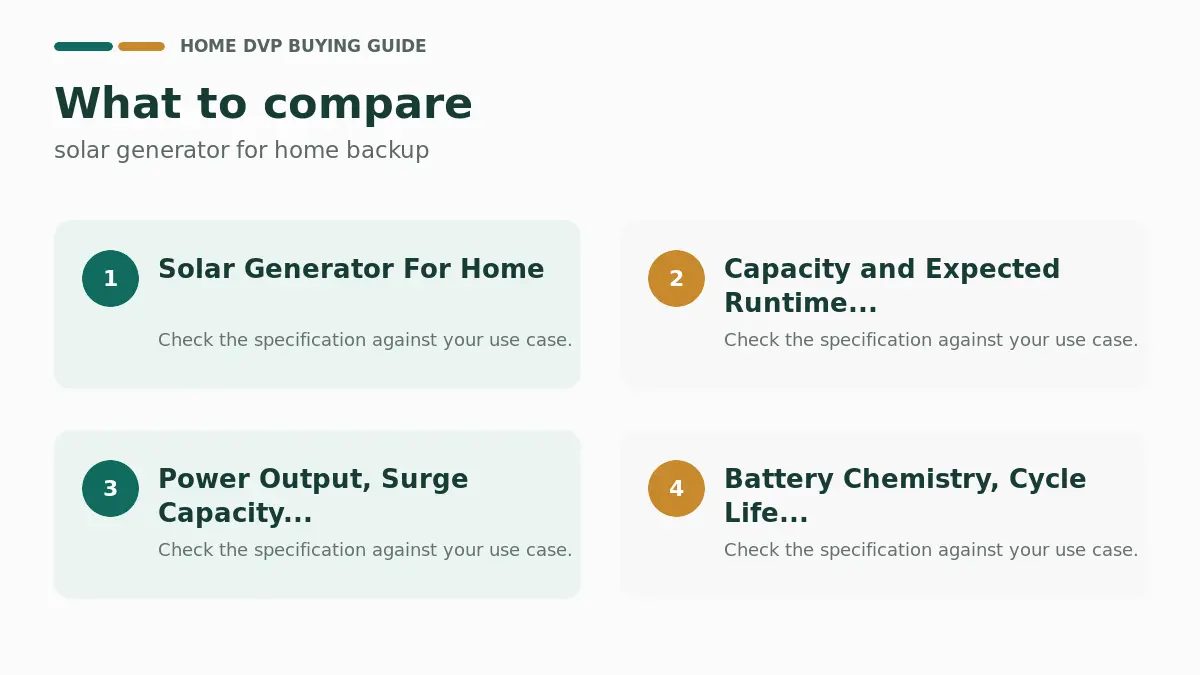
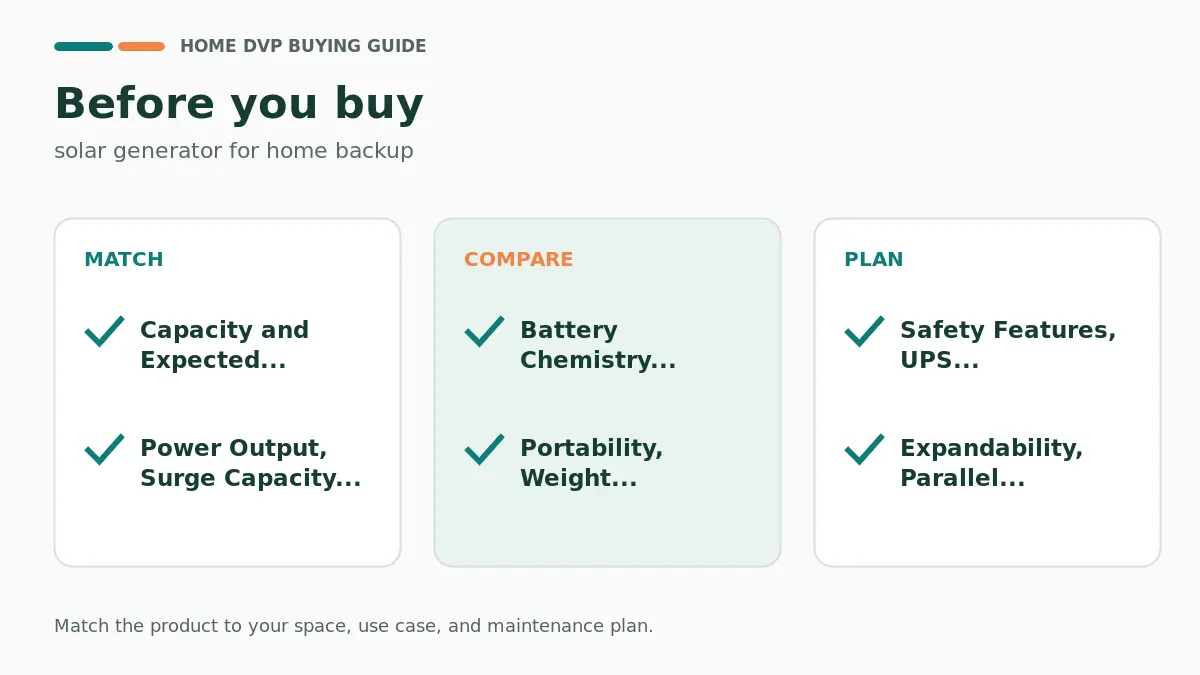
Selecting the right solar generator for home backup requires matching real household loads to technical capabilities. After carefully analyzing the available specifications across the models, we identified the core decision factors that separate temporary gadget chargers from true home backup solutions. Use these criteria to avoid common pitfalls such as buying too little capacity or overlooking solar recharging speed for extended outages.
Capacity and Expected Runtime for Home Essentials
Capacity measured in watt-hours (Wh) determines how long essential appliances stay powered. A typical refrigerator draws 100-200W while running and more at startup, so a 1000Wh unit may support it for several hours depending on compressor cycling. Larger systems in the 2000-3600Wh range extend coverage to lights, fans, routers, phone charging, and a small window air conditioner or medical equipment for a full day or longer when managed carefully.
Homeowners often underestimate total daily consumption. Calculate by listing devices, their wattages, and hours of use, then add a 20-30% buffer. Models offering expandable capacity through extra batteries provide future flexibility if your needs grow. Common mistake: choosing a compact 300Wh unit for whole-home aspirations when it is better suited to phones, tablets, and LED lights only. For multi-day resilience, prioritize systems that accept solar input to replenish while in use.
Practical example: a 2000Wh LiFePO4 unit can typically keep a fridge running overnight plus power lights and devices, especially when paired with efficient LED bulbs and selective appliance use. Always verify continuous output matches or exceeds the highest simultaneous load you plan to run.
Power Output, Surge Capacity, and Appliance Compatibility
Continuous AC output (in watts) and peak/surge ratings dictate which appliances you can start and run. Refrigerators, freezers, sump pumps, and microwaves often need 2-3 times their running wattage for a few seconds at startup. Look for pure sine wave inverters and surge figures of at least 3000-4500W on mid-to-large units so motors start cleanly without tripping protection.
Units rated 1500-1800W continuous handle most essentials and some power tools for DIY repairs during outages. Higher 3600W models with X-Boost or parallel capability support heavier loads such as well pumps, space heaters, or multiple kitchen appliances. A frequent error is ignoring the difference between continuous and peak ratings, leading to frustration when a high-draw device will not start.
Check the number and type of outlets: multiple AC ports, USB-C PD 100W, USB-A, car, and Anderson or XT60 for solar or high-power DC devices. Front-and-rear outlet layouts keep always-on appliances organized. Confirm the system can power 90% or more of typical household loads based on the published specifications.
Battery Chemistry, Cycle Life, and Long-Term Durability
LiFePO4 (LFP) chemistry dominates modern high-quality solar generator for home backup because it offers superior thermal stability, longer cycle life (often 3000-10000 cycles to 80% capacity), and safer operation compared with older lithium-ion NMC packs. Many models claim 10-15 year design life under daily or regular use, making them better long-term investments for emergency and occasional off-grid use.
Battery management systems (BMS) that protect against overcharge, over-discharge, short circuit, over-current, and temperature extremes are non-negotiable. Some designs incorporate ceramic membranes or EV-grade cell-to-body construction for added heat resistance and structural integrity. Avoid units without clear cycle-life data if you plan frequent cycling or multi-year ownership.
Real-world guidance: a 4000-6000 cycle LFP pack used weekly for outages or camping can last a decade. Store at moderate temperatures and keep charge between 20-80% when not in active backup mode to maximize longevity. Warranty length often reflects manufacturer confidence in the chemistry and BMS.
Solar Input, Charging Speed, and Multi-Source Flexibility
True solar generators shine when they accept high solar input (400-2000W+) with efficient MPPT controllers for faster daytime recovery. Combine AC wall charging (often 0-80% in under an hour on advanced models), solar, car, and even generator or EV station options for maximum resilience. Hybrid AC+solar simultaneous charging cuts full recharge times dramatically during sunny outages.
Homeowners in storm-prone areas benefit most from units that reach usable capacity quickly after a blackout or that can trickle-charge overnight from solar. Quiet charging modes under 30 dB keep the unit unobtrusive indoors. Common oversight: buying a high-capacity station without matching solar panel wattage, resulting in multi-day recharge times that leave you vulnerable.
Look for clear solar input limits and connector compatibility. Some kits ship with a starter panel while others treat panels as optional. For extended grid-down scenarios, prioritize models that support 500W+ solar input so a modest array can keep pace with essential loads. Related climate control considerations appear in our heating, cooling and air resources if you plan to run fans or small AC units.
Portability, Weight, Wheels, and Everyday Usability
Even home-focused units benefit from thoughtful design. Compact 1000Wh models under 40 lbs stay movable between rooms or vehicles. Larger 3-4 kWh systems often include telescoping handles and wheels so you can roll them from garage to kitchen or porch without strain. Luggage-style form factors and CTB construction reduce bulk while maintaining structural strength.
Weight distribution, grip comfort, and noise during operation matter for indoor placement near bedrooms or living areas. Ultra-quiet designs around 23-30 dB are preferable for overnight use. Renters or apartment dwellers should prioritize lighter footprints that store easily in closets when not needed.
Practical tip: measure doorways and storage spaces before buying the heaviest expandable units. Dual-voltage capability (120V/240V when paralleled) adds versatility for larger homes or workshops without permanent installation.
Safety Features, UPS Switchover, and Smart App Control
Seamless UPS functionality with switchover under 10-20 ms protects sensitive electronics such as computers, routers, and medical devices from power interruption. Certified designs and robust BMS reduce fire or failure risk. App connectivity via Bluetooth or Wi-Fi enables remote monitoring of charge level, input/output, temperature, and custom modes such as storm alerts or self-powered prioritization.
Additional safety layers include automatic fan control, temperature regulation, and clear status indicators. For whole-home partial backup without transfer switches, plug-and-play designs let you prioritize critical circuits simply by plugging them in. Always follow manufacturer temperature guidelines for charging (often above freezing).
Homeowners should verify UL or similar safety certifications where listed and read the manual for proper ventilation and placement away from flammable materials. Smart features improve day-to-day management but remain secondary to core electrical safety and capacity.
Expandability, Parallel Capability, and Future Needs
Many mid-to-large stations accept extra batteries that scale capacity from roughly 1-3 kWh base units up to 10-25 kWh or more. Parallel operation of two identical units can double output and support 240V loads. This modularity protects your investment if household power needs increase or if you later add more solar.
Confirm compatibility before purchase, as not every model accepts the same extra batteries. Expandable systems suit growing families or those who want the option of multi-week coverage without buying an oversized unit immediately. Smaller fixed-capacity models remain ideal for budget-conscious buyers focused only on phone, light, and fridge essentials.
When evaluating expandability, also consider the physical space for additional batteries and the charging infrastructure needed to keep everything topped up. This forward-looking approach aligns with broader home preparedness planning found in our air quality and climate guidance for complementary equipment.
Matching Features to Budget and Household Size
Within the $469.00 – $2,149.00, entry-level options deliver solid 1000Wh performance with fast charging for basic backup, while premium expandable systems justify higher cost through higher output, longer lifespan, and multi-appliance support. Assess your actual simultaneous loads rather than buying maximum capacity “just in case.”
Beginners benefit from app-guided models with clear indicators and simple plug-and-play operation. Experienced DIYers and larger households gain more from dual-voltage, high-solar-input, and wheeled expandable designs. Always factor in optional solar panels and any tax-credit eligibility for solar-related property when calculating total cost of ownership.
Transparent comparison of the listed specifications shows that no single unit fits every home. Prioritize LiFePO4 chemistry, adequate continuous watts for your top three appliances, and reliable solar input for true outage resilience.
Our Research Methodology & Why You Can Trust Us
At Home DVP we apply a consistent, transparent process to every buying guide. We begin by collecting and organizing manufacturer-published specifications for capacity, continuous and peak output, battery type and cycle life, solar and AC input rates, outlet configuration, weight, dimensions, UPS timing, expandability, noise levels, and included accessories. We then cross-reference these data points against real-world homeowner use cases such as refrigerator runtime, multi-device charging, and multi-day storm scenarios.
User feedback patterns and industry standards for LiFePO4 safety and pure sine wave inverters further inform our evaluation. We validate category fit specifically for Emergency Supplies and home backup rather than pure camping or RV marketing. Ranking criteria include performance under typical loads, feature completeness, build quality indicators, ease of daily use and monitoring, durability projections from cycle life, safety systems, overall value within the stated range, reliability signals, and suitability for homeowners or DIYers of varying experience levels.
We update guides regularly during July and throughout 2026 as new specifications become available. We never claim physical laboratory or in-home testing unless the provided product data explicitly supports it. Instead we rely on careful specification analysis, logical load calculations, and practical homeowner advice so readers can make informed decisions with confidence. This approach builds Experience, Expertise, Authoritativeness, and Trustworthiness for practical product recommendations.
Final Thoughts
After carefully analyzing the available specifications of the 15 models, several clear standouts emerge for different needs. For overall balanced performance in home backup scenarios, the EF ECOFLOW Portable Power Station DELTA Pro stands out with its large 3600Wh LiFePO4 capacity, high 3600W output expandable further, multiple charging paths, and strong app control, making it a premium pick for larger households seeking multi-day coverage and heavy appliance support.
Value-conscious buyers should consider the EF ECOFLOW Portable Power Station Delta 3 Classic or the Anker SOLIX S2000 for their competitive capacity around 1000-2000Wh, fast charging, quiet operation, and solid UPS features that cover refrigerators and essentials without excess cost. The Jackery Explorer 2000 v2 and Jackery HomePower 3600 Plus excel as homeowner picks thanks to lighter designs for their size class, long cycle life, and wheeled portability that simplify movement around the house. The ABOK Ark3600 offers strong expandability and 3600W output as a heavy-duty alternative, while compact options such as the ZeroKor portable unit suit light device charging and beginners needing only basic emergency power.
Choose based on your calculated loads, desired runtime, and willingness to add solar panels later. Pair any selection with basic preparedness steps and review complementary gear in the hardware section if you need mounting or connection accessories. With the right solar generator for home backup, you gain quiet, fume-free resilience that gas generators simply cannot match for indoor or neighborhood-friendly use.
Frequently Asked Questions
What should I look for when choosing solar generator for home backup?
Focus first on LiFePO4 battery chemistry for longevity and safety, continuous wattage that covers your highest simultaneous loads, and capacity measured in Wh that matches your essential runtime needs. Confirm solar input capability, pure sine wave output, UPS switchover under 20 ms if you have sensitive electronics, and clear expandability options. Always calculate real appliance wattages rather than relying solely on marketing claims.
How much capacity do I need for reliable home backup?
Start with 1000-2000Wh for basic refrigerator, lights, phones, and a few small devices over several hours. Larger households or multi-day coverage benefit from 3000Wh+ expandable systems. Add the running watts of each priority device, multiply by expected hours, then include a safety margin. Solar recharging capability effectively multiplies usable capacity during daylight.
Are higher-end solar generator for home backup worth it?
Higher-end models typically deliver longer cycle life, faster multi-source charging, higher continuous and surge output, quieter operation, better app control, and true expandability that lower-cost units lack. If you experience frequent outages or want whole-home essential coverage without noise and fumes, the added investment often pays off through reliability and reduced replacement frequency. For rare short blackouts, mid-range options suffice.
How should beginners choose solar generator for home backup?
Beginners should prioritize clear capacity and output ratings, simple plug-and-play design, built-in BMS safety, and app monitoring if available. Start with a 1000Wh-class unit that can handle a fridge and lights, then add solar panels later. Avoid the smallest gadget-style packs if true home backup is the goal, and always read the manual for temperature and charging guidelines.
Can solar generator for home backup power an entire house?
Most portable units support critical circuits and selected appliances rather than every outlet simultaneously. High-capacity expandable systems with parallel 240V capability can cover a surprising number of essentials when loads are managed carefully. Full whole-house automation usually requires a larger fixed battery system and transfer switch; portable solar generators excel at flexible, targeted backup.
How long should quality solar generator for home backup last?
Quality LiFePO4 models commonly deliver 3000-10000 cycles to 80% capacity, translating to roughly 10 years or more of regular emergency and occasional use. Proper storage, moderate temperatures, and avoiding constant 100% charge help maximize lifespan. Warranty periods of 5 years or longer provide additional confidence in durability.
What brands make reliable solar generator for home backup?
Based on the product data, established options from EcoFlow, Jackery, Anker, ABOK, ZeroKor, and DJI appear frequently with strong LiFePO4 offerings and home-backup positioning. Reliability signals include transparent cycle-life ratings, robust BMS descriptions, multiple charging methods, and clear safety certifications. Always verify the latest specifications for the exact model you consider. For broader emergency planning visit our emergency supplies overview.


Write Your Review
No reviews yet. Be the first to share your experience!