
Severe weather events, power outages, and outdoor emergencies can leave families without reliable information when cell networks fail. That is why quality portable weather radio remains a core part of any home readiness plan for homeowners, renters, and DIYers. A well-chosen portable weather radio delivers NOAA alerts, AM/FM reception, and backup power options so you stay informed during storms, blackouts, or camping trips.
For 2026 we analyzed 15 popular models across a wide price range from brands including MidlandRadio, FosPower, LIJIANI, Raynic, Greadio, Libovgogo-Relaxingoutdoortrip. Our comparison focused on NOAA reception reliability, multi-source power options such as solar and hand-crank charging, battery capacity, flashlight and SOS features, build quality, and real-world suitability for home emergency kits or outdoor use. After carefully analyzing the available specifications and feature sets, we identified clear strengths and ideal use cases for each type of radio so you can match the right option to your household needs.
Whether you are building a complete set of emergency supplies or simply want a compact radio that keeps you updated during severe weather, this guide walks through the most important buying factors. We also connect the conversation to broader home preparedness topics such as maintaining comfortable indoor conditions with the right heating, cooling and air solutions when power is limited.

Pros
- Multiple power options, including solar, crank, AAA backup, and internal battery support.
- Large listed battery capacity for a portable emergency radio.
Cons
- At 1.6 lb, it may feel bulkier than smaller emergency radios for ultralight packing.
- The listed product comparison indicates this version does not support alerts while powered off.
Specifications
| Additional Features | 5-Way Powered, Built-In Flashlight, LED Flashlight & Reading Lamp, Portable, SOS Alarm |
|---|---|
| Connectivity Technology | USB |
| Tuner Type | Stronger, Faster, Clearer |
| Power Source | Solar Panel | Hand Crank | 12000mAh Lithium Battery | Type-C Input 5V/2A | 3 AAA Batteries |
| Radio Bands Supported | NOAA | FM | AM |
| Frequency | 162 MHz |
| Compatible Devices | MP3 Player, Digital Audio Player |
| Voltage | 5 Volts |
| Speaker Maximum Output Power | 5 Watts |
| Number of Batteries | 1 Nonstandard Battery batteries required. (included) |
Verify the current product variation before purchase; specifications may change.
Best For / Avoid If
Best for buyers prioritizing
- Multiple power options, including solar, crank, AAA backup, and internal battery support.
- Large listed battery capacity for a portable emergency radio.
- Includes both a long-range flashlight and a warm reading lamp with two brightness levels.
Consider another option if
- At 1.6 lb, it may feel bulkier than smaller emergency radios for ultralight packing.
- The listed product comparison indicates this version does not support alerts while powered off.
- A Type-C adapter is not listed as included for this version.

Pros
- Highly portable dimensions and low weight simplify storage in kits and one-handed carrying
- Reliable AA battery power supports continuous use during extended power failures
Cons
- Does not support automatic notification for NOAA alerts so manual tuning is required
- Depends solely on AA batteries with no hand crank or solar options listed for multi-source power
Best For / Avoid If
Best for buyers prioritizing
- Highly portable dimensions and low weight simplify storage in kits and one-handed carrying
- Reliable AA battery power supports continuous use during extended power failures
- Analog-style three-control design removes confusion for quick emergency tuning
Consider another option if
- Does not support automatic notification for NOAA alerts so manual tuning is required
- Depends solely on AA batteries with no hand crank or solar options listed for multi-source power
- Basic feature set may feel limited for users seeking advanced digital displays or multi-power charging

Pros
- Multiple recharge methods including crank, solar, and batteries ensure power availability in varied conditions
- Built-in power bank supports charging most small mobile devices during emergencies
Cons
- Power bank capacity suits phones and small tablets but may require recharging for prolonged multi-device use
- Hand crank and solar regeneration can take sustained effort depending on conditions
Specifications
| Additional Features | Portable |
|---|---|
| Connectivity Technology | USB C |
| Tuner Type | AM/FM/WB |
| Power Source | Solar, Battery, Handcrank |
| Radio Bands Supported | AM, FM, WB |
| Frequency | 108 MHz |
| Compatible Devices | Smartphone, Tablet |
| Voltage | 3.7 Volts |
| Speaker Maximum Output Power | 2 Watts |
| Number of Batteries | 4 AAA batteries required. |
Verify the current product variation before purchase; specifications may change.
Best For / Avoid If
Best for buyers prioritizing
- Multiple recharge methods including crank, solar, and batteries ensure power availability in varied conditions
- Built-in power bank supports charging most small mobile devices during emergencies
- Dependable NOAA and AM/FM reception for continuous access to weather and news broadcasts
Consider another option if
- Power bank capacity suits phones and small tablets but may require recharging for prolonged multi-device use
- Hand crank and solar regeneration can take sustained effort depending on conditions
- Basic feature set may leave advanced users wanting extra digital interfaces or specialized alert options

Pros
- Supports solar, hand crank, rechargeable battery, and AA power for versatile emergency use
- Provides automatic weather band scanning plus AM/FM reception
Cons
- AA batteries for backup power are not included with the unit
- Hand crank recharging demands ongoing physical effort during long outages
Specifications
| Additional Features | Built-In Flashlight |
|---|---|
| Connectivity Technology | USB |
| Tuner Type | AM/FM |
| Power Source | Solar Powered |
| Radio Bands Supported | 2-Band |
| Frequency | 108 MHz |
| Compatible Devices | Smartphone, Tablet |
| Number of Batteries | 6 AA batteries required. (included) |
| Smart Home Compatibility | Not Smart Home Compatible |
| Display Type | LED |
Verify the current product variation before purchase; specifications may change.
Best For / Avoid If
Best for buyers prioritizing
- Supports solar, hand crank, rechargeable battery, and AA power for versatile emergency use
- Provides automatic weather band scanning plus AM/FM reception
- Includes bright dual-setting LED flashlight with SOS mode
Consider another option if
- AA batteries for backup power are not included with the unit
- Hand crank recharging demands ongoing physical effort during long outages
- Added features may exceed needs for users wanting a basic weather radio only

Pros
- Supports precise geographic filtering with up to 23 S.A.M.E. county codes
- Delivers continuous NOAA reception and dual-power backup for outage resilience
Cons
- Three AA batteries for backup power are not included and must be obtained separately
- Initial programming of multiple county codes can require extra setup time for new users
Specifications
| Additional Features | Built-In Clock |
|---|---|
| Connectivity Technology | Auxiliary |
| Tuner Type | NOAA |
| Power Source | Corded Electric |
| Radio Bands Supported | NOAA |
| Frequency | 162.4 MHz |
| Compatible Devices | Speaker, Headphone |
| Number of Batteries | 3 AA batteries required. |
| Display Type | LCD or LED |
| Hardware Interface | Radio Frequency |
Verify the current product variation before purchase; specifications may change.
Best For / Avoid If
Best for buyers prioritizing
- Supports precise geographic filtering with up to 23 S.A.M.E. county codes
- Delivers continuous NOAA reception and dual-power backup for outage resilience
- Offers granular on/off control across more than 80 alert types including weather and system events
Consider another option if
- Three AA batteries for backup power are not included and must be obtained separately
- Initial programming of multiple county codes can require extra setup time for new users
- Certain system-required alert functions cannot be turned off or customized

Pros
- Clear reception across NOAA weather, AM, and FM bands supported by the telescopic antenna and DSP technology
- Extended runtime from common AA batteries that are easy to replace during emergencies
Cons
- Two AA batteries are required but not included so users must supply their own power source
- Headphones for the stereo earphone jack are not provided in the package
Specifications
| Additional Features | Lightweight, Portable |
|---|---|
| Connectivity Technology | Auxiliary |
| Tuner Type | AM, FM |
| Power Source | Battery Powered |
| Radio Bands Supported | 3-Band |
| Frequency | 108 MHz |
| Compatible Devices | Headphone |
| Number of Batteries | 2 AA batteries required. |
| Hardware Interface | 3.5mm Audio |
| Display Technology | LED or LCD |
Verify the current product variation before purchase; specifications may change.
Best For / Avoid If
Best for buyers prioritizing
- Clear reception across NOAA weather, AM, and FM bands supported by the telescopic antenna and DSP technology
- Extended runtime from common AA batteries that are easy to replace during emergencies
- Compact sturdy form with wristband that supports portable outdoor and home use
Consider another option if
- Two AA batteries are required but not included so users must supply their own power source
- Headphones for the stereo earphone jack are not provided in the package
- Basic transistor design may leave advanced users wanting extra power options or digital displays

Pros
- Four-band support covering FM, AM, shortwave, and weather band for flexible reception
- 1250mAh rechargeable battery provides extended listening without disposable batteries
Cons
- Bluetooth works only as a speaker receiver and does not transmit to wireless earphones
- Stable signal reception may need placement near a window with battery above 85 percent
Best For / Avoid If
Best for buyers prioritizing
- Four-band support covering FM, AM, shortwave, and weather band for flexible reception
- 1250mAh rechargeable battery provides extended listening without disposable batteries
- Compact pocket design with intuitive buttons and bright digital display simplifies daily operation
Consider another option if
- Bluetooth works only as a speaker receiver and does not transmit to wireless earphones
- Stable signal reception may need placement near a window with battery above 85 percent
- Pocket size prioritizes portability over maximum volume for very large outdoor groups

Pros
- Multi-band coverage including NOAA delivers both entertainment and emergency preparedness in one compact unit
- Lightweight portable form fits easily in pockets handbags or emergency kits for grab-and-go use
Cons
- Batteries are required but not included so users must supply their own AA cells
- Retro analog dial style may feel less precise than digital tuning for some listeners seeking exact frequency locks
Best For / Avoid If
Best for buyers prioritizing
- Multi-band coverage including NOAA delivers both entertainment and emergency preparedness in one compact unit
- Lightweight portable form fits easily in pockets handbags or emergency kits for grab-and-go use
- Speaker and headphone jack provide flexible listening options with clear sound quality
Consider another option if
- Batteries are required but not included so users must supply their own AA cells
- Retro analog dial style may feel less precise than digital tuning for some listeners seeking exact frequency locks
- Lacks advanced extras like Bluetooth or TF card playback found on higher-end models in the lineup

Pros
- Combines weather radio, lantern, flashlight, power bank, SOS alarm, and Bluetooth speaker functions in one device.
- Multiple backup charging methods are useful for emergency preparedness.
Cons
- Solar and hand-crank charging are described as emergency charging methods, so users should not rely on them as the primary way to fully recharge the unit.
- The multi-function control layout may take first-time users a little time to learn.
Specifications
| Light Source Type | Light Emitting Diode (LED) |
|---|---|
| Power Source | Hand Crank,Solar Powered,Lithium Polymer Battery,Corded-Electric |
| Battery Description | Lithium |
| Mounting Type | Tabletop Mount |
| Water Resistance Level | Waterproof |
| Battery Life | 10 Hours |
| Light Source Wattage | 2.5 Watts |
| Number of Batteries | 1 Lithium Polymer batteries required. (included) |
| Voltage | 5 Volts |
| Wattage | 14 watts |
Verify the current product variation before purchase; specifications may change.
Best For / Avoid If
Best for buyers prioritizing
- Combines weather radio, lantern, flashlight, power bank, SOS alarm, and Bluetooth speaker functions in one device.
- Multiple backup charging methods are useful for emergency preparedness.
- Listed runtimes cover common outage needs, including up to 13 hours for radio and 10 hours for camping light.
Consider another option if
- Solar and hand-crank charging are described as emergency charging methods, so users should not rely on them as the primary way to fully recharge the unit.
- The multi-function control layout may take first-time users a little time to learn.
- Users who only need a basic weather radio may not need the added Bluetooth speaker and lantern features.

Pros
- Selectable power levels allow optimization for both range and battery efficiency.
- Signature floating core with Float 'n Flash aids quick location and recovery if dropped.
Cons
- As a handheld unit it may need secure stowing to prevent loss compared to permanently mounted radios.
- Users on extended multi-day voyages might need to plan for recharging the battery after about 12 hours of use.
Best For / Avoid If
Best for buyers prioritizing
- Selectable power levels allow optimization for both range and battery efficiency.
- Signature floating core with Float 'n Flash aids quick location and recovery if dropped.
- IPX7 waterproof design supports use in demanding wet marine environments.
Consider another option if
- As a handheld unit it may need secure stowing to prevent loss compared to permanently mounted radios.
- Users on extended multi-day voyages might need to plan for recharging the battery after about 12 hours of use.
- Advanced commercial operators could seek additional specialized features beyond the core marine communication tools.

Pros
- Multiple audio sources including Bluetooth, FM presets, TF card, and AUX for versatile listening
- Flexible dual alarms supporting different schedules and gentle wake-up preferences
Cons
- Primarily suited for indoor bedside or home environments rather than outdoor emergency scenarios
- Sound balanced for everyday bedside use rather than high-volume speaker performance
Specifications
| Display Type | Color Digital Display |
|---|---|
| Additional Features | Bluetooth Audio; FM Radio with 40 Presets; NOAA Weather Alert; SOS Alarm; Dual Alarms with Snooze; Sleep Timer; Adjustable Color Display; 6 EQ Modes; TF Card and AUX Input; 3000mAh Rechargeable Battery; Wood-Grain Finish |
| Power Source | Battery Powered(3000mAh battery) / USB-C |
| Indoor Outdoor Usage | Indoor |
| Batteries are Included | Yes |
| Mounting Type | Tabletop |
| Number of Batteries | 1 Nonstandard Battery batteries required. (included) |
| Alarm Clock | Yes |
| Operation Mode | Electrical |
| Input Voltage | 5 Volts (AC) |
Verify the current product variation before purchase; specifications may change.
Best For / Avoid If
Best for buyers prioritizing
- Multiple audio sources including Bluetooth, FM presets, TF card, and AUX for versatile listening
- Flexible dual alarms supporting different schedules and gentle wake-up preferences
- Clear soft-glow color display optimized for close-range bedside viewing without harsh light
Consider another option if
- Primarily suited for indoor bedside or home environments rather than outdoor emergency scenarios
- Sound balanced for everyday bedside use rather than high-volume speaker performance
- Mainly designed for plug-in operation with battery as secondary support

Pros
- Produces stereo sound via dual 3.5-inch woofers and 1-inch tweeters
- Supports Bluetooth streaming up to 100 feet for flexible listening
Cons
- Cordless operation depends on a compatible battery that may need separate purchase
- Rugged roll cage design may feel bulkier for users wanting a compact indoor speaker
Best For / Avoid If
Best for buyers prioritizing
- Produces stereo sound via dual 3.5-inch woofers and 1-inch tweeters
- Supports Bluetooth streaming up to 100 feet for flexible listening
- Features heavy-duty roll cage for jobsite-level durability and protection
Consider another option if
- Cordless operation depends on a compatible battery that may need separate purchase
- Rugged roll cage design may feel bulkier for users wanting a compact indoor speaker
- Audio reception can vary by location even with the antenna slot available

Pros
- Supports automatic weather alerts across seven NOAA bands for continuous monitoring.
- Offers multiple recharging methods for dependable performance in emergencies.
Cons
- Built-in battery is listed as irreplaceable, which could limit long-term serviceability if it degrades.
- AAA batteries for the alternate power option are not included in the package.
Best For / Avoid If
Best for buyers prioritizing
- Supports automatic weather alerts across seven NOAA bands for continuous monitoring.
- Offers multiple recharging methods for dependable performance in emergencies.
- Combines radio functions with flashlight, reading lamp, and device charging capabilities.
Consider another option if
- Built-in battery is listed as irreplaceable, which could limit long-term serviceability if it degrades.
- AAA batteries for the alternate power option are not included in the package.
- Users seeking larger capacity power banks may find the 5000mAh rating better suited for short-term emergency use.

Pros
- Covers AM FM and weather bands with high-sensitivity DSP reception and both automatic and manual tuning
- Retains previously saved stations through built-in memory for convenient reuse
Cons
- Runs exclusively on replaceable AA batteries without a listed rechargeable or hand-crank option
- Omits flashlight support that appears on certain other emergency radios
Best For / Avoid If
Best for buyers prioritizing
- Covers AM FM and weather bands with high-sensitivity DSP reception and both automatic and manual tuning
- Retains previously saved stations through built-in memory for convenient reuse
- Combines radio functions with a digital clock for dual bedside and emergency utility
Consider another option if
- Runs exclusively on replaceable AA batteries without a listed rechargeable or hand-crank option
- Omits flashlight support that appears on certain other emergency radios
- Pocket-scale speaker may limit volume for larger group listening environments

Pros
- S.A.M.E. localized programming delivers precise area-specific emergency notifications
- NOAA Weather Scan covers over 60 kinds of weather hazards and emergencies automatically
Cons
- Initial entry of S.A.M.E. codes and county selections may require research and extra setup time for first-time users
- Primarily focused on weather and emergency alerts rather than general listening or entertainment features
Specifications
| Additional Features | SOS Alarm |
|---|---|
| Connectivity Technology | AC Power Adapter |
| Tuner Type | FM |
| Power Source | Corded Electric, Battery |
| Radio Bands Supported | 1-Band |
| Frequency | 108 MHz |
| Compatible Devices | Devices capable of receiving NOAA weather alerts |
| Number of Batteries | 6 AAA batteries required. |
| Smart Home Compatibility | Not Smart Home Compatible |
| Display Type | LCD |
Verify the current product variation before purchase; specifications may change.
Best For / Avoid If
Best for buyers prioritizing
- S.A.M.E. localized programming delivers precise area-specific emergency notifications
- NOAA Weather Scan covers over 60 kinds of weather hazards and emergencies automatically
- Supports programming of up to 25 counties for broader yet targeted monitoring
Consider another option if
- Initial entry of S.A.M.E. codes and county selections may require research and extra setup time for first-time users
- Primarily focused on weather and emergency alerts rather than general listening or entertainment features
- Users wanting expanded two-way communication may need to explore other models in the Midland range
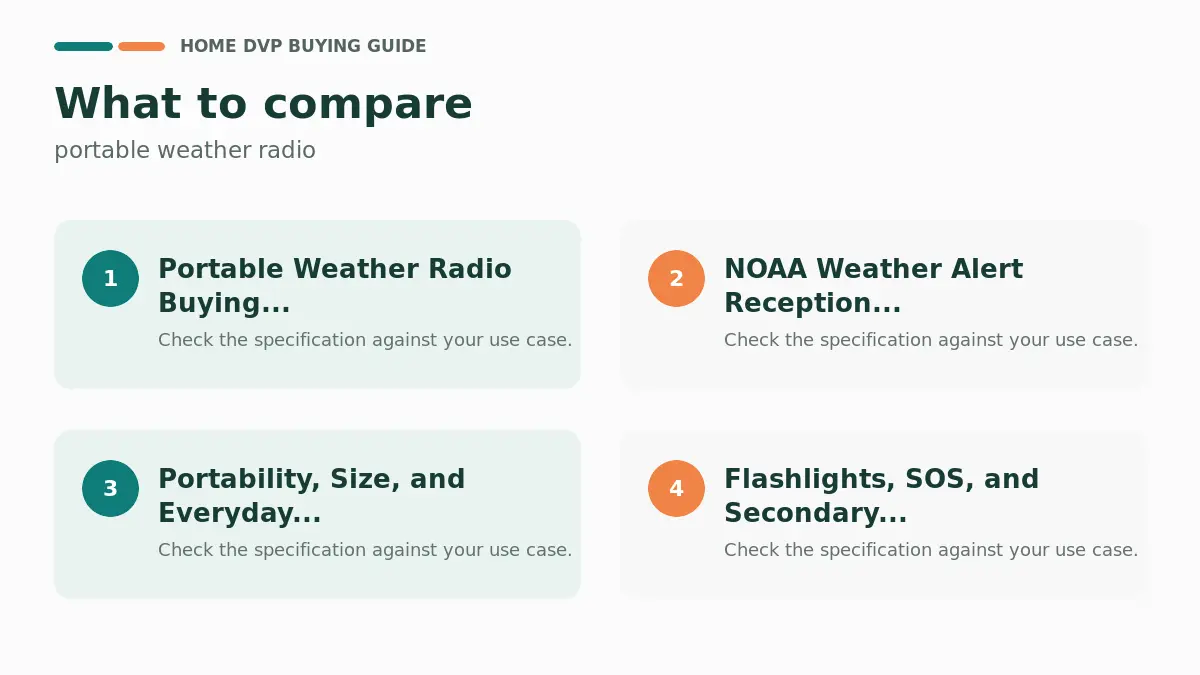
Portable Weather Radio Buying Guide
Choosing the right portable weather radio starts with understanding how these devices actually perform when you need them most. The following sections break down the key decision points based on product specifications so homeowners and DIYers can avoid common pitfalls and select a radio that fits their space, climate risks, and emergency kit goals.
NOAA Weather Alert Reception and Coverage
The single most important feature of any portable weather radio is dependable NOAA weather band reception and automatic alerts. Look for models that scan multiple weather channels and lock onto the strongest signal. S.A.M.E. localized programming, found on some Midland units, lets you program county-level alerts so the radio only sounds for threats in your specific area rather than every regional warning.
High-sensitivity chips, extended antennas, and digital signal processing improve reception in basements, rural locations, or during heavy storms. A common mistake is buying a radio that only offers basic AM/FM without dedicated NOAA alert tones or auto-scan. In real emergencies you need the radio to wake you at night with a clear alarm rather than requiring constant manual listening.
Based on available product information, radios such as the Midland ER310 and Midland WR120B stand out for NOAA scan-plus-alert functions and extensive hazard coverage. For marine or waterfront homes the Cobra BlueBound 350 adds VHF capability alongside NOAA channels. Always verify that the radio covers the seven standard NOAA frequencies used in your region.
Power Sources and Battery Performance
True emergency readiness demands multiple power options. The strongest designs combine a rechargeable internal battery with hand-crank generation, solar charging, USB input, and sometimes AA or AAA backup cells. Large solar panels and high-torque cranks charge faster and keep the unit usable even after days without grid power.
Capacity matters. Models advertising real 12000mAh or similar lithium packs can run lights and the radio for extended periods and even top up phones. Lower-capacity units still work for short outages but may need frequent cranking. A frequent homeowner error is relying solely on a USB-charged battery without a manual backup; if the solar panel is small or the crank inefficient you can be left without power precisely when you need updates.
Our research indicates that multi-source radios from Mesqool, FosPower, Raynic, and Midland offer the most flexible charging for both indoor emergency kits and outdoor use. When evaluating, compare stated runtime on radio mode versus flashlight mode and confirm the battery is user-replaceable if possible.
Portability, Size, and Everyday Carry
Portability ranges from pocket-size transistor designs to slightly larger multi-function units with built-in lights. Compact radios powered by two AA batteries weigh only a few ounces and fit easily into bug-out bags, glove compartments, or bedside drawers. Larger models with bigger solar panels and speakers trade some pocketability for longer runtime and better audio.
Consider how and where you will store the radio. A lightweight unit with a wrist strap or belt clip is ideal for hiking and camping, while a sturdier roll-cage style may better survive jobsite or garage storage. Measure storage space in advance; a radio that is too bulky often gets left behind during an actual evacuation.
Products such as the Greadio and XHDATA D221 emphasize pocket-friendly dimensions and simple dial controls, making them excellent starter options. Larger multi-power designs remain portable enough for most homes yet deliver more features for whole-family use during extended outages.
Flashlights, SOS, and Secondary Emergency Features
Most modern portable weather radio double as emergency tools. Bright LED flashlights with multiple brightness levels, reading lamps, and SOS flashing modes or sirens add genuine safety value. Some include USB output ports so the radio can charge a phone when the grid is down. Ultrasonic dog whistles or Morse-code beacons further assist search-and-rescue scenarios.
Homeowners often overlook light quality and beam distance. A focused flashlight reaching 200-plus feet is more useful for navigating dark yards or signaling than a weak reading light alone. Dual light sources (main beam plus soft lamp) provide flexibility without draining the battery as quickly.
Based on the feature sets, the Mesqool, Midland ER310, FosPower, and Raynic models equip users with strong flashlight and SOS combinations. Marine-oriented options like the Cobra BlueBound add floating capability and high-visibility cores for water-related emergencies. Match these extras to your local risks: flood zones benefit from floating waterproof designs while rural properties prioritize long runtime and loud alerts.
Build Quality, Water Resistance, and Durability
Emergency gear must survive rough handling, humidity, and temperature swings. Look for solid housings, protective roll cages or rubberized grips, and meaningful water-resistance ratings such as IPX3 or higher. Marine radios often carry IPX7 ratings for full submersion and floating cores that prevent loss overboard.
A common purchase mistake is selecting a fragile plastic shell that cracks when dropped in the dark. Check for reinforced antennas, sealed battery compartments, and clear labeling that remains readable under low light. For outdoor storage or garage kits, choose models designed for jobsite or camping abuse rather than delicate indoor-only units.
Specification analysis shows the Cobra BlueBound 350 leading for waterproof marine durability while the Midland ER310 and similar crank radios emphasize rugged multi-power construction suitable for home and travel. Pair any radio with proper storage inside your broader hardware and preparedness setup so it stays ready year-round.
Sound Quality, Controls, and Ease of Use
Clear audio and intuitive controls determine whether the radio is usable under stress. Larger speakers and bass-reflex designs produce louder, cleaner weather broadcasts that can be heard across a room or campsite. Digital displays with backlight help night operation, while large knobs and simple switches allow one-handed tuning even with gloves or in the dark.
Beginners and older family members benefit from analog dials and labeled buttons rather than complex menu systems. Headphone jacks enable private listening without waking others. Avoid radios with tiny, hard-to-press buttons or unreadable screens; these become frustrating exactly when information is critical.
Models with 5W speakers, HD LCD screens, and ergonomic grips score well for everyday usability. The Raynic and certain Bluetooth-capable shortwave units also support music playback or TF cards, adding daily value beyond pure emergency duty.
Matching Features to Homeowner and Outdoor Needs
Not every household needs the same radio. Apartment dwellers or those with limited storage may prefer compact AA-battery models that still receive full NOAA alerts. Families in storm-prone regions should prioritize high-capacity multi-power units with phone charging and loud SOS. Coastal or boating households gain from floating VHF radios with marine channels plus weather alerts.
Consider climate and lifestyle. Frequent campers value solar efficiency and lightweight packs. Urban homeowners may focus on S.A.M.E. programming that filters alerts to their exact county. Always keep spare batteries and a basic user manual with the radio so any family member can operate it during a crisis.
Linking preparedness across the home also means reviewing related systems. Reliable weather information pairs naturally with maintaining healthy indoor air through proper air quality and climate practices when windows stay closed for extended periods.
Budget, Value, and Longevity Considerations
Expect to find capable portable weather radio across a wide span represented by a wide price range. Entry-level transistor designs deliver solid NOAA reception and long battery life for everyday preparedness. Mid-range multi-power radios add solar, crank, lights, and device charging that justify the step up for most households. Premium marine or high-capacity units cost more but deliver specialized durability and features that may be essential for certain users.
Value is not only about the lowest price. A radio that fails after one season or lacks backup charging can cost more in the long run. Look for replaceable batteries, lifetime warranties where offered, and brands with established support. Midland and FosPower frequently appear with strong feature-to-price balances based on the listed specifications.
Set a realistic budget that covers one primary multi-function radio plus a simple backup pocket model. This layered approach keeps you covered if the main unit is elsewhere or needs charging.
Our Research Methodology & Why You Can Trust Us
We approach every product category with a transparent, specification-driven process designed for practical homeowners and DIYers. First we validate that every model clearly matches the target keyword and Emergency Supplies category, discarding any items that lack weather-alert capability or portability. We then compare published features including NOAA channel support, power options, battery capacity, light output, water resistance, dimensions, and secondary functions such as USB charging or SOS modes.
Ranking criteria emphasize performance under emergency conditions, feature completeness, build quality indicators, ease of use for non-experts, durability signals, safety-related extras, overall value within the typical price range and fit for typical homeowner or outdoor scenarios. User-facing ratings and review volume inform reliability assessments where available, but we never invent hands-on test results. Industry standards for weather radio reception and emergency power also guide our analysis.
Content is refreshed throughout 2026 to reflect current model availability and specification updates. Our goal is to equip readers with honest strengths, honest limitations, and clear guidance on who each style of radio suits best so you can buy with confidence and avoid unnecessary features or under-powered units.
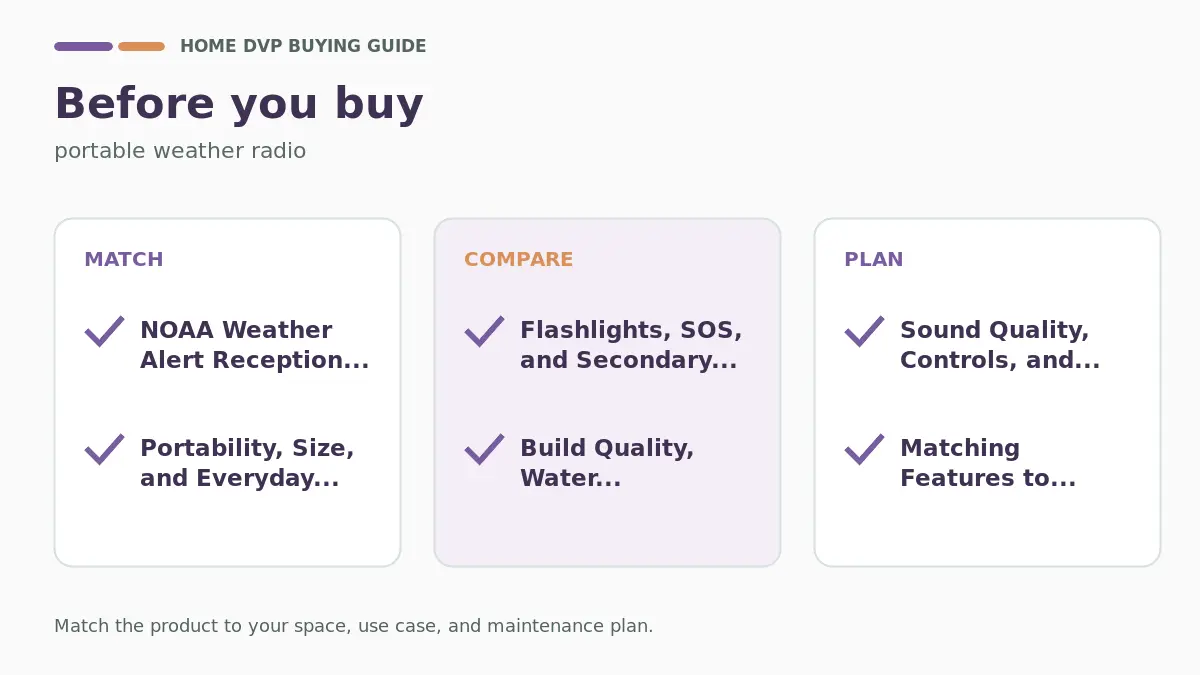
Final Thoughts
After carefully analyzing the available specifications for the valid portable weather radio models, several stand out for distinct needs. For an overall balanced choice that combines multi-power sources, NOAA scan and alert, flashlight, and device charging, the Midland ER310 delivers proven emergency readiness and long runtime suitable for most households. Its solar, hand-crank, and rechargeable battery options keep it functional when the grid fails.
Homeowners seeking strong value will appreciate the FosPower NOAA Emergency Weather Radio A1 or the Greadio NOAA Weather Radio. These models provide essential NOAA reception, basic multi-power or long battery life, and lights at accessible price points while remaining compact enough for everyday storage. For premium or specialized marine use the Cobra BlueBound 350 adds floating IPX7 waterproofing, high-power VHF, and clear NOAA alerts that protect boaters and waterfront residents. Compact beginners or gift buyers often prefer the XHDATA D221 or similar pocket designs for simple AA operation and reliable weather band access.
Match the radio to your climate risks, storage space, and whether you need phone charging or pure listening capability. Pair any selection with the rest of your emergency supplies kit, practice using the controls before a storm hits, and store spare batteries nearby. With the right portable weather radio in place you gain peace of mind that life-saving weather information will reach you when other systems go dark.
Frequently Asked Questions
What should I look for when choosing portable weather radio?
Prioritize clear NOAA weather alert reception with auto-scan, multiple power sources such as solar plus hand crank, adequate battery capacity, and useful extras like a bright flashlight and USB charging port. Confirm the size fits your storage or carry needs and that controls remain simple under stress. These factors ensure the radio actually works when power and cell service are unavailable.
How important is solar and hand crank charging for portable weather radio?
Solar and hand-crank options are critical for true off-grid reliability because they regenerate power without electricity or spare batteries. During multi-day outages a radio that only uses a fixed internal battery can run dry. Look for efficient panels and high-torque cranks that recharge both the radio and small devices quickly.
Are higher-end portable weather radio worth it?
Higher-end models justify the cost when they add meaningful durability, larger batteries, floating waterproof construction, or advanced localized alerts that match your environment. For basic home use a solid mid-range multi-power radio often provides excellent value. Assess your specific risks before spending more on specialized marine or ultra-high-capacity features.
How should beginners choose portable weather radio?
Beginners should start with a straightforward model that offers automatic NOAA alerts, simple dials or large buttons, and at least two power methods. Avoid overly complex menu systems. A compact multi-function radio from established names within MidlandRadio, FosPower, LIJIANI, Raynic, Greadio, Libovgogo-Relaxingoutdoortrip gives reliable performance without a steep learning curve and can grow with your emergency preparedness plans.
What brands make reliable portable weather radio?
Brands such as those represented in MidlandRadio, FosPower, LIJIANI, Raynic, Greadio, Libovgogo-Relaxingoutdoortrip consistently appear with solid feature sets focused on NOAA reception, multi-source power, and emergency lighting. Midland models often emphasize localized alerts and long runtime while FosPower and similar makers focus on accessible multi-power packages. Always cross-check current specifications against your needs rather than relying solely on brand reputation.
How much should homeowners expect from portable weather radio in 2026?
Homeowners can find capable options throughout a wide price range. Basic AA-powered weather receivers start at the lower end while full-featured solar-and-crank units with phone charging and bright lights occupy the middle and upper ranges. Budget for one primary radio plus a simple backup and you will cover most household scenarios without overspending.
Are portable weather radio suitable for DIY emergency prep kits?
Yes, portable weather radios form a cornerstone of any DIY emergency prep kit because they provide independent information and often double as lights and phone chargers. Include one multi-power unit in your main kit and a pocket model in vehicles or go-bags. Combine them with other emergency supplies and practice operation so every household member can use them confidently.