
HEPA Air Purifier for Large Rooms: A HEPA air purifier for large rooms should be sized by clean-air delivery, room volume, and the air-change target—not by the largest marketing coverage number alone. We compare 15 options using published specifications, filtration details, noise and control features, filter availability, and realistic ownership considerations.
Indoor air quality matters in large rooms because open living areas, bedrooms, basements, kitchens, and shared family spaces collect dust, pet dander, smoke particles, pollen, odors, and everyday airborne debris. Choosing a HEPA air purifier for large rooms is not just about picking the unit with the largest coverage claim. Homeowners and renters also need to consider CADR, filter design, noise level, smart controls, maintenance needs, and whether the purifier can realistically refresh the air in the room where it will be used most.
After carefully analyzing the available specifications, we compared 15 products across performance claims, filtration details, room coverage, ease of use, sensor features, sleep modes, filter maintenance, and overall suitability for practical home use. If you are planning a broader indoor comfort upgrade, our Air Quality & Climate category is also a helpful place to compare related home comfort products.
Based on the product data provided, the most relevant models for this guide are large-room air purifiers with HEPA, HEPA-grade, True HEPA, or high-efficiency particulate filtration claims. We did not include unrelated product types, and we avoided making hands-on testing claims. Instead, this guide focuses on what homeowners can verify from listed features, performance specifications, and practical use-case fit.
How to Size a HEPA Air Purifier for a Large Room
Measure the full connected space the purifier will serve. Open floor plans, ceilings above eight feet, smoke concerns, frequent door opening, and high particle loads can justify more clean-air capacity or more than one unit.
| Comparison point | What to verify |
|---|---|
| Smoke CADR | Use a certified or clearly published CADR to compare particle-cleaning output across models. |
| Air changes | Check how often the unit can process the room’s air volume, not only the maximum square-foot claim. |
| Lowest useful speed | A purifier that is quiet enough to run continuously may deliver more practical benefit than one used rarely on high. |
| Filter ownership cost | Confirm the exact filter number, replacement availability, interval, price, and whether carbon media is substantial. |
No portable purifier removes every pollutant or replaces source control, appropriate ventilation, humidity management, or professional remediation.

Pros
- Real-time air quality display and automatic speed adjustment reduce guesswork for consistent results
- NanoSeal filter exceeds basic HEPA requirements by capturing more micro-particles
- Quiet operation and dimmable lights make nighttime use practical in bedrooms
- Large room coverage suits open living spaces without needing multiple units
Cons
- Genuine Shark replacement filters are required to preserve performance and avoid damage
- Unit dimensions may occupy noticeable floor space in compact rooms
- Ongoing filter replacements add recurring maintenance every six to twelve months
Based on the provided product details, the Shark HP201 air purifier targets homeowners who need reliable air cleaning in larger indoor areas such as living rooms and basements. It combines Clean Sense IQ monitoring with Pure Air Microforce technology to sense particle levels and respond automatically.
The listed features indicate strong performance through four fan speeds that scale with detected air quality. The Anti-Allergen NanoSeal HEPA filter handles smoke, VOCs, dust, dander, and other non-living pollutants while exceeding standard HEPA capture rates for particles between 0.1 and 0.2 microns.
Controls appear straightforward with a panel that shows real-time air quality percentage, filter life, fan speed, and Eco mode. Dimmable lights and low-noise operation support use during sleep without unnecessary distraction.
Practical applications include protecting indoor air in homes with pets, recent renovations, or nearby wildfire smoke. The 1000-square-foot coverage rating based on one air change per hour makes it suitable for open-plan spaces where consistent circulation matters.
Filter replacements must use genuine HE2FKPRO Shark models every six to twelve months to maintain function, which represents a recurring consideration for long-term ownership. Overall the product information points to a capable choice for users prioritizing visible air quality feedback and large-room purification in residential settings.
Specifications
| Power Source | ac_dc |
|---|---|
| Control Method | Touch |
| Filter Type | HEPA |
| Floor Area | 1000 Square Feet |
| Noise Level | 52 Decibels |
| Particle Retention Size | 0.2 Micron |
| Controller Type | Button Control |
| Wattage | 36 watts |
| Contaminant Filtration Capability | True |
| Special Features | HEPA Filter |
Verify the current product variation before purchase; specifications may change.
Best For / Avoid If
Best for buyers prioritizing
- Real-time air quality display and automatic speed adjustment reduce guesswork for consistent results
- NanoSeal filter exceeds basic HEPA requirements by capturing more micro-particles
- Quiet operation and dimmable lights make nighttime use practical in bedrooms
Consider another option if
- Genuine Shark replacement filters are required to preserve performance and avoid damage
- Unit dimensions may occupy noticeable floor space in compact rooms
- Ongoing filter replacements add recurring maintenance every six to twelve months
HEPA Air Purifier for Large Rooms Buying Guide
Buying a large-room air purifier can feel confusing because coverage claims are often presented differently from one model to another. Some brands describe how much space a purifier can clean once per hour, while others emphasize smaller rooms cleaned several times per hour. For large rooms, that distinction matters because allergy relief, smoke reduction, and odor control typically improve when air changes happen more frequently.
Our research indicates that the strongest choices for most households balance airflow, filtration, sensor feedback, quiet operation, and filter maintenance. A purifier that looks powerful on paper may be frustrating if replacement filters are expensive, the sleep mode is too loud, or the unit lacks a real-time air quality display for changing conditions.
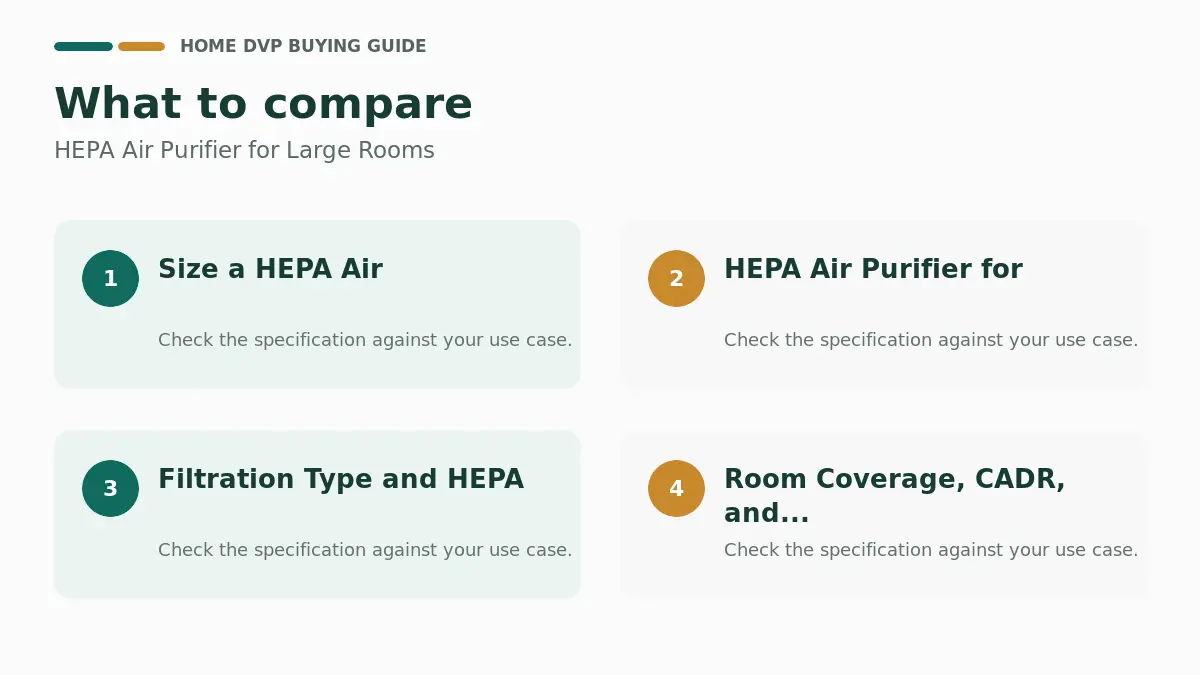
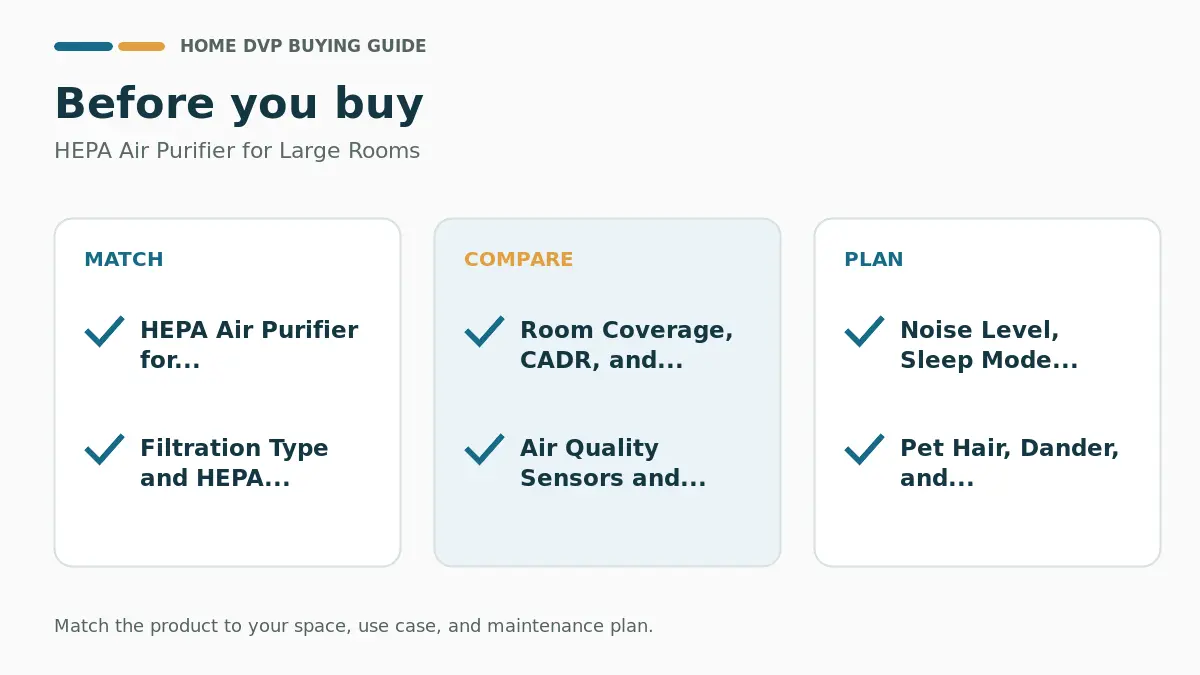
Filtration Type and HEPA Claims
The first specification to check when comparing HEPA air purifier for large rooms is the filter language. Some products list True HEPA filtration, some describe HEPA-grade filtration in a specific mode, and others use high-efficiency filtration claims for fine particles. These terms are not always interchangeable, so shoppers should read the product details carefully rather than relying only on the title.
For example, the LEVOIT Core 300-P lists a 3-in-1 filter and HEPA-grade filtration while operating in Sleep Mode, with filtration claims for very fine airborne particulates. The LEVOIT Core 400S-P and LEVOIT Vital 200S-P also emphasize multi-stage filtration and independent lab testing language. The WINIX 5520 lists True HEPA filtration and a high deodorization carbon filter, while the Shark HP201 describes an Anti-Allergen HEPA filter with NANOSEAL particle capture claims.
A common mistake is buying a purifier labeled for a large room without checking whether the filter also includes activated carbon. HEPA-style particle filtration is useful for dust, pollen, and dander, but odors, cooking smells, wildfire smoke smells, and VOC-related concerns are better addressed when a carbon stage is included. Pet owners, open-kitchen households, and basement users should give extra weight to carbon filtration and pre-filter access.
| Filter Feature | Why It Matters in Large Rooms |
|---|---|
| HEPA or HEPA-grade particle filter | Targets dust, pollen, dander, and fine airborne particles. |
| Activated carbon layer | Helps reduce odors from pets, cooking, smoke, and household activities. |
| Washable pre-filter | Captures larger debris and can reduce strain on the main filter. |
| Filter life indicator | Helps homeowners avoid running a clogged or overdue filter. |
Room Coverage, CADR, and Air Changes
Large-room coverage is one of the most important specs, but it is also one of the easiest to misunderstand. A purifier may be advertised for a very large area when cleaning the air once per hour, while the same unit may only deliver several air changes per hour in a smaller room. For allergies, smoke, and heavy dust, more air changes generally provide better real-world results.
Based on available product information, AHAM VERIFIDE models provide especially useful comparison data because they list CADR ratings for smoke, dust, and pollen. The LEVOIT Core 400S-P and LEVOIT Vital 200S-P include verified CADR figures in the product data, which helps shoppers understand how the purifier may perform with different airborne particles. The LEVOIT Core 300-P and LEVOIT Vital 100S-P also include AHAM-related performance details for smaller high-turnover rooms and larger once-per-hour coverage.
For a family room, open-plan apartment, or basement, choose a purifier with enough airflow for the actual occupied area, not just the theoretical maximum. If your room has high ceilings, open doorways, pets, a fireplace, or regular cooking odors, it is often smarter to choose a stronger model than the minimum coverage claim suggests.
| Home Situation | Buying Guidance |
|---|---|
| Bedroom or home office | Prioritize quiet sleep mode, display dimming, and reliable low-speed filtration. |
| Living room or open layout | Look for stronger CADR, wide intake design, and auto mode. |
| Pet household | Choose washable pre-filter access, pet mode, and carbon odor support. |
| Basement or kitchen-adjacent room | Favor air quality sensors, odor-focused carbon filtration, and higher airflow. |
Air Quality Sensors and Auto Mode
Air quality sensors can make HEPA air purifier for large rooms much easier to live with because the unit can respond to changing conditions. Dust from vacuuming, smoke from cooking, pollen from open windows, and pet activity can all change the particle level in a room during the day. A purifier with auto mode can raise or lower fan speed without requiring constant manual adjustment.
The LEVOIT Core 400S-P includes AirSight Plus technology and a PM2.5 display, which is useful for homeowners who want visible feedback. The LEVOIT Vital 200S-P adds an air quality monitor and light detection. The WINIX 5520 lists smart sensors and auto mode, while the Shark HP201 includes Clean Sense Technology that displays air quality changes in real time.
Auto mode is especially helpful in homes where the purifier runs all day. However, sensor-based operation should not replace basic maintenance. If the filter is clogged or the intake is blocked by furniture, even a smart purifier may struggle to deliver the performance promised in the specifications.
Noise Level, Sleep Mode, and Night Use
Noise matters because air purifiers work best when they run consistently. A loud unit may be effective on high speed, but homeowners often turn it down or shut it off if it disrupts sleep, TV watching, work calls, or quiet evenings. For bedrooms and nurseries, sleep mode and dimmable lights are just as important as raw airflow.
The ECOSELF HAP604 lists a very quiet sleep mode and 360-degree air intake and outlet, which may appeal to renters or bedroom users who want simple operation. The LEVOIT Core 300-P lists QuietKEAP Technology and a low-noise Sleep Mode. The LEVOIT Vital 100S-P includes sleep mode with light detection, while the Shark HP201 lists ultra-quiet performance with dimmable lights.
A practical mistake is judging noise only by the lowest setting. Large rooms may require medium or high speed during pollen season, after cooking, or when smoke particles are present. If you are sensitive to noise, look for a model with auto mode, so the purifier can run quietly most of the time and increase airflow only when needed.
Pet Hair, Dander, and Odor Control
Pet homes need more than a basic particle filter. Fur and larger debris can collect around the intake, while dander and odors require a combination of pre-filtering, fine-particle capture, and carbon filtration. If you have multiple pets, choose a purifier that makes pre-filter cleaning simple because clogged intakes can reduce airflow.
The LEVOIT Vital 200S-P is one of the stronger pet-focused options in the provided data because it includes a washable pre-filter, a U-shaped air inlet, and allergy-focused filtration claims. The LEVOIT Vital 100S-P includes Pet Mode and a washable pre-filter, making it a good fit for homeowners who want smart control in a more approachable format. The KNKA APH4000 also lists a washable pre-filter, AQI display, and Pet Mode, which are useful features for pet households.
For the best results, place the purifier near the area where pets spend the most time, but do not push it tightly against a wall, sofa, or curtain. Air purifiers need open intake and exhaust paths. Routine vacuuming, bedding washing, and HVAC filter replacement will also support better performance.
Smart Controls, App Features, and Everyday Convenience
Smart features are not mandatory, but they can make a purifier easier to manage in a busy household. App controls, schedules, voice assistant compatibility, filter life monitoring, and remote adjustments are helpful when the purifier is in a bedroom, basement, or open living area where you do not want to walk over to the unit every time conditions change.
The LEVOIT Core 400S-P and LEVOIT Vital 100S-P include smart WiFi features in the product data. These models are good candidates for shoppers who want scheduled operation, remote monitoring, and mode changes through an app. Smart control is also useful for renters because it can help maintain air quality without permanent installation or HVAC modifications.
If your home already uses connected thermostats or climate controls, it may be helpful to compare purifier scheduling with your broader comfort routine. For more on climate control decisions, see our guide to smart thermostats versus programmable thermostats.
Filter Maintenance and Long-Term Ownership
Filter replacement is one of the most important long-term costs of HEPA air purifier for large rooms. Even when the upfront price falls within several price tiers, ongoing filter replacement can affect value over time. A purifier with a washable pre-filter may reduce visible debris buildup, but the main filter and carbon layer will still need replacement according to the manufacturer guidance.
The LEVOIT models in this comparison emphasize genuine replacement filters, which is worth noting because off-brand filters may not fit properly or may reduce performance. The PuroAir 400 highlights subscription options for replacement filters, which may be useful for homeowners who prefer automatic reminders. The MOOKA PR1 lists a washable filter and filter reminder features, making maintenance visibility a strength for practical daily use.
A good maintenance routine includes checking the pre-filter, keeping intake vents clear, replacing filters on schedule, and wiping dust from the exterior. In humid rooms, basements, or homes with seasonal moisture problems, pairing air purification with moisture control may also be helpful. Our dehumidifier drain hose guide covers related maintenance considerations for moisture-prone spaces.
Value, Build Quality, and Who Should Spend More
Value is not only about finding the lowest upfront cost. For HEPA air purifier for large rooms, value comes from the right mix of airflow, filtration, sensor accuracy, quiet operation, and filter availability. A budget-friendly purifier may be a smart choice for a bedroom or rental unit, while a higher-end option can make sense for large living rooms, pet-heavy homes, or spaces affected by smoke and odors.
Based on our detailed comparison, the ECOSELF HAP604 and MOOKA PR1 are positioned as more budget-conscious large-room options in the provided product set, while the PuroAir 400 and Shark HP201 sit closer to the premium end of the listed range. The LEVOIT Vital 200S-P, LEVOIT Core 400S-P, WINIX 5520, and KNKA APH4000 offer a strong middle ground with large-room features, sensor functions, and practical home-use benefits.
Spend more if you need stronger coverage, better sensor feedback, quieter operation at useful speeds, or more capable odor management. Spend less if you need a secondary purifier for a guest room, dorm room, rental bedroom, or home office where air quality concerns are moderate rather than severe.
Our Research Methodology & Why You Can Trust Us
We evaluated the products based on available product information, category fit, filtration claims, airflow-related specifications, room coverage language, control options, maintenance features, and suitability for common homeowner use cases. We also reviewed whether each product clearly matched HEPA Air Purifier for Large Rooms and the Heating, Cooling & Air category. Unrelated product types were excluded from discussion.
Our ranking criteria focused on performance, features, build quality indicators, ease of use, durability expectations, safety-related usability features, value, reliability signals, and fit for renters, homeowners, pet owners, allergy-sensitive households, and large-room layouts. AHAM VERIFIDE information, CADR data, HEPA or HEPA-grade language, washable pre-filters, air quality sensors, and sleep modes received extra attention because they directly affect daily usefulness.
We did not claim physical testing because the provided product data does not confirm hands-on testing. Instead, we used a transparent specification-based review process. Based on user-facing specifications and listed features, we explain which products appear better suited for specific home situations and which shoppers may want to avoid certain feature sets.
This guide is structured for regular updates during July 2026 so homeowners can revisit it as product availability, feature sets, and replacement filter options change. For broader heating and air product comparisons, you can also browse our Heating, Cooling & Air category.
Final Thoughts
For an overall large-room choice, the LEVOIT Vital 200S-P stands out in the provided data because it combines AHAM VERIFIDE performance details, a washable pre-filter, an air quality monitor, HEPA Sleep Mode, and a design aimed at allergy and pet households. It is a strong fit for living rooms, bedrooms, basements, and high-traffic spaces where airborne dust, dander, and pollen are regular concerns.
For smart-home shoppers, the LEVOIT Core 400S-P is a compelling option because it includes smart WiFi, auto mode, an air quality monitor, and large-room purification claims. For a value-focused pick, the MOOKA PR1 offers large-room coverage language, a washable filter, PM2.5 display, and air quality sensor features at the more affordable side of several price tiers. For a premium pick, the PuroAir 400 offers broad coverage language, a HEPA CarbonTech filter, air quality sensor, auto mode, and quiet sleep mode.
If you want a familiar True HEPA option with strong deodorization features, the WINIX 5520 is worth considering. If you prefer a purifier with real-time display feedback and kitchen-friendly particle monitoring, the Shark HP201 also fits the category well. For additional indoor comfort planning, our guide to cool mist versus warm mist humidifiers can help you think through air quality from another angle.
FAQ
What should I look for when choosing a HEPA air purifier for large rooms?
Start with filtration type, CADR or airflow information, room coverage, noise level, and filter maintenance. For large rooms, prioritize models that can move enough air for the actual space instead of relying only on maximum coverage claims. Air quality sensors, auto mode, and washable pre-filters can make daily use easier.
Are higher-end large-room HEPA air purifiers worth it?
Higher-end models can be worth it if you need stronger coverage, better odor control, smart features, or quieter performance in a large open area. Premium models may also include better sensor feedback and more convenient automatic operation. For a smaller bedroom or occasional use, a simpler model may be enough.
How long should a quality large-room HEPA air purifier last?
A quality air purifier can last for years when filters are replaced on schedule and the intake areas are kept clean. The most common maintenance issue is not the motor itself, but reduced airflow from clogged filters or blocked vents. Always follow the manufacturer’s filter replacement guidance for the specific model.
Which brands make reliable large-room HEPA air purifiers?
The product data for this guide includes options from PuroAir, MOOKA, LUNINO, and other brands. Reliability depends on more than brand name, so compare filtration claims, CADR data, filter availability, sensor features, and owner-friendly maintenance. Models with clear specifications and replacement filter support are generally easier to own long term.
How much should homeowners budget for a large-room HEPA air purifier in 2026?
Homeowners should expect pricing to vary within several price tiers depending on coverage, filtration design, sensors, smart controls, and brand positioning. The lowest-cost option may work for secondary rooms, while higher-end models are usually better suited to open layouts or homes with pets, smoke, or allergy concerns. Remember to account for replacement filters when comparing value.
Are large-room HEPA air purifiers useful for home maintenance?
Yes, air purifiers can support regular home maintenance by reducing airborne dust, dander, pollen, and some odor-related particles between cleanings. They work best alongside vacuuming, HVAC filter changes, humidity control, and good ventilation habits. For whole-home planning, the Air Quality & Climate section includes related indoor comfort topics.
Independent Source and Research Note
For an independent technical reference, see the EPA Guide to Air Cleaners in the Home. Confirm current specifications, compatibility, warranty terms, safety instructions, and availability before purchasing or installing a product.