Choosing best whole house generator for Florida hurricanes requires more than comparing peak watt numbers. Florida homeowners must also think about hurricane-related outages, fuel availability, air-conditioning demand, transfer-switch compatibility, carbon-monoxide protection, storage, and the practical work required to keep a portable generator ready. A model that looks powerful on paper may still be a poor fit if it cannot support your essential circuits or if you have no safe, convenient place to operate and maintain it.
For this guide, We compared the listed models from DuroMax, Westinghouse using the available running and peak wattage, fuel options, outlet configuration, inverter technology, controls, safety features, engine information, and stated support details. We also considered the ownership tradeoffs for homeowners, renters with limited installation options, and DIY buyers planning emergency backup power. Because several listings provide limited feature information, recommendations are conditional rather than a substitute for a load calculation or licensed electrical installation. For a broader emergency-preparedness plan, see our guide to solar generator options for home backup.

Pros
- Offers 9,500 running watts and 12,500 peak watts on gasoline for substantial household backup capacity.
- Provides useful fuel flexibility with listed propane output of 8,500 running watts and 11,200 peak watts.
Cons
- The nearly 210-pound weight and sizable dimensions may be difficult to move or store in compact spaces.
- Propane operation provides lower listed running and peak wattage than gasoline operation.
Best For / Avoid If
Best for buyers prioritizing
- Offers 9,500 running watts and 12,500 peak watts on gasoline for substantial household backup capacity.
- Provides useful fuel flexibility with listed propane output of 8,500 running watts and 11,200 peak watts.
- Combines automatic low-oil shutdown, a digital hour meter, and a cast iron engine sleeve for maintenance awareness and durability support.
Consider another option if
- The nearly 210-pound weight and sizable dimensions may be difficult to move or store in compact spaces.
- Propane operation provides lower listed running and peak wattage than gasoline operation.
- Users planning a home transfer-switch installation may need additional setup considerations beyond the included accessories.

Pros
- High output with 12,000 peak and 9,000 running watts on gasoline
- Dual-fuel operation provides gasoline and propane flexibility
Cons
- The 187.4-pound weight and 30.2 by 25.2 by 26.6-inch dimensions may be difficult to move or store in compact spaces.
- The product information does not indicate that a transfer switch or interlock kit is included.
Specifications
| Color | Blue |
|---|---|
| Dimensions | 30.2 x 25.2 x 26.6 inches |
| Weight | 187.4 Pounds |
| Product Group | Lawn & Patio |
| Binding | Tools & Home Improvement |
Verify the current product variation before purchase; specifications may change.
Best For / Avoid If
Best for buyers prioritizing
- High output with 12,000 peak and 9,000 running watts on gasoline
- Dual-fuel operation provides gasoline and propane flexibility
- Transfer-switch-ready 50A and 30A outlets support home backup planning
Consider another option if
- The 187.4-pound weight and 30.2 by 25.2 by 26.6-inch dimensions may be difficult to move or store in compact spaces.
- The product information does not indicate that a transfer switch or interlock kit is included.
- Its high-capacity format may be more generator than some users need for basic emergency loads.

Pros
- Three fuel options provide useful backup flexibility.
- High listed wattage is well suited to demanding home power needs.
Cons
- At 240 pounds, it may be difficult to move without planning or assistance.
- The 30 x 29 x 26-inch size may require considerable storage space.
Specifications
| Color | Blue |
|---|---|
| Dimensions | 30 x 29 x 26 inches |
| Weight | 240 Pounds |
| Product Group | Lawn & Patio |
| Binding | Tools & Home Improvement |
Verify the current product variation before purchase; specifications may change.
Best For / Avoid If
Best for buyers prioritizing
- Three fuel options provide useful backup flexibility.
- High listed wattage is well suited to demanding home power needs.
- Remote and push-button starting reduce the effort required to begin operation.
Consider another option if
- At 240 pounds, it may be difficult to move without planning or assistance.
- The 30 x 29 x 26-inch size may require considerable storage space.
- Its transfer switch-ready outlet does not by itself confirm compatibility with every home electrical setup.

Pros
- High output provides substantial emergency power capacity for a home, RV, or jobsite.
- Fuel flexibility can be useful when one available fuel source is inconvenient or unavailable.
Cons
- Its 234-pound weight and large footprint may make storage and movement difficult for one person.
- A transfer-switch-ready outlet does not by itself provide a complete transfer-switch installation.
Specifications
| Color | Blue |
|---|---|
| Dimensions | 30 x 29 x 26 inches |
| Weight | 234 pounds |
| Product Group | Lawn & Patio |
| Binding | Tools & Home Improvement |
Verify the current product variation before purchase; specifications may change.
Best For / Avoid If
Best for buyers prioritizing
- High output provides substantial emergency power capacity for a home, RV, or jobsite.
- Fuel flexibility can be useful when one available fuel source is inconvenient or unavailable.
- The metal construction, copper windings, and no-flat tires support durability and mobility.
Consider another option if
- Its 234-pound weight and large footprint may make storage and movement difficult for one person.
- A transfer-switch-ready outlet does not by itself provide a complete transfer-switch installation.
- The high-capacity design may be more generator than needed for users seeking limited backup power.
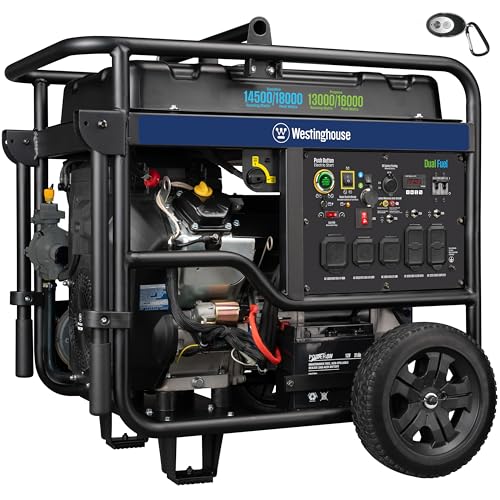
Pros
- Gas output of 18,000 peak watts and 14,500 running watts provides enough capacity for major appliances across a larger home
- Transfer switch and interlock kit ready outlets simplify professional connection to a household electrical panel
Cons
- Whole-home use depends on a transfer switch or interlock kit installed by a qualified electrician, which adds setup steps beyond unboxing the unit
- At 352 pounds, placement and storage require planning, a firm level surface, and likely more than one person to reposition it
Best For / Avoid If
Best for buyers prioritizing
- Gas output of 18,000 peak watts and 14,500 running watts provides enough capacity for major appliances across a larger home
- Transfer switch and interlock kit ready outlets simplify professional connection to a household electrical panel
- CO shutdown and automatic low oil shutdown reduce safety and engine risks during long or unattended runs
Consider another option if
- Whole-home use depends on a transfer switch or interlock kit installed by a qualified electrician, which adds setup steps beyond unboxing the unit
- At 352 pounds, placement and storage require planning, a firm level surface, and likely more than one person to reposition it
- Operating volume bottoms out at 74 dBA, which may be noticeable in quiet neighborhoods during extended or overnight runs

Pros
- Offers substantial household power capacity with separate gasoline and propane output ratings.
- Provides several practical outlet options, including a 120/240V twist-lock connection.
Cons
- The 202.1-pound weight and roughly 27-inch dimensions may make storage and repositioning difficult in smaller spaces.
- The listed output is lower when operating on propane than when using gasoline.
Specifications
| Color | Blue |
|---|---|
| Dimensions | 27.2 x 26.1 x 26 inches |
| Weight | 202.1 Pounds |
| Product Group | Lawn & Patio |
| Binding | Lawn & Patio |
Verify the current product variation before purchase; specifications may change.
Best For / Avoid If
Best for buyers prioritizing
- Offers substantial household power capacity with separate gasoline and propane output ratings.
- Provides several practical outlet options, including a 120/240V twist-lock connection.
- Includes remote starting and useful setup supplies, while automatic shutdown features support safer operation.
Consider another option if
- The 202.1-pound weight and roughly 27-inch dimensions may make storage and repositioning difficult in smaller spaces.
- The listed output is lower when operating on propane than when using gasoline.
- First-time generator owners may need extra time to understand fuel handling, controls, and backup-power procedures.
best whole house generator for Florida hurricanes Buying Guide
The central decision is not simply which generator has the largest advertised output. It is whether the generator can start and continuously operate the circuits you actually need, connect to the home safely, run on fuel you can obtain after a storm, and remain manageable throughout a long outage. Use the criteria below before treating any model as a final choice.
1. Running Watts Matter More Than Peak Watts
Running watts describe the sustained electrical output a generator can provide. Peak or starting watts are temporary capacity for motor-driven loads such as refrigerators, well pumps, sump pumps, air-conditioning equipment, and some power tools. For hurricane backup, running watts should be the first number you compare because the generator must carry the load continuously, not just start it.
Make a list of essential circuits rather than assuming “whole house” means every appliance can operate simultaneously. A central air-conditioning system, electric water heater, range, pool equipment, well pump, and dryer can quickly exceed the capacity of a portable unit. A qualified electrician or generator professional can perform a load calculation and determine whether circuits should be managed, staggered, or excluded.
- List the running watts for refrigerators, freezers, medical-support equipment, pumps, fans, and communications equipment.
- Identify motor loads with high starting demand, especially air-conditioning compressors and well pumps.
- Separate must-have circuits from comfort loads such as an electric range, dryer, or pool heater.
- Leave operating margin instead of sizing the generator at its maximum rating.
2. Match the Generator to Your Florida Home
Florida homes vary substantially. A small apartment, a newer energy-efficient home, and a larger house with central air-conditioning may have very different backup needs. Renters may be limited to powering individual appliances outdoors with heavy-duty extension cords, while homeowners may be able to install an inlet, transfer switch, or approved interlock arrangement.
Many of the listed models offer a 30-amp or 50-amp connection described as transfer-switch ready. That description does not mean the generator can be connected directly to a home, and it does not confirm that your existing electrical equipment is compatible. A transfer switch or interlock must be correctly sized and installed so utility power and generator power cannot feed the panel at the same time. Never use a male-to-male cord or improvise a panel connection.
| Home situation | Most important questions | Likely priority |
|---|---|---|
| Rental or small home | Where can the unit operate legally and safely? Which individual loads are essential? | Portability, manageable output, fuel flexibility, and safe appliance connection |
| Typical single-family home | Can the unit support refrigeration, cooling, lighting, internet, and selected circuits? | Running watts, transfer equipment, remote start, and fuel storage planning |
| Large home or high motor load | What is the calculated starting demand for air-conditioning, pumps, and other motors? | Higher sustained capacity, circuit management, and professional installation |
3. Compare Gasoline, Propane, and Natural Gas Flexibility
Dual-fuel generators can operate on gasoline or propane, giving owners more than one way to prepare for a storm. The Westinghouse 12500 Watt Dual Fuel Home Backup, Westinghouse 12000 Peak Watt Dual Fuel, and DuroMax XP13000EH 13,000-Watt Dual Fuel all provide gasoline and propane operation in the published specifications. The DuroMax XP13000HXT 13,000-Watt 500cc Tri Fuel Gas is identified as a tri-fuel model, but the published information does not include its output by fuel, runtime, or detailed outlet information.
Fuel choice affects usable output, runtime, storage, and convenience. The Westinghouse 12500 Watt Dual Fuel Home Backup is documented at 9,500 running watts on gasoline and 8,500 running watts on propane. The Westinghouse 12000 Peak Watt Dual Fuel is documented at 9,000 running watts on gasoline and 8,100 running watts on propane. Do not compare peak gasoline output with running propane output as if they were equivalent.
Propane is often easier to store for emergency use than gasoline, but cylinders still require proper storage and handling. Gasoline can be more convenient for some users but has a limited storage life and creates additional fire-safety and maintenance considerations. If a home has natural gas service, a tri-fuel design may be attractive, but confirm that the model is approved and configured for your specific installation before buying.
4. Decide Whether Inverter Output Is Worth the Premium
The Westinghouse 12000 Peak Watt Dual Fuel is the only listed model explicitly identified as an inverter generator. Its published specifications state low total harmonic distortion of no more than 3%, an Eco Mode, parallel capability, a carbon-monoxide sensor, and a stated operating sound level as low as 64 dBA. These features may matter if you want quieter operation, more controlled engine speed at lighter loads, or an output specification designed for sensitive electronics.
However, inverter technology does not automatically make a generator suitable for every house. Its documented running output is lower than the peak figure, and the premium may be difficult to justify for a buyer who mainly needs basic emergency circuits and is comfortable with a conventional open-frame generator. Consider where the unit will operate, how close neighbors are, how often it may run at partial load, and whether electronics protection is a major priority.
5. Treat Transfer-Switch Compatibility as an Installation Issue
A portable generator does not become a permanent standby system simply because it has electric start or a large outlet. A home backup setup normally involves an outdoor inlet, correctly rated conductors, a transfer switch or listed interlock, circuit selection, grounding and bonding considerations, and compliance with local requirements. The generator must remain outdoors and away from doors, windows, vents, and other openings so exhaust cannot enter the home.
Before purchase, photograph or record your electrical panel information and ask an electrician whether the proposed connection is feasible. Confirm the inlet rating, plug type, cable length, breaker arrangement, and whether the generator’s neutral configuration is compatible with the transfer equipment. The product data describes several units as transfer-switch ready, but it does not establish compatibility with every panel or installation.
6. Prioritize Carbon-Monoxide and Weather Safety
Carbon monoxide is an odorless, potentially fatal gas produced by fuel-burning engines. A CO sensor or alert feature is useful, but it is not permission to run a generator in a garage, carport, shed, screened porch, or other partially enclosed location. Follow the generator manual, local fire-safety guidance, and placement requirements every time the unit runs.
Hurricanes also create wet, windy conditions. Portable generators are not indoor appliances, and the published product information does not establish that any listed model is waterproof or safe to operate while exposed to rain. Use only a properly ventilated, manufacturer-appropriate weather shelter that does not trap exhaust or create a fire hazard. Keep fuel containers away from ignition sources, let the engine cool before refueling, and use appropriately rated cords and connections.
Emergency readiness extends beyond the generator itself. A suitable ABC fire extinguisher for emergency preparedness and a stocked first aid kit can address other hurricane risks, but neither replaces safe generator operation or electrical work by a qualified professional.
7. Plan for Maintenance and Long-Term Ownership
A generator stored for most of the year can be less reliable than one that is periodically inspected and exercised according to its manual. Typical ownership tasks may include checking oil, maintaining the starting battery, inspecting fuel lines and connections, managing gasoline storage, cleaning the air filter, and running the unit under an appropriate load. Exact intervals depend on the model and manufacturer instructions, so do not rely on a generic schedule alone.
Remote start can reduce inconvenience when the generator is installed outside, while a digital hour meter helps track service. The Westinghouse 12500 Watt Dual Fuel Home Backup includes a digital hour meter and VFT display, along with a stated three-year limited service, labor, and parts coverage. The Westinghouse 12000 Peak Watt Dual Fuel includes display information for fuel level, power output, remaining runtime, voltage, and lifetime hours. Those features improve visibility, but they do not eliminate inspections or fuel management.
8. Compare the Ownership Tradeoff, Not Just the Purchase Cost
Budget for a properly rated inlet and transfer device, installation labor, fuel containers or propane cylinders, maintenance supplies, a safe storage location, and potentially a weather shelter. A higher-output model may also be heavier and more difficult to move, while a lower-output unit may require stricter circuit management.
For many households, the most economical choice is the model that covers the calculated essential load with some margin, not the largest unit available. Paying for output that cannot be safely connected or that exceeds your fuel-handling capacity does not improve resilience. Conversely, choosing too little capacity can lead to nuisance overloads, inconvenient appliance switching, or inability to start critical motors.
How the Listed Models Compare
| Model | Documented strengths | Important limitation | Best fit based on available data |
|---|---|---|---|
| Westinghouse 12500 Watt Dual Fuel Home Backup | 9,500 gasoline running watts, 8,500 propane running watts, remote and electric start, 30-amp and 50-amp connections, display, low-oil shutdown | Conventional generator design, and no low-THD inverter specification is provided | Homeowners seeking substantial dual-fuel capacity and useful monitoring features |
| Westinghouse 12000 Peak Watt Dual Fuel | Inverter design, no more than 3% THD claim, Eco Mode, CO sensor, remote start, 50-amp connection, parallel capability | 9,000 gasoline running watts and 8,100 propane running watts may not cover large simultaneous loads | Buyers prioritizing electronics-friendly output, quieter operation, and monitoring |
| DuroMax XP13000EH 13,000-Watt Dual Fuel | Dual-fuel operation, push-button start, 50-amp transfer-switch-ready outlet, all-metal frame, copper windings, no-flat tires | The published information does not state running wattage, runtime, noise, or CO-sensor details | Buyers valuing a rugged frame and broad emergency-use portability |
| Westinghouse 18000 Peak Watt Dual Fuel Home Backup | Product name identifies high peak output, dual-fuel operation, remote electric start, transfer-switch readiness, and CO sensor | No key specifications are listed for output, runtime, noise, outlets, or warranty | Only after verifying the full manufacturer specifications and installation requirements |
| Westinghouse 9500 Peak Watt Dual Fuel Home Backup | Product name identifies dual-fuel operation, electric start, transfer-switch readiness, and CO sensor | No key specifications are listed for running watts, runtime, outlets, or noise | Buyers seeking a potentially smaller option, subject to confirming its actual continuous capacity |
| DuroMax XP13000HXT 13,000-Watt 500cc Tri Fuel Gas | Product name identifies tri-fuel capability, a 500cc engine, and CO alert | The published information does not state output by fuel, runtime, outlets, noise, or installation details | Homeowners with a strong reason to use natural gas, after specification verification |
Our Research Methodology and Why You Can Trust Us
We evaluated the listed generators by comparing the product information available for this article. The analysis separates continuous running output from peak output, distinguishes conventional and inverter designs, notes fuel configurations, and checks practical home-backup features such as transfer-switch readiness, outlet types, remote start, runtime displays, low-oil shutdown, and CO-related features. We also validated category fit because every included model is a portable fuel-powered generator intended for emergency or home backup use.
Our process uses manufacturer-provided feature claims and available user-facing feedback signals where they are listed. Several listings contain no detailed key features. We therefore do not claim hands-on testing, measured noise performance, independently confirmed fuel savings, or proven long-term durability. Statements such as low THD, runtime, warranty coverage, and construction materials are treated as published product claims rather than results from our own laboratory or field testing.
Ranking emphasis reflects performance, features, build quality, ease of use, durability indicators, safety information, value, reliability signals, and fit for homeowner or DIY use. We also considered the practical consequences of operating a generator during a prolonged Florida outage, including fuel choice, maintenance, electrical connection, cooling loads, and safe outdoor placement. We review and update this type of buying guidance during September, but buyers should still confirm current manuals, local requirements, warranty terms, specifications, and availability before purchase.
Final Thoughts
Based on the available specifications, the Westinghouse 12500 Watt Dual Fuel Home Backup is the strongest overall fit for a homeowner who wants substantial dual-fuel capacity, remote start, a 50-amp connection, useful output monitoring, and clearly stated running-watt figures. Its gasoline and propane ratings make the fuel tradeoff easier to evaluate, but the unit still needs a verified load calculation and a correctly installed connection system.
The Westinghouse 12000 Peak Watt Dual Fuel is the more feature-focused choice for buyers who place a high value on inverter technology, the listed low-THD claim, lower stated noise, Eco Mode, and detailed runtime monitoring. The DuroMax XP13000EH 13,000-Watt Dual Fuel is a reasonable alternative for shoppers who prioritize its documented all-metal construction, push-button start, transfer-switch-ready 50-amp outlet, and copper windings, although the published information leaves important output and safety questions unanswered.
Approach the Westinghouse 18000 Peak Watt Dual Fuel Home Backup, Westinghouse 9500 Peak Watt Dual Fuel Home Backup, and DuroMax XP13000HXT 13,000-Watt 500cc Tri Fuel Gas cautiously because their records do not include enough detailed specifications for a confident ranking. They may fit particular homes, especially when higher output or natural-gas flexibility is important, but verify continuous wattage, starting capacity, outlet configuration, CO protections, runtime, dimensions, weight, and installation requirements first. For other hurricane supplies, the Emergency Supplies category provides additional preparation resources, including food and fire-safety guides.
What should I look for when choosing best whole house generator for Florida hurricanes?
Start with a load calculation that identifies continuous and starting wattage for the circuits you need during an outage. Then compare fuel options, transfer-switch compatibility, outlet ratings, CO safety features, maintenance requirements, physical size, and the support information listed by the manufacturer. Peak wattage alone is not enough to determine whether a generator can run your home safely.
Are higher-end best whole house generator for Florida hurricanes worth it?
A higher-priced model may be worthwhile if it offers features that solve a real problem, such as inverter output, lower stated noise, larger fuel capacity, more detailed monitoring, or a fuel configuration that fits your property. It is not automatically better if your electrical panel, essential-load calculation, storage space, or fuel plan cannot take advantage of the extra capacity. Include installation and maintenance costs when comparing total ownership value.
How should beginners choose best whole house generator for Florida hurricanes?
Beginners should choose based on a written list of essential circuits and professional advice about the connection method. A model with electric or remote start, clear displays, dual-fuel flexibility, and stated low-oil or CO protections may be easier to manage, but those features do not replace reading the manual. Never connect a portable generator to a home panel without properly rated equipment and qualified installation.
Can a portable generator run an entire Florida house?
It depends on the home’s calculated load and which appliances operate at the same time. A portable unit may support selected essential circuits, and some homes may be able to operate air-conditioning with careful load management, while electric water heating, cooking, pool equipment, and other large loads can exceed the available capacity. Confirm the starting and running requirements before relying on any model.
Is dual-fuel operation useful during hurricanes?
Dual-fuel operation gives the owner gasoline and propane as separate fuel options, which can improve preparation flexibility when one fuel is difficult to obtain or store. Output and runtime can differ between fuels, so compare the manufacturer’s ratings rather than assuming the gasoline figure applies to propane. Store and handle both fuels according to applicable fire-safety rules and the product manual.
How long should quality best whole house generator for Florida hurricanes last?
The published product information does not establish a guaranteed service life for any listed generator. Longevity depends on load, operating conditions, fuel handling, oil and filter maintenance, storage, corrosion exposure, and adherence to the manual. Treat durability features such as an all-metal frame or cast-iron sleeve as design indicators, not guarantees of a specific lifespan.
Are best whole house generator for Florida hurricanes suitable for DIY projects or home repairs?
A portable generator can provide temporary power for selected tools or home systems, but it should be treated as fuel-burning electrical equipment rather than an ordinary DIY accessory. Outdoor placement, cord ratings, grounding and bonding, overload protection, and panel connection all require careful attention. For a permanent home connection or any uncertainty about electrical safety, consult a qualified electrician.