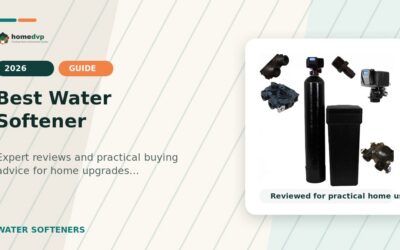

Water softener grain capacity explained simply: it is the amount of hardness a softener can remove before it needs to regenerate. The number is usually shown as grains, such as a model family or setting capacity. It is not the same thing as water quality, flow rate, salt efficiency, or how long the system will last.
Answer-first summary: Grain capacity tells you how much hardness a softener can handle between regeneration cycles. To use it well, you need three inputs: your water hardness, your household water use, and the unit’s manual. Bigger is not automatically better. The practical goal is a system that regenerates often enough to stay effective, but not so often that it wastes salt and water.
A conventional ion-exchange water softener removes hardness minerals from household water by passing the water through a resin bed. Over time, that resin becomes loaded with hardness and must be regenerated according to the manufacturer’s process. Grain capacity is a way to describe how much hardness the resin can remove before that regeneration is needed.
The confusing part is that capacity can be presented in more than one way. A model may be marketed with a large capacity number, while the manual may show several operating settings. Those settings can trade off salt use, water use, regeneration frequency, and practical capacity. Treat the label as a starting point, not the final sizing answer.
Softening is also separate from contaminant reduction. A softener may help with scale, soap performance, and hard-water deposits, but it should not be assumed to remove lead, PFAS, pathogens, or other drinking-water contaminants. For broader drinking-water concerns, start with testing and treatment matched to the contaminant. Home DVP’s guide to the best home water test kit can help you think through what to measure before buying treatment equipment.
Why Grain Capacity Matters in Real Homes
Capacity affects how often the softener regenerates. If capacity is too low for your household, the unit may regenerate frequently or let hardness break through before the next cycle. If capacity is oversized or set poorly, you may pay for equipment you do not use well, store more salt than needed, or run inefficient regeneration cycles.
The U.S. Environmental Protection Agency’s WaterSense program focuses on water efficiency for eligible labeled products and offers home maintenance guidance that emphasizes finding and fixing leaks. That matters here because leaks and running fixtures can make a softener regenerate more often than expected, even if the capacity calculation looked right on paper. WaterSense is not a grain-capacity certification for softeners, so do not use the label as a substitute for the softener manual or local plumbing guidance. See the EPA WaterSense label page for what the label does and does not cover: https://www.epa.gov/watersense/watersense-label.
Grain capacity also matters for renters. If you rent a home with an existing softener, knowing the capacity helps you discuss settings, salt use, and maintenance with the property owner. If you rent an apartment, you may not be allowed to install a whole-home softener at all. In that case, focus on point-of-use filtration where appropriate and review your lease before modifying plumbing.
The Inputs You Need Before Sizing Capacity
You cannot size a softener accurately from household size alone. Two households with the same number of people can have very different water hardness, laundry habits, guest use, irrigation connections, and leak problems. Gather the inputs below before comparing grain capacity claims.
| Input | Why it matters | How to get it |
|---|---|---|
| Water hardness | Harder water uses capacity faster. | Use a reliable water test, a recent utility report if applicable, or a lab test. For private wells, use drinking-water guidance from EPA and CDC as a starting point. |
| Household water use | More water through the softener means more hardness removal per day. | Check water bills, smart meter data, or the softener’s own meter if it has one. |
| Iron, sediment, or other water issues | Some conditions can affect resin performance or require pretreatment. | Confirm with a water test and the manufacturer’s manual before relying on a softener alone. |
| Plumbing layout | Outdoor spigots, irrigation, or dedicated drinking-water lines may bypass or overload the softener. | Trace the plumbing or hire a plumber if the layout is not clear. |
| Manual settings | Marketing capacity and programmed capacity may differ. | Read the model-specific manual before changing capacity, salt dose, or regeneration settings. |
If you are on a public water system, EPA’s drinking water information can help you understand how regulated drinking-water information is organized and where to start with questions: https://www.epa.gov/ground-water-and-drinking-water. If you use a private well or have health concerns, CDC’s drinking-water guidance is a helpful public-health starting point: https://www.cdc.gov/drinking-water/.
A Practical Grain Capacity Decision Framework
Use this framework to avoid both undersizing and oversizing. It does not replace the softener manual, but it gives you a disciplined way to read capacity claims.
- Confirm hardness first. Do not estimate from taste, scale, or neighbor reports. Test the water that will actually enter the softener.
- Estimate softened water demand. Use water bills or meter data when available. Exclude water that bypasses the softener, such as some irrigation lines, if your plumbing is set up that way.
- Calculate daily hardness load. Multiply the hardness value by the amount of water that will be softened. Keep the units consistent with your test report and the calculator or manual you use.
- Choose a regeneration interval target. Many homeowners prefer a setup that avoids very frequent regeneration, but the right interval depends on the model, water quality, and household pattern.
- Compare manual settings, not just the box number. Look for capacity at specific salt settings or efficiency modes in the manual.
- Build in real-life variability. Guests, laundry days, leaks, and seasonal changes can shift demand.
- Have the installer verify plumbing and code issues. Local rules, drain requirements, air gaps, and discharge limits vary, so do not assume a universal installation method.
Worked Example Using Hypothetical Numbers
Here is a simple example to show the logic. Suppose a household test result and water-use data show that the home creates a daily hardness load of 6,000 grains. If the owner wants the softener to regenerate about every 5 days, the working capacity target would be 30,000 grains before allowing for the model’s reserve setting and the manufacturer’s programming method.
That does not automatically mean the homeowner should buy a product marketed as 30,000 grains. The manual may show that the same unit can be programmed at different usable capacities depending on salt dose and regeneration settings. A nearby model with a larger advertised capacity may be reasonable if the plumbing and flow needs fit, but it should be judged by the manual’s operating data, not by the biggest number on the carton.
The example numbers are only placeholders to explain the math. Your water hardness, actual water use, reserve setting, and model-specific programming are what matter. If your water contains iron, sediment, or other issues, confirm whether pretreatment is needed before relying on a capacity calculation.
Marketing Capacity vs. Usable Capacity
The phrase grain capacity can describe several things, and mixing them up leads to bad decisions. A seller may use the highest capacity associated with a resin tank size. An installer may talk about the programmed capacity they plan to use. A manual may show capacity at different salt doses. These are related, but they are not identical.
- Advertised capacity: A broad product label or model-family number. Useful for sorting options, but not enough for final sizing.
- Programmed capacity: The capacity entered into the control valve. This affects when the unit regenerates.
- Reserve capacity: Capacity held back so the home does not run out of soft water before regeneration.
- Service flow considerations: The system also has to deliver enough water during showers, laundry, and fixture use. Capacity alone does not prove flow performance.
- Regeneration setting: The salt and water used during regeneration are model-specific and should be confirmed in the manual.
Because these values are model-specific, this guide does not assign universal salt doses, regeneration volumes, or flow rates. Those numbers need to come from the manufacturer’s documentation and, where applicable, the installer’s code-compliant setup.
What Grain Capacity Does Not Tell You
Grain capacity is useful, but it is narrow. It does not tell you whether your water is safe to drink. EPA and CDC drinking-water resources are better starting points for health-related questions, especially for private wells, unusual taste or odor, known local contamination, or vulnerable household members.
Capacity also does not tell you whether a system reduces PFAS, lead, or other specific contaminants. If testing shows a contaminant of concern, look for treatment designed and certified for that contaminant rather than assuming a softener will solve it. For related research, see Home DVP’s guides to water filters for PFAS, whole-house PFAS filtration, and lead-reduction water filters.
Finally, capacity does not tell you whether you should soften every line in the home. Some homes leave outdoor spigots or irrigation unsoftened to reduce salt and water use. Some homeowners prefer a separate drinking-water treatment approach at the kitchen sink. The right layout depends on plumbing, local rules, water chemistry, and personal preference.
Common Mistakes When Interpreting Grain Capacity
- Buying by household size only. Number of people helps estimate demand, but hardness and actual water use are just as important.
- Assuming bigger is always better. Oversizing can create unnecessary cost and may not improve day-to-day performance if settings are poor.
- Ignoring leaks. Running toilets, dripping faucets, and hidden leaks can send extra water through the softener and distort regeneration timing. EPA WaterSense home maintenance guidance emphasizes checking for leaks as part of efficient household water use: https://www.epa.gov/watersense/home-maintenance.
- Using old hardness data. Water sources and blending can change, and private wells can vary. Retest when conditions change.
- Confusing softening with filtration. Softening addresses hardness, not every contaminant.
- Changing settings without the manual. A control valve may accept a number, but that does not mean it is correct for the resin, tank, injector, brine system, or household demand.
Maintenance Implications of Capacity
A correctly sized and programmed softener still needs attention. Keep the brine tank supplied according to the manual, check for salt bridging if performance drops, and watch for unusual regeneration timing. If the system regenerates much more often than expected, look for leaks, changes in household use, an incorrect hardness setting, or a control-valve issue.
If the softener seems to stop working shortly after regeneration, the unit may be undersized, misprogrammed, fouled, or dealing with water conditions it was not designed to handle. Do not keep increasing settings randomly. Retest the water, compare the result with the programmed hardness, and review the troubleshooting section of the manual.
For private wells, do not treat the softener as the only maintenance item. Well water may need periodic testing and additional treatment depending on local conditions. CDC drinking-water guidance is a better safety reference than a softener sales sheet when health questions are involved.
Checklist Before You Choose or Reset a Softener
- Test the incoming water hardness at the point where the softener will be installed.
- Check whether the home is on public water or a private well, and review relevant drinking-water information.
- Estimate actual softened water use from bills, meters, or household patterns.
- Identify lines that bypass the softener, such as outdoor spigots or irrigation, if any.
- Inspect for obvious leaks before finalizing capacity assumptions.
- Read the model manual for capacity, regeneration, salt, drain, and programming requirements.
- Confirm installation constraints with a qualified plumber when plumbing changes, drains, electrical outlets, or local code questions are involved.
- After setup, monitor salt use, regeneration frequency, and hardness at a fixture for the first few cycles.
When This Advice Does Not Apply
This guide is for typical residential softener sizing and interpretation. It does not cover commercial kitchens, medical facilities, boilers, hydronic systems, industrial process water, or unusual water chemistry. Those applications may require engineered treatment and professional design.
It also does not replace a water-quality diagnosis. If water has a sudden change in color, odor, taste, pressure, or causes illness concerns, stop treating the issue as a capacity problem. Use official drinking-water guidance, contact the water utility if you have one, and consider a qualified water-treatment professional or local health authority.
Call a professional before installing or modifying a softener if you are unsure about shutoff valves, pressurized plumbing, drain connections, electrical requirements, backflow protection, or local discharge rules. Water softeners connect to pressurized water lines, and mistakes can cause leaks or property damage.
Final Action: Use Water Softener Grain Capacity Explained as a Sizing Tool
The best way to use water softener grain capacity explained is as a sizing and programming tool, not as a promise of better water. Test hardness, estimate softened water use, compare the result with the manual’s usable capacity settings, and verify installation details. If contaminant reduction is the goal, start with water testing and choose treatment matched to the specific contaminant.
How We Prepared This Guide
This guide was prepared as an informational homeowner resource and checked against the official EPA and CDC guidance linked below for drinking-water context, water-efficiency context, and maintenance considerations. It does not report hands-on testing, lab testing, or professional installation work. Because softener capacity and regeneration settings are model-specific, homeowners should confirm final details in the product manual and with local code-aware professionals when needed.