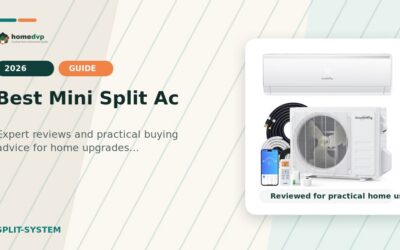

Mini split short cycling means the system repeatedly starts, stops, or changes operating state before the room settles near the selected temperature. A brief pause is not automatically a fault because inverter-driven systems can reduce output, indoor fans may behave differently by mode, and heating operation may pause temporarily. The pattern becomes concerning when comfort suffers, controls behave unpredictably, ice appears, or the system repeatedly shuts down soon after starting.
Answer-first summary: Common mini split short cycling causes include a blocked filter, obstructed indoor or outdoor airflow, a poorly located temperature sensor, conflicting control settings, an oversized system, condensate protection, electrical faults, or a refrigerant-system problem. Start with safe checks of modes, filters, vents, and visible obstructions. Stop and call a qualified technician for ice, leaks, recurring fault codes, breaker trips, burning odors, or exposed electrical components.
| What you observe | Likely direction | Safe first action |
|---|---|---|
| Indoor fan changes speed, but comfort remains steady | Normal inverter modulation may be mistaken for cycling | Observe the outdoor unit and room temperature before changing settings |
| System stops soon after starting and the room remains uncomfortable | Airflow, sensing, sizing, control, or equipment fault | Check mode, setpoint, filter, louvers, and visible obstructions |
| One zone cycles while other zones operate normally | Zone-specific sensor, airflow, control, or load issue | Compare settings and conditions among indoor heads |
| All zones stop together | Outdoor-unit protection, power, shared control, or refrigerant issue | Record indicators and call for service if the pattern repeats |
| Water, ice, or a fault code appears | Drainage, airflow, sensor, or sealed-system problem | Stop operation if damage could worsen and arrange service |
| Breaker trips, wiring looks damaged, or there is a burning odor | Electrical or fire hazard | Turn the system off only if it is safe to do so and contact a professional |
Confirm that the system is actually short cycling
A mini split does not always sound or behave like a conventional single-stage central air conditioner. Many models vary compressor and fan output instead of running at one fixed level. A quieter outdoor unit, a slower fan, or a temporary indoor-fan pause may indicate reduced output rather than a complete shutdown.
Watch both the indoor head and outdoor unit. Note whether the compressor appears to stop, whether the room reaches the selected temperature, and whether the same pattern occurs in cooling, heating, dry, or automatic mode. Avoid diagnosing by sound alone. Indicator lights, displayed temperatures, mobile-app status, and fault codes can provide more useful clues.
Heating mode has an important exception: temporary interruptions can occur while the outdoor unit manages frost. Fan behavior during that process is model-specific. Consult the manual before treating every heating pause as a failure. Likewise, built-in restart delays and minimum operating logic differ by manufacturer and should not be assigned a universal time limit.
Most common mini split short cycling causes
Restricted airflow at the indoor head
A loaded filter, blocked return area, closed louver, dirty coil, or furniture placed too close to the unit can reduce airflow. The temperature around the indoor head may then change faster than the temperature in the occupied part of the room. That can make the control respond as if the room has already reached its target.
With the system off according to the manual, inspect accessible filters and the area around the head. Clean only the parts identified as homeowner-serviceable. Do not insert tools through the louvers or spray household cleaners into the cabinet. Deep coil and blower cleaning requires appropriate disassembly, cleaning products, and protection of electrical parts.
Blocked or dirty outdoor equipment
Leaves, stored items, lint, vegetation, snow, or dirt around the outdoor unit can interfere with heat transfer. Look for visible obstructions without removing panels. Required clearances and cleaning procedures are model-specific, so use the installation and maintenance instructions rather than a generic distance found online.
The Department of Energy presents equipment selection, operation, and maintenance as connected parts of effective home cooling. Its overview of home cooling systems is useful context, but the mini split manual remains the controlling reference for accessible maintenance and service intervals.
Temperature sensing and control conflicts
The system may sense temperature at the indoor head, a wired controller, a wireless remote, or another model-specific location. Direct sun, a nearby appliance, an exterior door, a draft, or warm air collecting near the ceiling can make that reading unrepresentative of the occupied area.
Check whether a follow-me, occupancy, scheduling, energy-saving, sleep, or remote-sensing feature is active. Also look for overlapping commands from a handheld remote, wall controller, smart-home platform, or utility program. Do not assume a third-party thermostat is compatible with a ductless system. If control replacement is being considered, review compatibility first and use our smart thermostat cost comparison only after confirming that the mini split supports the proposed interface.
Capacity is poorly matched to the space
An oversized system can change the room temperature near the indoor unit quickly, shut down, and restart as heat or cooling loads return. Sizing should account for more than floor area. Insulation, windows, air leakage, orientation, climate, ceiling conditions, occupancy, and connected zones can all affect the load.
Do not replace equipment based only on a short-cycling impression. First rule out settings, airflow, sensor placement, installation defects, and maintenance problems. If sizing remains suspect, ask an HVAC professional to explain the load assumptions and whether the indoor and outdoor components are approved to operate together.
Multi-zone interaction or low room demand
On a multi-zone system, the outdoor unit serves several indoor heads whose demands may not align. One small room may need very little output while another zone continues calling. The apparently affected head may cycle, temper its airflow, or behave differently from a single-zone unit. Compare all zones before concluding that the outdoor unit is defective.
Mild weather can also produce low demand. If the room stays comfortable and the system shows no fault, modulation or occasional stopping may be normal. A persistent pattern that creates temperature swings or humidity discomfort deserves further evaluation. Cooling equipment that satisfies temperature demand too quickly may not provide the moisture removal the occupant expects. For a separate moisture problem, compare operating costs and limitations in our dehumidifier price guide rather than using a portable dehumidifier as a substitute for repairing faulty HVAC equipment.
Condensate or drainage protection
In cooling and drying modes, the indoor coil produces condensate. A blocked drain, failed condensate pump, poor drain routing, or activated overflow protection can interrupt operation on some installations. Water marks, dripping, pump noise, or a recurring shutdown after moisture begins forming are useful clues.
Turn off a leaking unit if water could reach wiring, walls, flooring, or furnishings. Renters should document the leak and contact the property owner or manager rather than opening the indoor head or modifying the drain. Concealed water damage or suspected microbial growth should be evaluated instead of covered or painted over.
Refrigerant, sensor, board, or electrical fault
A refrigerant leak, incorrect refrigerant charge, damaged thermistor, failing control board, loose connection, unstable power supply, or compressor protection event can produce repeated starts and stops. These possibilities cannot be confirmed safely by cleaning a filter or resetting a remote.
Refrigerant circuits are pressurized, and electrical compartments may remain hazardous even when the system is not actively heating or cooling. Do not connect gauges, add refrigerant, bypass a switch, replace a fuse with a different type, open service valves, or probe terminals unless you are properly qualified and authorized to service that equipment.
Safe diagnostic sequence for homeowners and renters
- Record the pattern. Note the mode, selected temperature, weather conditions, rooms affected, indicator lights, fault codes, water, ice, and whether the outdoor unit stops too.
- Simplify the controls. Cancel schedules and optional comfort features, then select one appropriate operating mode. Avoid repeatedly changing the setpoint while observing the result.
- Check accessible airflow points. Inspect homeowner-serviceable filters, the open space around each indoor head, and visible obstructions around the outdoor unit.
- Compare zones. On multi-zone systems, note whether other heads are off, calling for a different mode, or showing the same symptom.
- Check the manual. Look up the displayed code, indicator-light pattern, filter procedure, permitted reset process, and normal heating or defrost behavior for the exact model.
- Observe after one controlled change. Make only one reversible adjustment at a time so you can identify what affected the pattern.
- Escalate with evidence. If cycling continues, provide the installer or service company with photos, codes, operating modes, affected zones, and a short timeline.
A practical decision framework
Worked example: Suppose a bedroom head starts, runs briefly, and stops while the room remains warm. The filter is visibly loaded, the remote is sitting in direct sunlight, and the living-room zone operates normally. First clean the filter as the manual directs. Then move the remote only if that model uses remote-based sensing. Test again with schedules disabled. If the bedroom improves, airflow or sensing was the likely contributor. If it still cycles while the other zone works, report a zone-specific problem rather than assuming the entire outdoor unit has failed.
Use three questions to decide the next step. First, is the symptom system-wide or limited to one head? Second, does it change after a safe airflow or control correction? Third, is there evidence of a protection event, such as a code, ice, water, or simultaneous shutdown? A one-zone symptom points first toward local airflow, sensing, controls, or drainage. A simultaneous failure across all zones more strongly justifies checking shared power, outdoor equipment, and the refrigerant system professionally.
When to stop troubleshooting and call a professional
- A breaker trips again after the system is turned off or reset according to the manual.
- You see damaged wiring, scorch marks, sparks, smoke, or melted components.
- There is a burning odor, harsh electrical buzzing, or an unusual mechanical sound.
- Ice repeatedly forms on refrigerant lines or indoor or outdoor coils.
- Water is entering a wall, ceiling, electrical area, or finished surface.
- A fault code returns after the manual-authorized reset procedure.
- The unit was recently installed and has never operated correctly.
- A refrigerant leak, incorrect charge, compressor fault, or control-board problem is suspected.
- The outdoor unit or wall-mounted head appears loose, tilted, or structurally unsupported.
If smoke, active burning, or an immediate electrical hazard is present, leave the area and use local emergency procedures. Do not touch wet electrical equipment or repeatedly reset a tripping breaker. A mini split normally does not burn fuel at the indoor head, so this guide does not cover troubleshooting a separate gas furnace, boiler, fireplace, or other combustion appliance.
Common troubleshooting mistakes
- Judging only by indoor-fan sound. Fan changes do not prove that the compressor is fully cycling.
- Making several changes at once. This hides the cause and makes a service report less useful.
- Using an extreme setpoint as a test. It does not reveal whether a sensor, load calculation, or control is correct.
- Power-cycling the unit repeatedly. Follow only the reset process in the manual and stop if a fault returns.
- Assuming a larger unit is better. Capacity must match the building and operating conditions.
- Cleaning with unapproved chemicals or high-pressure water. These can damage finishes, coils, insulation, or electrical parts.
- Treating an air cleaner as an HVAC repair. Filtration may help manage airborne particles, but it cannot correct a refrigerant, sensor, drainage, or electrical defect.
The EPA explains that filtration is only one part of indoor-air management and does not replace source control or appropriate ventilation. Its guide to air cleaners in the home can help separate air-cleaning decisions from HVAC repair decisions. EPA also outlines broader actions to improve indoor air quality, which is useful when comfort complaints include odors, pollutants, or moisture rather than temperature alone.
Maintenance implications and limitations
Regular filter care and keeping airflow paths unobstructed can prevent some repeat problems, but maintenance cannot correct every cause of cycling. Dirty internal blowers, inaccessible coils, condensate pumps, control boards, electrical connections, and sealed refrigerant components may require trained service. The correct maintenance scope and interval depend on the model, occupancy, dust exposure, pets, operating hours, and installation environment.
This diagnostic method has limits. It does not establish refrigerant charge, verify electrical values, calculate building load, test a thermistor, or determine whether components are correctly matched. It also may not apply to portable heat pumps, window units, packaged terminal equipment, or a central system with ductless-looking controls. Browse the broader Heating, Cooling and Air section when the equipment is not actually a ductless mini split.
ENERGY STAR provides general heating and cooling equipment information for homeowners comparing efficient systems. Certification or efficiency information does not diagnose short cycling, however. A certified product can still be incorrectly sized, installed, configured, maintained, or controlled.
Final action plan for mini split short cycling causes
Confirm that both the indoor and outdoor units are actually stopping, record which zones are affected, simplify the controls, inspect accessible filters and airflow paths, and check the exact model manual. If one safe correction resolves the pattern, continue monitoring comfort and visible moisture. If the problem persists, returns with a code, affects every zone, or involves water, ice, electricity, refrigerant, or mounting, stop troubleshooting and arrange qualified service.
How we prepared this guide
This guide was checked against the cited Department of Energy, ENERGY STAR, and EPA guidance for home cooling, heating equipment, maintenance context, and indoor-air considerations. Because operating logic, fault codes, clearances, reset procedures, controls, and homeowner-serviceable parts vary, manufacturer-specific details should be confirmed in the installation and operation manuals for the exact indoor and outdoor models. No hands-on inspection or testing was performed for this article.