

A water sensor can provide an early warning when a supply line, appliance, water heater, sump area, or drain begins leaking. However, finding best water leak sensor compatible with Matter requires more than checking whether a product sends phone notifications. Matter support, controller requirements, alarm design, probe placement, network coverage, and automation compatibility all affect how useful a sensor will be after installation.
After carefully analyzing the available specifications, we screened 9 listed products for category fit and explicit Matter support. Only the qualifying models are discussed as Matter-compatible recommendations below. We compared their stated connectivity, sensing designs, audible alarms, platform support, installation considerations, environmental protection, and likely homeowner use cases. Readers planning a broader safety setup can also explore our Smart Home Security guides.
The short answer is that the THIRDREALITY model is the more straightforward candidate for multi-room indoor coverage, while the Shelly model offers a more flexible mix of wireless protocols and a leak-sensing cable. That recommendation remains conditional because the published product information does not include complete manuals, Matter certification records, controller requirements, or long-term user feedback for either qualifying model.

Pros
- Extended sensor cable can cover more than the sensor body alone, making placement near leak-prone areas easier.
- Supports Alexa, SmartThings, Google Home, and Apple HomeKit compatibility as listed.
Cons
- Battery runtime is not specified, so buyers cannot estimate replacement intervals from manufacturer specifications.
- The product requires a compatible smart-home platform or the Shelly Smart Control app to make full use of remote alerts and automation features.
Best For / Avoid If
Best for buyers prioritizing
- Extended sensor cable can cover more than the sensor body alone, making placement near leak-prone areas easier.
- Supports Alexa, SmartThings, Google Home, and Apple HomeKit compatibility as listed.
- Compact white housing and a listed weight of about 0.20 pounds make it convenient to position around the home.
Consider another option if
- Battery runtime is not specified, so buyers cannot estimate replacement intervals from manufacturer specifications.
- The product requires a compatible smart-home platform or the Shelly Smart Control app to make full use of remote alerts and automation features.
- The IP44 rating may make placement selection important in areas exposed to more than limited moisture or splash conditions.

Pros
- Strong coverage potential for large homes, basements, garages, and outbuildings.
- Several notification channels help keep homeowners and designated contacts informed.
Cons
- The gateway supports only 2.4 GHz Wi-Fi and is limited to GoveeLife H5059/H5830 sensors.
- Users must rely on the compatible gateway and app features for remote notifications.
Specifications
| Color | white |
|---|---|
| Dimensions | 8.3858267631 x 2.4015748007 x 2.4015748007 inches |
| Product Group | Home Improvement |
| Binding | Tools & Home Improvement |
Verify the current product variation before purchase; specifications may change.
Best For / Avoid If
Best for buyers prioritizing
- Strong coverage potential for large homes, basements, garages, and outbuildings.
- Several notification channels help keep homeowners and designated contacts informed.
- Adjustable alarm volume and remote silencing add practical control for day and night use.
Consider another option if
- The gateway supports only 2.4 GHz Wi-Fi and is limited to GoveeLife H5059/H5830 sensors.
- Users must rely on the compatible gateway and app features for remote notifications.
- A 105 dB maximum alarm may be louder than some users want in bedrooms or other quiet areas, even though the volume is adjustable.
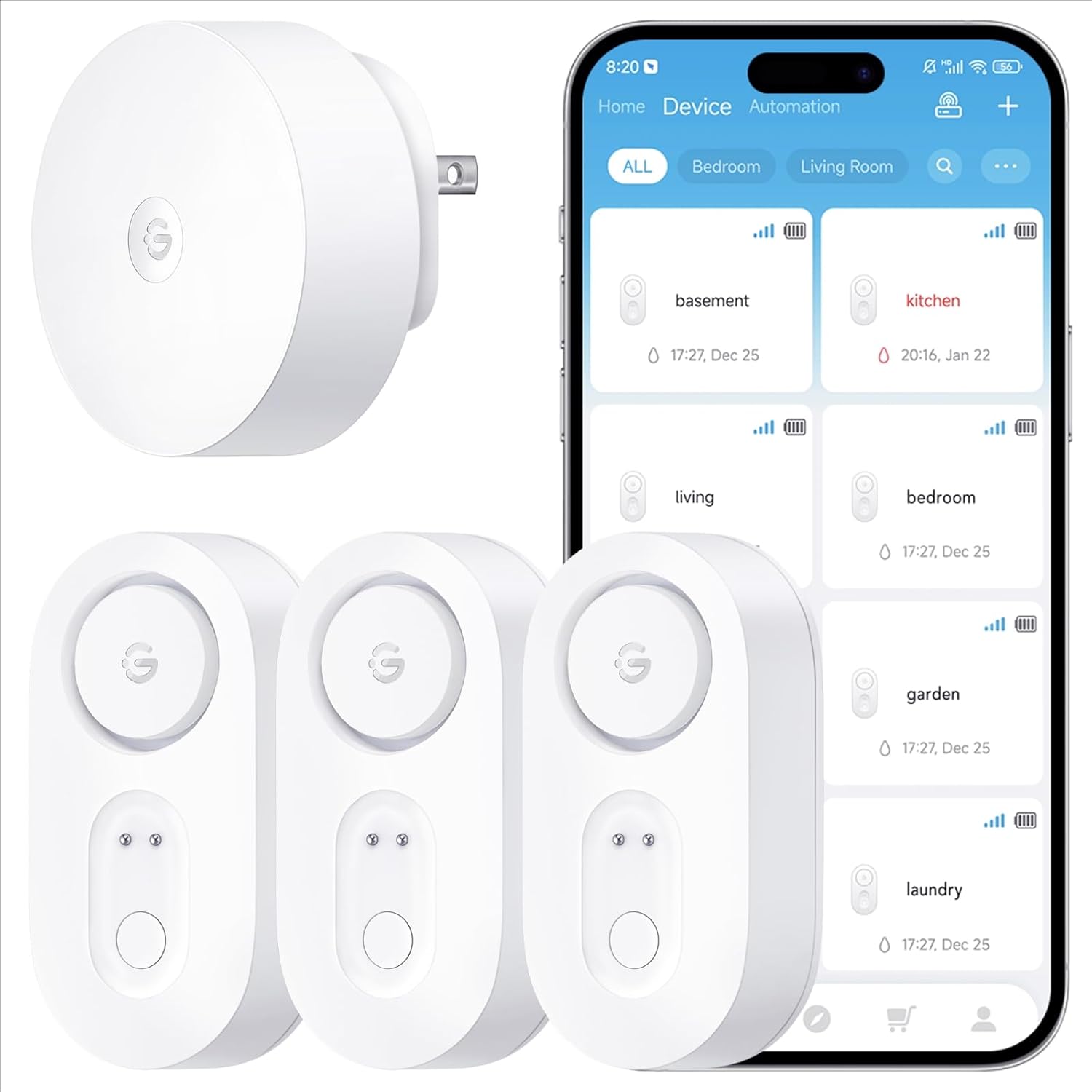
Pros
- Robust listed range through multiple walls for larger properties
- Multi-channel remote alerts including free SMS
Cons
- Gateway supports only 2.4G Wi-Fi and pairs with specified GoveeLife sensors
- First-time smart gateway setup may take extra time for some homeowners
Best For / Avoid If
Best for buyers prioritizing
- Robust listed range through multiple walls for larger properties
- Multi-channel remote alerts including free SMS
- Long listed battery life for low-maintenance monitoring
Consider another option if
- Gateway supports only 2.4G Wi-Fi and pairs with specified GoveeLife sensors
- First-time smart gateway setup may take extra time for some homeowners
- Users needing contractor-scale sensor counts may want higher-capacity systems

Pros
- Combines water detection with temperature monitoring in one indoor sensor.
- Works with the SmartThings app and listed compatible ZigBee hubs for remote notifications.
Cons
- Requires a compatible smart home hub, so it is not a standalone leak alarm based on the listed requirements.
- Indoor use is required, and ZigBee range may vary with the construction of the home.
Specifications
| Color | white |
|---|---|
| Dimensions | 0.913384 x 0.64960629855 x 0.79 inches |
| Product Group | Home Improvement |
| Binding | Tools & Home Improvement |
Verify the current product variation before purchase; specifications may change.
Best For / Avoid If
Best for buyers prioritizing
- Combines water detection with temperature monitoring in one indoor sensor.
- Works with the SmartThings app and listed compatible ZigBee hubs for remote notifications.
- Automation support can help coordinate connected water shutoff or electronic power-down actions.
Consider another option if
- Requires a compatible smart home hub, so it is not a standalone leak alarm based on the listed requirements.
- Indoor use is required, and ZigBee range may vary with the construction of the home.
- The operating temperature range is limited to 32 to 104 degrees Fahrenheit.

Pros
- Two sets of sensor probes on each unit improve early leak detection coverage.
- Volume can be adjusted with button presses or via the app when a compatible gateway is used.
Cons
- Sensors cannot join an app for remote monitoring without a separate GoveeLife H5044 gateway, which is not included.
- Compatible only with the GoveeLife H5044 gateway and not with other brands or certain GoveeLife models such as H5040 and H5043.
Specifications
| Power Source | Battery Powered |
|---|---|
| Compatible Devices | Smartphone |
| Battery Description | Alkaline |
| Number of Batteries | 10 AAA batteries required. (included) |
| Control Method | App |
| Audible Noise | 105 Decibels |
| Mounting Type | Wall Mount |
| Maximum Range | 550 Meters |
| Sensor Technology | 915Mhz |
| Smart Home Compatibility | Smart Home Compatible |
Verify the current product variation before purchase; specifications may change.
Best For / Avoid If
Best for buyers prioritizing
- Two sets of sensor probes on each unit improve early leak detection coverage.
- Volume can be adjusted with button presses or via the app when a compatible gateway is used.
- Ready to use out of the package with a built-in battery and no initial battery install required.
Consider another option if
- Sensors cannot join an app for remote monitoring without a separate GoveeLife H5044 gateway, which is not included.
- Compatible only with the GoveeLife H5044 gateway and not with other brands or certain GoveeLife models such as H5040 and H5043.
- Battery replacement requires removing waterproof pads and screws, which may take extra care for some users.

Pros
- Combines leak detection with freeze monitoring in one compact device.
- Remote alerts can help users stay informed even when they are away from the monitored area.
Cons
- The product information does not specify the WiFi network requirements or alert range.
- The one-year limited warranty covers the alarm only, and its coverage period begins when the device is powered on.
Best For / Avoid If
Best for buyers prioritizing
- Combines leak detection with freeze monitoring in one compact device.
- Remote alerts can help users stay informed even when they are away from the monitored area.
- The included AA batteries and QR-code setup reduce the number of initial installation steps.
Consider another option if
- The product information does not specify the WiFi network requirements or alert range.
- The one-year limited warranty covers the alarm only, and its coverage period begins when the device is powered on.
- Users who need coverage in multiple locations may need more than the included one-pack unit.
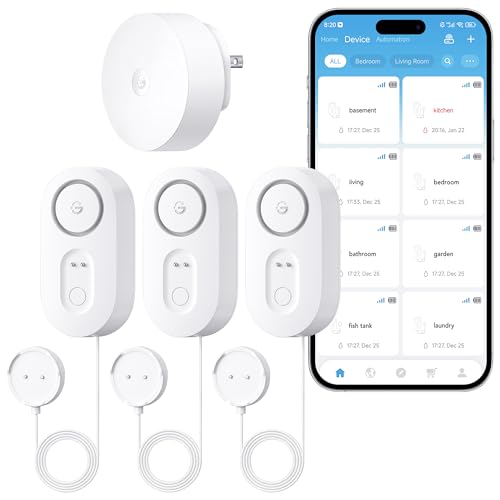
Pros
- Three sensors provide coverage for multiple leak-prone areas from one gateway.
- The extended probe cable improves placement flexibility in concealed or hard-to-access locations.
Cons
- The gateway works only with 2.4 GHz Wi-Fi and the listed GoveeLife H5059 or H5830 water sensors.
- Users who want a simple standalone alarm may find the gateway and app-based setup more involved than a basic local detector.
Specifications
| Color | White |
|---|---|
| Size | 1 Gateway+3 Sensors |
| Dimensions | 4.1732283422 x 3.0708661386 x 7.87401574 inches |
| Product Group | Home Improvement |
| Binding | Tools & Home Improvement |
Verify the current product variation before purchase; specifications may change.
Best For / Avoid If
Best for buyers prioritizing
- Three sensors provide coverage for multiple leak-prone areas from one gateway.
- The extended probe cable improves placement flexibility in concealed or hard-to-access locations.
- Long-range wireless communication and several notification methods support monitoring across larger properties.
Consider another option if
- The gateway works only with 2.4 GHz Wi-Fi and the listed GoveeLife H5059 or H5830 water sensors.
- Users who want a simple standalone alarm may find the gateway and app-based setup more involved than a basic local detector.
- The available data does not specify whether the gateway includes additional networking features beyond the listed alert and sensor functions.

Pros
- Continuous leak monitoring helps provide ongoing awareness around common household water sources.
- App-based alerts can help users act quickly when moisture is detected.
Cons
- A 2.4 GHz Wi-Fi network is required for app connectivity and smart alerts.
- The Moen Flo Shutoff is sold separately, so automatic shutoff functionality requires an additional product.
Specifications
| Color | White |
|---|---|
| Size | 3 Sensors |
| Dimensions | 3.25 x 2.63 x 1.5 inches |
| Weight | 0.8 Pounds |
| Product Group | Home Improvement |
| Binding | Tools & Home Improvement |
Verify the current product variation before purchase; specifications may change.
Best For / Avoid If
Best for buyers prioritizing
- Continuous leak monitoring helps provide ongoing awareness around common household water sources.
- App-based alerts can help users act quickly when moisture is detected.
- Expandable detector coverage supports monitoring multiple areas throughout the home.
Consider another option if
- A 2.4 GHz Wi-Fi network is required for app connectivity and smart alerts.
- The Moen Flo Shutoff is sold separately, so automatic shutoff functionality requires an additional product.
- Users seeking coverage in several areas may need multiple detector units.
Which Listed Sensors Clearly Support Matter?
Product relevance matters here because a smart water alarm is not automatically a Matter water alarm. Wi-Fi, Zigbee, Alexa, SmartThings, or app compatibility by itself does not establish Matter support. Based strictly on the listed titles and specifications, the qualifying recommendations are THIRDREALITY Smart Water Leak Sensor KM1 and Shelly Flood Gen4, WiFi, Bluetooth, Zigbee.
The THIRDREALITY listing explicitly identifies Matter over Wi-Fi and names Apple Home, Alexa, Home Assistant, and Homey. It describes a controller with multiple water detectors, an audible alarm, and stated multi-year battery operation for the detectors. The Shelly listing explicitly identifies Matter alongside Wi-Fi, Bluetooth, and Zigbee, and it describes a leak-sensing cable, flood and rain detection, and IP44 protection.
| Qualifying model | Documented listing highlights | Likely fit | Important limitation |
|---|---|---|---|
| THIRDREALITY Smart Water Leak Sensor KM1 | Matter over Wi-Fi, controller, multiple detectors, audible alarm, named smart-home platforms | Indoor buyers who want coverage at several leak-prone points | Full setup requirements and independent user feedback were not listed |
| Shelly Flood Gen4, WiFi, Bluetooth, Zigbee | Matter, multiple radio options, sensing cable, flood and rain detection, IP44 rating | Buyers who value protocol flexibility or cable-based detection | Battery details, cable coverage, and precise Matter functions were not listed |
Other listed products may still function as conventional app-connected, Wi-Fi, or hub-based leak alarms, but the available evidence does not explicitly confirm Matter compatibility. They are therefore not presented as alternatives for this exact reader needs. This distinction prevents a buyer from assuming that general smart-home support guarantees commissioning through a preferred Matter ecosystem.
best water leak sensor compatible with Matter Buying Guide
Confirm Matter Support and Device Functions
Start by verifying that the exact model and hardware revision support Matter. Similar-looking products within one brand may use different radios, gateways, or app ecosystems. A title containing Wi-Fi, HomeKit, Alexa, or SmartThings does not necessarily mean the device supports Matter. Look for explicit Matter language, a commissioning code, compatible-controller requirements, and current manufacturer documentation before ordering.
It is also important to distinguish basic Matter compatibility from the features available in a specific platform. A sensor may expose wet or dry status through Matter while reserving battery information, alarm-volume controls, history, firmware updates, or specialized alerts for its manufacturer app. Confirm that your preferred platform can display water-leak events and use them in automations rather than assuming every advertised feature crosses ecosystem boundaries.
The common mistake is purchasing for a platform logo without checking the exact function exposed. Apple Home, Alexa, Google Home, SmartThings, Home Assistant, and Homey can differ in interface, automation options, and support by software version. If leak status must trigger another device, verify that complete automation path before relying on it.
Understand Controllers, Hubs, and Network Requirements
A Matter device still needs an appropriate Matter controller in the chosen ecosystem. Matter over Wi-Fi models connect differently from Matter over Thread products, and a Thread model normally requires a compatible Thread border router. The THIRDREALITY listing specifies Matter over Wi-Fi and a KM1 controller, while the Shelly listing names Wi-Fi, Bluetooth, Zigbee, and Matter. The manufacturer does not fully explain how each radio is used, so consult current setup documentation before purchase.
Wi-Fi coverage deserves special attention in basements, utility rooms, garages, and cabinets. Dense masonry, metal appliances, plumbing, and mechanical equipment can weaken a signal. A sensor that works beside the router may not remain dependable behind a water heater or at the far end of a finished basement. Check signal strength at the intended location and avoid hiding a wireless controller inside a metal enclosure.
Renters and beginners should favor a system with a clear commissioning process and minimal extra hardware. Experienced smart-home users may prefer protocol flexibility, especially if they already operate Zigbee or local automation equipment. For related planning, our smart light switch buying guide explains similar controller and ecosystem considerations.
Choose Between Point Sensors and Leak-Sensing Cables
Point sensors detect water where their contacts touch the floor or another surface. They work well beneath sink traps, beside toilets, near washing-machine connections, under dishwashers, and at the base of water heaters. Their effectiveness depends heavily on placement. Water following a sloped floor or cabinet edge can bypass a sensor positioned only a short distance away.
A sensing cable can monitor a longer path and may be more useful around an appliance perimeter, below a row of plumbing connections, or along an area where the exact leak point is uncertain. The Shelly listing includes a leak sensor cable, which is its most meaningful differentiator in the published information. Before choosing it, verify the cable length, replacement availability, allowed routing, bend limitations, and whether the complete cable detects moisture or only specific sections.
For several distinct risk points, the THIRDREALITY package design may be easier to distribute because its listing describes multiple detectors connected to a controller. A homeowner could assign separate detectors to an appliance, sink cabinet, and utility area. Do not place a detector where routine splashes, condensation, or floor cleaning will produce avoidable alerts.
Evaluate Local Alarms, Remote Alerts, and Automations
A local siren remains valuable because internet, cloud, router, or phone-notification failures can occur. The THIRDREALITY listing specifies an audible controller alarm. The Shelly title does not document a siren level, so buyers who require a loud local warning should verify that feature rather than infer it from the term flood sensor.
Remote alerts matter when no one is home, but they are only useful if notification permissions, internet access, and platform automations remain active. During setup, enable critical notifications where supported, name each sensor by location, and send a test event to every household member expected to respond. A message reading “laundry supply leak” is more actionable than a generic device identifier.
Matter can also support a broader response plan, depending on what the controller exposes. A detected leak might turn on selected lights, announce an alert, or notify a monitoring routine. Automatic water shutoff is a separate capability and should not be assumed. If an automation controls plumbing equipment, follow the valve manufacturer’s installation requirements and keep a manual response plan. A leak sensor warns of water; it does not repair the source or guarantee damage prevention.
Match Environmental Protection to the Location
Water resistance and submersion resistance are not interchangeable. The Shelly product title states IP44, which generally indicates protection against certain solid objects and splashing water, not indefinite immersion. Treat the published rating as a placement boundary and follow the manufacturer’s instructions for sensor orientation, cable routing, rain exposure, and drying after an event.
Indoor utility spaces can also expose sensors to dust, condensation, temperature swings, cleaning chemicals, or physical impact. Avoid placing a device where it will be crushed by an appliance, buried under stored items, or repeatedly kicked. For rain detection or semi-exposed use, verify permitted operating conditions because an advertised detection function does not automatically mean unrestricted outdoor installation.
Freeze alerts are another distinct feature and should not be inferred from ordinary leak detection. Homes with pipes in cold crawl spaces, garages, or vacation properties may need dedicated temperature monitoring in addition to water contacts. Homeowners building a broader hazard plan may also want to compare our smoke detector guide and emergency supplies resources.
Plan for Battery Care, Connectivity Checks, and Maintenance
The THIRDREALITY listing advertises multi-year battery life for its detectors and also uses the phrase “no batteries,” which is ambiguous without fuller documentation. It may refer to included batteries or a component-specific design, but the published information is not sufficient to resolve that wording. Confirm the battery type, whether batteries are included, whether they are replaceable, and how the platform reports low charge.
Battery-life claims are estimates affected by radio activity, alarm events, signal strength, temperature, firmware, and battery quality. Put leak sensors on a recurring home-maintenance calendar instead of waiting for a low-battery warning. Inspect for corrosion or debris, confirm the sensor remains flat and unobstructed, check the app or controller for offline devices, and run the manufacturer-approved test procedure.
A sensible routine is to inspect sensors whenever you check supply hoses, shutoff valves, drain pans, and visible plumbing. Replace swollen, cracked, or corroded components and investigate recurring moisture rather than repeatedly silencing alarms. Never pour uncontrolled amounts of water near electrical equipment to test a sensor.
Calculate Coverage and Long-Term Ownership Cost
Compare systems by protected location, not merely by package cost. A lower-priced sensor that requires an additional controller, proprietary gateway, cable, or subscription may cost more than expected. Conversely, an existing compatible Matter controller can reduce startup expense.
Make a room-by-room risk map before choosing a package. Typical priorities include the water heater, washing machine, dishwasher, refrigerator supply line, sump pit, HVAC condensate equipment, and sink cabinets. Start with locations where a leak could remain hidden or cause substantial damage, then expand coverage. Renters should prioritize portable sensors that do not require permanent plumbing changes and should notify the property manager promptly when water is detected.
Long-term cost also includes replacement batteries, proprietary controllers, replacement sensing cables, and the time required to maintain separate apps. If local control or privacy is important, investigate whether essential detection and alarm behavior continues during an internet outage. Matter can improve interoperability, but it does not guarantee that every manufacturer feature operates locally or without an account.
A Practical Placement Plan
| Risk area | Useful sensor approach | Placement caution |
|---|---|---|
| Water heater | Point detector in the drain pan or cable around the likely escape path, if permitted | Keep the device away from burner areas, heat, and service access |
| Washing machine | Detector near supply connections or a cable covering the appliance edge | Do not place it where vibration or movement can damage it |
| Sink cabinet | Point detector beneath shutoff valves and the trap | Cleaning products and stored items must not cover the contacts |
| Dishwasher or refrigerator | Low-profile point detector or routed sensing cable | Confirm the appliance will not crush the sensor or cable |
| Basement or sump area | Multiple detectors for separate flow paths | Verify wireless coverage and avoid routine standing water |
Placement should follow the expected path of water rather than visual symmetry. Examine floor slope, drain location, cabinet lips, and appliance feet. A small amount of water can travel along grout lines or settle in a low spot away from the plumbing source. After placement, label each device in the app and record its installation location so another household member can find it quickly.
How We Compared These Picks
We evaluated the listed products based on exact category fit, explicit Matter language, connectivity, detection method, local alerting, platform claims, environmental protection, maintenance needs, installation complexity, and likely value by use case. Category validation came first. Products described only as Wi-Fi, Zigbee, app-connected, or hub-compatible were not treated as Matter recommendations without explicit supporting information.
Our research is specification-based rather than hands-on. Where manuals, certification records, complete specifications, or meaningful feedback were absent, we narrowed the recommendation and identified what a buyer should verify.
Ranking criteria included detection coverage, connectivity, platform flexibility, audible warning capability, build protection, ease of setup, maintenance, reliability considerations, safety, and fit for homeowners or renters. We also considered ownership implications such as controller requirements, battery upkeep, network dependence, and replacement components. The guide is reviewed during August so compatibility claims and category fit can be reassessed as product information changes.
No water sensor can guarantee that a leak will be detected before damage occurs. Our goal is to help readers choose a suitable warning device and understand its limitations, not to substitute for plumbing inspection, appliance maintenance, code-compliant installation, or professional advice when leaks involve electrical systems, structural damage, sewage, mold, or pressurized plumbing.
Final Thoughts
Based on our detailed comparison, THIRDREALITY Smart Water Leak Sensor KM1 is the stronger conditional pick for buyers who want one controller and detectors distributed across several indoor risk areas. Its listing explicitly states Matter over Wi-Fi, names several major platforms, and specifies an audible alarm. Buyers should still confirm controller power requirements, battery details, app dependence, and the exact functions exposed through their chosen Matter platform.
Shelly Flood Gen4, WiFi, Bluetooth, Zigbee is the more compelling option for buyers who prioritize a sensing cable and multiple connectivity choices. It may suit an appliance perimeter or another location where water could appear along a path rather than at one predictable point. Skip it if you require documented submersion protection, a confirmed loud onboard siren, or complete battery specifications and cannot verify those details in current manufacturer documentation.
The right choice depends on your existing controller, coverage plan, and response strategy. Buy only after confirming the exact model’s Matter setup process and platform features, then test alerts and inspect the installation regularly. Leak detection works best as one layer in a broader home-safety plan that may also include a home security system and properly maintained smoke and carbon-monoxide alarms.
Frequently Asked Questions
What should I look for when choosing best water leak sensor compatible with Matter?
Confirm explicit Matter support for the exact model, the type of network it uses, required controllers, and whether your preferred platform exposes leak events and automations. Also compare local alarms, sensor or cable coverage, environmental rating, battery maintenance, and performance when the internet is unavailable.
Does Matter mean a water sensor works without a hub?
No. A Matter device generally needs a compatible Matter controller, and the required network equipment depends on whether it communicates over Wi-Fi, Thread, or another supported arrangement. Some products may also use a brand controller or app for advanced settings, updates, or accessory communication.
Will every feature appear in Apple Home, Alexa, or another Matter platform?
Not necessarily. Basic leak status may be available while alarm controls, history, battery details, firmware updates, or specialized notifications remain in the manufacturer’s app. Check current support documentation for both the sensor and your chosen platform before buying.
Where should a Matter water leak sensor be placed?
Place sensors at likely leak sources and along expected water paths, including beneath sink plumbing, near appliance supply lines, beside water heaters, and around sump or condensate equipment. Keep contacts unobstructed, avoid locations with routine splashing, and make sure wireless coverage is dependable.
Can a Matter leak sensor automatically shut off the water?
Only if it is paired with a compatible shutoff device and the selected controller supports the required automation. Leak detection alone does not provide shutoff capability. Plumbing-mounted valves may require professional installation, and any automatic response should retain a safe manual override.
How often should water leak sensors be checked?
Follow the manufacturer’s maintenance and test schedule, and include every sensor in a recurring household safety check. Confirm that contacts are clean, batteries are healthy, devices remain online, location names are accurate, and alerts reach the intended phones. Our motion sensor light guide offers additional ideas for building practical smart-home alert and visibility routines.
Is a sensing cable better than a point detector?
Neither design is universally better. A point detector is practical when the likely leak location is known, while a cable can cover a longer edge or uncertain flow path. Choose according to floor slope, appliance layout, permitted cable routing, replacement availability, and the number of separate locations you need to protect.