
For subzero Fahrenheit weather, the Vivideye Security Cameras Wireless Outdoor 5G& 2.4G is the clearest match in this group: Vivideye states an operating range of -4°F to 122°F. That rating does not cover colder conditions. The other models make general claims about extreme temperatures or describe a range that bottoms out above 0°F, so check the exact operating-temperature limit before buying for a colder climate.
All five options are solar or battery-powered outdoor cameras, but the available cold-weather claims are not equally specific. A weather-resistance rating such as IP65 or IP66 addresses protection from water and dust; it does not, by itself, establish a minimum operating temperature. Solar charging also depends on suitable sunlight, so consider how the camera will stay charged during short winter days.
Cold-weather claims at a glance
| Camera | Cold-weather information stated by the brand | What to check before buying |
|---|---|---|
| Vivideye Security Cameras Wireless Outdoor 5G& 2.4G | IP66 housing and an advertised operating range of -4°F to 122°F | Whether your lowest expected temperature stays within that range; auto-tracking must be enabled in the app |
| GNCC Solar Security Cameras Wireless Outdoor 2.4G | IP65; stated operating range of -10°C to 45°C, approximately 14°F to 113°F | This range does not extend below 0°F |
| Carltec No Monthly Fee Solar Security Camera | IP66; the brand claims resistance to extreme temperatures but does not specify a minimum | Ask for the exact operating range for your winter conditions |
| 2K Security Camera System | IP65; the brand describes year-round performance in extreme temperatures without giving a numeric limit | Confirm the minimum operating temperature |
| SEHMUA 2K Solar Security Cameras Wireless Outdoor | IP65 and general all-weather claims, with no numeric temperature range stated | Confirm the minimum operating temperature and winter charging expectations |
These figures are manufacturer claims, not a guarantee that a camera will maintain every function or battery performance at the stated limit. If your location regularly falls below -4°F, none of these options has a listed operating range that clearly covers those temperatures. Ask the manufacturer about the exact model and expected low before relying on it for winter security.
Camera comparisons
Vivideye Security Cameras Wireless Outdoor 5G& 2.4G
Vivideye is the most straightforward choice here if your expected lows remain within its advertised -4°F to 122°F range. The two-camera system includes a hub with 128GB of local storage, dual-band Wi-Fi, 4MP video, and solar panels with 8,000mAh batteries. Vivideye also lists IP66 weather protection and color night vision.
Pros: The brand gives a specific subzero Fahrenheit operating range. Local storage avoids a required monthly subscription, and the cameras support 2.4GHz and 5GHz Wi-Fi.
Cons: The stated lower limit is -4°F, not a fit for colder conditions. Auto-tracking is off by default and must be enabled in the app. The manufacturer describes solar charging but does not give a winter sunlight requirement.
Who should skip it: Skip it if local temperatures can fall below -4°F, or if you need auto-tracking to work without changing app settings.
GNCC Solar Security Cameras Wireless Outdoor 2.4G
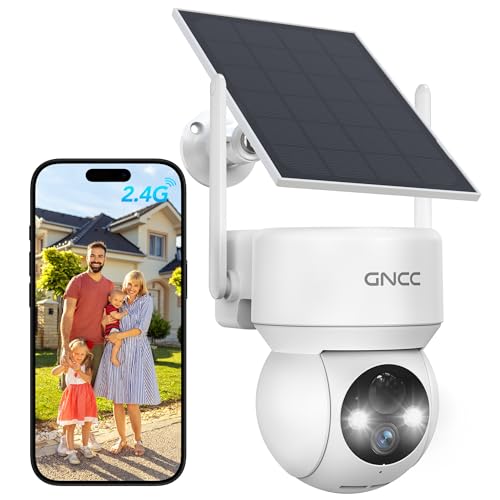
GNCC states an operating range of -10°C to 45°C, approximately 14°F to 113°F. That is a numeric temperature claim, but its lower limit is above freezing in Fahrenheit, so this model is not a documented choice for subzero Fahrenheit operation. It offers 1080p video, pan-and-tilt coverage, 2.4GHz Wi-Fi, and local microSD storage up to 128GB.
Pros: GNCC publishes a specific operating range and lists an IP65 rating. The camera supports local storage and solar charging.
Cons: The stated minimum is about 14°F. The camera supports only 2.4GHz Wi-Fi, records motion events rather than continuously, and has no motion tracking. The manufacturer says optional AI recognition requires a subscription.
Who should skip it: Skip it if your camera must operate below 0°F or you require continuous recording.
Carltec No Monthly Fee Solar Security Camera
Carltec describes this four-camera system as suitable for snow and extreme temperatures and lists an IP66 rating, but it does not state a numeric minimum operating temperature. The system includes a hub for local storage, dual-band Wi-Fi, 4MP cameras, and solar panels. A microSD card is required for the hub’s local storage and is not included.
Pros: The system offers local storage without a mandatory cloud subscription, 360-degree pan-and-tilt control, human detection, and two-way audio. The IP66 rating is higher than the IP65 ratings listed for several alternatives, though it does not establish a cold-temperature limit.
Cons: The minimum operating temperature is not specified, so the broad extreme-temperature claim is not enough to establish suitability for a particular subzero climate. The system requires Wi-Fi and a separately purchased microSD card for local storage.
Who should skip it: Skip it if you cannot confirm that its operating range covers your expected winter lows.
2K Security Camera System
Gianteye describes this four-camera system as suitable for snow and extreme temperatures and lists an IP65 rating, but no numeric operating range. Its listed features include 2K video, dual-band Wi-Fi, pan-and-tilt control, human detection, and solar charging. Local microSD storage is supported, but the card is not included.
Pros: Dual-band Wi-Fi, local storage, and a four-camera setup give buyers flexibility in coverage and connection options. The brand makes a general year-round weather claim.
Cons: The manufacturer does not specify a minimum operating temperature, so suitability for subzero Fahrenheit conditions cannot be confirmed from the stated range. The advertised solar performance depends on sunlight, and the card for local recording must be purchased separately.
Who should skip it: Skip it if you need a published temperature limit before choosing equipment for severe winter weather.
SEHMUA 2K Solar Security Cameras Wireless Outdoor
SEHMUA describes its two-camera system as suitable for all-weather use and lists IP65 protection, but gives no numeric operating-temperature range. The cameras offer 2K video, pan-and-tilt control, a removable solar panel, two-way audio, and a microSD card slot. They connect to 2.4GHz Wi-Fi, not 5GHz.
Pros: The two-camera package includes solar panels and offers local microSD storage, with optional cloud storage also listed. The brand describes the housing as suitable for rain, snow, and sun.
Cons: There is no stated minimum operating temperature to confirm subzero Fahrenheit suitability. The cameras support only 2.4GHz Wi-Fi, and the microSD card is not included.
Who should skip it: Skip it if your winter lows are severe and you need a specific temperature rating, or if your installation requires 5GHz Wi-Fi.

Pros
- Four cameras provide multiple units for monitoring different areas.
- IP65 weather resistance supports outdoor placement in rain, snow, and dust, according to product details.
Cons
- MicroSD card is not included, and cloud storage is optional.
- Solar charging performance depends on sunlight, so shaded placements may not suit the stated daily charging claim.
Specifications
| Color | White |
|---|---|
| Dimensions | 4.3 x 4.7 x 5.5 Inches |
| Weight | 7.68972369856 pounds |
| Product Group | Home Improvement |
| Binding | Tools & Home Improvement |
Verify the current product variation before purchase; specifications may change.
Best For / Avoid If
Best for buyers prioritizing
- Four cameras provide multiple units for monitoring different areas.
- IP65 weather resistance supports outdoor placement in rain, snow, and dust, according to product details.
- Solar charging is paired with a built-in backup battery for periods with less sunlight.
Consider another option if
- MicroSD card is not included, and cloud storage is optional.
- Solar charging performance depends on sunlight, so shaded placements may not suit the stated daily charging claim.
- Buyers should confirm their WiFi coverage and preferred band at each camera location before choosing placement.

Pros
- No recurring subscription is required for the listed local recording setup.
- Solar-assisted, wire-free operation can simplify camera placement where running power cables is inconvenient.
Cons
- The home hub must still connect to a compatible 2.4GHz or 5GHz Wi-Fi network, so setup depends on suitable network coverage.
- The system relies on solar power, which may require thoughtful panel placement for dependable exposure.
Specifications
| Color | White |
|---|---|
| Dimensions | 8 x 5 x 16 inches |
| Product Group | Camera |
Verify the current product variation before purchase; specifications may change.
Best For / Avoid If
Best for buyers prioritizing
- No recurring subscription is required for the listed local recording setup.
- Solar-assisted, wire-free operation can simplify camera placement where running power cables is inconvenient.
- Dual-band Wi-Fi support, pre-paired cameras, and a choice of Ethernet or Wi-Fi hub connection can make initial setup more approachable.
Consider another option if
- The home hub must still connect to a compatible 2.4GHz or 5GHz Wi-Fi network, so setup depends on suitable network coverage.
- The system relies on solar power, which may require thoughtful panel placement for dependable exposure.
- Users who need cloud storage or more than the included two-camera kit may prefer a different system.

Pros
- Removable solar panel supports continuous operation.
- Versatile mounting options fit various home setups.
Cons
- Limited to 2.4GHz WiFi networks only.
- SD card must be purchased separately.
Specifications
| Other Special Features of the Product | Easy to Install |
|---|---|
| Indoor Outdoor Usage | Outdoor |
| Compatible Devices | ALL |
| Controller Type | APP Control |
| Mount Type | Wall Mount & Ceiling Mount |
| Color | White |
| Form Factor | Dome |
| Installation Type | Screw In |
| Alert Type | Motion Only |
| Room Type | Kitchen, Living Room, Nursery, Office |
Verify the current product variation before purchase; specifications may change.
Best For / Avoid If
Best for buyers prioritizing
- Removable solar panel supports continuous operation.
- Versatile mounting options fit various home setups.
- Local storage up to 128GB offers flexible data options.
Consider another option if
- Limited to 2.4GHz WiFi networks only.
- SD card must be purchased separately.
- Cloud storage requires subscription after trial period.

Pros
- No mandatory cloud subscription for recorded footage
- Broad camera movement with AI auto-tracking and synchronized event clips
Cons
- The system cannot operate without WiFi and does not support 4G or LTE cellular service
- An SD card is required for local storage but is not included
Specifications
| Color | White |
|---|---|
| Size | 4 Cam Home Hub Kit |
| Dimensions | 5.1 x 4.1 x 5.3 inches |
| Product Group | Camera |
Verify the current product variation before purchase; specifications may change.
Best For / Avoid If
Best for buyers prioritizing
- No mandatory cloud subscription for recorded footage
- Broad camera movement with AI auto-tracking and synchronized event clips
- Solar charging, two-way communication, and full-color night vision support everyday exterior monitoring
Consider another option if
- The system cannot operate without WiFi and does not support 4G or LTE cellular service
- An SD card is required for local storage but is not included
- Solar charging performance depends on available sunlight and the placement of each detachable panel
Pros
- Solar-assisted battery operation is convenient for outdoor locations where running power cables is impractical.
- The pan-and-tilt range offers broad visual coverage for common residential monitoring areas.
Cons
- The camera supports 2.4GHz WiFi only, so it cannot connect directly to a 5GHz network.
- It does not provide motion tracking or 24/7 continuous recording, with recording limited to motion-triggered events.
Specifications
| Color | White |
|---|---|
| Size | 1 Pack |
| Dimensions | 5.31 x 3.35 x 4.72 inches |
| Product Group | Home Improvement |
| Binding | Tools & Home Improvement |
Verify the current product variation before purchase; specifications may change.
How to choose for winter
- Match the minimum temperature: Compare the camera’s operating range with the coldest conditions it may face. If the brand gives only a general extreme-weather claim, ask for a numeric limit.
- Separate cold resistance from weather protection: IP65 or IP66 describes an enclosure’s protection against dust and water ingress. It does not replace an operating-temperature specification.
- Plan for reduced winter solar charging: Solar-powered cameras depend on light reaching the panel. Check panel placement, winter sun exposure, and what happens during extended cloudy periods.
- Check connection and recording needs: Confirm Wi-Fi band compatibility and whether the camera supports event recording or continuous recording. Check whether local storage requires a separately purchased card.
- Confirm the exact model rating: Ask the manufacturer whether the listed temperature range applies to the camera, its battery, and normal operation.
If avoiding cloud fees is also important, compare storage options in our guide to security cameras with local storage and no fee. For this cold-weather decision, choose a camera only when its stated operating range covers your actual winter lows.