
Smart lighting has become one of the simplest upgrades a homeowner or renter can make, and Smart Light Bulbs options in 2026 are more capable, brighter, and easier to set up than ever. Whether you want hands-free voice control, color-changing scenes for movie night, or automated schedules that mimic natural daylight, the right smart bulbs can transform everyday rooms without rewiring or a full remodel. For readers browsing our Light Bulbs category, this guide focuses on practical choices that fit real homes, real Wi-Fi networks, and real daily routines.
Our research also considered hub requirements, Matter support, energy monitoring, and whether each model is better for bedrooms, living rooms, kitchens, or accent fixtures. Brands represented include KasaSmartbyTP-Link, Tapo, Linkind, Govee, PhilipsLightingLED, giving shoppers a clear view of premium ecosystems and budget-friendly packs.
Home DVP decision summary
Quick Answer
For Best Smart Light Bulbs, Home DVP compared 15 products from 5 brands. Confirm bulb base, brightness, dimming behavior, and platform support before comparing effects. Decide whether you want direct Wi-Fi control or a hub-based system that can remain responsive during internet outages.
| Comparison coverage | 15 products from 5 brands, including Tapo, KasaSmartbyTP-Link, Govee. |
|---|---|
| Selection priority | Confirm bulb base, brightness, dimming behavior, and platform support before comparing effects. Decide whether you want direct Wi-Fi control or a hub-based system that can remain responsive during internet outages. |
| Evidence basis | Manufacturer specifications, compatibility details, retailer-provided product data, and common homeowner use cases. |
| Reference guidance | U.S. Department of Energy lighting guidance. |
This summary describes the article's comparison set, not every product on the market. Product details should be confirmed before purchase.
This buying guide is written for homeowners, renters, DIY beginners, and smart home shoppers who want reliable recommendations without marketing fluff. We explain what matters most before you buy, who each style of bulb is best for, and how to avoid common mistakes like pairing the wrong base type or overloading a crowded 2.4 GHz network. If you are also planning related upgrades, you may find our guide to the Best LED Bathroom Mirror 2026 useful for cohesive lighting plans.
Top Smart Light Bulbs at a Glance

Pros
- Wide color range and many preset scenes support custom moods
- Voice assistant and app control simplify everyday operation
Cons
- Works only on 2.4 GHz WiFi and does not support 5 GHz networks
- Not compatible with smart switches according to product notes
Best For / Avoid If
Best for buyers prioritizing
- Wide color range and many preset scenes support custom moods
- Voice assistant and app control simplify everyday operation
- Music sync and group control add entertainment and convenience value
Consider another option if
- Works only on 2.4 GHz WiFi and does not support 5 GHz networks
- Not compatible with smart switches according to product notes
- Music sync needs an available phone microphone and app permissions

Pros
- Integrates with Alexa and Google Home without requiring an additional hub
- Supports both app based and voice based control methods for flexibility
Cons
- Requires 2.4GHz WiFi network during initial setup and does not support 5GHz
- Incompatible with traditional wall dimmer switches which may cause flickering
Specifications
| Light Type | LED |
|---|---|
| Additional Features | 1800K~6500K, Color Changing, Dimmable, Energy Efficient, Group Control |
| Wattage | 9 watts |
| Bulb Shape Size | A19 |
| Bulb Base | E26 |
| Incandescent Equivalent Wattage | 60 Watts |
| Specific Uses For Product | Lamp |
| Light Color | Multicolor |
| Voltage | 120 Volts |
| Color Temperature | 6500 Kelvin |
Verify the current product variation before purchase; specifications may change.
Best For / Avoid If
Best for buyers prioritizing
- Integrates with Alexa and Google Home without requiring an additional hub
- Supports both app based and voice based control methods for flexibility
- Features extensive preset scenes and timer functions for automated routines
Consider another option if
- Requires 2.4GHz WiFi network during initial setup and does not support 5GHz
- Incompatible with traditional wall dimmer switches which may cause flickering
- Depends on companion app for full access to advanced features like music sync
Pros
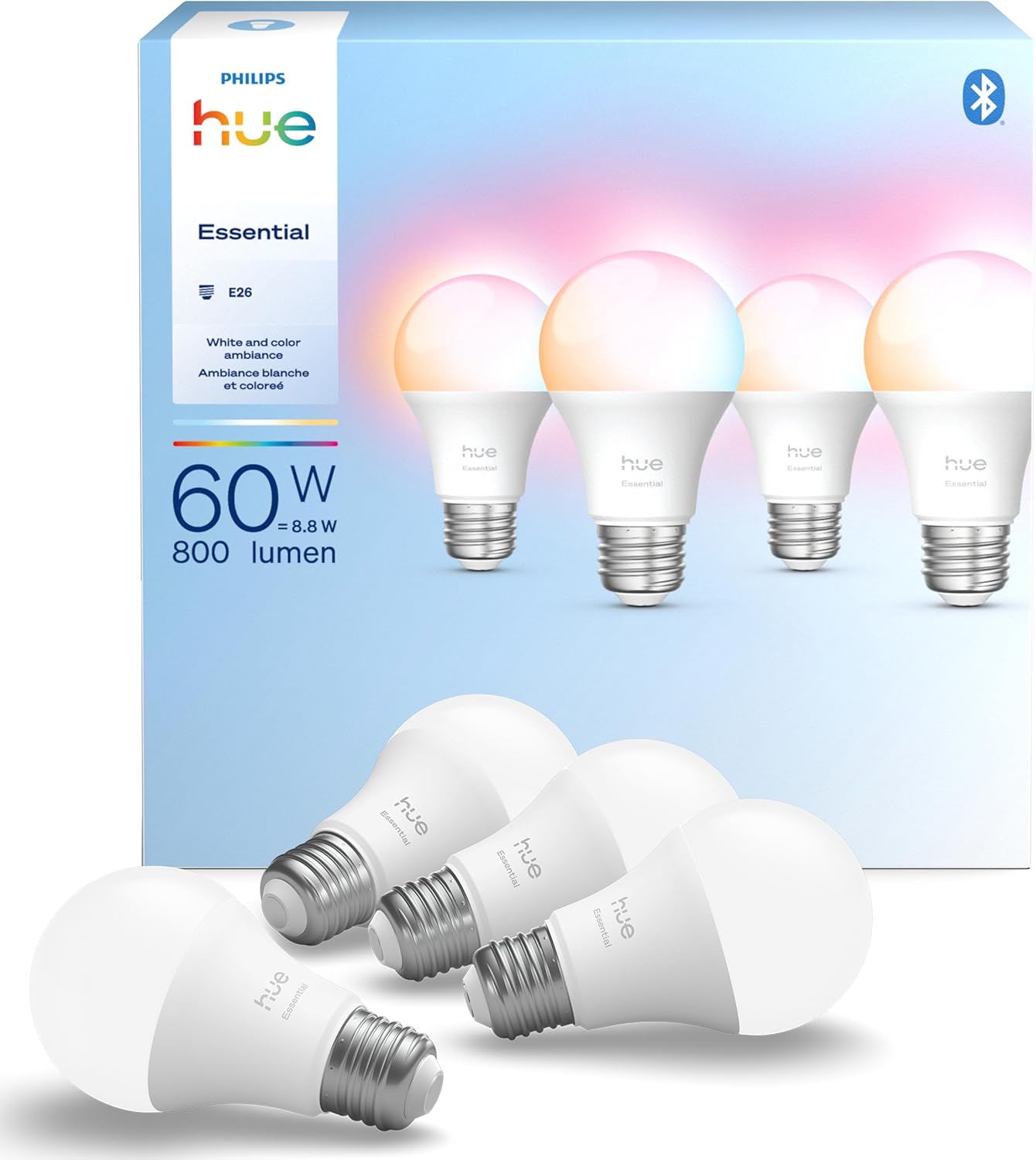
- Straightforward smart lighting start with screw-in bulbs and the Hue app
- Millions of colors plus tunable white support flexible home ambiance
Cons
- Advanced features such as content syncing and broader home security routines need a Hue Bridge
- First-time smart lighting users may need extra time learning scenes and app controls
Best For / Avoid If
Best for buyers prioritizing
- Straightforward smart lighting start with screw-in bulbs and the Hue app
- Millions of colors plus tunable white support flexible home ambiance
- Works with major voice assistants for remote and hands-free control
Consider another option if
- Advanced features such as content syncing and broader home security routines need a Hue Bridge
- First-time smart lighting users may need extra time learning scenes and app controls
- Buyers who only want basic on-off white bulbs may find color options more than necessary

Pros
- Supports a broad spectrum of colors and temperatures for flexible home ambiance
- Integrates seamlessly with popular voice assistants for hands-free operation
Cons
- Operates exclusively on 2.4GHz WiFi networks which may require router adjustments
- Initial configuration relies on the mobile app and may involve a learning curve
Specifications
| Light Type | LED |
|---|---|
| Additional Features | Auto White, Dimmable, Energy Monitoring, Tunable |
| Wattage | 9 watts |
| Bulb Shape Size | A19 |
| Bulb Base | E26 |
| Incandescent Equivalent Wattage | 60 Watts |
| Specific Uses For Product | Appliance |
| Light Color | RGB |
| Voltage | 120 Volts |
| Color Temperature | 6500 Kelvin |
Verify the current product variation before purchase; specifications may change.
Best For / Avoid If
Best for buyers prioritizing
- Supports a broad spectrum of colors and temperatures for flexible home ambiance
- Integrates seamlessly with popular voice assistants for hands-free operation
- Includes built-in scheduling and remote access features through the app
Consider another option if
- Operates exclusively on 2.4GHz WiFi networks which may require router adjustments
- Initial configuration relies on the mobile app and may involve a learning curve

Pros
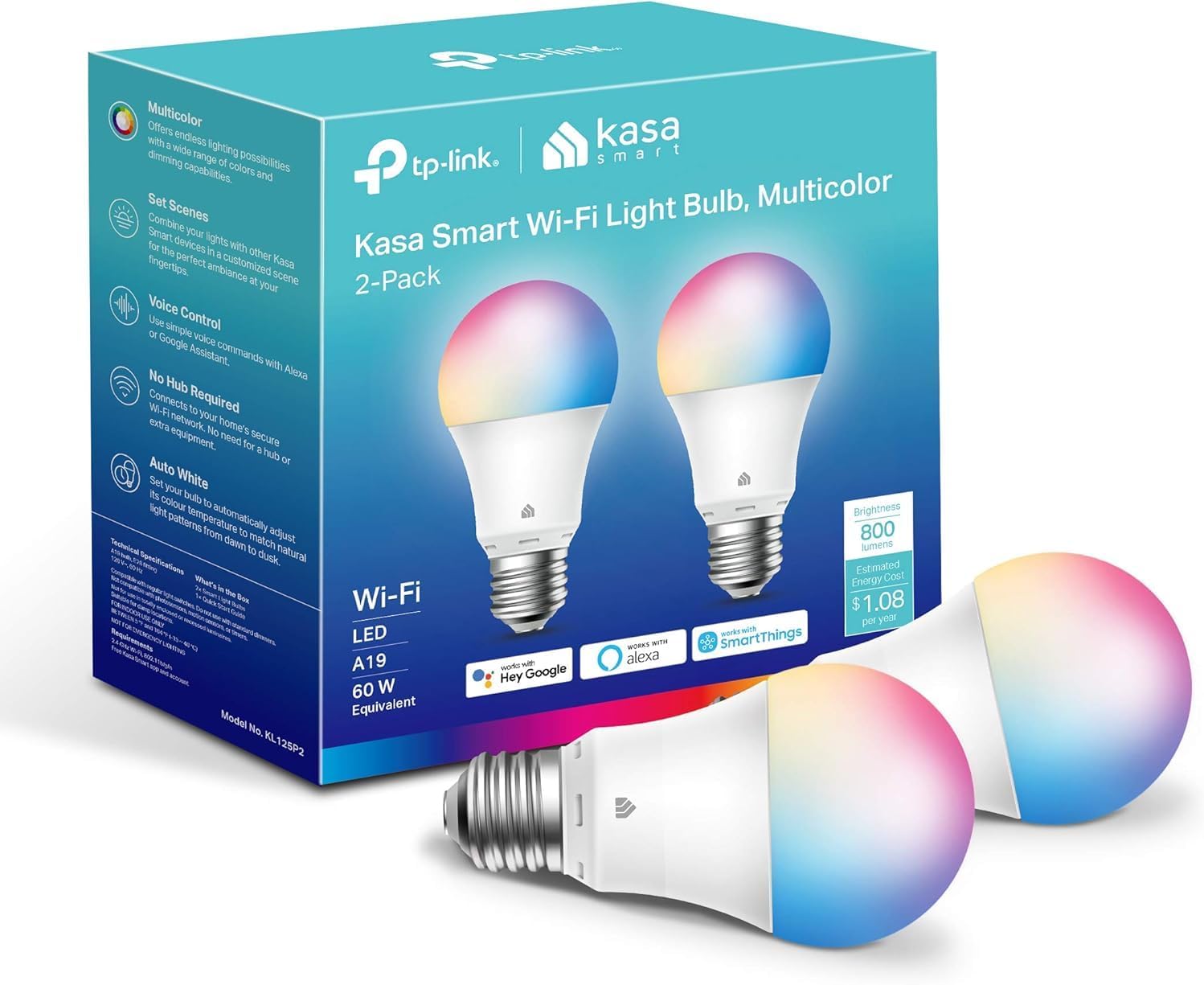
- No hub required for WiFi connection
- Broad 1 to 100 percent dimming range
Cons
- Limited to 2.4 GHz WiFi networks only
- Soft white color temperature cannot be changed
Specifications
| Brand | Kasa Smart |
|---|---|
| Light Type | LED |
| Special Feature | Dimmable, Energy Monitoring |
| Wattage | 9 watts |
| Bulb Shape Size | A19 |
Verify the current product variation before purchase; specifications may change.
Best For / Avoid If
Best for buyers prioritizing
- No hub required for WiFi connection
- Broad 1 to 100 percent dimming range
- Energy monitoring built into the app
Consider another option if
- Limited to 2.4 GHz WiFi networks only
- Soft white color temperature cannot be changed
- Requires ongoing internet connection for remote and voice features

Pros
- Compatible with major voice assistants for hands-free adjustments.
- Offers group control to manage several bulbs simultaneously from the app.
Cons
- Presets require active Wi-Fi connection with Bluetooth disabled.
- Incompatible with smart switches.
Best For / Avoid If
Best for buyers prioritizing
- Compatible with major voice assistants for hands-free adjustments.
- Offers group control to manage several bulbs simultaneously from the app.
- Includes both Wi-Fi and Bluetooth connectivity for flexible setup options.
Consider another option if
- Presets require active Wi-Fi connection with Bluetooth disabled.
- Incompatible with smart switches.
- Depends on 2.4GHz Wi-Fi network for full remote features.
Pros
- Supports 16 million colors plus tunable white light for diverse scene setting.
- Provides remote control and scheduling options via dedicated mobile application.
Cons
- Depends on 2.4GHz Wi-Fi connectivity which may not match all home networks.
- Bulb brightness reaches 800 lumens equivalent limiting use in high-demand areas.
Specifications
| Light Type | LED |
|---|---|
| Additional Features | Auto White, Dimmable, Energy Monitoring, Tunable |
| Wattage | 9 watts |
| Bulb Shape Size | A19 |
| Bulb Base | E26 |
| Incandescent Equivalent Wattage | 60 Watts |
| Specific Uses For Product | Lighting |
| Light Color | RGB |
| Voltage | 120 Volts |
| Color Temperature | 6500 Kelvin |
Verify the current product variation before purchase; specifications may change.
Best For / Avoid If
Best for buyers prioritizing
- Supports 16 million colors plus tunable white light for diverse scene setting.
- Provides remote control and scheduling options via dedicated mobile application.
- Enables voice operation through major smart home platforms.
Consider another option if
- Depends on 2.4GHz Wi-Fi connectivity which may not match all home networks.
- Bulb brightness reaches 800 lumens equivalent limiting use in high-demand areas.
- Requires individual setup for each unit in a multi-pack configuration.

Pros
- Broad smart home compatibility including Matter support.
- Music mode enhances entertainment setups.
Cons
- Limited to 2.4GHz Wi-Fi connections.
- Incompatible with dimmer switches.

Pros
- Seamless voice control through Amazon Alexa and Google Assistant
- Real-time power monitoring available directly in the Tapo app
Cons
- Operates only on 2.4GHz WiFi networks
- Full features require initial app setup and account creation
Specifications
| Light Type | LED |
|---|---|
| Additional Features | Dimmable, Energy Efficient, High Efficiency, Timer |
| Wattage | 60 watts |
| Bulb Base | E27 |
| Incandescent Equivalent Wattage | 60 Watts |
| Specific Uses For Product | Appliance, Home, Lamp |
| Light Color | Daylight White |
| Voltage | 120 Volts |
| Color Temperature | 4000 Kelvin |
| Indoor Outdoor Usage | Indoor |
Verify the current product variation before purchase; specifications may change.
Best For / Avoid If
Best for buyers prioritizing
- Seamless voice control through Amazon Alexa and Google Assistant
- Real-time power monitoring available directly in the Tapo app
- Flexible dimming range supports multiple lighting moods without extra hardware
Consider another option if
- Operates only on 2.4GHz WiFi networks
- Full features require initial app setup and account creation
- Voice assistant compatibility limited to listed platforms

Pros
- Works with Alexa and Google Home without requiring a separate hub
- Includes energy monitoring and scheduling features accessible via the Tapo app
Cons
- Requires a 2.4 GHz Wi-Fi network and cannot use 5 GHz connections
- Advanced automation depends on the Tapo mobile app for setup and management
Best For / Avoid If
Best for buyers prioritizing
- Works with Alexa and Google Home without requiring a separate hub
- Includes energy monitoring and scheduling features accessible via the Tapo app
- Supports smooth dimming and a wide beam angle for flexible room coverage
Consider another option if
- Requires a 2.4 GHz Wi-Fi network and cannot use 5 GHz connections
- Advanced automation depends on the Tapo mobile app for setup and management
- This 4-pack configuration does not include Matter support available in other variants

Pros
- Works over Bluetooth without a hub for basic single-room control
- White and Color Ambiance range supports both tunable white and full color from first install
Cons
- Full remote access, automations, and larger ecosystems need an optional Hue Bridge
- First-time smart lighting users may need extra time to learn scenes, routines, and multi-device pairing
Specifications
| Light Type | LED |
|---|---|
| Additional Features | Color Changing, Dimmable |
| Wattage | 60 watts |
| Bulb Shape Size | A19 |
| Bulb Base | E26 |
| Incandescent Equivalent Wattage | 60 Watts |
| Specific Uses For Product | Decoration |
| Light Color | White, Color |
| Voltage | 120 Volts |
| Power Source | Corded Electric |
Verify the current product variation before purchase; specifications may change.
Best For / Avoid If
Best for buyers prioritizing
- Works over Bluetooth without a hub for basic single-room control
- White and Color Ambiance range supports both tunable white and full color from first install
- Voice commands available through major assistants after app setup
Consider another option if
- Full remote access, automations, and larger ecosystems need an optional Hue Bridge
- First-time smart lighting users may need extra time to learn scenes, routines, and multi-device pairing
- Designed for indoor A19 fixtures, so it may not cover specialty outdoor or nonstandard bulb needs

Pros
- Higher 1100-lumen brightness than many standard 800-lumen smart color bulbs
- Broad multi-platform support through Matter Multi-Admin and major voice assistants
Cons
- Initial setup requires a compatible WiFi network and the Tapo app, which may take extra time for first-time smart home users
- Standard A19 E26 base only, so it may not fit specialty or nonstandard fixtures
Best For / Avoid If
Best for buyers prioritizing
- Higher 1100-lumen brightness than many standard 800-lumen smart color bulbs
- Broad multi-platform support through Matter Multi-Admin and major voice assistants
- Full 1% to 100% dimming with both multicolor and warm-to-cool white options
Consider another option if
- Initial setup requires a compatible WiFi network and the Tapo app, which may take extra time for first-time smart home users
- Standard A19 E26 base only, so it may not fit specialty or nonstandard fixtures
- Extensive color and scene options may be more than needed for users seeking basic white lighting

Pros
- No hub required for operation and connectivity
- Motion sensing adds convenience using existing bulbs
Cons
- Motion feature needs multiple bulbs to function
- Incompatible with the Philips Hue system
Specifications
| Light Type | LED |
|---|---|
| Additional Features | Color Changing, Eye-Friendly, Frosted, Wireless Dim |
| Wattage | 8.8 watts |
| Bulb Shape Size | A19 |
| Bulb Base | E26 |
| Incandescent Equivalent Wattage | 60 Watts |
| Specific Uses For Product | Lamp |
| Light Color | Multicolor, White |
| Voltage | 120 Volts |
| Color Temperature | 2700 Kelvin |
Verify the current product variation before purchase; specifications may change.
Best For / Avoid If
Best for buyers prioritizing
- No hub required for operation and connectivity
- Motion sensing adds convenience using existing bulbs
- Wide compatibility with major voice assistants and ecosystems
Consider another option if
- Motion feature needs multiple bulbs to function
- Incompatible with the Philips Hue system
- Initial app configuration may involve a learning curve for some

Pros
- High lumen output supports brighter everyday room illumination
- Full RGBWW color range with dimming and tunable white temperatures
Cons
- Connects only to 2.4GHz Wi-Fi and does not support 5G networks
- Cannot be used with smart switches per product notes
Best For / Avoid If
Best for buyers prioritizing
- High lumen output supports brighter everyday room illumination
- Full RGBWW color range with dimming and tunable white temperatures
- Works with Matter plus Alexa and Google Assistant voice platforms
Consider another option if
- Connects only to 2.4GHz Wi-Fi and does not support 5G networks
- Cannot be used with smart switches per product notes
- First-time smart-home users may need extra time for app setup
Smart Light Bulbs Buying Guide
Choosing Smart Light Bulbs is less about chasing every feature and more about matching connectivity, brightness, and control style to your home. The products in this roundup range from entry-level color packs to premium Hue options designed for larger smart lighting systems. Below are the criteria we prioritize for homeowners and DIYers shopping in 2026.
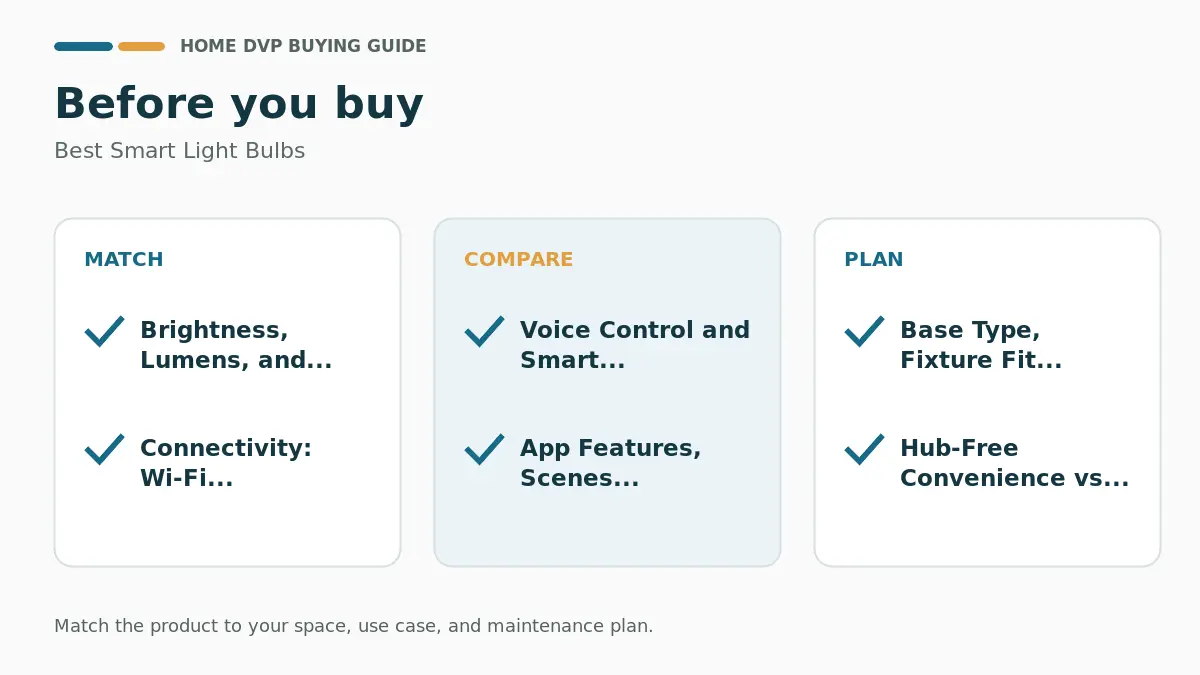
Brightness, Lumens, and Color Temperature
Brightness is one of the first specs to check. Many standard smart A19 bulbs deliver around 800 lumens, which is roughly equivalent to a traditional 60W bulb and works well for bedrooms, hallways, and side lamps. Higher-output models around 1000 to 1100 lumens are better for kitchens, living rooms, or larger open areas where you need more light for tasks and general illumination.
Color temperature matters just as much as raw brightness. Tunable white ranges that move from warm white around 2200K to 2700K up to cool daylight near 6500K let you shift from cozy evening light to alert morning light without changing fixtures. Full color RGB or RGBWW bulbs add millions of colors for parties, holidays, and accent scenes, but they should still produce clean whites if you plan to use them as everyday household lighting.
A common mistake is buying colorful bulbs for a workspace and then realizing the whites look dull or the output is too low. If reading, cooking, or homework is the priority, prioritize high lumens, solid white tuning, and a good color rendering index when listed. Save lower-lumen candelabra styles for chandeliers and decorative fixtures where accent light is enough.
Connectivity: Wi-Fi, Bluetooth, Hub, and Matter
Most modern smart bulbs connect over 2.4 GHz Wi-Fi and do not need a hub, which keeps setup simple for apartments and starter smart homes. Bluetooth is useful for local control during setup or when the network is down, and dual Wi-Fi plus Bluetooth models often feel more responsive in daily use. Hub-based systems, especially Philips Hue with a Bridge, unlock more advanced automations, stronger multi-room reliability, and better scaling when you expand beyond a few bulbs.
Matter support is increasingly important in 2026 because it improves cross-platform compatibility with Apple Home, Alexa, Google Home, and SmartThings. Matter-certified bulbs can also keep working on the local network even if internet service drops. That said, Matter does not automatically make every scene or music-sync feature identical across brands, so still compare the app experience.
Before you buy, confirm your router still supports a stable 2.4 GHz band. Many smart bulbs do not work on 5 GHz-only networks. Also avoid pairing smart bulbs with traditional wall dimmers or smart switches unless the manufacturer explicitly supports that setup, because flickering and connection issues are common.
Voice Control and Smart Home Compatibility
Hands-free control is one of the biggest reasons people switch to smart lighting. Look for clear support for Alexa, Google Assistant, and, when relevant, Apple Home or Siri. Voice commands should cover the basics: on and off, brightness, color, and scene selection. Premium ecosystems usually offer smoother multi-room routines, while budget packs still work well for simple “turn on the living room lights” commands.
Compatibility also affects long-term flexibility. If your household already uses Apple Home heavily, Matter-ready options or Hue products tend to fit more cleanly. Alexa-first homes often do fine with Kasa, Tapo, Govee, or Linkind. Mixed households should prioritize multi-assistant support so everyone can control the lights without installing three different apps.
Think about shared spaces carefully. A family kitchen benefits from group control and simple voice phrases, while a bedroom may need quieter automations such as gradual sunrise dimming. Match the control style to the room rather than buying the most complex system available.
App Features, Scenes, Scheduling, and Music Sync
The app experience determines whether smart bulbs feel convenient or fussy. Strong apps offer remote control, schedules, timers, group control, and scene libraries for reading, movie night, focus, sleep, and parties. Some models go further with music sync, AI-assisted scene creation, energy monitoring, or dynamic light effects that shift brightness and color over time.
Schedules are especially useful for energy savings and security. Setting lights to brighten at wake-up, dim at bedtime, or turn on while you are away can make a home feel more comfortable and lived-in. Energy monitoring, available on some Kasa models, helps you see real-time usage and decide where smarter lighting actually reduces costs.
Music sync and large scene libraries are fun, but they are not essential for every buyer. If you mainly want reliable daily lighting, prioritize stable connection, dimming quality, and white tuning. If you entertain often or want playful accent lighting, Govee and Linkind-style features can be worth the trade-offs.
Base Type, Fixture Fit, and Room Suitability
Most household fixtures use A19 E26 bulbs, which cover table lamps, floor lamps, and many ceiling fixtures. Candelabra E12 bases are better for chandeliers, sconces, and decorative fixtures where a smaller form factor is required. Always measure or check the fixture before ordering multi-packs, especially if the shade is narrow or enclosed.
Room use should drive brightness and color choices. Soft white dimmable bulbs work well in bedrooms and dining rooms. Brighter tunable options suit kitchens and home offices. Color-changing packs shine in living rooms, game rooms, and kids’ spaces. For bathrooms and vanity areas, clean white light and accurate color rendering often matter more than RGB effects, and coordinated upgrades like a quality vanity or bathroom vanity setup can improve the overall result.
Also consider heat and enclosure ratings. Not every smart bulb is ideal for fully enclosed fixtures. When product data does not clearly support enclosed use, choose open or semi-open fixtures and leave airflow around the bulb for longer lifespan.
Hub-Free Convenience vs Expandable Ecosystems
Hub-free bulbs are ideal for renters and first-time buyers because setup is usually screw-in, connect to Wi-Fi, and control from an app. Kasa, Tapo, Govee, and Linkind models in this guide follow that approach and keep costs lower when you only need a few rooms. They are excellent for phased upgrades where you replace lamps one room at a time.
Expandable ecosystems like Philips Hue cost more up front but reward larger installations. Adding a Hue Bridge can improve remote reliability, automation depth, and integration with other smart devices. If you plan to grow into multi-room scenes, security lighting routines, or entertainment sync later, paying more for a mature ecosystem can be the smarter long-term move.
Our research indicates that buyers often underestimate how quickly a single living-room pack turns into a whole-home project. If you expect to expand, choose a brand and platform you are willing to live with for years, not just the cheapest pack available today.
Energy Efficiency, Safety, and Long-Term Value
Smart LED bulbs already use far less energy than old incandescent bulbs, and scheduling can reduce waste even further. Look for models that clearly list wattage, lumen output, and equivalent watt claims so you can compare efficiency fairly. Some Kasa options also include energy monitoring, which is useful if you want measurable feedback rather than estimated savings.
Safety and reliability matter for devices that stay powered all day. UL certification, stable Wi-Fi behavior, and clear manufacturer guidance around dimmers or voltage help reduce frustration. Lifespan claims around 25,000 hours are common in this category, but real-world longevity still depends on heat, fixture design, and network stability.
Value is not only the sticker price. A lower-priced 4-pack may be the better buy for a starter setup, while a premium Hue 3-pack may deliver smoother color quality and a more durable platform for whole-home automation. Weigh cost per bulb, feature depth, and expansion plans together instead of ranking by price alone.
Quick Comparison Table for Shoppers
| Priority | What to Look For | Best Fit |
|---|---|---|
| Everyday white light | 800+ lumens, tunable white, smooth dimming | Bedrooms, kitchens, offices |
| Color scenes | 16M colors, scene library, music sync | Living rooms, parties, media spaces |
| Simple setup | No hub, Wi-Fi + app, Alexa/Google support | Renters and first-time buyers |
| Whole-home growth | Bridge options, Matter, mature app ecosystem | Homeowners expanding over time |
| Decorative fixtures | E12 candelabra form factor | Chandeliers and sconces |
Choose the Ecosystem Before the Bulb
Quick answer: first confirm the bulb base, fixture type, required lumens, and dimming needs. Then choose a connectivity path that works with the controllers already in the home. A compatible logo does not guarantee that every scene, transition, energy report, or special effect is available in every app.
| Connection path | Best fit | Verify before buying | Main tradeoff |
|---|---|---|---|
| Direct Wi-Fi | A few bulbs and simple app or voice control | Supported Wi-Fi band, account requirements, router capacity, and cloud dependence | Many devices can crowd a home network; features may depend on vendor cloud service |
| Vendor hub or Zigbee | More bulbs, mature scenes, switches, and sensors | Hub compatibility, supported accessories, local behavior, and migration options | Additional hardware and a more committed ecosystem |
| Matter over Wi-Fi | Cross-platform basic lighting control without a separate radio bridge | Matter controller, supported lighting functions, app requirements, and remote-control setup | Vendor-only effects may remain in the manufacturer’s app |
| Matter over Thread | A local IP mesh where the bulb and ecosystem support Thread | A compatible Thread border router plus Matter controller | Hardware roles and platform support must be checked carefully |
Home DVP compatibility checklist
- Confirm base, voltage, fixture enclosure rating, and physical size.
- Choose brightness in lumens and white range in Kelvin before evaluating colors.
- Check the exact platform badge or Matter certification for the model, not only the brand.
- Identify required controller, hub, Thread border router, app, account, and Wi-Fi band.
- Verify what still works locally during an internet outage.
- Avoid placing a smart bulb on an incompatible wall dimmer unless the manufacturer explicitly allows it.
- Check firmware support, reset procedure, household sharing, and deletion of account/device data.
Matter can improve cross-platform control and local operation, but it does not make every bulb feature identical across ecosystems. Compare the functions your household will actually use, then treat decorative effects and music sync as secondary.
Our Research Methodology & Why You Can Trust Us
At Home DVP, we approach product guides with a specification-first process designed for practical home improvement decisions. For this Smart Light Bulbs roundup, we compared listed features such as lumen output, color range, connectivity type, voice assistant support, pack size, app capabilities, and known limitations. We also reviewed category patterns that matter in real homes, including 2.4 GHz network requirements, hub versus hub-free setups, and fixture compatibility.
We paid special attention to homeowner use cases: renters who need no-wiring upgrades, families who want schedules and voice control, and DIYers building a larger smart home over time. User-facing product information and public feedback signals helped us identify which strengths and trade-offs appear consistently.
We do not invent hands-on claims. When product data does not confirm physical testing, we stick to transparent language based on available specifications and research. Content is reviewed and refreshed with category changes during July so recommendations stay aligned with current options, platform support, and shopper priorities. That process is how we protect Experience, Expertise, Authoritativeness, and Trustworthiness for readers making real purchasing decisions.
Final Thoughts
If you want a premium overall pick with polished color ambiance and a path to advanced automations, the Philips Hue A19 LED Smart Light Bulb 3-Pack – White and Color Ambiance stands out based on feature depth, ecosystem maturity, and strong user reception. For shoppers who want strong everyday color performance without a hub, the Govee Smart Light Bulbs 4-Pack and the brighter Govee 1000LM 4-Pack are compelling homeowner picks for living rooms and multi-bulb setups. Budget-minded buyers can start with the Kasa Smart Light Bulbs 2-Pack or the Linkind Smart Light Bulbs 4-Pack for capable color control, app scheduling, and voice support at a lower entry cost.
For high brightness and Matter flexibility, the TP-Link Tapo L535E 2-Pack is an excellent modern choice, especially if you care about Apple Home, Alexa, and Google Home interoperability. Soft-white-only households may prefer the Kasa dimmable soft white 4-pack when color changing is unnecessary. Decorative fixture owners should look at the Govee E12 candelabra pack for chandeliers and accent lighting rather than forcing standard A19 bulbs into the wrong base.
The smartest purchase is the one that matches your fixtures, network, and expansion plans. Start with the rooms you use most, confirm base type and brightness needs, then expand with the same ecosystem when possible. For more home upgrade ideas beyond lighting, explore related bathroom planning resources such as the Best Bathroom Sink guide and keep your smart home choices consistent across rooms.
FAQ
What should I look for when choosing Smart Light Bulbs?
Focus on lumen output, white color quality, Wi-Fi or Matter compatibility, app reliability, and the correct base type for your fixtures. Also confirm voice assistant support and whether you need full color or simple dimmable white light. Matching the bulb to the room is more important than buying the most feature-packed model.
Are higher-end Smart Light Bulbs worth it?
They can be worth it if you want smoother color performance, better multi-room automations, and a more expandable ecosystem. Premium options like Hue are especially useful for whole-home plans. For a few lamps or a renter setup, a midrange Wi-Fi pack often delivers excellent value.
Do smart light bulbs work without a hub?
Yes, many modern models connect directly to 2.4 GHz Wi-Fi and work through a mobile app without a separate hub. Hub systems can still be better for larger installations or advanced routines. Check product details carefully if you want Matter support or local control during internet outages.
Can I use Smart Light Bulbs with existing dimmer switches?
Often no. Many smart bulbs are not designed for traditional wall dimmers and may flicker, buzz, or disconnect when used that way. It is usually better to leave the wall switch on and dim through the app or voice control unless the manufacturer clearly supports a dimmer-compatible setup.
About This Home DVP Research
Home DVP is an independent home-improvement research and product-comparison publisher. Ryan Mitchell prepared this guide by comparing manufacturer specifications, compatibility details, retailer-provided product data, key limitations, and common homeowner use cases. We do not claim hands-on testing unless an article explicitly says so.
Review methodology Affiliate disclosure Last reviewed October 16, 2026