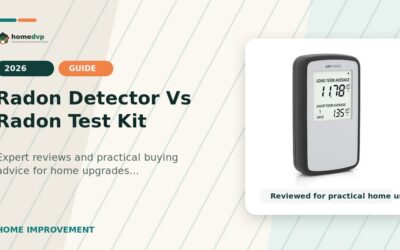

Radon is one of those home safety issues that is easy to ignore because you cannot see it, smell it, or feel it. That is exactly why choosing the best Radon Detector For Home matters for homeowners, renters, basement remodelers, and anyone buying or maintaining a home. A reliable radon monitor can help you understand long-term exposure trends, spot seasonal changes, and decide when professional mitigation may be needed.
For this updated guide, we analyzed 15 products using available specifications, sensor features, display design, app support, battery operation, alarms, portability, long-term tracking, and practical home-use value. We also considered whether each model fits real homeowner needs, such as basement monitoring, rental-unit checks, home-office safety, and broader indoor air quality tracking. For more ways to improve indoor comfort and safety, see our Air Quality & Climate resource page.
After carefully analyzing the available specifications, the strongest options in this category are continuous digital radon detectors rather than one-time lab kits. They are not a substitute for professional mitigation advice, but they can give households clearer visibility into radon patterns over days, weeks, and months.

Pros
- Seven sensors enable broad coverage of radon and air quality factors
- Battery operation supports easy indoor positioning without outlets
- WiFi and app features allow remote access and multi-room expansion
- Long-term radon monitoring helps verify mitigation system performance
Cons
- Radon readings require at least 30 days for reliable averages due to fluctuations
- CO2 and VOC sensors need up to a week for initial environmental adjustment
- Full remote functionality depends on consistent internet and an app account
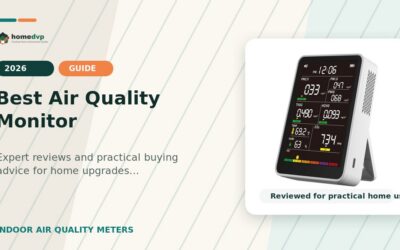
The Airthings 2960 View Plus functions as a battery-powered indoor air quality monitor equipped with seven sensors to track radon, PM2.5, CO2, VOCs, humidity, temperature, and pressure.
Its continuous operation allows homeowners to observe how ventilation changes affect pollutant levels in real time while providing alerts for potential issues.
The understated design includes an eInk display that users can customize, and the unit can be placed on surfaces or mounted on walls without cables for convenient setup.
This monitor proves valuable in homes where radon mitigation systems need verification or where external factors like city pollution influence indoor conditions.
Limitations include the need for a 30-day period to establish reliable radon averages and initial calibration time for certain sensors, making it less immediate for quick assessments.
Homeowners prioritizing long-term air health insights may find it suitable, whereas those seeking instant results without app connectivity might consider simpler alternatives.
Specifications
| Power Source | Battery Powered |
|---|---|
| Alarm | Visual |
| Compatible Devices | Airthings View series, Airthings Hub, Alexa, Homey |
| Sensor Type | radon detector |
| Battery Average Life | 2 years |
| Smart Home Compatibility | Smart Home Compatible |
| Upper Temperature Rating | 104 Degrees Fahrenheit |
| Product Style | View Plus |
| Color | white |
| Item Dimensions D x W x H | 4"D x 4"W x 2"H |
Verify the current product variation before purchase; specifications may change.
Best For / Avoid If
Best for buyers prioritizing
- Seven sensors enable broad coverage of radon and air quality factors
- Battery operation supports easy indoor positioning without outlets
- WiFi and app features allow remote access and multi-room expansion
Consider another option if
- Radon readings require at least 30 days for reliable averages due to fluctuations
- CO2 and VOC sensors need up to a week for initial environmental adjustment
- Full remote functionality depends on consistent internet and an app account
Best Radon Detector For Home Buying Guide
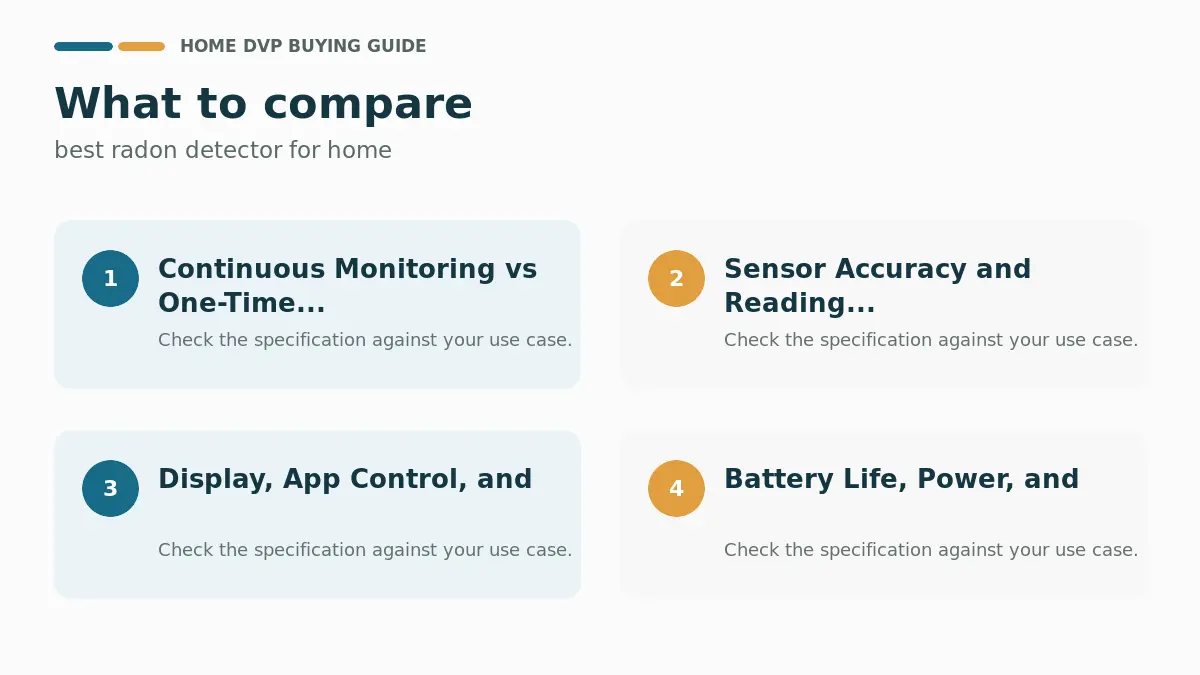
Continuous Monitoring vs One-Time Testing
The main advantage of a digital radon detector is continuous monitoring. Radon levels can fluctuate based on weather, ventilation, foundation conditions, soil pressure, and whether windows or HVAC systems are running. A short-term test can provide a snapshot, but a continuous monitor can show whether your home has a recurring pattern that deserves attention.
Models such as the Airthings Corentium Home Radon Detector 223, X-Sense XR0A-SR, X-Sense XR0B-SR, HOUND-2070, and Ecosense EcoQube Flex are built around ongoing home monitoring. That makes them especially useful for basements, finished lower levels, crawl-space-adjacent rooms, and homes where family members spend long periods below grade.
A common mistake is moving a detector too often before it has enough time to develop a useful average. For the most meaningful reading, place the unit in a lived-in area on the lowest regularly occupied level and let it collect data consistently before making big conclusions.
Sensor Accuracy and Reading Time
Radon detectors rely on specialized sensors to estimate radon concentration, commonly displayed in pCi/L or Bq/m³. Some models prioritize faster early readings, while others focus on long-term averaging. SAF Aranet Radon Detector for Home highlights short measurement intervals, while X-Sense models emphasize improved accuracy over several days of tracking.
For everyday homeowners, the key is not only the first number on the screen. Long-term trend data is more important because radon exposure risk is tied to sustained levels. A detector with daily, weekly, monthly, or yearly trend views can help you identify whether a spike is temporary or part of a bigger problem.
If you are buying best radon detector for home for a real estate decision, renovation project, or suspected high-radon area, consider confirming digital results with an approved test method or licensed radon professional. A home monitor is valuable for awareness and tracking, but mitigation decisions should be made carefully.
| Feature | Why It Matters | Best Fit |
|---|---|---|
| Short-term readings | Gives early insight after setup | Quick checks and room comparisons |
| Long-term averages | Shows meaningful exposure patterns | Basements and occupied living areas |
| App-based history | Makes trends easier to review | Smart home users and data-focused homeowners |
| Audible or visual alerts | Helps prompt action when levels rise | Busy households and rental properties |
Display, App Control, and Data History
A radon detector should be easy to read at a glance. E-ink displays, always-on screens, and simple reset controls make a big difference when the unit is placed in a basement, utility area, home gym, or office. The SAF Aranet Radon Detector for Home, Ecosense EcoQube Flex, Hello Radon S, and Airthings 2960 View Plus all emphasize display or app visibility in different ways.
App support is useful if you want notifications, historical charts, or remote access. However, app-connected models may require WiFi, Bluetooth, cloud storage, or account setup. The Airthings 2960 View Plus offers broad connected air quality tracking, while the Ecosense EcoQube Flex focuses on smart radon trend visibility through an app.
If you prefer a low-maintenance monitor, a standalone screen may be better than a connected model. If you already manage indoor comfort with connected devices, you may also appreciate our guide to the smart thermostat options for home climate control.
Battery Life, Power, and Placement Flexibility
Battery-powered detectors are easier to place correctly because they do not need to sit near an outlet. That matters because radon monitors should generally be positioned away from drafts, direct sunlight, exterior doors, windows, and high-humidity problem spots. A cable-free design makes it easier to place the monitor in the lowest regularly occupied level where readings are most useful.
The Airthings Corentium Home Radon Detector 223 uses standard household batteries, while the SAF Aranet Radon Detector for Home highlights extended battery life. The HOUND-2070 uses a rechargeable design, which may appeal to homeowners who dislike disposable batteries. X-Sense XR0A-SR and Hello Radon S also emphasize multi-month or multi-year operation depending on the model specifications.
Before choosing, think about where the detector will live. A monitor for a finished basement should be easy to read and leave in place, while a portable model for checking multiple rooms should be lightweight and simple to reset.
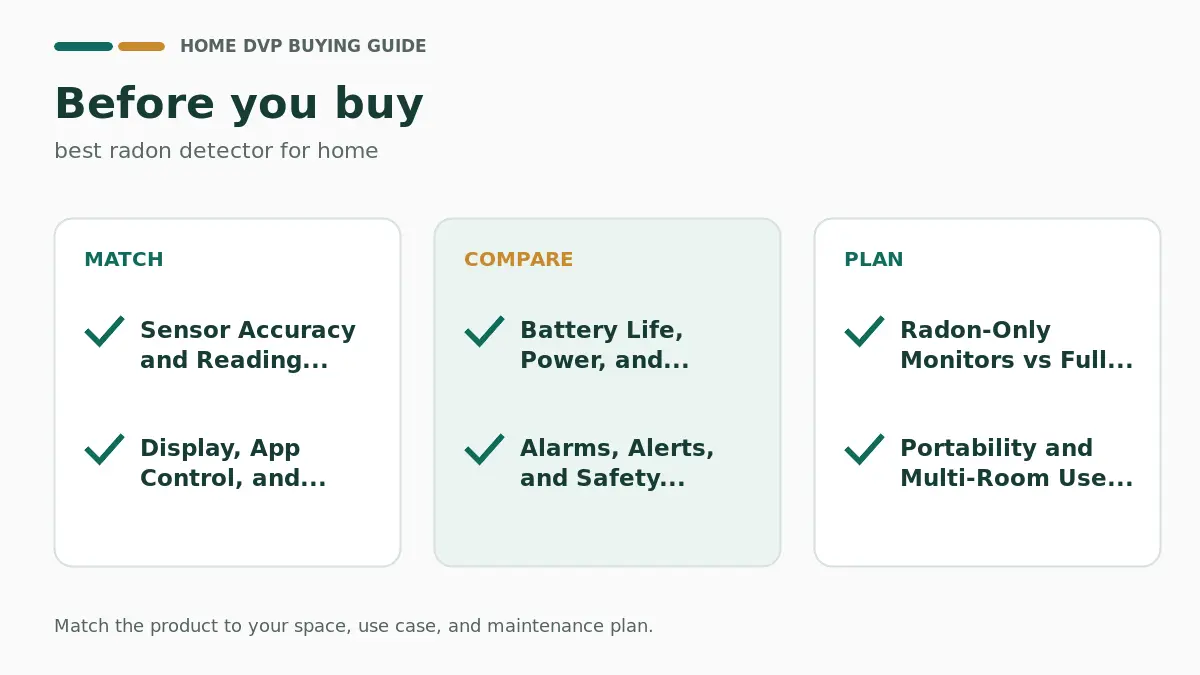
Alarms, Alerts, and Safety Features
Some radon detectors are passive information tools, while others include audible or visual alerts. Alerts can be helpful for homeowners who do not want to check an app or display every day. The HOUND-1011S Portable Radon Detector and X-Sense XR0B-SR both highlight audible or visual alert features, making them practical choices for households that want a more active warning system.
Do not treat an alarm as the only reason to act. If your detector shows elevated long-term averages, review local health guidance and consider professional testing or mitigation. Radon mitigation often involves ventilation, sub-slab depressurization, sealing, or other measures that should be designed for the specific home.
Because radon is part of a broader home safety picture, it is also worth maintaining filters, humidity, and airflow. Our HVAC filter buying guide can help if you are also improving dust, pollen, and particulate control.
Radon-Only Monitors vs Full Air Quality Monitors
Some shoppers only need radon data. In that case, dedicated models like the Airthings Corentium Home Radon Detector 223, X-Sense XR0A-SR, HOUND-1011S, and Radon Detector by Forensics may be the more focused choice. They are designed around radon monitoring without overwhelming the user with unrelated readings.
Other households may want a broader view of indoor air quality. The Airthings 2960 View Plus measures radon along with PM2.5, carbon dioxide, VOCs, humidity, temperature, and air pressure based on the provided product information. That makes it more of a whole-room air quality dashboard than a single-purpose radon tool.
If your home has dry winter air, condensation, musty rooms, or comfort issues, a broader air quality strategy may be useful. You can compare related solutions in our whole house humidifier guide and air circulator fan guide.
Portability and Multi-Room Use
Portability matters if you want to compare a basement, bedroom, home office, finished lower level, and utility room. A lightweight detector with simple controls makes it easier to check different spaces over time. The Airthings Corentium Home Radon Detector 223, HOUND-1011S, HOUND-2070, and X-Sense XR0A-SR are especially relevant for homeowners who want flexible placement.
When comparing rooms, avoid moving the device every few hours. Give the detector enough time in each location to collect meaningful data, and keep notes about location, ventilation, weather, and HVAC use. This helps you understand whether one area consistently reads higher or whether levels are changing across the whole home.
Value, Durability, and Long-Term Ownership
The right value depends on how you plan to use the detector. A basic standalone model may be enough for one basement, while a connected model with app history, multiple sensors, and notifications may be worth the investment for a family home, rental property, or long-term indoor air quality plan. The listed market range is $16.98–$280, so shoppers can choose between focused budget-friendly monitors and premium connected systems.
Build quality, sensor life, warranty support, and battery design all affect ownership cost. Radon Detector by Forensics highlights an upgraded long sensor life, Airthings 2960 View Plus offers an extended warranty option when registered, and several models emphasize long-term data storage or multi-month battery performance. These factors are often more important than choosing the lowest upfront cost.
Based on our detailed comparison, homeowners should choose a detector they will actually leave in place and check regularly. The most advanced model is not useful if it is too complicated for the household to maintain.
Our Research Methodology & Why You Can Trust Us
We evaluated the products based on available product information, user-facing specifications, category fit, home safety relevance, and practical use cases. Every discussed model was validated as a radon detector or radon-focused air quality monitor suitable for home, basement, office, or workplace monitoring within the Air Quality & Climate category.
Our ranking criteria included performance indicators, sensor features, display clarity, app support, battery or rechargeable operation, data history, alerts, ease of use, durability signals, safety value, and suitability for homeowners or DIY maintenance routines. We also looked for meaningful differences between dedicated radon monitors and multi-sensor air quality devices.
Because the product data does not document hands-on testing, we do not claim that we physically tested or installed these devices. Instead, our research indicates which products appear strongest based on specifications, listed features, and the way those features translate into everyday home monitoring needs.
This guide is reviewed for relevance during July so the recommendations remain aligned with current product information, homeowner expectations, and practical indoor air quality concerns.
Final Thoughts
For most homeowners, the Airthings Corentium Home Radon Detector 223 is a strong overall pick because it is portable, lightweight, battery operated, and focused on simple radon monitoring. It is especially practical for people who want clear readings without relying on a connected app ecosystem.
For shoppers who want a broader indoor air quality dashboard, the Airthings 2960 View Plus is the premium pick because it tracks radon along with particulate matter, carbon dioxide, VOCs, humidity, temperature, and pressure. For value-focused buyers, HOUND-1011S, HOUND-2070, X-Sense XR0A-SR, and X-Sense XR0B-SR offer practical home-monitoring features such as portability, alerts, tracking, or room-to-room flexibility.
If you are building a more complete healthy-home setup, pair radon monitoring with ventilation, filtration, humidity control, and regular maintenance. The Heating, Cooling & Air category is a useful next stop for homeowners comparing comfort and air quality upgrades.
FAQ
What should I look for when choosing the best radon detector for home?
Look for continuous monitoring, clear display readings, long-term averages, battery flexibility, and simple placement options. If you want trend charts or remote alerts, choose a connected model with app support.
Are higher-end radon detector for home worth it?
Higher-end models can be worth it if they add useful features such as app history, notifications, multiple air quality sensors, or extended warranty support. If you only need basic basement radon tracking, a simpler dedicated monitor may be a better value.
Where should I place a home radon detector?
Place it on the lowest regularly occupied level of the home, such as a finished basement, family room, or home office. Avoid windows, exterior doors, vents, direct sunlight, and unusually damp locations that could distort readings.
Can radon detectors replace professional testing?
A digital detector is useful for ongoing awareness, but professional testing or mitigation advice may still be needed if readings remain elevated. For a broader home air strategy, also review related indoor air resources such as HVAC filter recommendations.