Choose by alert targeting first, backup power second, and charging connection third. The published product information confirms SAME programming across these radios, but it does not confirm USB-C input or output on any model. Midland WR400 lists a USB output, yet its connector type is not stated. Verify exact-model photos or documentation before buying for USB-C.
What to compare
| Priority | What matters | What the listings state |
|---|---|---|
| SAME targeting | County selection and alert count | Models support single, multiple, or broader alert programming, with stated limits from 23 to 25 counties where provided. |
| Alert delivery | Voice, siren, display, lights, and volume | Alert modes vary by model. Some include visual indicators or external warning lights. |
| Outage operation | Battery type and stated runtime | Most listed models use AA batteries. RunningSnail states more than 54 hours during power failure. |
| USB-C | Connector type, direction, and charging use | No published listing confirms USB-C. Midland WR400 lists USB output only. |
SAME, or Specific Area Message Encoding, filters alerts by programmed geographic codes. It does not guarantee reception. Placement, local signal strength, antenna setup, and correct county codes still matter. Confirm local coverage and enter codes exactly as required by each radio’s instructions.
Product comparison

Specifications
| Color | Silver Grey |
|---|---|
| Dimensions | 6.02 x 5.59 x 2.95 Inches |
| Weight | 1.21 Pounds |
| Product Group | Electronics |
| Binding | Electronics |
Verify the current product variation before purchase; specifications may change.

Pros
- S.A.M.E. county code programming delivers only relevant local warnings
- Three alert modes plus color indicators provide flexible notification options
Cons
- Alert volume cannot be adjusted independently from the FM radio and weather broadcast volume
- Three AA alkaline batteries required for backup are not included
Best For / Avoid If
Best for buyers prioritizing
- S.A.M.E. county code programming delivers only relevant local warnings
- Three alert modes plus color indicators provide flexible notification options
- Dual plug-in and battery power supports both daily and emergency use
Consider another option if
- Alert volume cannot be adjusted independently from the FM radio and weather broadcast volume
- Three AA alkaline batteries required for backup are not included
- Initial county programming and optional event settings may need extra time for first-time setup

Pros
- S.A.M.E. localized programming delivers precise area-specific emergency notifications
- NOAA Weather Scan covers over 60 kinds of weather hazards and emergencies automatically
Cons
- Initial entry of S.A.M.E. codes and county selections may require research and extra setup time for first-time users
- Primarily focused on weather and emergency alerts rather than general listening or entertainment features
Specifications
| Additional Features | SOS Alarm |
|---|---|
| Connectivity Technology | AC Power Adapter |
| Tuner Type | FM |
| Power Source | Corded Electric, Battery |
| Radio Bands Supported | 1-Band |
| Frequency | 108 MHz |
| Compatible Devices | Devices capable of receiving NOAA weather alerts |
| Number of Batteries | 6 AAA batteries required. |
| Smart Home Compatibility | Not Smart Home Compatible |
| Display Type | LCD |
Verify the current product variation before purchase; specifications may change.
Best For / Avoid If
Best for buyers prioritizing
- S.A.M.E. localized programming delivers precise area-specific emergency notifications
- NOAA Weather Scan covers over 60 kinds of weather hazards and emergencies automatically
- Supports programming of up to 25 counties for broader yet targeted monitoring
Consider another option if
- Initial entry of S.A.M.E. codes and county selections may require research and extra setup time for first-time users
- Primarily focused on weather and emergency alerts rather than general listening or entertainment features
- Users wanting expanded two-way communication may need to explore other models in the Midland range

Pros
- Supports precise geographic filtering with up to 23 S.A.M.E. county codes
- Delivers continuous NOAA reception and dual-power backup for outage resilience
Cons
- Three AA batteries for backup power are not included and must be obtained separately
- Initial programming of multiple county codes can require extra setup time for new users
Specifications
| Additional Features | Built-In Clock |
|---|---|
| Connectivity Technology | Auxiliary |
| Tuner Type | NOAA |
| Power Source | Corded Electric |
| Radio Bands Supported | NOAA |
| Frequency | 162.4 MHz |
| Compatible Devices | Speaker, Headphone |
| Number of Batteries | 3 AA batteries required. |
| Display Type | LCD or LED |
| Hardware Interface | Radio Frequency |
Verify the current product variation before purchase; specifications may change.
Best For / Avoid If
Best for buyers prioritizing
- Supports precise geographic filtering with up to 23 S.A.M.E. county codes
- Delivers continuous NOAA reception and dual-power backup for outage resilience
- Offers granular on/off control across more than 80 alert types including weather and system events
Consider another option if
- Three AA batteries for backup power are not included and must be obtained separately
- Initial programming of multiple county codes can require extra setup time for new users
- Certain system-required alert functions cannot be turned off or customized
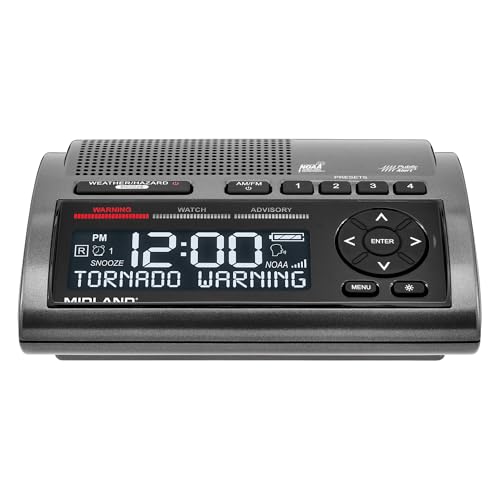
Specifications
| Color | Gray |
|---|---|
| Size | WR400 |
| Dimensions | 7 x 5.5 x 2.2 inches |
| Weight | 0.5 pounds |
| Product Group | Electronics |
| Binding | Electronics |
Verify the current product variation before purchase; specifications may change.
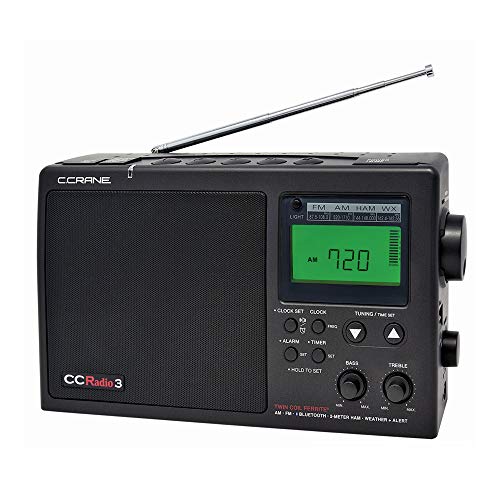
Specifications
| Color | Black Mica |
|---|---|
| Dimensions | 11 x 4 x 6.5 Inches |
| Weight | 4 Pounds |
| Product Group | Electronics |
| Binding | Electronics |
Verify the current product variation before purchase; specifications may change.
NOAA Weather Radio with S.A.M.E. Localized
Strengths: Rychi model scans seven WX channels, supports more than 80 selectable emergency alerts, and offers all, single, or multiple county modes. Multiple mode supports up to 23 counties. Voice, siren, and display modes provide different notification choices. External antenna and external flashing light can help users who need flexible placement or stronger visible notification. AC power and four AA batteries provide backup power.
Limits: Published information does not mention USB-C or any USB connection. It also does not provide measured reception, battery runtime, or connector details. Who should skip it: Buyers who require confirmed USB-C should skip it unless exact-model documentation confirms that connection.
DreamSky Weather Radio NOAA Alert with Battery
Strengths: DreamSky provides SAME county programming, more than 80 emergency alerts, voice, tone, and display modes, FM radio, alarm clock functions, and three backlight settings. It uses plug-in power with three AA batteries for outages. This fits a home user who wants daily FM and clock functions alongside alerts.
Limits: Batteries are not included. Published information does not confirm USB-C, USB charging, a stated battery runtime, or an external antenna. Who should skip it: Buyers needing confirmed USB-C, long stated outage runtime, or documented external antenna support should skip it.
Midland WR120B
Strengths: MidlandRadio WR120B supports SAME programming for up to 25 counties and more than 60 emergency hazards. Color-coded indicators, continuous backlighting, and alert override support users who need clear visual status and automatic priority alerts.
Limits: Published information does not mention USB-C, USB output, battery backup, FM, or an external antenna. Its stated alert count is lower than several competing models in this set. Who should skip it: Buyers seeking documented USB-C, battery outage operation, or a broader stated alert catalog should skip it.
RunningSnail NOAA Weather Radio with 80+Emergency
Strengths: RunningSnail supports up to 23 county codes, seven WX channels, more than 80 alert types, voice, siren, and visual alerts, plus 110V AC and three AA batteries. The published information states more than 54 hours during power failures and a maximum siren output of 110 dB. Individual alert controls and a backlit display add configuration flexibility.
Limits: Batteries are not included. The listing does not confirm USB-C, USB output, or a USB charging function. The stated 110 dB figure is a maximum siren output claim, not a guarantee of audibility in every room. Who should skip it: Buyers who need USB-C or quieter alert behavior should skip it unless connector and sound settings meet their requirements.
Midland WR400 Weather Radio Deluxe
Strengths: WR400 supports SAME programming for up to 25 counties and 80 emergency alerts. It scans 10 WX channels, offers an 85 dB siren, voice and visual alerts, AM/FM radio, an alarm clock, and four AA battery backup. Published information also lists USB output, making this the closest match for a USB-related requirement.
Limits: The connector type is not stated, so USB output does not equal confirmed USB-C. Batteries are not included. The product data does not state USB input, charging speed, device compatibility, or outage runtime. Who should skip it: Buyers who need confirmed USB-C rather than generic USB output should skip it until Midland documentation identifies the port.
C. Crane CCRadio 3 Long Range Reception AM, FM
Strengths: C.Crane CCRadio 3 includes NOAA weather alerts, AM, FM, Bluetooth, a 2-meter ham band, clock, alarm, sleep timer, headphone jack, and adjustable display light. Its supplied power information lists an AC cord and four D batteries, with approximately 250 hours at moderate volume. It suits users who value general radio reception and audio features.
Limits: The published information does not mention SAME county programming, USB-C, USB output, or selectable county alerts. Its weather feature therefore does not meet this keyword’s confirmed SAME requirement from available evidence. Who should skip it: Buyers who require documented SAME localization or USB-C should skip it.
How to verify USB-C before purchase
- Find exact-model documentation, not only a product title.
- Confirm whether the port is USB-C, USB-A, micro-USB, or another connector.
- Check port direction. USB output can charge another device, while USB input can power or recharge the radio.
- Confirm whether cable, adapter, and batteries are included.
- Check whether SAME county programming and backup operation remain active during an outage.
Bottom line
For the strongest documented combination of SAME features and USB-related hardware, inspect Midland WR400 first, but verify its connector because published information says USB output, not USB-C. Choose RunningSnail when county controls, multiple alert modes, and stated outage runtime matter more than USB. Choose DreamSky for FM and clock functions, or Midland WR120B for simpler SAME-focused operation. Treat C. Crane CCRadio 3 as a general emergency radio option, not a confirmed SAME and USB-C match.
Safety note
Weather radios supplement, not replace, local emergency instructions. Keep AC equipment dry, use only the supplied or specified adapter, and follow exact-model battery guidance. Do not assume a USB port supports every phone or charging method. Verify applicable FCC and manufacturer requirements before relying on any radio for emergency notification.