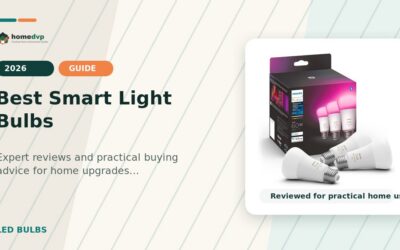

Choose a smart bulb by lumens first and Kelvin second. Lumens describe light output; color temperature describes whether white light appears warm or cool. Room size, fixture count, shades, wall colors, beam spread, and the visual task determine whether one bulb is sufficient.
Smart controls cannot compensate for the wrong base, poor fixture fit, or inadequate output. Use this room guide to set requirements, then compare compatible products in our smart light bulb roundup.
Lumens vs. Watts
Buy brightness by lumens rather than treating LED wattage as a direct replacement for incandescent wattage. Wattage describes electrical input. Efficient bulbs can produce different lumen levels from similar wattage, and colored modes often produce less perceived brightness than the rated white-light mode.
What Kelvin Means
| White range | Typical appearance | Useful starting point |
|---|---|---|
| About 2200–2700K | Very warm to warm white | Relaxed evening light, bedrooms, and living rooms |
| About 3000–3500K | Warm-neutral to neutral white | Kitchens, dining areas, bathrooms, and mixed-use spaces |
| About 4000–5000K | Cooler neutral to daylight appearance | Task lighting, utility rooms, garages, and focused work |
These are planning ranges, not strict rules. Surfaces, daylight, age, preference, and fixture optics change perception. Tunable-white bulbs are useful when one room shifts from daytime work to evening relaxation.
Room-by-Room Starting Points
| Room | Brightness approach | White-light approach |
|---|---|---|
| Living room | Layer several lamps or fixtures instead of relying on one glaring source | Warm evening setting with a brighter neutral scene for cleaning or reading |
| Bedroom | Moderate ambient light plus dedicated bedside task light | Warm white at night; avoid using saturated color as the only functional light |
| Kitchen | Prioritize adequate counter illumination and minimize shadows | Neutral white often supports food preparation and cleanup |
| Bathroom | Use even face lighting and fixtures rated for the location | Neutral white with good color rendering for grooming |
| Home office | Combine ambient and desk/task light while controlling screen glare | Neutral to cooler white during focused work, warmer later if preferred |
| Garage or utility room | Use sufficient distributed output for the whole work area | Neutral or daylight appearance for inspection tasks |
Color Rendering and Full-Color Modes
Color Rendering Index (CRI) helps describe how naturally colors appear under a white light source compared with a reference. It is useful for kitchens, closets, finishes, artwork, and grooming, but a single CRI value does not describe every color sample or dimming behavior. Look for transparent specifications rather than assuming every smart bulb renders whites equally.
RGB or full-color modes are best treated as accent and scene tools. Compare brightness in normal white mode, minimum dim level, color consistency across multiple bulbs, and the transition between settings. The maximum-lumen claim may apply only to one white point.
Fixture and Dimmer Checks
- Confirm base, voltage, bulb dimensions, and shade clearance.
- Check whether the bulb is approved for enclosed, damp, wet, or outdoor locations as needed.
- Do not use a conventional wall dimmer unless the smart-bulb manufacturer explicitly supports it.
- Keep wall power available for schedules and remote control; use compatible smart remotes or switches where appropriate.
- Check beam angle for recessed cans, spotlights, and directional fixtures.
A Simple Selection Process
- Identify the room task and existing fixture count.
- Record base, shape, dimensions, voltage, and location rating.
- Set a target total brightness and divide it across useful fixture positions.
- Choose fixed white, tunable white, or full color based on real routines.
- Verify platform and network compatibility.
- Buy one sample and test brightness, glare, dimming floor, color, and connectivity before scaling.
Test the Bulb in the Actual Room
Evaluate a sample after dark and during daytime. Check the lowest stable dim level, flicker visible to occupants or a phone camera, glare from normal seating positions, color consistency beside existing lamps, and whether the bulb reconnects after wall power is restored. A shade or recessed trim can change useful output substantially.
Create a small set of purposeful scenes rather than dozens of novelty presets: a bright task scene, an everyday scene, a warm evening scene, and a low pathway scene are enough for many rooms. Use schedules as convenience tools, not as a substitute for safe switches, adequate task lighting, or fixture ratings.
Brightness and Comfort Considerations
More output is not always more comfortable. Exposed bright points can create glare, and high contrast between a screen and dark surroundings can be tiring. Distribute light, shield direct view of intense sources, and keep manual control available. People with low vision, migraines, or light sensitivity may need different levels and transition speeds than a generic room preset.
FAQ
Is a higher Kelvin bulb brighter?
Not necessarily. Kelvin describes white-light appearance, while lumens describe output. Two bulbs can have the same lumens and different color temperatures.
How many lumens does a room need?
There is no single room-only number. Area, task, fixture placement, shades, surfaces, daylight, and user needs all affect the target. Layering several sources often provides better comfort than one very bright bulb.
Sources
- U.S. Department of Energy: Consumer Guide to Energy-Efficient Lighting
- U.S. Department of Energy: Purchasing Energy-Efficient Light Bulbs
About This Home DVP Research
Home DVP is an independent home-improvement research and product-comparison publisher. Ryan Mitchell prepared this guide by comparing manufacturer specifications, compatibility details, retailer-provided product data, key limitations, and common homeowner use cases. We do not claim hands-on testing unless an article explicitly says so.
Review methodology Affiliate disclosure Last reviewed August 12, 2026