
Choosing the best Voc Monitor For Home is more important than many homeowners realize. Volatile organic compounds can come from cleaning products, paint, furniture, flooring, adhesives, candles, cooking fumes, and stored household chemicals. Because these pollutants are often invisible and odor can fade before exposure ends, a reliable indoor air quality monitor can help homeowners, renters, and DIYers make smarter decisions about ventilation, filtration, and product use.
For this updated guide, we analyzed 15 popular products and validated each one against the Air Quality & Climate category, focusing only on models that clearly fit home air monitoring needs. After carefully analyzing the available specifications, we looked at VOC or TVOC detection, CO2 and particulate monitoring, app support, display quality, alerts, portability, calibration requirements, and practical day-to-day usability. If you are upgrading your broader indoor air setup, our guide to HVAC filter options is a helpful companion resource.
Based on our detailed comparison, the strongest choices are not always the most expensive. Some homeowners may want a simple plug-in smart monitor, while others need a more complete dashboard with VOC, PM2.5, CO2, formaldehyde, humidity, and temperature readings. The right choice depends on whether you are tracking renovation fumes, improving ventilation, managing allergies, or simply trying to understand what is happening inside your home.
Pros
- Comprehensive eight-parameter monitoring delivers more insight than single-metric devices
- App-based history and CSV export support detailed trend analysis
- Professional NDIR sensor contributes to precise CO2 readings
- Versatile power options accommodate both portable and stationary applications
Cons
- Portable battery operation lasts only 1-2 hours before requiring a power connection
- Limited to 2.4 GHz WiFi networks for app connectivity
- Regular calibration may be necessary to ensure continued accuracy
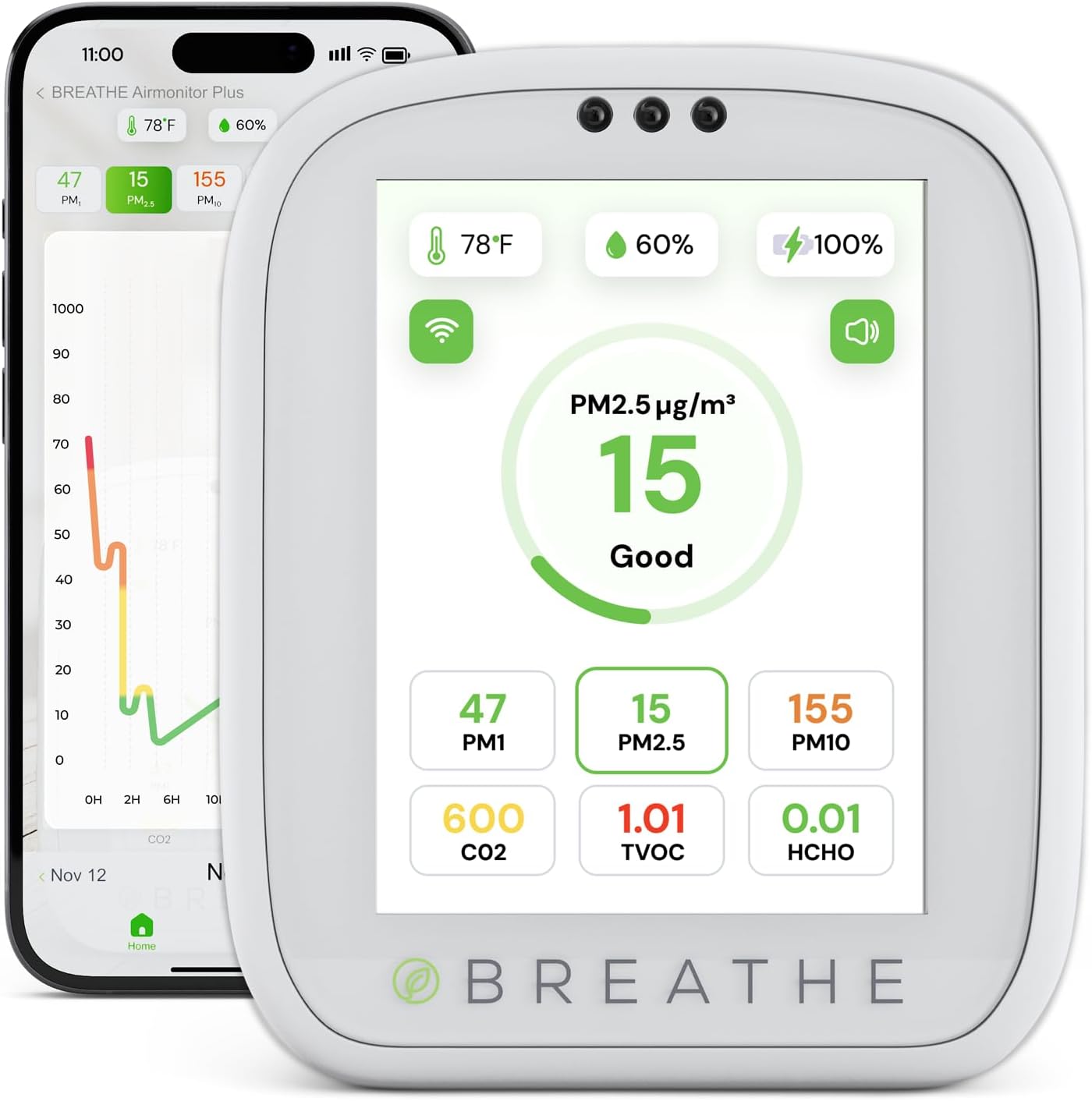
The BREATHETECH Airmonitor Plus functions as a multi-sensor device that tracks various indoor air components for users concerned about environmental conditions in their living or working areas.
Its sensors capture data on particulates of different sizes along with gas concentrations and temperature humidity levels to offer a fuller view of air quality changes over time.
Setup occurs through a dedicated app that links to 2.4 GHz WiFi networks, while the unit itself presents a modern compact form that blends into different room settings.
Homeowners can apply the information to address influences from daily activities such as cooking or cleaning, and the system aids in maintaining conditions that support productivity in home offices.
One consideration involves the short duration of battery power for mobile scenarios, though the device works well when connected to a steady supply, making it a solid choice for those prioritizing ongoing air parameter awareness.
Specifications
| Power Source | Corded Electric |
|---|---|
| Compatible Devices | Android devices running v6.0 or later, iOS devices running v13.0 or later |
| Sensor Type | TVOC |
| Smart Home Compatibility | Smart Home Compatible |
| Product Style | Modern Aesthetic |
| Color | White |
| Item Dimensions D x W x H | 1.4"D x 2.8"W x 3.3"H |
| Item Weight | 4 ounces |
| Brand | BREATHE |
| Model Number | BTL40001 |
Verify the current product variation before purchase; specifications may change.
Best For / Avoid If
Best for buyers prioritizing
- Comprehensive eight-parameter monitoring delivers more insight than single-metric devices
- App-based history and CSV export support detailed trend analysis
- Professional NDIR sensor contributes to precise CO2 readings
Consider another option if
- Portable battery operation lasts only 1-2 hours before requiring a power connection
- Limited to 2.4 GHz WiFi networks for app connectivity
- Regular calibration may be necessary to ensure continued accuracy

Pros
- Real-time buzzer alerts for multiple parameters enhance awareness of air changes
- High precision sensors provide detailed readings for accurate monitoring
- Cordless capability facilitates checking air quality across different rooms
- Brightness settings on the display accommodate different room lighting conditions
Cons
- External sensors may require avoidance of certain household products to preserve accuracy
- Battery operation limits continuous use without recharging after several hours
The YNAK WBA01 air quality monitor serves homeowners interested in tracking indoor environmental conditions across multiple metrics at once.
Its sensor system detects CO2, particulates, and other compounds while issuing alerts through distinct buzzers, allowing for timely responses to changing air conditions.
The 7-inch screen presents all readings clearly, and the device supports easy switching between temperature units along with clock adjustments for personalized use.
Users can move it freely thanks to the built-in battery, making it suitable for checking air quality in bedrooms, living areas, or home offices throughout the day.
While the external sensors need protection from strong odors, the overall feature set makes it a solid choice for those prioritizing comprehensive monitoring over basic single-function devices.
Specifications
| Brand | YNAK |
|---|---|
| Model Number | AK22A |
| Manufacturer | YNAK |
| Mfr Part Number | AK22A |
| Built-In Media | 1 x air quality monitor, 1 x charging adapter, 1 x USB-C cable, 1 x user manual |
| Best Sellers Rank | #6,777 in Industrial & Scientific (See Top 100 in Industrial & Scientific) #14 in Indoor Air Quality Meters |
| ASIN | B0FCDCWKJV |
| Customer Reviews | 4.3 4.3 out of 5 stars (325) 4.3 out of 5 stars |
| Product Style | 8h Standard-White |
| Color | White |
Verify the current product variation before purchase; specifications may change.
Best For / Avoid If
Best for buyers prioritizing
- Real-time buzzer alerts for multiple parameters enhance awareness of air changes
- High precision sensors provide detailed readings for accurate monitoring
- Cordless capability facilitates checking air quality across different rooms
Consider another option if
- External sensors may require avoidance of certain household products to preserve accuracy
- Battery operation limits continuous use without recharging after several hours

Pros
- Seven sensors enable broad coverage of radon and air quality factors
- Battery operation supports easy indoor positioning without outlets
- WiFi and app features allow remote access and multi-room expansion
- Long-term radon monitoring helps verify mitigation system performance
Cons
- Radon readings require at least 30 days for reliable averages due to fluctuations
- CO2 and VOC sensors need up to a week for initial environmental adjustment
- Full remote functionality depends on consistent internet and an app account
The Airthings 2960 View Plus functions as a battery-powered indoor air quality monitor equipped with seven sensors to track radon, PM2.5, CO2, VOCs, humidity, temperature, and pressure.
Its continuous operation allows homeowners to observe how ventilation changes affect pollutant levels in real time while providing alerts for potential issues.
The understated design includes an eInk display that users can customize, and the unit can be placed on surfaces or mounted on walls without cables for convenient setup.
This monitor proves valuable in homes where radon mitigation systems need verification or where external factors like city pollution influence indoor conditions.
Limitations include the need for a 30-day period to establish reliable radon averages and initial calibration time for certain sensors, making it less immediate for quick assessments.
Homeowners prioritizing long-term air health insights may find it suitable, whereas those seeking instant results without app connectivity might consider simpler alternatives.
Specifications
| Power Source | Battery Powered |
|---|---|
| Alarm | Visual |
| Compatible Devices | Airthings View series, Airthings Hub, Alexa, Homey |
| Sensor Type | radon detector |
| Battery Average Life | 2 years |
| Smart Home Compatibility | Smart Home Compatible |
| Upper Temperature Rating | 104 Degrees Fahrenheit |
| Product Style | View Plus |
| Color | white |
| Item Dimensions D x W x H | 4"D x 4"W x 2"H |
Verify the current product variation before purchase; specifications may change.
Best For / Avoid If
Best for buyers prioritizing
- Seven sensors enable broad coverage of radon and air quality factors
- Battery operation supports easy indoor positioning without outlets
- WiFi and app features allow remote access and multi-room expansion
Consider another option if
- Radon readings require at least 30 days for reliable averages due to fluctuations
- CO2 and VOC sensors need up to a week for initial environmental adjustment
- Full remote functionality depends on consistent internet and an app account

Pros
- Integrates directly with Alexa for voice control and smart home routines
- Monitors multiple air components in a single compact unit
- Simplifies understanding through color LED and app score display
Cons
- Requires compatible Alexa devices for full alert and automation features
- Detailed readings rely on the companion app rather than the device itself
- Best suited for users already within the Amazon smart home ecosystem
Based on the listed features, the Amazon Smart Air Quality Monitor helps homeowners monitor indoor conditions through seamless Alexa connectivity and straightforward sensor tracking.
It continuously measures particulate matter, VOCs, carbon monoxide, humidity and temperature then translates the data into an easy-to-understand score shown in the app alongside the color-coded LED indicator.
Setup involves simple plug-in connection followed by quick Alexa app pairing that enables voice routines and hands-free updates within minutes.
The product information indicates strong real-world value when paired with other Alexa devices, allowing automated responses such as activating an air purifier when readings change.
Limitations include dependence on the Alexa platform and app for detailed insights, so users outside this ecosystem may find fewer benefits; overall it suits those seeking basic smart monitoring without complex installation.
Best For / Avoid If
Best for buyers prioritizing
- Integrates directly with Alexa for voice control and smart home routines
- Monitors multiple air components in a single compact unit
- Simplifies understanding through color LED and app score display
Consider another option if
- Requires compatible Alexa devices for full alert and automation features
- Detailed readings rely on the companion app rather than the device itself
- Best suited for users already within the Amazon smart home ecosystem

Pros
- Long battery life minimizes the need for frequent power maintenance
- App provides clear historical graphs for understanding air quality patterns
- Portable wireless design works across multiple indoor environments
- NDIR sensor offers precise CO2 detection without external calibration tools
Cons
- Historical data viewing requires a smartphone and app connection
- No built-in smart home platform integration listed in product details
- Optional buzzer may need manual activation depending on user preference
The Aranet4 Home functions as a portable wireless monitor suited for homeowners, renters, and facility managers who want ongoing visibility into indoor conditions across living spaces, workspaces, or classrooms.
Its nondispersive infrared sensor measures carbon dioxide in real time while also capturing temperature, relative humidity, and atmospheric pressure, allowing users to respond quickly to changes that affect comfort and focus.
The e-ink screen remains easy to read without constant power draw, and the unit operates without cords for extended periods thanks to its efficient design and long-lasting battery.
In daily use the color-coded display and optional audible alert notify occupants when CO2 levels rise, while the companion application organizes up to 90 days of readings into graphs that reveal ventilation patterns over time.
Limitations include the requirement for a smartphone to access full historical records and the absence of direct compatibility with major smart home ecosystems based on listed specifications, making it best for those who prefer standalone monitoring.
Buyers seeking straightforward, accurate air quality data without complex setup will find this device practical, whereas those needing automated integration with other home systems may prefer alternatives with broader connectivity options.
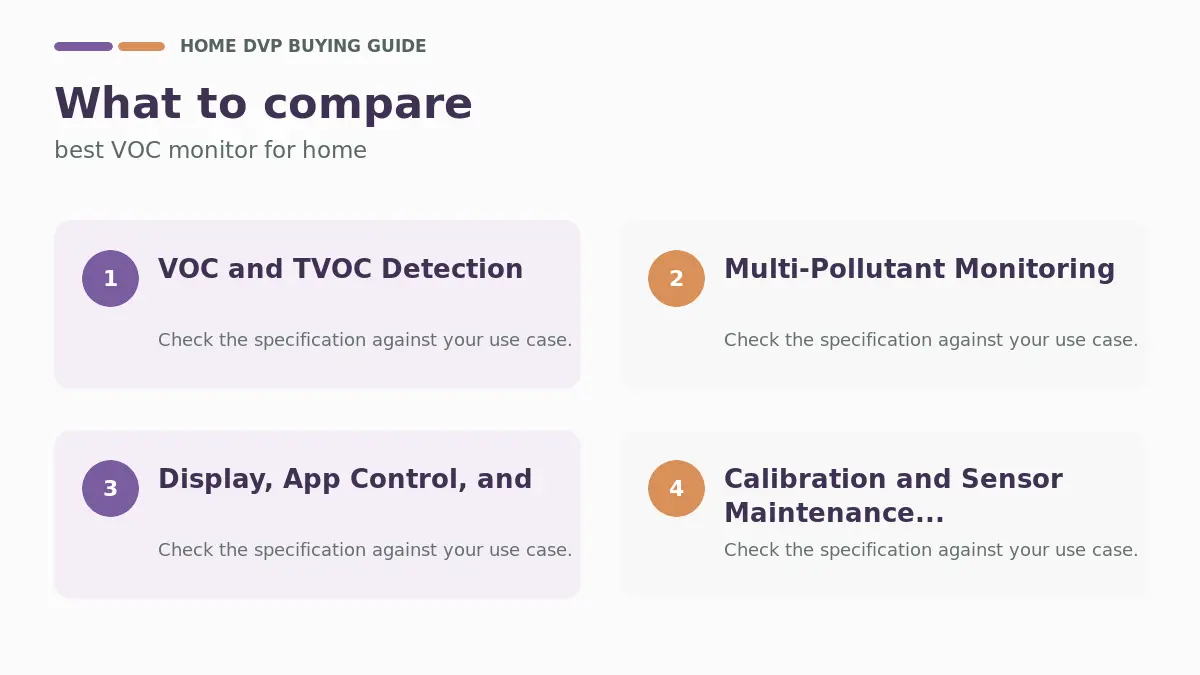
Best Voc Monitor For Home Buying Guide
VOC and TVOC Detection
The first specification to confirm is whether the monitor actually measures VOCs or TVOC. TVOC readings group multiple volatile organic compounds into a single air quality indicator, which is useful for detecting spikes from paint, furniture off-gassing, cleaning sprays, adhesives, solvents, smoke, and some cooking byproducts. A model such as the AprilAire ZAWTHCPV Smart Indoor 5-in-1 Wi-Fi Air Quality Monitor, Amazon Smart Air Quality Monitor, BREATHE Airmonitor Plus Indoor Air Quality Monitor, YNAK 16 in 1 Air Quality Monitor Indoor, and Airthings 2960 View Plus clearly lists VOC or TVOC monitoring in the available product information.
A common mistake is assuming every indoor air monitor measures VOCs. Some excellent air quality devices focus on CO2, humidity, temperature, or pressure, but those readings do not directly show VOC activity. If your main concern is fumes from remodeling, new flooring, cabinets, paint, stored chemicals, or household cleaners, prioritize a monitor with VOC or TVOC detection rather than a ventilation-only CO2 meter.
Keep in mind that consumer VOC sensors are best used for trend awareness rather than laboratory-grade identification of individual chemicals. A rising TVOC number can tell you when to open windows, run ventilation, reduce product use, or move chemical storage, but it usually will not tell you the exact compound. For most homes, that trend-based insight is still highly practical.
| Monitoring Need | What to Look For | Why It Matters |
|---|---|---|
| Renovation fumes | VOC or TVOC detection, alerts, app history | Helps track changes after painting, flooring, cabinetry, or adhesive use |
| Everyday household exposure | VOC, PM2.5, humidity, temperature | Useful for cleaning routines, cooking, candles, and ventilation decisions |
| Whole-air awareness | VOC, CO2, PM2.5, humidity, temperature, and optional radon | Gives a broader view of comfort and indoor air risk factors |
Multi-Pollutant Monitoring
VOC monitoring is valuable, but indoor air quality is rarely a single-factor issue. Many homes also struggle with particulate matter from cooking, fireplaces, outdoor smoke, dust, pets, and clogged filtration. Models that combine VOC readings with PM2.5, PM1, PM10, CO2, humidity, and temperature can help homeowners understand whether the problem is chemical, particle-based, ventilation-related, or comfort-related.
The BREATHE Airmonitor Plus Indoor Air Quality Monitor stands out on paper for tracking CO2, PM1, PM2.5, PM10, TVOC, formaldehyde, temperature, and humidity. The Airthings 2960 View Plus adds radon and air pressure to the mix, which may be valuable in homes where basement air, older construction, or regional radon concerns are part of the indoor air picture. The AprilAire ZAWTHCPV focuses on CO2, VOCs, PM2.5, humidity, and temperature, making it a balanced option for many homeowners who want smart alerts without an overly complicated display.
For homeowners who already use air purifiers or HVAC filtration, a multi-pollutant monitor can help confirm whether those upgrades are affecting the air you breathe. Pairing a monitor with better filtration, ventilation, and air movement can be more useful than relying on one device alone. If stagnant rooms are part of the problem, consider reading our comparison of air circulator fans for ways to improve room-to-room airflow.
Display, App Control, and Alerts
The best monitor for your home should be easy to read and easy to act on. Some devices use a large built-in screen with real-time numbers, while others rely more heavily on a phone app. A large display can be ideal for kitchens, bedrooms, workshops, or nurseries where you want at-a-glance readings. App-based monitors are better when you want notifications, trend history, and the ability to check air quality away from home.
The Amazon Smart Air Quality Monitor is especially appealing for Alexa households because it can send alerts and trigger compatible routines. That means a poor air quality reading can help start a fan, purifier, or dehumidifier if your smart home setup supports it. The AprilAire ZAWTHCPV also emphasizes app-based monitoring, smart alerts, and educational guidance inside the Healthy Air App.
For homeowners who dislike app-only products, look closely at the physical display. The YNAK 16 in 1 Air Quality Monitor Indoor includes a large screen designed to show multiple readings without menu diving. This can be useful for renters, older family members, or anyone who wants simple visual feedback without depending on a phone.
Power Source and Placement
Placement has a major effect on how useful your readings are. A VOC monitor should usually sit in the breathing zone, away from open windows, direct vents, humidifiers, stoves, and strong localized drafts unless you are intentionally measuring those sources. For general monitoring, place it in a room where your family spends the most time, such as a living room, bedroom, home office, or kitchen-adjacent area.
Battery-powered and portable monitors are helpful when you want to move the unit from a bedroom to a basement, garage entry, craft room, or recently painted space. Plug-in or Wi-Fi-connected models are better for continuous tracking in one location. The Airthings 2960 View Plus is battery powered and Wi-Fi connected, while the YNAK model offers cordless use for room-to-room checks. The Amazon Smart Air Quality Monitor is better suited to a fixed smart-home location.
Avoid placing a monitor directly beside a cleaner bottle, scented candle, fresh paint can, or air freshener unless you want a source-specific reading. Doing so may exaggerate the room-wide condition. For whole-room awareness, give the monitor open air around its sensors and allow readings to stabilize after moving it.
Calibration and Sensor Maintenance
Indoor air monitors depend on sensors, and sensors need proper care. Some models include calibration tools or app-guided setup, while others are designed to work with minimal adjustment. Based on available product information, the BREATHE Airmonitor Plus highlights quick-calibration tools for CO2, VOC, formaldehyde, and temperature readings. That can be useful for homeowners who want more control over long-term accuracy.
Maintenance usually means keeping the device clean, avoiding dust buildup around the sensor openings, using the recommended power cable or adapter, and keeping it away from perfumes, sprays, steam, and direct chemical exposure. The YNAK product information specifically cautions users to avoid touching sensors or exposing them to strong odors in ways that could affect accuracy. This is good advice for any consumer-grade air monitor.
Do not expect instant perfection immediately after unboxing. Many air quality monitors need time to stabilize, especially VOC and gas sensors. For practical home use, watch patterns over hours and days rather than reacting to every tiny fluctuation.
Smart Home Compatibility
Smart home compatibility can turn a monitor from a passive display into an active part of your home maintenance routine. If you already use Alexa devices, the Amazon Smart Air Quality Monitor can connect with the Alexa app, phone notifications, Echo announcements, and compatible routines. That makes it a practical option for homeowners who want air quality alerts tied to air purifiers, fans, or dehumidifiers.
The AprilAire ZAWTHCPV is more specialized. It requires the AprilAire Healthy Air App and can integrate with certain AprilAire filtration or ventilation products when paired with compatible AprilAire thermostats. That may be appealing if your home already uses AprilAire equipment or if you plan to build a more connected indoor air system.
If you are building a connected comfort system, indoor air monitoring works well alongside thermostat upgrades. Our guide to smart thermostat choices can help you understand how climate automation fits into a larger home air quality strategy.
Value and Long-Term Use
When comparing value, do not look only at the upfront cost. The useful value of the best voc monitor for home depends on the number of pollutants tracked, alert quality, app history, screen usability, power flexibility, warranty support, and whether the data helps you take action. The available product set spans $69.99–$280, so homeowners can choose between simpler smart monitors, larger display models, and more advanced multi-sensor systems.
The YNAK 16 in 1 Air Quality Monitor Indoor may appeal to value-focused shoppers who want many displayed readings and portable use. The BREATHE Airmonitor Plus offers a strong feature mix for people who want TVOC, formaldehyde, particulate matter, CO2, app alerts, and history. The Airthings 2960 View Plus is the premium option in this group, mainly because it adds radon monitoring and a broader long-term air quality platform.
For long-term satisfaction, choose a monitor that matches how you will actually respond. If you only want a quick warning, a simple smart monitor may be enough. If you plan to compare rooms, track post-renovation trends, or make decisions about filtration and ventilation, a more complete multi-sensor unit is worth considering.
Best Uses by Home Situation
Different homes create different VOC challenges. A newly renovated house may need strong VOC and formaldehyde awareness after paint, caulk, flooring, cabinets, or furniture installation. A rental apartment may need a compact monitor that is easy to move and does not require installation. A smart home may benefit more from alerts and automation than from a large screen.
For chemical-sensitive households, a monitor with TVOC, formaldehyde, and particulate readings may provide the most useful everyday feedback. For basements or ground-level rooms, the Airthings 2960 View Plus is notable because it includes radon monitoring in addition to VOC and other air quality readings. For families who want simple air quality alerts in an Alexa-centered home, the Amazon Smart Air Quality Monitor is one of the easiest fits based on the listed specifications.
Humidity also affects indoor comfort, perceived odors, and pollutant behavior. If dry or overly damp air is a recurring issue, our guide to whole house humidifier options may help you round out your air quality plan.
Our Research Methodology & Why You Can Trust Us
We evaluated the products based on available product information, category fit, listed sensor capabilities, user-facing specifications, smart features, display design, alerts, maintenance needs, and suitability for practical home use. We did not claim hands-on testing because the available data does not support a physical test process. Instead, our recommendations are based on specification analysis, product feature comparison, and homeowner-focused use cases.
Our research indicates that category validation is especially important for the best voc monitor for home. Some indoor air monitors are excellent for ventilation tracking but do not list VOC or TVOC detection. For this guide, we focused our discussion on models that clearly align with VOC, TVOC, or broader indoor air quality monitoring needs for homes, apartments, offices, bedrooms, kitchens, and renovation spaces.
Ranking criteria included performance potential, feature depth, build and display design, ease of setup, app support, alert quality, sensor variety, durability signals, safety relevance, value, reliability indicators, and fit for homeowner or DIY use. We also considered how each product might help with common scenarios such as cleaning product fumes, new furniture off-gassing, cooking particles, basement air concerns, and ventilation decisions. This guide is reviewed and updated during July to keep the recommendations aligned with the latest available product data.
Trust matters in air quality content because homeowners may use this information to make health and safety decisions. A consumer monitor should not replace professional testing when you suspect a serious hazard, but it can be a useful early-warning and trend-tracking tool. For more category-level resources, visit our Air Quality & Climate hub.
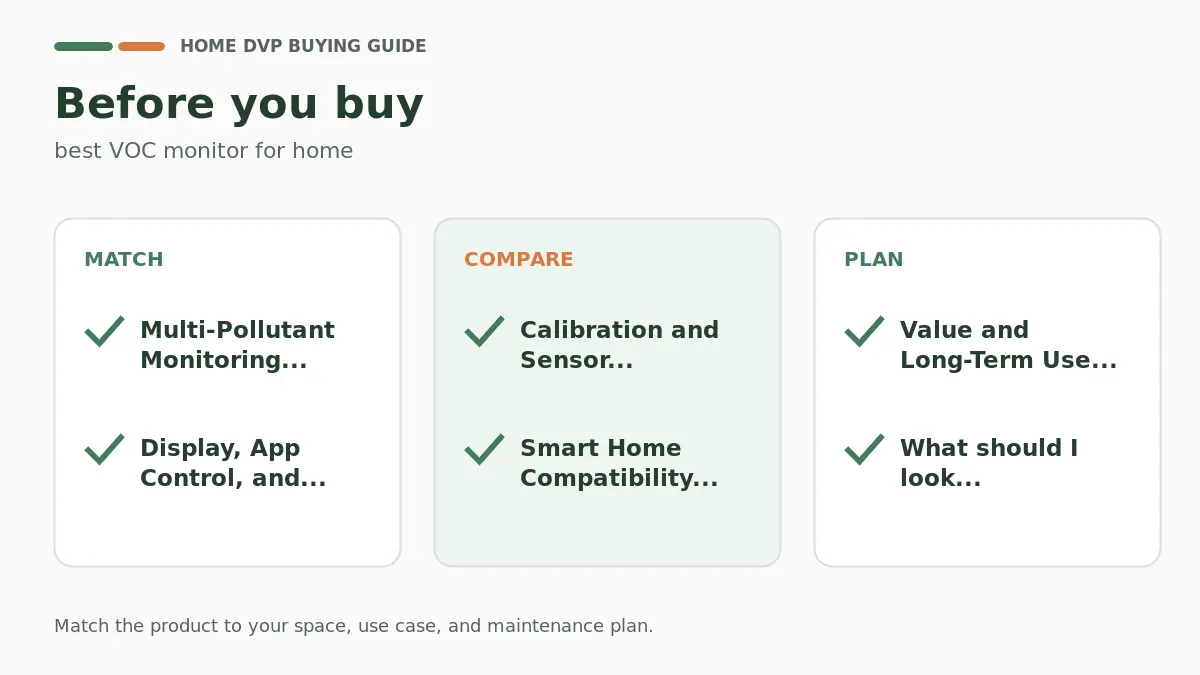
Final Thoughts
Based on the feature set, the BREATHE Airmonitor Plus Indoor Air Quality Monitor is a strong overall pick for many homeowners because it combines TVOC, formaldehyde, CO2, particulate matter, temperature, humidity, app alerts, and history. It is a practical choice for families who want a broader picture of indoor pollutants rather than a single air quality number.
The AprilAire ZAWTHCPV Smart Indoor 5-in-1 Wi-Fi Air Quality Monitor is a good homeowner pick for app-guided air quality awareness, especially if you value clear alerts and educational guidance. The Amazon Smart Air Quality Monitor is an easy setup pick for Alexa users who want simple automation and notifications. The YNAK 16 in 1 Air Quality Monitor Indoor is a value-oriented display pick for shoppers who want a large screen and portable readings.
For premium monitoring, the Airthings 2960 View Plus is the most complete option among the valid products discussed because it includes VOC, PM2.5, CO2, humidity, temperature, air pressure, and radon monitoring. If you are improving indoor air quality room by room, start with a monitor that matches your main concern, then pair the readings with better filtration, ventilation, and smart climate control where appropriate.
FAQ
What should I look for when choosing the best voc monitor for home?
Look for clear VOC or TVOC detection, useful alerts, stable readings, and an interface you will actually check. For broader indoor air awareness, consider models that also track PM2.5, CO2, humidity, and temperature.
Are higher-end voc monitor for home worth it?
Higher-end models can be worth it if they add meaningful sensors, better app history, stronger alerts, or specialized monitoring such as radon. If you only need basic VOC trend awareness in one room, a simpler model may be enough.
Can best voc monitor for home help during painting or renovation projects?
Yes, VOC or TVOC monitoring can help you see when fumes rise after painting, caulking, flooring, furniture delivery, or adhesive use. It should not replace safe work practices, but it can help you decide when to ventilate, run filtration, or delay reoccupying a room.
Do I still need better filtration if I use the best voc monitor for home?
A monitor tells you what is happening, but it does not clean the air by itself. Pairing readings with ventilation, source control, and better filtration is usually more effective, and our HVAC filter guide can help you compare filtration upgrades.