
Choosing the right cooling solution is one of the most important decisions homeowners, renters, and apartment dwellers face when summer heat arrives. An updated Window Air Conditioner Comparison helps you navigate the many options available in 2026, from compact units for bedrooms to higher-capacity models for living areas. After carefully analyzing the available specifications of 15 models, we created this practical guide focused on real-world needs such as room size, noise levels, energy use, and installation ease.
Window air conditioners remain a popular choice because they deliver strong cooling without the complexity or cost of central systems or permanent installs. Whether you live in a rental where you cannot modify walls or simply want a reliable seasonal solution, understanding the differences between traditional, U-shaped, and casement designs will save you time and money. Our comparison methodology prioritizes cooling capacity in BTUs, quiet operation data, smart features, filter maintenance, and window compatibility based on manufacturer specifications and user-facing details. For those whose windows are not suitable, you may also want to explore a portable air conditioner for bedroom as an alternative.
This guide covers models ranging across $144.92 – $550.19 from brands including AmazonBasics, PerfectAire, AntarcticStar and more. We highlight who each type of unit is best for and common pitfalls to avoid so you can select a unit that fits your space and lifestyle. Regular updates during July ensure the information stays current with the latest product data.
Pros
- Three comfort modes for cooling, circulating air, and reducing humidity
- Quiet low-mode operation paired with remote control including batteries
- Auto restart restores previous settings after power loss
- Removable washable filter helps capture dust and pet hair
- Backed by 1 year parts and labor warranty
Cons
- Screwdriver is required for installation but not included
- Pilot holes may be needed for certain window frames
- Capacity suits spaces up to 150 square feet so larger rooms may need higher BTU units
Based on the available product data, the Midea 5,000 BTU EasyCool Window Air Conditioner offers homeowners and renters a focused option for cooling modest interiors such as bedrooms, living rooms, or home offices. Ideal users include those seeking straightforward electronic control and multi-mode comfort without advanced smart-home complexity.
Performance centers on its ability to cool spaces up to 150 square feet while also circulating air with a 3-speed fan or reducing humidity in dehumidifier mode. Flexible settings like EcoSave and SleepWell plus automatic temperature control via remote help maintain comfort efficiently, and auto restart resumes the last settings after any power interruption.
Usability stands out through the intuitive LED display and remote control that includes batteries for adjusting time, temperature, and modes from across the room. Installation fits existing window frames with expandable panels and all mounting accessories provided, though a screwdriver is needed and pilot holes may assist some frames. The washable reusable filter with clean filter warning supports easy upkeep and helps limit dust and pet hair.
Practical strengths appear in everyday scenarios where quiet operation as low as 52dB benefits sleep or focused work, while the EasyTimer enables up to 24-hour scheduling that matches daily routines. Apartment residents or owners updating smaller rooms can leverage the energy-efficient modes for ongoing comfort and simpler maintenance.
Limitations arise mainly from the room-size focus, which may leave larger areas insufficiently cooled, and from basic tool requirements during setup that first-time installers should anticipate. Based on the listed features and specifications, the unit delivers solid value for quiet multi-mode cooling and convenient controls in compact living spaces.
Those with rooms under 150 square feet who want remote convenience, reusable filtration, and reliable auto restart will find it a practical match, while buyers needing higher capacity or expanded connectivity options may consider other window units.
Pros
- Remote control provides convenient setting changes from anywhere in the room
- Washable filter and alert system reduce maintenance effort
- Eco and Sleep modes help manage electricity consumption during daily use
- Quiet performance supports restful environments in small bedrooms
Cons
- Cooling capacity suits spaces no larger than 250 square feet
- Window installation is required and may involve extra preparation for some users
Based on the listed specifications the Frigidaire FHWC063TC1 functions as a window air conditioner built to cool rooms up to 250 square feet with 6000 BTU output.
It achieves effective temperature control through adjustable settings and multi-directional airflow while Eco Mode and Sleep Mode assist with energy management during extended operation.
The included remote simplifies daily use and the 24-hour timer allows scheduling that aligns with household routines along with Dry Mode for humidity control.
Practical applications include small bedrooms or apartments where the 52 dBA noise rating supports undisturbed rest and the washable filter with alerts keeps performance steady over time.
Users should consider that the unit targets smaller areas only and requires proper window placement for installation.
This option works well for homeowners needing basic reliable cooling without additional connectivity features.
Pros
- Mechanical controls remove any need for internet connectivity or smartphone pairing.
- Washable reusable filter and lack of required draining reduce ongoing maintenance tasks.
- Auto-restart function preserves user settings during outages for reliable daily operation.
Cons
- Mechanical design omits remote control and timer functions present on electronic GE models.
- Cooling capacity targets only rooms up to 150 square feet so larger spaces need a higher BTU unit.
- Fits only double-hung windows within the listed width and height range.
This GE window air conditioner addresses cooling needs in compact spaces such as bedrooms, home offices, and dorm rooms where square footage stays at or below 150.
Two cooling modes paired with two fan speeds allow users to select lower output for quiet nighttime conditions or higher output for faster temperature reduction during warmer periods.
The fixed chassis and mechanical dials support direct installation in double-hung windows measuring 27.125 to 36 inches wide, with the EZ Mount kit supplying side panels and foam insulation for a complete seal.
Practical benefits include automatic resumption of prior settings after power loss and a washable filter that maintains airflow without replacement purchases.
Owners seeking basic reliable performance may appreciate the straightforward controls, while those needing remote access or scheduling functions could explore electronic alternatives within the GE window unit range.
Pros
- Effective noise reduction from the U design
- Smart connectivity for remote management
- Energy efficient inverter operation
- Secure installation with window lock feature
Cons
- Compatible only with windows between 22 and 36 inches wide
- Does not include heating capability
- May require precise alignment during initial setup
Based on the provided product details, this Midea window air conditioner targets homeowners needing reliable cooling for medium sized rooms without excessive noise.
The inverter system supports stable temperatures and notable energy reductions while the low decibel rating promotes comfortable use in living areas.
Its U shaped configuration stands out by enabling partial window opening for ventilation alongside an anti theft mechanism for safety.
Practical applications include apartments or homes where maintaining views and fresh air matters alongside temperature control through multiple smart options.
Potential users should verify window measurements match the specified range before purchase, though the overall design supports straightforward setup for most double hung styles.
Pros
- Suitable capacity for compact bedrooms, offices, or small living spaces
- Quiet performance supports restful sleeping and productive working environments
- Washable filter simplifies maintenance while helping manage dust and allergens
- Quick-install kit with expandable panels suits common window sizes
- Intuitive mechanical controls and multiple settings allow easy customization
Cons
- Capacity is limited to rooms up to 150 square feet so larger areas may need a higher BTU model
- Installation requires basic tools such as a screwdriver that is not included in the kit
- Mechanical controls may feel less advanced for users seeking digital or smart options
The Amazon Basics 5000-BTU Window Air Conditioner is a compact cooling appliance aimed at small rooms. Based on the provided product details, it suits homeowners and renters who need reliable temperature relief in bedrooms, home offices, or similar spaces up to 150 square feet without large or complex equipment.
Performance centers on efficient cooling with a two-in-one cool and fan-only design. The listed features indicate seven precise temperature settings, two-speed cooling and fan modes, and two-way air direction control, giving users flexible ways to manage comfort and airflow in everyday home conditions.
Design emphasizes practical usability and straightforward setup. Intuitive mechanical controls keep operation simple, while the easy-access washable filter captures dust and allergens for routine care. The unit ships with an adjustable window kit, expandable side panels, and complete mounting hardware that fits standard windows 23 to 36 inches wide and a minimum of 13 inches high, though basic tools are needed for installation.
In real-world home scenarios the quiet operation rated up to 56 dB supports peaceful sleeping and focused work. Combined with the dual modes and directional airflow, the unit becomes a useful option for targeted cooling in compact living areas during warmer seasons or for light air circulation year round.
Limitations include its size-specific capacity, so households with bigger rooms may require a more powerful model, and first-time installers may need extra time gathering tools. Based on the available product information, this window air conditioner remains a practical choice for simple, quiet cooling needs in small spaces.
Buyers seeking an uncomplicated solution for bedrooms or offices will find the feature set well matched, while those wanting larger coverage or advanced digital interfaces may prefer alternative units with expanded capabilities.
Pros
- Operates quietly to minimize noise interference
- Includes remote for convenient control
- Auto restart feature ensures uninterrupted cooling
- Slide-out washable filter promotes easy cleaning
Cons
- Best suited for spaces no larger than 250 square feet
- Window mounting may present challenges in certain home configurations
- Lacks advanced smart connectivity options
The LG LW6017R serves as an effective cooling solution for medium-sized living spaces such as bedrooms and dens based on the provided product details.
Its 6000 BTU output combined with three cooling speeds delivers customizable comfort while the low noise operation reduces audible distractions during use.
The digital control panel works alongside the remote for flexible adjustments and the 2-way air deflection helps direct airflow evenly throughout the room.
Practical benefits include the auto restart function that maintains temperature consistency and the washable filter that supports straightforward upkeep for better air quality.
While installation requires a compatible window opening the included kit aids the process and the unit suits homeowners seeking reliable seasonal cooling without excessive complexity.
Pros
- Innovative placement keeps windows fully functional after installation
- WiFi connectivity enables control and energy tracking from any location
- Flex-depth design accommodates a range of wall thicknesses without extra brackets
- Built-in pump reduces the need for manual condensate management
Cons
- Requires a double-hung window meeting specific width and height minimums
- Smart features depend on a stable home WiFi connection
- May not align with non-standard wall depths outside the stated range
Based on the provided product details, the GE Profile ClearView Window Air Conditioner offers a practical solution for homeowners needing to cool medium rooms while keeping natural light and window access intact.
The 8300 BTU output covers spaces up to 350 square feet, with four modes and three fan speeds allowing adjustments for different comfort needs throughout the day.
Design elements include flex-depth construction that expands to fit walls between 4.5 and 13.75 inches thick, plus an included kit for straightforward placement in double-hung windows 20 to 40 inches wide.
Real-world use benefits from the low-profile siting below the sill, the 40 dB quiet operation, and the built-in pump that moves condensation outside without extra effort.
Limitations center on the need for specific window dimensions and types, which could restrict options in older homes, though the overall feature set supports reliable seasonal cooling where the unit matches the space.
Pros
- Engineered specifically for narrow casement and sliding windows where standard units will not fit
- Includes expandable mounting kit, support bracket, and foam seal for sealed installation
- Remote doubles as thermostat for location-based temperature sensing
- Multiple speeds, sleep mode, and programmable timer offer flexible daily operation
Cons
- Requires the unit to stand upright for at least 24 hours before first use to protect compressor function
- Fits only a limited window width and height range, so careful measurement is essential
- Sized for rooms around 400 to 450 square feet and may prove less effective in larger or high-heat spaces
The PerfectAire 10,000 BTU casement window air conditioner addresses a common homeowner challenge by fitting narrow sliding and crank-out windows that reject conventional horizontal units. Its vertical chassis targets rooms of roughly 400 to 450 square feet, positioning it for bedrooms, living rooms, and home offices. Buyers with nonstandard window styles who want straightforward cooling without custom framing will find this model especially relevant.
Performance centers on the 10,000 BTU rating for medium spaces along with the Follow Me remote that acts as a portable thermostat within a 26 foot range. Temperature can be set between 68 and 86 degrees F while three cooling and fan speeds, sleep mode, and a 24-hour timer allow fine control. Adjustable vents further refine comfort by directing airflow where it is needed most.
Design features a compact vertical form roughly 23.5 inches high by 14.75 inches wide by 21 inches deep. The included expandable mounting kit with accordion panels, top rail, hardware, support bracket, and foam seal accommodates windows 15.5 to 16.25 inches wide and 21.25 to 39.5 inches high. Soft-touch digital controls and an LED display keep everyday adjustments simple, and the kit arrives ready for DIY installation with an illustrated manual.
In practical home settings the unit supports consistent cooling for everyday living areas while avoiding the need for costly window modifications. Strengths include the location-aware remote, customizable speeds and modes, and complete sealing accessories that promote stable operation once installed. It suits routine comfort needs in correctly sized rooms with matching casement or sliding openings.
Limitations include the mandatory 24-hour upright standing period before initial operation to safeguard the compressor and the narrow acceptable window dimensions that demand precise measuring. When those conditions are met, the listed features indicate a capable and convenient casement window air conditioner for medium-space cooling.
Homeowners whose windows fall within the specified ranges and who need reliable cooling for rooms near 450 square feet should consider this option. Those with larger areas, standard double-hung windows, or different installation preferences may want to explore alternative air conditioner styles.
Pros
- Mechanical controls provide direct and reliable adjustments without needing apps or connectivity
- Washable filter design supports straightforward monthly cleaning to keep the unit efficient
- Auto-restart capability reduces manual intervention following outages for continued operation
Cons
- Best matched to rooms of 150 square feet or smaller per the listed cooling coverage
- No remote or smart features included which limits hands-free or automated control options
The LG LW5024X window air conditioner addresses cooling needs for homeowners managing smaller living areas such as bedrooms, home offices, or dorm rooms where targeted capacity matters most.
Performance centers on 5000 BTU output that covers up to 150 square feet combined with two cooling and fan speeds plus an energy save mode that supports customized comfort and efficient operation throughout varying conditions.
Design emphasizes straightforward mechanical controls for daily adjustments along with a fixed chassis that aligns with double-hung window dimensions from 21 to 35 inches wide and 12 inches high through the provided installation kit.
In practical home settings the 2-way air deflection promotes even distribution while the washable filter aids dust capture and the auto-restart function maintains prior settings after interruptions to support uninterrupted use in compact spaces.
Limitations include restriction to smaller room sizes and lack of remote or connected features which may prompt consideration of other models for users seeking expanded capabilities or larger coverage areas.
Pros
- Low noise performance supports use in bedrooms or quiet living spaces
- Remote and electronic controls add daily convenience for adjustments
- Auto restart restores function without manual intervention after outages
- Washable filter reduces ongoing maintenance effort
Cons
- Installation requires a compatible window opening and proper support
- Designed strictly for cooling with no heating capability listed
- Filter must be cleaned regularly to preserve performance
The LG LW8024RD window air conditioner addresses cooling needs in medium-sized rooms reaching 350 square feet such as bedrooms or living areas.
Performance centers on 8000 BTU output with quiet low-mode operation at 53 dB and multiple speed settings that allow users to balance temperature and sound levels effectively.
Design includes electronic controls paired with a remote for adjustments without direct contact, a 24-hour timer for scheduling, and 4-way air deflection to guide airflow where needed most during installation.
Practical home applications benefit from the auto restart feature that resumes operation after power loss plus the washable reusable filter that supports ongoing efficiency in daily use.
Potential limitations involve the need for a suitable window size and type along with periodic filter maintenance to sustain results, making this model best suited for straightforward seasonal cooling rather than advanced or multi-function requirements.
Pros
- Includes smart WiFi for app and voice control plus a physical remote
- Offers multiple modes including cooling, fan, dry, eco, sleep, and 24-hour timer
- Comes with an easy-install kit needing only 14.5 inches of vertical clearance
- Uses a high-quality compressor aimed at efficient cooling and extended service life
- Delivers whisper-quiet performance suitable for bedroom overnight use
Cons
- Best matched to spaces up to 350 square feet and may fall short for larger open areas
- Limited to single or double-hung windows between 23 and 36 inches wide
- Window mounting occupies opening space and can reduce natural light or ventilation when in place
The GarveeHome 8000 BTU window air conditioner provides a practical cooling option for homeowners and renters who need dependable temperature control in compact indoor spaces. Based on the product information, it suits bedrooms, living rooms, or similar areas up to 350 square feet where consistent comfort matters during warmer weather.
Performance draws from its 8000 BTU capacity paired with three fan speeds and a temperature range of 61 to 88 degrees Fahrenheit. The listed details indicate it removes 0.9 liters of humidity per hour to promote drier air, while multi-mode choices such as cooling, fan, dry, eco, and sleep let users match the unit to different daily needs. A 24-hour timer further supports scheduled operation for efficient routine use.
Design focuses on a compact 115V energy-saving layout with a high-quality compressor intended for longer working life. Controls combine smartphone app access for iOS and Android, voice assistant compatibility, and a dedicated physical remote. Installation relies on the included kit that accommodates single or double-hung windows 23 to 36 inches wide and requires only 14.5 inches of vertical clearance, allowing a no-tools process described as taking about 15 minutes.
In everyday home settings, the unit supports quiet overnight comfort through its sleep mode and whisper-quiet operation, making it helpful in restful environments. Reusable filters aid air circulation with minimal upkeep, and the smart connectivity options add modern convenience without requiring permanent wiring changes.
Potential limitations center on its capacity being aimed at smaller rooms, so larger spaces may need supplemental cooling. Window size and type restrictions can also limit placement in some homes. Overall, based on the available product data, the GarveeHome 8000 BTU window air conditioner combines smart controls, straightforward installation, and flexible comfort features into a useful choice for many practical buyers seeking seasonal cooling upgrades.
Pros
- U-shaped layout preserves outdoor views without blocking the glass
- Low indoor sound level supports peaceful evening or overnight use
- Multiple fan speeds and airflow directions improve even room coverage
- Removable washable filter reduces long-term filter replacement needs
- Compatible with common residential window sizes for many homes
Cons
- Requires precise window measurements within the listed opening width and sill limits to fit properly
- Cooling capacity may fall short for spaces larger than 450 square feet
- Limited to double-hung and sliding window styles rather than every window configuration
The Electactic U-shaped window air conditioner targets homeowners renters and apartment dwellers who need dependable room cooling without sacrificing daylight or outdoor views. Based on the listed specifications this 10,000 BTU unit is sized for living areas bedrooms and offices up to 450 square feet and focuses on quiet everyday comfort rather than industrial performance.
Performance centers on strong cooling combined with flexible climate options. The product information indicates six modes including cool dry fan auto sleep and energy saver along with three fan speeds and temperature control from 62F to 86F. Dry mode helps manage humidity while fan mode offers simple air movement making the unit useful beyond peak summer heat. A CEER 11 rating and timer functions further support efficient operation when energy use matters.
Design places the compressor outside the living space so indoor noise stays as low as 45dB. The U-shaped saddle form leaves the window largely unobstructed for light and scenery. Installation is described as tool-free for double-hung and sliding windows with a minimum 16-inch opening 24- to 48-inch width and sill height up to 11 inches. Touch controls plus a remote simplify daily adjustments and the washable filter keeps maintenance straightforward.
In practical home settings the combination of full-window visibility quiet running and multi-mode operation suits shared living spaces home offices or bedrooms where both temperature and tranquility matter. Four-way airflow helps direct cool air where it is needed most and the overall feature set addresses common homeowner desires for easy setup and year-round utility without complex hardware.
Potential limitations include the need for careful window measuring before purchase and the unit remaining best matched to mid-sized rooms rather than open-concept great rooms. Users with casement or other non-listed window types will need a different solution. Overall the product data positions this Electactic model as a practical quiet window AC choice for those prioritizing view preservation energy-aware cooling and simple seasonal comfort.
Buyers seeking an unobstructed window experience and low indoor noise should find this unit well aligned with their needs while those requiring higher capacity or broader window compatibility may prefer traditional or portable alternatives.
Pros
- Compressor isolation and sealing create a far quieter environment than traditional 60dB units
- Multiple modes and high-performance compressor with copper motor support reliable long-term cooling
- Side sealing and U-shaped fit boost efficiency while maintaining open window flexibility
- Complete kit and remote simplify setup and daily control for renters and busy families
Cons
- Best suited to sliding and double-hung windows which may limit compatibility in some homes
- Designed for rooms no larger than 450 square feet so bigger spaces may need additional units
- First-time installers of U-shaped models may require extra care for bracket adjustment and sealing
Based on the available product data the Tehanld 10,000 BTU U-shaped window air conditioner targets homeowners renters and apartment dwellers who need dependable cooling for bedrooms living rooms offices dorms or sun-exposed areas up to 450 square feet while keeping noise low and window views open.
Performance relies on a high-performance compressor and copper motor that provide fast consistent cooling with four-way wide-angle airflow for even coverage without weak spots. Six modes including Cool Dry Fan Sleep Auto and Energy Saver help customize comfort and the design uses 37 percent less energy than standard models for practical efficiency during hot weather.
The U-shaped structure places the compressor outside for operation as low as 42dB supported by vibration-dampening brackets and sealing strips that also reduce external sound. Adjustable brackets ensure a secure fit in most sliding and double-hung windows while side seals eliminate air leaks and boost efficiency. An intuitive touch panel remote control and removable washable filter make operation and maintenance straightforward with a complete accessory kit for tool-free setup.
In everyday home scenarios this unit creates a tranquil setting ideal for light sleepers infants elderly family members or anyone seeking quiet work and relaxation spaces. It suits apartments older homes and rental properties where preserving natural light and easy installation matter and the even airflow covers multi-use rooms effectively without major renovations.
Potential limitations center on window style compatibility and the 450 square foot capacity range where larger areas may call for different solutions. Based on the listed features and specifications the Tehanld air conditioner offers a practical energy-conscious choice for buyers focused on quiet reliable cooling and flexible window use delivering solid home comfort value overall.
Pros
- Effective 5000 BTU capacity matched to small rooms for focused cooling
- Low sound levels support quieter daily living spaces
- Fixed chassis and included kit simplify window installation
- Reusable washable filter streamlines routine maintenance
- Multiple fan and cooling speeds allow personalized airflow
Cons
- No remote control or WiFi connectivity may limit convenience for users wanting hands-off or smart adjustments
- Best suited only to rooms of 150 square feet or less and may leave larger spaces undercooled
- Mechanical-only interface could feel basic for those who prefer digital displays or programmable options
Based on the listed specifications, the LG LW5023 stands out as a compact 5000 BTU window air conditioner aimed at homeowners and renters who need reliable cooling in small spaces such as bedrooms, dorm rooms, or home offices up to 150 square feet. Its fixed-chassis design and focus on straightforward operation make it a practical choice for first-time buyers or anyone seeking basic comfort without complex extras.
Performance centers on efficient cooling coverage for a single room or zone, with two cooling modes and two fan speeds that let users tailor airflow to current conditions. The 2-way air deflection system helps distribute cool air more evenly, while the Energy Save function and eco-friendly R32 refrigerant support lower electricity use during extended operation. Sound levels drop as low as 50 dB in low mode, which the product information indicates helps maintain a quieter environment for sleep or concentration.
Design and usability emphasize simplicity. The unit measures 17.32 by 14.37 by 11.14 inches and fits double-hung windows from 21 to 35 inches wide by 12 inches high using the included EZ Mount installation kit. Mechanical controls and an adjustable thermostat keep operation intuitive, and the slide-out washable filter allows easy cleaning to sustain performance. Auto-restart returns the unit to prior settings after a power interruption, adding everyday reliability without requiring user intervention.
In practical home settings, these features translate to dependable relief in compact living areas where larger systems would be oversized. The washable filter and energy-conscious modes reduce ongoing upkeep, while the quiet low setting and customizable speeds make the unit suitable for overnight use or quiet workspaces. Based on the feature set, it fills a clear niche for seasonal cooling in apartments, guest rooms, or similar smaller environments.
Potential limitations include the absence of remote control or smart connectivity, so users must adjust settings at the unit itself. Coverage is also capped at 150 square feet, which may leave bigger rooms inadequately cooled. Overall, the LG LW5023 offers solid value for those prioritizing quiet, easy-to-install cooling in limited spaces, though buyers needing smart features or higher capacity should consider larger options in the same lineup.
Those with small rooms and a preference for mechanical simplicity will find it a matching fit, while households seeking WiFi integration or multi-room power may prefer higher-BTU models with additional connectivity.
Pros
- 8000 BTU capacity matches mid-sized room cooling needs
- Multi-function modes cover cooling, air circulation, and humidity control
- Remote and illuminated digital controls improve daily usability
- Adjustable airflow system promotes consistent room coverage
- Portable lightweight form allows flexible window placement
Cons
- Cooling performance is specified for areas up to 350 sq ft and may fall short in larger open floor plans
- Requires a suitable window opening, which can limit options in some apartments or homes with fixed glass
- Lacks advanced smart-home connectivity that some tech-oriented users may prefer
The AntarcticStar 8000 BTU window air conditioner serves as a practical cooling option for homeowners, renters, and apartment dwellers who need reliable temperature control in medium rooms. Based on the provided product details, it targets living rooms, bedrooms, offices, and small apartments up to 350 square feet, making it a suitable choice for those seeking multi-season climate management without complex systems.
Performance centers on the 8000 BTU cooling capacity that delivers effective temperature reduction in the stated room sizes. The 6-in-1 modes combine air conditioning with fan and dehumidifying functions, allowing use during peak summer heat as well as more humid transitional periods. ECO mode further supports energy-conscious operation while the timer function prepares a cool environment ahead of arrival, enhancing everyday comfort based on the listed feature set.
Design emphasizes accessibility through a clear digital display, soft LED lighting for nighttime use, and a remote control for adjustments across the room. Adjustable horizontal louvers paired with vertical air deflectors help direct airflow where it is needed most. The unit is described as lightweight and easy to install or relocate between windows, which simplifies setup and storage considerations for practical DIY or rental situations.
In real-world home scenarios, the features support consistent cooling across a space along with humidity reduction when needed. Users can shift the unit as weather or room priorities change, offering flexibility that permanent systems cannot match. The combination of multi-mode operation and straightforward controls makes it useful for everyday living areas where simple, effective climate control matters most.
Potential limitations include the defined 350 square foot capacity, which may prove insufficient for larger open layouts, and the requirement for a compatible window that not every home or rental may provide. Advanced connectivity options are not indicated in the product information. Overall, based on the available details, this AntarcticStar window unit stands as a capable, versatile solution for medium-room cooling and multi-season comfort needs.
Buyers focused on easy installation, remote convenience, and adaptable modes for bedrooms or small apartments will find the strongest match. Those requiring coverage for bigger spaces or smart-home integration may want to explore higher-capacity or connected alternatives instead.
Window Air Conditioner Comparison Buying Guide
Selecting the right window unit involves more than just looking at price or brand name. Homeowners and renters need to match cooling power to room size, check window type and measurements carefully, and balance features like smart controls against energy efficiency and noise. Below we break down the key factors that matter most based on available product specifications and practical home use considerations.
Cooling Capacity and Matching BTU to Room Size
BTU rating is the starting point for any Window Air Conditioner Comparison. Units listed range from 5,000 BTU models designed for spaces up to 150 square feet to 12,000 BTU options that can handle areas around 550 square feet. Choosing too small a capacity leaves a room feeling warm and forces the unit to run constantly, increasing wear and energy use. Oversizing can lead to short cycling, poor dehumidification, and higher costs.
Measure your room carefully, including height, and account for factors like high ceilings, sun exposure, kitchen heat, or the number of people who regularly occupy the space. For a typical bedroom around 10 by 15 feet, a 5,000 to 6,000 BTU unit is often sufficient. Medium living rooms or open areas may need 8,000 to 10,000 BTU. Always err on the side of accurate measurement rather than assuming bigger is better. Many of the models in this comparison provide clear square-footage guidance in their specifications.
A common mistake is ignoring insulation quality or window orientation. South-facing rooms with large glass areas often require higher BTU. If your primary need is a small bedroom or office, look at compact 5,000 BTU options with simple mechanical or electronic controls. For larger or multi-use spaces, prioritize higher capacity combined with inverter technology when available for more stable temperatures.
Energy Efficiency and Long-Term Operating Costs
Energy efficiency directly affects your monthly utility bills during peak cooling season. Look for ENERGY STAR certification or higher CEER ratings when comparing units. Inverter models stand out because they adjust compressor speed rather than cycling fully on and off, which can deliver significant savings. One U-shaped inverter unit in this comparison claims over 37 percent energy savings compared with traditional fixed-speed designs and is noted as among the first window units to achieve ENERGY STAR certification under its technology.
Even non-inverter units can be efficient when properly sized and equipped with eco or energy-saver modes, timers, and sleep settings. Features such as 24-hour programmable timers allow you to cool the space only when needed. Washable filters that are easy to clean also help maintain efficiency because dirty filters force the unit to work harder. When evaluating options within $144.92 – $550.19, calculate not just purchase price but estimated running costs based on local electricity rates and expected hours of daily use.
Homeowners who plan to run a unit many hours each day or across an entire summer season should prioritize efficiency features. Renters who use a unit only occasionally may accept slightly lower efficiency for a lower upfront cost. Always check the listed voltage requirements, usually 115V for most residential window units, to ensure compatibility with existing outlets without needing special wiring.
Noise Levels and Quiet Operation for Comfortable Living
Noise is a frequent complaint with traditional window air conditioners, especially in bedrooms or home offices. Decibel ratings matter. Many standard units operate in the low 50s dB on low settings, while advanced U-shaped designs can reach as low as 32 dBA by placing the compressor outside the living space and using the window itself as a sound barrier. Quieter operation supports better sleep and less distraction during work or conversation.
Look for models that specify low-mode noise levels and offer multiple fan speeds plus dedicated sleep modes. Sleep modes typically lower fan speed and gradually raise the temperature slightly overnight to reduce both noise and energy use. Some units include soft LED displays that dim at night to avoid light pollution. Mechanical controls can be quieter in the sense that they produce no electronic beeps, which some users prefer.
If noise sensitivity is high, prioritize U-shaped or saddle-style units that keep the noisiest components outside. For standard designs, read the low-mode specifications carefully. A unit that runs at 52 dB on low is generally acceptable for most bedrooms, while anything significantly higher may become noticeable over long periods. Placement also affects perceived noise; ensure the unit is properly sealed and supported so vibration is minimized.
Installation Requirements and Window Compatibility
Not every window works with every unit. Measure width, height, and sill depth before buying. Most traditional units fit single-hung or double-hung windows in the 22 to 36 inch width range with minimum height around 13 to 14 inches. Side panels or accordion-style kits expand to fill the remaining space and must seal tightly to prevent warm air infiltration and improve efficiency.
U-shaped designs often allow the window to open partially for fresh air while still securing the unit, and many include anti-theft locking features. Casement or sliding window units use a vertical chassis and special mounting kits designed for narrow openings that standard window ACs cannot fill. One casement model in this comparison accommodates specific min/max width and height ranges for horizontal sliding or crank-out windows and includes expandable panels and seal foam.
Installation kits are usually included, but some units require a screwdriver or minor pilot holes. Quick-snap brackets or tool-free designs reduce setup time to as little as 15 minutes for experienced DIYers. Always follow the upright storage recommendation for 24 hours before first use if the unit was shipped on its side, as this protects the compressor. Renters should confirm landlord rules about window modifications and use non-permanent mounting methods when possible. Proper installation is essential for safety, efficiency, and preventing water leaks.
Smart Controls, Modes, and Everyday Usability
Modern window units offer a range of control options from simple mechanical dials to full Wi-Fi app control and voice assistant compatibility. Mechanical controls are straightforward, reliable, and free of connectivity issues, making them ideal for users who prefer no apps or smart home integration. Electronic controls with remotes, LED displays, and timers provide more precision and convenience.
Several models support app control via iOS or Android, Alexa or Google Assistant voice commands, and multi-mode operation including cool, dry, fan, auto, sleep, and energy saver. Follow-me remotes that act as portable thermostats sense temperature near you rather than at the unit, improving comfort in larger rooms. Adjustable louvers and 2-way or 4-way air deflection help direct airflow where it is needed most.
Decide how much technology you actually want. Smart features add convenience for remote pre-cooling before you arrive home or integration with other smart home routines, but they also introduce potential app or network dependency. For many homeowners a good remote, clear digital display, and useful timer are sufficient. Check that batteries for remotes are included and that the filter is easy to access and clean without tools.
Filter Maintenance and Long-Term Care
Washable, reusable filters are standard on most quality window air conditioners and should be cleaned every few weeks during heavy use to maintain airflow and efficiency. Slide-out or easy-access designs make this task simple. Some units include filter reminder lights. Regular cleaning also reduces dust and allergen circulation, which is especially helpful for allergy sufferers.
Beyond filters, check for easy drainage if the unit produces significant condensate, although most modern window units manage moisture automatically under normal conditions. Keep the exterior coils free of debris and ensure the window seal remains intact each season. Units with durable chassis and quality compressors tend to last longer with basic care. When storing the unit off-season, clean it thoroughly, dry it completely, and store upright if possible.
If you plan multi-year use, prioritize brands known for parts availability and warranty coverage. Many models offer one-year limited warranties covering parts and labor. Proper maintenance is far more important than any single feature for long-term reliability and cooling performance.
Design Types: Traditional, U-Shaped, and Specialty Casement
Traditional box-style window units are widely available, relatively affordable, and effective when correctly sized. Their main drawbacks can include higher indoor noise and a blocked window view. U-shaped or saddle designs solve both issues by straddling the window sill so the compressor sits outside, reducing indoor noise dramatically and preserving more of the window opening and view. Some allow the window to open for fresh air while installed.
Casement and sliding window units fill a specific niche for homes whose windows open sideways rather than up and down. These vertical-chassis models come with specialized installation kits and are essential if standard units simply will not fit. Consider your exact window type early in the shopping process. Also note color and finish if aesthetics matter; most units are white or light ivory to blend with common window frames.
Weight and portability can matter if you plan to move the unit between rooms or remove it each winter. Lighter compact models are easier for one person to handle. Heavier higher-BTU units usually require two people and a secure bracket for safety. Always use the included mounting hardware and follow weight and support guidelines.
Budget Considerations and Overall Value
The models in this comparison fall within $144.92 – $550.19. Entry-level 5,000 BTU units with mechanical controls deliver solid basic cooling for small spaces at the lower end. Mid-range options add electronic controls, remotes, multiple modes, and better noise performance. Premium and specialty units, including high-BTU inverter and casement models, sit at the higher end and justify their cost through energy savings, quiet operation, smart features, or unique window compatibility.
Value is not solely about the lowest price. A slightly more expensive efficient unit can pay for itself over a couple of summers through reduced electricity use. Factor in expected lifespan, warranty, and how well the unit matches your actual room and window. Avoid the cheapest option if it lacks adequate capacity or has poor sealing, as those shortcomings create ongoing discomfort and higher running costs.
For many homeowners the sweet spot is a well-reviewed mid-capacity unit with quiet operation and simple smart or electronic controls. Students, renters, or those cooling a secondary space may prioritize the lowest reliable price and easy install. Always verify current pricing and stock, as window AC demand spikes in heat waves.
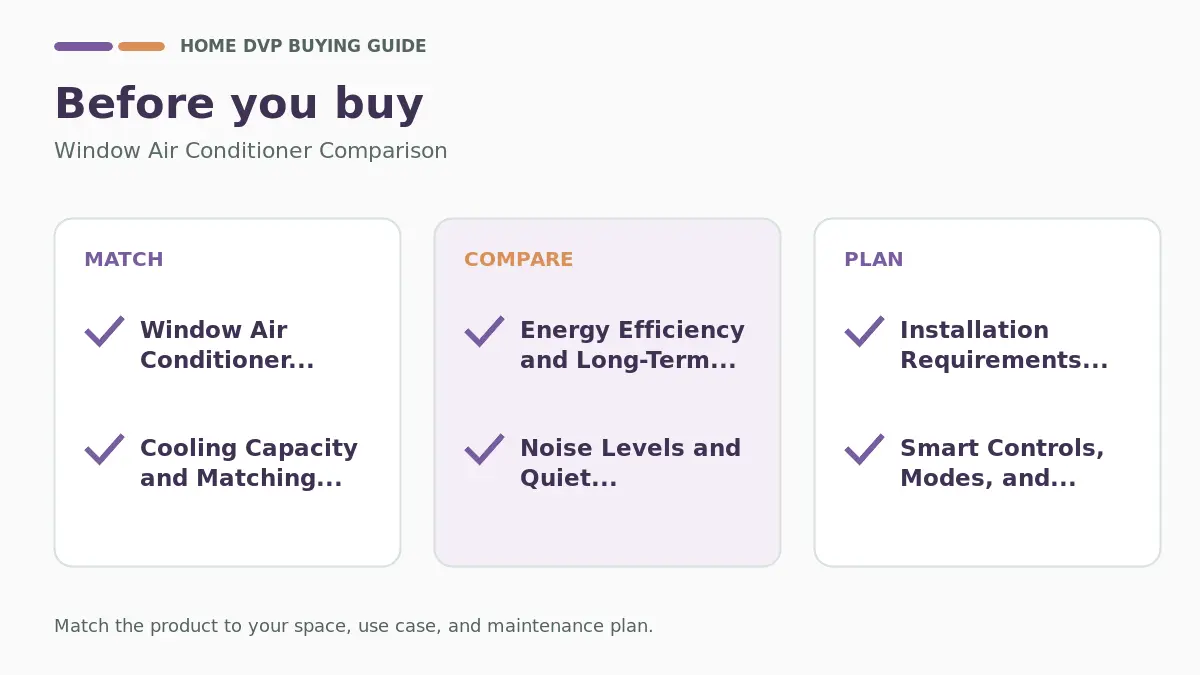
Our Research Methodology & Why You Can Trust Us
At Home DVP we approach every Window Air Conditioner Comparison with a transparent, specification-driven process designed to serve practical homeowners and renters. We begin by collecting detailed product data including BTU capacity, stated square-footage coverage, noise levels where provided, energy-related claims, control options, installation dimensions, filter type, and available modes. We then cross-check these details against typical home use cases such as bedroom cooling, living room comfort, and apartment constraints.
Our evaluation criteria include cooling performance relative to room size, energy efficiency indicators, quiet operation potential, ease of installation and daily use, build and feature completeness, durability signals such as warranty and filter design, safety considerations like secure mounting and auto-restart, overall value within the stated price range, and reliability for DIY or renter installation. We also review user feedback patterns for common praise and complaints when available, while remaining careful not to invent hands-on testing claims.
Category fit is validated against Heating, Cooling & Air needs. Unrelated product types are excluded entirely. We update content regularly during July of 2026 as new specification data becomes available. This methodology emphasizes Experience through real homeowner scenarios, Expertise via detailed feature analysis, Authoritativeness from consistent comparison standards, and Trustworthiness through honest strengths-and-weaknesses discussion and clear suitability guidance. For related cooling topics you can also review our guide to the best mini split ac if permanent or multi-room solutions interest you.
Final Thoughts
After carefully analyzing the available specifications across 15 models, several clear recommendations emerge for different needs. For overall performance and modern features, the Midea 12,000 BTU U Shaped Smart Inverter Window Air Conditioner stands out with its ultra-quiet operation as low as 32 dBA, claimed energy savings exceeding 37 percent, Wi-Fi and voice control, and the ability to keep the window partially open. It suits larger rooms up to 550 square feet and users who want smart home integration and quiet nights.
As a strong value pick for small spaces, the Amazon Basics 5000-BTU Window Air Conditioner offers straightforward cooling for rooms up to 150 square feet, washable filter, adjustable window kit, and quiet enough operation for bedrooms at a budget-friendly point. The GE Window Air Conditioner 5,000 BTU and Midea 5,000 BTU models provide similar small-room reliability with mechanical or electronic controls and easy install kits. For medium rooms the Antarctic Star 8,000 BTU and LG 8,000 BTU units deliver solid multi-mode performance and remote convenience. The Electactic U-Shaped 10,000 BTU option balances full window view, low indoor noise around 45 dB, and versatile modes for rooms up to 450 square feet. Specialty casement needs are addressed by the Perfect Aire 10,000 BTU Casement Window Air Conditioner, which is purpose-built for sliding or crank-out windows.
Choose based on your measured room size, window type, noise tolerance, and desire for smart features rather than brand alone. Measure twice, confirm the installation kit matches your window, and prioritize efficiency if you will run the unit daily. With the right match from this comparison you can stay comfortable all season. If window installation is not feasible, consider options covered in our portable air conditioner not cooling troubleshooting and selection resources for additional guidance. Explore more in the Heating, Cooling & Air category for complementary products.
Frequently Asked Questions
What should I look for when choosing Window Air Conditioner Comparison?
Focus first on BTU capacity matched to your room square footage, then check window dimensions and type for compatibility. Prioritize noise ratings if the unit will be in a bedroom, energy efficiency features such as inverter technology or ENERGY STAR, easy-to-clean filters, and controls that fit your preference for simple dials or app/voice operation. Always verify the included installation kit works with your specific window style.
How should beginners choose Window Air Conditioner Comparison?
Beginners should start by accurately measuring the room and the window opening, then select a unit whose stated coverage matches or slightly exceeds the space. Choose models with clear digital or mechanical controls, included remote, and straightforward installation kits that do not require special tools. Avoid oversizing and look for washable filters and auto-restart for simple ownership. Reading the square-footage guidance on the product listing prevents the most common mistakes.
Are higher-end Window Air Conditioner Comparison worth it?
Higher-end models with inverter compressors, U-shaped quiet designs, or advanced smart controls can be worth the investment if you run the unit many hours per day, value low noise for sleep, or need specialty window fit. The energy savings and comfort improvements often offset the higher purchase price over a couple of seasons. For occasional use in a small room, a well-reviewed mid or entry-level unit usually provides excellent value without extra features you may not need.
How much should homeowners expect from Window Air Conditioner Comparison in 2026?
Homeowners can expect reliable room-specific cooling within the $144.92 – $550.19 range depending on capacity and features. Current models deliver quiet operation options, multi-mode functionality including dehumidify and fan, easy DIY installation for standard windows, and in some cases app or voice control. Proper sizing remains the most important factor for satisfactory performance and efficiency throughout the cooling season.
What brands make reliable Window Air Conditioner Comparison?
Brands represented in this comparison such as AmazonBasics, PerfectAire, AntarcticStar and more along with established names like LG, GE, and Midea consistently appear with solid specification packages for residential use. Reliability comes more from correct capacity matching, proper installation, and regular filter cleaning than from any single brand. Check warranty length and parts support when comparing similar units.
Are Window Air Conditioner Comparison suitable for DIY projects, home repairs, or regular maintenance?
Yes, most modern window air conditioners are designed for straightforward DIY installation by homeowners or renters using the included kits and basic tools such as a screwdriver. Ongoing maintenance is limited mainly to washing the reusable filter every few weeks and ensuring seals remain tight. No professional HVAC license is required for standard window units, making them accessible for regular seasonal home cooling projects. For more permanent solutions, see our coverage of best mini split ac systems.
How long should quality Window Air Conditioner Comparison last?
With proper sizing, correct installation, and consistent filter maintenance, a quality window air conditioner typically provides several seasons of reliable service. Factors such as usage hours, local climate, and protection from debris affect longevity. Units with robust compressors, washable filters, and solid warranties tend to deliver better long-term performance when cared for according to the manufacturer guidelines.


Write Your Review
No reviews yet. Be the first to share your experience!