

For an interconnected home, choose detectors that make every linked alarm sound when one detects danger. Add app alerts only if remote notifications matter, and confirm that each model works with your existing alarms, wiring, network, and smart-home platform. Interconnection does not automatically mean Wi-Fi or app control.
Options here range from battery-powered local networks to hardwired alarms with app notifications and a gateway-based smart system. Product details identify advertised features and listed certifications, but they do not establish compatibility with every home or system.
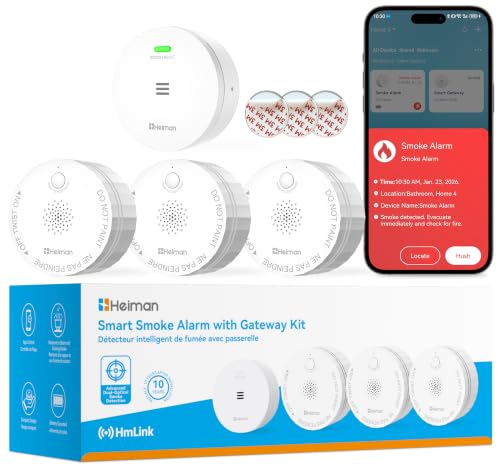
Pros
- Local wireless interconnection can continue without Wi-Fi, allowing linked alarms to trigger together.
- UL 217 10th Edition, CSFM, and FCC certifications provide useful compliance information for safety-focused buyers.
Cons
- Gateway app setup requires a 2.4GHz Wi-Fi network and does not support 5GHz Wi-Fi.
- Remote alerts and smart home automations depend on the gateway, network connection, and compatible ecosystem setup.
Best For / Avoid If
Best for buyers prioritizing
- Local wireless interconnection can continue without Wi-Fi, allowing linked alarms to trigger together.
- UL 217 10th Edition, CSFM, and FCC certifications provide useful compliance information for safety-focused buyers.
- Compact white housings measure 2.75 by 2.75 by 1.45 inches and weigh 0.22 pounds each according to the listed specifications.
Consider another option if
- Gateway app setup requires a 2.4GHz Wi-Fi network and does not support 5GHz Wi-Fi.
- Remote alerts and smart home automations depend on the gateway, network connection, and compatible ecosystem setup.
- The package includes three smoke detectors, so larger homes or multi-story properties may need additional compatible units.

Pros
- Combines smoke and CO detection with voice alerts in a single hardwired device
- Supports whole-home mobile connectivity through one smart alarm addition
Cons
- Smart app features require a stable 2.4 GHz Wi-Fi network
- Hardwired installation may need basic electrical knowledge or professional help for some users
Specifications
| Brand | Kidde |
|---|---|
| Style | Smart Smoke & Carbon Monoxide Detector |
| Power Source | Corded Electric |
| Color | White |
| Product Dimensions | 2"D x 5"W x 5"H |
| Item Weight | 1.31 Pounds |
| Alarm | Audible |
| Operating Humidity | 10 to 95% relative humidity (RH), non-condensing |
| Upper Temperature Rating | 100 Degrees Fahrenheit |
| Sensor Type | Photoelectric, Electrochemical |
Verify the current product variation before purchase; specifications may change.
Best For / Avoid If
Best for buyers prioritizing
- Combines smoke and CO detection with voice alerts in a single hardwired device
- Supports whole-home mobile connectivity through one smart alarm addition
- Enables remote silencing of false alarms directly from a smartphone
Consider another option if
- Smart app features require a stable 2.4 GHz Wi-Fi network
- Hardwired installation may need basic electrical knowledge or professional help for some users
- Full interconnected alerts depend on integrating at least one smart unit into the system

Pros
- Combines local whole-home alarm interconnection with optional remote notifications through one gateway.
- Long-life battery operation can reduce ongoing maintenance compared with alarms that require frequent battery changes.
Cons
- Gateway setup requires a 2.4GHz Wi-Fi network and is not compatible with 5GHz Wi-Fi.
- Smart home integrations require compatible hub or ecosystem setup, which may add configuration steps.
Specifications
| Color | White |
|---|---|
| Size | 1 + 6-Pack |
| Dimensions | 2.75 x 2.75 x 1.45 Inches |
| Weight | 0.22 Pounds |
| Product Group | Home Improvement |
Verify the current product variation before purchase; specifications may change.
Best For / Avoid If
Best for buyers prioritizing
- Combines local whole-home alarm interconnection with optional remote notifications through one gateway.
- Long-life battery operation can reduce ongoing maintenance compared with alarms that require frequent battery changes.
- UL 217 10th Edition, CSFM, and FCC certifications are listed in the product information.
Consider another option if
- Gateway setup requires a 2.4GHz Wi-Fi network and is not compatible with 5GHz Wi-Fi.
- Smart home integrations require compatible hub or ecosystem setup, which may add configuration steps.
- The six-detector package may provide more units than needed for smaller homes or limited spaces.

Pros
- Combines smoke and CO sensing with mobile alerts that need no subscription for basic use
- Battery operation and included cells allow quick setup without electrical work
Cons
- Continuous 24/7 professional monitoring requires an optional Ring subscription sold separately
- Battery-powered design means users must plan for periodic AA replacements
Specifications
| Brand | Kidde |
|---|---|
| Style | Smoke & Carbon Monoxide Detector |
| Power Source | Battery Powered |
| Color | White |
| Product Dimensions | 2"D x 5"W x 5"H |
| Alarm | Audible |
| Operating Humidity | 10 to 95% relative humidity (RH), non-condensing |
| Upper Temperature Rating | 100 Degrees Fahrenheit |
| Sensor Type | Photoelectric, Electrochemical |
| Material | Plastic |
Verify the current product variation before purchase; specifications may change.
Best For / Avoid If
Best for buyers prioritizing
- Combines smoke and CO sensing with mobile alerts that need no subscription for basic use
- Battery operation and included cells allow quick setup without electrical work
- Wire-free whole-home connectivity links multiple units for coordinated alarms
Consider another option if
- Continuous 24/7 professional monitoring requires an optional Ring subscription sold separately
- Battery-powered design means users must plan for periodic AA replacements
- Full interconnectivity setup may require consulting the user guide for best results
Pros
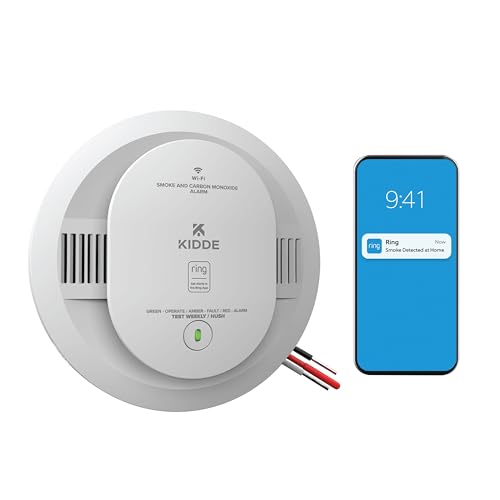
- Provides dual smoke and carbon monoxide detection in a single unit.
- Offers remote Ring notifications for smoke, CO, and low-battery conditions.
Cons
- Advanced 24/7 Ring monitoring requires a separately sold subscription.
- Hardwired installation and whole-home connectivity may require careful setup and consultation of the user guide.
Specifications
| Color | White |
|---|---|
| Size | 5 Inches |
| Dimensions | 2 x 5 x 5 inches |
| Weight | 1.2 pounds |
| Product Group | Home Improvement |
| Binding | Tools & Home Improvement |
Verify the current product variation before purchase; specifications may change.
Best For / Avoid If
Best for buyers prioritizing
- Provides dual smoke and carbon monoxide detection in a single unit.
- Offers remote Ring notifications for smoke, CO, and low-battery conditions.
- Supports whole-home alerts for connected hardwired alarms after adding one Kidde smart detector.
Consider another option if
- Advanced 24/7 Ring monitoring requires a separately sold subscription.
- Hardwired installation and whole-home connectivity may require careful setup and consultation of the user guide.

Pros
- Wireless RF interconnection links all units so one alarm activates the rest across the home
- 10-year sealed battery design limits ongoing maintenance for long-term use
Cons
- Lacks Wi-Fi support so remote smartphone monitoring is unavailable
- No LCD display means status relies on LEDs instead of detailed numerical readouts
Best For / Avoid If
Best for buyers prioritizing
- Wireless RF interconnection links all units so one alarm activates the rest across the home
- 10-year sealed battery design limits ongoing maintenance for long-term use
- Straightforward mounting process works for renters and owners without hardwiring needs
Consider another option if
- Lacks Wi-Fi support so remote smartphone monitoring is unavailable
- No LCD display means status relies on LEDs instead of detailed numerical readouts
- Sealed battery requires full unit replacement once the 10-year life ends

Pros
- Dual smoke and carbon monoxide sensing in certified combination units.
- Long-life sealed battery minimizes ongoing maintenance for a decade.
Cons
- Sealed battery requires full unit replacement after the 10-year period rather than a simple swap.
- Wireless interconnection effectiveness depends on proper unit placement and signal range in larger homes.
Best For / Avoid If
Best for buyers prioritizing
- Dual smoke and carbon monoxide sensing in certified combination units.
- Long-life sealed battery minimizes ongoing maintenance for a decade.
- RF wireless linking creates system-wide warnings without extra cables.
Consider another option if
- Sealed battery requires full unit replacement after the 10-year period rather than a simple swap.
- Wireless interconnection effectiveness depends on proper unit placement and signal range in larger homes.
- Users preferring hardwired power or advanced smart features may need different models.

Pros
- Maintenance-free operation from the 10-year sealed battery
- Simultaneous sounding of all linked units for faster whole-home response
Cons
- Supports wireless RF interconnection only and does not include Wi-Fi for remote app monitoring
- The 6-pack size may exceed requirements for smaller single-story homes
Best For / Avoid If
Best for buyers prioritizing
- Maintenance-free operation from the 10-year sealed battery
- Simultaneous sounding of all linked units for faster whole-home response
- Dual photoelectric smoke and electrochemical CO detection capabilities
Consider another option if
- Supports wireless RF interconnection only and does not include Wi-Fi for remote app monitoring
- The 6-pack size may exceed requirements for smaller single-story homes
- First-time users may need extra care placing units to maintain reliable interconnection range

Pros
- Combines photoelectric smoke sensing with electrochemical carbon monoxide detection.
- Provides audible voice warnings that distinguish fire from carbon monoxide alerts.
Cons
- The hardwired design may be less convenient for buyers without an existing compatible AC alarm setup.
- Interconnection is useful for broader coverage, but connecting multiple units may require additional setup.
Specifications
| Size | 5 PACK |
|---|---|
| Dimensions | 6.1 x 6.1 x 1.7 inches |
| Weight | 0.6 pounds |
| Product Group | Home Improvement |
Verify the current product variation before purchase; specifications may change.
Best For / Avoid If
Best for buyers prioritizing
- Combines photoelectric smoke sensing with electrochemical carbon monoxide detection.
- Provides audible voice warnings that distinguish fire from carbon monoxide alerts.
- Offers continuous AC-powered monitoring with replaceable battery backup.
Consider another option if
- The hardwired design may be less convenient for buyers without an existing compatible AC alarm setup.
- Interconnection is useful for broader coverage, but connecting multiple units may require additional setup.
- The listed dimensions may be less suitable for spaces where a more compact detector is preferred.

Pros
- Combines hardwired power, AA backup, interconnected operation, and app-based notifications.
- Provides smoke detection described as three times more precise, along with reduced nuisance alarms.
Cons
- Wi-Fi setup requires a compatible 2.4 GHz network.
- Remote whole-home alerts require adding at least one Kidde smart alarm to the hardwired alarm system.
Specifications
| Color | White |
|---|---|
| Size | 5 Inches |
| Dimensions | 2 x 5 x 5 inches |
| Weight | 1.21 pounds |
| Product Group | Home Improvement |
| Binding | Tools & Home Improvement |
Verify the current product variation before purchase; specifications may change.
Best For / Avoid If
Best for buyers prioritizing
- Combines hardwired power, AA backup, interconnected operation, and app-based notifications.
- Provides smoke detection described as three times more precise, along with reduced nuisance alarms.
- Includes testing, hush control, low-battery alerts, and an automatic end-of-life reminder.
Consider another option if
- Wi-Fi setup requires a compatible 2.4 GHz network.
- Remote whole-home alerts require adding at least one Kidde smart alarm to the hardwired alarm system.
- The 5-inch size and 1.21-pound weight may require careful placement where existing alarm space is limited.
Compare the main system types
| System type | What it offers | What to confirm |
|---|---|---|
| Wireless local interconnection | Linked alarms sound together without relying on Wi-Fi. Some models use sealed batteries. | Confirm the exact models can join the same network and check maximum network size. Local interconnection alone does not provide phone alerts. |
| Gateway-based smart system | A gateway can add remote notifications and smart-home integrations to compatible alarms. | Check required app, 2.4 GHz Wi-Fi support, gateway setup, and compatibility with your specific platform. |
| Hardwired interconnected alarms | Uses home wiring, with some models offering battery backup or app notifications. | Confirm wiring and interconnection compatibility against product documentation. Do not assume one brand or model works with existing wiring or alarms. |
How the listed options differ
These products do not all solve the same problem. X-Sense SC06-W and SC07-W provide wireless alarm-to-alarm interconnection, but their product details explicitly say they do not have Wi-Fi. Heiman bundles a gateway for app notifications, while the listed Kidde models focus on app alerts through Ring or Kidde and include hardwired and battery-powered variants. SITERLINK is a hardwired smoke and carbon monoxide alarm with battery backup.
Product claims such as faster detection, nuisance-alarm reduction, or sensor performance are manufacturer-provided claims, not independent comparative findings.
Gateway-based system: Heiman
Heiman Smart Smoke Detector pairs three smoke alarms with a gateway; the six-alarm kit is also listed. The product details describe local wireless interconnection without Wi-Fi and app or email alerts when paired with the gateway over 2.4 GHz Wi-Fi. They list integration with Home Assistant, IFTTT, Google Home, and SmartThings, with compatible setup required. The detector is smoke-only, so it does not replace a carbon monoxide alarm where one is needed.
Pros: Local alarm interconnection, gateway-based remote alerts, listed smart-home integrations, and a stated 10-year battery. The six-pack listing says up to 24 detectors can be grouped.
Cons: Remote alerts require gateway and network setup, and the gateway requires 2.4 GHz Wi-Fi, not 5 GHz. It detects smoke, not carbon monoxide. Confirm platform and local-code compatibility before purchase.
Who should skip it: Anyone needing a combination smoke and CO alarm, or unwilling to configure a separate gateway.
Wireless local interconnection: X-Sense
X-Sense Interconnected Smoke and CO Detector models SC06-W and SC07-W offer wireless interconnection and sealed 10-year batteries, but no Wi-Fi. The SC07-W details specify photoelectric smoke and electrochemical CO sensors, support for up to 18 X-Sense alarms, and a stated range of up to 820 feet. Treat that range as a product specification, not a guarantee for every building. The SC06-W also combines smoke and CO detection and lists UL 217 and UL 2034 certification.
Pros: Multiple linked alarms sound together, no rewiring is required, and sealed batteries avoid routine battery replacement during the stated battery life. Both models are described as smoke-and-CO alarms.
Cons: These models do not provide Wi-Fi or remote phone alerts. The SC07-W network limit applies to X-Sense alarms, not automatically to other brands.
Who should skip them: Anyone whose priority is app notifications or integration with a smart-home platform.
App notifications: Kidde
The Kidde Smart Smoke and Carbon Monoxide Detector uses AA batteries and offers Ring app notifications plus wire-free interconnection with compatible Kidde alarms, according to the listing. Its product details say a subscription is not required for app notifications; optional Ring monitoring is a separate paid service. Two hardwired Kidde app-enabled models are also listed, one for smoke and one for smoke and CO. Their descriptions say one smart alarm can provide mobile alerts for every hardwired alarm in the home, but instruct buyers to check the user guide.
Pros: The battery-powered combination model needs no wiring and lists Ring app alerts for smoke, CO, and low battery. Hardwired variants offer app notifications and battery backup is specified for the combination model.
Cons: App and interconnection details depend on the exact model and compatible Kidde alarms. The smoke-only hardwired model does not detect CO. Optional Ring monitoring costs extra; do not confuse it with the included app notifications.
Who should skip them: Anyone who needs verified compatibility with an existing non-Kidde alarm network or does not want to rely on the listed app ecosystem.
Hardwired combination alarm: SITERLINK
SITERLINK Hardwired Smoke and Carbon Monoxide is a hardwired combination alarm with replaceable AA battery backup. Its listing describes interconnection for up to 18 units and spoken alerts identifying fire or carbon monoxide. No app or Wi-Fi feature is listed in the product details, so do not treat it as a remote-notification system.
Pros: Smoke and CO detection, battery backup, and voice alerts are specified. The listing describes linking up to 18 units.
Cons: Hardwired installation requires compatible existing wiring. Published details do not identify app alerts or provide certification information for this listing.
Who should skip it: Anyone seeking a battery-only installation or remote phone alerts, or unable to confirm wiring compatibility.
Buying checklist
- Choose the alert path: Decide whether local alarms sounding together are enough, or whether you also need phone alerts away from home.
- Check power and wiring: Separate sealed-battery and replaceable-battery models from hardwired models. For hardwired replacements, confirm exact-model wiring and interconnection requirements before installation.
- Confirm smoke and CO coverage: Some products detect smoke only; others combine smoke and carbon monoxide. Check which hazards existing alarms cover.
- Verify ecosystem requirements: Check app, gateway, Wi-Fi band, subscription, and compatible-alarm requirements. A shared brand name does not by itself prove compatibility.
- Review certification and local rules: Match the exact model’s certification markings and installation instructions to applicable local requirements. Product listings cite UL standards for some models, but requirements vary by location.
- Plan placement and maintenance: Follow the alarm’s manual and local requirements for location, testing, and end-of-life replacement. See smoke detector placement by room.
Safety note
Smoke and carbon monoxide alarms are life-safety devices. Do not disable required alarms or rely on phone alerts as a substitute for audible local alarms. Follow product instructions and local codes. Have a qualified professional assess hardwired compatibility or installation when uncertain.
Choosing a suitable setup
Choose Heiman if gateway-based alerts and its listed platform integrations fit your network. Choose X-Sense if local wireless interconnection and sealed batteries matter more than Wi-Fi. Consider Kidde when its specific Ring or Kidde app features match your existing setup. Consider SITERLINK only after confirming hardwired compatibility. Before ordering, compare model instructions with existing alarms, wiring, required hazard coverage, and local rules.