
Choosing the best Carbon Dioxide Monitor For Home matters more than many homeowners realize. Carbon dioxide levels can rise in bedrooms, home offices, nurseries, classrooms, basements, apartments, and tightly sealed energy-efficient homes, especially when ventilation is limited. A good CO2 monitor does not clean the air by itself, but it gives you the information needed to open windows, adjust HVAC settings, run ventilation fans, or improve overall indoor air management.
After carefully analyzing the available specifications for 15 products, we narrowed our practical discussion to models that clearly match the Air Quality & Climate category and actually monitor carbon dioxide rather than a different household gas. We compared sensor technology, display readability, alerts, power options, app support, data history, portability, and everyday home usability. If you are upgrading your broader indoor air setup, you may also find our guide to HVAC filters for home air quality useful alongside a CO2 monitor.
Home DVP decision summary
Quick Answer
For Best Carbon Dioxide Monitor For Home, Home DVP compared 15 products from 6 brands. Favor a true NDIR sensor, documented calibration behavior, readable alerts, and useful history or logging. A home carbon dioxide monitor is a ventilation indicator, not a substitute for a carbon monoxide alarm.
| Comparison coverage | 15 products from 6 brands, including Aranet, SwitchBot, FirstAlert. |
|---|---|
| Selection priority | Favor a true NDIR sensor, documented calibration behavior, readable alerts, and useful history or logging. A home carbon dioxide monitor is a ventilation indicator, not a substitute for a carbon monoxide alarm. |
| Evidence basis | Manufacturer specifications, compatibility details, retailer-provided product data, and common homeowner use cases. |
| Reference guidance | EPA indoor-air and combustion guidance. |
This summary describes the article's comparison set, not every product on the market. Product details should be confirmed before purchase.
Based on our detailed comparison, the strongest choices for carbon dioxide tracking are models with clear CO2 readouts, reliable NDIR or advanced CO2 sensing, practical alerts, and placement flexibility. The available product set spans $23.99–$189, with options from FirstAlert, Aranet, Temtop, SwitchBot, GoveeLife, Kidde, so renters, homeowners, smart home users, and work-from-home households can choose based on how much data and automation they need.

Pros
- Long battery life minimizes the need for frequent power maintenance
- App provides clear historical graphs for understanding air quality patterns
- Portable wireless design works across multiple indoor environments
- NDIR sensor offers precise CO2 detection without external calibration tools
Cons
- Historical data viewing requires a smartphone and app connection
- No built-in smart home platform integration listed in product details
- Optional buzzer may need manual activation depending on user preference
The Aranet4 Home functions as a portable wireless monitor suited for homeowners, renters, and facility managers who want ongoing visibility into indoor conditions across living spaces, workspaces, or classrooms.
Its nondispersive infrared sensor measures carbon dioxide in real time while also capturing temperature, relative humidity, and atmospheric pressure, allowing users to respond quickly to changes that affect comfort and focus.
The e-ink screen remains easy to read without constant power draw, and the unit operates without cords for extended periods thanks to its efficient design and long-lasting battery.
In daily use the color-coded display and optional audible alert notify occupants when CO2 levels rise, while the companion application organizes up to 90 days of readings into graphs that reveal ventilation patterns over time.
Limitations include the requirement for a smartphone to access full historical records and the absence of direct compatibility with major smart home ecosystems based on listed specifications, making it best for those who prefer standalone monitoring.
Buyers seeking straightforward, accurate air quality data without complex setup will find this device practical, whereas those needing automated integration with other home systems may prefer alternatives with broader connectivity options.
Best Carbon Dioxide Monitor For Home Buying Guide
Before choosing the best carbon dioxide monitor for home, it helps to understand the difference between basic household gas alarms and indoor air quality monitors. For this guide, we focused our recommendations on products that measure carbon dioxide levels for ventilation awareness. The most relevant models from the available data are the Aranet4 Home, SwitchBot CO2 Detector, and GoveeLife Smart Air Quality Monitor CO2 Detector H5140.
| Model | Best Fit | Key Strength | Potential Limitation |
|---|---|---|---|
| Aranet4 Home | Homeowners who want a premium portable CO2 monitor | NDIR sensing, e-ink display, long battery life, and app-based history | Higher-end option in the category |
| SwitchBot CO2 Detector | Smart home users and everyday room monitoring | Large display, app alerts, Swiss-made NDIR sensor, and portable design | Some app notification features may require a compatible hub |
| GoveeLife Smart Air Quality Monitor CO2 Detector H5140 | Continuous bedroom, office, or nursery monitoring | Fast refresh rate, app tracking, smart assistant support, and outlet power | Requires AC power, so it is less travel-friendly |
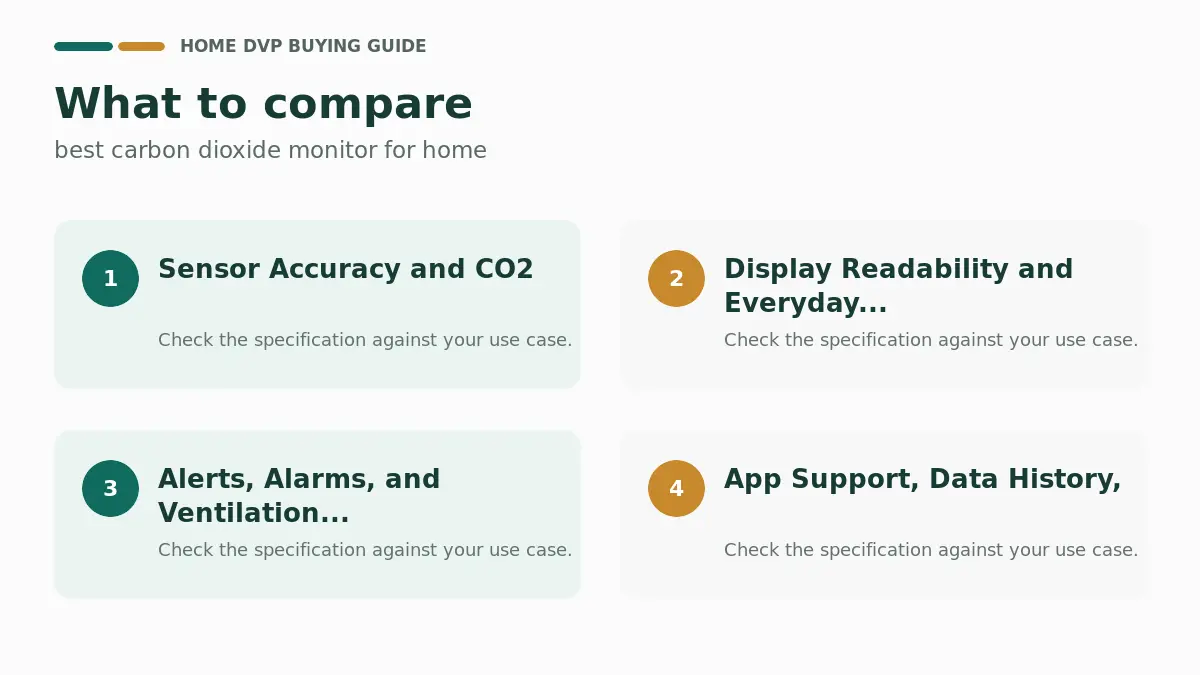
Sensor Accuracy and CO2 Measurement Technology
The most important feature in best carbon dioxide monitor for home is the sensor. Carbon dioxide monitors are commonly purchased to help identify stale indoor air, poor ventilation, or crowded-room buildup, so the reading should be easy to interpret and based on dependable sensing technology. In the available product data, the Aranet4 Home uses nondispersive infrared sensor technology, while the SwitchBot CO2 Detector lists a Swiss-made NDIR sensor and the GoveeLife H5140 uses a CO2 sensor based on a photoacoustic NDIR principle.
For homeowners, the practical takeaway is simple: prioritize models that specifically list CO2 measurement and give a real-time or frequently refreshed reading. Avoid assuming that every wall alarm or plug-in safety device tracks carbon dioxide. Some home safety devices are designed for other gases, and those are important for safety, but they do not replace a dedicated CO2 monitor for ventilation decisions.
A common mistake is buying a device because the name looks similar to what you need. Carbon dioxide and other household gas hazards are not the same measurement category. If your goal is to know when to ventilate a bedroom, home office, classroom, or greenhouse, choose a unit that clearly displays CO2 concentration and supports indoor air quality monitoring.
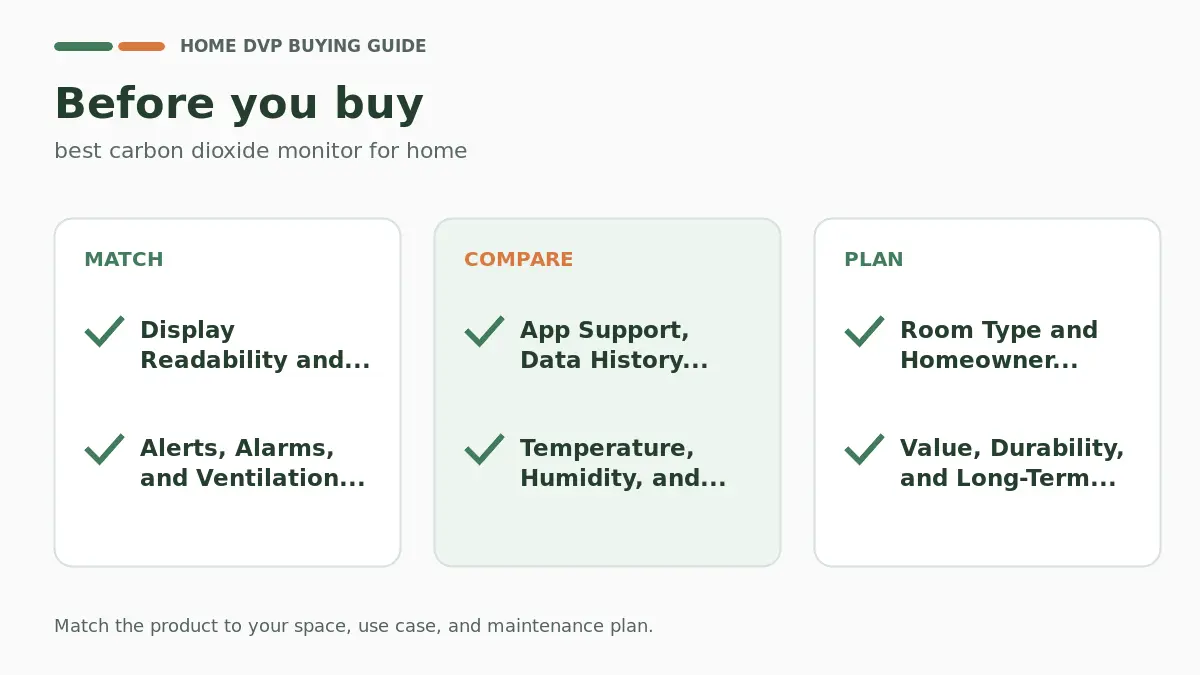
Display Readability and Everyday Use
A CO2 monitor is most useful when the reading is visible at a glance. The Aranet4 Home uses an e-ink screen with color-coded guidance and a prominent CO2 number, which is helpful for desks, nightstands, and classrooms where you do not want a bright screen running constantly. The SwitchBot CO2 Detector emphasizes a large multi-function display that shows CO2, temperature, humidity, time, date, and comfort level. The GoveeLife H5140 offers a display with CO2, temperature, humidity, and clock information.
Think about where the monitor will live. A bedroom monitor should be easy to read without creating distracting light at night. A home office monitor should show enough information to help you decide when to open a window or run a fan. A family room or nursery model should make alerts obvious without requiring constant app checking.
If you are already tuning your home comfort setup, display visibility pairs well with airflow improvements. For example, a CO2 monitor can tell you when air feels stale, while an air circulator fan may help move air within a room once you have a ventilation source.
Alerts, Alarms, and Ventilation Reminders
Alerts are one of the biggest differences between basic readout devices and more practical home monitors. The Aranet4 Home includes color coding and an optional buzzer to warn when CO2 concentration becomes too high. The SwitchBot CO2 Detector offers sound alerts, visual screen alerts, and app notifications when configured with the appropriate setup. The GoveeLife H5140 provides a triple alert system with buzzer, app notifications, and email reports when CO2, temperature, or humidity exceeds custom thresholds.
For most homes, customizable thresholds are more useful than a simple static display. A remote worker may want a prompt before afternoon drowsiness sets in. Parents may want notifications for a nursery or playroom. Someone monitoring a basement, workshop, or small apartment may prefer a louder local alarm because the monitor might not always be within view.
The main buying advice is to choose alerts that match your habits. If you rarely check apps, prioritize a visible display and audible alert. If you manage your home through smart devices, app notifications and history charts may be more valuable than a standalone beeper.
Power Source, Portability, and Placement
Power source affects how you will use the best carbon dioxide monitor for home day to day. The Aranet4 Home is battery powered and designed for cable-free use, with an e-ink display that supports extended battery life. The SwitchBot CO2 Detector is also portable, includes a built-in battery, and can be placed on a surface or mounted. The GoveeLife H5140 is designed for continuous outlet power, which is ideal for fixed monitoring but less convenient if you want to move it from room to room.
Renters often benefit from portable monitors because they can move them between a bedroom, office, and living area without installation. Homeowners may prefer a fixed monitor in the room where they spend the most time, then use the data to make decisions about HVAC scheduling, air exchange, and ventilation habits. If you are optimizing heating and cooling comfort too, see our guide to smart thermostats for ideas on coordinating comfort settings with indoor air observations.
Placement also matters. Avoid putting the monitor directly beside an open window, fan, air vent, or breathing zone where readings may swing unusually high or low. A stable location at normal room height usually gives more useful trend data than constantly moving the monitor every few minutes.
App Support, Data History, and Smart Home Features
App support can turn a CO2 monitor from a simple number display into a planning tool. The Aranet4 Home app provides historical data and graphs, which is useful for identifying patterns during sleep, work hours, or family gatherings. The SwitchBot CO2 Detector supports app control and notifications, with some alert functions tied to a compatible hub. The GoveeLife H5140 offers long-term data tracking, exportable reports, and voice assistant compatibility.
Data history is especially helpful if you are trying to solve a recurring comfort issue. For example, if a home office feels stuffy every afternoon, a graph can show whether CO2 rises at the same time each day. In a bedroom, overnight data may reveal whether the room needs better ventilation before sleep or during early morning hours.
Smart home buyers should look beyond the app screenshot and check what functions work locally, what requires a hub, and whether voice assistant support is informational or can trigger useful routines. A monitor that only reports data may still be valuable, but a monitor that integrates with fans or other devices can make indoor air management easier.
Temperature, Humidity, and Whole-Room Comfort
Many homeowners shopping for the best carbon dioxide monitor for home also care about temperature and humidity because those conditions affect comfort, sleep, and perceived air quality. The Aranet4 Home measures CO2, temperature, relative humidity, and atmospheric pressure. The SwitchBot CO2 Detector shows CO2, temperature, humidity, and comfort level. The GoveeLife H5140 combines CO2 readings with temperature and humidity data on its display and in the app.
This multi-sensor design is useful because stale air is rarely the only issue in a room. A bedroom may have acceptable CO2 but uncomfortable humidity. A home office may have rising CO2 and warm temperatures after several hours with the door closed. A nursery may require more careful temperature and humidity awareness along with ventilation monitoring.
If your home has dry winter air or inconsistent humidity, a CO2 monitor can be part of a broader comfort strategy. Our guide to whole house humidifiers may help if humidity control is also a priority.
Room Type and Homeowner Use Case
The right monitor depends on the room. For a bedroom, a dimmable or low-glare display, quiet operation, and reliable overnight data are valuable. For a home office, a large screen and quick refresh rate may matter more because you want to react during the workday. For a classroom, shared office, or family room, color coding and audible alerts help multiple people understand when ventilation is needed.
The Aranet4 Home is a strong fit for users who want premium portability and long battery life. The SwitchBot CO2 Detector makes sense for smart home users who want a large screen and notification options. The GoveeLife H5140 is well suited to fixed, continuous monitoring in a room where outlet power is available and long-term app data matters.
Do not overspend on features you will not use. If you only need a simple ventilation cue in one room, a clear display and dependable sensor may be enough. If you want to analyze patterns, export data, or connect with a broader smart home setup, a more connected model can justify the upgrade.
Value, Durability, and Long-Term Ownership
Value is not just the lowest cost in $23.99–$189. It is the combination of reliable readings, useful alerts, practical power design, readable display, and features you will actually use. A portable monitor with long battery life may deliver better value for renters or teachers, while a plug-in smart monitor may be better for homeowners who want continuous room data without battery maintenance.
Durability also includes software support, battery expectations, calibration process, and whether the unit can be placed securely where it will not be knocked over. Based on available product information, the Aranet4 Home emphasizes premium build quality and European Union manufacturing, the SwitchBot model highlights a compact portable body with mounting options, and the GoveeLife model focuses on uninterrupted power and long-term data tracking.
For regular home maintenance, treat a CO2 monitor like a diagnostic tool. Use it to identify ventilation patterns, then pair those insights with air filtration, airflow, and humidity improvements. You can browse more related guides in our Air Quality & Climate category.
Our Research Methodology & Why You Can Trust Us
After comparing the listed specifications, we evaluated each product for category fit before making recommendations. Because the target is best carbon dioxide monitor for home, we only discussed products that clearly measure carbon dioxide for indoor air quality or ventilation awareness. Products that monitor a different household gas may be important safety devices, but they were not treated as direct recommendations for this guide.
Our research indicates that the most useful CO2 monitors for homeowners combine dependable sensing technology, clear displays, practical alerts, sensible power options, and room-friendly placement. We reviewed available product information for performance, features, build quality, ease of use, durability, safety-related alerts, value, reliability, and fit for common homeowner or renter use cases.
We also considered how each monitor would fit into real household routines, such as working from home, improving bedroom ventilation, managing nursery comfort, monitoring shared spaces, or tracking indoor air trends over time. This guide is updated during July to keep the buying advice aligned with current product data and the needs of practical home improvement shoppers.
We do not claim physical testing where the product data does not support it. Instead, this comparison is based on available product specifications, manufacturer-stated features, user-facing design details, and category-specific analysis. That approach helps keep the recommendations transparent and avoids overstating what can be concluded from the available information.
Final Thoughts
For most shoppers looking for the best carbon dioxide monitor for home, the Aranet4 Home stands out as the premium pick because it combines NDIR CO2 monitoring, an easy-to-read e-ink display, app-based history, portability, and long battery life. It is especially appealing for homeowners, teachers, and remote workers who want a dedicated carbon dioxide monitor that can move between rooms without relying on an outlet.
The SwitchBot CO2 Detector is a strong homeowner and smart home pick thanks to its large display, Swiss-made NDIR sensor, portable design, and multiple alert options. It is a practical fit for living rooms, offices, bedrooms, and greenhouse spaces where you want quick visual feedback plus app-based awareness.
The GoveeLife Smart Air Quality Monitor CO2 Detector H5140 is the best fixed-room option from the valid product data. Its outlet-powered design, fast refresh rate, app tracking, exportable data, and smart assistant support make it a good choice for bedrooms, offices, nurseries, and kitchens where continuous monitoring is more important than portability. For a fuller indoor air strategy, consider pairing CO2 awareness with filtration, airflow, and humidity improvements across your home.
FAQ
What should I look for when choosing the best carbon dioxide monitor for home?
Look for a monitor that clearly measures carbon dioxide, uses dependable CO2 sensing technology, and provides a readable display. Alerts, app history, battery life, and placement flexibility are also important depending on whether you need it for a bedroom, office, nursery, or shared living space.
Are higher-end carbon dioxide monitor for home worth it?
Higher-end models can be worth it if you want better data history, premium display design, longer battery life, or stronger app support. If you only need a simple reminder to ventilate one room, a more basic CO2 monitor with a clear display may be enough.
Where should I place a carbon dioxide monitor at home?
Place it in the room where you spend the most time, such as a bedroom, office, classroom, or living area. Keep it away from open windows, direct vents, fans, and spots where someone breathes directly onto the sensor, because those locations can distort readings.
Do the best carbon dioxide monitor for home improve indoor air quality by themselves?
No, a CO2 monitor measures conditions but does not remove carbon dioxide. It helps you decide when to ventilate, adjust airflow, or improve your HVAC habits. For broader air quality upgrades, our HVAC filter guide can help with filtration decisions.
About This Home DVP Research
Home DVP is an independent home-improvement research and product-comparison publisher. Ryan Mitchell prepared this guide by comparing manufacturer specifications, compatibility details, retailer-provided product data, key limitations, and common homeowner use cases. We do not claim hands-on testing unless an article explicitly says so.
Review methodology Affiliate disclosure Last reviewed September 10, 2026