A compact reciprocating saw can reach between framing members, beneath sinks, inside cabinets, and around pipes where a conventional full-size saw is difficult to position. However, the word “compact” is not standardized. Some models are genuinely short, while others are simply more maneuverable than older full-size designs. Choosing best compact reciprocating saw for tight spaces therefore requires looking beyond the label to stroke length, speed control, battery placement, shoe design, and the space needed to insert a blade.
After carefully analyzing the available specifications for 4 listed products, we found that not every entry fits the same category. Three are cordless reciprocating saws, while one is a manually operated hacksaw. The manual tool may fit confined areas, but it is not a reciprocating saw and is excluded from our powered-saw recommendations. We compared the valid saws by documented cutting specifications, handling features, battery compatibility, blade-change design, work-area visibility, and suitability for common DIY repairs.
The clearest overall choice from the documented feature sets is the DEWALT model for buyers prioritizing a brushless motor, a longer stroke, a pivoting shoe, and an onboard light. The CRAFTSMAN is the more clearly documented choice for shoppers who want a stated overall length and variable-speed control. The RYOBI may appeal to existing ONE+ battery owners, but the published information is too limited for an equally confident feature-by-feature recommendation.
Product Listings
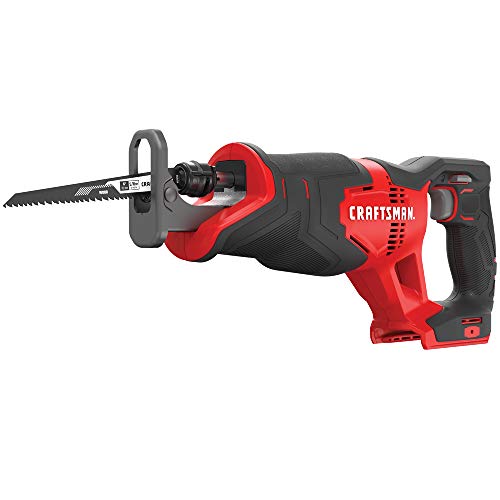
Pros
- Adjustable trigger control provides more flexibility than a single-speed design.
- Compact form can be useful for cutting tasks where workspace is limited.
Cons
- The package does not include a battery or charger, which adds a separate setup requirement.
- VERSATRACK storage requires separately sold clips and accessories.
Best For / Avoid If
Best for buyers prioritizing
- Adjustable trigger control provides more flexibility than a single-speed design.
- Compact form can be useful for cutting tasks where workspace is limited.
- The tool-free blade release makes blade changes straightforward.
Consider another option if
- The package does not include a battery or charger, which adds a separate setup requirement.
- VERSATRACK storage requires separately sold clips and accessories.
- Users outside the CRAFTSMAN V20 system may need to purchase additional battery equipment.

Pros
- Brushless motor provides a practical power-focused design for recurring cutting jobs.
- Variable trigger and pivoting shoe support controlled, steadier operation.
Cons
- The tool-only package does not include a battery, so new users need a compatible battery separately.
- Reciprocating saws can require careful handling when making controlled cuts in smaller or more delicate workpieces.
Best For / Avoid If
Best for buyers prioritizing
- Brushless motor provides a practical power-focused design for recurring cutting jobs.
- Variable trigger and pivoting shoe support controlled, steadier operation.
- Compatible with DEWALT 20V MAX and FLEXVOLT batteries already in the user's tool collection.
Consider another option if
- The tool-only package does not include a battery, so new users need a compatible battery separately.
- Reciprocating saws can require careful handling when making controlled cuts in smaller or more delicate workpieces.
- The listed one-size format may not provide the specialized configuration some advanced users prefer for specific cutting applications.

Pros
- Portable cordless format for working without a power cord
- Variable-speed operation provides adjustable cutting control
Cons
- Battery and charger are not included, so users without a compatible battery will need additional equipment.
- The published specifications do not identify included blades, accessories, or specialized cutting features.
Best For / Avoid If
Best for buyers prioritizing
- Portable cordless format for working without a power cord
- Variable-speed operation provides adjustable cutting control
- Manageable listed weight and compact dimensions for storage and handling
Consider another option if
- Battery and charger are not included, so users without a compatible battery will need additional equipment.
- The published specifications do not identify included blades, accessories, or specialized cutting features.

Pros
- Compact 10-inch format is practical for confined cutting areas.
- Blade changes do not require a separate tool.
Cons
- The compact format may not suit users who prefer a larger saw for broader cutting tasks.
- The package information lists one included blade, so additional blade needs may depend on the project.
Specifications
| Color | Red/Black |
|---|---|
| Size | 10 inches |
| Dimensions | 14.5 x 4.7 x 2.1 inches |
| Weight | 0.50044933474 pounds |
| Product Group | Tools |
| Binding | Tools & Home Improvement |
Verify the current product variation before purchase; specifications may change.
Best For / Avoid If
Best for buyers prioritizing
- Compact 10-inch format is practical for confined cutting areas.
- Blade changes do not require a separate tool.
- Adjustable blade length adds flexibility for flush cuts.
Consider another option if
- The compact format may not suit users who prefer a larger saw for broader cutting tasks.
- The package information lists one included blade, so additional blade needs may depend on the project.
- As a hand-operated tool, cutting requires manual effort rather than powered operation.

Pros
- Accepts standard reciprocating saw replacement blades available at most hardware retailers
- Includes eight durable high speed steel blades suited for wood, drywall, plastic, and metal
Cons
- Manual hand-stroke design limits speed and efficiency on extensive demolition projects
- Short 6.7-inch body offers less leverage than full-size dedicated panel saws
Best For / Avoid If
Best for buyers prioritizing
- Accepts standard reciprocating saw replacement blades available at most hardware retailers
- Includes eight durable high speed steel blades suited for wood, drywall, plastic, and metal
- Non-slip TPR handle provides dependable control and reduces hand fatigue
Consider another option if
- Manual hand-stroke design limits speed and efficiency on extensive demolition projects
- Short 6.7-inch body offers less leverage than full-size dedicated panel saws

Pros
- Compact 14.5-inch length fit easily between framing studs and tight corners.
- Four-position tool-free blade clamp allow flush cuts in multi-directional angles.
Cons
- Tool-only package exclude battery and charger needed for operation.
- Five-pound bare tool weight increase once high-capacity battery pack attach.
Best For / Avoid If
Best for buyers prioritizing
- Compact 14.5-inch length fit easily between framing studs and tight corners.
- Four-position tool-free blade clamp allow flush cuts in multi-directional angles.
- Variable speed trigger deliver precise control up to 2,900 strokes per minute.
Consider another option if
- Tool-only package exclude battery and charger needed for operation.
- Five-pound bare tool weight increase once high-capacity battery pack attach.
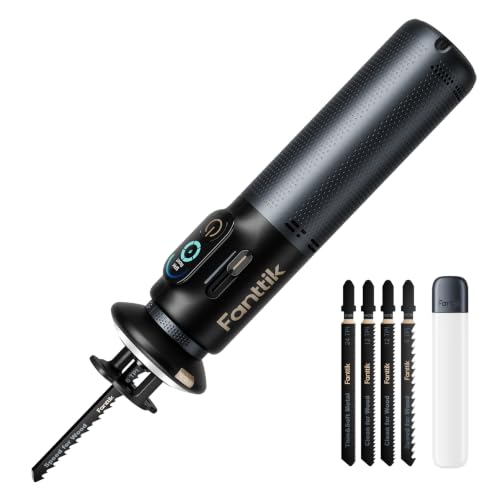
Pros
- Dual counterweight mechanism limits vibration for precise cuts in confined areas
- Pocketable 8.92-inch frame with direct Type-C charging cuts toolbox bulk
Cons
- Maximum cutting thickness capped at 3/4 inch based on manufacturer specifications
- Blade clamp gap fits only T-shank blades 1.4mm thick or thinner and 3 to 4 inches long
Best For / Avoid If
Best for buyers prioritizing
- Dual counterweight mechanism limits vibration for precise cuts in confined areas
- Pocketable 8.92-inch frame with direct Type-C charging cuts toolbox bulk
- Gradient LED panel clearly displays remaining power and operating stroke speed
Consider another option if
- Maximum cutting thickness capped at 3/4 inch based on manufacturer specifications
- Blade clamp gap fits only T-shank blades 1.4mm thick or thinner and 3 to 4 inches long
- Internal non-removable battery prevents quick battery swapping during extended work

Pros
- Dual 4.0Ah batteries and fast charger keep workflow continuous across lengthy tasks
- Lightweight two-pound chassis allows comfortable single-handed use in awkward spaces
Cons
- Short 15mm stroke length cuts slower through thick lumber than standard full-size demolition saws
- Total package weight reaches over 7.6 pounds when packed with all accessories in storage box
Best For / Avoid If
Best for buyers prioritizing
- Dual 4.0Ah batteries and fast charger keep workflow continuous across lengthy tasks
- Lightweight two-pound chassis allows comfortable single-handed use in awkward spaces
- Brushless motor reaches up to 3500 RPM for clean cuts across mixed materials
Consider another option if
- Short 15mm stroke length cuts slower through thick lumber than standard full-size demolition saws
- Total package weight reaches over 7.6 pounds when packed with all accessories in storage box
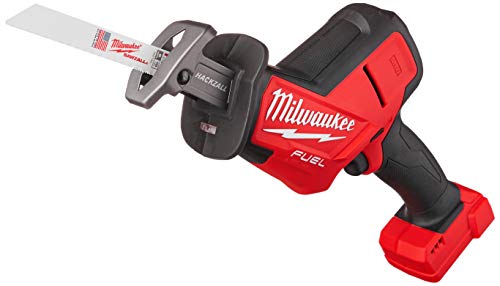
Pros
- Brushless motor pairs with 7/8 inch stroke length for rapid material removal
- One-handed profile fits tight quarters standard reciprocating saws cannot reach
Cons
- Bare tool configuration includes no battery or charger
- Compact one-handed design offers less leverage than full-size two-handed reciprocating saws
Best For / Avoid If
Best for buyers prioritizing
- Brushless motor pairs with 7/8 inch stroke length for rapid material removal
- One-handed profile fits tight quarters standard reciprocating saws cannot reach
- Pivoting shoe reduces vibration and bucking during aggressive cuts
Consider another option if
- Bare tool configuration includes no battery or charger
- Compact one-handed design offers less leverage than full-size two-handed reciprocating saws
Pros
- Short 14-inch total length enables access to tight framing bays and restricted spaces
- Four-position tool-free blade clamp provides flexible cutting angles and flush cuts
Cons
- Sold as a bare tool, requiring separate purchase of compatible DEWALT 20V MAX batteries and charger
- Bare tool weight of nearly five pounds may cause fatigue during prolonged overhead cutting without rests
Best For / Avoid If
Best for buyers prioritizing
- Short 14-inch total length enables access to tight framing bays and restricted spaces
- Four-position tool-free blade clamp provides flexible cutting angles and flush cuts
- Variable speed up to 2,900 spm paired with a 1-1/8-inch stroke length yields fast cutting speed
Consider another option if
- Sold as a bare tool, requiring separate purchase of compatible DEWALT 20V MAX batteries and charger
- Bare tool weight of nearly five pounds may cause fatigue during prolonged overhead cutting without rests

Pros
- Delivers 10,000 strokes per minute for fast cutting across sheet metal, aluminum, and composites.
- Lightweight 1.32-pound design with reduced vibration ensures steady control in tight spots.
Cons
- Requires compatible air compressor and pneumatic air hose to function.
- Pneumatic hose connection restricts mobility compared to cordless battery alternatives.
Best For / Avoid If
Best for buyers prioritizing
- Delivers 10,000 strokes per minute for fast cutting across sheet metal, aluminum, and composites.
- Lightweight 1.32-pound design with reduced vibration ensures steady control in tight spots.
- Spring-loaded throttle lock-out lever protects against accidental tool starts.
Consider another option if
- Requires compatible air compressor and pneumatic air hose to function.
- Pneumatic hose connection restricts mobility compared to cordless battery alternatives.

Pros
- Weighs only 2.2 pounds for low-fatigue one-handed operation
- Compact 11-inch length fits between close joists and tight wall cavities
Cons
- Sold as bare tool, requiring separate Bosch 12V Max battery and charger
- Compact 12V platform lacks raw output needed for heavy structural demolition
Best For / Avoid If
Best for buyers prioritizing
- Weighs only 2.2 pounds for low-fatigue one-handed operation
- Compact 11-inch length fits between close joists and tight wall cavities
- Delivers up to 3,000 SPM for quick cuts through conduit and copper
Consider another option if
- Sold as bare tool, requiring separate Bosch 12V Max battery and charger
- Compact 12V platform lacks raw output needed for heavy structural demolition

Pros
- Compact footprint cuts tubing inside low-clearance plumbing spaces.
- 32 TPI bi-metal blade produces clean cuts on multiple materials.
Cons
- Low-profile mini frame restricts cut depth on wide workpieces.
- Manual hand saw requires user muscle power for dense materials.
Specifications
| Color | Orange |
|---|---|
| Dimensions | 10.83 x 2.84 x 1.02 inches |
| Weight | 0.45 pounds |
| Product Group | Tools |
| Binding | Tools & Home Improvement |
Verify the current product variation before purchase; specifications may change.
Best For / Avoid If
Best for buyers prioritizing
- Compact footprint cuts tubing inside low-clearance plumbing spaces.
- 32 TPI bi-metal blade produces clean cuts on multiple materials.
- Tool-free lever enables fast blade swaps without extra hardware.
Consider another option if
- Low-profile mini frame restricts cut depth on wide workpieces.
- Manual hand saw requires user muscle power for dense materials.

Pros
- Slim profile accesses narrow wall cavities and cramped pipe runs
- High-carbon 32 TPI blade cuts dense metals cleanly
Cons
- Six-inch blade length restricts maximum cutting depth on thick stock
- Manual hand power requires extra time on hardened steel cuts
Specifications
| Color | Red |
|---|---|
| Size | No Size |
| Dimensions | 10.5 x 5.63 x 0.33 inches |
| Weight | 0.02 Pounds |
| Product Group | Tools |
| Binding | Tools & Home Improvement |
Verify the current product variation before purchase; specifications may change.
Best For / Avoid If
Best for buyers prioritizing
- Slim profile accesses narrow wall cavities and cramped pipe runs
- High-carbon 32 TPI blade cuts dense metals cleanly
- Cushioned handle improves grip stability during delicate cuts
Consider another option if
- Six-inch blade length restricts maximum cutting depth on thick stock
- Manual hand power requires extra time on hardened steel cuts
- Non-standard compact design less suited for large framing lumber

Pros
- Blades interchange directly between manual handle and standard power tools
- Eight-blade assortment handles sheetrock, metal, PVC, and wood out of box
Cons
- Manual hand operation limits cutting speed on thick lumber compared to motorized cutting
- Small mini-saw profile lacks rigidity needed for heavy framing jobs
Best For / Avoid If
Best for buyers prioritizing
- Blades interchange directly between manual handle and standard power tools
- Eight-blade assortment handles sheetrock, metal, PVC, and wood out of box
- Quick-release mechanism secures blades tightly without separate screwdrivers
Consider another option if
- Manual hand operation limits cutting speed on thick lumber compared to motorized cutting
- Small mini-saw profile lacks rigidity needed for heavy framing jobs
The Milwaukee entry is a compact hand-operated hacksaw rather than a powered reciprocating saw, so it is not evaluated or recommended as an answer to best compact reciprocating saw for tight spaces. Compare the three cordless reciprocating saws when shopping for this specific tool category.
Quick Comparison of the Valid Reciprocating Saws
| Model | Documented cutting specifications | Notable tight-space features | Important limitation |
|---|---|---|---|
| DEWALT 20V MAX* Reciprocating Saw, Cordless | 1-1/8-inch stroke; brushless motor | Compact design, two-finger variable trigger, LED, pivoting shoe, keyless blade clamp | Bare tool; battery and charger are sold separately |
| CRAFTSMAN V20 Reciprocating Saw, Cordless | 1-inch stroke; variable speed up to 3,000 strokes per minute | Stated 14.5-inch length, contoured overmolded handle, tool-free blade release | Bare tool; the manufacturer does not document an LED or pivoting shoe |
| RYOBI ONE+ 18V Cordless Reciprocating Saw | Product title states up to 3,400 strokes per minute and a 1-inch stroke | Cordless format and ONE+ battery-platform compatibility | Listed supporting feature data is incomplete, so compact dimensions and handling features cannot be verified here |
Individual Product Analysis
DEWALT 20V MAX* Reciprocating Saw, Cordless: Feature-Rich Overall Pick
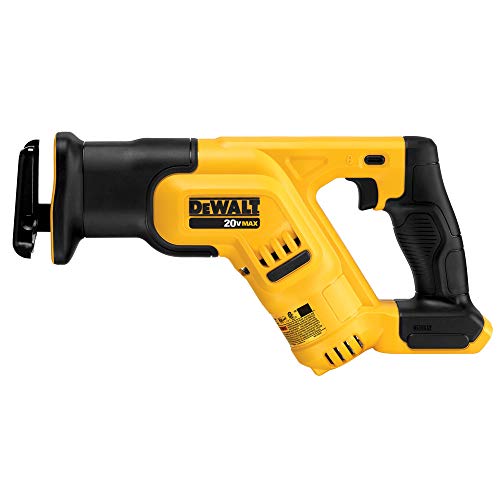
The DEWALT 20V MAX* Reciprocating Saw, Cordless has the most complete documented feature set of the qualifying models. Its manufacturer-listed equipment includes a brushless motor, 1-1/8-inch stroke, two-finger variable trigger, twist-style keyless blade clamp, onboard LED, and pivoting shoe. The compact design is intended to improve range of motion, although no overall tool length is included.
The longer stroke can remove more material with each cycle, which is useful for demolition cuts through framing lumber and for cutting pipe with an appropriate blade. That potential productivity comes with a tradeoff: a longer stroke also requires more clearance in front of and behind the workpiece. Before cutting a pipe close to a finished wall, confirm that the moving blade cannot strike wiring, another pipe, tile, or the wall surface.
The pivoting shoe is a practical advantage because it can provide a stable contact point against irregular work. The LED should also help when working in a dark cabinet or mechanical cavity, though it does not replace adequate task lighting. This is the strongest fit for an existing DEWALT 20V MAX or FLEXVOLT battery owner who wants documented control and support features. Buyers without compatible batteries should include a battery and charger in the ownership cost.
CRAFTSMAN V20 Reciprocating Saw, Cordless: Best Documented Fit for Confined Areas
The CRAFTSMAN V20 Reciprocating Saw, Cordless is the only qualifying model with a specific overall length in the published information. At a stated 14.5 inches, it gives shoppers a useful number to compare against the cabinet, joist bay, or wall opening where work will occur. Its 1-inch stroke and variable-speed trigger, rated up to 3,000 strokes per minute, provide a sensible combination for general DIY cutting.
A tool-free blade release reduces downtime and avoids the need to retrieve a hex key during a repair. The overmolded, contoured handle may improve grip comfort, but comfort remains dependent on hand size, glove thickness, battery weight, and cutting orientation. No tool weight is listed, so shoppers concerned about prolonged overhead work should verify that specification before buying.
This model makes the most sense for homeowners already invested in the CRAFTSMAN V20 platform or anyone who needs a documented length before ordering. It is sold as a bare tool. The published information also does not identify an onboard LED, so separate lighting may be needed beneath sinks or inside cabinets.
RYOBI ONE+ 18V Cordless Reciprocating Saw: Consider for Existing ONE+ Owners
The title listed for the RYOBI ONE+ 18V Cordless Reciprocating Saw identifies variable speed up to 3,400 strokes per minute and a 1-inch stroke. Those figures suggest the cutting speed needed for common pruning, plastic-pipe, and light demolition tasks when paired with the correct blade. It is also a bare tool in the ONE+ cordless system, making battery ownership an important part of its value.
However, the supporting feature text provided for this listing does not describe the saw and appears to refer to an unrelated product category. We therefore cannot verify its overall length, weight, blade-clamp design, shoe configuration, lighting, or included accessories from the available evidence. That prevents a confident claim that it is more compact or easier to control than the DEWALT or CRAFTSMAN options.
Existing ONE+ owners may still find it worth considering because they can potentially avoid buying into another battery ecosystem. New buyers should consult the current manufacturer documentation for dimensions, safety instructions, blade compatibility, and package contents before purchasing.
best compact reciprocating saw for tight spaces Buying Guide
1. Measure the Entire Cutting Envelope
Tool length is only part of tight-space suitability. A reciprocating saw also needs clearance for the battery, your gripping hand, the shoe, and the blade as it travels through its stroke. Measure the opening, the distance behind the material, and the angle from which the saw must enter. A saw that fits inside a cabinet may still be unusable if its blade would strike the cabinet back.
A common mistake is measuring only the saw body and overlooking blade length. Use the shortest blade that can complete the cut without the blade tip leaving the workpiece at the rear of the stroke. A blade that is too short can kick or bend; one that is unnecessarily long can whip and damage nearby finished surfaces.
Battery geometry matters as well. A large pack can add runtime but may block access between studs or beneath a low shelf. If the job involves short, intermittent cuts, a smaller compatible pack may improve balance and access, provided it meets the tool manufacturer’s requirements.
2. Match Stroke Length and Speed to the Material
Stroke length describes how far the blade travels per cycle, while strokes per minute describes cycling speed. A longer stroke can clear chips efficiently and cut quickly, but it also increases the space the blade occupies behind the material. This is especially important when cutting drywall, pipe, or trim near hidden utilities.
Variable speed is more valuable than simply choosing the largest speed figure. Slower starts help position the blade without skating across metal or finished material. Higher speed can improve progress once the cut is established, subject to the blade manufacturer’s recommendations. Do not treat strokes per minute as a direct measure of power, because motor design, electronics, blade condition, pressure, and battery state all affect cutting performance.
| Task | Useful setup | Tight-space concern |
|---|---|---|
| Plastic pipe | Fine or medium-tooth blade suited to plastic; controlled start | Support the pipe and avoid striking nearby plumbing |
| Metal pipe or fasteners | Bi-metal blade with suitable tooth pitch; moderate pressure | Allow for sparks and keep them away from combustibles |
| Nail-embedded wood | Demolition-rated wood-and-metal blade | Check for wiring and plumbing before entering a wall |
| Pruning | Pruning blade and stable footing | Do not use a reciprocating saw from an unstable ladder |
3. Choose a Battery Platform Before Comparing Bare-Tool Cost
All three qualifying products are listed as bare tools, so their displayed tool cost does not represent a complete setup for a first-time buyer. A compatible battery and charger are required. Battery-platform compatibility can outweigh a modest difference in tool cost because packs and chargers often serve multiple tools within the same system.
Existing DEWALT, CRAFTSMAN, or RYOBI battery owners should verify the precise platform markings rather than assuming batteries from the same brand always interchange. Voltage family, connector design, and manufacturer guidance determine compatibility. Do not modify a battery or rely on an unapproved adapter, since doing so can affect tool operation and safety protections.
For occasional repairs, one appropriately sized battery may be sufficient. Renovation work involving repeated demolition cuts can justify a second pack so one can charge while the other operates. Store batteries according to the manufacturer’s instructions and avoid leaving them in vehicles exposed to extreme temperatures.
4. Prioritize Trigger Control, Grip, and Balance
Confined cuts often begin at an awkward angle, making low-speed trigger control particularly important. A variable-speed trigger lets the operator establish the kerf before increasing speed. The DEWALT specifies a two-finger trigger, while the CRAFTSMAN lists a contoured overmolded handle. These are useful design details, but neither guarantees comfort for every user.
Balance changes after a battery is installed. A high-capacity pack may make a compact body feel rear-heavy, especially during horizontal or overhead work. If possible, evaluate the tool with the battery size you expect to use and while wearing normal work gloves. Renters and DIY beginners should prioritize controllability over maximum cutting speed.
Keep both hands away from the blade path and never reach behind the material while the battery is attached. If the workspace cannot accommodate a stable grip and a clear line of sight, enlarge the access opening where appropriate or choose a different cutting method rather than forcing the saw into position.
5. Look for a Stable Shoe and Convenient Blade Clamp
The shoe should rest firmly against the workpiece whenever the cut allows. This reduces vibration, improves control, and helps prevent the saw from hammering back and forth. A pivoting shoe, such as the one documented for the DEWALT, can follow angled or uneven surfaces. It does not eliminate the need to secure loose material.
Tool-free blade clamps simplify blade changes, but users should still remove the battery first and allow a hot blade to cool. After inserting a blade, tug it gently to confirm that it is locked. Inspect the clamp periodically for packed sawdust or metal debris, following the manual’s cleaning directions.
Blade orientation may affect access and flush-cutting ability, but orientation options are not documented consistently. Verify the manual if you need the blade installed teeth-up, sideways, or in another position. Never force a blade into an orientation the clamp was not designed to accept.
6. Treat the Blade as Part of the Tool
A capable saw fitted with the wrong blade can cut slowly, vibrate excessively, or damage the work. Blade material, tooth pitch, length, width, and thickness should match the application. Fine teeth are generally used for thinner metal, while aggressive wood blades clear chips faster. Multi-material demolition blades are convenient but may not provide the cleanest result in finished materials.
Use a blade long enough to remain inside the workpiece throughout the complete stroke. Bent, cracked, dull, or missing-tooth blades should be replaced. For visible plumbing or trim, protect adjacent finishes and consider whether a hand saw, oscillating multi-tool, or tubing cutter would offer better precision than a reciprocating saw.
Reciprocating saws are primarily rough-cutting tools. They excel at demolition and access-limited cuts but are not substitutes for a jigsaw, circular saw, or miter saw when a straight, finish-quality edge is required.
7. Account for Lighting, Vibration, and Maintenance
An onboard LED can illuminate the immediate cut line, which gives the DEWALT an advantage in the published comparison. However, the saw body and your hand can cast shadows. Use fixed task lighting when possible, particularly when checking for utility lines or determining where a blade will exit.
Vibration contributes to fatigue and can make a blade wander. Keep the shoe against the material, use a sharp blade, and let the teeth cut instead of applying excessive pressure. If vibration increases suddenly, stop and inspect the blade, clamp, shoe, workpiece support, and fasteners according to the manual.
Routine ownership needs are modest but important. Remove dust from ventilation openings without introducing liquids into the motor housing, inspect the shoe and clamp, and store blades where their teeth cannot be damaged. Battery contacts should remain clean and dry. Repairs involving the motor, wiring, or battery pack should be handled through an appropriate service provider.
8. Know When a Reciprocating Saw Is the Wrong Tool
A compact body does not make every confined cut safe. Avoid blind cuts into walls until hidden electrical wiring, plumbing, gas lines, and structural elements have been located. Turn off and verify relevant utilities when the project requires it. Professional assistance is appropriate when the work involves energized circuits, gas piping, structural modification, or uncertain building conditions.
For copper tubing in a finished cabinet, a compact tubing cutter may produce a cleaner result with less risk to the cabinet. An oscillating multi-tool can be better for shallow plunge cuts, while a manual saw may provide more control where power-tool clearance is inadequate. The right decision is not the smallest saw at any cost; it is the tool that can complete the cut with adequate control and clearance.
Wear eye protection and use hearing and respiratory protection appropriate to the material and environment. Determine whether the material may contain lead paint, asbestos, or other hazardous substances before disturbing it. Follow the tool, blade, battery, and material manufacturers’ instructions rather than relying solely on general buying advice.
How We Compared These Picks
We evaluated the listed products based on category fit, documented cutting performance, speed control, stroke length, access-oriented design, blade-change mechanism, shoe configuration, battery compatibility, visibility features, and likely homeowner use cases. We also considered ownership implications such as bare-tool packaging, battery-platform commitment, blade replacement, and the need for task lighting.
Category validation was performed before ranking. The manually operated hacksaw in the source list was excluded because it does not use a motor-driven reciprocating action. The RYOBI remains a qualifying reciprocating saw based on its product identification, but its incomplete supporting data lowered our confidence in detailed comparisons. We did not infer missing dimensions or features.
The published ratings were not used as evidence of reliability or owner satisfaction because the accompanying review counts do not provide a meaningful feedback base. Our conclusions rely on available product information and specification-based editorial analysis. Build quality, long-term durability, runtime, vibration, and real-world cutting speed cannot be confirmed from manufacturer specifications alone.
This guide is reviewed during August for specification clarity and category relevance. Product packages and manufacturer documentation can change, so shoppers should confirm current dimensions, included components, warranty terms, battery compatibility, and safety instructions before purchase.
Final Thoughts
Based on our detailed comparison, the DEWALT 20V MAX* Reciprocating Saw, Cordless is the strongest overall recommendation for buyers who want the most complete documented feature set. Its brushless motor, 1-1/8-inch stroke, variable trigger, LED, pivoting shoe, and keyless clamp make it well suited to renovation and maintenance work. It is especially logical for someone who already owns compatible DEWALT batteries.
The CRAFTSMAN V20 Reciprocating Saw, Cordless is the practical pick when a stated tool length is important. Its 14.5-inch body, 1-inch stroke, variable speed, and tool-free blade release provide a clearly documented basis for confined-space planning. Existing V20 owners are likely to receive the greatest value because the tool is sold without a battery or charger.
The RYOBI ONE+ 18V Cordless Reciprocating Saw may suit a homeowner with compatible ONE+ batteries, but its listing should be verified against current official documentation before purchase. Whichever model you choose, measure the complete cutting envelope and budget for suitable blades, protective equipment, and any required battery hardware rather than comparing bare-tool cost alone.
Frequently Asked Questions
What should I look for when choosing best compact reciprocating saw for tight spaces?
Measure the available opening and account for the saw body, battery, hand position, blade length, and blade stroke. Then compare variable-speed control, shoe stability, tool weight, blade-clamp design, lighting, and battery compatibility. A model already compatible with your batteries may offer better total value than a less expensive bare tool from another platform.
Is a longer stroke always better in a tight space?
No. A longer stroke can increase cutting productivity and chip clearance, but it also causes the blade to travel farther behind the workpiece. Verify rear clearance before cutting near a wall, pipe, wire, or finished surface.
Are higher-end best compact reciprocating saw for tight spaces worth it?
They can be worthwhile when the added cost provides features you will use, such as a brushless motor, pivoting shoe, onboard light, improved trigger control, or compatibility with batteries you already own. Occasional users may be better served by a simpler model with good speed control and an accessible blade clamp. Compare the complete kit cost rather than the bare tool alone.
How should beginners choose best compact reciprocating saw for tight spaces?
Beginners should prioritize a controllable variable-speed trigger, stable shoe, comfortable grip, and straightforward tool-free blade change. Start with accessible cuts in securely supported material and learn how blade length and tooth selection affect control. Avoid blind wall cuts and projects involving uncertain wiring, plumbing, gas lines, or structural components.
Can a compact reciprocating saw make precise finish cuts?
A reciprocating saw is primarily intended for rough cutting, demolition, pruning, and repair access. The moving blade can flex and wander, particularly when it is long or unsupported. Use a jigsaw, oscillating multi-tool, tubing cutter, or another precision-oriented tool when the finished edge will remain visible.
Do bare cordless reciprocating saws include batteries?
Not usually, and all qualifying models in this comparison are presented as tool-only products. Confirm the exact package before ordering, then factor a compatible battery and charger into the total cost. Battery packs should match the manufacturer’s specified platform and should not be modified to fit.
What safety equipment is needed for reciprocating-saw work?
Eye protection is fundamental, while hearing protection, gloves, and respiratory protection may be appropriate depending on the material and environment. Keep hands out of the blade path, remove the battery before changing blades, and inspect for hidden utilities before cutting. Hazardous materials and work involving gas, electricity, or structural components may require a qualified professional.