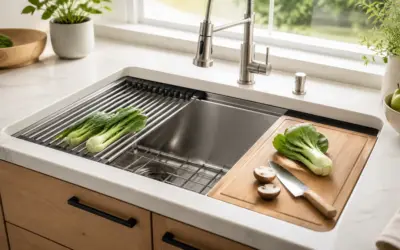

A shallow sink changes what makes a kitchen faucet practical. A tall outlet, forceful spray, or stream landing near the front wall can send water across the counter, while a poorly routed retractable hose may snag under the cabinet. For most shallow basins, the safest starting point is a compact pull-out faucet with an aerated stream, controlled flow, and enough reach to rinse the sink without placing the outlet unnecessarily high above it.
For this best pull out faucet for shallow sinks guide, we analyzed 8 models across $29.99–$132. We compared faucet profile, spray settings, hose reach, flow rate, mounting pattern, materials, certifications, installation requirements, and warranty information. Our leading fit is the Comllen model because its manufacturer specifically describes it as low profile and suitable for smaller sinks. The Moen Renzo is the stronger premium option for buyers who prioritize documented standards and warranty support. If you prefer a taller sprayer design, see our separate guide to pull-down kitchen faucets.
These recommendations are based on available specifications rather than hands-on plumbing tests. Several listings do not provide complete spout reach, outlet height, or sink-clearance measurements, so homeowners should verify those dimensions against their own basin before ordering. That step matters more than a star rating when the goal is controlling splash in a shallow sink.
Quick Verdict and Product Comparisons
After carefully analyzing the available specifications, the most important distinction is not simply pull-out versus pull-down. It is where the water exits relative to the basin floor and drain. A lower outlet generally reduces the distance water can fall, while an aerated stream helps soften its impact. A long hose adds cleaning reach, but it does not compensate for a fixed spout that directs water too close to the front of a small basin.
| Model | Documented strengths | Main limitation for a shallow sink | Good fit for |
|---|---|---|---|
| Comllen Kitchen Faucet with Pull Out Sprayer | Low-profile design, dual spray modes, stainless steel construction, deck plate | Complete outlet height and reach are not provided | Compact kitchens and low cabinet clearance |
| Moen Renzo Spot Resist Stainless One-Handle | Pull-out format, optional deck plate, Duralock connection, NSF 61 compliance, limited lifetime warranty | Higher purchase cost and no dimensions in the supplied data | Long-term homeowner installation |
| FORIOUS Kitchen Faucet with Pull Out Sprayer | Two modes, retractable hose, listed certifications, stainless steel, documented flow rate | Its outlet remains relatively high for a very shallow basin | Workstation, bar, RV, or moderately shallow sink |
| Bar Sink Faucet Single Hole | Long hose, multiple modes, aerator, brass body, full swivel | Single-hole mounting and unusually long hose require careful clearance checks | Prep sinks and compact work areas |
| CENOSA Bar Sink Faucet Single Hole with Pull Down | Lower documented flow rate, dual modes, gravity-assisted retraction | Pull-down configuration may place the outlet higher than a classic pull-out faucet | Water-conscious prep-sink use |
| GIMILI Bar Sink Faucet Brushed Nickel Single Hole | Single handle, pull-out sprayer, single-hole installation | Limited dimensional and material details | Simple bar-sink replacement after confirming measurements |
| Brushed Nickel Kitchen Faucets with Pull Down | Multiple spray modes, long hose, deck plate, stainless steel | High-arc design can increase splash risk | Shallow but wide sinks where reach matters more than height |
| JS Jackson Supplies Dual Handle Pull Out Faucet | Compact utility format, long spray hose, rust-resistant ABS body | Designed primarily for utility or laundry tubs; supply lines are not included | Utility installations rather than a primary kitchen sink |
Overall Pick: Comllen Kitchen Faucet with Pull Out Sprayer
The Comllen Kitchen Faucet with Pull Out Sprayer is the clearest specification-based match for a shallow basin. Comllen explicitly describes it as a low-profile faucet for smaller sinks and spaces with limited height. Its pull-out head offers an aerated stream for routine filling and a stronger spray for rinsing, which lets the user choose the gentler mode when splash control matters.
The listed construction is 304 stainless steel, and a deck plate is included for compatible multi-hole sink decks. The manufacturer also states that the faucet meets cUPC requirements, although buyers should confirm current certification documentation and local plumbing-code acceptance before installation. The missing spout-reach and outlet-height figures remain important limitations, so this is the leading candidate rather than a guaranteed fit for every shallow sink.
Premium Pick: Moen Renzo Spot Resist Stainless One-Handle
The Moen Renzo Spot Resist Stainless One-Handle uses a traditional pull-out configuration instead of a high spring or tall gooseneck. Its retractable hose, optional deck plate, Duralock quick connection, and spot-resistant finish form a practical package for a frequently used kitchen or laundry sink. Moen states that its residential faucets comply with the Federal Safe Drinking Water Act and NSF 61 requirements.
This is also the only model in the supplied information backed by a stated limited lifetime warranty, making it the more defensible choice for an owner-occupied home where parts support and long-term coverage matter. It may be more faucet than a renter or temporary renovation needs, and the provided data does not specify the exact outlet position. Confirm the current specification sheet before treating its low visual profile as proof of a splash-free fit.
Compact Feature Pick: FORIOUS Kitchen Faucet with Pull Out Sprayer
The FORIOUS Kitchen Faucet with Pull Out Sprayer combines stream and spray modes with a retractable hose and a swiveling sprayer. The listing provides more technical information than many alternatives, including a maximum flow rate, overall faucet height, spout height, 304 stainless steel construction, and a ceramic cartridge. It also lists cUPC and NSF/ANSI/CAN 61 certification.
Its compact L-shaped form can work in an RV, bar area, laundry space, or small kitchen, but its documented spout height may still be excessive over a particularly shallow basin. Choose it when hose reach and a defined flow rate are priorities, but measure the vertical drop to the basin and the stream landing point first. A short faucet is not automatically splash resistant if its outlet aims at a flat section instead of near the drain.
Prep-Sink Pick: Bar Sink Faucet Single Hole
The Bar Sink Faucet Single Hole is designed for compact bar and prep areas. According to its listing, it has a brass body, stainless steel spout, Neoperl aerator, multiple water modes, a long retractable hose, and full spout rotation. Those features are useful when a small sink cannot accommodate large cookware but the spray head still needs to reach a nearby container.
The tradeoff is that an extended hose needs an unobstructed path below the sink. In a small vanity-style cabinet, the hose and counterweight can collide with shutoff valves, storage bins, or drain components. Its single-hole format also makes it a poor direct replacement for some older sink decks unless a compatible cover plate is purchased separately.
Water-Conscious Pick: CENOSA Bar Sink Faucet Single Hole with Pull Down
The CENOSA Bar Sink Faucet Single Hole with Pull Down has the lowest documented flow rate among the models for which flow data is supplied. Its two spray modes, flexible hose, full-swivel spout, and gravity-ball retraction are useful in a prep or bar sink. The listing identifies 304 stainless steel as the primary material.
Lower flow can make splash easier to manage, but pressure, aerator design, outlet height, and stream angle still influence the result. This model does not include a deck plate, so it is most straightforward for a sink or counter already drilled for one-hole mounting. The supplied information does not document third-party drinking-water certification, which buyers may want to investigate before using it as a primary kitchen faucet.
Other Models Worth Considering Carefully
The GIMILI Bar Sink Faucet Brushed Nickel Single Hole offers a pull-out sprayer, single handle, and compact bar-faucet positioning, but its supplied specifications do not provide enough dimensional, certification, or material detail for a stronger recommendation. It may suit a simple single-hole prep sink after the buyer obtains a dimensional drawing from the seller.
The Brushed Nickel Kitchen Faucets with Pull Down provides a long hose, three operating modes, a deck plate, and listed stainless steel construction. However, its high-arc design is not the natural first choice for a shallow basin. It makes more sense when the sink is shallow but wide, the water pressure can be moderated, and the outlet aligns close to the drain rather than the front wall.
The JS Jackson Supplies Dual Handle Pull Out Faucet is a specialized alternative for a compact utility or laundry tub. Its ABS construction will not rust, and the pull-out hose includes a spray setting and garden-hose attachment. It uses a four-inch centerset layout, has two handles, and does not include supply lines, so it should not be treated as a universal replacement for a single-hole kitchen faucet.
best pull out faucet for shallow sinks Buying Guide
Measure Outlet Height, Spout Reach, and Stream Landing
Start by measuring the sink from the mounting surface to the basin floor. Then measure from the faucet hole to the drain center and front inside wall. Compare those figures with the faucet’s outlet height and horizontal reach, not merely its overall height. The ideal stream usually lands near the drain or on a sloped area that directs water into it.
A common mistake is buying from a lifestyle photo without checking the dimensional drawing. Photos may show a deep undermount sink even when the product is advertised for small spaces. If the manufacturer does not publish spout reach, request it before ordering or choose a model with more complete documentation.
As a practical decision rule, prioritize outlet position first, aeration second, and maximum hose length third. Hose reach improves cleanup, but it has little effect on splashing while the spray head is docked. Buyers outfitting a particularly compact prep area can also compare compatible basin sizes in our bar sink buying guide.
Choose Pull-Out or Pull-Down Based on Basin Geometry
A classic pull-out faucet usually has a lower, more horizontal spout. The spray head pulls toward the user, which can be advantageous above a shallow basin and beneath a low cabinet or windowsill. A pull-down model typically has a taller arc and a head that moves downward, providing more room for cookware but potentially increasing water-drop distance.
Neither design is automatically superior. A shallow but wide workstation sink may benefit from the reach and swiveling action of a pull-down faucet. A short, narrow sink is generally better served by a low pull-out body that keeps the outlet closer to the drain. Do not confuse a product’s description as compact with a verified low outlet.
Control Flow, Spray Pattern, and Water Pressure
Flow rate indicates water volume, but it does not tell the whole splash-control story. A concentrated spray can ricochet sharply from flat-bottom cookware, while an aerated stream mixes air into the water and usually feels softer. Dual-mode faucets are useful because the stream can handle routine handwashing and filling while spray mode remains available for targeted rinsing.
If a new faucet splashes, partially closing the handle can help, but a faucet should remain controllable at normal household pressure. Check that the aerator is installed correctly and free of debris. If pressure appears abnormally high throughout the home, consult a qualified plumber rather than relying on the faucet handle as a permanent pressure regulator.
Pause buttons and sweep modes can be convenient, but they are secondary to a predictable aerated stream. A pause control also should not be treated as a plumbing shutoff. Turn off the faucet at the handle when finished to avoid leaving the hose and spray head under unnecessary pressure.
Match the Faucet to the Sink-Hole Pattern
Count the existing faucet holes and measure their spacing before removing the old fixture. A single-hole faucet can often cover a multi-hole pattern when a compatible deck plate is included, but the plate must be wide enough to cover the unused openings. A four-inch centerset utility faucet requires a different layout from most single-handle kitchen models.
Also check countertop thickness, mounting-shank length, and access around the retaining nut. Thick butcher-block counters and tight rear sink rails can create problems even when the visible hole pattern looks correct. Renters should obtain the property owner’s permission and preserve the original fixture and hardware if the change must be reversible.
For a broader look at fixture layouts, finishes, and accessories, browse the Kitchen Fixtures collection. Matching the installation pattern before comparing cosmetic details prevents avoidable returns.
Inspect Hose Clearance Below the Sink
A retractable sprayer needs vertical room under the sink. The hose should move freely through its full travel without rubbing the drain trap, disposal, shutoff valves, supply tubes, or stored cleaning products. Gravity-assisted systems also need the counterweight positioned where the manufacturer specifies it.
Before installation, empty the cabinet and identify the planned hose path. After connecting the faucet, operate the sprayer several times while watching from below. Correct interference immediately because repeated abrasion can damage a hose, and a snagged weight can prevent the spray head from docking securely.
Evaluate Materials, Certifications, and Warranty Support
Stainless steel and brass are common faucet-body materials, while some utility models use engineered plastic. Material labels alone do not establish the quality of the cartridge, seals, hose, plating, or internal waterways. For a primary drinking-water faucet, look for clearly documented compliance with applicable lead-content and potable-water standards rather than relying only on broad terms such as safe or premium.
In the supplied data, Moen documents NSF 61 compliance and a limited lifetime warranty, while FORIOUS lists cUPC and NSF/ANSI/CAN 61 certification. Other manufacturers make cUPC or lead-free statements, but current certificates were not supplied for independent verification. Buyers should check the manufacturer’s current documentation and warranty terms because marketplace descriptions can change.
Warranty value depends on parts availability and claim terms, not simply duration. For a permanent kitchen renovation, established replacement-cartridge and spray-head support may justify paying more. For a lightly used bar or RV sink, a simpler model can offer adequate value if its dimensions and connections are correct.
Plan Installation and Leak Checks
Manufacturer estimates for installation time assume accessible shutoff valves, compatible supply connections, and no corroded hardware. Real projects may take longer when the old mounting nut is seized or cabinet access is restricted. Verify whether supply lines, deck plates, adapters, and mounting hardware are included before beginning.
Shut off both water supplies, relieve pressure, and follow the model-specific instructions. Do not automatically apply thread-seal tape to compression fittings unless the instructions call for it. After installation, remove or protect the aerator as directed, flush the lines, reconnect the spray head, and inspect every connection with dry paper for slow leaks.
If shutoff valves do not close fully, pipes are damaged, connections are unfamiliar, or local rules require licensed work, hire a plumber. Easy-installation claims are not a substitute for evaluating the condition of the existing plumbing.
Consider Cleaning and Long-Term Ownership
Shallow sinks expose the faucet base and surrounding deck to frequent droplets, so a finish that disguises fingerprints and water spots can reduce daily wiping. Even spot-resistant finishes still need cleaning. Use a soft cloth and the manufacturer’s recommended cleaner, avoiding abrasive pads and harsh chemicals that may damage the coating.
Mineral deposits can distort the spray pattern and create sideways jets. Flexible nozzle tips may make buildup easier to remove, while removable aerators can often be cleaned separately according to the manual. Hard-water households should place cartridge availability, replaceable spray heads, and finish care alongside appearance when comparing ownership cost.
Plan deck accessories at the same time. A separate sink soap dispenser can use an otherwise open hole, but it should not crowd the handle or block the faucet’s rotation.
Decision Framework for Different Buyers
| Buyer scenario | Prioritize | Avoid | Likely match |
|---|---|---|---|
| Very shallow primary kitchen sink | Low outlet, aerated stream, documented compliance | High arc and aggressive spray as the default mode | Comllen or Moen Renzo, after measurement |
| Owner planning a long-term upgrade | Warranty, standards, parts support, finish care | Buying on appearance alone | Moen Renzo |
| Small prep or wet-bar sink | Compact body, single-hole fit, hose clearance | Oversized deck plates and restricted swivel | ALEASHA, CENOSA, or GIMILI |
| RV or compact workstation | Defined dimensions, hose reach, secure mounting | Assuming residential fittings will automatically match | FORIOUS after connection checks |
| Shallow but wide basin | Reach, swivel, controllable flow | Stream landing near the front wall | OWOFAN only if height and landing point work |
| Laundry or utility tub | Correct centerset spacing and specialized attachments | Treating a utility faucet as a universal kitchen replacement | JS Jackson Supplies |
This framework highlights why there is no universal winner. The most durable or feature-rich faucet can still be the wrong purchase if the stream lands poorly in the basin. Conversely, an inexpensive compact model may work well in a lightly used prep sink but offer less documentation or long-term support than a homeowner wants for the primary kitchen.
Our Research Methodology and Why You Can Trust Us
We evaluated the products based on category fit, faucet profile, spray functionality, hose reach, stated flow rate, mounting compatibility, construction materials, installation features, potable-water documentation, warranty support, maintenance, and value. Because the target application is a shallow sink, we gave extra weight to low-profile geometry, stream control, and the likelihood of avoiding splash.
Our research used the available manufacturer and retailer specifications supplied for each model. We separated documented dimensions and certification statements from editorial interpretation, and we did not claim physical testing. Although product ratings were supplied, no underlying review counts were available, so ratings were not used as decisive evidence of durability or owner satisfaction.
We also validated whether each product belonged in kitchen, bar, prep, laundry, or utility faucet use. Specialized products were labeled accordingly rather than presented as universal kitchen replacements. Rankings considered performance potential, features, build quality, ease of installation, safety documentation, reliability signals, maintenance, and homeowner or DIY use-case fit.
This guide is reviewed during September and should be treated as a comparison starting point. Specifications, certifications, package contents, warranties, and availability can change. Confirm the current manufacturer documentation and measure your installation before purchasing.
Final Thoughts
For most shoppers seeking best pull out faucet for shallow sinks, the Comllen Kitchen Faucet with Pull Out Sprayer is the most direct match because its listing specifically identifies a low-profile design for small sinks and limited-height spaces. Its dual modes also allow an aerated stream to be used for gentler everyday flow. Choose it only after confirming the missing outlet-height and reach measurements with your sink layout.
The Moen Renzo Spot Resist Stainless One-Handle is the more compelling premium homeowner choice because of its pull-out format, documented NSF 61 compliance, installation features, and stated limited lifetime warranty. FORIOUS is a feature-rich compact alternative, while the ALEASHA and CENOSA models are better aligned with prep and bar installations. A taller OWOFAN pull-down faucet is worth considering only when the basin is wide enough and the stream landing can be verified.
Do not choose solely from price, hose length, or overall faucet height. Measure the basin, locate the drain, check the mounting holes, and inspect under-sink clearance. Those practical checks are more likely to prevent splashing and installation problems than selecting the longest feature list.
Frequently Asked Questions
What should I look for when choosing best pull out faucet for shallow sinks?
Prioritize outlet height, spout reach, stream landing, aeration, and controllable flow. Also verify the sink-hole pattern, countertop thickness, hose clearance, potable-water documentation, and included installation parts. A low pull-out profile is often preferable, but actual measurements should decide the fit.
Does a pull-out faucet splash less than a pull-down faucet?
It can, because many pull-out faucets position the outlet lower than high-arc pull-down models. Splash also depends on pressure, aerator design, basin slope, and where the stream lands. A well-matched pull-down faucet may splash less than a poorly positioned pull-out model.
How do I measure a shallow sink for a new faucet?
Measure from the mounting deck to the basin floor, from the faucet hole to the drain center, and from the hole to the front inside wall. Compare those measurements with the faucet’s outlet height and spout reach. Check cabinet height above the sink and unobstructed space below it for the retractable hose.
Is a lower flow rate always better for a shallow sink?
No. Lower flow may reduce splash, but spray concentration, household pressure, outlet height, and basin geometry can matter just as much. A quality aerated stream that remains easy to control is generally more useful than selecting from flow rate alone.
Can I install a single-hole faucet on a three-hole sink?
Often, provided a compatible deck plate covers the unused openings and fits the sink deck. Confirm hole spacing, plate dimensions, mounting-shank length, and countertop thickness. Some models include a plate, while others require one to be purchased separately.
Are higher-end best pull out faucet for shallow sinks worth it?
A higher-end faucet may be worthwhile for a primary kitchen when it provides stronger warranty coverage, clearer standards documentation, better parts support, and a finish that is easier to maintain. It is not automatically a better fit for a shallow basin, so dimensional compatibility still comes first. Buyers prioritizing hands-free operation can separately compare touchless kitchen faucet options.
Can a DIY beginner replace a pull-out kitchen faucet?
Many beginners can complete a compatible replacement when the shutoff valves work, connections are accessible, and the instructions are clear. Check for leaks after restoring water and make sure the retractable hose moves freely. Call a plumber if valves fail to close, fittings are corroded, pipes are damaged, or local rules require licensed installation.