Moisture meters can help homeowners, renters, and DIYers compare damp areas, monitor drying materials, and decide when a suspicious stain deserves further investigation. However, the least expensive meter is not automatically the best value. Sensor design determines whether a tool leaves pinholes, reports direct or relative readings, scans broad areas efficiently, and works well on finished surfaces. This moisture meter price comparison by sensor type explains those differences before comparing features.
After carefully analyzing the available specifications for 10 relevant products, we grouped the meters into pin, pinless, and combination designs. We considered supported materials, stated sensing depth, measurement modes, calibration or self-check features, display usability, replaceable probes, and suitability for home maintenance. If moisture appears to be hidden behind a wall, a meter can be paired with one of the options in our thermal camera guide for water leaks, although neither tool identifies the source with certainty on its own.
The products covered here span a wide price range but that broad range reflects major differences in sensor configuration and intended use. Prices and availability can change, so compare the current listing against the ownership implications discussed below rather than buying solely from a displayed price.

Pros
- Pinless operation helps preserve drywall, wood, and masonry surfaces during moisture checks.
- The meter can scan below the surface rather than limiting readings to visible areas.
Cons
- Readings are intended for drywall, masonry, hardwood, and softwood, so other materials are outside the listed calibration.
- The nine LED bars indicate a moisture range rather than providing a detailed numeric moisture percentage in the published specifications.
Best For / Avoid If
Best for buyers prioritizing
- Pinless operation helps preserve drywall, wood, and masonry surfaces during moisture checks.
- The meter can scan below the surface rather than limiting readings to visible areas.
- Simple status features, including low-battery indication and auto-power off, support routine maintenance use.
Consider another option if
- Readings are intended for drywall, masonry, hardwood, and softwood, so other materials are outside the listed calibration.
- The nine LED bars indicate a moisture range rather than providing a detailed numeric moisture percentage in the published specifications.
- Users seeking specialized professional moisture analysis may want a meter with additional material settings or measurement details.

Specifications
| Size | Pinless |
|---|---|
| Dimensions | 1.13 x 3 x 6.5 inches |
| Weight | 0.25 Pounds |
| Product Group | Tools |
| Binding | Tools & Home Improvement |
Verify the current product variation before purchase; specifications may change.

Specifications
| Product Group | Tools |
|---|
Verify the current product variation before purchase; specifications may change.

Pros
- Supports both wood and building-material checks in one compact moisture meter.
- Self-testing aid and printed wood-reference table can make calibration and scale selection more manageable.
Cons
- Users must choose the correct wood scale from the available options, so accurate setup requires consulting the manual.
- Pin-style readings are intended for spot checks and may not provide the broader surface coverage of a different meter design.
Specifications
| Color | Orange |
|---|---|
| Weight | 0.4629707502 pounds |
| Product Group | Tools |
| Binding | Unknown Binding |
Verify the current product variation before purchase; specifications may change.
Best For / Avoid If
Best for buyers prioritizing
- Supports both wood and building-material checks in one compact moisture meter.
- Self-testing aid and printed wood-reference table can make calibration and scale selection more manageable.
- Backlit screen, colored indicators, and an anti-slip grip support practical use during home inspection tasks.
Consider another option if
- Users must choose the correct wood scale from the available options, so accurate setup requires consulting the manual.
- Pin-style readings are intended for spot checks and may not provide the broader surface coverage of a different meter design.
- The provided information does not specify advanced data logging, remote connectivity, or professional-grade measurement features.

Specifications
| Color | Not Specified |
|---|---|
| Size | Pin Type or Pinless |
| Dimensions | 9 x 2.75 x 1.625 Inches |
| Weight | 2 pounds |
| Product Group | Tools |
| Binding | Tools & Home Improvement |
Verify the current product variation before purchase; specifications may change.
Specifications
| Color | Black-green |
|---|---|
| Product Group | Tools |
| Binding | Misc. |
Verify the current product variation before purchase; specifications may change.

Specifications
| Color | Gray |
|---|---|
| Product Group | Tools |
| Binding | Tools & Home Improvement |
Verify the current product variation before purchase; specifications may change.

Specifications
| Color | Black-MT19C |
|---|---|
| Product Group | BISS |
Verify the current product variation before purchase; specifications may change.

Specifications
| Color | Green |
|---|---|
| Dimensions | 3.93700787 x 1.574803148 x 1.181102361 Inches |
| Product Group | Tools |
| Binding | Tools & Home Improvement |
Verify the current product variation before purchase; specifications may change.
Specifications
| Color | 2 in 1 |
|---|---|
| Weight | 0.5291094288 Pounds |
| Product Group | Tools |
| Binding | Misc. |
Verify the current product variation before purchase; specifications may change.
moisture meter price comparison by sensor type Buying Guide
Start With the Sensor Type, Not the Lowest Price
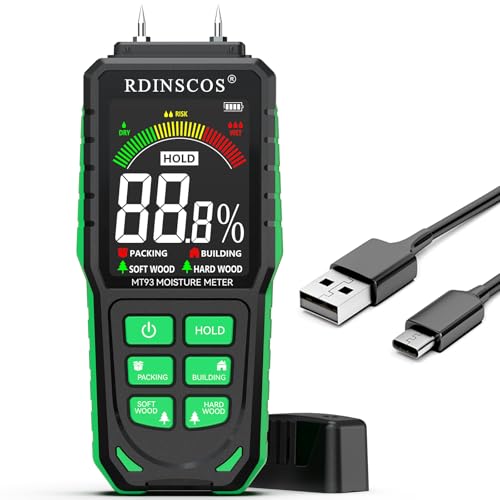
A pin meter passes a small electrical signal between two probes inserted into the material. It is useful for checking a specific point and commonly reports a moisture-content percentage when the selected material scale supports one. Pin meters in this comparison include the RDINSCOS Digital Moisture Meter Pin-Type Wood, RDINSCOS MT93 Wood Moisture Meter, RDINSCOS Rechargeable Moisture Meter for Wood, and Mecurate Digital Pin Type Wood Moisture Meter. They are sensible choices when tiny probe marks are acceptable.
A pinless meter uses an electromagnetic or capacitive sensor to compare moisture below a surface without puncturing it. The Klein Tools ET140 Pinless Moisture Meter, General Tools Digital Moisture Meter MMD7NP, and Neoteck Pinless Moisture Meter with REF fit this category. Pinless models cost more than several basic pin choices in the product set, but the premium may be justified on finished drywall, flooring, cabinetry, or furniture where probe holes are undesirable.
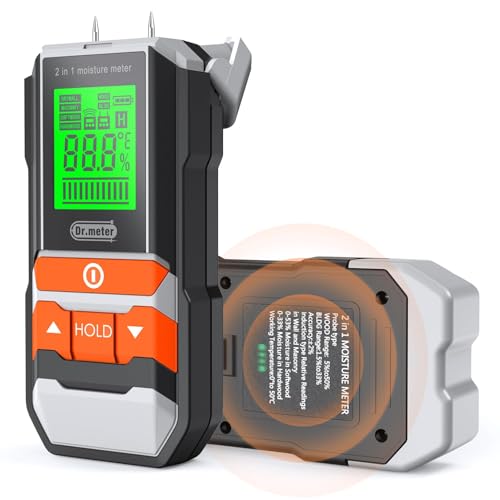
Combination meters provide both workflows. Use the pinless mode to map a broad area, then confirm selected points with pins where surface damage is acceptable. The Dr.meter 2 in 1 Pin & Pinless Wood Moisture Meter, NDI 7 in 1 Pin-Type and Non-invasive Moisture, and General Tools Moisture Meter MMD950 offer this flexibility. The MMD950 occupies the premium end of the listed range and adds a remote probe plus a manufacturer-claimed deep pinless sensing capability, so its value case is strongest for frequent or specialized investigations rather than an occasional drywall check.
| Sensor type | Typical strength | Main tradeoff | Most suitable buyer |
|---|---|---|---|
| Pin | Localized readings and direct contact with the material | Leaves two small holes and requires proper insertion | Woodworkers and DIYers checking unfinished materials |
| Pinless | Fast, non-destructive area scanning | Readings can be influenced by metal, edges, density, and surface geometry | Homeowners checking finished walls or floors |
| Combination | Broad scanning followed by spot verification | More controls, and sometimes greater cost or bulk | Renovators and frequent maintenance users |
Understand Percentage Readings Versus Relative Readings
Not every number on a moisture meter represents an absolute moisture percentage. Pin meters may display moisture content based on electrical resistance and a selected wood or building-material calibration. Pinless meters frequently provide a relative or index value that is most useful when comparing a suspected wet area with a known dry reference made from the same material.
This distinction matters on drywall and masonry. A high relative reading can identify an area that differs from its surroundings, but it does not by itself establish the amount of water present, prove mold growth, or diagnose a plumbing failure. The Klein ET140 is described as measuring relative moisture in building materials, while the General Tools MMD7NP lists percentage ranges for supported wood and relative readings for wallboard, drywall, and masonry. Compare like with like, keep the meter orientation consistent, and take several readings in a grid.
A common mistake is comparing a wood-mode reading on one wall with a masonry-mode reading elsewhere. Select the correct material mode and document it with every result. For examining inaccessible cavities after mapping an anomaly, see our guide to choosing a borescope for home inspection.
Match the Meter to the Material
Wood species and density affect electrical behavior, which is why a wood scale or species group is more useful than a generic display. The Mecurate model lists multiple calibrated wood scales and places a quick-reference index on the meter. The rechargeable RDINSCOS model provides separate stated ranges for softwood and hardwood. These features are relevant for lumber, trim, flooring, and woodworking stock, but users still need to select the correct setting.
For building investigations, confirm that the meter explicitly supports the surface. Klein states that the ET140 is calibrated for drywall, masonry, hardwood, and softwood. Neoteck lists concrete, cement, plaster, wood, and a reference index. NDI lists dedicated modes for drywall, cement board, softwood, and hardwood. A mode label does not make readings interchangeable across materials; use it to establish a consistent baseline within one material.
Tile, foil-backed insulation, pipes, wiring, fasteners, corner bead, and metal studs can distort non-invasive readings. If a pinless meter spikes in a straight vertical line or close to an edge, investigate the construction before assuming water is present. Additional imaging from an infrared camera for home inspection may add context, but temperature patterns also require careful interpretation.
Compare Sensing Depth Carefully
Depth specifications are not directly comparable across sensor types. A pin meter generally responds along the inserted electrode path, while a pinless meter senses a volume beneath its contact area. Klein and General Tools list sensing up to three-quarters of an inch for their ET140 and MMD7NP pinless models. Neoteck lists a broader depth interval, and the premium MMD950 carries a manufacturer claim of pinless detection much farther behind walls and ceramic tile.
Greater stated depth does not guarantee that a meter can identify the precise depth or source of moisture. A deeper field may include multiple material layers, and dense finishes can affect interpretation. Treat depth as a screening capability, not an X-ray view. For a ceiling stain, compare the center, perimeter, and an unaffected area made from the same material, then repeat the readings over time.
Decide Whether Surface Damage Is Acceptable
Pinholes are usually minor in exposed framing, firewood, subflooring awaiting a finish, or the back of trim. They are less acceptable on visible hardwood, painted walls, veneer, cabinetry, and rental surfaces. Renters should avoid puncturing finishes without permission and may find a pinless model more practical, although a reading cannot replace notifying the property owner about active water intrusion.
If you choose pins, inspect whether replacements are included or available. The RDINSCOS Digital Pin-Type model lists spare probes, while the MT93 and rechargeable RDINSCOS models specify replaceable stainless-steel pins. Replacement capability lowers the ownership penalty if a probe bends or dulls. Always cap sharp electrodes during storage and keep fingers away from the tips.
Look for Calibration, Reference, and Hold Functions
Useful controls matter more than a long feature list. A hold button lets you preserve a result when the display is hidden in a corner or under a cabinet. Backlighting helps in basements and crawl spaces, while audible and color alerts speed up mapping. These alerts should be treated as thresholds generated by the selected mode, not as proof that a material is unsafe.
Self-check and reference functions support repeatable work. The rechargeable RDINSCOS model and Mecurate meter describe checks built into their protective caps. Neoteck lets the user establish a dry reference and compare other points against it. For any model, follow the manual’s startup procedure, allow automatic calibration to finish, keep the sensor clean, and avoid placing a hand over the sensing area.
Record the location, material mode, reading, and date instead of relying on memory. A sequence of readings taken under comparable conditions is generally more informative than one isolated number. Homeowners building a broader inspection kit can explore the site’s Tools & DIY resources for complementary equipment.
Evaluate Power, Probe Access, and Durability
Rechargeable meters can reduce disposable-battery purchases, but a depleted internal battery may delay an unplanned inspection. Replaceable-battery models are easy to restore if spares are available. Before buying, verify the battery format in the current listing and consider how often the tool will be stored. Remove replaceable batteries before very long storage periods and inspect the compartment for leakage.
A remote probe can be more valuable than a larger display when checking awkward areas. The MMD950 includes a cabled pin probe according to the published information, which can help with ceilings, subfloors, and confined locations. Klein lists drop protection for the ET140, an ownership advantage for regular jobsite use. However, the published information does not establish comparative long-term durability for the entire group, so we do not infer service life from casing appearance or price.
Choose by Use Case and Total Value
For occasional checks on unfinished wood, a straightforward pin meter usually provides the most economical route. For recurring checks on finished drywall or flooring, paying more for pinless scanning can prevent cosmetic repairs. A combination tool makes sense when one user handles both broad leak mapping and focused wood measurements. Premium equipment is worthwhile only when its remote probe, deeper stated sensing, display, or workflow advantages will be used.
Do not buy a moisture meter as a mold detector, leak locator, or clearance certificate. It measures or estimates a material’s moisture response under defined conditions. It cannot determine whether hidden mold is present, whether framing is structurally sound, or whether water contains contaminants. For extensive flooding, persistent dampness, electrical hazards, sewage exposure, or suspected structural damage, stop DIY investigation and consult qualified professionals.
Product Fit by Sensor Category
| Product | Sensor approach | Notable documented feature | Consider before buying |
|---|---|---|---|
| Klein Tools ET140 Pinless Moisture Meter | Pinless | Relative readings on listed building materials and stated drop protection | No pin mode for spot confirmation |
| General Tools Digital Moisture Meter MMD7NP | Pinless | Auto-calibration, color bar, and listed wood ranges | Wall materials use relative readings |
| Neoteck Pinless Moisture Meter with REF | Pinless | Dry-reference comparison and several material modes | Metal and hand placement may influence readings |
| Dr.meter 2 in 1 Pin & Pinless Wood Moisture Meter | Combination | Both scanning and pin measurement with material modes | Users must understand two measurement methods |
| NDI 7 in 1 Pin-Type and Non-invasive Moisture | Combination | Dedicated modes and both sensor options | More modes require careful selection |
| General Tools Moisture Meter MMD950 | Combination | Remote probe and deep-sensing manufacturer claim | Premium positioning is difficult to justify for occasional use |
| Mecurate Digital Pin Type Wood Moisture Meter | Pin | Multiple wood scales and cap self-check | Leaves probe holes |
| RDINSCOS pin models | Pin | Replaceable or spare probes on listed models | Most appropriate where tiny holes are acceptable |
Our Research Methodology & Why You Can Trust Us
We first validated every listed product against the target category. All included models are moisture meters intended for wood, drywall, masonry, or related building materials, so no unrelated tools were added. We then classified each meter by sensor type and compared available specifications for measurement modes, supported materials, sensing depth, calibration, probes, display functions, power, portability, and homeowner use-case fit.
Our rankings and recommendations rely on the listing information, specification-based analysis, and practical interpretation of how each sensor works. We did not physically test these meters, and customer ratings were not treated as proof of reliability. Manufacturer statements about accuracy, depth, and performance are presented as stated specifications rather than independently verified measurements.
We evaluated performance potential, features, build-related details, ease of use, maintenance, safety, value, reliability indicators, and fit for common home projects. During August, this guide should be reviewed for specification, listing, and availability changes. Readers should confirm the current manual and warranty before purchasing because seller pages and product revisions can change.
Final Thoughts
For non-destructive homeowner scanning, the Klein Tools ET140 Pinless Moisture Meter is a strong fit because its documented material calibrations, reverse-contrast display, hold function, and stated drop protection create a practical maintenance package. The General Tools Digital Moisture Meter MMD7NP is a close alternative for buyers who want a pinless design with color indicators and listed wood ranges. Neither is ideal when direct pin confirmation is required.
For the most flexible value proposition, the Dr.meter 2 in 1 Pin & Pinless Wood Moisture Meter combines broad, non-invasive scanning with localized pin measurement. Frequent users who need a remote probe and the premium model’s specialized feature set can consider the General Tools Moisture Meter MMD950, but occasional DIYers are unlikely to need that level of capability. Buyers focused on unfinished lumber can save by choosing a basic pin design instead.
The right choice ultimately depends on whether surface preservation, direct contact, or a two-stage workflow matters most. A meter should guide further investigation, not replace repairs or professional assessment. If a moisture pattern suggests a concealed building defect, consult our comparison of home-inspection infrared cameras before deciding which complementary diagnostic tool makes sense.

Frequently Asked Questions
What should I look for when choosing moisture meter price comparison by sensor type?
Start with sensor type, supported materials, and whether small probe holes are acceptable. Next, compare measurement modes, stated sensing depth, calibration steps, replacement probes, display readability, and the usefulness of hold or reference functions.
Are higher-end moisture meter price comparison by sensor type worth it?
They can be worthwhile for frequent inspections, remote-probe access, combination sensing, or specialized depth requirements. An occasional user checking unfinished wood may receive better value from a simpler pin meter, while owners protecting finished surfaces may benefit more from pinless sensing.
How should beginners choose moisture meter price comparison by sensor type?
Beginners should choose a meter with clearly labeled material modes, a readable display, a hold button, and straightforward calibration. A pinless model is easier on finished surfaces, while a combination model offers more flexibility if the user is willing to learn how relative and percentage readings differ.
Are pinless moisture meters accurate through drywall?
A compatible pinless meter can identify relative differences beneath drywall within its stated sensing capability, but nearby metal, corners, material density, and layered construction can affect the result. Use a dry reference area, make a grid of readings, and do not interpret one number as definitive proof of a leak.
Can a moisture meter detect mold?
No moisture meter directly confirms mold. It can identify areas with elevated moisture response that may warrant investigation, but mold assessment depends on visual evidence, building conditions, and sometimes professional evaluation.
Can moisture meters locate the source of a leak?
They can map where materials appear wetter than surrounding areas, but water may travel along framing, pipes, or membranes before becoming visible. Pair systematic meter readings with inspection, and consider a home-inspection borescope only when safe access and permission to open or enter a cavity are available.
How should homeowners use a moisture meter safely?
Read the manual, select the correct material mode, cap sharp pins after use, and avoid probing where concealed wiring or plumbing may be present. Do not open wet walls near energized electrical systems, and seek qualified help for flooding, sewage, structural concerns, or persistent unexplained moisture.