Choosing best budget reverse osmosis system for well water is not simply a matter of finding the least expensive RO unit. Private-well water can contain sediment, hardness minerals, iron, manganese, sulfur odors, microorganisms, nitrates, arsenic, or other contaminants, and no single treatment configuration is right for every well. The most economical long-term choice is the system that matches a laboratory water test, operates within the home’s available water pressure, and is protected by appropriate pretreatment.
After carefully analyzing the available specifications for 10 products, we compared filtration claims, NSF/ANSI certifications, output capacity, storage design, drain efficiency, installation requirements, maintenance access, and suitability for common household scenarios. Our leading value options are conventional under-sink systems, while tankless, countertop, whole-house bundle, and commercial models make sense only under more specific conditions. Product claims are identified as such, and a TDS display or stage count should not replace contaminant-specific test results.
The short answer is that iSpring RCC7AK, NSF Certified, 75 GPD offers the strongest overall balance for many well-water households because the manufacturer documents full-system NSF/ANSI 58 certification, accessible replacement filters, remineralization, and a transparent sediment housing. The Express Water RO5DX 5-Stage Under Sink Reverse is a simpler value alternative with a leak-stop feature. Neither should be connected to untreated water with serious sediment, hardness, iron, manganese, sulfur, or microbiological problems without first designing suitable pretreatment.

Pros
- Comprehensive five stage process reduces a wide range of contaminants including pharmaceuticals and nitrates
- Compact cabinet friendly design supports wall or freestanding mounting for flexible placement
Cons
- Requires water pressure between 40 and 80 psi or may need a booster pump or regulator
- Produces one to three gallons of wastewater for every gallon of purified water
Specifications
| Color | Chrome |
|---|---|
| Size | 5 Stage |
| Dimensions | 13.99999998572 x 4.9999999949 x 14.9999999847 inches |
| Weight | 31 Pounds |
| Product Group | Home Improvement |
| Binding | Tools & Home Improvement |
Verify the current product variation before purchase; specifications may change.
Best For / Avoid If
Best for buyers prioritizing
- Comprehensive five stage process reduces a wide range of contaminants including pharmaceuticals and nitrates
- Compact cabinet friendly design supports wall or freestanding mounting for flexible placement
- Expert technician support available for questions on installation or home water quality
Consider another option if
- Requires water pressure between 40 and 80 psi or may need a booster pump or regulator
- Produces one to three gallons of wastewater for every gallon of purified water
- Remote installations such as basements may require additional tubing or a delivery pump
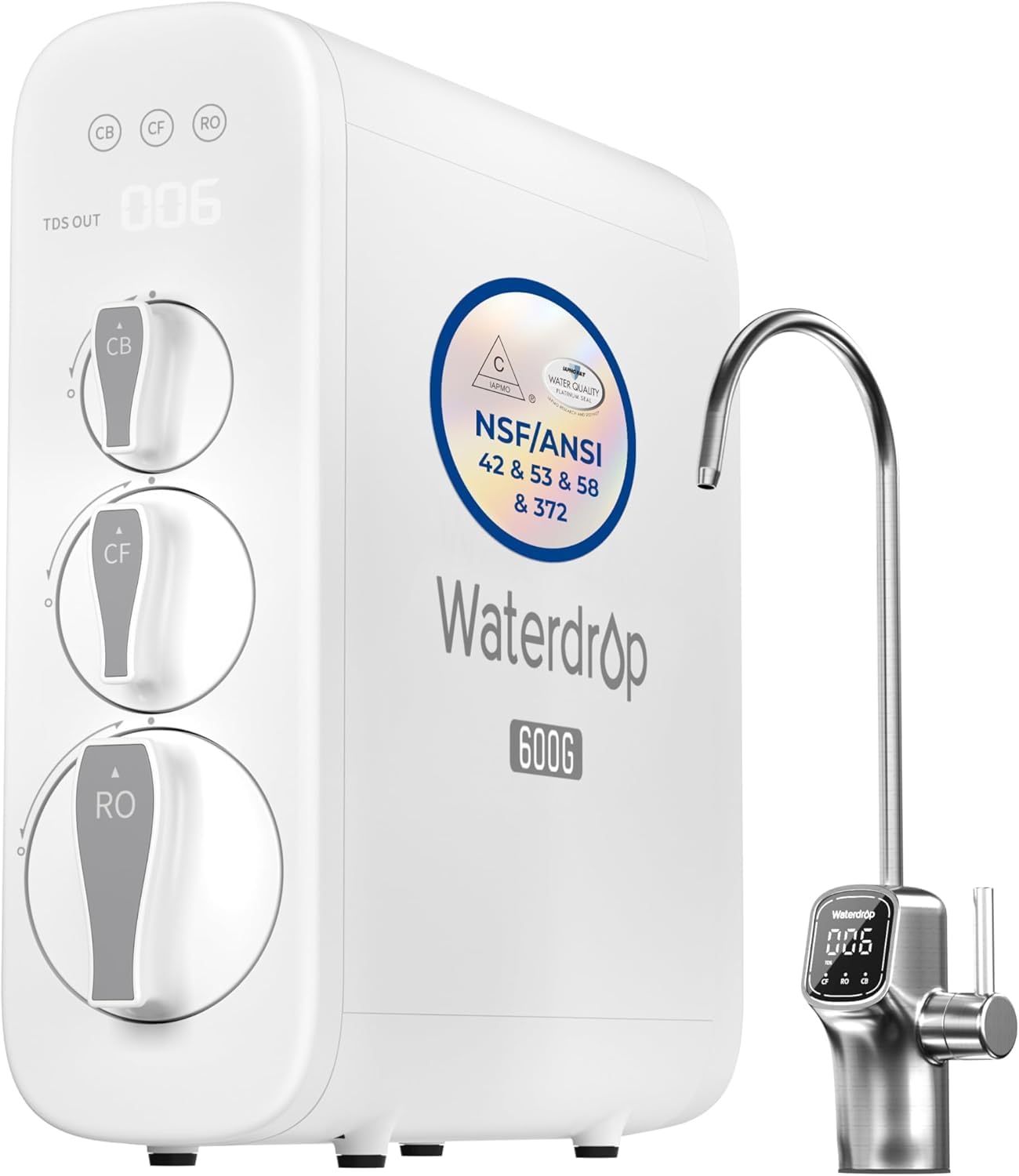
Pros
- Eight-stage filtration addresses a wide range of tap water impurities
- Tankless layout saves substantial storage space beneath the sink
Cons
- Requires under-sink electrical connection to function
- Installation needs drilling for the faucet and drain line
Specifications
| Other Special Features of the Product | 8-stage Filtration, 600GPD high capacity, 2:1 low drain ratio, Smart display faucet |
|---|---|
| Container Type | Cartridge |
| Installation Type | Under Sink |
| Purification Method | Carbon Block, Reverse Osmosis |
| Power Source | Corded Electric |
| LowerTemperature Range | 41 Degrees Fahrenheit |
| Maximum Flow Rate | 0.42 Gallons Per Minute |
| Operating Pressure Range | 87 PSI |
| Upper Temperature Rating | 100 Degrees Fahrenheit |
| Supported Water TDS Level Maximum (PPM) | 1500 |
Verify the current product variation before purchase; specifications may change.
Best For / Avoid If
Best for buyers prioritizing
- Eight-stage filtration addresses a wide range of tap water impurities
- Tankless layout saves substantial storage space beneath the sink
- Smart faucet offers convenient real-time monitoring of water quality and filter life
Consider another option if
- Requires under-sink electrical connection to function
- Installation needs drilling for the faucet and drain line
- Cabinet dimensions must be checked against the unit size before purchase

Pros
- Full-system NSF/ANSI 58 certification provides useful verification for key contaminant-reduction claims.
- Alkaline remineralization distinguishes it from standard five-stage systems that do not restore minerals.
Cons
- The 15.5 x 16 x 18-inch size may be difficult to accommodate in smaller under-sink cabinets.
- Installation still requires checking available cabinet space and following the supplied setup instructions.
Specifications
| Color | Sleek Black Faucet |
|---|---|
| Dimensions | 15.5 x 16 x 18 Inches |
| Weight | 27.55778275 pounds |
| Product Group | Home Improvement |
| Binding | Tools & Home Improvement |
Verify the current product variation before purchase; specifications may change.
Best For / Avoid If
Best for buyers prioritizing
- Full-system NSF/ANSI 58 certification provides useful verification for key contaminant-reduction claims.
- Alkaline remineralization distinguishes it from standard five-stage systems that do not restore minerals.
- The visible first-stage housing and membrane-protecting pre-filters support more straightforward maintenance planning.
Consider another option if
- The 15.5 x 16 x 18-inch size may be difficult to accommodate in smaller under-sink cabinets.
- Installation still requires checking available cabinet space and following the supplied setup instructions.
- The available product data does not specify filter replacement intervals or operating water-production capacity.

Pros
- Top-mounted fastener reduces common installation challenges under the sink
- Remineralization improves water taste while maintaining healthy pH levels
Cons
- System requires dedicated under-sink space for tanks and filters
- Periodic filter replacements are necessary for continued performance
Specifications
| Other Special Features of the Product | Multi Stage Filtrartion, NSF certified |
|---|---|
| Container Type | Tube |
| Installation Type | Under Sink |
| Purification Method | Reverse Osmosis, Alkaline, Activated Carbon, Carbon block |
| Power Source | No Power Needed |
| LowerTemperature Range | 40 Degrees Fahrenheit |
| Maximum Flow Rate | 284 Liters Per Day |
| Operating Pressure Range | 70 PSI |
| Upper Temperature Rating | 100 Degrees Fahrenheit |
| Supported Water TDS Level Maximum (PPM) | 98 |
Verify the current product variation before purchase; specifications may change.
Best For / Avoid If
Best for buyers prioritizing
- Top-mounted fastener reduces common installation challenges under the sink
- Remineralization improves water taste while maintaining healthy pH levels
- Clear housing allows monitoring without full disassembly
Consider another option if
- System requires dedicated under-sink space for tanks and filters
- Periodic filter replacements are necessary for continued performance
- First-time users may need to consult installation videos for plumbing connections

Pros
- High output rate supports busy households needing water on demand
- Remineralization improves flavor compared to basic RO systems
Cons
- Faucet installation requires drilling a hole in the countertop
- Regular filter changes remain necessary based on the listed lifespans
Best For / Avoid If
Best for buyers prioritizing
- High output rate supports busy households needing water on demand
- Remineralization improves flavor compared to basic RO systems
- Compact footprint fits tighter cabinet spaces effectively
Consider another option if
- Faucet installation requires drilling a hole in the countertop
- Regular filter changes remain necessary based on the listed lifespans
- May need sufficient clearance underneath the sink for proper fit

Pros
- No plumbing connection is required, so setup is simpler than installing an under-sink reverse osmosis system.
- Real-time TDS information and filter-life reminders make routine maintenance easier to follow.
Cons
- The countertop footprint may be difficult to accommodate in kitchens with limited workspace.
- The 5L tank and dual 1.1L pitchers may not meet the needs of households requiring continuous, high-volume water production.
Best For / Avoid If
Best for buyers prioritizing
- No plumbing connection is required, so setup is simpler than installing an under-sink reverse osmosis system.
- Real-time TDS information and filter-life reminders make routine maintenance easier to follow.
- Automatic pitcher filling, self-cleaning, and twist-to-install filter replacement support convenient everyday use.
Consider another option if
- The countertop footprint may be difficult to accommodate in kitchens with limited workspace.
- The 5L tank and dual 1.1L pitchers may not meet the needs of households requiring continuous, high-volume water production.
- As a countertop unit, it still requires a nearby outlet and dedicated space for operation.
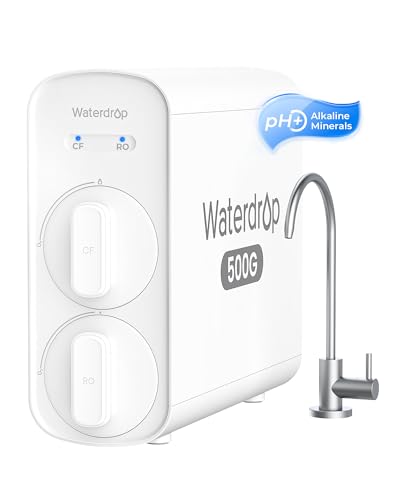
Pros
- Combines a 0.0001 μm RO membrane with alkaline mineralization.
- Space-conscious tankless design fits kitchens where a traditional storage tank would be inconvenient.
Cons
- Installing the included faucet requires drilling a hole in the countertop.
- The 5.69 x 16.69 x 13.9-inch system still requires a suitable under-sink installation area.
Specifications
| Color | White |
|---|---|
| Size | Alkaline |
| Dimensions | 5.69 x 16.69 x 13.9 Inches |
| Weight | 21.4 pounds |
| Product Group | Home Improvement |
| Binding | Misc. |
Verify the current product variation before purchase; specifications may change.
Best For / Avoid If
Best for buyers prioritizing
- Combines a 0.0001 μm RO membrane with alkaline mineralization.
- Space-conscious tankless design fits kitchens where a traditional storage tank would be inconvenient.
- Fast stated dispensing and appliance connection options add everyday convenience.
Consider another option if
- Installing the included faucet requires drilling a hole in the countertop.
- The 5.69 x 16.69 x 13.9-inch system still requires a suitable under-sink installation area.
- Buyers who do not want mineralization may prefer a filtration system with a different water-treatment approach.

Pros
- Provides both softened household water and reverse osmosis drinking water in one coordinated bundle.
- The 48,000-grain capacity is suited to many medium-size households with up to four family members.
Cons
- The 149-pound weight and 62-inch height may make placement and installation planning more demanding.
- Its stated capacity is targeted to homes with 3 to 4 bathrooms and up to 4 family members, so larger households may need a different system size.
Specifications
| Color | Black |
|---|---|
| Size | 48,000 Grains |
| Dimensions | 10 x 10 x 62 Inches |
| Weight | 149 Pounds |
| Product Group | BISS |
Verify the current product variation before purchase; specifications may change.
Best For / Avoid If
Best for buyers prioritizing
- Provides both softened household water and reverse osmosis drinking water in one coordinated bundle.
- The 48,000-grain capacity is suited to many medium-size households with up to four family members.
- Automatic metered control and the listed high-efficiency components may help limit unnecessary water use and maintenance.
Consider another option if
- The 149-pound weight and 62-inch height may make placement and installation planning more demanding.
- Its stated capacity is targeted to homes with 3 to 4 bathrooms and up to 4 family members, so larger households may need a different system size.
- The product data does not specify installation requirements, included accessories, or available finish options beyond the black color.

Pros
- SGS testing supports reliable contaminant removal across many common substances
- Integrated monitoring reduces guesswork for filter maintenance timing
Cons
- Tank capacity aligns best with one or two person households
- Requires available countertop surface area for placement
Specifications
| Other Special Features of the Product | Built In TDS Meter, Change Filter Indicator, Reduce TDS, Touch Control |
|---|---|
| Container Type | Dispenser |
| Purification Method | Reverse Osmosis |
| Item Dimensions L x W x H | 14.5"L x 6.7"W x 13.4"H |
| Capacity | 3 liters |
| Item Weight | 9.46 Pounds |
| Material Type | Acrylonitrile Butadiene Styrene |
| Brand Name | DREO |
| Included Components | 1 × DREO RO Water Filter 112 Body; 1 × RO Filter; 1 × Autofill Water Pitcher |
| Model Name | DREO RO Water Filter 112 |
Verify the current product variation before purchase; specifications may change.
Best For / Avoid If
Best for buyers prioritizing
- SGS testing supports reliable contaminant removal across many common substances
- Integrated monitoring reduces guesswork for filter maintenance timing
- Compact footprint and included pitcher suit daily needs in smaller households
Consider another option if
- Tank capacity aligns best with one or two person households
- Requires available countertop surface area for placement
- Filter changes remain necessary after the stated capacity is reached

Pros
- Commercial-scale output is well matched to high-demand filtered-water applications.
- The mobile frame and locking casters add practical flexibility for placement and servicing.
Cons
- Water pressure below 80 psi may require the optional PMP1000 booster pump for the listed operating range.
- The 23 x 17 x 17-inch freestanding design may need more dedicated space than a compact countertop filtration unit.
Specifications
| Color | White, Blue |
|---|---|
| Size | 1000 GPD Commercial RO Tankless |
| Dimensions | 23 x 17 x 17 inches |
| Weight | 20.5 pounds |
| Product Group | Major Appliances |
| Binding | Unknown Binding |
Verify the current product variation before purchase; specifications may change.
Best For / Avoid If
Best for buyers prioritizing
- Commercial-scale output is well matched to high-demand filtered-water applications.
- The mobile frame and locking casters add practical flexibility for placement and servicing.
- Filter replacement intervals are clearly provided, including three to six months for the sediment filter and two to three years for the RO membrane.
Consider another option if
- Water pressure below 80 psi may require the optional PMP1000 booster pump for the listed operating range.
- The 23 x 17 x 17-inch freestanding design may need more dedicated space than a compact countertop filtration unit.
- The commercial-size filter configuration may require more maintenance planning than a simpler household system.
best budget reverse osmosis system for well water Buying Guide
Test the well before choosing treatment
A laboratory water analysis is the starting point for a responsible purchase. At minimum, determine which contaminants are relevant to your location and well history, then consult local health or environmental authorities for testing guidance. Common concerns include coliform bacteria, nitrates, arsenic, iron, manganese, hardness, pH, total dissolved solids, and nuisance compounds associated with taste or odor. Nearby agriculture, flooding, septic systems, industrial activity, and changes in color or taste may justify additional testing.
RO is a point-of-use treatment method designed primarily for drinking and cooking water. It can reduce many dissolved contaminants when the system carries the appropriate performance certification or has reliable contaminant-specific documentation. It is not automatically a whole-house disinfectant, sediment filter, iron filter, or sulfur-removal solution. If a test detects bacteria or another acute health concern, stop relying on assumptions and follow the recommendations of a qualified water-treatment professional or public-health authority.
A common mistake is buying from a TDS reading alone. TDS indicates the concentration of dissolved material but does not identify which substances are present, and a low reading does not establish microbiological safety. Use TDS as an operating indicator for membrane performance, not as a complete safety test.
Match pretreatment to sediment, hardness, and iron
Well water often needs protection upstream of the RO membrane. Heavy sediment can load the first cartridge rapidly, while hardness can scale the membrane and reduce production. Dissolved iron and manganese can also foul components or create staining. Depending on the test results, pretreatment may include a spin-down or cartridge sediment filter, an iron or manganese treatment system, activated carbon for certain tastes and odors, a softener, pH correction, or disinfection.
The Aquasure 48,000 Grains Whole House Water Filter is the only listed package combining a metered softener with a drinking-water RO system. That makes it a possible option for a larger home with measured hardness, but it is not a universal well-water solution. The published information does not establish that this bundle treats every form or concentration of iron, sulfur, microorganisms, or other well contaminants. It also requires more installation space, drainage, plumbing work, salt management, and maintenance than a basic under-sink unit.
Do not assume a carbon prefilter fixes every odor. Hydrogen sulfide treatment, for example, depends on concentration and water chemistry. Likewise, a softener addresses hardness through ion exchange but is not a substitute for a contaminant-specific treatment train. Buying the RO unit first and investigating repeated membrane fouling later is often more expensive than specifying pretreatment correctly at the beginning.
Check pressure, pump cycling, and production capacity
RO production ratings are typically based on defined test conditions. Real output can be lower when well pressure is weak, water is cold, feed-water TDS is high, or the membrane is fouled. A private-well pressure tank also operates within a pressure range rather than delivering one fixed pressure. Confirm the RO manufacturer’s minimum and recommended feed pressure at the actual installation point, especially if household flow drops when showers, laundry, or irrigation are running.
A conventional tank system slowly produces water and stores it for short periods of higher demand. The Express Water model is rated at 50 GPD, while the two iSpring RCC7AK variants are rated at 75 GPD. These capacities are normally adequate for a dedicated drinking faucet in many homes, but the tank occupies cabinet space and usable delivery declines as it empties. Tankless models such as the Waterdrop G3P600 Reverse Osmosis System provide substantially higher listed output and faster faucet service, but they need electricity and may be less attractive during an outage.
The iSpring CRO1000 4-Stage Tankless Commercial is not a routine budget choice. Its listed 1,000 GPD output is intended for high-demand residential or light-commercial applications, and the manufacturer specifies an 80 to 130 psi working range, with an optional booster pump recommended below 80 psi. Most buyers seeking one kitchen drinking faucet would be paying for capacity and infrastructure they do not need.
Understand certification instead of counting stages
More filtration stages do not automatically mean better contaminant reduction. Some stages are sediment or carbon prefilters, one is the RO membrane, another may polish taste, and an alkaline cartridge may add minerals back. Evaluate what each stage does, whether the complete system is certified, and whether the certification covers the contaminant relevant to your water test.
| Reference | What it generally addresses | Buying implication |
|---|---|---|
| NSF/ANSI 58 | RO system performance, including specified reduction claims | Check the certified system and its exact reduction claims, not only the standard number |
| NSF/ANSI 42 | Aesthetic effects such as chlorine, taste, and odor | Useful for supported claims but not proof of broad health-contaminant reduction |
| NSF/ANSI 53 | Specified health-effect contaminant reductions | Verify which contaminants are covered for the exact model |
| NSF/ANSI 372 | Lead content of materials | Lead-free material compliance is not the same as certified contaminant removal |
| Third-party laboratory testing | Performance under the stated test method and conditions | Review the report scope; it may not equal full-system certification |
The manufacturer states that both iSpring RCC7AK versions have full-system NSF/ANSI 58 certification. Waterdrop states that the G3P600 is certified to NSF/ANSI 58 for TDS reduction, NSF/ANSI 42 for chlorine, taste, and odor, and NSF/ANSI 372 for lead-free materials. By contrast, the Waterdrop T3-T information available here identifies NSF/ANSI 372 material certification but does not document full-system NSF/ANSI 58 certification. That distinction matters more than whether the label says five, six, seven, or eight stages.
Choose between tank, tankless, and countertop designs
Conventional tank systems generally offer a lower entry cost, use common service procedures, and work without an electrical outlet. Their tradeoffs are a larger footprint, slower membrane production, periodic tank sanitation, and more tubing and filter housings. The Waterdrop T3-T, 220 GPD Faster Flow is an interesting middle ground: it uses a tank, requires no power, has a compact listed footprint, includes remineralization, and carries a claimed 2:1 pure-to-drain ratio. Its lead-free material certification should not be confused with certified reduction of every contaminant claimed in the listing.
Tankless systems save cabinet space and deliver water on demand. The Waterdrop G3P600 includes a smart faucet displaying TDS and filter-life information, while the Waterdrop G5P500A Reverse Osmosis System adds minerals and lists a 500 GPD capacity. Both require consideration of electrical access, proprietary replacement cartridges, noise while operating, and service availability. The listed G5P500A data does not document the same certification details provided for the G3P600, so compare current certification records before treating the models as equivalents.
Countertop units are practical for renters or kitchens where drilling and drain connections are prohibited. The two DREO configurations require electricity and manual filling, then dispense into one or two pitchers. The manufacturer reports a 3:1 pure-to-drain ratio and SGS testing, but countertop convenience comes with smaller batch capacity, reservoir cleaning, wastewater handling, and counter-space use. These units are not a substitute for whole-house pretreatment when raw well water contains heavy sediment, iron, microorganisms, or other conditions outside the appliance’s feed-water limits.
Calculate drain efficiency and lifetime ownership cost
The purchase price is only one part of a budget decision. Add replacement sediment and carbon cartridges, the RO membrane, remineralization cartridges, sanitizing supplies, possible professional installation, pretreatment service, electricity for powered units, and water sent to the drain. Proprietary quick-change filters are convenient but can tie the owner to one supplier. Standard filter housings may be messier to service but can offer broader replacement availability.
Waterdrop lists a 2:1 pure-to-drain ratio for the G3P600, G5P500A, and T3-T, while DREO lists 3:1 for its countertop models. These manufacturer ratios are useful comparison points, but actual efficiency can vary with feed pressure, temperature, incoming water quality, filter condition, and flushing cycles. A low sticker price can become poor value if hard or sediment-heavy well water shortens cartridge and membrane life.
Before buying, price a complete replacement cycle rather than one cartridge. Confirm whether the membrane and postfilter are included in a bundle, how frequently each stage is expected to be replaced under your water conditions, and whether filters remain readily available. The iSpring RCC7AK listing identifies several replacement sets, which improves maintenance planning. Express Water uses a traditional multistage layout and includes a leak-stop detector, but owners still need to inspect fittings and replace cartridges on schedule.
Plan installation, drainage, and sanitation
An under-sink installation normally needs a cold-water feed connection, a drain saddle or approved drain connection, space for the system and possibly a tank, and a dedicated faucet hole. Tankless systems also need a suitable electrical receptacle. Measure around the garbage disposal, trap, cabinet framing, and stored items rather than comparing only the empty cabinet dimensions. Follow local plumbing and electrical requirements, particularly where an outlet may be exposed to leaks.
Faucet drilling is easy to underestimate. Natural stone, engineered stone, porcelain, and metal sinks require appropriate tools and techniques, and drilling can damage a surface or affect a warranty. The iSpring RCC7AK’s top-mounted faucet fastener may reduce awkward work beneath the counter, while the Waterdrop T3-T and G5P500A listings explicitly note that faucet installation requires drilling. Renters should obtain permission or favor a countertop design.
Sanitize the system at installation and at the intervals specified by the manufacturer. Shut off water before servicing, relieve pressure, verify that tubing is fully seated, and inspect for leaks after filter changes. A leak detector is helpful but does not replace correct installation. If untreated well water has tested positive for microorganisms, do not rely on routine RO maintenance alone to manage the source problem.
Decide whether remineralization is worth paying for
RO water can taste flat to some people because the membrane reduces dissolved minerals. Remineralization cartridges add selected minerals after the membrane and can alter taste and pH. The two iSpring RCC7AK models, Waterdrop T3-T, and Waterdrop G5P500A include mineral-addition stages according to their manufacturers. This is primarily a taste and user-preference feature, not proof that a system treats the contaminants found in a particular well.
Do not choose an alkaline stage as a substitute for correcting corrosive source water or an unsuitable well pH. Source-water pH correction is a separate treatment decision that may be needed to protect household plumbing. Also remember that added minerals can influence postfilter readings, so a TDS value after remineralization should not be interpreted the same way as a reading directly after the RO membrane.
Product Fit at a Glance
| Product | Most suitable scenario | Main limitation |
|---|---|---|
| iSpring RCC7AK | Value-focused under-sink installation with remineralization | Tank takes space; challenging well water may require pretreatment |
| Express Water RO5DX | Simple conventional system with leak-stop protection | Lower listed production and no remineralization stage |
| iSpring RCC7AK-BLK | Same general certified format with a black faucet | Finish is the main differentiator from the standard version |
| Waterdrop T3-T | Compact, nonpowered system with faster listed production | Available evidence documents material certification, not full-system NSF/ANSI 58 certification |
| Waterdrop G3P600 | High-flow tankless setup where certification and cabinet space matter | Needs electricity and costs more than conventional value systems |
| Waterdrop G5P500A | Tankless flow with remineralization | Certification evidence is less complete in the published information |
| DREO countertop configurations | Renters or homes where plumbing changes are not possible | Manual filling, reservoir cleaning, and limited batch convenience |
| Aquasure bundle | Larger home with tested hardness requiring softening plus drinking-water RO | Complex installation and not a complete answer for every well contaminant |
| iSpring CRO1000 | High-demand or light-commercial use | Excessive capacity and infrastructure for a typical budget kitchen system |
Our Research Methodology and Why You Can Trust Us
We evaluated the products based on available product information rather than claiming physical testing. Our comparison considered RO capacity, tank or tankless architecture, pressure requirements, documented certifications, contaminant-reduction claims, drain ratio, electrical needs, faucet installation, maintenance access, leak protection, replacement-filter clarity, and fit for homeowners or renters using private-well water.
We gave greater weight to full-system NSF/ANSI 58 information than to stage count, vague removal percentages, or lead-free material certification alone. We also separated manufacturer claims from certification details and editorial interpretation. Where the published information references SGS testing without the underlying report, we treat that as supporting product information rather than independently verified proof for every possible well-water condition.
Category fit validation was especially important. Conventional under-sink systems received stronger value consideration for ordinary drinking-water use, countertop units were evaluated as renter-friendly alternatives, and the whole-house softener bundle and commercial system were treated as specialist options rather than direct budget equivalents. We also considered ownership factors such as pretreatment, membrane fouling, sanitation, water pressure, replacement access, and wastewater.
Our research is reviewed to account for changes in model specifications, documentation, and availability. Ratings or listings can change, so buyers should verify current certification databases, replacement-filter requirements, feed-water limits, warranty terms, and installation instructions before ordering. A current laboratory analysis remains more important than any generalized ranking.
Final Thoughts
For many homeowners seeking balanced value, iSpring RCC7AK, NSF Certified, 75 GPD is our overall pick. Its documented full-system NSF/ANSI 58 certification, remineralization stage, visible first housing, top-mounted faucet fastener, and named replacement sets create a practical ownership package. Choose the iSpring RCC7AK-BLK, NSF/ANSI 58 Certified instead if the black faucet better matches the kitchen. Both need enough room for the tank and suitable pretreatment where the well contains problematic sediment, hardness, iron, or manganese.
The Express Water RO5DX 5-Stage Under Sink Reverse is the straightforward value pick for buyers who prefer a traditional system and appreciate its leak-stop feature. The Waterdrop G3P600 is the more compelling premium tankless option because its listed certification information is stronger than that of the other listed Waterdrop models, but it requires under-sink power. Renters should consider a DREO countertop configuration only after confirming that the tested feed water is appropriate for the appliance and accepting the work of filling and cleaning its reservoirs.
The final decision should follow this sequence: test the well, identify necessary whole-house pretreatment, verify pressure and installation space, match certified reduction claims to detected contaminants, and calculate a full replacement-filter cycle. That process may lead to a modest under-sink system, a countertop unit, or a more extensive treatment train. It also prevents the most expensive mistake in budget RO shopping: purchasing a capable membrane and then feeding it water that causes premature fouling or leaves an untreated health concern.
Frequently Asked Questions
What should I look for when choosing best budget reverse osmosis system for well water?
Start with a laboratory well-water test, then match contaminant-specific certification claims, feed-pressure requirements, and pretreatment needs to the results. Also compare replacement-filter cost, drain ratio, available cabinet space, electrical access, faucet installation, and whether the household prefers a storage tank or on-demand flow.
Can reverse osmosis make untreated well water safe to drink?
Do not assume that it can. RO may reduce many dissolved contaminants, but system performance depends on the exact certification, water chemistry, pressure, maintenance, and pretreatment. Microbiological contamination or other acute hazards require guidance from a qualified professional or local health authority.
Does well water need a softener before an RO system?
Not every well does, but hard water can scale an RO membrane and shorten its useful life. Base the decision on measured hardness and the RO manufacturer’s feed-water limits. A softener also does not replace treatment for bacteria, sulfur, or every type of iron.
Is a tankless RO system better for a private well?
A tankless system offers faster flow and saves cabinet space, but it usually requires electricity and adequate feed pressure. A conventional tank model can be less expensive and stores water for short bursts of demand. Neither design is inherently better unless it matches the home’s pressure, water quality, space, and outage priorities.
What does an RO pure-to-drain ratio mean?
A 2:1 ratio means the system is rated to produce two units of purified water for every unit sent to the drain under the manufacturer’s stated conditions. A higher first number generally indicates better water efficiency, but actual performance can change with temperature, pressure, feed-water quality, filter condition, and automatic flushing.
Is a TDS monitor enough to confirm that well water is safe?
No. TDS is a broad measure of dissolved substances and does not identify bacteria, nitrates, arsenic, pesticides, or other individual contaminants. It is useful for tracking changes in membrane performance, but periodic laboratory testing is still necessary.
How often should an RO system on well water be serviced?
Follow the exact manufacturer’s schedule, then adjust only with appropriate professional guidance and evidence from water quality, usage, pressure, and filter condition. Sediment-heavy or hard well water may shorten cartridge and membrane life. Sanitize the system as directed and investigate sudden changes in taste, odor, flow, pressure, or TDS rather than merely resetting a reminder.