Table of Contents

4 sections 13 min read

Choosing Best Carbon Dioxide Monitor For Home matters more than many homeowners realize. Carbon dioxide levels can rise in bedrooms, home offices, nurseries, classrooms, basements, apartments, and tightly sealed energy-efficient homes, especially when ventilation is limited. A good CO2 monitor does not clean the air by itself, but it gives you the information needed to open windows, adjust HVAC settings, run ventilation fans, or improve overall indoor air management.

After carefully analyzing the available specifications for 15 products, we narrowed our practical discussion to models that clearly match the Air Quality & Climate category and actually monitor carbon dioxide rather than a different household gas. We compared sensor technology, display readability, alerts, power options, app support, data history, portability, and everyday home usability. If you are upgrading your broader indoor air setup, you may also find our guide to HVAC filters for home air quality useful alongside a CO2 monitor.

Home DVP decision summary

Quick Answer

For Best Carbon Dioxide Monitor For Home, Home DVP compared 15 products from 6 brands. Favor a true NDIR sensor, documented calibration behavior, readable alerts, and useful history or logging. A home carbon dioxide monitor is a ventilation indicator, not a substitute for a carbon monoxide alarm.

Home DVP comparison findings for Best Carbon Dioxide Monitor For Home
Comparison coverage15 products from 6 brands, including Aranet, SwitchBot, FirstAlert.
Selection priorityFavor a true NDIR sensor, documented calibration behavior, readable alerts, and useful history or logging. A home carbon dioxide monitor is a ventilation indicator, not a substitute for a carbon monoxide alarm.
Evidence basisManufacturer specifications, compatibility details, retailer-provided product data, and common homeowner use cases.
Reference guidanceEPA indoor-air and combustion guidance.

This summary describes the article's comparison set, not every product on the market. Product details should be confirmed before purchase.

Based on our detailed comparison, the strongest choices for carbon dioxide tracking are models with clear CO2 readouts, reliable NDIR or advanced CO2 sensing, practical alerts, and placement flexibility. The available product set spans $23.99 – $189.00, with options from FirstAlert, Aranet, Temtop and more, so renters, homeowners, smart home users, and work-from-home households can choose based on how much data and automation they need.

Paid link disclosure: As an Amazon Associate I earn from qualifying purchases. Learn how we review products.Amazon price and availability data last refreshed: Aug 14, 2026 9:14 PM GMT-0700. Product prices and availability are accurate as of the date/time indicated and are subject to change. Any price and availability information displayed on Amazon.com at the time of purchase will apply to the purchase of this product. CERTAIN CONTENT THAT APPEARS ON THIS SITE COMES FROM AMAZON. THIS CONTENT IS PROVIDED AS IS AND IS SUBJECT TO CHANGE OR REMOVAL AT ANY TIME.

1

Kidde COPD Carbon Monoxide Detector Review: Plug-In Safety with Backlit Digital Display

In Stock
9.8 /10
Research Score
A research aid based on published product information. It is not a hands-on test result or a customer rating.
Updated: Aug 14, 2026
Last refreshed from Amazon Creators API: Aug 14, 2026.

Quick take: Homeowners and renters gain dependable CO monitoring from the Kidde COPD plug-in detector with its backlit digital display showing levels and an 85 dB alarm for clear evacuation alerts. The rotating plug design and included AA bat...

  • Meets UL 2034 5th Edition standards and carries ETL Listing for reliable residential use
  • 10-year limited warranty and end-of-life notifications support long-term replacement planning
  • Not approved for RV or boat use, so mobile travelers need a different option
Pros & Cons

Pros

  • Meets UL 2034 5th Edition standards and carries ETL Listing for reliable residential use
  • 10-year limited warranty and end-of-life notifications support long-term replacement planning
  • No nighttime chirps help maintain quiet sleep while full alerts remain available
  • Included batteries and surge protection add convenience for everyday household coverage

Cons

  • Not approved for RV or boat use, so mobile travelers need a different option
  • Works only with 120V outlets and specific alkaline batteries, limiting some setups
  • Intended for conditioned indoor spaces only, excluding unconditioned or outdoor areas
Detailed Review

The Kidde COPD carbon monoxide detector delivers straightforward plug-in protection against colorless, odorless CO gas from fuel-burning appliances such as furnaces, water heaters, and stoves. It serves homeowners, renters, and pet owners who want dependable residential monitoring with a clear digital readout rather than basic beep-only units.

Based on the listed specifications, the detector tracks CO levels and sounds a loud 85 dB alarm with an LED warning light when dangerous concentrations appear, giving occupants time to move outside. The backlit display keeps current readings visible even in dim conditions, while the absence of nighttime chirps supports peaceful sleep without sacrificing alert readiness.

Design centers on easy installation through a rotating plug that works in both vertical and horizontal outlets and leaves neighboring sockets free. The unit runs on 120V AC with two included AA alkaline batteries for outage backup, and power surge immunity helps maintain operation during voltage swings. A single Test/Hush button simplifies routine checks or temporary quieting.

In practical home settings the compact form fits near sleeping areas or on every floor for broader coverage, and the lightweight build packs easily for hotels or vacation rentals that may not provide CO alarms. Pet owners gain added peace of mind because animals can be more sensitive to CO, and the 10-year limited warranty plus end-of-life signals encourage timely replacement.

Limitations include restriction to conditioned indoor spaces, incompatibility with RVs, boats, or 220V systems, and the need for specific alkaline batteries only. Pack carefully and remove batteries before travel. Overall the product information indicates a reliable everyday choice for residential CO awareness where plug-in convenience and a readable display matter most.

Buyers focused on simple, battery-backed plug-in detection with visual levels will find this model well suited, while those needing smart connectivity, multi-gas sensing, or portable non-plug designs may look at other Kidde options.

2
-7%
Kidde COB Carbon Monoxide Detector Review: Portable Battery-Powered Alarm for Home and Travel

Kidde COB Carbon Monoxide Detector Review: Portable Battery-Powered Alarm for Home and Travel

In Stock
9.9 /10
Research Score
A research aid based on published product information. It is not a hands-on test result or a customer rating.
Updated: Aug 14, 2026
Last refreshed from Amazon Creators API: Aug 14, 2026.

Quick take: Kidde COB delivers portable carbon monoxide monitoring with an 85 dB alarm and color-changing LED indicators for flexible protection. Renters, travelers, and pet owners gain reliable coverage that works without wiring and continue...

  • No-wiring design suits renters and temporary placements equally well
  • Independent battery operation maintains protection when household power fails
  • Not approved for RV or boat use
$26.97 Save $2.00
$24.97
Pros & Cons

Pros

  • No-wiring design suits renters and temporary placements equally well
  • Independent battery operation maintains protection when household power fails
  • Lightweight portable build supports easy transport for trips and moves
  • Dual audible and visual alerts improve awareness for households with pets or multiple floors
  • Meets current safety standards with extended limited warranty coverage

Cons

  • Not approved for RV or boat use
  • Requires occasional AA battery changes for continued operation
  • Lacks digital display or smart connectivity found on higher models
Detailed Review

Based on the provided product details, the Kidde COB carbon monoxide detector offers dependable monitoring for homeowners, renters, and travelers who need flexible protection against invisible CO hazards from fuel-burning appliances. Its portable AA battery design and lack of wiring make it a practical choice for apartments, temporary housing, or any conditioned space where permanent alarms may be missing or outdated.

The unit continuously watches for elevated carbon monoxide levels and responds with a loud 85 dB alarm that prompts immediate evacuation to fresh air. Color-changing LED status lights add a clear visual layer so users can assess readiness or alerts at a glance. This combination of audible and visual cues supports faster household response whether the source is a furnace, water heater, stove, or fireplace.

Installation stays simple because the detector runs solely on two included AA batteries and can be wall-mounted or set on a tabletop. The Test/Hush button allows quick verification of function and temporary silencing when appropriate. Product information indicates the compact size also supports careful packing for travel, though batteries should be removed before transit and reinserted upon arrival.

In real-world residential settings the COB helps cover every floor and sleeping area as recommended for full-home awareness. Pet owners gain added reassurance because animals can be more susceptible to CO, while renters and vacation guests benefit from bringing their own detector to spaces that may not require one. The 10-year limited warranty and testing to UL 2034 5th Edition standards further reinforce its role as everyday safety equipment.

Limitations include the explicit restriction against RV or boat use and the need to manage battery power over time. Users seeking digital readouts or connected features will find those on other Kidde models. Overall, the listed specifications position the COB as a straightforward, trusted option for standard home and portable CO protection.

Anyone needing simple battery-powered coverage for primary residences, rentals, or travel should consider this unit, while those wanting plug-in backups or smart integration may prefer alternate configurations in the same brand lineup.

3

Kidde COP Plug-In Carbon Monoxide Detector Review: Battery Backup and 85 dB Alarm for Home Safety

In Stock
9.5 /10
Research Score
A research aid based on published product information. It is not a hands-on test result or a customer rating.
Updated: Aug 14, 2026
Last refreshed from Amazon Creators API: Aug 14, 2026.

Quick take: The Kidde COP plug-in carbon monoxide detector delivers continuous CO monitoring with an 85 dB alarm and AA battery backup that keeps protection active during outages. Its rotating plug and LED status indicators suit homeowners, r...

  • Provides dependable CO detection with battery backup during electrical interruptions
  • No nighttime chirps allow for peaceful overnight operation
  • Not approved for RV or boat use and limited to conditioned indoor spaces
Pros & Cons

Pros

  • Provides dependable CO detection with battery backup during electrical interruptions
  • No nighttime chirps allow for peaceful overnight operation
  • Supports use by renters, homeowners, and pet owners in everyday living spaces
  • Includes power surge immunity to help sustain performance during voltage fluctuations
  • End-of-life notifications help users know when replacement is due

Cons

  • Not approved for RV or boat use and limited to conditioned indoor spaces
  • Works with 120V single voltage only and may not function with 220V outlets
  • Requires specific alkaline AA battery types for backup rather than lithium options
Detailed Review

The Kidde COP carbon monoxide detector is a plug-in unit designed to help protect homes, apartments, and temporary accommodations from colorless, odorless CO gas generated by fuel-burning appliances such as furnaces, water heaters, stoves, and fireplaces. Based on the listed specifications, it serves homeowners, renters, and pet owners who want dependable everyday monitoring without complex installation.

It continuously checks CO levels and activates a loud 85 dB alarm when hazardous concentrations are present, prompting immediate evacuation to fresh air. Bright LED lights change color according to status for quick visual confirmation, while the absence of nighttime chirps supports restful sleep. Power surge immunity further helps the unit continue operating through voltage fluctuations, according to the product information.

The rotating plug design allows installation in either vertical or horizontal outlets without obstructing neighboring sockets, and two included AA alkaline batteries supply backup power during outages. A convenient Test/Hush button enables rapid function verification or temporary alert silencing. Its lightweight, compact build also makes packing for travel straightforward when hotels or rentals may lack detection equipment.

In practical home settings the detector supports recommended coverage on every floor and near sleeping areas, and it can travel with the household for added awareness in unfamiliar locations. Pets, who may be more susceptible to CO exposure, benefit from the same continuous monitoring. The unit is tested to meet UL 2034 5th Edition standards, is ETL Listed, and carries a 10-year limited warranty.

Limitations include restriction to conditioned indoor spaces, incompatibility with RVs, boats, and 220V outlets, plus the need for specific alkaline backup batteries. Based on the feature set, the Kidde COP remains a practical choice for users prioritizing simple plug-in reliability, backup power, and travel flexibility over advanced displays or smart connectivity. Those seeking multi-gas detection or app integration may prefer other models within the same brand lineup.

4

Kidde 3rd Edition Combination CO and Explosive Gas Alarm Review: Dual Protection with Digital Display

In Stock
9.6 /10
Research Score
A research aid based on published product information. It is not a hands-on test result or a customer rating.
Updated: Aug 14, 2026
Last refreshed from Amazon Creators API: Aug 14, 2026.

Quick take: Homeowners needing simultaneous carbon monoxide and explosive gas monitoring gain practical dual detection from this plug-in Kidde unit, which pairs a clear digital LED readout with reliable battery backup support.

  • Straightforward plug-in installation suits standard household outlets
  • Battery backup keeps the unit functional if main power fails
  • Primary operation depends on access to a standard 120V outlet
Pros & Cons

Pros

  • Straightforward plug-in installation suits standard household outlets
  • Battery backup keeps the unit functional if main power fails
  • Digital display and LED indicators improve monitoring visibility
  • Loud alarm strengthens early warning capability for gas or CO events

Cons

  • Primary operation depends on access to a standard 120V outlet
  • Backup battery will require occasional replacement over time
  • One unit monitors a limited area so larger homes may need additional placement
Detailed Review

This Kidde combination carbon monoxide and explosive gas alarm serves homeowners, renters, and DIY-minded buyers who want a single plug-in device to watch for carbon monoxide along with natural gas and propane threats. Based on the provided product details, it suits everyday residential use near kitchens, basements, or living spaces where fuel-burning appliances or potential gas sources exist.

Functionality centers on dual detection with a digital LED display that reports carbon monoxide levels being sensed or shows GAS when explosive gas is present. An 85-decibel alarm activates to announce detection of either hazard, while peak level memory records the last carbon monoxide reading or test event. These features support practical awareness without requiring complex interactions.

Installation relies on simple insertion into a standard 120V outlet, and a 9-volt battery backup maintains operation during outages. LED status indicators help confirm the unit is ready. The overall design emphasizes accessibility and continuous monitoring rather than advanced connectivity or extensive controls, making setup approachable for most users.

In real-world home settings the unit can provide layered protection around furnaces, water heaters, stoves, or other gas appliances. The digital feedback and memory function help occupants track conditions over time, while the battery backup addresses common power-loss scenarios that might otherwise leave spaces unprotected.

Potential limitations include dependence on an available outlet for primary power and the need for eventual battery maintenance. Users seeking whole-house coverage will likely require multiple units. Overall the product information indicates a practical choice for those prioritizing combined gas and carbon monoxide alerts with straightforward plug-and-play convenience.

Buyers focused on dual-threat safety and easy installation will find this option aligns well with typical homeowner needs, while those wanting hardwired multi-sensor networks or smart-home integration may prefer alternatives with expanded connectivity features.

5
-7%
Klein Tools ET110 CO Meter Review: Precise Carbon Monoxide Detection for HVAC Professionals

Klein Tools ET110 CO Meter Review: Precise Carbon Monoxide Detection for HVAC Professionals

In Stock
9.9 /10
Research Score
A research aid based on published product information. It is not a hands-on test result or a customer rating.
Updated: Aug 14, 2026
Last refreshed from Amazon Creators API: Aug 14, 2026.

Quick take: Easy-to-use carbon monoxide metering with ppm readings, temperature display, and dual-level alarms positions the Klein Tools ET110 as a practical tool for HVAC technicians needing portable air quality checks. Its STEL alarm and in...

  • Detects and measures CO concentration alongside ambient temperature on one device
  • Features both audible and visual alarms with low and high thresholds for layered awareness
  • Meter is not intended for use as personal protection equipment
$139.99 Save $10.00
$129.99
Pros & Cons

Pros

  • Detects and measures CO concentration alongside ambient temperature on one device
  • Features both audible and visual alarms with low and high thresholds for layered awareness
  • Comes ready with batteries and a pouch for convenient portability
  • Backlit screen improves readability in varied lighting conditions
  • Auto shutoff helps maintain battery performance between uses

Cons

  • Meter is not intended for use as personal protection equipment
  • May offer more features than needed for basic residential spot checks
  • Requires AAA batteries that will eventually need replacement with regular use
Detailed Review

The Klein Tools ET110 stands out as a dedicated carbon monoxide meter designed for detecting and measuring concentration levels in ppm while also tracking temperature. Based on the provided product details, it suits HVAC professionals who need a portable instrument for assessing gas levels during system checks, furnace inspections, or air quality evaluations in residential and light commercial settings.

Functionality centers on precise CO measurement ranging from 0 to 1000 ppm, paired with a short-term exposure limit alarm and dual thresholds at 35 ppm for low alerts and 200 ppm for high alerts. The listed features indicate that audible and visual alarms activate to signal elevated levels, while the backlit display presents clear readings of both carbon monoxide and temperature in Fahrenheit or Celsius, supporting efficient on-site decision making without extra tools.

Design emphasizes usability with a compact form, multiple function buttons, and a warning indicator light. The product information shows it includes a carrying pouch and four AAA batteries for immediate readiness, plus an auto-power off after 20 minutes of inactivity to conserve power. This setup promotes straightforward handling and storage convenience for technicians moving between locations.

In practical home and job applications, the ET110 supports monitoring for potential CO sources related to heating equipment or ventilation issues. Its portable nature and dual measurement capabilities make it useful for verifying safe conditions after repairs or during seasonal maintenance, helping homeowners and pros address air quality concerns with data-driven insights drawn from the feature set.

Potential limitations include its explicit note that the meter is not intended for personal protection equipment use, so it serves best as a diagnostic tool rather than continuous personal monitoring. Overall, based on the listed specifications, the Klein Tools ET110 offers reliable measurement and alert features that make it a solid choice for HVAC-focused carbon monoxide testing where accuracy and portability matter most.

Those performing regular system diagnostics or air quality assessments will find the combination of STEL protection, clear display, and ready-to-use accessories valuable, while occasional home users seeking only basic fixed detectors may prefer simpler permanent options.

6
-13%
Kidde COPDLQW Smart Carbon Monoxide Detector Review: Low-Level Alerts and Air Quality Monitoring

Kidde COPDLQW Smart Carbon Monoxide Detector Review: Low-Level Alerts and Air Quality Monitoring

In Stock
9.9 /10
Research Score
A research aid based on published product information. It is not a hands-on test result or a customer rating.
Updated: Aug 14, 2026
Last refreshed from Amazon Creators API: Aug 14, 2026.

Quick take: Kidde COPDLQW pairs carbon monoxide sensing with continuous indoor air quality tracking of temperature, humidity, and TVOCs. Low-level alerts from 30 ppm plus app notifications suit tech-savvy households with children, elderly res...

  • Dual-alert system provides earlier awareness at lower CO concentrations before the standard high-level alarm
  • Core app notifications and multi-phone sharing work without a required subscription
  • Smart features require a 2.4 GHz Wi-Fi network and will not operate on 5 GHz alone
$79.97 Save $10.39
$69.58
Pros & Cons

Pros

  • Dual-alert system provides earlier awareness at lower CO concentrations before the standard high-level alarm
  • Core app notifications and multi-phone sharing work without a required subscription
  • Battery backup and power surge immunity keep the unit functional during electrical interruptions
  • Meets UL 2034 5th Edition standards and carries ETL listing with a 10-year limited warranty
  • Backlit display and test-hush functions simplify routine checks

Cons

  • Smart features require a 2.4 GHz Wi-Fi network and will not operate on 5 GHz alone
  • Fuller air quality analysis and personalized insights depend on the optional paid subscription
  • Outlet-dependent form factor may restrict placement compared with pure battery models
Detailed Review

The Kidde COPDLQW functions as a combined carbon monoxide detector and indoor air quality monitor aimed at connected homes. It appeals to tech-oriented homeowners and renters who want proactive safety alerts along with basic environmental data, particularly families that include young children, elderly members, pregnant women, or pets.

Based on the provided product details, the detector issues low-level CO notifications from 30 to 70 ppm using a distinct light and sound pattern, then triggers a separate alarm pattern at 70 ppm for higher concentrations. It continuously measures temperature, relative humidity, and total volatile organic compounds while sounding an 85 dB alarm when carbon monoxide reaches dangerous thresholds. Real-time alerts travel through the Kidde app without a mandatory subscription for core functions.

Setup centers on plugging the rotating connector into a standard 120V outlet, supported by two included AA batteries for backup power. The unit fits vertical or horizontal outlets, avoids low-battery chirps, and includes test-and-hush controls. Smart operation relies on 2.4 GHz Wi-Fi and works with Amazon Alexa-enabled devices as well as Google Home for notifications.

In everyday home use the device supports remote monitoring of one or more properties and allows shared access across multiple phones. Optional Advanced Home Health insights expand the picture with weekly IAQ trends plus information on mold risk and thermal comfort. The alarm meets UL 2034 5th Edition requirements, is ETL listed, and includes a 10-year limited warranty for lasting reliability.

Limitations include the need for compatible 2.4 GHz Wi-Fi to unlock app and smart-home features, plus the extra cost of the subscription for deeper analysis. The plug-in design also requires a nearby outlet. Overall, the Kidde COPDLQW offers practical value for households that want early carbon monoxide protection integrated with continuous air quality visibility in a connected package.

Buyers focused on remote peace of mind and multi-user alerts will appreciate the feature set, while those seeking a completely wireless or subscription-free simple detector may prefer a basic non-smart alternative.

7

Temtop CO2 Monitor Indoor Air Quality Meter Review: Real-Time Room Monitoring

Temtop
In Stock
9.8 /10
Research Score
A research aid based on published product information. It is not a hands-on test result or a customer rating.
Updated: Aug 14, 2026
Last refreshed from Amazon Creators API: Aug 14, 2026.

Quick take: Homeowners, renters, and facility users who want one compact display for CO2, temperature, and humidity can use this monitor across bedrooms, offices, nurseries, and schools. Its rapid readings and portable format are practical, b...

  • Measures three useful indoor conditions without requiring separate thermometers or humidity gauges.
  • Provides stated accuracy of ±40 ppm plus 5% of the reading within the 400 to 2500 PPM range.
  • It cannot detect carbon monoxide, so it is not a substitute for a dedicated CO alarm.
Pros & Cons

Pros

  • Measures three useful indoor conditions without requiring separate thermometers or humidity gauges.
  • Provides stated accuracy of ±40 ppm plus 5% of the reading within the 400 to 2500 PPM range.
  • Lightweight 0.31-pound design is convenient to move between rooms or monitoring locations.
  • Temperature readings span 14°F to 140°F, supporting use in many indoor environments.

Cons

  • It cannot detect carbon monoxide, so it is not a substitute for a dedicated CO alarm.
  • The manufacturer advises keeping it plugged in for the most current real-time monitoring, which may limit fully cordless use.
  • The standard-size unit may require careful placement in smaller spaces despite its portable design.
Detailed Review

For homeowners, renters, schools, offices, and other users who want a quick view of indoor conditions, the Temtop CO2 Monitor combines carbon dioxide, temperature, and humidity measurement in one portable unit. Its coverage includes CO2 from 400 to 5000 PPM, temperatures from 14°F to 140°F, and humidity from 0 to 99% RH, making it suited to general room monitoring rather than a single specialized application.

The listed sensing system uses NDIR technology and provides 1 ppm resolution with a five-second refresh rate. Within the stated 400 to 2500 PPM range, the specified accuracy is ±40 ppm plus 5% of the reading. These details give users a more informative way to observe changing room conditions, particularly when occupancy, ventilation, or daily activities affect CO2 levels.

Its lightweight body measures 5.51 by 1.26 by 4.09 inches and weighs 0.31 pounds. The product information lists versatile mounting options, a bracket or accessories set, a USB cable, and a user manual. Audio alerts and display illumination can be disabled, which may make the monitor less disruptive in bedrooms, nurseries, or other quiet areas.

Practical uses include checking air conditions in a home office, nursery, classroom, grow tent, or shared room. The listed 70-day standby capability may reduce charging demands, while keeping the unit plugged in is recommended for more current real-time monitoring. The monitor is also portable enough to move between locations as household needs change.

Who should buy: Buyers who want a compact, multifunctional indoor air-quality meter with CO2, temperature, and humidity readings, fast updates, and adjustable alerts should find the feature set useful. Who should skip: Anyone seeking carbon monoxide protection or a completely cable-free solution for continuous, most-current monitoring should choose a dedicated CO alarm or consider a different monitor that better matches those requirements.

8
-15%
SwitchBot Meter Pro CO2 Air Quality Monitor: Real-Time Indoor Tracking

SwitchBot Meter Pro CO2 Air Quality Monitor: Real-Time Indoor Tracking

SwitchBot
In Stock
9.5 /10
Research Score
A research aid based on published product information. It is not a hands-on test result or a customer rating.
Updated: Aug 15, 2026
Last refreshed from Amazon Creators API: Aug 15, 2026.

Quick take: SwitchBot Meter Pro CO2 tracks carbon dioxide along with temperature and humidity on a large LCD screen using Swiss NDIR sensors that update every second. Homeowners focused on maintaining healthier indoor environments will value...

  • Large clear display readable from distance and angles.
  • Compact lightweight design with versatile mounting choices.
  • App notifications and ecosystem automation require a separate SwitchBot Hub.
$69.99 Save $10.50
$59.49
Pros & Cons

Pros

  • Large clear display readable from distance and angles.
  • Compact lightweight design with versatile mounting choices.
  • Long battery life reduces need for frequent charging.
  • One-button control for quick data refresh and settings.

Cons

  • App notifications and ecosystem automation require a separate SwitchBot Hub.
  • Local storage holds only 38 days of data before overwriting.
Detailed Review

The SwitchBot Meter Pro CO2 functions as a dedicated indoor air quality monitor that measures carbon dioxide alongside temperature and humidity. Its design targets homeowners who want straightforward visibility into room conditions to support better ventilation decisions.

The Swiss-made NDIR sensor delivers readings every second across a 400-9000 ppm range with stated accuracy of plus or minus 50 ppm. This rapid update rate helps users notice changes in CO2 concentration quickly and respond before levels become uncomfortable.

Build quality centers on a 92-millimeter LCD that presents all five data points simultaneously while remaining legible from different distances. The unit measures 92 by 79 by 25 millimeters and weighs 154 grams, allowing it to sit on a shelf or mount using the included bracket or wall holes at either 42 or 90 degrees.

Practical use cases include bedrooms, living rooms, offices, classrooms, and greenhouses where consistent air monitoring supports daily comfort. The device also shows local weather forecasts when paired with compatible SwitchBot meters, adding context for planning outdoor activities.

Limitations include the need for a separate SwitchBot Hub to unlock app notifications and automation routines. Standalone operation still covers core monitoring and one-button controls, yet users seeking full smart-home integration should account for that additional component.

9

Aranet4 Home Wireless Indoor Air Quality Monitor: Real-Time CO2 Tracking

Aranet
In Stock
9.5 /10
Research Score
A research aid based on published product information. It is not a hands-on test result or a customer rating.
Updated: Aug 14, 2026
Last refreshed from Amazon Creators API: Aug 14, 2026.

Quick take: Aranet4 Home tracks CO2 levels alongside temperature, humidity, and pressure through its NDIR sensor and delivers the data via an efficient e-ink screen that lasts up to four years on battery power. Users in homes, offices, or sch...

  • Long battery life minimizes the need for frequent power maintenance
  • App provides clear historical graphs for understanding air quality patterns
  • Historical data viewing requires a smartphone and app connection
Pros & Cons

Pros

  • Long battery life minimizes the need for frequent power maintenance
  • App provides clear historical graphs for understanding air quality patterns
  • Portable wireless design works across multiple indoor environments
  • NDIR sensor offers precise CO2 detection without external calibration tools

Cons

  • Historical data viewing requires a smartphone and app connection
  • No built-in smart home platform integration listed in product details
  • Optional buzzer may need manual activation depending on user preference
Detailed Review

The Aranet4 Home functions as a portable wireless monitor suited for homeowners, renters, and facility managers who want ongoing visibility into indoor conditions across living spaces, workspaces, or classrooms.

Its nondispersive infrared sensor measures carbon dioxide in real time while also capturing temperature, relative humidity, and atmospheric pressure, allowing users to respond quickly to changes that affect comfort and focus.

The e-ink screen remains easy to read without constant power draw, and the unit operates without cords for extended periods thanks to its efficient design and long-lasting battery.

In daily use the color-coded display and optional audible alert notify occupants when CO2 levels rise, while the companion application organizes up to 90 days of readings into graphs that reveal ventilation patterns over time.

Limitations include the requirement for a smartphone to access full historical records and the absence of direct compatibility with major smart home ecosystems based on listed specifications, making it best for those who prefer standalone monitoring.

Buyers seeking straightforward, accurate air quality data without complex setup will find this device practical, whereas those needing automated integration with other home systems may prefer alternatives with broader connectivity options.
10
-17%
Kidde COBD Carbon Monoxide Detector Review: Portable AA Battery Powered Alarm with Digital Display

Kidde COBD Carbon Monoxide Detector Review: Portable AA Battery Powered Alarm with Digital Display

In Stock
9.6 /10
Research Score
A research aid based on published product information. It is not a hands-on test result or a customer rating.
Updated: Aug 14, 2026
Last refreshed from Amazon Creators API: Aug 14, 2026.

Quick take: Featuring a backlit digital display and 85 dB alarm, the Kidde COBD carbon monoxide detector delivers flexible battery-powered monitoring suited to renters, families, and travelers needing protection at home or away.

  • Continues operating during power outages thanks to AA battery power
  • Provides visual confirmation through LED status indicators and backlit display
  • Not approved for RV or boat applications
$31.97 Save $5.28
$26.69
Pros & Cons

Pros

  • Continues operating during power outages thanks to AA battery power
  • Provides visual confirmation through LED status indicators and backlit display
  • Supports both permanent home placement and portable travel use in conditioned spaces
  • Includes a 10-year limited warranty along with rigorous UL testing
  • Allows simple setup without electrical wiring for renters and homeowners

Cons

  • Not approved for RV or boat applications
  • Requires careful packing with batteries removed prior to travel
  • Limited to conditioned indoor spaces and lacks smart connectivity options
Detailed Review

The Kidde COBD carbon monoxide detector is a compact AA battery powered unit intended for dependable monitoring of carbon monoxide hazards in residential settings. Based on the product information, it serves renters, homeowners, pet owners, and travelers who want straightforward protection without permanent wiring or complex installation.

Detection triggers a loud 85-decibel alarm while the backlit digital display conveys status and event details for clear awareness. LED status indicators supply additional visual cues confirming proper operation, and the battery design ensures the unit remains functional even if household power fails.

Placement options include wall mounting with the supplied hardware or simple tabletop positioning, giving flexibility across floors and sleeping areas. The Test/Hush button supports routine function verification or temporary silencing when appropriate, and the lightweight form factor aids packing for trips to hotels or rentals, provided batteries are removed beforehand as directed.

In everyday home use the detector addresses needs for coverage near bedrooms and living spaces, helping protect children and pets who may be more vulnerable. It also fills gaps in apartments or vacation properties that may not supply their own alarms, while the 10-year limited warranty and UL 2034 5th Edition compliance reinforce long-term reliability for conditioned indoor environments.

Limitations include the restriction against RV or boat use and the requirement to operate only in conditioned spaces. Users seeking low-level alerts, smart features, or hardwired options may find other models more suitable. Overall, the listed features position the COBD as a practical portable choice for essential carbon monoxide awareness.

Families and frequent travelers prioritizing easy battery-powered coverage should find this model meets basic safety needs, whereas those wanting advanced sensors or permanent plug-in units can consider alternatives in the same product range.

11
-20%
Kidde COBD10 Carbon Monoxide Detector Review: 10-Year Battery Convenience

Kidde COBD10 Carbon Monoxide Detector Review: 10-Year Battery Convenience

Kidde
In Stock
9.5 /10
Research Score
A research aid based on published product information. It is not a hands-on test result or a customer rating.
Updated: Aug 14, 2026
Last refreshed from Amazon Creators API: Aug 14, 2026.

Quick take: Kidde's COBD10 provides residential carbon monoxide monitoring with an 85 dB alarm, hazard LED, and maintenance-free 10-year battery. It suits homeowners, renters, and pet owners who want flexible wall or tabletop placement, thoug...

  • Long-term battery operation minimizes ongoing battery maintenance.
  • Audible and visual alerts provide two ways to recognize a carbon monoxide warning.
  • The one-pack configuration may not be enough for buyers who need monitoring in multiple areas of a home.
$52.97 Save $10.36
$42.61
Pros & Cons

Pros

  • Long-term battery operation minimizes ongoing battery maintenance.
  • Audible and visual alerts provide two ways to recognize a carbon monoxide warning.
  • Flexible wall or countertop placement works well for renters and homeowners.

Cons

  • The one-pack configuration may not be enough for buyers who need monitoring in multiple areas of a home.
  • The built-in battery is intended for a 10-year service period, so the detector provides replacement reminders rather than a user-replaceable battery option.
  • Its feature set is focused on standalone carbon monoxide detection, with no listed app connectivity or other smart-home controls.
Detailed Review

The Kidde COBD10 is a standalone carbon monoxide detector for everyday residential use. Based on the provided product details, it is a practical fit for homeowners, renters, and pet owners who want added awareness of carbon monoxide hazards without managing frequent battery changes.

Its core function is straightforward: the detector monitors for carbon monoxide and uses an 85 dB alarm to signal a potential need to move to fresh air. A warning LED adds a visual indication, while the Test/Hush button allows users to check the alarm or temporarily silence it when appropriate.

The built-in 10-year battery is the main convenience feature. It is intended to reduce routine battery replacement and avoid low-battery chirps, with replacement reminders after 10 years. The white housing measures 1.4 by 5.14 by 2.83 inches and weighs 0.28 pounds. Wall mounting hardware is included, and the unit can also be placed on a table or countertop.

For practical home use, the placement flexibility makes it easier to choose a convenient monitoring location without limiting the buyer to wall installation. The listed UL 2034, 5th Edition testing and ETL listing also give comparison-minded shoppers clear standards information when evaluating residential carbon monoxide alarms.

Who should buy: Homeowners, renters, and pet owners seeking a low-maintenance carbon monoxide detector with audible and visual alerts, flexible placement, and a long-life built-in battery.

Who should skip: Buyers who need several detectors from one package or specifically want app connectivity, networked alerts, or a user-replaceable battery should consider a different option with those listed features.

12

GoveeLife H5140 Smart Air Quality Monitor Review: Accurate CO2 Tracking for Better Sleep and Comfort

GoveeLife
In Stock
9.9 /10
Research Score
A research aid based on published product information. It is not a hands-on test result or a customer rating.
Updated: Aug 14, 2026
Last refreshed from Amazon Creators API: Aug 14, 2026.

Quick take: Homeowners prioritizing indoor health gain clear value from the GoveeLife H5140 CO2 detector, featuring an SCD4x sensor for fast accurate readings of CO2, temperature, and humidity plus multi-level alerts ideal for bedrooms, offic...

  • Precise CO2 sensing with altitude compensation and rapid updates for consistent indoor readings
  • Integrated multi-metric display for quick visual checks of air quality factors
  • Full clock and calibration features require app connection and outdoor setup when needed
Pros & Cons

Pros

  • Precise CO2 sensing with altitude compensation and rapid updates for consistent indoor readings
  • Integrated multi-metric display for quick visual checks of air quality factors
  • Customizable multi-channel alerts that cover CO2, temperature, and humidity
  • Extended historical data storage with export options for long-term insights
  • Voice assistant support and appliance connectivity for smarter home automation

Cons

  • Full clock and calibration features require app connection and outdoor setup when needed
  • AC power dependence means it works best near outlets rather than as a portable unit
  • Smart linkages exclude air purifiers since they cannot lower CO2 concentrations
Detailed Review

The GoveeLife H5140 functions as a dedicated smart air quality monitor that combines CO2 detection with temperature and humidity sensing. Based on the listed features, it serves practical homeowners, renters, and families who want continuous insight into indoor conditions that influence sleep quality, concentration, and energy use in bedrooms, offices, kitchens, and nurseries.

Core performance relies on the SCD4x CO2 sensor using photoacoustic NDIR principle for accuracy of plus or minus 40 ppm plus 5 percent, a 5-second refresh rate, and built-in pressure compensation for any altitude. These capabilities, paired with temperature and humidity readings, help users identify conditions that may contribute to headaches or drowsiness and support efforts to maintain healthier indoor environments.

Design centers on a customizable LED display with a tri-color light bar that automatically adjusts brightness according to app-based day and night schedules. The unit plugs into a standard outlet for continuous power, eliminating battery changes, while full clock functionality and advanced settings require app connection for complete usability in fixed home locations.

In everyday home scenarios the triple alert system provides buzzer, instant app notifications, and email reports whenever customizable thresholds are exceeded, delivering reassurance especially for households with children or elderly members. Data tracking stores up to two years of history in interactive charts with CSV export options, and smart connectivity allows voice queries via Alexa or Google Assistant plus automated responses from linked humidifiers and tower fans.

Potential limitations include the need for outdoor calibration through the app in certain cases and the fixed AC power requirement that reduces flexibility for temporary setups. Based on the provided product details, the GoveeLife H5140 offers solid practical value for users seeking multi-function monitoring and smart home integration to improve indoor comfort. Buyers who prefer fully portable battery-powered options or extensive air purifier automation may explore other devices, yet this model aligns well with always-on room monitoring needs.

13

First Alert CO606 Plug-In Carbon Monoxide Detector Review: Battery Backup Safety

FirstAlert
In Stock
9.5 /10
Research Score
A research aid based on published product information. It is not a hands-on test result or a customer rating.
Updated: Aug 15, 2026
Last refreshed from Amazon Creators API: Aug 15, 2026.

Quick take: Plug-in convenience pairs with an electrochemical sensor in the First Alert CO606 carbon monoxide detector for accurate monitoring and battery backup support, suiting homeowners who want simple multi-level protection without compl...

  • Straightforward plug-in design works with standard outlets without tools or wiring
  • Battery backup ensures continuous detection during electrical outages
  • Occupies a wall outlet that could otherwise serve other household devices
Pros & Cons

Pros

  • Straightforward plug-in design works with standard outlets without tools or wiring
  • Battery backup ensures continuous detection during electrical outages
  • Electrochemical technology delivers accurate sensing for reliable early warnings
  • One-button interface handles testing and silencing with ease
  • End-of-life signal and UL standards compliance support long-term homeowner safety

Cons

  • Occupies a wall outlet that could otherwise serve other household devices
  • Basic design lacks digital displays or advanced connectivity options for users wanting extra data
Detailed Review

The First Alert CO606 is a plug-in carbon monoxide detector aimed at homeowners and renters seeking dependable early warnings against this odorless gas from fuel-burning sources such as furnaces, chimneys, gas stoves, and dryer vents. Based on the product details, its simple design makes it a practical option for those who prefer easy whole-home coverage without complicated navigation or mounting.

Performance centers on the electrochemical carbon monoxide sensor, noted as accurate technology that detects levels effectively wherever the unit sits in a room. A loud 85-decibel alarm activates when concentrations become dangerous, while battery backup maintains monitoring through power outages for consistent protection. The product information indicates this combination supports reliable functionality in everyday residential settings.

Design emphasizes usability with a compact body measuring 3.4 inches long, 1.38 inches wide, and 5 inches high that plugs into any standard outlet. There are no complicated displays or settings, just a single button that tests alarm functions and silences nuisance alerts, including low-battery signals for up to 8 hours. Based on the listed specifications, the unit meets UL standards and includes an end-of-life chirp for clear replacement guidance under the 7-year limited warranty.

In practical home use, the features support placing units on every level and in each bedroom to create thorough coverage against common CO sources. The plug-in approach and mute capability reduce setup hassles and interruptions, making the detector a straightforward addition for family safety routines or rental properties where permanent changes are limited.

Limitations include the need for available outlets and a focus on core detection without expanded features. Overall, based on the available product data, the CO606 offers solid, no-fuss protection that prioritizes accuracy and continuous operation for typical homeowner needs.

It fits buyers looking for basic, plug-and-play carbon monoxide safeguards, while those requiring interconnected systems or detailed readouts may consider other options within the category.

14
-18%
Kidde COPDW Smart Carbon Monoxide Detector Review: Real-Time App Alerts for Home Safety

Kidde COPDW Smart Carbon Monoxide Detector Review: Real-Time App Alerts for Home Safety

In Stock
9.9 /10
Research Score
A research aid based on published product information. It is not a hands-on test result or a customer rating.
Updated: Aug 14, 2026
Last refreshed from Amazon Creators API: Aug 14, 2026.

Quick take: Kidde’s COPDW plug-in carbon monoxide detector delivers real-time app notifications over 2.4 GHz Wi-Fi along with an 85 dB alarm and AA battery backup. It suits homeowners and renters who want remote CO monitoring and smart home c...

  • App-based notifications provide awareness of CO conditions from anywhere
  • Simple QR code setup and plug-in design make installation straightforward
  • Requires a 2.4 GHz Wi-Fi network and may not connect on 5 GHz-only setups
$59.97 Save $10.58
$49.39
Pros & Cons

Pros

  • App-based notifications provide awareness of CO conditions from anywhere
  • Simple QR code setup and plug-in design make installation straightforward
  • AA battery backup ensures operation when power is lost
  • Compatible with popular voice assistants for added convenience
  • Built to recognized safety standards with long-term warranty coverage

Cons

  • Requires a 2.4 GHz Wi-Fi network and may not connect on 5 GHz-only setups
  • Plug-in form factor restricts placement options to available wall outlets
  • Users seeking basic non-connected alarms may find the smart features unnecessary
Detailed Review

The Kidde COPDW is a smart carbon monoxide detector designed for everyday home protection. Based on the provided product details, it combines plug-in convenience with Wi-Fi connectivity, making it a practical choice for homeowners, renters, and anyone who needs to monitor CO levels across one or more properties.

Performance centers on continuous carbon monoxide monitoring that triggers a loud 85 dB alarm when gas is detected. The listed features indicate real-time notifications through the Kidde app work without a subscription, using 2.4 GHz Wi-Fi so users can stay informed whether they are home or away. This functionality supports reliable daily safety for modern households that value remote awareness.

Design emphasizes ease of use with a rotating plug that accommodates both vertical and horizontal outlets. Setup follows a straightforward process of downloading the Kidde app, scanning the QR code on the unit, and plugging it into a standard 120V outlet. Two included AA batteries provide backup power, and the product information notes the absence of low battery chirps for quieter nights. The unit also supports integration with Alexa-enabled devices and Google Home.

In practical home scenarios, this detector helps tech enthusiasts and multi-property managers check CO status remotely while offering local audible protection. The combination of app alerts, battery backup, and smart home compatibility delivers useful coverage for living spaces where continuous monitoring matters most, according to the available feature set.

Potential limitations include reliance on a compatible 2.4 GHz Wi-Fi network and the need for an available outlet for the plug-in design. Based on the listed specifications, users who prefer purely battery-powered or non-smart detectors may prefer simpler alternatives. Overall, the Kidde COPDW stands as a solid option for those seeking connected carbon monoxide protection that meets UL 2034 5th Edition standards and carries a 10-year limited warranty on the alarm.

Homeowners and renters who prioritize remote notifications and smart home integration will find this model well matched to their needs, while those wanting only basic local detection might consider a non-Wi-Fi unit instead.

Best Carbon Dioxide Monitor For Home Buying Guide

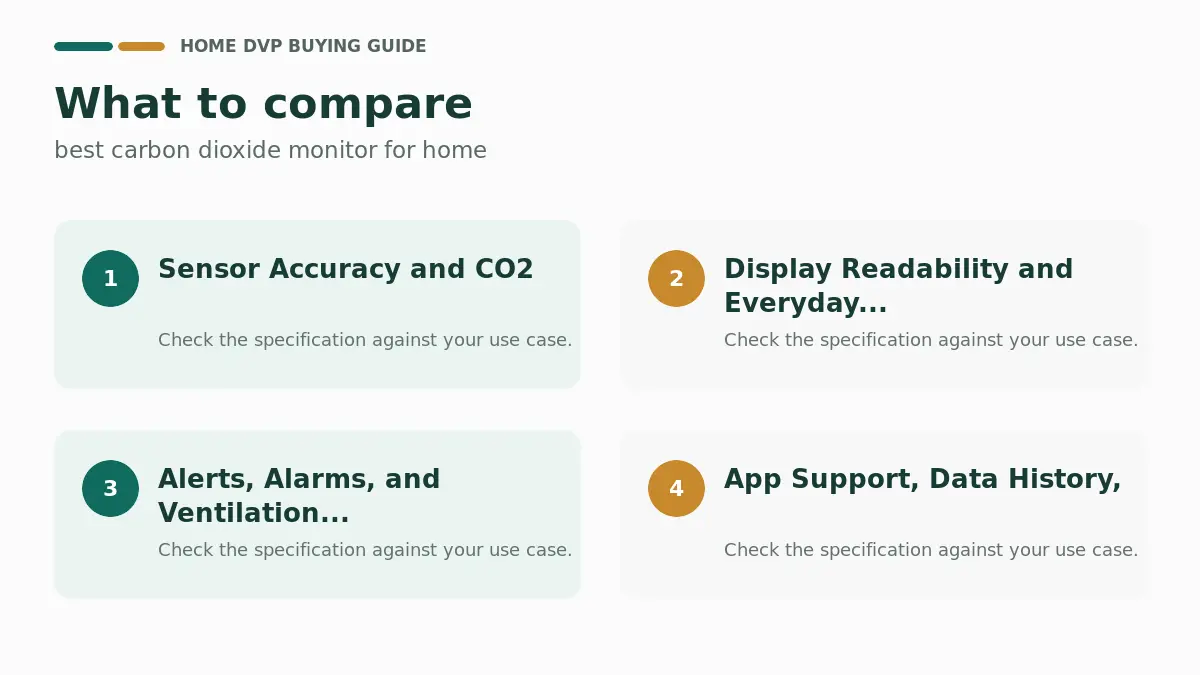
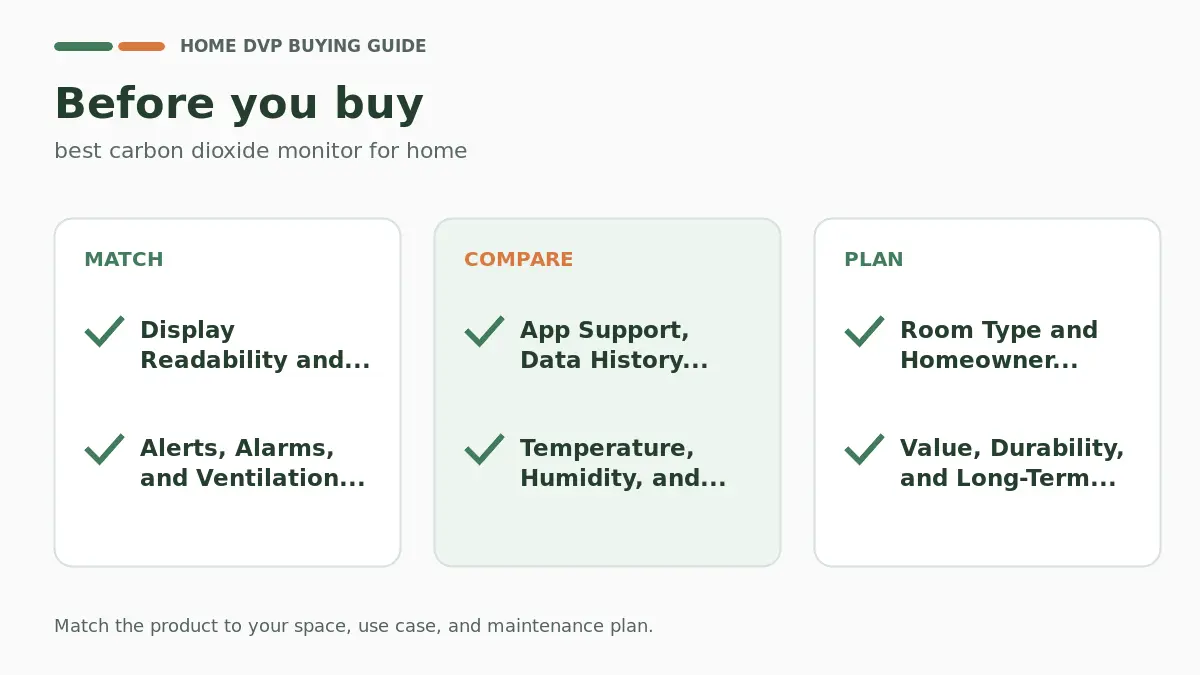
Before choosing best carbon dioxide monitor for home, it helps to understand the difference between basic household gas alarms and indoor air quality monitors. For this guide, we focused our recommendations on products that measure carbon dioxide levels for ventilation awareness. The most relevant models from the available data are the Aranet4 Home, SwitchBot CO2 Detector, and GoveeLife Smart Air Quality Monitor CO2 Detector H5140.

ModelBest FitKey StrengthPotential Limitation
Aranet4 HomeHomeowners who want a premium portable CO2 monitorNDIR sensing, e-ink display, long battery life, and app-based historyHigher-end option in the category
SwitchBot CO2 DetectorSmart home users and everyday room monitoringLarge display, app alerts, Swiss-made NDIR sensor, and portable designSome app notification features may require a compatible hub
GoveeLife Smart Air Quality Monitor CO2 Detector H5140Continuous bedroom, office, or nursery monitoringFast refresh rate, app tracking, smart assistant support, and outlet powerRequires AC power, so it is less travel-friendly

Sensor Accuracy and CO2 Measurement Technology

The most important feature in best carbon dioxide monitor for home is the sensor. Carbon dioxide monitors are commonly purchased to help identify stale indoor air, poor ventilation, or crowded-room buildup, so the reading should be easy to interpret and based on dependable sensing technology. In the available product data, the Aranet4 Home uses nondispersive infrared sensor technology, while the SwitchBot CO2 Detector lists a Swiss-made NDIR sensor and the GoveeLife H5140 uses a CO2 sensor based on a photoacoustic NDIR principle.

For homeowners, the practical takeaway is simple: prioritize models that specifically list CO2 measurement and give a real-time or frequently refreshed reading. Avoid assuming that every wall alarm or plug-in safety device tracks carbon dioxide. Some home safety devices are designed for other gases, and those are important for safety, but they do not replace a dedicated CO2 monitor for ventilation decisions.

A common mistake is buying a device because the name looks similar to what you need. Carbon dioxide and other household gas hazards are not the same measurement category. If your goal is to know when to ventilate a bedroom, home office, classroom, or greenhouse, choose a unit that clearly displays CO2 concentration and supports indoor air quality monitoring.

Display Readability and Everyday Use

A CO2 monitor is most useful when the reading is visible at a glance. The Aranet4 Home uses an e-ink screen with color-coded guidance and a prominent CO2 number, which is helpful for desks, nightstands, and classrooms where you do not want a bright screen running constantly. The SwitchBot CO2 Detector emphasizes a large multi-function display that shows CO2, temperature, humidity, time, date, and comfort level. The GoveeLife H5140 offers a display with CO2, temperature, humidity, and clock information.

Think about where the monitor will live. A bedroom monitor should be easy to read without creating distracting light at night. A home office monitor should show enough information to help you decide when to open a window or run a fan. A family room or nursery model should make alerts obvious without requiring constant app checking.

If you are already tuning your home comfort setup, display visibility pairs well with airflow improvements. For example, a CO2 monitor can tell you when air feels stale, while an air circulator fan may help move air within a room once you have a ventilation source.

Alerts, Alarms, and Ventilation Reminders

Alerts are one of the biggest differences between basic readout devices and more practical home monitors. The Aranet4 Home includes color coding and an optional buzzer to warn when CO2 concentration becomes too high. The SwitchBot CO2 Detector offers sound alerts, visual screen alerts, and app notifications when configured with the appropriate setup. The GoveeLife H5140 provides a triple alert system with buzzer, app notifications, and email reports when CO2, temperature, or humidity exceeds custom thresholds.

For most homes, customizable thresholds are more useful than a simple static display. A remote worker may want a prompt before afternoon drowsiness sets in. Parents may want notifications for a nursery or playroom. Someone monitoring a basement, workshop, or small apartment may prefer a louder local alarm because the monitor might not always be within view.

The main buying advice is to choose alerts that match your habits. If you rarely check apps, prioritize a visible display and audible alert. If you manage your home through smart devices, app notifications and history charts may be more valuable than a standalone beeper.

Power Source, Portability, and Placement

Power source affects how you will use best carbon dioxide monitor for home day to day. The Aranet4 Home is battery powered and designed for cable-free use, with an e-ink display that supports extended battery life. The SwitchBot CO2 Detector is also portable, includes a built-in battery, and can be placed on a surface or mounted. The GoveeLife H5140 is designed for continuous outlet power, which is ideal for fixed monitoring but less convenient if you want to move it from room to room.

Renters often benefit from portable monitors because they can move them between a bedroom, office, and living area without installation. Homeowners may prefer a fixed monitor in the room where they spend the most time, then use the data to make decisions about HVAC scheduling, air exchange, and ventilation habits. If you are optimizing heating and cooling comfort too, see our guide to smart thermostats for ideas on coordinating comfort settings with indoor air observations.

Placement also matters. Avoid putting the monitor directly beside an open window, fan, air vent, or breathing zone where readings may swing unusually high or low. A stable location at normal room height usually gives more useful trend data than constantly moving the monitor every few minutes.

App Support, Data History, and Smart Home Features

App support can turn a CO2 monitor from a simple number display into a planning tool. The Aranet4 Home app provides historical data and graphs, which is useful for identifying patterns during sleep, work hours, or family gatherings. The SwitchBot CO2 Detector supports app control and notifications, with some alert functions tied to a compatible hub. The GoveeLife H5140 offers long-term data tracking, exportable reports, and voice assistant compatibility.

Data history is especially helpful if you are trying to solve a recurring comfort issue. For example, if a home office feels stuffy every afternoon, a graph can show whether CO2 rises at the same time each day. In a bedroom, overnight data may reveal whether the room needs better ventilation before sleep or during early morning hours.

Smart home buyers should look beyond the app screenshot and check what functions work locally, what requires a hub, and whether voice assistant support is informational or can trigger useful routines. A monitor that only reports data may still be valuable, but a monitor that integrates with fans or other devices can make indoor air management easier.

Temperature, Humidity, and Whole-Room Comfort

Many homeowners shopping for best carbon dioxide monitor for home also care about temperature and humidity because those conditions affect comfort, sleep, and perceived air quality. The Aranet4 Home measures CO2, temperature, relative humidity, and atmospheric pressure. The SwitchBot CO2 Detector shows CO2, temperature, humidity, and comfort level. The GoveeLife H5140 combines CO2 readings with temperature and humidity data on its display and in the app.

This multi-sensor design is useful because stale air is rarely the only issue in a room. A bedroom may have acceptable CO2 but uncomfortable humidity. A home office may have rising CO2 and warm temperatures after several hours with the door closed. A nursery may require more careful temperature and humidity awareness along with ventilation monitoring.

If your home has dry winter air or inconsistent humidity, a CO2 monitor can be part of a broader comfort strategy. Our guide to whole house humidifiers may help if humidity control is also a priority.

Room Type and Homeowner Use Case

The right monitor depends on the room. For a bedroom, a dimmable or low-glare display, quiet operation, and reliable overnight data are valuable. For a home office, a large screen and quick refresh rate may matter more because you want to react during the workday. For a classroom, shared office, or family room, color coding and audible alerts help multiple people understand when ventilation is needed.

The Aranet4 Home is a strong fit for users who want premium portability and long battery life. The SwitchBot CO2 Detector makes sense for smart home users who want a large screen and notification options. The GoveeLife H5140 is well suited to fixed, continuous monitoring in a room where outlet power is available and long-term app data matters.

Do not overspend on features you will not use. If you only need a simple ventilation cue in one room, a clear display and dependable sensor may be enough. If you want to analyze patterns, export data, or connect with a broader smart home setup, a more connected model can justify the upgrade.

Value, Durability, and Long-Term Ownership

Value is not just the lowest cost in $23.99 – $189.00. It is the combination of reliable readings, useful alerts, practical power design, readable display, and features you will actually use. A portable monitor with long battery life may deliver better value for renters or teachers, while a plug-in smart monitor may be better for homeowners who want continuous room data without battery maintenance.

Durability also includes software support, battery expectations, calibration process, and whether the unit can be placed securely where it will not be knocked over. Based on available product information, the Aranet4 Home emphasizes premium build quality and European Union manufacturing, the SwitchBot model highlights a compact portable body with mounting options, and the GoveeLife model focuses on uninterrupted power and long-term data tracking.

For regular home maintenance, treat a CO2 monitor like a diagnostic tool. Use it to identify ventilation patterns, then pair those insights with air filtration, airflow, and humidity improvements. You can browse more related guides in our Air Quality & Climate category.

Our Research Methodology & Why You Can Trust Us

After comparing the listed specifications, we evaluated each product for category fit before making recommendations. Because the target is best carbon dioxide monitor for home, we only discussed products that clearly measure carbon dioxide for indoor air quality or ventilation awareness. Products that monitor a different household gas may be important safety devices, but they were not treated as direct recommendations for this guide.

Our research indicates that the most useful CO2 monitors for homeowners combine dependable sensing technology, clear displays, practical alerts, sensible power options, and room-friendly placement. We reviewed available product information for performance, features, build quality, ease of use, durability, safety-related alerts, value, reliability, and fit for common homeowner or renter use cases.

We also considered how each monitor would fit into real household routines, such as working from home, improving bedroom ventilation, managing nursery comfort, monitoring shared spaces, or tracking indoor air trends over time. This guide is updated during August to keep the buying advice aligned with current product data and the needs of practical home improvement shoppers.

We do not claim physical testing where the product data does not support it. Instead, this comparison is based on available product specifications, manufacturer-stated features, user-facing design details, and category-specific analysis. That approach helps keep the recommendations transparent and avoids overstating what can be concluded from the available information.
Final Thoughts

For most shoppers looking for best carbon dioxide monitor for home, the Aranet4 Home stands out as the premium pick because it combines NDIR CO2 monitoring, an easy-to-read e-ink display, app-based history, portability, and long battery life. It is especially appealing for homeowners, teachers, and remote workers who want a dedicated carbon dioxide monitor that can move between rooms without relying on an outlet.

The SwitchBot CO2 Detector is a strong homeowner and smart home pick thanks to its large display, Swiss-made NDIR sensor, portable design, and multiple alert options. It is a practical fit for living rooms, offices, bedrooms, and greenhouse spaces where you want quick visual feedback plus app-based awareness.

The GoveeLife Smart Air Quality Monitor CO2 Detector H5140 is the best fixed-room option from the valid product data. Its outlet-powered design, fast refresh rate, app tracking, exportable data, and smart assistant support make it a good choice for bedrooms, offices, nurseries, and kitchens where continuous monitoring is more important than portability. For a fuller indoor air strategy, consider pairing CO2 awareness with filtration, airflow, and humidity improvements across your home.

FAQ

What should I look for when choosing best carbon dioxide monitor for home?

Look for a monitor that clearly measures carbon dioxide, uses dependable CO2 sensing technology, and provides a readable display. Alerts, app history, battery life, and placement flexibility are also important depending on whether you need it for a bedroom, office, nursery, or shared living space.

Are higher-end best carbon dioxide monitor for home worth it?

Higher-end models can be worth it if you want better data history, premium display design, longer battery life, or stronger app support. If you only need a simple reminder to ventilate one room, a more basic CO2 monitor with a clear display may be enough.

Where should I place a carbon dioxide monitor at home?

Place it in the room where you spend the most time, such as a bedroom, office, classroom, or living area. Keep it away from open windows, direct vents, fans, and spots where someone breathes directly onto the sensor, because those locations can distort readings.

Do best carbon dioxide monitor for home improve indoor air quality by themselves?

No, a CO2 monitor measures conditions but does not remove carbon dioxide. It helps you decide when to ventilate, adjust airflow, or improve your HVAC habits. For broader air quality upgrades, our HVAC filter guide can help with filtration decisions.

About This Home DVP Research

Home DVP is an independent home-improvement research and product-comparison publisher. Ryan Mitchell prepared this guide by comparing manufacturer specifications, compatibility details, retailer-provided product data, key limitations, and common homeowner use cases. We do not claim hands-on testing unless an article explicitly says so.