
Choosing the best Water Filter For Lead is not just about improving taste. In older homes, rental properties, and neighborhoods with aging service lines, lead reduction should be treated as a serious kitchen and bathroom safety upgrade. The right filter can help reduce specific contaminants, fit your sink or refrigerator routine, and make daily drinking water easier to manage without relying on bottled water.
After carefully analyzing the available specifications, certifications, filter life claims, installation requirements, and everyday homeowner use cases, we compared 13 products across the listed $25.99–$235 range. We focused on models that clearly relate to drinking-water filtration, with special attention to lead-reduction claims, NSF, ANSI, WQA, or IAPMO references, cartridge maintenance, capacity, and setup difficulty.
Home DVP decision summary
Quick Answer
For Best Water Filter For Lead, Home DVP compared 13 products from 6 brands. Select a filter certified by an accredited third party for lead reduction, then verify the exact replacement cartridge, rated capacity, flow rate, and change schedule. Certification claims should match the contaminant in the water test.
| Comparison coverage | 13 products from 6 brands, including Brita, Waterdrop, PUR. |
|---|---|
| Selection priority | Select a filter certified by an accredited third party for lead reduction, then verify the exact replacement cartridge, rated capacity, flow rate, and change schedule. Certification claims should match the contaminant in the water test. |
| Evidence basis | Manufacturer specifications, compatibility details, retailer-provided product data, and common homeowner use cases. |
| Reference guidance | EPA guidance for filters certified to reduce lead. |
This summary describes the article's comparison set, not every product on the market. Product details should be confirmed before purchase.
If you are planning a broader kitchen or bath update, it may also be worth reviewing our Kitchen & Bathroom category for related fixture, water, and home improvement guides. This guide focuses specifically on the best water filter for lead and how to choose a filter that makes sense for renters, homeowners, families, and DIY-minded shoppers.
Best Water Filter For Lead Buying Guide
Based on our detailed comparison, the strongest choices for lead-focused filtration are the models that clearly state lead-reduction performance or cite third-party standards related to contaminant reduction. Systems such as the iSpring RCC7AK, CuZn Under Sink Water Filter, Waterdrop 15UA, PUR Plus faucet filters, Brita Elite dispenser, ZeroWater 10-Cup Ready-Pour pitcher, and Clearly Filtered pitcher are all relevant because their product data directly addresses lead or contaminant reduction. Standard taste-and-odor filters can still be useful for chlorine taste, but they should not be treated as a dedicated lead solution unless the compatible filter being used is certified or rated for lead reduction.
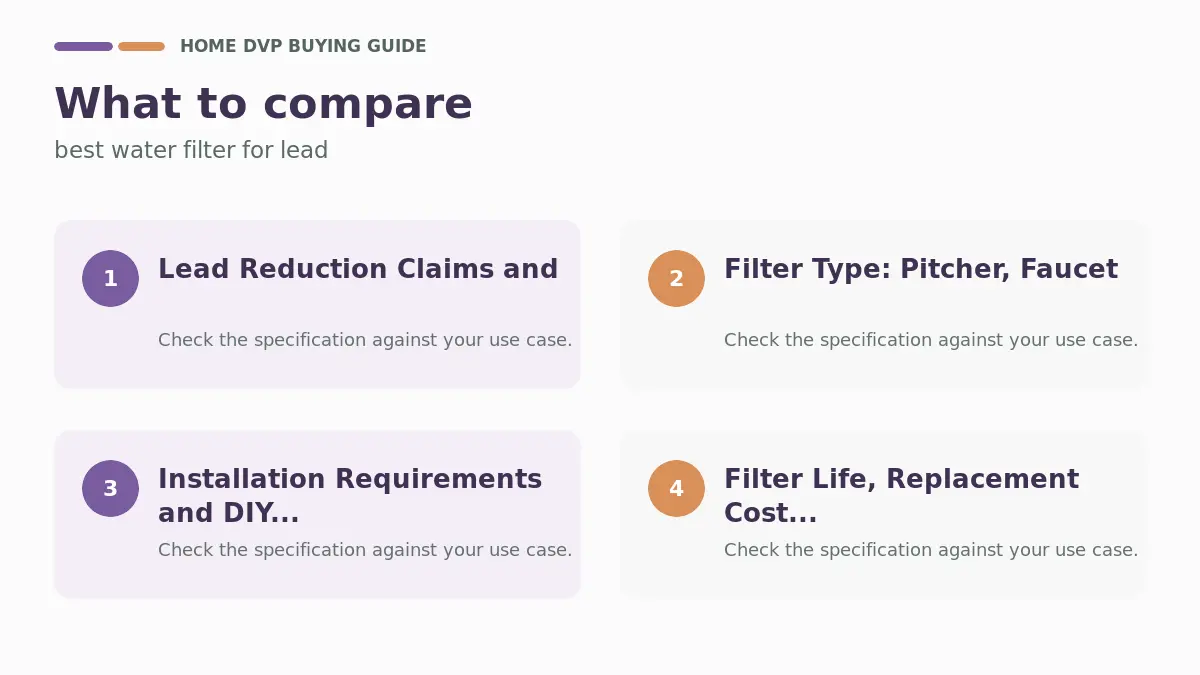
Lead Reduction Claims and Certifications
The first specification to check when shopping for the best water filter for lead is the lead-reduction claim. Look for clear language tied to third-party standards, such as NSF/ANSI, WQA, or IAPMO references. A vague phrase like “improves water quality” is not the same as a stated lead-reduction claim.
For example, the iSpring RCC7AK lists NSF 58 certification for the reverse osmosis system and states a lead reduction figure in its performance data. The PUR Plus faucet-mount filters cite WQA certification to reduce lead, while the Brita Elite dispenser states WQA NSF/ANSI certification for reducing lead. ZeroWater also lists IAPMO certification to reduce lead, and the Waterdrop 15UA references third-party testing against NSF/ANSI 53 for lead reduction.
A common mistake is buying a pitcher or faucet filter based only on brand recognition without checking which cartridge is included. Some systems are compatible with more advanced lead-reducing cartridges, while the included standard filter may focus more on chlorine taste, odor, copper, mercury, or other impurities. Always match the filter cartridge to the contaminant you care about most.
| Filter Type | Best Use Case | Lead-Focused Buying Tip |
|---|---|---|
| Reverse osmosis | Dedicated under-sink drinking water | Check full-system certification and replacement filter schedule |
| Under-sink inline filter | Cleaner water from an existing faucet | Confirm lead-reduction testing and faucet compatibility |
| Faucet-mount filter | Renters and fast setup | Verify it fits your faucet style before buying |
| Pitcher or dispenser | Fridge or countertop use | Use the lead-reducing cartridge, not just a standard taste filter |
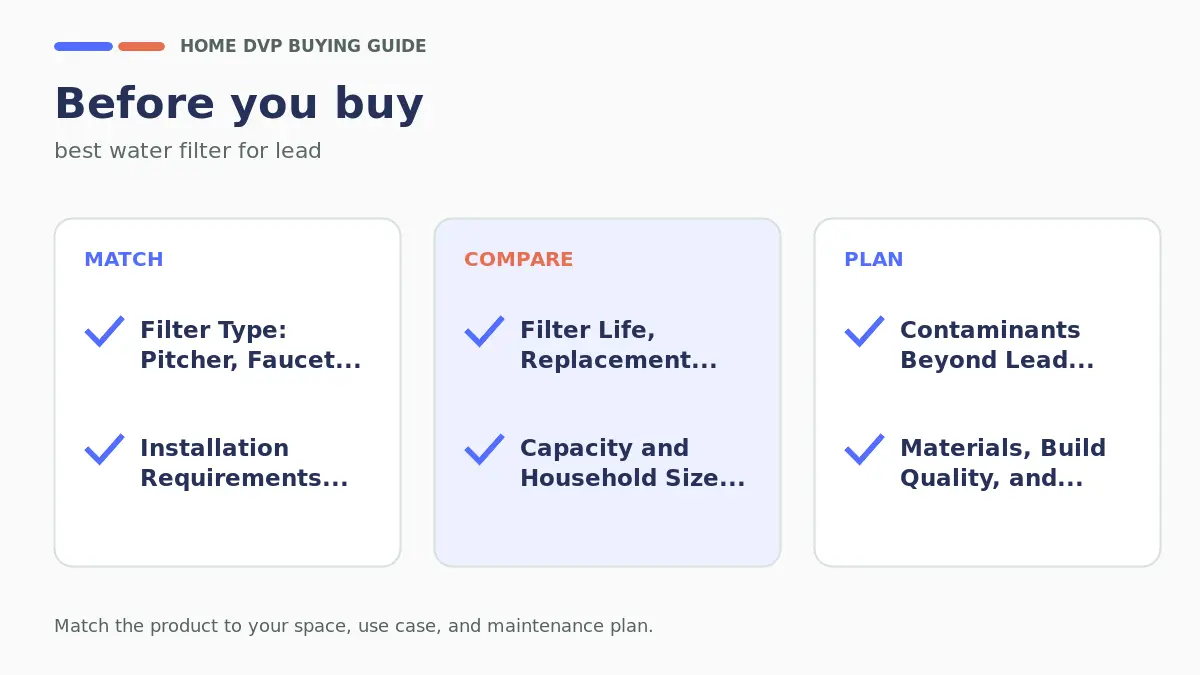
Filter Type: Pitcher, Faucet Mount, Under Sink, or Reverse Osmosis
The best format depends on your home, lease situation, counter space, and how much filtered water your household uses. Pitchers and dispensers are easy for renters because they need no plumbing changes. Faucet-mounted filters like the PUR Plus models are also renter-friendly, but they require a compatible faucet with an external aerator.
Under-sink filters such as the CuZn Under Sink Water Filter and Waterdrop 15UA keep the countertop clear and deliver filtered water directly from the sink. These are strong choices for homeowners who want a more permanent setup without necessarily installing a separate reverse osmosis faucet. The iSpring RCC7AK is a more involved under-sink reverse osmosis system, but it offers broader contaminant reduction and remineralization for households that want a dedicated drinking-water system.
If you are also upgrading fixtures, review faucet compatibility before choosing a filtration system. Our guide to the best touchless faucet can help you think through sink layout, faucet clearance, and installation planning before committing to an under-sink setup.
Installation Requirements and DIY Difficulty
Installation is one of the biggest differences between lead-reducing water filters. Pitchers and dispensers require only filter soaking, priming, or flushing according to the manufacturer instructions. Faucet filters typically attach in minutes, but they may not work with pull-out, handheld, or nonstandard faucets.
Under-sink systems require more planning. The Waterdrop 15UA is designed as a direct-connect cold-water filter with push-to-connect fittings, while the CuZn model is positioned as a simple inline faucet connection with included parts. The iSpring RCC7AK has more stages and a dedicated faucet design, so homeowners should expect a more detailed installation process even though the product data describes it as DIY-friendly.
Before buying, look under your sink and confirm available cabinet space, water shutoff access, tubing size, and whether you are comfortable working around supply lines. Renters should also check lease rules before installing anything that changes plumbing connections.
Filter Life, Replacement Cost, and Maintenance
Filter life affects convenience as much as long-term value. A lower upfront cost can become less attractive if replacement cartridges are frequent or expensive. Conversely, a higher-cost under-sink system may be a better fit for a busy household if it has a longer service interval and easy replacement access.
The CuZn Under Sink Water Filter stands out in the product data for its long filter-life claim, while Waterdrop emphasizes a long service life for municipal cold-water use. Brita Elite lists a longer filter life than standard Brita filters, while PUR Plus faucet filters include a filter-change light to reduce guesswork. ZeroWater includes a TDS meter, which can help users identify when filtration performance is changing, though TDS readings do not specifically measure lead.
One common homeowner mistake is installing a filter and forgetting about it. Any filter can become less effective if it is used past its rated capacity. Put replacement dates on your calendar, especially if you have children, an older home, or known lead concerns in your plumbing system.
Capacity and Household Size
Capacity matters because a filter only helps if your household actually uses it. A small pitcher may be fine for one person or a home office, but it can become frustrating for a family that cooks, fills bottles, and drinks filtered water throughout the day. Larger dispensers, under-sink systems, and reverse osmosis units are usually more convenient for daily family use.
The Brita Elite dispenser is a practical option for households that want a refrigerator or countertop dispenser with lead-reducing cartridge compatibility. The Clearly Filtered pitcher and ZeroWater pitcher are better for shoppers who want portable, no-installation filtration with stronger contaminant-focused claims than basic taste filters. For continuous sink access, the CuZn, Waterdrop, and iSpring systems are more convenient because you are not refilling a container.
Think about your real routine. If your family already struggles to keep a pitcher full, an under-sink system may lead to better compliance. If you live in an apartment and cannot modify plumbing, a dispenser or faucet filter may be the more practical choice.
Contaminants Beyond Lead
Although this guide is centered on the best water filter for lead, many shoppers also care about chlorine taste, PFAS, microplastics, mercury, chromium, fluoride, or general dissolved solids. Not every filter addresses the same contaminants, and no single label tells the whole story. Read the performance claims and certification details carefully.
The iSpring RCC7AK lists broad reverse osmosis reduction claims for contaminants including lead, PFAS, chlorine, fluoride, and other substances. Clearly Filtered targets a wide contaminant list and emphasizes publicly available removal rates. ZeroWater focuses on a multi-stage ion exchange filter and very low TDS taste, while CuZn and Waterdrop emphasize lead, chlorine, PFAS-related contaminants, and heavy metals based on their listed data.
If your main issue is hard water rather than lead, a drinking-water filter may not solve scale buildup on fixtures or appliances. For that separate problem, see our guide to the best water softener for whole-home hardness control considerations.
Materials, Build Quality, and Safety Details
Because these products contact drinking water, material quality matters. Look for BPA-free materials, lead-free component standards, and certifications such as NSF/ANSI 372 where provided. Under-sink systems should also have reliable fittings, secure tubing connections, and housings that are easy to inspect or replace.
The Waterdrop 15UA lists lead-free and BPA-free materials with IAPMO certification against NSF/ANSI 372. The CuZn model also references NSF/ANSI 42 and 372 certified components or materials. Clearly Filtered highlights medical-grade Tritan plastic that is BPA-free and BPS-free, while several pitcher and dispenser models are described as BPA-free.
For under-sink filters, build quality also includes leak prevention. Homeowners should make sure fittings are fully seated, cold-water connections are used where required, and the filter is mounted where it will not be knocked loose by cleaning supplies or stored items.
Value Across the $25.99–$235 Range
Value is not always the lowest upfront cost. A faucet filter can be a smart short-term solution, especially for renters or small households, while a more expensive reverse osmosis or under-sink system may make sense for homeowners who want higher capacity and less countertop clutter. The listed products span the $25.99–$235 range, so it is important to compare both purchase cost and replacement needs.
Budget-focused shoppers should look closely at PUR Plus faucet filters, ZeroWater, and Brita Elite if the form factor fits their home. Homeowners who want longer service intervals may prefer CuZn or Waterdrop. Shoppers seeking broader contaminant reduction may see stronger value in the iSpring RCC7AK or Clearly Filtered, depending on installation preference and maintenance expectations.
If you are renovating a kitchen and replacing multiple sink-area components, consider the total project, not just the filter. Related upgrades such as a garbage disposal can affect under-sink space, making filter size and mounting location even more important.
Our Research Methodology & Why You Can Trust Us
We evaluated the products based on available product information, listed specifications, contaminant-reduction claims, third-party certification references, installation requirements, capacity, maintenance needs, and suitability for real household use. We did not claim hands-on testing, and our recommendations are based on the product data provided, user-facing specifications, and category fit validation.
Our research indicates that the most important ranking factors for the best water filter for lead are lead-reduction credibility, filtration performance, build quality, ease of use, durability, safety-related materials, value, reliability, and fit for homeowners, renters, and DIY users. Products that clearly referenced lead reduction were given stronger consideration than filters that mainly address taste and odor.
We also considered whether each product belongs in the Kitchen & Bathroom category and whether it makes sense for drinking-water use. Models that did not clearly match the lead-filtering purpose should not be treated as primary recommendations, even if they are useful for general water taste improvement.
This guide is structured for regular updates during July so homeowners can compare current product information, changing availability, and updated specifications. For more kitchen and bath planning ideas, browse our best bidet and best bidet toilet seat guides.
Final Thoughts
For an overall pick, the iSpring RCC7AK is the strongest option for homeowners who want a dedicated under-sink reverse osmosis system with broad contaminant reduction and remineralization. It requires more installation planning than a pitcher or faucet filter, but its feature set is well suited to households that want a more complete drinking-water upgrade.
For an easy setup pick, the PUR Plus Vertical Faucet-Mount Water Filtration System is a practical choice for renters or homeowners who want lead-reducing filtration without under-sink work, provided the faucet is compatible. For a small-space or no-installation pick, the Brita Elite dispenser, ZeroWater 10-Cup Ready-Pour pitcher, and Clearly Filtered pitcher are useful options, with the reminder that the exact filter cartridge and certification details matter.
For long-term under-sink value, the CuZn Under Sink Water Filter and Waterdrop 15UA are worth comparing because both are designed for direct sink use and list lead-related reduction claims. The right best water filter for lead ultimately depends on your water concerns, plumbing setup, filter replacement habits, and whether you need a renter-friendly solution or a more permanent kitchen upgrade.
FAQ
What should I look for when choosing the best water filter for lead?
Start with a clear lead-reduction claim supported by recognized standards or third-party certification references. Then compare filter type, installation needs, cartridge life, capacity, and whether the product fits your sink, refrigerator, or countertop routine.
Are higher-end water filter for lead worth it?
Higher-end options can be worth it when they provide broader contaminant reduction, longer service life, or a more convenient under-sink setup. However, a lower-cost faucet filter or pitcher may be a better fit for renters, small spaces, or short-term use.
Can best water filter for lead replace a water softener?
No. A drinking-water filter focused on lead reduction is not the same as a whole-home softening system for hard water scale. If hardness, mineral buildup, or appliance scale is your main issue, review a dedicated water softener buying guide in addition to choosing a drinking-water filter.
Are the best water filter for lead suitable for renters?
Many are suitable for renters, especially pitchers, dispensers, and compatible faucet-mount filters. Under-sink systems may still work in rentals, but tenants should confirm lease rules and avoid plumbing changes that cannot be reversed easily.
About This Home DVP Research
Home DVP is an independent home-improvement research and product-comparison publisher. Ryan Mitchell prepared this guide by comparing manufacturer specifications, compatibility details, retailer-provided product data, key limitations, and common homeowner use cases. We do not claim hands-on testing unless an article explicitly says so.
Review methodology Affiliate disclosure Last reviewed September 10, 2026