
Choosing the best Scratch Resistant Flooring For Large Dogs is different from choosing ordinary floor covering. Large dogs add concentrated pressure from claws, fast turns, water bowls, muddy paws, and the occasional accident, so homeowners and renters need surfaces that protect the subfloor while staying safe underfoot. This updated 2026 guide is designed for practical buyers who want better traction, easier cleanup, and less visible damage in high-use rooms.
After carefully analyzing the available specifications, We compared the listed products and focused our recommendations on options that clearly fit the flooring, floor protection, or surface-covering needs of homes with large dogs. We considered material type, surface texture, water resistance, slip control, coverage area, installation effort, cleaning needs, and long-term value. For more home surface and renovation resources, you can also browse the Building Materials section at Home DVP.
Home DVP decision summary
Quick Answer
For Best Scratch Resistant Flooring For Large Dogs, Home DVP compared 15 products from 14 brands. Compare wear-layer or finish durability, scratch visibility, traction, water resistance, repairability, and room acoustics. Samples tested with the dog present provide better evidence than a generic hardness claim, and low-emitting materials can support indoor-air goals.
| Comparison coverage | 15 products from 14 brands, including G-Floor, PICK FOR LIFE, Sunheir. |
|---|---|
| Selection priority | Compare wear-layer or finish durability, scratch visibility, traction, water resistance, repairability, and room acoustics. Samples tested with the dog present provide better evidence than a generic hardness claim, and low-emitting materials can support indoor-air goals. |
| Evidence basis | Manufacturer specifications, compatibility details, retailer-provided product data, and common homeowner use cases. |
| Reference guidance | EPA guidance on VOCs and indoor air quality. |
This summary describes the article's comparison set, not every product on the market. Product details should be confirmed before purchase.
One important note: not every pet mat or training pad is the same as scratch resistant flooring. Some products are better for temporary accident control, while others are better for protecting hardwood, concrete, low-pile carpet, entryways, kitchens, and living areas. This guide separates durable floor protection from general pet-care accessories so you can make a cleaner buying decision.
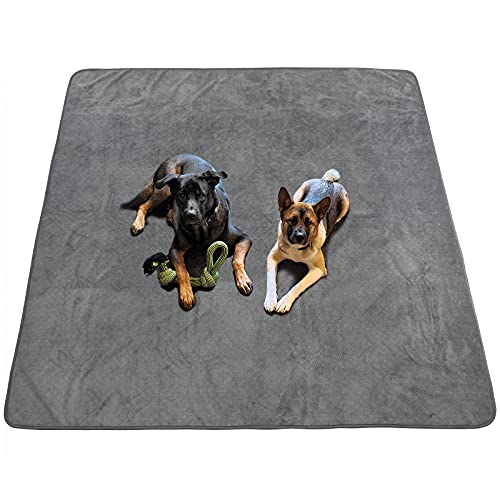
Pros
- Extra-large coverage is useful for puppy pens, senior-dog accident protection, and larger furniture or floor areas.
- Reusable washing options make it practical for ongoing training and routine pet care.
Cons
- The large footprint may be difficult to position, fold, or store in smaller rooms and compact living spaces.
- The supplied information lists both a 65-by-48-inch size and dimensions of 64 by 48 inches, so buyers should confirm the expected fit before ordering.
Specifications
| Color | Gray |
|---|---|
| Size | 65“x48" |
| Dimensions | 64 x 48 x 0.1 inches |
| Product Group | Pet Products |
| Binding | Kitchen |
Verify the current product variation before purchase; specifications may change.
Best For / Avoid If
Best for buyers prioritizing
- Extra-large coverage is useful for puppy pens, senior-dog accident protection, and larger furniture or floor areas.
- Reusable washing options make it practical for ongoing training and routine pet care.
- Non-slip waterproof backing adds stability while helping contain moisture on hard floors.
Consider another option if
- The large footprint may be difficult to position, fold, or store in smaller rooms and compact living spaces.
- The supplied information lists both a 65-by-48-inch size and dimensions of 64 by 48 inches, so buyers should confirm the expected fit before ordering.
- Drying instructions call for low heat or hanging, which may add time between uses.

Pros
- Large coverage area for crates, enclosures, beds, and open floor spaces
- Washable construction with two pads included for easier rotation
Cons
- The 36-by-48-inch size may require more storage and floor space than smaller training pads
- Washing and drying are still necessary after use, so it may be less convenient than disposable options for some households
Specifications
| Color | Leaves - Deep Grey |
|---|---|
| Size | 36x48 Inch (Pack of 2) |
| Dimensions | 48 x 36 x 0.1 inches |
| Weight | 3.06001619656 pounds |
| Product Group | BISS |
| Binding | Kitchen |
Verify the current product variation before purchase; specifications may change.
Best For / Avoid If
Best for buyers prioritizing
- Large coverage area for crates, enclosures, beds, and open floor spaces
- Washable construction with two pads included for easier rotation
- Non-slip backing helps limit shifting during everyday use
Consider another option if
- The 36-by-48-inch size may require more storage and floor space than smaller training pads
- Washing and drying are still necessary after use, so it may be less convenient than disposable options for some households
- The provided information does not specify a measured liquid capacity beyond the stated absorbency and overnight-use claims

Pros
- High listed liquid capacity for overnight or extended coverage
- Large coverage area for whelping boxes and puppy playpens
Cons
- The 72x72-inch footprint may be cumbersome for small rooms, crates, or compact storage areas
- Only one pad is included, and the cage shown in the product description is not included
Specifications
| Color | Gray |
|---|---|
| Size | 72x72 Inch (Pack of 1) |
| Dimensions | 72 x 72 x 0.0393700787 inches |
| Weight | 3.527396192 pounds |
| Product Group | Pet Products |
| Binding | Kitchen |
Verify the current product variation before purchase; specifications may change.
Best For / Avoid If
Best for buyers prioritizing
- High listed liquid capacity for overnight or extended coverage
- Large coverage area for whelping boxes and puppy playpens
- Washable design offers a practical alternative to disposable pads
Consider another option if
- The 72x72-inch footprint may be cumbersome for small rooms, crates, or compact storage areas
- Only one pad is included, and the cage shown in the product description is not included
- The available information does not specify drying time or how quickly the pad dries between washes

Pros
- Extra-large dimensions provide substantial coverage for larger spaces and active pet areas
- Waterproof backing helps protect underlying surfaces from urine penetration
Cons
- The large 72 x 72-inch size may be cumbersome for small rooms, compact crates, or limited storage areas
- The available product details do not specify washing instructions, drying time, or care requirements
Specifications
| Color | Gray |
|---|---|
| Size | 72"X72"(2Pack) |
| Dimensions | 72 x 72 x 0.0393700787 inches |
| Product Group | Pet Products |
| Binding | Kitchen |
Verify the current product variation before purchase; specifications may change.
Best For / Avoid If
Best for buyers prioritizing
- Extra-large dimensions provide substantial coverage for larger spaces and active pet areas
- Waterproof backing helps protect underlying surfaces from urine penetration
- Reusable design can support a more sustainable and economical potty-training routine
Consider another option if
- The large 72 x 72-inch size may be cumbersome for small rooms, compact crates, or limited storage areas
- The available product details do not specify washing instructions, drying time, or care requirements
- The product is gray only, so color selection is limited

Pros
- Large surface accommodates scratching and resting for medium and large pets.
- Protective waterproof backing helps keep floors and crate interiors drier.
Cons
- The 36 x 24 inch footprint may be too large for small crates or tight storage areas.
- The provided information does not specify whether the mat is suitable for outdoor exposure beyond listed outdoor travel and courtyard use.
Specifications
| Color | Browm |
|---|---|
| Size | 36.0" L x 24.0" W |
| Dimensions | 36 x 24 x 0.6 inches |
| Weight | 0.220462262 pounds |
| Product Group | Pet Products |
Verify the current product variation before purchase; specifications may change.
Best For / Avoid If
Best for buyers prioritizing
- Large surface accommodates scratching and resting for medium and large pets.
- Protective waterproof backing helps keep floors and crate interiors drier.
- Washable, foldable construction supports easier maintenance and transport.
Consider another option if
- The 36 x 24 inch footprint may be too large for small crates or tight storage areas.
- The provided information does not specify whether the mat is suitable for outdoor exposure beyond listed outdoor travel and courtyard use.
- A scratching pad may not meet the needs of owners seeking a freestanding scratching post or vertical scratching option.

Pros
- Extra-large coverage is useful for protecting broad floor or furniture surfaces.
- Washable design allows the pad to be cleaned with ordinary laundry.
Cons
- The oversized footprint may be inconvenient for small rooms, crates, or limited storage areas.
- Because the package includes one pad, there is no spare available while it is being washed.
Specifications
| Color | Gray |
|---|---|
| Size | 72*80 Inch (Pack of 1) |
| Dimensions | 80 x 72 x 0.1 inches |
| Product Group | BISS |
Verify the current product variation before purchase; specifications may change.
Best For / Avoid If
Best for buyers prioritizing
- Extra-large coverage is useful for protecting broad floor or furniture surfaces.
- Washable design allows the pad to be cleaned with ordinary laundry.
- Anti-slip backing is intended to help limit movement on hard floors.
Consider another option if
- The oversized footprint may be inconvenient for small rooms, crates, or limited storage areas.
- Because the package includes one pad, there is no spare available while it is being washed.
- The provided information does not specify washing temperatures, drying time, or a replacement schedule.
Pros
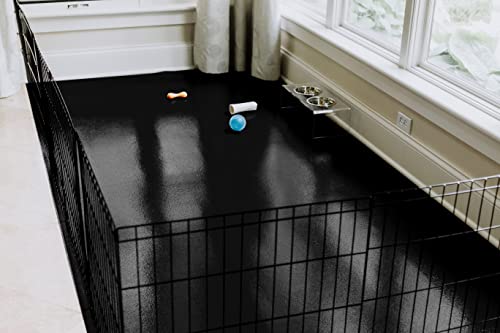
- Large surface area provides substantial floor coverage.
- Liquid-resistant protection helps keep moisture away from listed flooring surfaces.
Cons
- The 5-by-10-foot format may be difficult to place or store in smaller rooms.
- At 23 pounds, repositioning may require more effort than with a smaller mat.
Specifications
| Color | Midnight Black |
|---|---|
| Size | 120"L x 60"W |
| Weight | 23 pounds |
| Product Group | Pet Products |
Verify the current product variation before purchase; specifications may change.
Best For / Avoid If
Best for buyers prioritizing
- Large surface area provides substantial floor coverage.
- Liquid-resistant protection helps keep moisture away from listed flooring surfaces.
- Textured grip and straightforward cleaning support easier daily maintenance.
Consider another option if
- The 5-by-10-foot format may be difficult to place or store in smaller rooms.
- At 23 pounds, repositioning may require more effort than with a smaller mat.
- The product information does not specify included accessories or installation details.

Pros
- Large 5-by-10-foot footprint for wider floor coverage
- Listed compatibility with hardwood, concrete, and low-pile carpet
Cons
- The 29-pound weight and large dimensions may make storage or frequent repositioning inconvenient
- The 0.1-inch thickness may not provide the cushioning of a thicker pet mat
Specifications
| Color | Slate Grey |
|---|---|
| Size | 120"L x 60"W x 0.1"Th |
| Weight | 29 Pounds |
| Product Group | Pet Products |
Verify the current product variation before purchase; specifications may change.
Best For / Avoid If
Best for buyers prioritizing
- Large 5-by-10-foot footprint for wider floor coverage
- Listed compatibility with hardwood, concrete, and low-pile carpet
- Neutral Slate Grey color and ribbed surface design
Consider another option if
- The 29-pound weight and large dimensions may make storage or frequent repositioning inconvenient
- The 0.1-inch thickness may not provide the cushioning of a thicker pet mat
- The supplied information does not identify included accessories or additional installation features

Pros
- Generous coverage for larger play areas and floor sections
- Reusable, machine-washable design for ongoing training routines
Cons
- The one-pad package may require careful scheduling when the pad is being washed.
- The 82-by-82-inch footprint may be too large for small rooms, crates, or compact storage areas.
Best For / Avoid If
Best for buyers prioritizing
- Generous coverage for larger play areas and floor sections
- Reusable, machine-washable design for ongoing training routines
- Soft fleece top combined with a stabilizing non-slip underside
Consider another option if
- The one-pad package may require careful scheduling when the pad is being washed.
- The 82-by-82-inch footprint may be too large for small rooms, crates, or compact storage areas.
- The provided specifications do not state a maximum urine capacity or drying time.

Pros
- Clear design protects the floor without concealing its existing finish.
- Wipe-clean surface makes it useful for food spills, pet messes, and other household debris.
Cons
- The 8x10-foot size may be cumbersome to move or store when not in use.
- A transparent mat offers floor protection but does not provide the decorative pattern or softness of a traditional fabric rug.
Specifications
| Color | Shiny Transparent |
|---|---|
| Size | 8' x 10' (Rectangular) |
| Dimensions | 120 x 96 x 0.06 inches |
| Weight | 27.55 pounds |
| Product Group | Furniture |
Verify the current product variation before purchase; specifications may change.
Best For / Avoid If
Best for buyers prioritizing
- Clear design protects the floor without concealing its existing finish.
- Wipe-clean surface makes it useful for food spills, pet messes, and other household debris.
- Large rectangular coverage can help protect more flooring around tables, seating, or other high-use areas.
Consider another option if
- The 8x10-foot size may be cumbersome to move or store when not in use.
- A transparent mat offers floor protection but does not provide the decorative pattern or softness of a traditional fabric rug.
- The listed dimensions are intended for hard floors, so buyers should confirm their intended surface before purchase.

Pros
- Generous 72-by-72-inch surface is suitable for large dogs, multiple pets, and spacious containment areas.
- Waterproof polyester construction combines a soft feel with a barrier intended to help prevent leaks through to the floor.
Cons
- The oversized 72-by-72-inch footprint may be difficult to place or store in smaller rooms.
- A two-pad set may require planning around wash and dry cycles when both pads become soiled.
Specifications
| Color | Brown |
|---|---|
| Size | 72x72 Rectangle-2Pack |
| Dimensions | 72 x 72 x 0.1 inches |
| Product Group | BISS |
| Binding | Kitchen |
Verify the current product variation before purchase; specifications may change.
Best For / Avoid If
Best for buyers prioritizing
- Generous 72-by-72-inch surface is suitable for large dogs, multiple pets, and spacious containment areas.
- Waterproof polyester construction combines a soft feel with a barrier intended to help prevent leaks through to the floor.
- Reusable design and included backup pad make ongoing pet cleanup more manageable.
Consider another option if
- The oversized 72-by-72-inch footprint may be difficult to place or store in smaller rooms.
- A two-pad set may require planning around wash and dry cycles when both pads become soiled.
- The listed absorption time is about one minute, so users may prefer to monitor heavily used areas.

Pros
- Combines waterproof floor protection with a washable design for simpler pet-mess cleanup.
- Low-profile construction is suited to doorways and routine vacuuming.
Cons
- The 24-by-72-inch size may not cover wider rooms or longer walking paths.
- Because it ships folded, temporary creases may need several days to flatten or require reverse-rolling or low-heat drying.
Specifications
| Color | Sky Black |
|---|---|
| Size | 2' x 6' (Runner) |
| Dimensions | 12.59 x 9.84 x 5.11 Inches |
| Product Group | Furniture |
Verify the current product variation before purchase; specifications may change.
Best For / Avoid If
Best for buyers prioritizing
- Combines waterproof floor protection with a washable design for simpler pet-mess cleanup.
- Low-profile construction is suited to doorways and routine vacuuming.
- Textured loop pile offers cushioning for feet and paw traction without snagging nails.
Consider another option if
- The 24-by-72-inch size may not cover wider rooms or longer walking paths.
- Because it ships folded, temporary creases may need several days to flatten or require reverse-rolling or low-heat drying.
- The available product information does not specify additional size or color options.

Pros
- Reusable PVC construction is suited to ongoing pet cleanup needs.
- Non-slip backing can provide added stability on different floor surfaces.
Cons
- The supplied measurements are inconsistent, so buyers should confirm the actual dimensions before ordering.
- A single large piece may be less convenient to move or store in smaller homes.
Specifications
| Color | Dark Gray |
|---|---|
| Dimensions | 60.63 x 5.51 x 0.1 inches |
| Product Group | BISS |
Verify the current product variation before purchase; specifications may change.
Best For / Avoid If
Best for buyers prioritizing
- Reusable PVC construction is suited to ongoing pet cleanup needs.
- Non-slip backing can provide added stability on different floor surfaces.
- Large sheet format offers flexible coverage for multiple dog-related applications.
Consider another option if
- The supplied measurements are inconsistent, so buyers should confirm the actual dimensions before ordering.
- A single large piece may be less convenient to move or store in smaller homes.
- It is a floor covering rather than a complete containment system, so separate playpen or kennel equipment may still be needed.

Pros
- Large roll format can reduce visible breaks compared with using many separate planks or tiles.
- Peel-and-stick application offers a straightforward path for renter-friendly and DIY renovation projects.
Cons
- Installation depends on a smooth, clean, dry, dust-free, and level surface, so preparation may take additional time.
- The long roll format may require careful handling and planning when cutting around corners, fixtures, or irregular spaces.
Specifications
| Color | Grey |
|---|---|
| Size | 590"L*11.8"W(48.4 Sq.Ft.) |
| Dimensions | 590 x 11.8 x 0.02 Inches |
| Product Group | Home Improvement |
Verify the current product variation before purchase; specifications may change.
Best For / Avoid If
Best for buyers prioritizing
- Large roll format can reduce visible breaks compared with using many separate planks or tiles.
- Peel-and-stick application offers a straightforward path for renter-friendly and DIY renovation projects.
- Wood-grain appearance, scratch resistance, and damp-cloth cleaning provide useful everyday practicality.
Consider another option if
- Installation depends on a smooth, clean, dry, dust-free, and level surface, so preparation may take additional time.
- The long roll format may require careful handling and planning when cutting around corners, fixtures, or irregular spaces.
- Scissors are recommended for smoother, more accurate cuts, and the provided data does not list additional installation accessories.

Pros
- Wood grain printing gives cushioned foam flooring a more finished appearance than plain-colored mats.
- No-adhesive interlocking installation supports quick DIY setup and straightforward removal.
Cons
- The listed applications focus on indoor spaces, so buyers seeking confirmed outdoor flooring suitability may need a different option.
- At 3/8 inch thick, the tiles may not satisfy shoppers specifically looking for a thicker foam surface.
Specifications
| Color | Grey |
|---|---|
| Size | 24 Pack |
| Dimensions | 24 x 0.38 x 24 inches |
| Product Group | Home Improvement |
| Binding | Kitchen |
Verify the current product variation before purchase; specifications may change.
Best For / Avoid If
Best for buyers prioritizing
- Wood grain printing gives cushioned foam flooring a more finished appearance than plain-colored mats.
- No-adhesive interlocking installation supports quick DIY setup and straightforward removal.
- Suitable for varied indoor uses, including playrooms, basements, yoga areas, dorms, classrooms, offices, and trade shows.
Consider another option if
- The listed applications focus on indoor spaces, so buyers seeking confirmed outdoor flooring suitability may need a different option.
- At 3/8 inch thick, the tiles may not satisfy shoppers specifically looking for a thicker foam surface.
- The product information describes durability for common foot traffic, which may limit its fit for heavier-duty flooring needs.
Best Scratch Resistant Flooring For Large Dogs Buying Guide
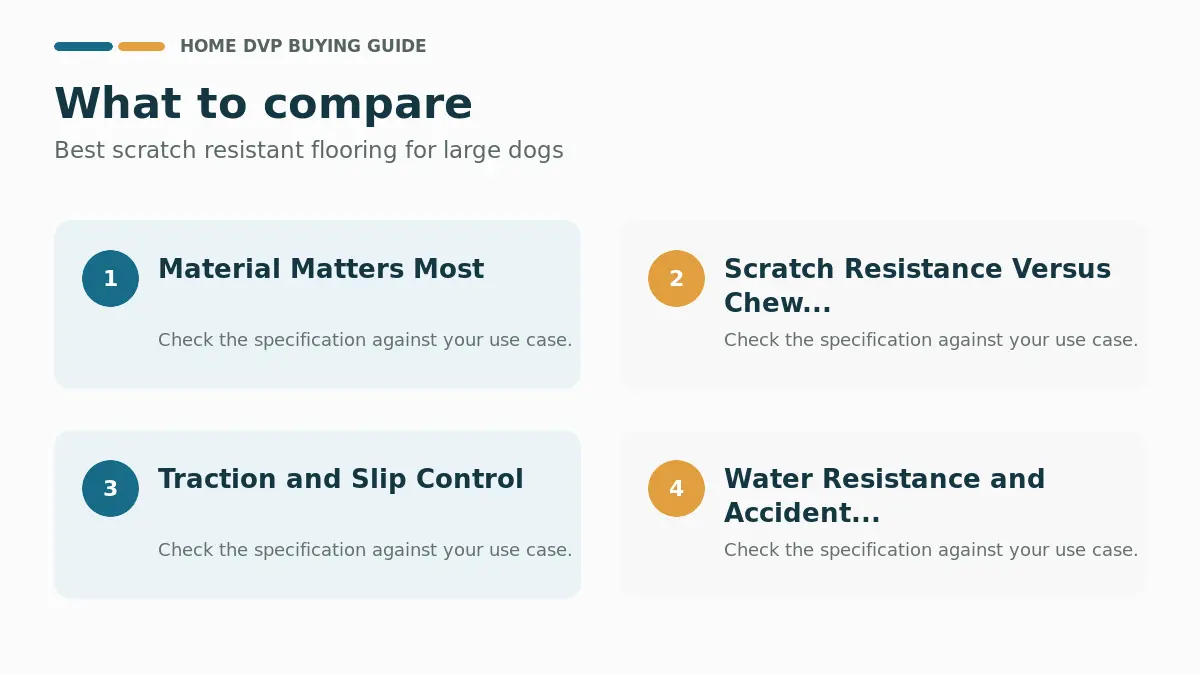
Material Matters Most
The best flooring protection for large dogs usually starts with the material. Dense vinyl, clear PVC, and sturdy interlocking foam are common choices because they create a sacrificial layer over more expensive surfaces such as hardwood, laminate, tile, or finished concrete. In the available product data, G-Floor for Pets Ceramic Texture Protective Vinyl Floor Covering, Area Mat for Floor, Transparent PVC Area Rug for Home, and Sorbus Wood Grain Floor Tiles Foam Mat EVA Interlocking Mats are the most relevant floor-covering options.
Vinyl and PVC are typically easier to wipe clean and tend to resist moisture better than soft fabric mats. Foam interlocking tiles can add comfort and traction, but large dogs with sharp nails may eventually mark softer foam faster than dense vinyl or PVC. If your main concern is scratch protection on existing hard floors, prioritize a tougher top layer over plushness.
A common mistake is buying a soft pet pad and expecting it to behave like flooring. Absorbent pads can be useful for training, senior dogs, or whelping areas, but they are not the same as a scratch-resistant surface for daily traffic. For true floor protection, look for a product that is described as a floor covering, floor protector, runner, area mat, or interlocking flooring.
Scratch Resistance Versus Chew Resistance
Scratch resistance and chew resistance are related, but they are not identical. Scratch resistance refers to how well the surface handles claw marks, sliding paws, furniture movement, and daily abrasion. Chew resistance is more about edge durability and whether a dog can bite or tear the material. Large dogs can challenge both, especially in crates, hallways, and near doors.
For open-room floor protection, dense vinyl and PVC options are usually easier to manage because they can lie flat and cover a larger surface. For doorways and hallways, a non-slip runner can help reduce skidding, which also reduces claw scraping. For playrooms, basements, and low-impact zones, interlocking foam tiles may be useful when comfort matters as much as surface protection.
Based on the feature set, avoid judging durability from one claim alone. Look at the whole system: material, thickness, texture, backing, edge design, and cleaning method. A tough surface with poor grip may still cause dogs to dig in harder with their nails, which can increase visible wear over time.
Traction and Slip Control
Large dogs need traction, especially older dogs, energetic breeds, and pets recovering from joint issues. Slippery floors force dogs to brace with their claws, which can damage the surface beneath them and increase the chance of slips. A textured floor covering, non-slip runner, or stable mat can make daily movement safer and quieter.
The Waterproof 2×6 Runner Rug Non Slip is relevant for narrow traffic paths such as hallways, kitchens, laundry rooms, and entryways. It is not a full-room flooring replacement, but it can protect the strips of floor where dogs run, turn, or wait by doors. For renters, this type of temporary solution can be especially useful because it does not require adhesive or permanent installation.
For homeowners planning broader surface protection, consider how a product behaves at the edges. Raised corners, curling edges, or sliding mats can become trip hazards. If a dog is large enough to push lightweight mats around, a heavier protective vinyl covering or properly fitted area protector may provide better day-to-day stability.
| Use Case | Helpful Surface Type | What to Watch For |
|---|---|---|
| Hallways and entryways | Non-slip runner | Edges, backing grip, washable surface |
| Living rooms and dining areas | Clear PVC area protector | Furniture placement, curling, visibility |
| Garages, basements, or utility rooms | Protective vinyl floor covering | Coverage area, texture, cleanability |
| Playrooms or exercise spaces | Interlocking foam tiles | Claw marks, seams, indentation |
Water Resistance and Accident Cleanup
Water resistance is essential in homes with large dogs. Water bowls, wet paws, drool, muddy entryways, and accidents can all damage unprotected wood and seep into seams. Protective vinyl and PVC surfaces are attractive because they can create a barrier between moisture and the finished floor below.
Area Mat for Floor, Transparent PVC Area Rug for Home is especially relevant for homeowners who want a protective surface that does not visually cover the entire floor pattern. Clear protectors can work well under dining tables, dog feeding stations, office chairs, or pet beds. However, clear PVC can show trapped dust underneath, so cleaning both the floor and underside matters.
Washable absorbent pads are useful for accidents, but they should not be treated as long-term scratch resistant flooring. If you need both moisture control and surface protection, consider pairing a true floor protector with a washable pet pad in a specific potty or recovery area. For cleaning routines and hard-surface care, the Cleaning & Floor Care category can help you compare related maintenance tools.
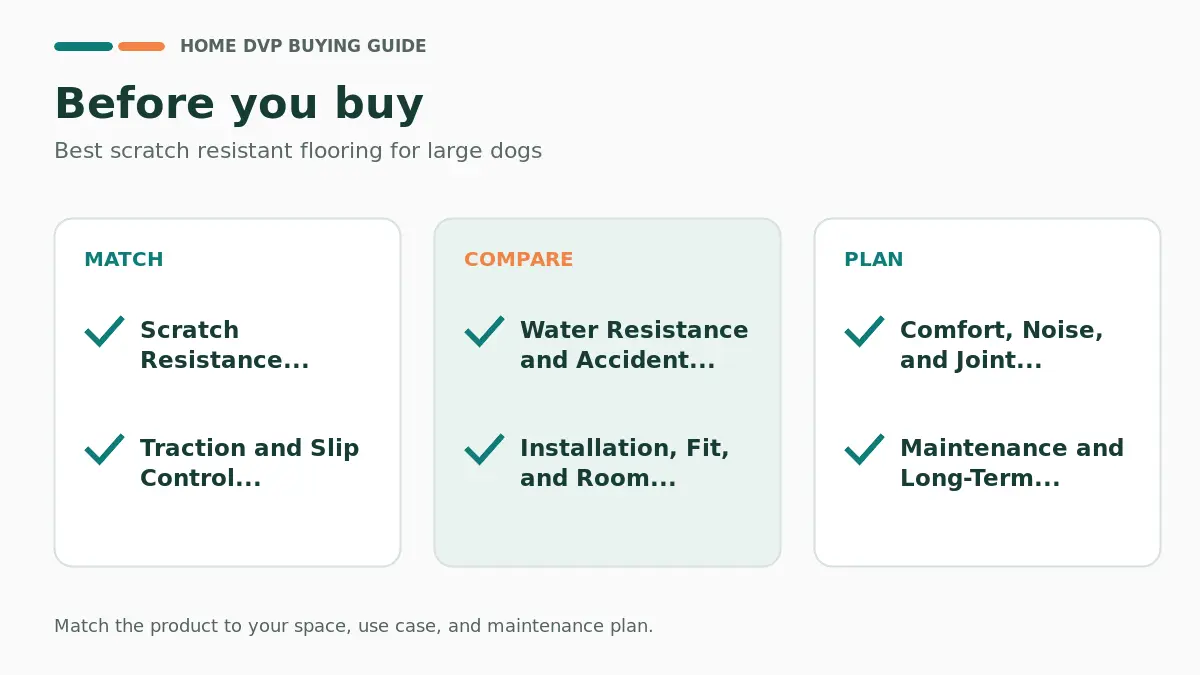
Installation, Fit, and Room Layout
One advantage of temporary scratch-resistant floor coverings is that most do not require a remodel. Renters can protect floors without glue, nails, or permanent changes, while homeowners can protect high-traffic zones before investing in a full flooring replacement. Still, the right fit depends on room layout.
Roll-out protective vinyl like G-Floor for Pets Ceramic Texture Protective Vinyl Floor Covering is better suited to larger coverage areas such as utility rooms, dog rooms, mudrooms, and garage-adjacent spaces. Interlocking foam tiles like Sorbus Wood Grain Floor Tiles Foam Mat EVA Interlocking Mats are better when you need modular coverage that can be expanded, removed, or reconfigured. A runner is better when the problem area is a narrow traffic lane.
Measure the space before buying and think about dog behavior. If your dog runs from the back door to the kitchen, a hallway runner may solve more real damage than a large mat placed in the wrong room. If your dog spends time in a dedicated feeding or sleeping area, a larger protector may be the more practical choice.
Comfort, Noise, and Joint Support
Scratch protection should not make the floor unpleasant or unsafe for your dog. Hard, slick surfaces may protect the floor but offer poor grip. Softer foam can reduce noise and add cushioning, but it may not resist claw wear as well as a denser floor covering. The best choice depends on whether your priority is durability, comfort, sound control, or a balance of all three.
For senior dogs, traction and cushioning can be more important than maximum hardness. A non-slip runner in a hallway or a cushioned modular tile area can help dogs stand, turn, and walk more confidently. For young, high-energy dogs, tougher vinyl or PVC protection may be the smarter choice because quick starts and sudden stops can be rough on softer materials.
Noise is another real-world factor. Large claws clicking on hard floors can be distracting, especially in apartments or homes with bedrooms below. A runner or foam tile section can soften footfall noise while helping protect the main traffic path.
Maintenance and Long-Term Value
Floor protection only works if it is easy enough to maintain. A product that traps dirt, shifts constantly, or is difficult to clean may become frustrating even if it looks good at first. Large dogs bring in grit that acts like sandpaper, so regular sweeping, vacuuming, and wipe-downs are part of protecting the surface underneath.
Dense vinyl and PVC can often be wiped clean, which is helpful around feeding areas and entryways. Fabric runners may need washing or more frequent vacuuming. Foam tiles may require seam cleaning because hair, crumbs, and grit can collect between puzzle-style edges. If you use floor scrubbers or hard-floor cleaning tools, compare maintenance guidance in resources such as floor scrubber reviews before using aggressive equipment on protective coverings.
Value is not only about the upfront cost. A protective covering can help avoid scratches, stains, and refinishing costs on existing floors. Based on our detailed comparison, the strongest value usually comes from matching the product to the exact problem area rather than buying the largest or thickest option available.
Matching Products to Common Home Scenarios
Different homes need different solutions. A mudroom with wet paws needs water resistance and easy wiping. A hallway with a running dog needs traction. A rental apartment needs removable protection. A basement play area may need modular coverage and some cushioning. Choosing the best scratch resistant flooring for large dogs is easier when you start with the problem, not the product label.
| Product Type | Best Fit | Less Ideal For |
|---|---|---|
| Protective vinyl floor covering | Large utility zones, dog rooms, garages, mudrooms | Homes needing a decorative rug look |
| Transparent PVC area mat | Dining rooms, feeding stations, offices, living areas | Uneven floors or spaces where edges may curl |
| Non-slip runner | Hallways, kitchens, entryways, laundry rooms | Full-room protection |
| Interlocking foam tiles | Play zones, basements, exercise areas | Dogs that dig, chew, or scratch aggressively |
If you are also upgrading door hardware, thresholds, or transition strips around a pet-friendly space, the Hardware category can be useful for related home improvement planning. A well-protected floor often works best when transitions and room edges are also safe and secure.
Our Research Methodology & Why You Can Trust Us
We evaluated the products based on available product information, user-facing specifications, category fit, and practical homeowner use cases. Because the source data does not confirm physical installation or hands-on testing, we do not claim that we installed or tested these products in a home. Instead, our analysis focuses on material type, stated use, floor compatibility, slip resistance, water protection, cleaning method, durability signals, and suitability for large dogs.
Product relevance was a major part of the process. Items that function mainly as training pads, whelping pads, or absorbent pet-care pads may be useful for dog ownership, but they are not the same as scratch resistant flooring. For recommendations, we prioritized products that clearly serve as floor coverings, floor protectors, runners, or modular flooring surfaces.
Our ranking criteria included performance potential, features, build quality, ease of use, durability, safety, value, reliability, and homeowner or renter fit. We also considered how products would work in common spaces such as kitchens, hallways, entryways, mudrooms, basements, and living rooms. This guide is reviewed for freshness during July so buyers can compare options with an updated home improvement perspective.
Trust also comes from clear limitations. The available product data does not include full laboratory abrasion ratings, installation manuals, or verified long-term wear results. For that reason, we avoid overstating performance and instead explain which products appear best suited to specific floor-protection scenarios based on the information provided.
Final Thoughts
Based on our research, G-Floor for Pets Ceramic Texture Protective Vinyl Floor Covering is the strongest heavy-duty pick among the valid flooring-focused options because it is specifically positioned as a protective vinyl floor covering for hardwood, concrete, and low-pile carpet. It makes the most sense for homeowners who need broad, wipeable protection in a dog room, mudroom, utility area, or garage-adjacent space.
Area Mat for Floor, Transparent PVC Area Rug for Home is a practical premium-style pick for buyers who want visible floor protection without covering the look of the surface underneath. Waterproof 2×6 Runner Rug Non Slip is the better small-space or traffic-path pick for hallways, kitchens, and laundry areas where traction matters. Sorbus Wood Grain Floor Tiles Foam Mat EVA Interlocking Mats are worth considering for modular comfort in play areas, but large dogs that dig or chew may wear softer foam faster.
The right best scratch resistant flooring for large dogs depends on where your dog causes the most wear. Choose vinyl or PVC for moisture-prone and scratch-prone zones, runners for narrow traffic lanes, and interlocking tiles for flexible comfort areas. For broader floor maintenance planning, Home DVP also covers related tools and upkeep topics in floor scrubber comparisons.
FAQ
What should I look for when choosing the best scratch resistant flooring for large dogs?
Look for durable materials, good traction, water resistance, stable edges, and a size that matches the area your dog uses most. For large dogs, a textured vinyl or PVC protector is often better for hard-floor protection, while runners can help in narrow traffic paths.
Are higher-end scratch resistant flooring for large dogs worth it?
Higher-end options can be worth it when they provide better coverage, thicker material, easier cleaning, and more stable placement. The value depends on whether the product prevents damage to a more expensive floor underneath.
How should renters choose the best scratch resistant flooring for large dogs?
Renters should prioritize removable products that do not require adhesive, nails, or permanent installation. Non-slip runners, transparent PVC mats, and roll-out protective coverings can help reduce damage while keeping lease-friendly flexibility.
Is foam flooring a good choice for large dogs?
Foam flooring can be comfortable and useful in playrooms, basements, or low-impact areas. However, large dogs with sharp nails, digging habits, or chewing behavior may mark softer foam faster than dense vinyl or PVC.
How do I keep protective flooring from smelling like pets?
Clean spills quickly, remove trapped hair and grit, and wash or wipe the surface according to the product instructions. For ongoing home cleaning ideas, the upholstery cleaner guide may be helpful for pet owners dealing with fabric surfaces as well.
Can best scratch resistant flooring for large dogs protect hardwood floors?
Yes, the right protective covering can help reduce scratches, moisture exposure, and wear on hardwood. Make sure the product lies flat, does not trap moisture underneath, and is safe for the finish on your specific floor.
About This Home DVP Research
Home DVP is an independent home-improvement research and product-comparison publisher. Ryan Mitchell prepared this guide by comparing manufacturer specifications, compatibility details, retailer-provided product data, key limitations, and common homeowner use cases. We do not claim hands-on testing unless an article explicitly says so.
Review methodology Affiliate disclosure Last reviewed October 16, 2026