

Keeping a wet dry vacuum performing at its best starts with the right replacement filters. Homeowners, renters, and DIYers who tackle garage cleanups, workshop dust, basement water, or renovation debris know that clogged or mismatched filters quickly reduce suction, allow fine particles to escape, and can even damage the motor. In 2026, choosing quality wet dry vacuum filters remains one of the simplest ways to protect your investment and maintain strong cleaning results across wet and dry messes.
After carefully analyzing the available specifications and feature sets of 15 options currently popular with practical buyers, we put together this updated guide. Our comparison focused on real-world homeowner needs such as universal compatibility with common shop vacs, washable construction, multi-pack value, dual-stage filtration, and ease of installation. Whether you own a Shop-Vac, DeWalt, Vacmaster, Craftsman, or similar unit, understanding the differences between cartridge filters, foam sleeves, disc filters, and cloth bags will help you pick the right solution without wasting money on incompatible parts.
This guide also covers how wet dry vacuum filters fit into broader home maintenance routines. For related cleaning equipment insights, explore our coverage of robot vacuum options and visit the full Cleaning & Floor Care category for more practical home improvement recommendations. Read on for clear buying advice tailored to garages, workshops, basements, and everyday DIY projects.
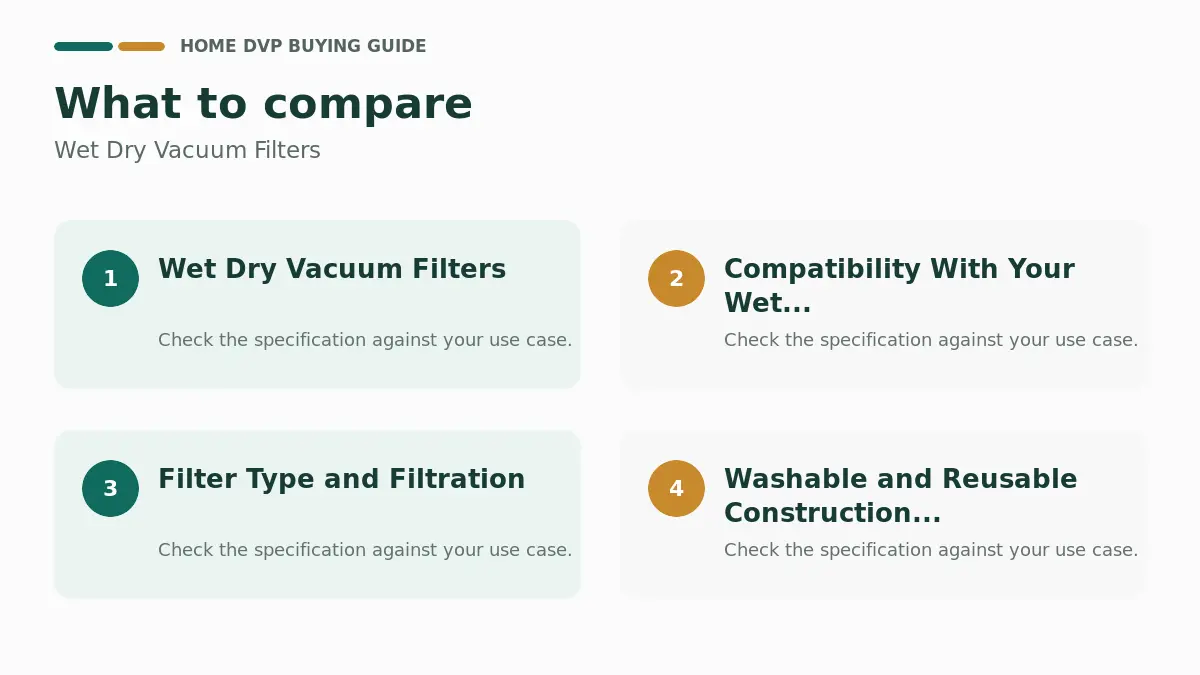
Wet Dry Vacuum Filters Buying Guide
Selecting the right wet dry vacuum filters requires more than grabbing the cheapest multi-pack. Based on our detailed comparison of materials, compatibility lists, washability claims, and pack configurations, several practical factors separate filters that simply fit from those that deliver reliable long-term performance. Homeowners who clean after woodworking, drywall projects, vehicle maintenance, or flood cleanup will benefit most from matching filter type to the mess type and vacuum model.
Compatibility With Your Wet Dry Vacuum Model
The single most important factor is exact fit. Many replacement wet dry vacuum filters list broad compatibility with Shop-Vac 5-gallon and larger units, specific part numbers such as 90304, 90585, 90107, VF2002, or DCV5801H, and brands including Vacmaster, Genie, Craftsman, Armor All, and DeWalt. Always cross-check your vacuum model number against the filter description before ordering. A filter that nearly fits can allow dust bypass around the seal, reduce suction, or damage the filter cage.
Common mistakes include assuming all 5-gallon filters are interchangeable or ignoring exceptions such as portable hang-up models or wall-mount units. For smaller 1.5 to 3.2 gallon units, look for kits sized specifically for Armor All AA255 series or Vacmaster VH105-style machines. Larger 4 to 16 gallon shop vacs often accept the popular cartridge-plus-foam sleeve combinations. If you are unsure, note the exact model stamped on your vacuum and match it carefully. Checking compatibility first prevents wasted money and keeps fine dust out of the motor.
In home workshops and garages, mismatched filters show up quickly as reduced suction on sawdust or drywall dust. Take a few minutes to verify fit the same way you would match bits for a cordless drill project. For more DIY tool organization tips that pair well with shop vac maintenance, see our guide on tool box options.
Filter Type and Filtration Efficiency
Wet dry vacuums commonly use several filter styles: pleated cartridge filters for dry debris, foam sleeves for wet pickup, disc or bag filters for dry collection, and cloth filters for finer dust. High-efficiency nanofiber or pleated paper cartridges capture more particles while maintaining airflow. Dual-stage kits that pair a cartridge with a foam sleeve offer the most versatility for mixed messes. Foam sleeves excel at liquid and damp debris, while cloth or non-woven disc filters handle dry household waste, sand, and pet hair.
Look for claims of 99.97 percent particle capture when available and larger surface area designs that reduce clogging. Pleated construction increases the filtering area without increasing overall size, which helps maintain strong suction longer. For fine drywall dust or workshop sawdust, a high-efficiency cartridge outperforms basic foam alone. For wet basement water or garage spills, the foam sleeve protects the motor from moisture and debris. Choosing the correct type for your most common jobs prevents early clogging and keeps the vacuum motor cooler.
Many modern kits combine multiple filter styles so you can switch between wet and dry modes quickly. Homeowners who use the same vacuum for both workshop cleanup and occasional water extraction will appreciate these flexible multi-piece sets. Always install the foam sleeve first for wet work and add the dry disc or cartridge for dry work when the design calls for it.
Washable and Reusable Construction
Washable filters deliver the best long-term value for frequent users. High-quality foam sleeves, cloth filters, and some pleated cartridges can be rinsed with low-flow water, allowed to dry completely, and reinstalled. This approach cuts replacement costs dramatically compared with single-use designs. Non-woven fabrics and dense foam resist deformation when cleaned properly, while locking lids on cartridge filters help maintain a tight seal after repeated use.
A common mistake is reinstalling a damp filter. Moisture left in the media reduces airflow and can promote mold or odors. Always dry filters thoroughly in open air or sunlight before putting them back. Manufacturers typically recommend cleaning foam every 1-2 months and replacing every 4-5 months depending on usage intensity. For heavy renovation or daily shop use, keep a spare set ready so the vacuum is never down while one filter dries.
Reusable construction also supports more sustainable home maintenance. Instead of tossing filters after every major cleanup, you rinse and reuse them across many projects. This practice pairs well with other durable home gear choices such as quality ladders for elevated cleaning tasks. Check our related coverage of ladder options for safe access during whole-house projects.
Pack Size, Value, and Included Accessories
Multi-packs ranging from 2 to 8 filters plus foam sleeves and retaining bands offer clear value for most homeowners. Kits that include locking lids, cleaning brushes, or extra retaining bands make installation and maintenance easier. A complete 7-piece or 16-piece set covering both wet and dry needs reduces the number of separate purchases. Look for bundles that clearly list the number of cartridges, foam sleeves, disc filters, and bands so you know exactly what you receive.
Price alone does not indicate value. A lower-cost 6-pack of basic disc filters may suit light dry use, while a mid-range kit with high-efficiency cartridges and multiple foam sleeves better serves mixed wet-dry jobs. Genuine brand options and carefully engineered third-party replacements both appear in the $7.99–$29.99 range. Compare total pieces and reusability rather than unit price alone. Value packs also help you stock spares for seasonal cleanups or multi-room renovations.
Accessories such as retaining bands and cleaning brushes are more useful than they first appear. Bands secure disc filters tightly so they do not slip during high suction, while a brush helps remove embedded dust from pleats. These small extras extend filter life and keep performance consistent.
Material Quality and Build Durability
Durable materials directly affect how long wet dry vacuum filters last under real garage and workshop conditions. Dense high-quality foam resists tearing during wet pickup of debris. Pleated nanofiber or washable paper media holds its shape better than thin standard paper. Ultra-fine polyester cloth filters capture fine dust and pet hair without rapid clogging. Non-hazardous, non-toxic, non-flammable materials add safety for indoor use around family and pets.
Locking lid designs improve reliability by creating a leak-proof seal that holds under heavy suction. Elastic seals on cloth bags prevent the filter from falling off the cage. Reinforced edges and consistent thickness across the media help maintain airflow even as the filter loads with dust. Cheap thin materials may look similar at first but tear or compress quickly, reducing both suction and filtration effectiveness.
Based on available product information, filters built for 5-gallon and larger shop vacs generally use more robust materials than those sized for compact 1.5-3 gallon units. Match material strength to your typical debris load. Wood chips, nails, and drywall dust demand tougher construction than light household dust.
Ease of Installation and Maintenance Routine
Most replacement wet dry vacuum filters install without tools. You simply remove the old filter, slide the new foam sleeve over the cage if required, seat the cartridge or disc, and secure with the lid or retaining band. Clear instructions that specify installation order (foam first, then dry filter) prevent common errors. Upgraded locking lids make removal and reinstallation faster and more secure for frequent users.
Establish a simple maintenance schedule based on usage. Clean washable filters every 1-2 months for regular home or garage work and replace every 3-6 months depending on dust volume. Heavy renovation projects may require more frequent changes. Always rinse with low-flow water rather than high pressure that can damage the media, and dry completely before reuse. Keeping a spare set on hand means the vacuum stays ready while one set is cleaned.
Homeowners who combine filter maintenance with other shop organization tasks find the process easy to remember. Store spare filters near the vacuum or in a dedicated tool storage area. For additional workshop setup ideas, browse the Tools & DIY resources on our site.
Wet Versus Dry Performance Considerations
Not every filter works for both wet and dry pickup. Foam sleeves are designed for liquid and damp debris. They protect the motor from water and large particles. Dry cartridge, disc, and cloth filters should be used only for dry debris. Using a dry filter for wet work can ruin the media and allow moisture into the motor. Many multi-piece kits include both types so you can switch as needed.
For mixed jobs such as cleaning a flooded basement floor that also has mud and leaves, start with the foam sleeve alone or follow the dual-stage instructions carefully. For pure dry sawdust or drywall dust, the high-efficiency cartridge or cloth filter delivers better fine-particle capture. Always remove and clean the wet foam thoroughly after liquid pickup to prevent odors and mold.
Understanding this distinction avoids premature filter failure and keeps suction strong. Label spare filters clearly as wet or dry if the packaging is not obvious. This small habit saves time during urgent cleanups.
Who Should Choose Which Style of Filter
Light household users who occasionally empty the garage or clean up after pets can start with affordable multi-packs of disc or basic foam filters. Workshop and renovation DIYers benefit most from high-efficiency cartridge kits that include locking lids and multiple foam sleeves. Owners of compact Armor All or Vacmaster units should choose the smaller VRC2 or VFF-style kits sized for 1.5 to 3.2 gallon tanks. Craftsman and older large-shop owners often need the red-stripe style cartridge designed for 5-gallon and larger models produced since the late 1980s.
If you frequently switch between wet and dry jobs, prioritize dual-stage or multi-pack kits that cover both needs. Budget-conscious buyers should focus on washable reusable sets rather than single-use options. Always match the filter to the vacuum capacity and the primary mess type for the best results.
These guidelines help you avoid overspending on features you will not use or under-buying for heavy-duty needs. The right choice keeps the vacuum efficient and protects the motor for years of reliable service.
Our Research Methodology & Why You Can Trust Us
At Home DVP we approach product guides with transparency and a strong focus on homeowner and DIY practicality. For this Wet Dry Vacuum Filters review we began by collecting detailed specifications, compatibility lists, material descriptions, pack contents, and listed features for 15 popular options. We then evaluated each product against consistent criteria that matter in real garages, workshops, basements, and renovation sites.
Our ranking process considered filtration performance potential based on media type and surface area, ease of installation, washability and reusability claims, build quality indicators such as locking lids and dense foam, pack value and included accessories, wet-dry versatility, and overall fit for common homeowner use cases. We also reviewed user-facing information on recommended replacement intervals and cleaning methods. Industry standards for shop vac filtration and common failure points informed our analysis of seal design and material durability.
We did not perform physical hands-on testing for this guide. Instead we relied on thorough specification comparison, category fit validation, and synthesis of available product data. This approach allows us to highlight strengths and limitations honestly without overstating results. Content is reviewed and updated regularly, including during September, so recommendations stay current with popular models and feature improvements. Our goal is to give practical buyers clear, unbiased information they can trust when protecting their wet dry vacuum investment.
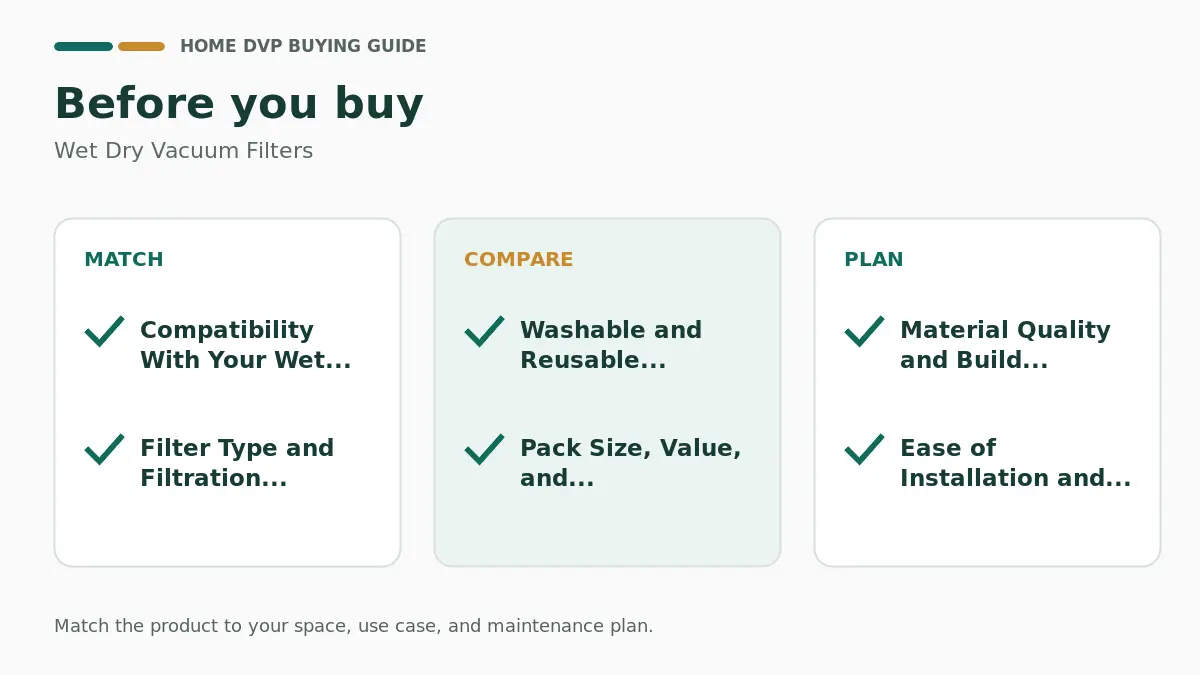
Final Thoughts
After comparing the listed specifications and feature sets, several clear recommendations stand out for different homeowner needs. For overall versatility and complete maintenance coverage, the NABEECA 2-Pack 90304 Cartridge Filter with Lids + 4 Foam Sleeves & 1 Cleaning Brush kit offers dual-stage filtration, washable construction, locking lids, and broad Shop-Vac compatibility for 5-gallon and larger units. It suits workshops and garages that handle both wet and dry messes regularly.
Budget-conscious buyers who need high volume dry disc filters will appreciate the JAMHER 6Pack Reusable Wet/Dry Filter VF2002 90107 set. It provides solid value with retaining bands and fits many Shop-Vac, Vacmaster, and Genie models. For DeWalt DCV580 and DCV581H owners, the A-KARCK DCV5801H 2Pack delivers a precise washable pleated replacement that protects the motor and improves airflow. Genuine Shop-Vac 90304 Cartridge and 90585 Foam Sleeve combinations remain excellent premium choices for users who prefer original-equipment fit and high-efficiency nanofiber media.
Homeowners with compact Vacmaster or Armor All units should look at the Zibopon VRC2 or VRC5 multi-packs that include both cloth and foam options. Craftsman owners benefit from the GHM 17816 Red Stripe Cartridge designed for a wide range of gallon sizes produced since 1988. Matching the filter to your specific vacuum model and primary mess type will deliver the best suction, filtration, and longevity. Keep spares on hand, follow proper cleaning and drying steps, and your wet dry vacuum will continue performing reliably for years of home projects. For more cleaning and organization ideas that support a well-maintained workshop, visit our Air Quality & Climate resources and the main Cleaning & Floor Care section.
FAQ
What should I look for when choosing wet dry vacuum filters?
Start with exact model compatibility, then evaluate filter type for wet or dry use, washable construction, material density, pack size, and seal design. High-efficiency pleated cartridges and dual-stage kits with foam sleeves offer the most flexibility for mixed home and workshop messes. Always verify the part numbers match your vacuum before purchasing.
Are higher-end wet dry vacuum filters worth it?
Higher-end options with nanofiber media, locking lids, and multi-piece reusable kits often last longer and maintain stronger suction under heavy dust loads. For frequent workshop or renovation use they deliver better long-term value. Occasional light cleaning can be handled well by solid mid-range multi-packs that still offer washable materials and good compatibility.
How should beginners choose wet dry vacuum filters?
Beginners should first identify their vacuum brand and gallon size, then select a multi-pack that clearly lists matching part numbers and includes both foam and dry filters if they plan mixed use. Look for easy tool-free installation and washable designs so maintenance stays simple. Starting with a versatile Shop-Vac style kit covers most common homeowner needs.
How long should quality wet dry vacuum filters last?
With proper cleaning every 1-2 months and complete drying, quality washable filters typically last 3-6 months of regular home use or 4-5 months under heavier shop conditions. Replacement intervals depend on dust volume and whether the filter is used for wet or dry pickup. Keeping a spare set ensures continuous performance.
What brands make reliable wet dry vacuum filters?
Popular reliable options come from GHM, Extolife, Cabiclean, A-KARCK, LINNIW, Shop-Vac as well as Shop-Vac genuine parts and well-reviewed third-party makers such as NABEECA, JAMHER, A-KARCK, Zibopon, and LINNIW. Focus on clear compatibility lists, washable materials, and solid seal designs rather than brand name alone. Many third-party kits match original performance at lower cost when specifications align.
How much should homeowners expect to spend on wet dry vacuum filters in 2026?
Most quality multi-packs and kits fall within the $7.99–$29.99 range. Simple foam or disc packs start lower while complete high-efficiency cartridge kits with multiple foam sleeves and accessories sit toward the upper end. Value is highest when the pack includes reusable pieces that match your exact vacuum model.
Are wet dry vacuum filters suitable for DIY projects, home repairs, or regular maintenance?
Yes. Proper wet dry vacuum filters keep wet dry vacuums effective for post-project cleanup, garage organization, basement water removal, and everyday maintenance. They protect the motor from dust and moisture so the vacuum remains reliable across many seasons of home improvement work. Pair them with good storage and a regular cleaning schedule for best results. For more project planning ideas, check the Tools & DIY section.